
Although Drunkennesse be justly termed a vice which the Salvages are ignorant of, yet the benefit is very great that comes to the planters by the sale of strong liquor to the Salvages, who are much taken with the delight of it; for they will pawne their wits, to purchase the acquaintance of it. Yet in al the commerce that I had with them, I never proffered them any such thing; nay, I would hardly let any of them have a drame, unles hee were a Sachem, or a Winnaytue, that is a rich man, or a man of estimation next in degree to a Sachem or Sagamore. I alwayes tould them it was amongst us the Sachems drinke. But they say if I come to the Northerne parts of the Country I shall have no trade, if I will not supply them with lusty liquors: it is the life of the trade in all those parts: for it so happened that thus a Salvage desperately killed himselfe; when hee was drunke, a gunne being charged and the cock up, hee sets the mouth to his brest, and, putting back the tricker with his foote, shot himselfe dead.[282]
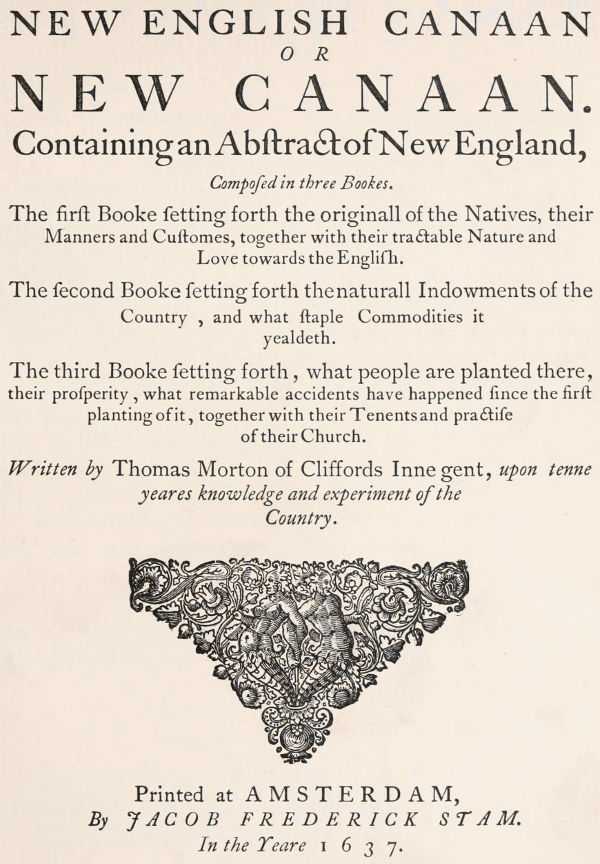
The New English Canaan of Thomas Morton with Introductory Matter and Notes
Explore more books like this:
About This Book
A first-person colonial narrative combines satirical social criticism with detailed observation of the region’s environment and inhabitants. The author alternates between polemic aimed at prevailing religious and civic authorities and attentive descriptions of landscape, plants, animals, fish, birds, and Indigenous customs, using anecdote, classical and scriptural allusion, and legal complaint. The work shifts tone from humor to invective to empirical reporting, creating a hybrid of natural history, social commentary, and personal defense; many later editions append extensive notes to clarify archaic terms, names, and scientific references.