
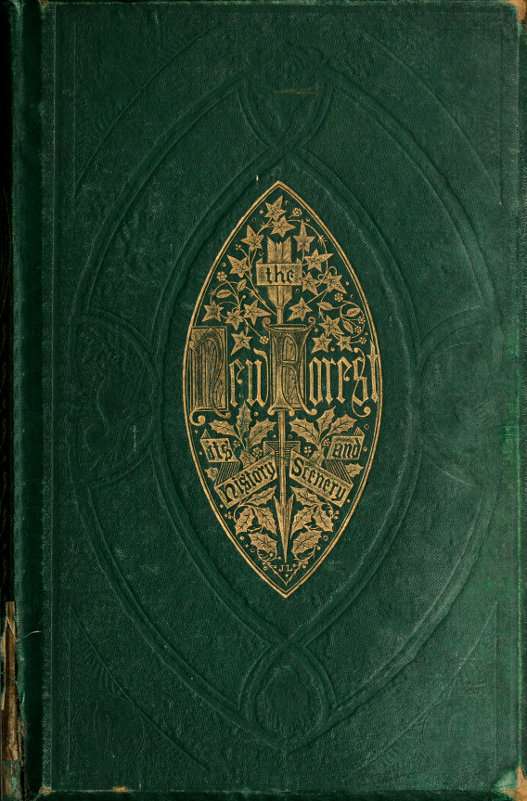
THE END.
London: Printed by Smith, Elder & Co., Little Green Arbour Court, Old Bailey, E.C.
By the same Author.
Crown 8vo. with Illustrations by W. J. Linton, printed on tinted paper,
and handsomely bound in cloth gilt, price 7s. 6d.
SHAKSPERE:
His Birthplace and its Neighbourhood.
Selection from Notices by the Press.
(The Westminster Review.)
‘A most elegant volume. Artist, printer, and author have vied with each other in its production. All the well-known spots are taken from their most favourable points of view, and engraved with a skill for which Mr. Linton’s name is a sufficient guarantee. Mr. Wise is peculiarly fitted for his task. He revels in painting the beauties of his native county with an enthusiastic admiration, in which he makes Shakspere share, by the readiness with which he localises descriptions in the poet’s works that would have no such home-like effect on an ordinary reader. He does this, too, without any arbitrary forcing, and gives a new grace to the character of the universally beloved poet by connecting him by hitherto unobserved ties with the home of his youth.’
(The Spectator.)
‘A critical biography of the one supreme poet of humanity; written with skill, discrimination, and taste.... Mr. Wise notices in a reverent spirit, and in soberly elegant language, the intellectual talents, the imperial diction and gorgeous colouring, the knowledge, the wisdom, imagination, and many-sidedness of this wonderful artist; but he lays even more stress on Shakspere’s moral characteristics, and on the effectual qualities of his nature, than on these more brilliant and obvious endowments; on his genial humour, his universal sympathy and tolerance, his serene hilarity, his robust simple-hearted patriotism, and his love of freedom—freedom of speculation, freedom of discussion. The essential goodness of our great poet is the main argument of Mr. Wise’s discourse.’
(The Daily News.)
‘We find the book as good as it is pretty, and therefore twice worthy commendation. We have to thank Mr. Wise for a glossary which not only explains the provincialisms of Shakspere, but, è converso, gives a Shaksperian colour to phrases in use among the Warwickshire peasantry to this day. So delightfully readable a glossary as this we have seldom encountered.’
(The Morning Herald.)
‘Mr. Wise has treated an old and well-worn subject with singular good sense and taste.... The chapter on Shakspere himself is a sound and masterly examination of the nature and spirit of his genius, as revealed in his works. Mr. Wise has a voice of his own in the matter, and it is well worth listening to.’
A Cheaper Edition, fcp 8vo. in cloth limp, may be had, price 2s. 6d.
MR. RUSKIN’S WORKS.
MODERN PAINTERS.
Complete in Five Volumes, imperial 8vo. With Eighty-seven Engravings on Steel, and Two Hundred and Sixteen on Wood, chiefly from Drawings by the Author. With Index to the whole Work. £8 6s. 6d.
Each Volume may be had separately.
- Vol. I. Of General Principles and of Truth. Sixth Edition. 18s.
- Vol. II. Of the Imaginative and Theoretic Faculties. Fourth Edition. 10s. 6d.
- Vol. III. Of Many Things. With Eighteen Illustrations drawn by the Author, and engraved on Steel. 38s.
- Vol. IV. On Mountain Beauty. With Thirty-five Illustrations engraved on Steel, and One Hundred and Sixteen Woodcuts, drawn by the Author. £2 10s.
- Vol. V. Of Leaf Beauty; Of Cloud Beauty; Of Ideas of Relation. With Thirty-four Engravings on Steel, and One Hundred on Wood. With Index to the Five Volumes. £2 10s.
THE STONES OF VENICE.
Complete in Three Volumes, imperial 8vo. With Fifty-three Plates and numerous Woodcuts, drawn by the Author. £5 15s. 6d.
Each Volume may be had separately.
- Vol. I. The Foundations. With Twenty-one Plates. 42s.
- Vol. II. The Sea Stories. With Twenty Plates. 42s.
- Vol. III. The Fall. With Twelve Plates. 31s. 6d.
EXAMPLES OF THE ARCHITECTURE OF VENICE,
Selected and drawn to Measurement from the Edifices. In Parts, of folio imperial size, each containing Five Plates, and a short Explanatory Text. £1 1s. each. Parts I. to III. are published. Fifty India Proofs only are taken on atlas folio. £2 2s. each Part.
THE SEVEN LAMPS OF ARCHITECTURE.
With Fourteen Plates, drawn by the Author. Second Edition. Imp. 8vo. 21s.
LECTURES ON ARCHITECTURE AND PAINTING.
With Fourteen Cuts, drawn by the Author. Second Edition. Crown 8vo. 8s. 6d.
THE ELEMENTS OF DRAWING,
In Three Letters to Beginners. With Illustrations, drawn by the Author. Seventh Thousand. Crown 8vo. 7s. 6d.
THE ELEMENTS OF PERSPECTIVE.
Arranged for the Use of Schools, and Intended to be Read in connection with the First Three Books of Euclid. With Eighty Diagrams. Crown 8vo. 3s. 6d.
THE TWO PATHS:
Being Lectures on Art, and its Relation to Manufactures and Decoration. With Two Steel Engravings. Crown 8vo. 7s. 6d.
‘UNTO THIS LAST.’
Four Essays on the First Principles of Political Economy. With Preface. Fcp. 8vo. 3s. 6d.
THE POLITICAL ECONOMY OF ART.
Fcp. 8vo. limp cloth, 1s.
PRE-RAPHAELITISM.
A New Edition. Demy 8vo. 2s.
THE CROWN OF WILD OLIVE:
Three Lectures on Work, Traffic, and War. Second Edition. Fcp. 8vo. gilt edges, 5s.
THE ETHICS OF THE DUST:
Ten Lectures to Little Housewives on the Elements of Crystallisation. Crown 8vo. 5s.
SESAME AND LILIES:
Two Lectures delivered at Manchester in 1864. I. Of Kings’ Treasuries. II. Of Queens’ Gardens. Third Edition. Fcp. 8vo. cloth, gilt edges, 3s. 6d.
THE KING OF THE GOLDEN RIVER;
OR, THE BLACK BROTHERS:
A Legend of Stiria. With Twenty-two Illustrations by Richard Doyle. Fifth Edition. Square 16mo. 2s. 6d.
SELECTIONS FROM THE WRITINGS OF
JOHN RUSKIN, M.A.
With a Portrait. Post 8vo. cloth, 6s.; morocco elegant, 12s.
Small 4to. Printed on Tinted Paper, and richly bound in cloth. 21s.
THE LAKE COUNTRY.
By E. LYNN LINTON.
ILLUSTRATED BY W. J. LINTON.
Selection from Notices by the Press.
(The Times.)
‘The Lake Country, by Mrs. Linton, is the best description of that part of England ever published.’
(The Illustrated London News.)
‘Its exterior is noble, and its interior, studded with many a glorious illustration, corresponds with the outer splendour.’
(The Saturday Review.)
‘A highly attractive and thoroughly enjoyable work.’
(The Athenæum.)
‘No one can leave Mrs. Linton’s book without being informed of much that is curious as well as valuable concerning times past. To the Tourist, who knows the Lakes, this book will be welcome, not only for its text, but on account of the charming drawings with which Mr. Linton has done his best—a very happy best—to recall many lovely and famous scenes.’
(The Examiner.)
‘The Book of The Lake Country is, in every picture, visibly the work of an artist who, whether in large plates or in small sketches, endeavours to represent the soul and life of English scenery, under some of its most picturesque and attractive aspects. Mrs. Linton’s book, were it not illustrated as it is, or printed luxuriously, would indeed win attention and credit, as a careful and interesting monograph of one of the most interesting districts in the kingdom.’
(The London Review.)
‘Mrs. Linton’s literary sketches are full of true feeling for the country they portray, and in imparting the writer’s own animation to the reader, bring before his mental vision the glory and the gloom, the majesty and the beauty, the pathos and the power, the loveliness and the desolation, of the mountains, lakes, and moors of Cumberland and Westmoreland. Of Mr. Linton’s designs we cannot speak too highly. They are drawn and engraved with the hand of a master, and bring before our vision, with exquisite truth and feeling, all the rugged beauty of the land they commemorate.’
London: SMITH, ELDER, & CO., 65 Cornhill.
Transcriber’s Notes
- Incorporated the errata below (from page ix in the original) into footnotes (and, if possible, changed in situ).
- Copyright notice provided as in the original—this e-text is public domain in the country of publication.
- Silently corrected palpable typos; left non-standard spellings and dialect unchanged.
- Corrected page numbers in the index for “Barton Cliffs, geology of”
| ERRATA. | |
|---|---|
| Page 33, line 12, | |
| ” 55,” 19, | The derivation of Leap as given in the text is very doubtful. |
| ” 69,” 1, | for which the Bishop of Hippo gives to the canons of his own order, read the injunction of their order. |
| ” 127,” 25, | for Ripley read Winkton. |
| ” 192,” 8, | Rere-mouse is derived from the Old-English hrere-mus, from hreran to flutter, literally the fluttering mouse, the exact equivalent of the German Flitter-maus. |