
CHAPTER X
KIWI GETS HIS WINGS
AS Kiwi, Armbruster and the Skipper moved over to where the Quirk sat, they were followed by the entire group who were interested in this novel experiment.
Armbruster helped Kiwi into the front seat, and then they discovered that his legs were too short to reach the rudderbar. A shout was sent up for more cushions. When two of them had been wedged in behind the boy’s back he could work the rudder very easily. His helmet and goggles were adjusted and the belt holding him in his seat snapped in place. Then Armbruster attached the telephones so that he could speak to Kiwi up in the air, and swung himself into the rear seat. The engine was started.
As they left the group of onlookers there were shouts of encouragement and Jack, who had just come over, called above the noise of the engine:
“Kiwi, don’t loop him the first time up, will you?”
Kiwi grinned, self-consciously.
They trundled some distance out on the field and turned into the wind. Then, with the propeller just ticking over, Armbruster said:
“Now, Kiwi, I am going to teach you to fly very much as I taught your Dad long ago. No harm can come to you here in learning to fly. But I know you would like to be just such a pilot as your Dad is, and so I am going to teach you, as he was taught, how to overcome the dangers which follow stalling a plane in the air and what you must do if the engine stops suddenly.
“I’ll take the plane off the ground with my set of controls, and after we get well up in the air I’ll let you fly it straight with your stick and rudder for a while. You know how it feels to be up. You know how the rudder works—that it swings the plane from side to side. You know that the joystick in your hand moved sidewise keeps your wings balanced; moved forward sends you down; pulled backward pulls the nose of the plane up. Now take your feet off the rudder and let me see both hands outside until I tell you to take over control.”
Kiwi did as he was told.
Once in the air, Armbruster could not resist stunting the plane about over the heads of their audience. Kiwi was treated to an exhibition in flying such as he had never experienced before. The plane dived toward the group below, swished up in climbing turns, swung dizzily off on one wing and, as the wires whistled, pulled sharply around and recovered its poise. Kiwi had difficulty keeping his sense of balance or a clear idea of what the plane was doing.
After several minutes of such antics they flew straight and, wiggling the stick violently, Armbruster told Kiwi through the phones that he might fly it.
“First of all,” he said, “just keep the plane straight. Keep the nose on the horizon—pick some point on it and fly toward it.”
Kiwi felt elated that at last he was actually controlling a plane. He couldn’t resist pushing the rudder slightly with his foot to see what effect it would have. It startled him to find that the slightest pressure sent the nose of the plane skidding sidewise. He hurriedly tried to correct this with the other foot, and discovered that he was overdoing it and that they were see-sawing back and forth in a crazy fashion.
The voice of Armbruster came through the phones:
“There, Kiwi, not too much rudder. Rudders are dangerous things. They have caused a good share of all the accidents.”
Kiwi had the feeling that Armbruster had hastily corrected his errors and he gained new respect for the art of flying.
Armbruster’s reassuring voice told him to try again. This time they sailed along very calmly, the nose on one spot on the horizon, seen through the glittering whirl of the propeller.
Again came Armbruster’s voice:
“Your left wing is low, Kiwi. Pull it up slightly with your stick.”
Here was another thing for him to watch out for!
At the end of a quarter of an hour they had gone a long distance from their friends and Armbruster said:
“I’ll turn the plane around and then we’ll fly back.”
As Kiwi felt his instructor take over the controls he let them go, and the plane swung around in a small arc. Then the voice came:
“Now, Kiwi, take me home.”
On the way back Kiwi practised again, only once getting into difficulties when he got the plane into that alarming zigzagging.
They made several trips to distant points and back again. Then Armbruster said, “We’ll land now and take a rest.” And Kiwi confessed to himself that a rest from this concentration would be most welcome.
As they landed and taxied up to the group, several called out to know how the pupil was making out. Kiwi was elated to hear Armbruster say:
“The boy is good. A little heavy on the controls, but we’ll have him flying in no time.”
Dad grinned at him as he climbed from his seat and gave him an approving pat as he came over to where Dad and Jack were standing with Thorne.
After a few minutes’ rest, and his instructor had had a smoke, they went up again.
Kiwi practised once more on this simple business of keeping the plane straight and on an even keel. Then Armbruster’s voice came:
“We’ll try a turn—a turn to the right—that’s an easy one. Now, keeping your hands and feet lightly on the controls, you feel what they do while I make this gradual turn.”
And while he was doing it, Armbruster repeated several times:
“A little bit of bank and a little bit of rudder—round she goes. Now you try it. Pull the stick slowly over to the right till your wings bank up; then when you have enough bank, pull the stick back to the center and at the same time push your rudder slightly to the right.”
The plane swung around dizzily.
Armbruster’s voice came through the phones: “Ah, you used a little too much rudder. It skidded that time. Now we’ll try another one.”
This time Kiwi’s combination of bank and rudder were more nearly right, and the plane turned in a more normal fashion.
They flew straight for a while and then tried another turn to the right.
Armbruster now said:
“We’ll try one to the left. That’s harder because the torque of the propeller tends to pull the plane around to the left if you give it half a chance. So this time you need less pressure on the left rudder than you had before on the right.”
Kiwi’s first try was not so bad. But a later one pulled the plane around with a terrific snap and it commenced to do things that were beyond Kiwi’s understanding. He felt Armbruster’s hand on the controls as he rescued him from this predicament, and the old singsong came to him now, “A little bit of bank, a little bit of rudder—round she goes.”
This flight lasted much longer than the other, and before they had landed Kiwi was beginning to make smooth and graceful turns in either direction.
During one of these later turns Kiwi was much startled as his engine stopped in the middle of one of them, and they seemed to be in difficulties. Then he noticed that Armbruster had throttled back the engine, and his clear voice came to Kiwi saying:
“I just wanted you to know what would happen if the engine suddenly stopped in the midst of one of your turns. You must quickly put on more bank and more rudder. If you don’t do this in time, you’ll find the plane out of control. Try a few more turns and I’ll stop the motor in some of them and you correct for it.”
After a few more minutes of such practice they landed and rejoined the others.
Kiwi was bubbling over with the excitement of what he had learned and he had a thousand questions to ask both Dad and Armbruster about his experiences. They talked it all over and tried to tell him what he must do in each emergency.
If the engine stopped unexpectedly when flying straight, he must instinctively push the stick forward, keep the nose down, and keep his flying speed. If it stopped during a turn, he must rudder into the turn and keep his flying speed. Always he must do these things instinctively when the motor failed.
Dad and Armbruster and Jack all had stories to tell of some spectacular experience when motors failed at crucial moments in the air. Always when in the air the pilot’s ear is attuned to the steady beat of the motor and he listens for its first missing stroke.
Another young flyer had joined the group and was listening interestedly to the talk about failing motors. During a lull in the conversation he said:
“Failing motors in the air are often bad enough, I grant you, but during the war a failing motor on solid ground turned out to be much more tragic for me.
“I had just returned to my squadron from a two weeks’ stay in England and was talking to old friends and getting accustomed to the new faces in the mess. The other pilots were admiring the new outfit I had bought—shiny new field boots that I had had made at that little shop in Oxford opposite Exeter College, my whipcord breeches that were the pride of a maker on the Haymarket in London, while my tunic came from Regent street—when an orderly came up and handed me a slip of paper. It requested me to report to the Major at once.
“I hurried over to the squadron office to my commanding officer. He looked up when I entered and said:
“‘I know you are just back from leave and may not have your bearings yet, but the people at the Wing Headquarters have just given me a job which is in your special line. You have done it so many times before that you should have no trouble this time. We have another spy to land back of the lines tonight, and since Gathergood is gone, you are the only man I have who can do the job. Here on this map is the location where you must land this fellow, and he’ll be here ready to start with you at eleven-thirty. I’ll have the Sergeant-Major get a good machine in readiness for you.’
“There was nothing for me to do but accept this doubtful honor. Landing spies back of the lines was no child’s play, as you know. If caught, your uniform was no protection. You, too, were classed as a spy and met a spy’s fate.
“However, as it was then only nine-thirty I went back to the mess and had a rubber of bridge before word came that my spy had arrived. I hurried over to the hangar, and as it was a warm night did not stop for a flying suit. I wrapped a muffler around my neck, slipped into my helmet and goggles, and climbed into the machine which the mechanics had all ready with the motor started.
“My passenger was already in the rear seat. I had no time to talk to him. He gave me a jaunty little wave with his hand and then slipped down low in the cockpit out of the way of the wind from the propeller. He looked like any middle-aged French peasant that one might meet on the road.
“Almost automatically I taxied down the field and took off. As I came across the hangars and swung over toward the direction of the lines, I saw that the lights in the hangars were being switched off and knew that all would be darkness there until it was time for my return.
“The motor hummed sweetly and I began looking for landmarks. There was no moon and the earth was a black smudge beneath me. I crossed the lines at a great height and could just discern the Lys River as a dim streak in the inky blackness. There were a few star-shells coming up from the direction of the lines, and here and there an occasional flash of artillery fire. It was a quiet night in this particular sector. A few miles to one side two searchlights were groping aimlessly across the sky. All seemed serene and peaceful up aloft.
“Shutting off my motor so that the propeller was just slowly turning over, I started on a long glide through the darkness. Leaning over the side I tried to pick up the little village that was to be my brief stopping place.
“Lower and lower we slipped through the still air. For a few moments I was a little confused, but upon switching on the light on my instrument board and consulting my map, I located a particular road that led through a large forest. By this time my spy was also leaning far over the side, and as we came lower he pointed out the field we must land in.
“It crossed my mind as we were getting low over the trees that I should have opened up the engine for a few seconds to keep it warm. A long dive such as we had just made was apt to cool it to the point where it might not pick up again when I needed it. But there was no time for that now. We were too low and the noise of it might arouse troops that happened to be in the vicinity. Sideslipping into the field, I straightened out just in time, and we came to a stop beside a fringe of trees.
“My passenger lost no time in getting out. He was just clambering over the side with a parting ‘Au revoir,’ when the motor and my heart-beats stopped at the same time.
“I explained to him rapidly in a low voice that he must turn the propeller over for me to start the motor again. He was willing enough but unaccustomed to such work, and he was not able to swing the propeller hard enough to do the trick.
“Unhooking my belt I jumped out. I had tried twice to turn it over when we heard the pounding thud of heavy boots on the road. It meant that we were discovered. Evidently soldiers in the neighborhood had heard the sing of the wires as we glided into the field.
“The spy said, ‘Be quick! Or they’ll stop you!’
“Swinging frantically on the propeller I tried twice again. But the engine refused to start. We could hear the crashing of underbrush as they approached, and without more ado the spy touched my arm and said, ‘Follow me!’
“We darted into thick woods and then through a clearing just as our pursuers discovered the plane. They must have halted to examine it, and thus gave us time to cover a lot more ground. The spy seemed familiar with the territory for he swung into a path through the forest which led to another road. We could hear the searching party floundering about in the woods, but they did not seem to know which direction we had taken.
“Cautiously following the road we kept well in the shadows and came at last to a stone farmhouse surrounded by a wall. The spy motioned me into the darkness of a doorway and told me to wait. He rapped cautiously at the gate with a peculiar knock, and sometime later a man’s voice answered him. The two men held a long consultation, and with many gestures seemed to be pointing out a direction.
“Then the spy came back to me and explained briefly that it was too dangerous to stay there—it was too close to where the plane had landed—and that we must make our way to a certain house about three miles farther on.
“Then began a nerve-wracking walk through roads and lanes. At one place we made a wide detour to avoid going through a town. If only I had worn my flying suit it would have covered my uniform and made it a little more difficult for the chance passerby to recognize me as an enemy.
“At last we came within sight of the farmhouse, which was to be my home. I was left in the shadow of a wayside shrine while the spy went ahead to make preparations for my reception.
“He came back in a few minutes with word that the coast was clear. I was taken into the white kitchen and introduced to the Belgian peasant and his wife and their son. He was about Kiwi’s size and regarded me shyly. They talked together for a long while, in what I took to be Flemish, apparently trying to decide how best to conceal me. The peasant and his wife seemed apprehensive, and the spy informed me that they were fearful that at any moment the Germans might come to search the house.
“A peasant outfit such as the farmer wore was given me. I discarded my uniform and field boots and slipped my feet into heavy wooden shoes such as they wore.
“Another consultation took place and a decision was finally reached. My precious uniform was to be destroyed! And as I sat sadly before the fireplace, my boots, breeches, tunic—one after the other—went up in flames. For only two days had I swanked about in them—and now they were gone.
“Realizing that I could speak nothing but English, which was entirely unsuited to my present rôle, they pondered a long time on how to overcome this difficulty. The spy, who must have been quick-witted or he never could have succeeded at his profession, solved it by painting the lower half of my face with iodine and binding it up with dirty cloths. He explained to me that if the house should be searched and I should be questioned, I was to indicate to the Germans that I had had an accident to my jaw and was unable to speak.
“There were several narrow escapes for me during the weeks that followed.
“The spy left just before dawn with the comforting word that he would be back for me in a few days’ time and conduct me through the lines.
“The days dragged into weeks, the weeks into months, and still I stayed on in this little farmhouse and watched our fellows flying overhead, ceaselessly bombing an innocent patch of woods which they probably thought contained an ammunition dump.
“Eventually I got through the lines and back home and was able to set them right about that harmless strip of woods. But you can easily understand why I feel so strongly about engines failing, even on the ground.”
The whole crowd laughed at the mournful face of the young fellow who had just told the story. He looked as though he were living over again the loss of his precious new uniform.
During this recital Kiwi had been stretched out on his back gazing up at the cloud-flecked, blue sky above him. A pilot in a very old type of plane had been doing the most spectacular flying just over his head during the whole story. He was dressed in ordinary clothes, had no helmet, but flew with a peak-cap worn backwards. Diving vertically, he pulled out just over their heads, grinning at them as he did so. Then he climbed straight up until he was a tiny speck in the blue and repeated his hair-raising dive.
Kiwi marveled at this performance. Never had he seen a plane stay in a vertical dive so long and come out of it unharmed. And this flyer seemed to get so much satisfaction from the maneuver and repeated it so many times that Kiwi finally inquired who he was.
Thorne told him that the pilot was one of the best of the early American flyers, who had been well known for this particular maneuver—and even here he was famous for it.
They watched him as he at last tired of flying and came down to rest on a solid-looking cloud above their heads. He got out of his machine, waved to those far below, and stretched out on the soft surface of the cloud for a nap.
Back home this would have astonished Kiwi, but here he was becoming accustomed to such things and did not consider it at all queer. Here he was seeing all sorts of strange things which interested him but had ceased to bewilder him.
Later on he was to see workshops everywhere, in which inventors were puzzling and studying over machines that in the other world they had had no time to develop.
One young fellow provided a great deal of quiet amusement for the others by exhibiting a large bump on the back of his head, which he proudly said was developing into a third eye.
Thorne explained to Kiwi that here was another of those war flyers who had been struck with the idea during the war that an additional eye in the back of one’s head was absolutely necessary for a flyer; that he had concentrated all his thought upon it, and that here he felt he would surely grow one.
Kiwi now became restless and got up to stretch his legs.
Armbruster rose too and said:
“Kiwi, let’s get on with the flying.”
They strolled over to their old plane which, though somewhat battered, still bore the number on the tail that the Skipper remembered so well—A-4812.
“Now this time, Kiwi,” Armbruster said, as they resumed their seats, “I am going to let you take the plane off the ground. Remember, open the throttle slowly till the engine is running smoothly; then, as the plane gathers headway, push the stick forward till the tail is off the ground. As it rolls along and gathers speed, pull the stick back ever so little. If the plane doesn’t rise, don’t force it but wait till it seems to pick itself off the ground. Keep a sharp look ahead and be sure and fly straight. Don’t let it swerve.” Then he added, “All right! Let her go!”
Kiwi did as he was directed, but was warned a few seconds later, “Don’t get the tail too high.” And as they were speeding over the ground, “A little back pressure on the stick,” came through the phones; and then the plane started to rise. Kiwi’s eyes were glued on the horizon and he concentrated on keeping the plane in a straight line until the voice told him it was time to turn.
He swung cautiously around to the right and was pleased to hear Armbruster’s voice telling him “That’s fine!” They practised turns to the right and turns to the left, and Armbruster landed the plane two or three times so that Kiwi could take it off and master that particular lesson.
They finally landed, for it was getting dark.
Early the next day Armbruster said:
“Now we’ll start on the landings. I’ll pick out a certain spot for you to land on, and you must judge your distance just right, throttle back the motor and glide down. Be sure and keep the nose down so that your flying speed doesn’t register below fifty-five miles an hour. Then, as you see the ground approaching, pull back slightly on the stick until you are flying on a level with the surface and just a few inches above it. It takes a lot of practice to judge this distance just right. You will find it’s easier if you look over one side or the other of your cockpit—whichever is more natural for you, do it that way. Then as you are gliding along level and just as you feel the plane start to sink, pull the stick back in your tummy and you’ll land all right.”
Kiwi took the plane off and did a few wide turns to the right and to the left until he realized he was performing big figure eights in the air. Then Armbruster said “There!” and pointed to a spot upon which they should land.
Kiwi’s first try at throttling back was too soon. He felt his instructor push the throttle forward again. But his next try seemed right and he glided down to make a landing. He watched, fascinated, as they drew closer to the ground, flattened out too soon, and discovered that they were flying level at least twelve feet off the surface.
Armbruster put the engine on. They climbed up and came back and tried again. This time Kiwi judged his distance better. They glided in, bounced a bit, but came to a stop with no damage done. Again and again this was repeated until Kiwi had learned to gauge the distance perfectly.
Stopping in the middle of the field, Armbruster called to him that now they would change places. Kiwi knew this meant that Armbruster trusted him. He took his cushions and moved into the rear cockpit. They took off again.
He made several landings from the back seat, and then his instructor said:
“There’s a few more tricks you’ve got to learn, Kiwi. I’m going to take you up and put you in a tail-spin and you must get out of it.”
Before going up again his instructor explained to him that all his turns up to this point had been gradual ones in which the control surfaces acted in a normal manner.
“To make a sharp turn,” Armbruster further explained, “it is necessary to increase the bank to keep the plane from skidding out sidewise. In banking sharply, where the wings tip up until they are vertical, the action of the elevator and the rudder is reversed. That is, you now use your elevator as a rudder and your rudder as an elevator.
“You must get this firmly fixed in your mind, Kiwi, for it is very important. If you don’t, when you come to make a vertical turn and find the nose dropping, you will instinctively pull back the stick which, in the vertical position of the plane, will not lift the nose. For now the elevator, acting as a rudder, only makes your turn sharper and the nose will continue to drop. To correct this you must lift the nose with the rudder.
“Are you sure you understand this, Kiwi? Starting to make a turn, you put on a little bit of bank and a little bit of rudder. As you put on more bank and the wings approach the vertical, the stick is returned to neutral and you reverse the rudder to keep the nose level, gradually pulling the stick back to keep you in the turn. That’s the way to make a vertical turn.
“Now if you do this wrong, and the nose drops and the plane starts to spin toward the earth, shut off the engine, put your stick and your rudder neutral, and immediately when they are neutral press the stick forward so that you will get into a straight dive. The plane will then be behaving normally and can be pulled out of the dive in the usual fashion by pulling back gently on the stick and at the same time putting on the engine.”
After this explanation they went up very high to practise vertical turns. There were many other planes much higher than they, and Armbruster called out:
“Kiwi, do you see that little group of tiny specks to the right? That’s a crowd who are going off on a sight-seeing tour to some other planet. Next time they go we’ll go with them, for it’s lots of fun. You fly on and on through space, and the air turns blue and lavender and finally a clear, yellowish white as you approach the other worlds. The pull of gravity gets less and less until you feel as light as a feather and your plane is rocked this way and that by the whirling eddies of air.
“But now, Kiwi, we must get on with our flying practice.”
Time after time Kiwi got into spins whenever Armbruster’s instructions as to the turns were not properly followed. But it was not long until he had become accustomed to the actions of the plane in a tail-spin, and as they were still very high he was able to pull them out.
Armbruster now felt that he had taught Kiwi enough of the art of flying for him to fly alone and to feel perfectly confident. They had flown at times when the air was very bumpy, and although at first it had frightened Kiwi somewhat, he had soon learned to correct for the bumps automatically.
Armbruster knew that after a little practice he could teach Kiwi to loop, which was only a matter of diving the plane until it had attained speed enough to carry itself over the top of the loop. He knew that Kiwi would soon learn to keep enough rudder on to prevent him from falling out of the loop sideways. All the other forms of acrobatics could only be learned by practice after the fundamental things had been thoroughly mastered.
As they landed, Armbruster said:
“Taxi the plane in, Kiwi, and we’ll see if Dad will give you a final test before I send you off solo.”
Rejoining the group who had been watching them, Kiwi’s face was wreathed in smiles.
Armbruster called out to the Skipper, “How about testing this pupil for me, Captain?”
Dad shook his head as he said, “I’d rather some one else did. Let Jack take him and give the final word.”
So Jack put on his helmet and goggles, climbed into the front seat and called back to Kiwi:
“All right! Take me up for a ride.”
Kiwi took the plane off beautifully, circled both to the right and to the left, put the plane into a spin and recovered from it, and amply proved to Jack that he was fit to go up alone. As they came down Jack called to him:
“You’ll do, Kiwi! Armbruster has done another good job!”
As the plane drew up to where Dad and Armbruster were standing, Jack stopped the motor and said to Kiwi:
“As soon as the air gets a little quieter I should think you could take it up alone.”
Here Armbruster cut in, “Don’t you think the boy does very well for the few lessons he’s had?” And Jack agreed with him.
While other planes overhead swooped and turned against the blue sky, they gave Kiwi his final instructions. Armbruster told him to take-off, go to at least five hundred feet before he made any turn, fly around until he felt perfectly comfortable, and then to shut off his motor and make his landing; that he ought to make at least five landings before they could pass on him as a finished pilot.
Then Dad said, “And don’t forget, Kiwi—don’t fly away and leave us, for we want you back here.”
“I’m ready to fly now,” replied Kiwi, very excited. “Is it all right, Dad?”
Permission was given, the engine was started, Kiwi’s cushions were patted into place and his belt buckled.
Armbruster called out, cheerily, “Don’t forget my instructions, Kiwi, and you’ll show them.”
As Kiwi taxied off by himself the little group cheered him on. Reaching the middle of the field, he turned into the wind and found a second in which to wave to those who were watching him. Then, without waiting further, he pushed forward the throttle and his first solo flight was on.
Cautiously but perfectly Kiwi took the plane off the ground. He felt a tremendous elation as he found himself alone in the air at last, in full command of a plane. Now no one was helping him. This bird of wood and fabric and metal was his to command.
While Kiwi had been learning to fly he had been watching the birds, which were present in great numbers, do their flying. Particularly he had noticed some large black birds, not unlike crows, wheeling and circling and coming to land amidst the gusty air close to the surface. They always swung around into the wind when landing, and one of them—his mind, no doubt, preoccupied by other matters—had flattened out too high up and came down on his feet with quite a bump, and looked as startled as Kiwi might have looked in a similar circumstance.
The little group on the ground saw Kiwi soar into the air, and each lived again his own first solo. They forgot, for the time being, that no harm could come to him, and hardly a word was spoken as they watched with bated breath while the plane circled and turned as Kiwi tried out his skill. No one in that group could help him now. He was “on his own.”
Then Kiwi decided that the time had come for him to attempt his first landing unaided. He throttled back his motor to make the attempt. Now was the test!
No strain ever quite equals that of a pupil’s first landing. No matter who the pupil is, everyone within sight or hearing pauses tense until it is over. The group stared, fascinated, as young Kiwi glided down, flattened out a few inches above the surface, and settled down to a perfect three-point landing.
Kiwi had done it!
A shout went up and they pounded the Skipper on the back as he watched, almost unbelieving. Kiwi was a pilot! He had mounted into the air alone, had mastered the air, and had landed beautifully. He was now one of them—a flyer in his own right, a pilot in that quiet kingdom.
He made several more landings, and then as he taxied back to the group Armbruster said:
“The name Kiwi doesn’t fit him now, but it will probably stick to him forever.”
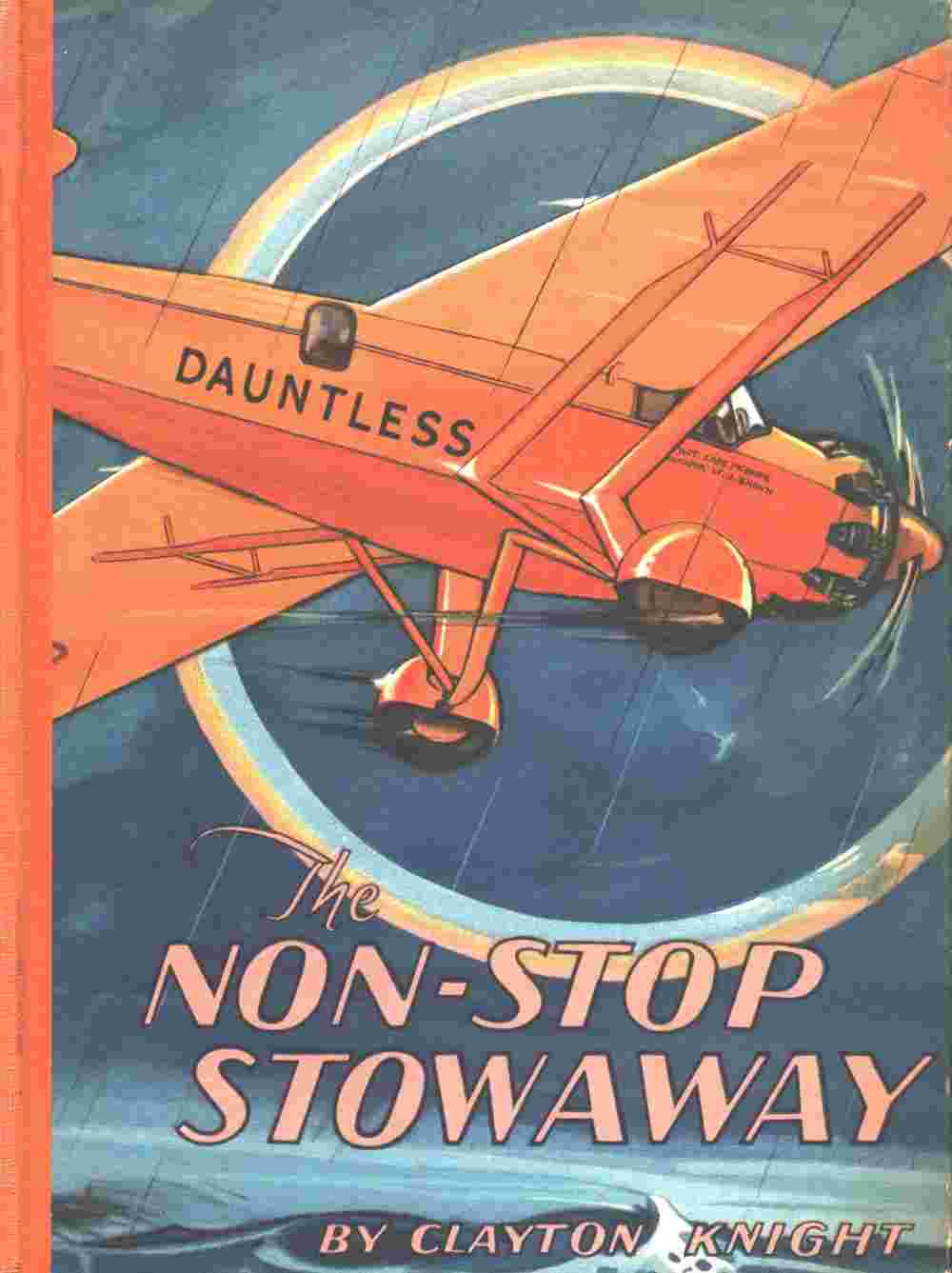
It was not long before Dad and Jack and Kiwi became accustomed to this carefree life and made many excursions off into the upper air in the “Dauntless.”
The moon had always had a great fascination for Kiwi, and on one flight with Armbruster and some of the others, they soared up to it and landed on its barren surface. They climbed in and out of the deep hollows of its dead volcanoes; they explored its caves and the rocky beds of its dried-up rivers.
They went on numerous excursions to other planets, where sometimes they landed and exchanged experiences with the strange inhabitants. The flyers were looked upon as strange adventurers, for on none of these other planets had the art of flying been developed. But always as they floated down like a bit of fluff to their own kingdom, they were happy to be back among their own kind.
And Kiwi began to feel that his place with them was now assured, that he was one of them—a pilot with wings—a Kiwi in name only.
Editor’s Note
For many weeks the newspapers in and about New York and in the Middle West carried an advertisement and a request for information. It had been inserted by order of the captain on one of the big trans-Atlantic liners. He was holding in trust a silver cigarette case which he wished to restore to the friends or relatives of Captain Malcolm McBride, skipper of the plane “Dauntless,” which had completely disappeared while on a non-stop flight from New York to India.
- Transcriber’s Notes:
- Missing or obscured punctuation was silently corrected.
- Typographical errors were silently corrected.
- Inconsistent spelling and hyphenation were made consistent only when a predominant form was found in this book.