
CHAPTER IV
THE PLANE IS CHRISTENED
KIWI awoke with a dread feeling that something was wrong. It was daybreak—light was just beginning to come in the window. Then he remembered that Dad and Jack had not come back in the plane.
Hurriedly dressing, he tiptoed down the stairs, opened the door onto the porch, and without disturbing anyone made his way down the path. The robins and the grackles were making a great racket in an old pine tree near a little lake in Bert’s yard.
He followed the shore, hurried on through the lumber yard, and out to the road. The way to the field was by this time well known to him and he started off at a fast clip. He felt that he must get over to the field and get some news of Dad.
There were few people on the road, and he had gone perhaps half a mile before anyone overtook him. The first car whizzed by, but another, coming along soon after, pulled up beside him and the man leaned out and called:
“Want a ride, Bub? How far are you going?”
Kiwi was not sure that he ought to get into this stranger’s car; but the man, dressed in dark clothes, a blue shirt and a cap with a shiny peak, seemed thoroughly friendly. So he hopped in. The car started off with a clatter and rattle as Kiwi said that he was going over to the flying field.
“That’s right on my way,” the man said. “I’m just going over to take out the 4:59.”
“Are you a flyer?” Kiwi asked.
“Well, not exactly. As a matter of fact I’m a fireman on the Long Island railroad. But I see lots of these flyers as my train passes by the field. One of these days I’m going to get one of them to take me up.”
“I’ve been up lots of times,” Kiwi replied, proudly.
They chattered on, and Kiwi told the man who he was and how his father was planning a non-stop flight to India.
The fireman said, a little incredulously, “Are you going, too?”
Kiwi had to admit, rather shamefacedly, that he wasn’t—at least Dad had said he wasn’t—“But I’d like to, and I’ve heard that India is a very nice place. Dad says they have elephants there the same as they have in the circus, except they are everywhere. The people wear turbans and bright-colored clothes, and even the men wear earrings.”
The fireman looked a bit skeptical as to that. He had seen such things at the movies, but really did not believe they were true.
As they turned the corner into the road that led past the field, he stopped and let Kiwi out. As Kiwi thanked him for the ride, he said, “Tell your Dad I’m coming over for a ride one of these days.”
“I don’t think he’ll take you,” Kiwi answered. “You have to tease him a lot for rides.”
As the car started away, it came over Kiwi that he did not know where Dad was just then. He might be down, almost anywhere along the coast.
There seemed to be no one at the field. He followed the road down toward their hangar, clambered through the fence, and came up through the tall grass at the back.
He heard voices inside the hangar and stopped. It might be Dad. He heard Cosgrave saying something, and then a strange voice broke in, “But you are going it too fast, old fellow. They’ll catch on to you. Wait till just before they hop. That’s time enough.”
This sounded funny to Kiwi, and he wondered who could be talking to Cosgrave in this manner. He hurried around to the front, opened the little door and went into the empty hangar, making his way to the room partitioned off at the back. The wind carried the small front door to with a bang, and the voices he had heard suddenly ceased. As he opened the inner door, Cosgrave was just standing up and starting for it. Kiwi looked at the other man, but it was no one he had seen before. He was neatly dressed and had a tiny black mustache.
Cosgrave said, in a strange voice, “Oh, hello, Kiwi. What are you doing around here so early?”
“I came over to find out what had happened to Dad.”
“Oh, he’s all right. We got a message during the night that he had landed near Trenton. Just some little vibration trouble with the engine, which they’ll fix up first thing this morning and probably be back here by noon.”
After a long pause the stranger lit a cigarette and said to Cosgrave, “Well, I’ll be running along. You phone me later, will you?” And with a backward glance at Kiwi, he walked out.
About two o’clock that afternoon the plane returned.
Dad said the plane had performed wonderfully until after they left Washington. They had been able to form a good idea of its speed and its new fuel consumption. They were flying a compass course over the clouds off Norfolk when a slight vibration had started in the engine. Since it had not been bad enough to worry them, they had kept on. However, as they had continued north, near Cape May, it had grown worse, and although it was dark when they reached Trenton, they decided to risk a landing at a strange field rather than strain the engine-bearers. They tried for some time to locate the airdrome, and finally concluded that they had better try to land on a large, flat field some miles out from the town. With the aid of one of their parachute flares, which they dropped, they had landed with little difficulty.
With flashlights they were able to locate the trouble. Two bolts, holding the engine to its frame, had become loosened and the cotter-pins from both were missing.
They had attracted the attention of a passing motorist who took Jack to a telephone, while Dad stayed with the plane. Jack had tried, without much success, to telephone through to Bert and to the field, and finally had sent telegrams instead. They tied the wing-tips of the plane to some fence posts, and a State policeman offered to watch it till morning. The policeman also directed them to a place where they spent the night.
In the morning, it was the work of but a few minutes to put the plane into good shape, and with a parting wave to the policeman and a few people who had gathered to see them take-off, they left. Without further difficulty they had landed at their own field.
This long test had reassured the Skipper and Jack on many points, and there seemed little more to do to the plane. The letters and the numbers of their license, NX-953, had been painted on the top of the right-hand and on the bottom of the left-hand wing and on the tail. The man who had done this had asked about a name, but Jack and the Skipper had been unable to agree on one.
The backers of the flight, having had word that the plane was nearly ready for the take-off, wrote the Skipper that they would be at the field by the end of the week. One of them suggested in the letter that there should be a formal christening. It would help the publicity. The fact that he had a very attractive daughter who photographed well may have put the idea into his head.
Kiwi’s excitement ran high at all these new preparations. His new uniform had been delivered, and he had strutted about the houseboat with it on. Both Dad and Jack were immensely pleased at his new appearance, and Jack promised to go with him to the barber for a last trimming up.
The makers of Kiwi’s uniform had added a touch of their own, and had sewed on a small pair of embroidered wings. But on this point Dad was firm. The wings could not be worn. “For,” he said, “you are not a pilot, Kiwi, and until you have learned to fly, no wings.”
This started Kiwi off anew on his demands to be taught to fly. He had worked on Jack on every possible occasion to get a promise of instruction from him. But so far no definite promise had been made. Jack, at odd times, had been teaching him the wireless code. By now Kiwi knew it by heart, and every evening, when possible, Jack would get him to learn the sing of the letters. Tacked over Kiwi’s bed was this card with the dots and the dashes and the letters they stood for:
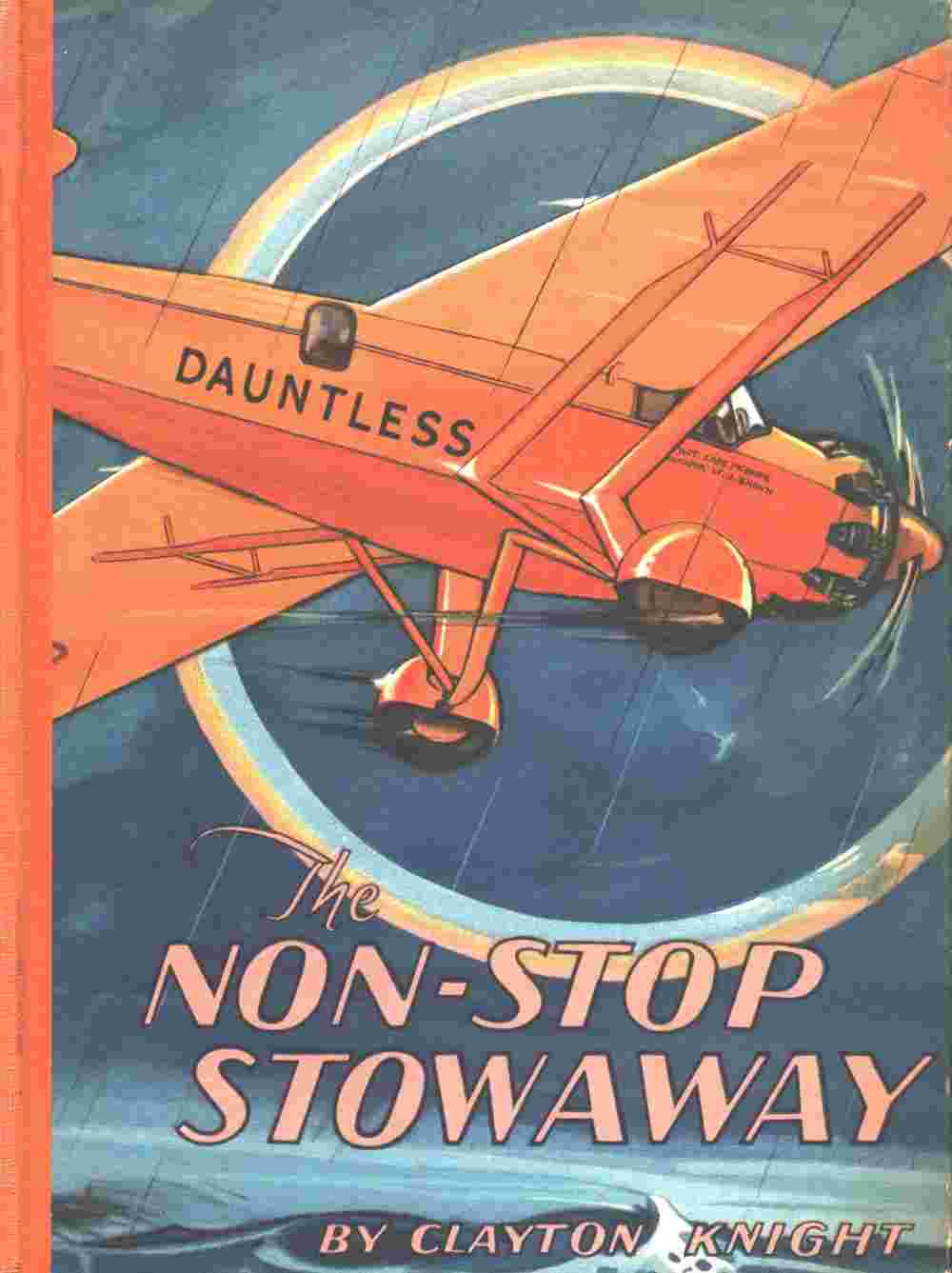
On Saturday afternoon, the party arrived with the attractive daughter, her mother, and a bottle of what they hoped was pre-war champagne. The field was crowded. A small platform had been built and the machine wheeled up to it so that the attractive daughter could just reach the big propeller. Both Billings and Cosgrave had spent the whole morning cleaning and polishing the plane until it shone. Jack, the Skipper and Kiwi were all in their uniforms. As they stood on the little platform in the bright sun, to the tune of clicking movie cameras, the bottle of champagne was brought down smartly on the metal propeller, and the young girl said, in a clear voice:
“I christen thee ‘Dauntless’, and wish thee all the luck in the world for thy big adventure.”
The crowd cheered, and the golden liquid foamed and bubbled as it ran down the long blade of the propeller. Everyone was happy. Any doubt of their success seemed out of place on this bright, sunny afternoon. Dad and Jack’s confidence in their machine and in themselves radiated from them.