
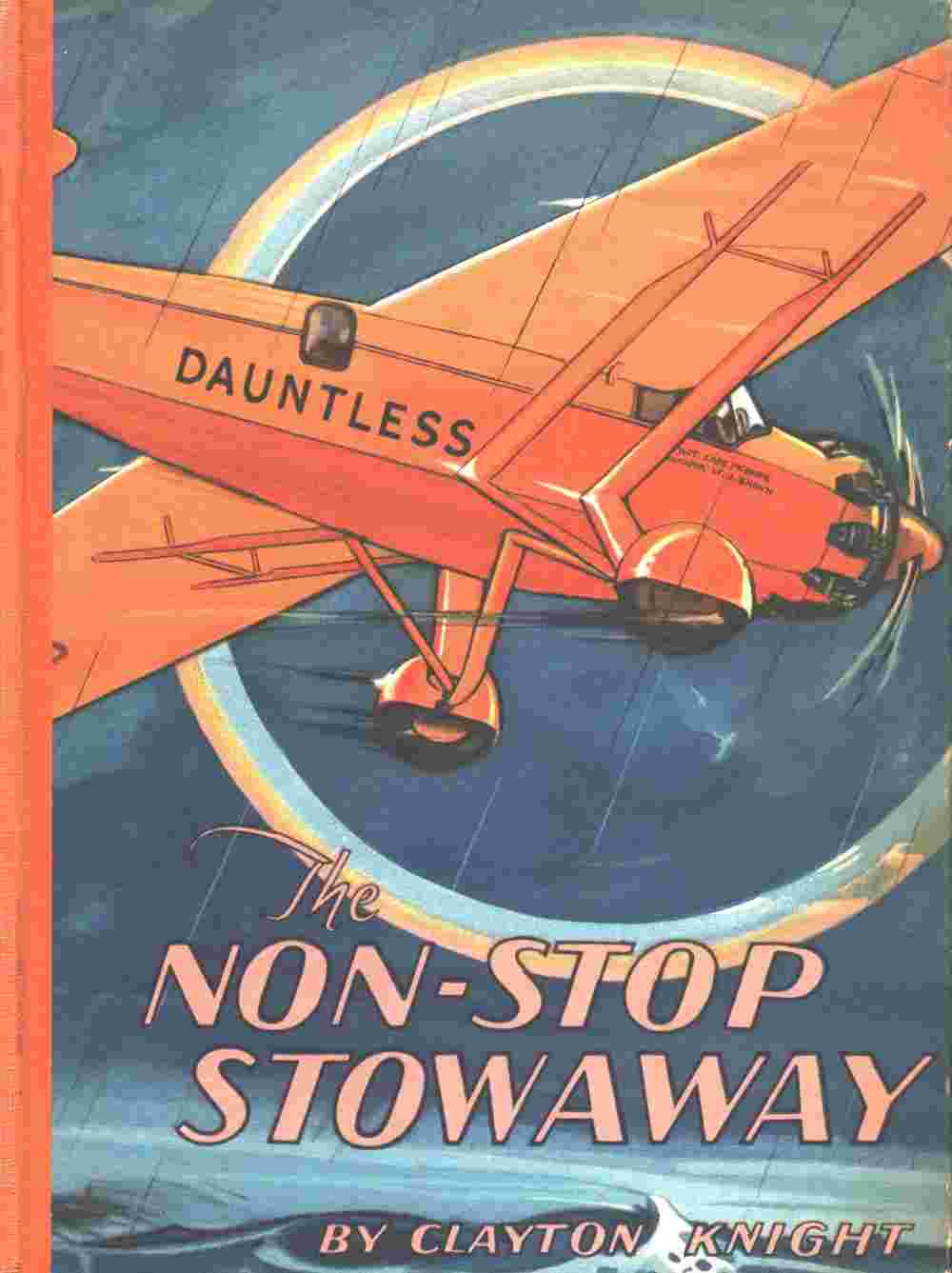
CHAPTER VI
THE FLIGHT IS ON
TO the two men in the cockpit of the monoplane, the tense drama of hours had been packed into those few seconds of the take-off.
As the Skipper very carefully opened the throttle, the engine took hold and the plane gathered headway. The soggy condition of the field after the rain seemed to hold them back. They could feel the wheels of the undercarriage sinking deep into the sod and the mud. Jack was conscious for a fleeting second of the lights of parked cars reflected in numberless puddles along the course.
The roar of the engine increased. They rolled faster and faster. The Skipper sat tense watching his instruments, with an occasional quick glance ahead.
They were rolling still faster now, gathering speed, and from the corner of his eye Jack saw the Skipper push the control stick forward to get the tail off the ground. Striking uneven spots in the field, the big plane rocked gently. Still it seemed to drag. But always their speed increased over the ground.
They were half way down the field, with still not enough momentum to lift their heavy load from the earth.
Three-quarters of the way down the field, and no tendency to spring away from the rain-soaked ground!
Jack glanced quickly at the Skipper’s face to see if all was well.
The Skipper was looking straight ahead in a fascinated manner as the end of the runway approached, and the shallow gulley that lay beyond. Too late now to shut down the engine and make another try. The next second would decide.
The Skipper pulled gently on the stick, the plane lifted ever so slightly, cleared the ground, dropped back again for one last little bounce—and then it was almost as if the intense concentration of those two men helped to lift that tremendous load into the air and hold it there.
They whizzed off the end of the runway and soared just above the shallow gulley which had been the grave-yard of an earlier attempt.
Once in the air, the plane gained altitude very slowly. Just ahead was the line of hangars, one of which had housed it for so many weeks. The Skipper turned the plane slightly so that they might pass between the hangars and a line of trees. The red obstacle light on top of the highest hangar was methodically flashing its warning. They cleared it safely by several feet and continued their climb.
By the time they had gone a mile farther, they had height enough to make a gradual turn and head into the rising sun.
As they came back over the field, escort planes came alongside, and in one of them a news-reel photographer was steadily grinding the crank of his machine, getting a record of their start.
The sun rose from behind a heavy bank of clouds and touched them, lighting up the orange wings till they seemed a blazing flame. The land beneath still lay wrapt in a blue haze. To their right a larger bank of threatening clouds was even then sprinkling its waters into the distant ocean.
The escorting planes came closer, looking tiny and unsupported, their whirling propellers perfectly visible against the blue-gray background.
By the time the “Dauntless” had reached the end of Long Island, all of them had turned back save one, and there its pilot, with his hands high in the air, sent them a last handshake and a wave, banked his machine sharply and left them.
It was like the last wave from a ship’s pilot as he sends the vessel off to sea alone.
By this time they had fifteen hundred feet altitude and were beginning to breathe easier. Jack leaned over to the Skipper and said:
“We’re off! How does it feel?”
The Skipper smiled and replied:
“She handles pretty well, but it did seem ungodly tail-heavy at the take-off. The sooner we can get those small cans in the rear compartment emptied, the better I’ll like it. We’d better not try it yet, but as soon as we use some fuel out of the main tank we’ll empty a few of those spare cans and heave them overboard.”
Setting their course across Long Island Sound, they could see ahead the dim line of the Connecticut shore, and Jack lowered their wireless aerial and clicked his first message to Connors. It was short and to the point.
“Everything going well. (signed) DAUNTLESS”
About seven o’clock they were over Cape Cod and could see many boats and steamers crawling over a smooth sea.
Jack sent another message to Connors reporting all well, then clicked off in code:
“Signing off to empty fuel from spare cans.”
The Skipper nodded as Jack explained that he would now attempt the replenishing of the main tank. He carefully climbed from his seat next the Skipper, and had only just started to squeeze up into the space between the top wing and the tank when he stopped with a start. Peering at him over the top of the tank was Kiwi, with a self-conscious smile on his face.
The Skipper partly turned to see why Jack had dropped back into his seat. Jack clutched the Skipper’s shoulder, leaned over and shouted:
“Cripes! The Kiwi’s with us!”
For a few seconds none of the three moved. The Skipper was plainly unbelieving. He thought that Jack must be dreaming. Coming out of his trance, Jack motioned to Kiwi to come forward.
Kiwi wiggled his way over the tank, still wondering how he would be received. He shyly put one hand forward and grasped Dad’s shoulder with as hard a squeeze as he could muster.
Dad realized then that Kiwi’s presence was an actual fact. Here was a stowaway, another life that must be reckoned with in this adventure. He would have preferred not having this additional responsibility. There had been enough details to think about. But there was nothing that could be done, and his plans must be adjusted to cover this new situation.
Kiwi could only say in a shy voice, “I can help, Dad. And I didn’t want you to go without me.”
Jack slipped back into his seat, put on his earphones, and sent out Connors’ call letter. As soon as he got an answer, he clicked off a message that the Kiwi was aboard, a stowaway, and that he would be put on the usual bread and water diet of all stowaways and made to work.
The Skipper then said to Jack, “Here’s your helper for the gas.”
And to Kiwi he said, “Well, boy, you’re in for a long ride this time.”
Kiwi went to work with a will—unlashed the cans, unscrewed the tops, and passed them over to Jack who, standing on his seat, poured the fuel into the main tank. They disposed of five of them. As Jack opened the sliding panel of glass beside him, a terrific stream of air blew into the cockpit, and he hurled each can in turn as far out and down as he could, so that they would not be carried back into the tail. Kiwi looked out of his little side-window to see them tumbling into space, turning over and over, the light glinting on them as they fell.
Beneath them the wind must have been freshening, for there were signs of whitecaps on the level floor of the ocean. Dimly to the left could be seen the shore line.
Shortly after eleven o’clock, Jack picked up signals from the S. S. Mauretania. She was notifying the shore stations that she believed she had sighted the “Dauntless” a short time before.
A little later they were passing over land, which Jack said was the shore line of Nova Scotia.
Kiwi commenced to feel hungry, and busied himself peeling one of Old Bill’s oranges, most of which he passed over to Dad and Jack.
Jack took over the controls and flew the plane a couple of hours while the Skipper stretched himself and carried on a halting conversation with Kiwi.
He learned how, when he had sent him to find Bert, Kiwi had made a hesitating search, had circled back to the plane, and, without being seen, had climbed into his place in the rear compartment.
Dad tried to look stern, but Kiwi could feel that already he had been forgiven.
The plane hummed along, and they felt almost as though they were on a picnic.
About twelve-thirty they passed Halifax, and Jack wirelessed that all was well.
Soon they passed over some broken clouds and found the air very bumpy. They were picked up and carried sometimes fifty feet before being dropped. Jack had his latest weather map tacked to a small board in front of him, and he remarked that they might expect this sort of weather, or worse, before they reached Newfoundland.
They noticed a slight haze coming up before them, and for the next hour they ran through intermittent showers.
Giving the Skipper his course to fly, after a careful checking with his drift indicator, Jack called to Kiwi and they began the transfer of five more cans of fuel to the big tank.
With the air as bumpy as it was now, this was no light task. Once, when the plane gave a sudden lurch and reared upward with one of the bumps, Kiwi lost his balance and tumbled over on the floor of his compartment; and before he could pick himself up and rescue the can some of the precious fluid had been lost. After that he was more careful, and braced himself securely against the sudden lurching of their ship.
They were twice as long making the transfer this time, but it was finally accomplished, and Jack heaved the empty cans overboard. This time Kiwi was unable to follow them on their downward flight. Often they disappeared from view within a split second of being hurled out.
The broken clouds were making the Skipper’s job of piloting much more difficult. Trying to keep the plane on an even keel and follow their set course took all his attention.
Intermittent showers beat down upon them, and big raindrops were carried back along the under side of the wings in small, hurried rivulets. To Kiwi in the back, with his nose pressed against the window pane, it seemed like summer downpours that he had witnessed from their little cabin back home.
He had become accustomed by now to the smooth roar of the motor, and was not so conscious of the strain on his eardrums. Through holes in the clouds he could occasionally see the ocean tossing black and green far beneath them.
Jack wanted to make sure of getting a last bearing on land before they swung off to the open Atlantic, and asked the Skipper if he could not drop a little lower under the clouds so that Newfoundland would be plainly seen.
Even under the clouds, which were only about eight hundred feet above the water, the visibility was very poor. A thick mist was shutting in on them. They flew on, trusting to their instruments, and once, later in the afternoon, the clouds parted for a few moments and gave them just a glimpse of land nearly dead ahead—not long enough, however, for them to identify it positively. They hoped for another such break in the clouds to help them with the navigation.
The bumpiness of the air was increasing. Jack caught a wireless call from some station in Canada, but the message was so badly garbled by the static that they could not be sure of its location. The call of some ship could be faintly heard, but it also was too confused to be of any use to them.
Between five-thirty and six they ran into an area of clear weather, which lasted long enough for them to place definitely the land ahead as Cape Race. It was just what they needed, and confirmed Jack’s navigation figures. Using it as their last point of land, Jack changed their course slightly and the real ocean voyage began.
They were not sure they had been sighted at this point, but rather hoped so, and that the world would know they were well on their way. Below them the sea looked angry and was flecked with white.
In his mind’s eye, Kiwi had pictured this breaking away from land, and had thought that he would be able to look far to the eastward across the Atlantic and feel its immensity. He was not so fortunate, for directly ahead and seeming to bear down upon them were ragged gray clouds, and rolling along the surface of the water a thick gray fog.
The plane was still being tossed about by the confused wind, and now that they had their last bearing determined, it was the Skipper’s idea to try and climb over these clouds. They were soon amongst them. Darkness seemed to shut in almost at once, and the Skipper switched on the running lights on the instrument board. Jack was watching his instruments closely, checking their drift.
Kiwi, having no light in his compartment, crept up on the tank and lay there watching the progress of their plane through these dense clouds. The hand on their altimeter slowly turned ... three thousand feet ... four thousand ... and if anything the clouds seemed thicker. The fog condensed on the windows of their cockpit and was carried backwards in wisps of water. Five thousand ... six thousand ... still as dark as ever. The wing-tips could scarcely be seen.
At times the plane would plunge and rear, and Kiwi had to brace himself to stay in position.
By the time they had reached nine thousand feet the darkness seemed a little less dense. At ten thousand they came out into comparative twilight. But even here they could not see the stars for there were other light masses of clouds above them.
A long time passed, with only the drone of the motor to be heard, and with nothing to be seen except piled up clouds in every direction. Kiwi must have dozed, for he awoke feeling stiff and cold, how much later he did not know. It took him a few seconds to realize where he was. Then he saw Dad still at the stick and Jack bending over his wireless key, tiny blue sparks showing that he was sending a message. Kiwi was just able to follow the code which told him that Jack was asking some ship if his signals were loud. The clock on the instrument board said half past two. The ship replied, and Jack wrote the message out on a little pad beside his instrument and showed it to the Skipper:
“Signals very loud. You must be near. Can you see our lights? Some fog on the surface.”
Another hour passed. The same ship sent word that the signals were getting fainter. But another ship broke in, gave its position and the ship’s operator, and then sent:
“Your signals strong enough to knock our heads off. What is your height? You must be just over us. We will send up rockets. Tell us if they are seen.”
All three watched on every side, but nothing except a tumbled mass of clouds met their gaze. The air up here was getting colder. Kiwi shivered. The Skipper, looking back, noticed him, and it crossed his mind that in the excitement he had forgotten to open the heater which ran from the exhaust pipe on the engine. It was the work of a moment to throw the lever over, and almost at once they felt the warm air come up into the cockpit.
Jack took over the controls for a little time, and the Skipper and Kiwi transferred the last of the extra fuel to the big tank and disposed of the empty cans.
The Skipper made a hurried check of their fuel supply in both the wing tanks and the main one, and appeared to be well content with the way it was holding out.
Kiwi was taking small cat-naps on the top of the tank and beginning to wonder if it were not time to eat again. It was still dark and there was nothing to be seen—no moon, no stars, just a gray pall on every side.
He awoke from a longer one of these naps to find it much lighter and the lights on the instrument board looking very yellow in the daylight. Jack was just saying, “I think I’ve picked up the government radio station at Malin Head, Ireland.”
While Jack was trying to pick up their message, the Skipper leaned forward to switch off the instrument-board lights, and as he did so he glanced out the window along the wing on Jack’s side and made an alarming discovery.
The fuel pipe line from the wing tank ran along the outside surface of the wing for a short distance, and then curved down to the fuselage, where it came through to the main tank and the carburetor. In the curved part was a flexible joint which had evidently vibrated loose, for streaking out behind was a flow of their precious fuel. There was no way of knowing how long this had been going on.
The Skipper had a terrible sinking sensation as he realized what the consequences of this tiny leak might be. Perhaps gallons had even now been lost and the seriousness of it appalled him. They would need every drop they had to reach India, and already enough might have escaped to ruin their chances of even making Europe.