
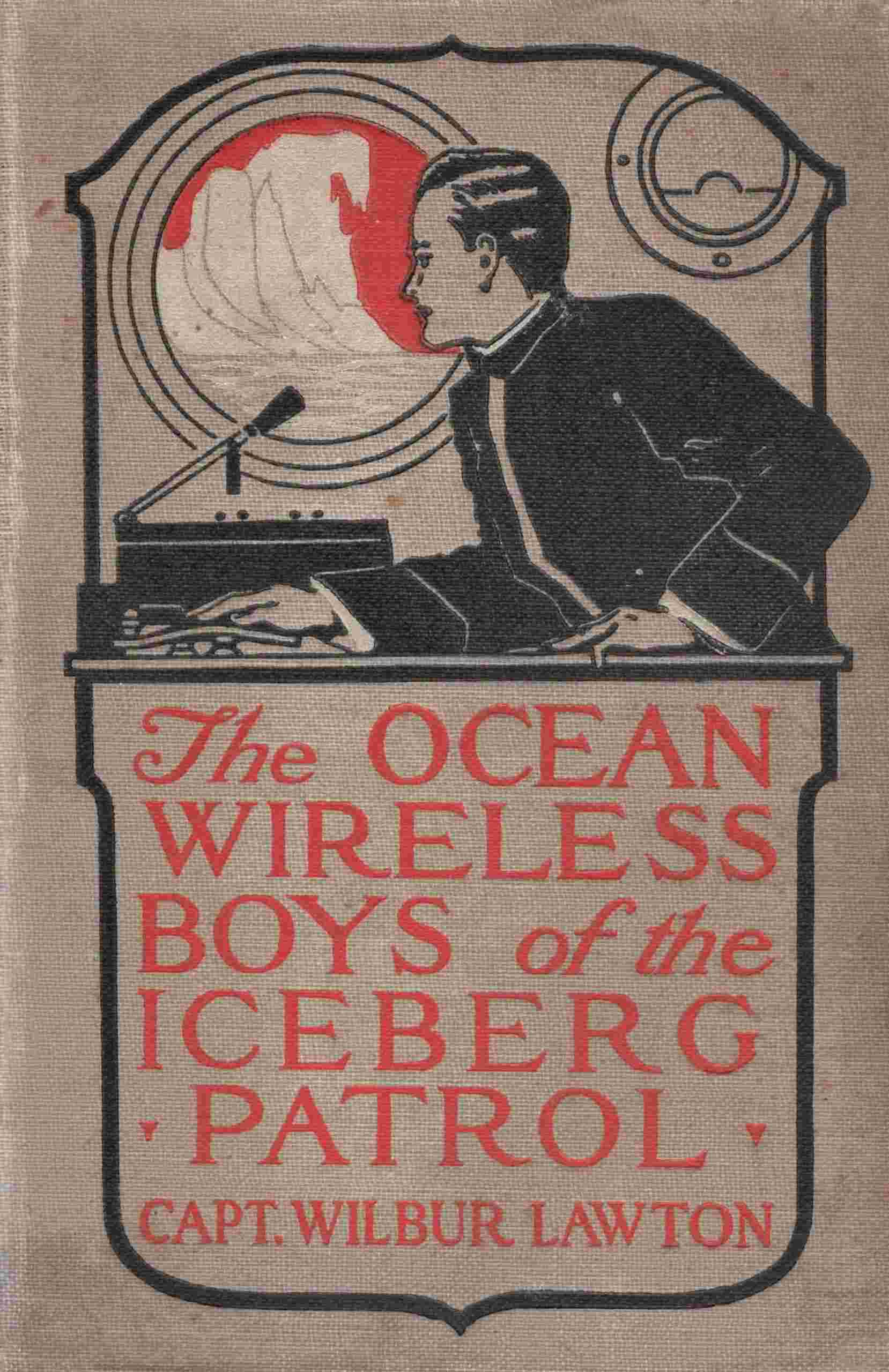
CHAPTER XX: JACK TRIES OUT HIS INVENTION.
“Icebergs ahead.”
The look-out in the crow’s nest of the Thespis sang out the warning sharply. Officers and men of the smart revenue cutter were instantly on the alert.
“Where away?” came from the bridge.
“Two points off the starboard bow, sir,” was the response.
The officer leveled his binoculars on a huge mass of ice about two miles off. It glittered like polished steel. It rose into two huge points like the steeples of a cathedral. Jack emerged from his wireless cabin and secured from the officer the latitude and longitude.
Then he returned to his instruments, and within half an hour every ship within reaching distance on the Atlantic track knew of the great berg and its position, rate of progression and probable course. For some days this had been Jack’s daily work.
He went forward to the bridge to make his report on the ships he had warned. Captain Simms was there eyeing the steely blue ice mountain.
“I’d like to dynamite that fellow just as I would a derelict that imperiled navigation,” he said.
“I’ve been thinking the same thing, sir,” said Jack respectfully, “and I’ve thought up a new method of doing it.”
“What’s that, my lad?”
“I could blow that berg up by wireless!”
The commander looked at the boy as if he thought Jack had taken leave of his senses or had had the temerity to joke with his commanding officer. But Jack was never more serious in his life.
“I mean it, sir,” he said steadily.
“Explain yourself, Ready. I must confess that your statement set me aback.”
“I’ve been figuring out a method,” rejoined the boy, “of firing torpedoes, guns and mines by wireless. I think I have it perfected, but if you would permit an experiment on that big iceberg yonder, it would be a magnificent opportunity to put my theories to the test.”
“Jove, boy, I’ve half a mind to do it. To destroy that berg is certainly in the line of duty.”
“Undoubtedly, sir. If you will allow me six men and a boat and the necessary explosives I think I can guarantee to blow that berg into smithereens within an hour by a simple pressure of the key in my wireless-room.”
“It sounds incredible—yet, great guns and little fishes, lad,—I’m going to let you try. Harley!”
The coxswain hailed, stepped up, and saluted smartly. “Aye, aye, sir.”
“Is the Number Two cutter in good condition?”
“Yes, sir.”
“Very well. You will take a crew of six and report to Mr. Ready, here, for his orders.”
The man saluted and hurried off. Before long the crew and the cutter were ready. In the meantime the explosives Jack wanted were brought on deck and then loaded in the boat. This done, Jack vanished into his cabin and emerged before long carrying a coil of copper wire and several powerful batteries.
“Now, if I could have two extra oars,” he said, briskly addressing Commander Simms, who had gazed on the preparations with interest but had asked no questions.
“All right, my boy. I’ve no idea what you want them for but you shall have them. Coxswain, get two more oars.”
“Yes, sir.”
At last all was ready, and the boat shot away from the side of the cutter. The six brawny jackies making up the crew pulled for the berg with quick, strong strokes. This trip was a welcome diversion from the monotony of the iceberg patrol duty. They made good time over the water, and soon the berg was reached.
A close view showed that a sort of valley bisected it between the towering steeples of ice that rose at each end. It was an easy matter to scramble up on the low-lying ledges of the edge of the berg. Half the party landed, while those remaining in the boat handed up the explosives and other apparatus to them. At last everything was ready. Jack ordered the men still remaining in the boat on to the berg.
They obeyed with alacrity, all eagerness to know what was coming next. Among the supplies brought were six crowbars, for the ice-patrol craft carried every kind of tool for dealing with ice.
Jack set the men to work digging holes,—like post holes in the ice at regular intervals right across the valley. When this had been done an oar was set up at each end of the row of holes.
“Now we’ll load ’em,” said Jack, and into each hole a “capped” charge of explosive was placed, being tamped down carefully.
When this had been done the copper wire was stretched from one oar to the other like a telegraph wire. From this main wire branch, wires were led to each of the loaded holes and there carefully attached to the fulminate of mercury caps. When all this had been done to Jack’s satisfaction, he electrified the system with his batteries, attaching them to the main wire.
“Now we’ll pull back to the ship,” he said.
“Beg pardon, sir, but ain’t you going to touch off all that dynamite?” asked the coxswain.
“And blow ourselves up as well as the berg? Not much,” laughed Jack, “come on, boys, give way lively now, and before long you’ll see fireworks.”
In a short time they were back on the ship. Jack reported to Captain Simms that everything was in readiness for the long distance explosion. All eyes turned curiously on the lad as he walked aft to the wireless room, for word had spread through the ship of the experiment that was to be tried.
Jack tested up his instruments carefully. Then he adjusted the dynamo for an extra heavy current of “juice.” When this had been done, he sat down coolly at the key.
“Now watch the berg!” he shouted, and the cry was taken up and passed along the decks.
He pressed down the key. There was a snap and a crackle as the live flame leaped between its points. Far above from the aërials, an invisible wave of electricity rolled.
It struck the copper wire on the berg and rushed along it and down the wires leading to the capped explosives.
Simultaneously there was a mighty roar.
“There she goes,” yelled the sailors.
The berg was seen to split in half and then dissolve as if it had been melted. Five minutes later nothing was to be seen where it had been but a cloud of yellowish smoke.
The pressure of a finger on a wireless key two miles away had destroyed the titanic berg and left not a trace of its dangerous existence.