
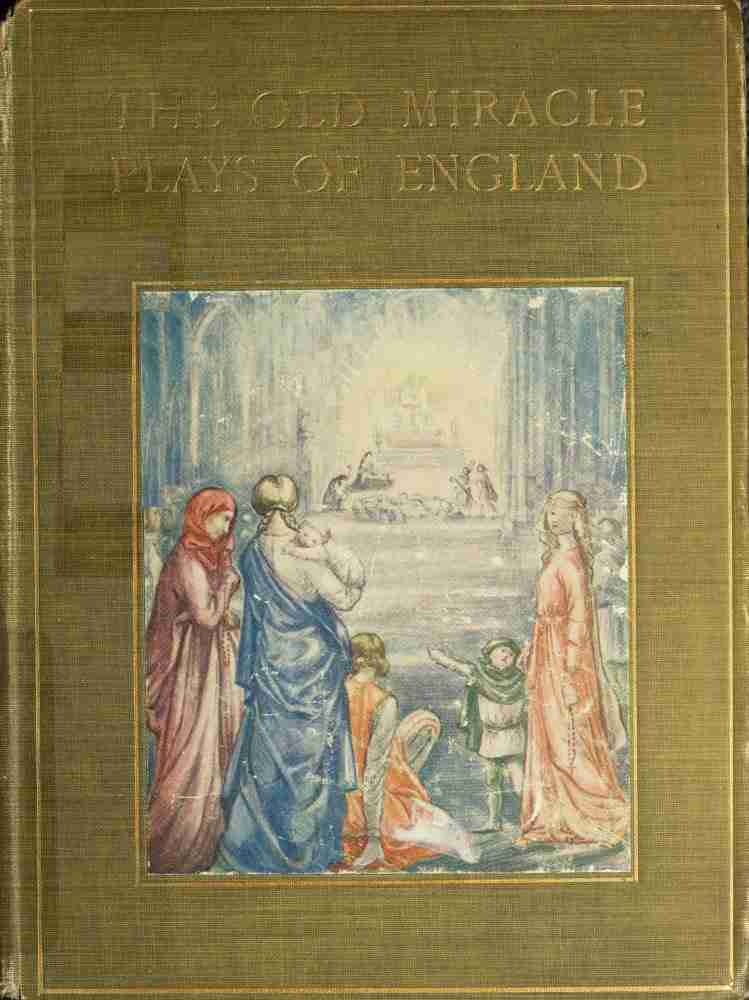
The Project Gutenberg eBook of The Old Miracle Plays of England
Title: The Old Miracle Plays of England
Author: Netta Syrett
Illustrator: Helen Thorp
Release date: July 17, 2021 [eBook #65860]
Most recently updated: October 18, 2024
Language: English
Original publication: United Kingdom: A. R. Mowbray & Co, 1911
Credits: MWS, Stephen Hutcheson, and the Online Distributed Proofreading Team at https://www.pgdp.net (This file was produced from images generously made available by The Internet Archive/Canadian Libraries)
BY THE SAME AUTHOR
THE STORY OF ST. CATHERINE OF SIENA
With twelve illustrations in half-tone, and frontispiece in colours.
2/6 net.
Miss Syrett writes with a remarkable freshness and deftness of touch which will appeal to readers of all ages, but especially to the young reader. For the story as she tells it has the colour and joy of a fairy tale—and yet is true; and the delicate reserve shown in dealing with the religious side of the narrative adds to its impressiveness.
A. R. MOWBRAY & CO. Ltd.
London and Oxford
Entrance of the Magi. [Page 83].
THE
OLD MIRACLE PLAYS
OF ENGLAND
By NETTA SYRETT
AUTHOR OF
“THE STORY OF ST. CATHERINE OF SIENA”
WITH TWO ILLUSTRATIONS FROM WATER-COLOUR DRAWINGS BY
HELEN THORP
A. R. MOWBRAY & CO. Ltd.
London: 28 Margaret Street, Oxford Circus, W.
Oxford: 9 High Street
The Young Churchman Co., Milwaukee
First impression, 1911
PREFACE
In the hope of bringing the actual presentment of Mediaeval Miracle Plays more vividly before the minds of children, I have cast information concerning them into the form of a story. But, while this method of dealing with the plays may prove to the childish reader more interesting and palatable than a mere summary of what is known concerning them, it leads to certain liberties difficult to avoid in fiction.
It seemed, to take an example, in some ways more convenient to lay the scene of the little story in York. Yet many of the Wakefield and Coventry plays lend themselves to description better than those of the York series. However, when in the course of the tale I have made use of an alien play, I have taken care to mention the fact, and to invent a reason (plausible enough, I trust, in a story) for its performance at York.
Again, the stage directions for some of these old plays are so vague that the precise manner of their presentment must be left to individual imagination and common sense. In a story there is no room for tentative speculations, nor for suggested alternative treatments; and this being the case, I trust I may be forgiven if occasionally I handle my material over-confidently. This explanation is offered to older students, to whom, simple as it is, my little summary, compiled from the recognized authorities on the subject of miracle plays, may yet be of some value. In writing it I found most helpful and delightful Mr. Sidney W. Clarke’s book, The Miracle Play in England, and, written by Mr. Ernest Rhys, the preface to Everyman, in Everyman’s Library. To both these gentlemen my thanks are specially due.
N. S.
CONTENTS
- CHAP. PAGE
- I. Introduction 1
- II. How Colin and Margery kept the Feast of Corpus Christi 17
- III. The Creation of the Angels, and the Fall of Lucifer 23
- IV. The Making of Sun, Moon and Stars: of Birds, Beasts, and Fishes: of Man and Woman. The Garden of Eden 35
- V. Noah’s Ark 44
- VI. The Story of Abraham and of Isaac 56
- VII. The Shepherds’ Play 67
- VIII. King Herod, the Wise Men, and the Massacre of the Innocents 77
- IX. At the End of the Day 91
- X. Everyman 99
THE OLD MIRACLE PLAYS OF ENGLAND
I
INTRODUCTION
Of all the delightful games which children play in the nursery or in the schoolroom, perhaps the favourite one is dressing-up, and acting. And of all the Christmas treats, perhaps the best is going to the theatre—either to the pantomime or to one of the fairy plays which fortunate children can now enjoy.
There are grown-up people too who never get tired of dressing-up and acting, nor of going to the theatre to see other people act. It is a taste which is shared by children and grown-up people alike. And it has always been so. Long, long ago, when all the people in the world were savage, there is no doubt that little naked children picked up their fathers’ spears, and bows and arrows (or made smaller ones in imitation of them), and “acted” the hunting of animals or the killing of enemies, while their parents looked on, pleased and interested by the performance.
Thousands of years have passed since the first “acting” took place on some lonely beach, perhaps, or in a clearing of the forest where savage children played; and now in all our big towns we have big houses specially built for acting, and there are many men and women who spend most of their time either in writing plays or in learning and acting them.
Every evening in London hundreds of cabs and motor-cars stop before some brilliantly lighted theatre to set down people who have come to see one of the many plays performed night after night in this great city. And seven hundred years ago people also crowded to see plays in London, though it was a very different London then, and a very different building at which they arrived.
Instead of ladies in evening gowns, and gentlemen all dressed alike in black coats, stepping out of cabs and motor-cars to walk across a pavement to the theatre door, you would have seen, on certain days long ago, a curiously dressed crowd of men, women, and children, some on horseback, some on foot, all pressing in one direction. There would be barefooted monks, soldiers with breastplates and helmets of steel, nuns with white caps and veils, little boys with long stockings, one red, one green perhaps, and short tunics belted at the waist; ladies with full flowing robes and strange head-dresses, some pointed like a sugar-loaf, some with veils arranged over a frame in the shape of two horns. And all these people in their quaint and varying costumes would be threading their way through narrow, dirty streets, like lanes, between overhanging houses, till they stopped—not before a big lighted house with playbills outside, and a marble hall and gilded ceiling with doors leading to the theatre within—but in front of the great gates of a church, and that church might have been Westminster Abbey. For there the play they had come to see was to be performed!
Strange as it may seem to us now, the first theatres in England were the churches, and, as you may guess, the first plays to be acted were religious plays.
Let us try to understand the reason for this. You remember that William I conquered England in 1066—eight hundred years ago. Well, from the time that he and his followers came to this country the English race has been gradually growing into the nation to which we belong and into the sort of people we see round us every day. Even the very poorest English children nowadays go to school and can read and write. Children whose parents are not so poor learn much besides reading and writing, and thousands of the sons and daughters of rich or fairly well-to-do people go to college, and spend years of their life in study. So that now, in the twentieth century, English people are on the whole educated. But it has taken a very long time to arrive at such a state of things as this, and for hundreds of years after the Conquest, not only the poor, but even the richer and quite rich people were ignorant. Very few men except those who belonged to the Church studied at all. Thousands of the rest could neither read nor write.
Now very naturally the Church considered that religion at least must in some way be taught and explained to these masses of ignorant folk. Whatever else they knew, or did not know, it was necessary that they should understand the faith they professed. They called themselves Christians, yet how were people who could not read, to learn even the Bible stories, or anything at all about the teaching of Christ?
“They might go to the churches,” you will say, perhaps, “where the Bible would be read to them by the priests.” But that would not do. For remember that for hundreds of years after the Conquest the service was always read in Latin, a language which very few people except lawyers, priests, and scholars understood. No doubt, so far as they could, the clergy privately explained the teaching of the Church to as many people as they could reach. But thousands and thousands of them were never reached privately at all. They just came to church on Sundays and on Saints’ days, and went away without any real knowledge of what the services meant.
It was a difficult problem, yet the monks and clergy conquered it. They thought of a way of teaching for which no books were necessary. A way moreover, by which hundreds of people could learn at the same time, merely by using their eyes and their ears. The life of Christ, the lives of the Saints, the whole Bible history, they discovered, could be shown to the people in the form of plays or acted stories. The clergy should write the plays, they agreed, and the clergy themselves should act them!
It was a clever idea, cleverly carried out. In various monasteries monks began to write and to arrange such plays, to be acted in the churches on special days, at special pauses in the service.
At first the religious scenes they prepared were very simple, and performed chiefly in dumb show.
We know, for instance, of one little play that was acted about eight hundred years ago in a church dedicated to S. Nicholas.
Now the priests of that church were naturally anxious for the people in their charge to know as much as possible about the saint—their own special saint, whose name they mentioned every time they spoke of the church.
On the feast day of S. Nicholas therefore, before the service began, they removed from its niche the stone image of the saint, and in its place a priest stood, dressed as much like the statue as possible.
That was the beginning of the story. The rest had to be explained by acting. Not only was S. Nicholas the special saint of children, he was also the protector of travellers, and the play was meant to show how powerful he was in this respect, and what miracles he could work for those who put their trust in him.
The usual service was begun, and then, at a stated time, a pause was made. The church doors were thrown open, and a priest dressed as a traveller from a distant land, came in and bowed before the shrine of S. Nicholas. The priest represented a heathen who had heard of the saint’s power, and wanted to discover whether all he had been told was true. His flowing robes and his jewelled turban showed the audience that he came from a foreign land, and was not a Christian. Presently, from the folds of his robe, this man took a rich treasure, and placing it at the feet of the saint, told him that he was going on a journey, and prayed him to guard the wealth he left in his keeping. Then he went his way out of the church.
But no sooner had he departed, than other priests dressed as robbers, crept in, and stealing up to the shrine, took the treasure and hurried away with their booty. Meanwhile, the heathen, who felt uneasy about leaving his wealth in the saint’s care, returned to make quite sure of its safety and finding the treasure gone, began to storm and rave. He was proceeding to beat and insult the image, when to his amazement it moved! Stepping down from the niche, it went out to seek the robbers who were hidden just outside the church. So terrified were they at the approach of a living saint when as they thought, only a statue had watched their theft, that they immediately restored the treasure, and tremblingly followed S. Nicholas into the church. The heathen, overjoyed and full of awe and wonder, fell at the saint’s feet. Then S. Nicholas bade him become a Christian, and worship the true God.
So the play ended, and the interrupted service went on.
Simple as it was, the little scene no doubt persuaded the congregation that S. Nicholas was a great and powerful personage, and the impression it made upon them was one they were not likely to forget, because of the strange and interesting manner in which the lesson was taught.
This is the first play we know anything about, but we may guess that others more or less like it, began to be very popular, for we find from old books—books written hundreds of years ago, that twice a year at least, at Christmas and at Easter, the people were taught by means of acting, two of the greatest events in the life of Christ.
Let us try to imagine a Christmas Eve in Westminster Abbey, long ago, when Henry III was king. The Abbey was not nearly so large then as it is to-day, for much of it has been built since. Yet the central part was finished, and six hundred years ago people looked up at some of the same soaring arches, and leant against some of the same pillars as those we now see in the beautiful church.
The Abbey bells had been ringing for a long time, calling the Londoners from their homes, and from the crooked narrow lanes of the city, through the gates in the walls which then surrounded Westminster, there had come flocking to the church a great crowd of gentle and simple folk. There were merchants and shopkeepers, wearing hoods like jelly-bags with their long points dangling at the back; ladies with strange fantastic head-dresses; poor women and children muffled in cloaks; soldiers, nobles, and monks of various orders. Some of them stood thronging the aisles, others knelt on stools, or beside wooden benches.
The church was dark and mysterious. Only on the altars, candles blazed like golden stars, and above them the arches rose stretching up into the gloom overhead. The air was full of a sweet heavy scent—the scent of incense.
Near the altar, surrounded by gleaming lights, the people could see a rough cradle shaped like a manger, and beside it, dressed in long robes, an image of the Virgin Mary.
Then from the side-doors leading to the space about the altar, there entered, in twos and threes, men dressed as shepherds, holding crooks, and driving before them real sheep. They were followed by dogs, who kept the flock together, running round them, and ordering them in the wonderful way of sheep-dogs. Some of the shepherds lay down as though to sleep. Others watched their flock, wide awake and talking amongst themselves.
Suddenly, while interested and curious the congregation looked on, a blast of trumpets rang out, and before the startling sound had died away, echoing through the aisles and the arches, an angel in a robe of rose colour, with big white wings, appeared in the pulpit. Very sweet and clear his voice sounded as he announced tidings of great joy. Christ was born in Bethlehem.
Then, somewhere from the darkness above, there followed, in a burst of song, the voices of the angels.
“Glory to God in the highest,” they sang, “and on earth, peace, good will toward men.”
Can you not imagine how the children gazed up through the gloom, expecting to see the white-winged angels hovering down towards them? And though the grown-up people knew that the music came from the singing boys placed in a gallery high up over the windows, they too must have felt that the message was a heavenly one, and many of them were filled with awe. And now, when the beautiful voices were silent, the shepherds began to crowd towards the altar. There, kneeling before the manger, they adored the Baby and His Mother, and afterwards, walking in procession through the church, past the watching crowd, they sang a hymn of praise.
This was the scene which in numberless churches all over England took place six hundred years ago on Christmas Eve, and even now a memory of it dwells at Christmas-time in many churches.
Nearly every church in Roman Catholic countries gives up one of its little chapels to a representation of the stable at Bethlehem. The actors are no longer real, but figures of Joseph and Mary and the shepherds take their place.
In Italy, the Christmas “manger scene” in the churches is often very elaborate. I remember one in a church just outside Florence, before which there was always a crowd of little children staring in delight. The whole of a tiny chapel was turned into a sort of cave or grotto, with winding paths from the heights, down which came figures to represent the Wise Men from the East, with toy camels and leopards following them. In the midst of the grotto there was a straw-filled manger, and in it lay the Baby Jesus. The Virgin Mary with clasped hands knelt beside it, and Joseph, leaning on his staff, looked over her shoulder at the Child. A group of shepherds with crooks knelt near the Holy Family, while their woolly toy flocks were huddled round them.
At Easter-time also, six hundred years ago, the people in England were taught by means of acting that Easter means the Resurrection of Christ from the dead.
Before the altar, a grave was prepared, and at a certain part of the service, choristers, representing the women who went to the sepulchre, walked up the aisle, bearing the spices and the ointments. When they arrived at the grave, they found seated beside it an angel, who said, “Why seek ye the living among the dead? He is not here, but is risen.”
Then the story as it is told in the Bible went on, acted by the clergy, till one of them, representing Christ Himself, appeared to the rest, announcing that He had risen from the grave. At this point the whole choir burst into songs of “Alleluia,” and the play ended.
Like the “manger scene,” a memory of this old play persists in some religious customs which still linger. In Italy, if you go to any of the churches just before Easter, you will see in front of one of the altars something that looks like a little garden of flowers. There are tubs of blossoming shrubs; masses of tulips and daffodils and anemones, some in pots, some in jars of water, and amongst the flowers you will find, cut in wood perhaps, and painted to look as real as possible, the spear, the nails, the cross—all the terrible things that were used at the Crucifixion. And this little “arranged” plot of colour and scent is called The Sepulchre. The Easter play is acted no more, but it is a beautiful thought to make a garden in memory of it, to show that death is conquered. For the “sepulchre” holds not death, but life—the lovely life of flowers.
This, you see, is another way of teaching people the meaning of the Resurrection.
The first plays, then, were religious plays, and they were acted in churches. But soon they grew so popular, and so many people crowded to see them, that the churches were not large enough to contain the throng, and by degrees the custom grew up of acting them outside the church, so that they might be seen by a much larger audience than the building itself could hold.
From a very old play in which stage directions are given, we are able to understand how the performance was arranged. The story of this play is The Disobedience of Eve, and the loss of Paradise through her sin.
Just below one of the windows of the church, supported by scaffolding, a platform was put up. From this platform, steps led to a lower stage, and there was a space between this under platform and the ground.
Thus the church itself stood for Heaven. The first platform was Paradise, the second Earth, and the space beneath it, Hell. So that when God the Father descended from Heaven to walk in the garden of Paradise “in the cool of the day,” the priest who represented Him, came from the church window to the “Paradise” platform. And when Adam and Eve, having tasted of the fruit, were driven out of the garden, they descended the steps to the “Earth” stage, and at last to the space below which meant Hell, where in the midst of clouds of smoke, and with great rattling of chains, boys dressed as demons lay in wait for them.
A play such as this must have been a quaint and curious sight, and to us who live so many years after the people who gazed at it from some churchyard long ago, it seems childish and even occasionally horrible. But we are in many ways unlike those homely folk who used to stand open-mouthed in amazement before such a scene. We have read many books, and our ideas about religion have changed so much that it is difficult to imagine how greatly acting, even of this sort, must have impressed the simple minds of men and women who had read nothing, and were often full of fears and superstitions. They were like little children who have to be taught in a way that will fix and hold their attention. Just as a tiny boy or girl is taught its letters with bright and highly coloured picture-blocks.
So far we have seen how these religious plays were at first acted in churches, then came to be performed outside them. Now we shall discover that a further change was presently to be made. As the years passed, people began to expect more and more in the way of acting. They wanted richer dresses for the players, more scenery, and bigger spaces for the performances. Far from getting tired of these theatrical performances, the taste for them grew, and greater and still greater throngs pressed towards the churchyards every time a play was announced. You will understand how disorder arose, and spread. Rough crowds spoilt the grass in the churchyards, and trampled upon the graves, for the plays began to be looked upon as amusements for a holiday, rather than as religious ceremonies to be watched quietly and with reverence. So in time it was felt that a churchyard was not a fit place for a boisterous throng. It was too near the sacred building, which the people profaned with their noise.
Yet if the plays were removed from the surroundings of the church, it no longer seemed fitting that priests should take part in them. Thus it happened that by the end of the thirteenth century, about the time when Edward I was king, the clergy had left off acting, except at Christmas-time and at Easter, when, as usual, the Nativity scene, and the scene of the Resurrection were performed in the churches. Every other sort of religious play was henceforward acted by the laity (that is, by people who, whatever they may be by trade or profession, are not clergy). So a class of men grew up who were paid for acting, and often gained their living in this way alone; and though the plays they acted were still religious plays, the cost of them was borne by rich people, and they were by degrees made into grand performances, as we shall see.
All through those years which are known as the Middle Ages it was the custom for men who belonged to the same trade to form themselves into a society, or guild as it was called, to protect and help one another in their own particular work. Each trade had its own guild, and its own special saint as guardian. There was the Tanners’ Guild, the Fishmongers’, the Carpenters’, the Armourers’, the Bakers’, and so forth—too many of them to mention. Now many of these guilds in the course of time had become very rich societies, and could afford to spend a great deal of money upon anything that interested them. Plays interested all the townsfolk immensely, and so even before the clergy had quite left off acting in them, the guilds began to take the management of these plays into their charge, paying the actors, providing rich and costly dresses, such scenery as could in those days be made, and everything in fact that is known as “stage property.”
The priests still wrote the stories, but the acting and the whole management of them passed into the care of the rich guilds.
Miracle plays was the name given to these religious “acted stories,” and very fortunately, four sets of Miracle plays have been found and preserved, so that we can read the very words spoken by actors long ago to audiences of eager and interested people.
These four sets are the York, Wakefield, Chester, and Coventry plays. Each “set” includes a great many plays—in the York collection, for instance, there are forty-eight—and year after year from the reign of Edward III to the time of Henry VII they were acted at the four towns mentioned. Not in these towns alone either, but all over England; for if a city had no plays of its own it borrowed one of the York, Chester, Wakefield, or Coventry set.
If we look at the York collection of Miracle plays, it will do as an example of the rest. We find that it begins with the Story of the Creation of the World, and all the chief stories of the Old and New Testament follow in proper order. So that, even if he could not read, any one who saw the whole series one after the other, would have a very good idea of all the teaching of the Bible.
Now let us in thought go back to the Middle Ages, and try to picture the scene in some old market-place, soon after Whitsuntide, the time when Miracle plays were generally acted. To help us to do this, let us imagine how the sight of them impressed two out of the thousands of children who with their parents went to see these plays.
II
How Colin and Margery kept the Feast of Corpus Christi
Colin and Margery were two children who, five hundred years ago, lived in the country, not far from York. Their father, who had a little farm, held his land from the great lord whose castle with its battlements and turrets stood up proudly on a neighbouring hill, and sometimes the children had seen him when, with a great company of followers, he went hawking, and rode past their cottage.
Now, except for the Lady Alicia, her young children, and a few retainers, the castle stood empty. Its lord, with all his men-at-arms, had gone to fight in the wars with France, for Henry V was king, and, not content with ruling England, he wanted to be King of France as well.
The children’s father, Farmer Short, was not rich, but neither was he very poor. The cottage in which he lived with his wife and his little son and daughter was in those days considered comfortable.
It was built of stone, had low walls and a thatched roof, and the kitchen, in which Colin and Margery slept, was paved with stone, and had a wooden ceiling, which Farmer Short could easily touch with his hand.
Neither Colin nor Margery went to school. There was no school nearer than York, some miles distant; and though Margery was nine and Colin ten, they did not even know their letters, and all their lives they never learnt to read. But without going to school there was plenty to do all day long. Colin had to look after the cows and to help his father in the fields; and every morning, besides learning to help her mother in the house, Margery was sent out on to the common to watch the geese, and to drive them back if they strayed too far.
One June evening both the children went to bed in a state of great excitement. The next day was the Feast of Corpus Christi—a festival in honour of the Lord’s Supper—and with their father and mother they were to ride into York to see the Miracle plays. The last time they were in church they had smiled at one another when they found it was Trinity Sunday, because they knew that Corpus Christi would come on the following Thursday, four days later. Now the great day was close at hand, and, though they lay down on the little sacks of straw which served them for beds, it was a long time before either of them slept. Colin had once seen the plays, and his sister kept asking him questions about them. What were they like? What did the people do? What did they say? But Colin’s explanations did not satisfy her. He remembered a big man dressed in bright clothes, who stamped and made a great noise, and had a sword. He told her about angels with great white wings, and something also about people with black faces and feathers and claws. But Margery was very little the wiser; and presently, when she found her brother’s voice growing drowsier and drowsier, she too curled round on her straw bed and went to sleep.
It was light when she awoke, though the sun had not yet risen; and, jumping up, she shook Colin, who directly he could be made to understand that the day had come, also leaped from his bed and began to struggle with the great bars of the kitchen-door. Just as he managed to undo them and to throw open the door to make quite certain that the morning was fine, his mother, Mistress Short, came clattering down the steps that led from the upper room right into the kitchen.
She wore all her best things. A gown of grey material was looped high over a girdle to show her red stockings and her buckled shoes. On her head there was a white cap, indented over the forehead, and rising into two wings on either side, while folds of linen were brought round her neck under her chin. Over her arm she carried the children’s holiday clothes, for this was a great occasion. The whole family was to spend the day at the house of her husband’s sister, Mistress Harpham, a rich glover’s wife in York, and Mistress Short was determined to make a good appearance.
Colin and Margery were soon dressed, and if no idea of much washing occurred to them, you must remember that they lived hundreds of years ago, when soap and water were not considered so necessary as they are now. They dipped their heads indeed, into a trough of water in the farmyard just outside, and rubbing their faces with a cloth, were ready to have the finishing-touches put to their clothes. In his long stockings and little brown tunic, Colin looked quite charming, and Margery was very proud of her green frock looped up over a girdle like her mother’s. Both children wore little capes of linen, to which a hood was attached, to be buttoned under the chin or left hanging, according to the state of the weather.
Their mother had prepared a meal of cakes and ale, but they were almost too excited to eat and drink, and it was not till their father, who had gone to fetch the horses, appeared, riding on Dobbin and leading Jock, that they could believe they were really going to start.
Margery was soon seated in front of her father on Dobbin’s broad saddle, and Colin rode with his mother on Jock, the other farm-horse; and so, long before the sun rose, they ambled out of the yard into a lane which led to the high road to York.
The sky was clear, the larks were singing, and the wild roses in the hedges were all wet with dew, as they rode under the arching trees. Soon, however, they turned into the long white road, where already groups of people, some on foot, some on horseback, others in wooden carts, were wending their way to the city, whose walls and gates could be seen in the distance.
Before long they were joined by several friends, and a company of ten or twelve jogged along together, discussing the probable events of the day.
You might find it difficult to understand their conversation if you could hear it now, for though these country people of course spoke English, it was not the English of to-day. Though many of the words were those we know well, there were others which have since fallen out of use, or are pronounced differently; so if I put their talk into the language to which we are accustomed, you must remember that though the sense of it is the same, it was not spoken in just this way.
“Whereabouts does the first play begin?” asked Farmer Short, who had not been to the city for a whole year.
“At the gates of the priory in Mikelgate,” said the man who rode next to him.
Master Brigg was a townsman on a visit to his country relations, with whom he was journeying.
“Next, at the door of Robert Harpham,” he went on. “Then at Skeldergate End. After that, I don’t know. I’ve forgotten.”
Colin pricked up his ears.
“We shan’t have to wait long,” he whispered, leaning across to Margery. “Aunt Harpham lives close to Mikelgate.”
“And who plays the Creation this year?” his father was asking.
“The Plasterers,” replied Master Brigg.
“And Adam and Eve?”
“That I forget. But the Glovers have charge of Cain and Abel, and the Shipwrights this year are giving The Building of the Ark.”
“A good thought! ’Tis the best play for shipwrights!” declared the farmer, laughing. “I’ll be bound they’ll see it built well and truly. What of The Shepherds’ Play?”
“The Chandlers have the care of that, and the Goldsmiths of The Coming of the Three Kings to Herod.”
“That’s the man I told you about,” cried Colin. “The man that stamped, and talked loud, and had a sword.”
“Oh, look!” interrupted Margery, excitedly. “We are coming quite close! We shall soon be there!” And indeed, while they talked, the little company had drawn near to the city, whose walls and frowning gates rose up before them. In a very few minutes they had clattered under the archway of Petergate, and the children found themselves in the city.
III
The Creation of the Angels, and the Fall of Lucifer
Margery, who had never been to any big town before, looked about her with delight and amazement as they rode towards the inn where Dobbin and Jock were to be left in the stables till the evening. The narrow streets were paved with cobble-stones, and lined with houses which compared with the little cottage at home, seemed to her marvellously grand and imposing. They were built of plaster and timber, with gables curiously carved, and as in many of them each story projected beyond the lower one, the top windows on either side of the streets were close together, so that opposite neighbours were near enough to shake hands. There was such a crowd that the horses had to walk very slowly, pushing their way amongst the people. Early as it still was, the whole city seemed to be awake and astir, and the noise was deafening. Carts clattered over the rough stones, their drivers shouting to the throng to make way. Boys whistled and screamed, whips cracked; mothers called to their children to keep close, and the whole crowd seemed to be moving in one direction.
“They are going to Mikelgate; that’s where the first play begins,” called Colin, looking back over his shoulder. “Oh, father, make haste! We shall be late.”
“Plenty o’ time! plenty o’ time!” declared Farmer Short. “Here we turn in, at the sign of the ‘Dragon.’ Pull Jock’s head round, mother!”
They had now reached an archway, and following a procession of other horses and carts, they soon found themselves in the big courtyard of the inn, which had a wooden gallery upon which the living-rooms of the first floor opened, running along three sides of it. Above the gallery there was another story, surmounted by gabled roofs, with carvings upon them of curious birds and beasts and hobgoblins. The blue sky formed the ceiling over the courtyard.
A stableman ran to lift Margery from Dobbin’s back, and then to help Mistress Short to dismount. Colin had slipped from the saddle by himself, and his father following him, went to see that the horses were as comfortably lodged as possible, for there were so many others that there was scarcely room for them all in the stables.
The children waited impatiently till he reappeared, for they were to go on foot to the house of Mistress Harpham, near Mikelgate.
“We shall be late! I know we shall be late!” Margery kept repeating till her mother bade her be quiet.
“It will take at least an hour for the first play to reach the house of your Aunt Harpham,” she assured her. “It has but just begun at Mikelgate.”
But Margery was not happy till, having pushed their way out of the throng in the courtyard, they found themselves on the way to their kinswoman’s dwelling.
Master Harpham’s house appeared very grand to the children. It had a big carved doorway leading to the shop, and the rooms above seemed to them magnificently furnished, with their big oak chests, and their high-backed chairs with leather seats, and the ornamented beams across the ceiling. Mistress Harpham, a stout, rosy-faced dame, greeted them very kindly, and called to her son to come and be introduced to his little cousins.
“Giles is going to act!” she told them proudly. “But not yet. His turn comes later. He is to be Isaac in the play of Abraham’s Sacrifice.”
Colin and Margery looked with awe and amazement upon their cousin. He was a pretty boy of twelve, with fair hair hanging to his shoulders, and a pale, delicate little face.
“Won’t you be frightened?” whispered Margery, gazing at him with breathless interest.
“No; not very,” he said, laughing. “I have been in the plays before. Last year I was an angel.”
“Take them to the window, Giles!” called his mother. “It’s time we were in our seats. Little ones in the front; grown-ups at the back!”
The room was by this time full of townsfolk, invited by the glover and his wife, and the first-floor windows, as well as the upper ones, were crowded with people in holiday dresses; the women in snowy wimples, and gowns of many colours; the men in tunics of russet brown or dull green.
Colin, Margery, and Giles sat on stools close to the window, and the country children looked with interest at the scene before them. The glover’s house was at the corner of the market-place, and the windows of all the houses surrounding it were hung with gay cloths, and packed from basement to roof with people.
Below, in the cobble-paved square, with a babel of noise and confusion, the poorer folk crowded.
“There won’t be any room when the play does come!” exclaimed Colin.
“The heralds will clear the way,” said Giles. “Last night it was such fun to watch them! They rode through all the town reading the proclamation. That’s a warning, you know, for every one to behave properly to-day.”
“Oh, what did they say?” asked Margery, with interest.
“Well, they came to the market-place here, on horseback, with trumpets, and one man shouted at the top of his voice. Let me see. What did he say? I believe I can remember some of it. It was like this.... Oyez. We command, on the King’s behalf, and the Mayor and the Sheriffs of this city, that no man go armed in this city with swords nor Carlisle axes, nor none other defences in disturbance of the King’s peace and the play, or hindering of the procession of Corpus Christi, and that they leave their harness in their inns.... I forget the words that came next, but they meant that each guild was to act its play in proper order. And that all manner of craftsmen who were responsible for a play should employ ‘good players well-arranged and openly speaking’ upon pain of a fine. And all that sort of thing, you know.”
“I can’t think how you can remember it!” said Margery.
“Oh, when you act, you have a great deal to learn by heart, so you must have a good memory,” returned Giles, airily.
“Oh, look! look!” interrupted Colin. “Here they come! These are the heralds, aren’t they?”
There was a stir and a swaying in the crowd, and all the people at the windows began to crane their necks to see three or four horsemen, who came riding down a narrow side-alley into the market-place, scattering the throng, which pressed back before them. Then a silence fell.
“Oh, how beautiful they look!” Margery whispered. And indeed in their tunics of blue and crimson, embroidered with gold, their horses also decked in gay velvet trappings, the heralds, with their silver trumpets, were quite magnificent.
One of them, after a long blast on his trumpet, had by this time begun to announce the plays.