
The reader will perceive, by the date at the head of each number, that the following papers were published weekly, and, from the contents, he will readily infer that they were intended for distribution amongst those Jews who still adhere to the rabbinic system. But in presenting them to the public as a volume, it may be well to state that the great object was to exhibit Judaism as it appears in its practical workings, and that, therefore, most references are made to the Jewish Prayer-book, and to the codes of law commonly in use amongst rabbinic Jews, and which are considered as authoritative. It was the Author’s wish, not to ridicule any man’s superstition, but to instruct those, whom Moses and the Prophets would have declared to be in error. He has therefore, carefully avoided the tone in which Eisenmenger and others have treated this subject, and, in treating the Jewish legends, has confined himself to those which are mentioned in the prayers of the Synagogue. The materials are the result of many years’ study and practical observation. Buxtorf, Majus, Edzard, Eisenmenger, Wagenseil, &c., have been carefully consulted, but the Jewish Liturgies, the Arbah Turim, the Shulchan Aruch, the Yad Hachasakah, are the principal sources, whence this view of Judaism has been drawn. The Author has only to add a hope, that these papers may not be misunderstood, either by Jew or Christian, but that all who read them will carefully distinguish between Judaism and the Jewish people—and a wish, that they may contribute to the welfare of Israel, and the promotion of truth.
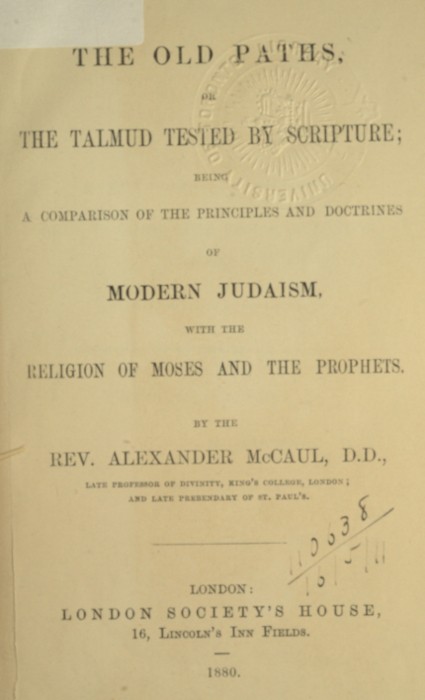
The old paths, or the Talmud tested by Scripture / Being a comparison of the principles and doctrines of modern Judaism with the religion of Moses and the prophets
Explore more books like this:
About This Book
The author assembles essays that compare rabbinic tradition and the Talmud with the religion of Moses and the prophets, arguing that many rabbinic practices and doctrines depart from Scripture. He examines ritual laws and observances such as hand-washing, Passover regulations, and the Purim festival, and critiques legal and social provisions affecting women, slaves, and non-Jews. The collection traces the origins and effects of oral traditions, challenges claims of unquestioning rabbinic authority, and calls for renewed adherence to biblical principles while noting contemporary debates and reforming tendencies within Jewish communities.