
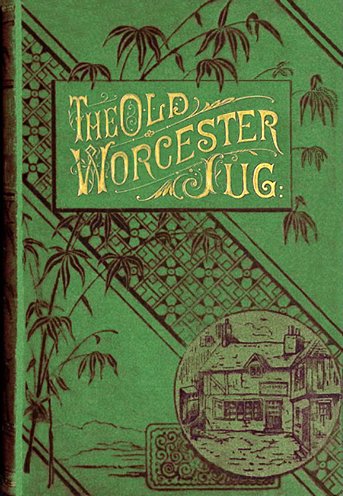
The Project Gutenberg eBook of The old Worcester jug
Title: The old Worcester jug
or, John Griffin's little maid
Author: Eglanton Thorne
Release date: March 12, 2025 [eBook #75600]
Language: English
Original publication: London: The Religious Tract Society, 1882
Transcriber's note: Unusual and inconsistent spelling is as printed.
THE JUG SOLD.
THE
OLD WORCESTER JUG;
OR,
JOHN GRIFFIN'S LITTLE MAID.
BY
EGLANTON THORNE
AUTHOR OF "IT'S ALL REAL TRUE," "AS MANY AS TOUCHED HIM."
THE RELIGIOUS TRACT SOCIETY
56, PATERNOSTER ROW; 65, ST. PAUL'S CHURCHYARD;
AND 164, PICCADILLY.
CONTENTS.
CHAPTER.
III. MAGGIE'S SECOND VISIT TO THE OLD CURIOSITY SHOP
V. MAUD PLATTEN AND LESLIE THORNTON
VI. HOW JOHN GRIFFIN KEPT HIS VOW
VIII. MAUD PLATTEN VISITS THE SHOP
X. MAGGIE GOES TO THE DOCTOR'S HOUSE
XI. COLONEL PLATTEN RECEIVES A STRANGE REQUEST
XIII. OLD GRIFFIN FALLS ASLEEP
THE
OLD WORCESTER JUG
CHAPTER I.
A Good Bargain.
MIDWAY in a long lane of houses, running east and west between Plymouth and Stonehouse, stood, some years ago, a small whitewashed house with bright green shutters and bright green door. It was hardly more than a cottage in size. The houses opposite were far larger, but the smaller dwelling had the advantage in respectability of appearance. It claimed attention, too, by the announcement painted in large letters over the door: JOHN GRIFFIN'S OLD CURIOSITY SHOP.
The house stood a little back from the lane, and a narrow flagged path led to the door. There was no shop frontage, but the window was filled with specimens of almost every variety of china and glass ware, and both shutters bore the words:
JOHN GRIFFIN,
Dealer in British and Foreign China
ALL KINDS OF OLD CHINA BOUGHT, SOLD, OR GIVEN
IN EXCHANGE.
REPAIRS NEATLY EXECUTED
Small as the shop was, it was perhaps the most important of all in the lane. This fact, however, did not reflect great credit on its owner, since most of the shops in that dingy thoroughfare were pawnbrokers', or second-hand stores of one kind or another, with a disproportionately large number of public-houses. But John Griffin's shop had peculiarities of its own, and his circumstances were certainly superior to those of his neighbours.
Although the lane had a bad character, being the resort of the most degraded characters of the two towns to which it belonged, so that few persons of the gentler classes passed that way, unless drawn there by business or charitable intent, it sometimes happened that a carriage drove up to John Griffin's door; and on rare occasions ladies had been seen to pass in and out the narrow doorway, drawing their skirts closely round them as they stepped through with an air of fastidious caution.
To any one possessed by the china mania, "THE OLD CURIOSITY SHOP" offered many attractions. Packed into its limited space were varieties of almost every china ware. The dealer prided himself on his thorough knowledge of his business. He was also a connoisseur of the fragile and costly articles, in which he did a not inconsiderable trade. No trouble was too great for him to take, in order to increase his knowledge or add to his store of curiosities. He would often walk a long distance merely to look upon a rare specimen of antique china.
One cold, damp December evening, Griffin was in his shop, examining some cracked cups and saucers and a venerable teapot, which he had that day purchased at a sale. The place dignified by the name of shop was only the front room of the house. It was scarcely fourteen feet square; but the quantity of goods it contained exceeded all expectation. Not an inch of space was wasted. To enter required the utmost caution, so narrow was the passage left between piles of most brittle ware, and tables and chests loaded with all sorts of curiosities.
The upper part of the walls to the edge of the low ceiling was hung with plates and dishes. Some of these were brown and cracked, colourless and common in appearance; others were prettily painted with landscapes, flowers, or figures. Many of the ugliest and shabbiest articles seemed to have gained places of high honour, showing that in respect to valuable china, it is not wise to judge by looks.
John Griffin did not deal exclusively in china. Standing against the back wall, and well-laden with goods, were three carved oak cabinets, richly-coloured by age; old pictures and quaintly wrought mirrors leaned against them; clocks of ancient form stood on the mantel-shelf; second-hand books lay in piles on the floor, and even a few broken-ribbed umbrellas were stowed away behind the door. The shop always seemed to be in the most hopeless muddle; but there was method in the confusion, and Griffin himself had never any difficulty in finding the article he wanted.
The china-dealer was by no means the terrible personage his name might suggest. He was a short, square-set man, about sixty years of age, with a large head, well covered by curly grey hair, keen grey eyes, made the keener by the round, thick-rimmed spectacles he wore, and the earnest intent expression of a man whose aims in life have all set into one narrow channel. He did not look unamiable this evening as he stood in his shop talking to himself, as was his habit. He had just taken a large, well-thumbed book from a drawer close at hand, and was comparing a mark that his quick eyes had discovered at the bottom of the cup, with one printed on the page before him.
"I thought so," he said, in a tone of triumph; "this is real old Dresden, and no mistake. Pity there should be that chip; but a little china clay and a touch of the brush will soon set that right, and few people will be the wiser. I didn't throw my money away when I bought that."
He gave a low chuckle of satisfaction at the thought. Just then he became conscious of a faint, somewhat hesitating knock at the door.
"Who's there?" asked Griffin; and as there was no response, he put down the cup, went to the door and opened it.
A woman stood in the narrow passage, with a little girl by her side.
"Do you buy old china?" she inquired.
"Yes, I buy it, ma'am, if it's worth buying," he replied, looking wonderingly at her.
She was a tall, slight woman, with pale, emaciated face, lit up by glittering dark eyes. She wore a thin black shawl, and a widow's bonnet, which was at the last degree of shabbiness. Evidently she was very poor, yet Griffin instinctively addressed her as he was wont to address his lady customers. Miserable as she looked, her pure refined speech, and the grace of her manner at once told him that she was a lady. Griffin's dealings with gentlefolks had taught him to distinguish between a real lady and a "would-be-fine" one.
"I have some china here, which I wish to dispose of," said the lady, taking from her child a large bag, which she seemed to carry with difficulty, though she was better able to support its weight than her mother.
"Very good, ma'am; please to walk inside, and I'll look at it," said the dealer; "only be careful how you move, if you please, or your skirts may do a mischief."
The lady advanced a few steps into the room, whilst the child lingered in the doorway, looking on with large dark eyes, preternaturally anxious and shrewd.
"This, I believe, is a Lowestoft bowl," said the widow, taking from the bag a small bowl of pale blue china, embellished with flowers of a darker blue.
"They calls them Lowestoft, but they're really Oriental," said Griffin, carelessly taking the bowl, and tapping it with his knuckles as if to test its soundness. "This ain't real Lowestoft china. You can see it in the book, if you like to look. I get a plenty of bowls like this: they're no great rarity."
"Then you would not be inclined to buy it," said the lady, laying her trembling hand on the table for support.
"I don't say I won't buy it," he returned, in his peculiar, nasal drawl; "but I couldn't give you more than five shillings for it."
"Only five shillings!" said the lady, heaving a deep sigh.
"I couldn't do more, ma'am, it wouldn't pay me," he said; "but you've some other things in your bag; let me see."
The white, wasted hand drew out a plate of pretty blue and gold ware.
"I have three others like this I could bring you, if you would care to buy them," she said.
Pretty though it was, the plate had clearly no attraction for the dealer. His lips emitted a faint sound of contempt at the sight of it.
"No, no, it wouldn't be worth my while to buy that," he said, decidedly, "it's scarce ten year old, and quite a common sort of china. I don't make no account of that. I'd give it to my wife to do what she liked with."
John Griffin could not more strongly depreciate a piece of china than by saying that he would give it to his wife, since he was careful to guard from her touch everything which he esteemed as valuable.
The lady looked discouraged. With reluctance she drew from her bag the last article it contained.
"This I know to be old," she said; "and I have heard my—I have been told that it is of considerable value."
It was a curious old-fashioned jug. The dealer knew its worth better than she did. Though he took it from her with an air of indifference, its appearance excited his warmest interest. He examined the jug carefully.
It was of rare old Worcester ware, and quaintly moulded. Its colour was pale yellow. The rim and handle were wreathed with roses and poppies; whilst butterflies, bees, and beetles were painted below at equal intervals. The spout was shaped to form the head of a man with long, pointed beard, and remarkably red cheeks and lips.
But the chief beauty of the jug was seen in the three exquisite little pictures of country life which adorned its wider circumference. One picture showed some cows in a meadow, and two pretty milkmaids, coquettishly dressed, about to bear away the milk. One girl had her bucket safely poised on her head, whilst her companion was in the act of receiving her burden from the hands of an obliging young man, with long, flowing locks. In the next picture, there was but one milkmaid, who leaned idly against a tree, stool in hand, and empty pails beside her, listening to the talk of a swain who stood near, dressed in the most fanciful of rural costumes; whilst the cows lay on the grass, lazily chewing the cud, and apparently content to await the milkmaid's pleasure. The third picture represented the milkmaid engaged in milking one of the reddest of cows, whilst her swain, resting beneath the tree, charmed her ear with the notes of his flute.
John Griffin did not notice all these details, however. He cast one rapid glance at the pictures, and then began searching with eyes and hands for crack or flaw. None was to be found. The jug was perfect, and a mark well-known to Griffin proved it to be genuine old Worcester. But the dealer was too clever at making bargains to declare unguardedly how valuable he thought it. He meant to get possession of it; but it would not do to show eagerness.
"It is good of its kind," he said, when he had made his hasty examination. "May I ask what price you've heard put upon it?"
"Oh, I cannot tell," said the lady; "I never thought I should have to sell the jug; for it is an old family possession, which I would not willingly part with. But of course I want to get a good price for it. It is very handsome, I think."
"Oh, it's pretty enough in its way," said the dealer, in a tone of depreciation. "But prettiness ain't everything. You see that jug there, mum," pointing to a plain-looking specimen of no particular colour, and with no beauty of form—"I daresay you wouldn't think it, for it's not what you would call a pretty jug, but I expect to get nine guineas for that jug."
"Indeed!" said the lady, in a faint tone of surprise. "How is that?"
"Plymouth, mum, real old Plymouth, marked so as any one can see,— I don't know where I could find its equal," said the dealer, in a tone of enthusiasm.
"But what sort of jug is mine, and what would you give me for it?" asked the widow, anxious to get her business over.
"It's Worcester, mum; and as it's without a crack, I can give you fifteen shillings for it."
"Only fifteen shillings!" she said; in a tone of disappointment, for his mention of the price of the other jug had made her think that he could not offer her less than a pound for this, and she had hoped he would say more.
"Fifteen shillings, and five for the bowl; and if you like to bring me the other plates I'll give you twenty-two shillings and sixpence for the lot. I'll take them to oblige you, for it's not my custom to buy such common china."
"Thank you," said the widow, after a moment's hesitation; "I agree to it."
Griffin put his hand in his pocket, and drew out a leathern bag, from which he extracted a sovereign and half-a-crown, and handed them to the lady.
"Shall I take all this now?" she said. "Will you pay for the plates before you get them?"
"It's no difference, mum," said the old dealer, "bring me the plates whenever you like: I know what it is to deal with ladies."
"You are very good," said the lady, faintly; "my little girl shall bring them to you to-morrow morning. We are living close by."
Till now Griffin had hardly been aware of the presence of the child, who stood still as a little statue in the doorway; but at these words he turned his gaze on her. He was conscious of a strange inward thrill as he met the full deep glance of her large brown eyes, which looked the larger for the tears that stood in them.
They would come—those tears—in spite of her resolve to be a good girl and not mind parting with the jug, which seemed like a part of her little life, for she could not remember the time when she had not loved to look at the pictures upon it, and hear her mother tell stories about the pretty cows and prettier milkmaids.
The child looked very different from the children Griffin was accustomed to see playing in the lane. Her face was small and pretty, though the sad, anxious look it now wore was not such, happily, as is often seen on children's faces. Her dress was threadbare, but perfectly clean and neat, and there was a delicacy and refinement in her bearing only rendered the more striking by her shabby clothing.
John Griffin noted all this as he looked upon her, and the child's unusual demeanour made him uncomfortable, for it seemed to him that her large dark eyes had power to read his thoughts, and she divined that he was taking an unfair advantage of her mother's ignorance. Griffin had a strange sense of being found out as he looked away from the child.
Yet he had never before thought it wrong to drive as good a bargain as he could. Since he began his trade it had been his endeavour to buy as cheaply as possible, in order to sell again at the highest price. It was absurd that this child's open, innocent gaze should make him feel as if he had done a mean action.
"Come, Maggie," said the child's mother, giving her the bag, "we must be going."
But as she turned to go, a violent fit of coughing seized the poor woman. So severe was the attack, that she staggered back against the wall of the passage, faint and panting for breath.
"Oh, mamma," cried little Maggie, running to her, and taking her hand; then turning to the dealer, she fixed on him a distressed, beseeching glance.
"I'll get you some water; it's dreadful, a cough like that," said old Griffin, with an alacrity strange to him where china was not concerned.
"No, thank you; I am better now," said the widow, slowly recovering breath; "it's nothing, I'm used to it."
"Poor mamma is so ill," said Maggie, addressing the old man with the easy confidence of childhood; "and she has eaten nothing to-day."
"Hush, Maggie!" interrupted her mother, in a sharp, quick tone. "Come along. Good night."
As she spoke she passed out into the cold, dark night. A delicate woman should not have been abroad on such a night. The keen wind which blew in at the open door made even old Griffin shiver.
"Who ever was that coughing so?" asked his wife, looking out of the inner room as he closed the door.
"A poor lady that came to sell some china," he replied.
"She must be very ill. I can't bear to hear a cough like that; it's what I call a churchyard cough," remarked Mrs. Griffin. "Did you buy any of the china?"
"Yes, I did; and a nice bit I've got too," returned her husband.
"What is it?" asked his wife, coming to the door of the shop.
Mrs. Griffin felt little interest in old china save as a means of making money. To her taste modern china seemed far preferable to most of the old cracked ware which her husband took such pains to mend and preserve. But the jug which Griffin was now holding up to view struck her as being a nice purchase.
"Why, that's a real pretty jug now!" she exclaimed. "What may you have given for that?"
"Fifteen shillings," he replied.
"And what do you expect to sell it for?"
"I hope I may make five guineas by it," he said.
"You don't mean it! Come now, that is a good bargain," she exclaimed, in a tone of delight; "and what about that bowl, did you buy that too?"
"Oh, that isn't good for much," he said; "and I bought that plate too, and three others that are to come. I don't know what made me buy them, for they're poor stuff."
"The plate is very pretty, I think," said Mrs. Griffin, examining it. "When are the others coming?"
"The child is to bring them to-morrow morning," said her husband, rather absently.
"What child? You surely haven't paid for them before you've got them?" she said.
"Yes, I have," he returned; "and you need not look as if you thought me foolish. She was a real lady. It'll be all right, I know; but if not, I sha'n't lose anything."
"Well, I only hope you'll get the plates," said his wife, in a tone expressive of strong doubt, as she retreated down the passage; "but anyhow, as you say, you'll have made a good bargain."
But John Griffin had ceased to feel pleased with his bargain, although the more closely he examined the jug the more he admired its perfections. As he turned it round in his hands he found himself actually wishing he had given more for it. It was little Maggie's influence which made him feel thus. He was haunted by the memory of her mute, appealing glance of childish sorrow. Nor could he forget the simple words she had uttered. Why had her mother eaten nothing that day? Was it because she had not had the money to procure food till she had sold her china? He felt uneasy at the thought that he had taken advantage of—he would not say cheated—a poor lady reduced to such straits.
CHAPTER II.
A Sudden Parting.
LEAVING the old curiosity shop, the pale-faced widow and her child passed slowly up the lane. Maggie held her mother's hand, not for her own protection, but in order that she might guide the invalid's feeble steps, which faltered from time to time as her strength threatened to give way.
"Was that a good old man, mamma?" she asked, as they went along.
"I hope so, dear. I trust he has dealt fairly with me, for I can ill afford to be cheated out of a single penny," said her mother, with a weary sigh.
"What will he do with the jug, mamma?" said Maggie.
"He will sell it, I suppose," her mother replied.
"And will he give you the money, mamma?" asked the child.
The simple question brought a faint, sad smile to the widow's face, as she answered, "Oh no, dear; he has given me all the money I shall get for it."
"Has he given you a lot of money, mamma?" asked Maggie. "Will you be able to buy cakes and jam again?"
Her mother shook her head. "Ah no, my poor child," she said, sadly. "I cannot give you cakes and jam. If only we can get bread for the next week or two, till I am strong again, we may be thankful. God grant I may soon be fit for work!"
Little Maggie looked disappointed. She had hoped that the happier days she had known when she was younger were about to return, but she held up her head, and said bravely: "I don't mind much, mamma. I can do without jam; and God will take care of us, won't He, mamma?"
"Bless you, my little comfort," said her mother, wondering if any other child of eight would have borne want so well. "Yes, I must trust in God. He has never failed me yet. He is far kinder than man. But oh, my heart is very heavy to-night."
They went on slowly till they came to a baker's shop, which they entered, much to Maggie's satisfaction, for the talk about jam had made her painfully conscious of a craving for food. The widow gave her child one of the large brown rolls which lay on the counter, and then asked for some milk.
"We don't sell milk," said the woman in charge of the shop. Then, touched by her customer's look of suffering, and the sad little face of the child, she added, "But I have a little I can give you, if you like."
Maggie was eyeing the roll with hungry eagerness; but ere she began to eat it, she said, pleadingly, "You will have some, mamma, won't you?"
"Yes, dear child," said her mother, "I will try to eat for your sake." And she broke off a piece of the roll, and dipping it into the milk the woman had brought, she put it to her lips. But she could only swallow a few morsels.
"You look very bad," said the shopwoman, meaning to be sympathetic; "have you been ill long?"
"Yes, a long time," said the widow, wearily; "but I am better, I am stronger to-day."
When Maggie had eaten the last crumb of her roll, and drained the cup of milk, to her now an unwonted luxury, her mother paid for their repast out of the money she had received from the china-dealer, and rising from the chair on which she had sunk exhausted on entering the shop, prepared to go on her way. The rest and refreshment seemed to have revived her somewhat. She was able to walk more quickly and steadily as they went out of the shop.
"Are we going home now, mamma?" asked the child.
"No, not yet," said her mother; and she walked on in the same direction as before.
They approached the end of the lane, where it widened out into a more respectable street. The shops here were gaily lighted, especially those where sweets and toys were sold, at which Maggie looked with a child's interested gaze, keeping close to her mother's side the while, in spite of the jostling she got from hurrying passers-by.
Presently they turned into a narrow, quiet street, which brought them out into a wider thoroughfare, where there were tram-cars and omnibuses passing to and fro, and larger, grander shops attracted the little girl's attention. They crossed this bustling street, and left its turmoil behind as they began to ascend a wide road, almost deserted at this hour. The wind now blew full in their faces. A scent of the sea came with it.
"Are you taking me to see the waves, mamma?" asked Maggie, remembering that she had come that way once before, and had then been gladdened by a sight of the beautiful waves breaking on the rocks beneath the Hoe.
Her mother replied by a shake of the head. She had no breath to spare for speech. It was all she could do to struggle against the strong breeze as she made her way up the hill. Yet Maggie, catching sight of her mother's face as they passed beneath a lamp, wondered to see how bright her eyes were, and how flushed her cheeks. Her mother must be much better, she thought, to be able to walk so far, after having been for weeks too ill to leave the house.
They had nearly gained the top of the hill, when the widow's steps slackened, and she stood still before a large house with many windows looking down on the road. The house seemed alive at this hour. Every window was lighted; and in the lower rooms the venetian blinds were half turned, revealing many figures flitting to and fro in the large, well-decorated rooms. As the widow stood on the pavement, panting for breath, and grasping the railings for support, a strain of merry music floated out on the night air.
A low moan of anguish broke from her at the sound. She had meant to knock at that closed door, and ask to speak with the master of the house. But how could she intrude now, when he was entertaining company? Besides, there might be some there who would know her, though surely the sorrows of the last few years must have aged her beyond all recognition. Her heart sank within her. It had cost her much to come there to-night, but for her child's sake she had nerved herself to the effort. And now it was in vain. Her courage failed her. She could not seek an interview to-night; and to-morrow it might be too late!
She shivered and moaned again.
"Mamma! mamma! what is the matter?" cried the child by her side. "Are you ill? Why do you stand here so long?"
Her mother did not reply. She was hardly conscious that the child spoke. Her mind was in the past; she was thinking of other days when she too had danced within those walls to the very tune that was now being played. Yes, she had once danced there, as lightly and gaily as any girl there to-night; but what a change had come! The contrast was too bitter.
"Mamma," said little Maggie, "won't you go home? It's very cold standing here."
The mother, heedless of her own bodily sensations, became aware of the bitter wind that was sweeping round the childish form, so ill-clad for such weather. She took the tiny hand upheld to her, and turned to go; but a fit of coughing arrested her. Again she leaned against the palings, weak and trembling, and struggled for breath.
"My good woman, with such a cough as that you have no business to be out to-night," said a voice near her as she began to recover from the paroxysm.
The speaker was a young gentleman in greatcoat and scarf, one of the guests invited to the party, who had paused for a moment, with his hand on the gate, to give the warning which his medical instincts prompted.
"Thank you: I am going home," said the sufferer, hurriedly, and taking her child's hand she passed on.
The light of the street lamp fell on her as she went by; and as the young doctor's observant glance read her face, he murmured to himself, "Past all help now, poor thing!"
She was dimly conscious of that truth at times, though for Maggie's sake she still clung to the hope of getting better. For how could she bear to think of leaving the child? What would become of Maggie, if at her tender age she were left alone in this pitiless world? The thought had weighed on the mother's heart through nights of wakefulness and pain.
As she felt her weakness increasing, her fears for Maggie grew stronger, till at last pride yielded, and she had resolved that for her child's sake she would make one more appeal to the parent who had vowed that he would never forgive her. This was the purpose that had brought her out to-night; but she had failed to accomplish it. No matter; she would not give way to despair, faint and discouraged though she felt. She would come again to-morrow. For Maggie's sake she would make another attempt, whatever it might cost her.
It was hard work to get home. The excitement which had sustained her as she ascended the hill was gone now, and the despairing reaction made her tremblingly aware of failing strength. More than once she was obliged to stand still whilst the cough shook her feeble frame; but at length they reached the lane again. Here the widow's staggering gait attracted attention. Rough girls and lads, mistaking its cause, jeered at her as she passed.
She, poor soul, was scarce conscious of their mockery; but little Maggie, young as she was, understood the meaning of their derisive looks and coarse pleasantry. The child's cheeks burned with indignation, and hot tears came into her dark eyes. The memory of the intense pain and shame of those moments was branded on her mind. She never forgot that walk through the lane.
But at last they had passed the old curiosity shop, and gained the turning into the quieter street where they lodged. A few steps brought them to the house in which the widow had hired a room. They had reached it not a moment too soon, for as she crossed its threshold, the invalid was seized with a fit of coughing worse than any which had preceded it. She leaned against the door, coughing violently.
Suddenly the sound ceased, and Maggie uttered a cry of horror, for her mother had fallen back against the wall deadly pale, and blood was flowing in a stream from her mouth.
Maggie's shrill cry brought the landlady and many of the lodgers to the spot. There followed a scene of confusion and dismay. No one knew what should be done. Everybody seemed to ask questions, which no one answered. They dragged the now senseless woman into the nearest room; and after some delay, one of the neighbours went in search of a doctor.
"She's struck with death, I reckon," said the landlady, a slatternly-looking woman, whose unhealthy countenance revealed but too plainly her liking for the gin-bottle; "it was ill-luck my taking her for a lodger."
Maggie heard her words. Already the fear that this was death had come to her. She had seen her father die, and now she knew that her mother too was going from her. With a loud and bitter cry, she threw herself on the ground beside her dying parent.
The despairing cry of her child seemed to penetrate the stupor in which the sufferer lay. Her heavy eyelids were lifted for a moment, and her dying gaze fell on her child.
"Maggie," she gasped out in broken utterance; "the house—you'll not forget—your grandfather."
The last word died away unheard as the deadly faintness stole over her anew.
"What's she saying?" asked one of the women.
"Something about the House," said the landlady; "she knows that's where the child will have to go to, for she's got no one belonging to her, I fancy."
No other words passed the white lips. The eyes closed again, the pallor of the face increased.
Maggie held her mother's hand, but the cold, stiff fingers could not respond to the child's clinging touch—mother love could shield her no longer. When, a little later, the doctor entered, impatiently pushing aside the women, who pressing round the patient kept back the air which was so precious, he found that his services were not needed. Death had been before him, and had given everlasting release from pain and sorrow.
CHAPTER III.
Maggie's Second Visit to the
Old Curiosity Shop.
ON the following day the china-dealer looked in vain for the plates which the widow had promised to send him. On the morrow, too, they were not forthcoming, and it vexed him to have to own the fact to his wife, when she asked about them.
"Oh, you'll not get them now," she said, in a tone of undoubted assurance.
"Oh, I don't give them up yet," replied the dealer; "maybe the lady's ill, or something else has happened to prevent her sending them before."
"Well, I shall be very much surprised, if they come," returned his wife, provokingly.
Griffin did not in the least care about having the plates. He was satisfied to have secured the old Worcester jug. But he did desire to have it proved that his strange customer was what he had judged her to be—a real lady, who would deal honourably with him. When we are interested in persons, and inclined to think highly of them, it is painful to discover that they are not all we have imagined them.
Griffin was none the less disposed to resent the widow's betrayal of his trust because he was conscious that he had not acted fairly by her. We are always ready to claim that others shall regulate their actions towards us by the golden rule, however often we ourselves may have failed to do unto others as we would they should do unto us.
As the hours of the second day passed, and the plates did not appear, Griffin felt himself to be an injured man. He grew so cross and irritable that his wife wondered what could ail him. Surely he must have something more on his mind than the absence of those plates. But watching him with wifely anxiety, she soon saw that his irritability arose from a physical rather than a mental cause. She feared that the cold, which he had caught two days before by getting wet through, and then standing in his wet clothes during the course of a long sale, had laid sharp hold on him. Mrs. Griffin soon knew that her fear was not unfounded. In a few hours her husband became so ill that he was obliged to go to bed; and in bed he lay for many days, smitten with an acute attack of inflammation of the lungs.
Great was Mrs. Griffin's distress when the doctor told her that her husband was dangerously ill. She was a small, slight, sickly-looking woman, with the expression of one inclined to take a dark view of human affairs. Such had indeed come to be the habitual attitude of her mind. There was much excuse for her melancholy, poor woman. Constant ill-health, and the bitterest grief and disappointment a woman can know, had made her the soured-looking mortal she was. She had had seven children, and not one of them had lived. Most of them had passed away in infancy ere they had learned to call her mother; but one—a pretty, delicate little girl—had struggled through her infantile ailments, and lived for nine years the darling of her home, only to fall a victim to scarlet fever, just as the parents hoped that she was beginning to grow strong and healthy.
It was a sore grief to Griffin and his wife when the little one was taken away. Griffin got over it in time as men do, by losing thought of his trouble in the absorbing interest of his daily pursuits. As his trade grew, he gradually ceased to miss the sound of little feet moving so lightly amidst his treasures, and the accents of the soft voice which had called him father. He forgot his little daughter, and gave more and more of his heart to his rare old china and costly curiosities.
But the wound in the mother's heart had never healed. Though twenty years had passed since her child died, the memory of little Polly was fresh as ever to her. She could still recall the sweet tones of her darling's voice, and fancy she heard again the patter of the restless feet which used to trot to and fro in the old house. The sight of a child brought her an aching sense of loss. In night visions she saw again the little face that she loved, and often would she murmur in her sleep the name of the child. As growing years added to her weakness the infirmities of age, making the burden of life heavier, Mrs. Griffin felt a deeper and deeper yearning for a child's love and aid.
Never had she felt her desolation more keenly than now, when she saw her husband laid low by alarming illness, and the thought thrust itself on her, that he would be taken first, and she left alone in the world. Her heart sank within her at the first hint of danger. It was easy for her to believe the worst. Her hopes had always been disappointed.
Mrs. Griffin made a sorry attempt to hide her distress from her husband. She did not want to frighten him; but he knew his wife's nature too well to be deceived by her assumption of cheerfulness. He knew that her smiles were forced, for what could be more mournful than her gaze as it rested upon him? Whilst her eyelids were red, and she sighed each time that she turned away from the bedside. He tried to cheer her.
"Don't ee take on, old wife," he said, speaking with difficulty, "I'm not going to die just yet. I shall be up and about again in a few days."
"I hope you may be, John, I'm sure," said his wife, lugubriously.
And, unable to keep back her tears; she slipped out of the room and went downstairs, where she could indulge her emotion without restraint. The deserted look of the shop and the little room behind, where lay Griffin's cement pot, his tools, and the piece of china he had been trying to mend when the attack of pain came on, gave fresh intensity to her grief. Sitting down on the first chair, Mrs. Griffin covered her face with her apron and sobbed aloud.
She had been crying thus for some minutes when she became aware of a dull, monotonous sound, which seemed as if it might have been going on for a considerable time. She raised her head and listened. Some one was tapping on the door of the shop. Hurriedly wiping her eyes with her apron, Mrs. Griffin went out to attend to the customer.
A little girl stood just within the shop, a slight, delicate-looking child, whose pale face and large dark eyes had a scared, nervous look. She was holding something carefully rolled up in her little apron. She started and almost dropped what she held as Mrs. Griffin came quietly upon her.
"What do you want, my dear?" asked the woman, noting with admiration the child's long dark eyelashes, and the pretty rings of hair, which hung over her white forehead.
"I want to see the old man who keeps the shop," said the child, tremulously; "I have brought him the plates mamma said he should have."
"All right, my dear, I know; I will take them for him," said Mrs. Griffin, taking the plates, which the child very reluctantly gave to her.
"Can't I see him?" asked Maggie.
"No, my dear, you can't, for he's in bed; he is very bad," said the wife, looking almost as if she expected sympathy from the child, who gazed at her with such grave, sad eyes; "but I'm his wife, and I'll take care of the plates for him. Have you anything else!" For she saw that the child still held something rolled up in her apron.
"Yes, they're mamma's books," said the child, in a tone of deep sadness; "I wanted to ask him to keep them for me. Mamma said he was a good old man, and I don't want Mrs. Cook to get them."
"Are you living at Mrs. Cook's?" asked Mrs. Griffin, wondering more and more at the child's strange appearance and manner.
Maggie nodded.
"And your mamma, is not she with you?"
"Mamma is dead!" said Maggie, dropping her voice to a whisper. "She died on Monday night, and I've no one belonging to me now, and they say I must go to the workhouse."
Large tears had gathered in the child's eyes; but, with a self-control far beyond her years, she checked the sobs that strove to rise.
"Your mother dead! Oh, my poor dear!" cried Mrs. Griffin, her motherly sympathies stirred into new life. "On Monday night, did you say? Why wasn't that the evening she was here, and brought the jug? Are you sure it was Monday night?"
"Oh yes; it was when we got home," said the child, beginning to sob as she read the kindness and pity in Mrs. Griffin's glance.
"Then 'twas very sudden?" said Mrs. Griffin.
"Yes, she broke a blood-vessel, the doctor said," replied Maggie.
"Poor soul, no wonder with such a cough," sighed Mrs. Griffin; "I remember it made me shudder to hear it, and I asked my man who it was coughing so. Dear, dear! And so she died that very night! How sad, to be sure!" And Mrs. Griffin sighed again as she thought what the mother's anguish must have been at the prospect of leaving this sweet child alone in the world.
"What is your name, my dear?" she asked, putting her arm lovingly around the child.
"Maggie," was the reply.
"Maggie what?" asked Mrs. Griffin.
"Maggie Knight," said the child.
"And have you really no one belonging to you?"
"No one," said the child; "and Mrs. Cook says I must go to the House. What is the House like? Will they be kind to me there?"
"Not very; and it's a dreary place," said Mrs. Griffin; "I would not like any child I cared for to go there."
"Mrs. Cook says that before mamma died she said I was to go to the House," said little Maggie, on whose face the look of distress had deepened.
"Did she? Then it must have been a sore grief to her, poor soul," said Mrs. Griffin, feelingly; "but there's my man knocking for me; I must go. I declare if I hadn't forgotten him for the moment."
"Will you take the books?" said Maggie, unrolling her apron, and showing a Bible and prayer-book, whose handsome bindings and gilt clasps bore signs of age and wear. "They were mamma's, they were all she had left; she sold the others; but she would not sell these because her mother gave them to her. Mrs. Cook has taken all the rest of our things to pay for the rent. She says the money mamma got for the jug won't half pay her for the expense and trouble she's had. I hid these and the plates where she could not find them, for I knew mamma had promised the old man the plates, and I thought he looked kind and good, and perhaps would take care of the books for me, for I was afraid they would not let me take them to the workhouse."