
The Project Gutenberg eBook of The omnipotent self, a study in self-deception and self-cure
Title: The omnipotent self, a study in self-deception and self-cure
Author: Paul Bousfield
Release date: October 8, 2021 [eBook #66496]
Most recently updated: October 18, 2024
Language: English
Credits: Turgut Dincer, Martin Pettit and the Online Distributed Proofreading Team at https://www.pgdp.net (This file was produced from images generously made available by The Internet Archive)
Transcriber’s Note:
Obvious typographic errors have been corrected.
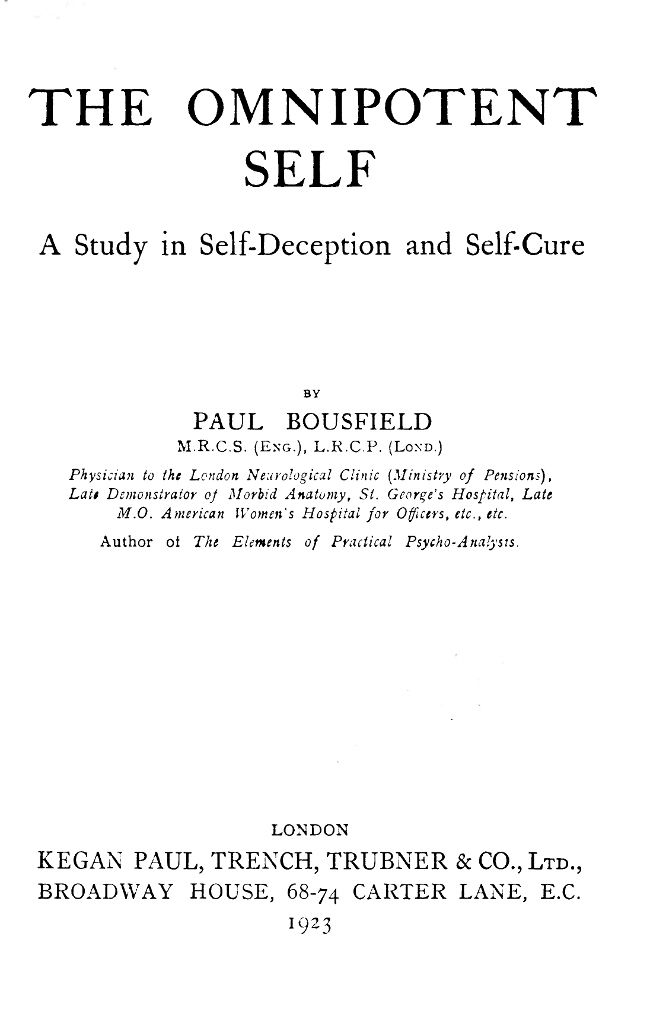
THE OMNIPOTENT SELF
THE OMNIPOTENT
SELF
A Study in Self-Deception and Self-Cure
BY
PAUL BOUSFIELD
M.R.C.S. (Eng.), L.R.C.P. (Lond.)
Physician to the London Neurological Clinic (Ministry of Pensions),
Late Demonstrator of Morbid Anatomy, St. George’s Hospital, Late
M.O. American Women’s Hospital for Officers, etc., etc.
Author of The Elements of Practical Psycho-Analysis.
LONDON
KEGAN PAUL, TRENCH, TRUBNER & CO., Ltd.,
BROADWAY HOUSE, 68-74 CARTER LANE, E.C.
1923
PRINTED IN GREAT BRITAIN BY THE DEVONSHIRE PRESS, TORQUAY.
PREFACE
“Nature has granted to all to be happy if we but knew how to use her gifts.”—Claudius.
Many people, while not considering themselves as suffering from any nervous ailment, nor desiring the services of a physician, are yet far from being perfectly happy in their mental outlook and temperament. Either their feelings are too easily roused, or they are inclined to worry, to be depressed, irritable, nervous, or over-sensitive. Trifles which to them seem no trifles interfere with the smooth course of their daily lives, or this slight abnormality may manifest itself in an over-sensitiveness to physical pain or to mental or moral difficulties and conflicts. It is with the hope of helping a few such individuals to a better understanding of themselves, and through this to a more equable temperament and greater happiness, that this little book is written.
There is no hard and fast line between the normal and the abnormal person, and indeed a very real difficulty exists in even defining a normal person. If we take our definition of normal as being “average or conforming to type or standard,” then the majority of people are normal. If, on the other hand, we take its other meaning, that of “performing the proper functions,” then there are few people approaching the normal under modern civilized conditions. A tendency to undue irritability or depression is a mild and very common form of abnormality. Hysterias, obsessions, and unreasonable fears are greater abnormalities, and fortunately of less frequent occurrence, while certain forms of insanity are still greater deviations from the normal. A similar combination of causes, however, may form the basis of all these abnormalities, and these various deviations from the normal are more of degree than of kind. But whereas in cases of obsessions and unreasonable fears or in such other abnormalities as homo-sexuality or sexual impotence, etc., the causes are deeply hidden and the forces at work somewhat complicated, in the lesser abnormalities there are causes frequently lying less deeply.
In the case of obsessions, phobias, hysterias, sexual abnormalities, and so forth, we can only hope to effect an improvement by a thorough analysis of the unconscious causes and conflicts by a competent psycho-analyst. In the lesser troubles of the mind, however, considerable improvement can often be effected by means of a somewhat superficial self-analysis. This will be directed towards investigating one in particular of the primary causes which play an important part in all the minor unpleasant temperamental faults.
In order to teach the patient to help himself, it will first of all be necessary to enlighten him to a considerable extent as to the general evolution of his character; at any rate in as far as one important mental complex known as “Narcissism” is concerned. In doing this, many other mental complexes will have to be superficially touched upon; but in order to simplify the work for the uninitiated, they will not be specifically named when they appear; for, although this would make the work more technically accurate, it would, at the same time, make it less clear, and in a book of this type this would be very undesirable. The first object I have in mind is that the work shall be lucid, concise, and readily understood by any person of ordinary education, so that he may gain an insight into the essential causes and growth of some of his abnormal characteristics without undue complication of ideas. It is further hoped that this small work may be of some assistance in suggesting to parents a few of the many things to be avoided in the early training of the child.
PAUL BOUSFIELD
7, Harley Street, W.
CONTENTS
| PART I: THE OMNIPOTENT SELF | ||
| CHAP. | PAGE | |
| I | The Unconscious Mind | 3 |
| II | Repression | 19 |
| III | The Forces Shaping Character | 27 |
| IV | Determinism and Will Power | 41 |
| V | Narcissism | 49 |
| VI | Fact and Phantasy | 64 |
| VII | Identification | 74 |
| VIII | The Irritable Temperament | 87 |
| IX | Rationalization | 98 |
| PART II: PRACTICAL APPLICATIONS | ||
| X | Self Analysis | 111 |
| XI | Readjustment of Objectives | 121 |
| XII | Readjustment of Thought | 138 |
| XIII | Auto-Suggestion | 157 |
| XIV | Conclusion | 165 |
PART I
THE OMNIPOTENT SELF
CHAPTER I THE UNCONSCIOUS MIND
§1
In considering the question of character, with its various irregularities and idiosyncracies, we shall have to accustom ourselves to dealing with factors which do not exist in consciousness at all. Strange as it may seem to the uninitiated, many of our thoughts, ideas, and motives are quite outside our normal consciousness, and of them only the resulting emotions and actions appear on the surface. This may be taken as an absolute and indisputable fact, and one which the reader should try to appreciate at the outset, although it is somewhat difficult to realise, for we always find it hard to apprehend and understand something which we can neither see nor touch.
If one were to tell the ordinary labourer that water is composed of two gases which when combined form a liquid, he would probably be quite incredulous, and possibly in his ignorance might even deny emphatically any such possibility, on the grounds that it was against all common-sense and experience; he failing to realise, of course, how very limited were both his sense and his experience. In spite of his feelings of absolute certainty, and in spite of complete faith in the unshakable logic behind his belief, he would be wrong.
While it is not to be expected that many readers of this book will deny the existence of the unconscious part of the mind, it may well be that many will fail to realise that it is of more than theoretical value. It therefore becomes necessary for us to examine the matter somewhat carefully, and to familiarise ourselves with the ideas of the working of this unconscious mind.
Without going into the further sub-divisions recognised in psychology, we will confine ourselves to dividing the mind into two parts—the conscious and the unconscious. And of these, at any given moment, the conscious is by far the smaller part. We are actually conscious at any moment of but very few things, such as the book we are reading, the chair we are sitting on, and dimly of our immediate surroundings. A thousand memories which we might conjure up of our childhood and our past are, for the time being, far from consciousness. Yet these matters exist somewhere in the mind, for we are able, if we choose, to search about in it, and bring them into consciousness, even though we may not have thought of them for many years. This leads us at once to a striking fact, namely, that while many things can be remembered at will, others which we feel we ought to remember, cannot be brought to mind at all. It is an extremely common experience to find that one has forgotten a name completely, and that no effort will bring it into consciousness, yet later on, apparently without effort, the name will “come back to us,” as we say. In fact, the very phrase we use—“come back to us”—implies that it has been somewhere away from us, that it has been lodged in some place that is foreign and unknown to us, yet which we are aware is somewhere within us.
It is also common knowledge that a great many events and scenes of considerable importance to us at the time of action are forgotten, and that they can only be recollected if some sort of stimulus or reminder be given. For instance, a person may have forgotten completely where and how he spent a holiday ten years ago. No amount of racking his brain brings anything to light. But having been reminded of a single incident that occurred during that holiday, the whole of the rest may come up from the unconscious in full detail.
There is a third kind of memory more important still, if one may be permitted to call it memory, and that is the memory of facts which no ordinary stimulus of this sort will ever bring up into consciousness again. The term “memory” is used here because we have every reason to believe that somewhere in the unconscious all facts have been registered, and in many cases may be partially brought into consciousness again by suitable means, such for instance, as hypnotism or psycho-analysis, (two very different methods, by the way). Yet, though these impressions have been made on the mind, and though there is this unconscious memory still in existence, in the ordinary course of events we should never again be conscious of them.
We may, however, be very conscious of actions and emotions emanating from the unconscious memory. Thus, suppose that as a child one had lived in the country, and on several very happy occasions a bonfire had been lighted at a picnic, and that later on one lived in a town, and that this picnic which happened at the age of three or four years had become completely forgotten, so much so that even photographs of the scenes or conversations on the subject carried on by other people brought no memory to light and seemed to touch no chord; it would still be quite likely that the mere smell of a bon-fire in the distance or any smell resembling this would be enough to cause a considerable feeling of elation and happiness in the person, a feeling that something pleasant was taking place, an idea that if only one could remember, a pleasant picture could be called up. This is because it is associated in the unconscious mind with these previous happy occasions.
Or again, suppose a child at the age of two or three years has been dropped into a pond and nearly drowned. Although the incident may in later years be completely forgotten, the horror of deep water and all its associations may vividly persist. It seems probable, and a considerable amount of work has been done on this subject in psycho-analysis, that every action, thought, or idea that has ever been registered in the mind, even to some extent before birth, is permanently fixed; and that although much of this cannot be brought into consciousness by present methods, yet all the feelings and emotions, however slight, which attended these thoughts, ideas, and actions are perpetually being called forth by slight stimuli of which we are unaware, and these are playing their part in moulding our thoughts, feelings and actions in the present time.
I had an interesting patient a short time ago who, owing to certain experiences in the war, was suffering from complete loss of memory; so complete that he did not know his own wife nor even his parents. Under hypnosis, the whole of his memory was rapidly brought back; and when it appeared to be normal and both he and his parents were quite confident that it was as good as it had ever been, I suggested that we might try an experiment to see if we could improve it still further. I asked him, amongst other things, if he could voluntarily remember the first time he wore knickerbockers. He had not the faintest recollection of the matter. I then hypnotised him, and told him to give me the details. He described the knickerbockers minutely, the number of buttons on them, the fact that he wore them on his third birthday, that his father had given him a penny, and told him that “now he was a little man, he must have money in his pocket,” together with a very large number of other details. I enquired of his father and mother and sisters, and they corroborated the details in every particular.
I have tried several similar experiments with him and with one or two other patients under hypnosis with considerable success, and have even tried to take them back to the memory of their own birth. They have frequently produced many memories of events that occurred before the age of one year, but previous to that could only give reproductions of movements and pleasant and unpleasant emotions. Whether these latter are memories or not one has unfortunately no means of proving. But the fact that under hypnosis both educated and uneducated people alike exhibit extremely similar ideas as to types of movements, expressions, and feelings at the various stages of their very early life, inclines one to think that these reproductions may be memories. One has, however, to beware of the fact that observation and knowledge acquired in later periods of their lives might be the real factor underlying their apparent reproductions. Further evidence of a different nature will be given on this point, however, at a later stage in the book.
§2
So far, we have shown that there is an unconscious part of the mind which acts as a store-house for memories, ideas, and emotions of the past. We have not, however, shown that it is anything more than a store-house. But if we look into it from other points of view, we shall see that it is a great deal more than a mere store-house, for it thinks, reasons, comes to conclusions, and in fact assists in controlling our acts at every turn; indeed this unconscious part of our mind wields driving forces of the utmost potency in moulding our lives.
Let us examine first the reasoning faculty of the unconscious mind.
Maeder gives a good example of this. A house-surgeon at a hospital wished particularly to keep a certain appointment, but he was not allowed to leave the hospital until his chief, who was out, should return later in the evening. As his appointment was of considerable importance, he decided to brave the anger of his chief. He therefore kept his appointment, but when he returned later, he found to his astonishment that he had left a light in his room, a thing he had never done before, although he had occupied that room for two years. He thought the matter over, and soon realised why he had done this. The chief, on going to his own house, would pass the window and would see the light burning within, and imagine that his house-surgeon was at home. The unconscious mind had rapidly reasoned this out and had determined that the conscious mind should forget to turn off the light.
Another illustration of the persistent way in which the unconscious mind will reason and act can be given from my own experience. I had to attend a lecture given by a man, with whose views I totally disagreed. I had no wish to attend the lecture, but felt compelled to do so in an official capacity. Consciously, I determined to go; unconsciously when I made the note of the lecture, I wrote down the time of it in my engagement-book a week late. On discovering this, I consciously endeavoured to rectify the matter, but my unconscious mind wrote Tuesday instead of Thursday in my engagement-book, so it went down wrong once again. Later, having been forced to see my mistake by a friend mentioning the matter, I omitted for a short time to rectify it in my engagement-book, feeling sure that I should remember to do so a little later. But alas! for the determination of my conscious mind. I forthwith made an appointment for a patient at the real time appointed for the lecture, and so could not in the end attend it. Now, these lectures were held regularly on a particular day of the week, and I had generally looked forward to them, and attended them without any difficulty. It was only in this one case that I did not wish to go. My conscious mind decided to attend; but my unconscious mind played trick after trick in order that my real desires should be satisfied. Such examples could be multiplied indefinitely. It is possible that many would say that they do not actually prove unconscious reasoning nor power of thought. Let me, therefore, give one or two simple examples of a different nature.
A friend of mine once told me that he had spent several days in trying to work out a chess problem without success. One morning, he woke up with a picture in his mind of the exact moves that he must make. The problem had been solved in his sleep unconsciously, and with no recollection on waking of any conscious effort at reaching the solution.
In my own experience, as a school-boy, I failed to solve a problem in Euclid during an examination. On the morning afterwards, the solution flashed through my brain suddenly, as I lay in bed. Whether I had solved it in my sleep, or whether it was solved in bed as I lay awake, I am not prepared to say. Of this much, however, I am certain. I made no conscious effort; my mind merely wandered lazily in the direction of the previous day’s failure, and almost instantaneously the right solution appeared without effort.
Let us now take another example of work which the unconscious mind is called upon to perform; an example which we are accustomed to view without question or thought, which is comparatively commonplace, and which we dismiss summarily by referring to it as “habit.” The accomplished pianist reads the music in front of him consciously, but he is not conscious of the extremely rapid translation which takes place from the brain to the fingers, so as to produce complicated movements on the key-board. And if we examine it carefully, we shall find that something very wonderful has actually taken place outside his consciousness. When he was first learning to play, he looked at the note on his music, and said to himself “That is C.” He looked at the key on the piano, and repeated “That is C.” He was taught that a particular finger must be placed on that particular note when playing in a certain key. He was taught that it had to be hit in a particular way and held down for a particular time, according to the size and shape of the note he was reading on the sheet of music in front of him. He was further taught that in order to modify any sound in a particular manner, he could use his feet on one or other of the pedals, and must be extremely careful to put his feet down and lift his feet up again at exactly the right moment. He was taught that when certain symbols, known as sharps and flats, preceded the notes at the beginning of his piece of music, the whole scheme of fingering would be different. And, at first, he had laboriously to go through the process of watching first the music and then the key-board, and of thinking at each point what he should do with his fingers and with his feet, and how he should do it, and for what period he should keep on doing it. Now, the whole process is gone through with half-a-million notes which he has never seen before, many of them played simultaneously, and with an exactitude which he never attained when he was consciously thinking. Whatever may be the nature of the unconscious action which is taking place, all he has in consciousness is the music in front of him, and the final sound that he is producing, together with the emotions which these called forth in him as a result of the whole.
Can there be any doubt left that a complicated unconscious process of the same kind is taking place?
Or again, let us examine our own personal likes and dislikes. Frequently one can assign no reason whatsoever for these. They may exist, in fact, against what we call our better judgment. We may love a person in spite of certain faults, or dislike him in spite of his virtues. If the matter be examined further, however, we not infrequently find the reasons for our emotions towards him. Either his manner, dress, or tone of voice, or some other trivial feature may resemble someone we have liked before, or on the contrary, some mannerism may call to mind a similar mannerism which we associate either in ourselves or in some other person, with unpleasant characteristics. Our unconscious mind has rapidly sized up all these points, appraised them, and presented our conscious mind with the resulting emotions alone.
So-called intuition is, to a large extent, merely rapid unconscious reasoning, in which minute details are taken into consideration by the unconscious, and only the final opinion presented to consciousness. One should beware of trusting intuition too much, however, in spite of popular prejudice to the contrary, for unconscious reasoning is just as liable to be wrong in its conclusions as is conscious reasoning; and it is just as liable to reach the conclusion which best serves its immediate purpose, and to suppress truth where it is unpleasant.[1]
Some psychologists think that the unconscious mind is infallible in purely deductive reasoning from the premises from which it starts. But it provides its own premises from a secret store and also accepts any suggested premises which are not repugnant. The premises may therefore be wrong but the deductive reasoning is accurate. In this case the conclusions will only be wrong because the premises are wrong.
FOOTNOTE:
[1] Unconscious reasoning or intuition is found chiefly in those who have not been trained in subjects which induce and train logical conscious reasoning. It is not a prerogative of sex, but on the whole is found more amongst women, merely because of their method of training from childhood upwards. In children and savages intuition is found equally present in both sexes. The loss of intuition merely means that the training of the conscious mind has caused us to mistrust conclusions for which we cannot consciously see the reasons.
CHAPTER II REPRESSION
§1
One other faculty of the unconscious mind requires special mention, and that is its power of obliterating memories from the conscious mind, or as it is better termed, of repressing, since this word not only implies pushing out of consciousness, but also preventing from coming into consciousness. It is found that all persons have formed a regular habit of forgetting or partially forgetting, (and so disguising), things which are unpleasant to them. This especially refers to those things which are unpleasant to their self-respect, their moral beliefs and ideas, and their general pride in themselves. The primitive immoralities and thoughts and actions of early childhood which would now offend their æsthetic and moral susceptibilities, are, more or less, completely put out of sight, together with a host of unpleasant ideas and thoughts which have cropped up from childhood onwards. Indeed, there is a general tendency for anything of an unpleasant nature to be pushed out of sight.
Darwin, in his autobiography, states, “I had, during many years, followed a golden rule, namely that whenever a published fact, a new observation or thought came across me, which was opposed to my general results, to make a memorandum of it without fail, and at once, for I had found by experience that such facts and thoughts were far more apt to escape from the memory than favourable ones.”
We had a further example in the case of the house-surgeon who “forgot” to put out his light, and examples are extremely common in everyday life. We forget to post letters entrusted to us against our will, but we do not forget to post our own love-letters. We mislay bills very readily, but rarely do we mislay a cheque.
Amongst my patients suffering from shell-shock, I have had very many hundreds who have completely forgotten some of the most unpleasant and terrifying experiences which occurred to them out at the front. Others unconsciously had found the easiest method of dealing with the unpleasant past to be that of blotting the whole of it out, dissociating it completely from their conscious mind, and then stating that they remembered nothing of their lives until they woke up in hospital. It is not only memories, however, which are repressed and remain dormant in the unconscious mind. Most of our primitive instincts handed on from our savage forefathers before even the evolution of man in his present form, lie similarly buried in this unconscious part of the mind, and we are wont to deny emphatically that we possess these unpleasant instincts. Nevertheless, just as in utero we repeat more or less in detail the history of our physical evolution, so do we at that period and in childhood repeat to a great extent the history of our psychic evolution; and just as during this early period we possess the physical attributes of many of our ancestors, such as the gills of the fish or the tail of the lower vertebrates, so psychically do we at a somewhat later period, possess the instincts and desires of our progenitors, and utilise them as the hidden foundation stones in building our adult mental constitution. These various primitive instincts include all kinds of desires which would consciously be regarded as sexual perversions and moral crimes of different kinds, and they are present in all of us without exception. Our upbringing and conscious outlook upon them, however, causes them to be so abhorrent to us, that we successfully keep the majority of such ideas and feelings from ever coming out of the unconscious in their primitive form. In other words, we repress them. Occasionally, however, there is a tendency for these ancestral instincts to become conscious, and in our further efforts to prevent this we may develop instead hysterias, obsessions and unreasonable fears, together with many other nervous and abnormal signs and symptoms, into the nature of which it is not my intention to inquire further in this present volume. Those who are interested in pursuing this line of investigation will find an elementary account of it in a previous work of mine, “The Elements of Practical Psycho-Analysis.” All that I wish to emphasise here is that we do push out from the conscious mind unpleasant thoughts and memories, that we do repress and keep in the unconscious mind unpleasant desires and instincts, and that we do, as a result of this, have many unconscious or semi-conscious conflicts within ourselves, which may lead to unpleasant feelings of depression, irritability, fear, or in more pronounced cases hysterias, obsessions, and even permanent mental derangement.
§2
A further and somewhat important result of our possessing so much which is unconscious and of having so many feelings and ideas in consciousness of which we do not know the origin, or of whose origins we have but the vaguest and haziest notion is known as rationalization. This word signifies that we find reasons for doing or believing things which are of a pleasant nature and agreeable to us, and vice versa.
Following on this rationalisation comes also a certain conservatism, which tends to retard progress of any sort, which dislikes looking at new ideas, and this for a very obvious reason. Looking at new ideas, examining ourselves or our work very closely, has a tendency to bring to light, from time to time, the very primitive instincts and feelings which we have been at so much pains to repress. And rather than submit to the indignity of discovering how really imperfect we are, and having our pride in our divinely constituted natures shaken, we have acquired a habit of denying and fighting strenuously against discovering truths connected with either our moral or physical evolution which would be unpleasant to us. In the light of our upbringing, such new truths are often unpleasant, therefore we rationalise that they must be untrue. For having been educated to venerate logic and reason, we can only be satisfied with any given conclusion we come to when we feel that it is justifiable in the light of logic and reason. But the logic of rationalisation is false logic.
For many years, scientific and popular thought denied strenuously the possibility of the now universally accepted theory of human evolution; and on scientific grounds it was urged, with much plausible reasoning, that it was not possible to develop a high type like man from any low form of animal. On religious grounds it was argued equally passionately that if evolution were true, the Bible was wrong, God disappeared, and therefore the theory of evolution was untrue. The real reasons lying behind those reasons advanced by both the scientist and the general public, however, were not the reasons so carefully thought out by them, but consisted largely in the fact that they did not wish to find that the body, which they had hitherto thought a special and divine creation partaking of the miraculous, to be merely a stage in the evolution of life on this planet, and possibly not a final stage at that. For in that case, no longer would man be able to flatter himself that he was almost divine, he would have to relegate himself to the possibility of being in a stage of semi-barbarism; he would no longer be a final perfect product, but merely a half-finished article. It was this blow to his pride that he could not stand. And it is the same to-day. Whenever there is a likelihood that examination, particularly through research work, has thrown light on his psychic evolution, on the imperfections of his moral laws, or on the crudity of some conventional custom, the process which takes place in him is much the same.
Firstly, dislike of the idea. Secondly, on further examination of it, hatred of the idea. Thirdly, rationalisation directed against the idea. Fourthly, contentment, in that he has proved by logic and reason that the idea is wrong. Hence, it is that the truth takes long to emerge, and that obsessions and hysterias, and even trivial abnormalities are difficult to cure, for the cure involves seeing our own imperfections naked and undisguised.
In all these cases, we are trying to keep out of consciousness those things which will distress us or cause us to have conflicts, or to have to readjust our views of ourselves, or in fact cause us unpleasantness in any form. It will be noticed that I have mentioned pride in the belief that we have reached a condition of final development, and in our superiority over the rest of nature, as being one of the important factors in preventing our advance. It is to the development of this pride, and its ramifications that I am devoting the major portion of this book.
CHAPTER III THE FORCES SHAPING CHARACTER
It will be seen from the foregoing that evolution of the individual character may be the result of a very large number of forces at work, of which many are quite unconscious; and that any considerable disturbance or variation of the unconscious factors will considerably modify the character of the individual, in spite of conscious desires in some other direction. The character of an individual is the sum of his thoughts, ideas, capacities, desires, feelings and actions, and the general forces moulding it may be briefly summarised as follows:
1. The primitive instincts inherited from his ancestors, and held back in the unconscious mind.
2. Environment and education.
3. That pride in his own greatness, to which we referred in the last chapter, which modifies all the other forces at work, according to the direction of its development. This force will henceforth be called by the name of Narcissism, for a reason shortly to be explained.
§2
Of the inherited instincts we have already said as much as is necessary here. It suffices for us to recognise that they are for the most part of a primitive erotic type, and that they are so repressed and modified as to be unrecognisable in the normal adult. When they have been ineffectually converted by environment and education, we have present the basis of many neurotic and functional conditions, and this again is a matter which is outside the scope of the present work.
§3
Environment and education are extremely comprehensive terms as used in psychology. Environment does not merely refer to the home with its visible surroundings, nor does education merely refer to the scholastic side of it. Environment and education include the treatment of the child by the nurse during the first week of life; for instance, whether she leaves it alone when it cries, or whether she soothes it and rocks it to sleep again. A trivial fact, the reader will think, especially in the first week of the child’s life, yet experience shows us that this environment and education of the first week is an extremely important factor in its after-life. The thousand little actions, the trivial chance words of anger or contempt, not merely of the parent but of strangers or of other children, all make their impressions on the infantile unconscious mind. They all belong, in the strictest sense, to what we term its environment and education. Any stimulus, in fact, however small, which is capable of reaching the brain forms part of this environment and education which is reacting on the child. Psychologists are now generally of the opinion that the essential elements of the individual character have all been definitely formed by the age of five, and that, important as training in successive years may be, the environment and education during those first five years are more important still.
It is the object of education and environment to modify and utilise the force of the primitive instincts with which the child comes into the world in the best possible way.
Three things may happen to any particular instinct. Firstly, it may remain unchanged and unrepressed, in which case the individual will be said, on reaching adult life, to be perverted in some way. Let us take as an example that instinct which exists in some animals, and which urges them at the mating season to exhibit their genital organs to their fellows of the opposite sex, with the perfectly natural and proper end in view of propagating the species. We occasionally find adult human beings in whom this instinct has remained unchanged and uncontrolled, and they generally find their way, sooner or later, into prison. The psychological term for the offence they commit is “exhibitionism.” In the small child, however, we have often seen this instinct at work, without regarding it as objectionable in any way. We have laughed at the little child who delights in running about naked, or asks us to come and see it being bathed, or on occasion calls even more obvious attention to its state of nakedness. It is quite unconscious of the primitive instinct which it is displaying, and since it is a child and cannot in any way fulfil the sexual objects of the instinct, we pass the matter over, without further thought.
Secondly, our primitive instincts may be displaced, and the displacement must be such as to conceal them from our conscious thoughts, in order that they may be tolerated by the conscious mind. For instance, the normal adult will not be guilty of exhibiting his nakedness in the way above referred to, nor will he display desires of sexual exhibitionism in a conscious manner. But he, or more frequently she, will displace these ideas, and will only call attention to the sex of her body indirectly by exhibiting the neck or arms, or more indirectly still through the medium of clothes, designed to suggest, (for the most part unconsciously) erotic ideas.
Thirdly, a much higher state may be reached by some people in which the primitive instinct has now lost entirely its erotic meaning, instead of being merely disguised and displaced as in the last case. The force and energy of it has all gone from the personal physical plane to serve a useful social purpose of a non-sexual nature. This is known as sublimation, and instead of the desire of our exhibitionist to show himself or herself physically, the person may attain the desire by showing a fine character, by designing a fine building, achieving some high position, or anything in fact of an ideal or non-erotic nature.
Exactly the same process takes place in the opposite of exhibitionism, which in its primitive form we term observationism. “Peeping Tom” is a celebrated example of this. We have a displacement of observationism in the fairly average young man, who likes to observe all that he can of the charms of every woman he comes into contact with, who takes an eager interest in her shoulders, breasts, underclothing, and any part she may exhibit. And we have the third or sublimated stage in the scientist, who has turned most of his primitive sexual instinct of “looking” in the sexual sense into looking down the microscope, or searching for the secrets of Nature, and delving amidst her hidden laws, instead of using the same primitive desire to look in an unsublimated and rather more infantile manner.
It is exactly the same with a large number of other primitive instincts, which even did I mention them here would not be grasped or understood at all by many without very much further explanation. Suffice it to say, that many of our higher activities and desires are sublimations of lower and more primitive instincts, which we are learning to develop and control; and that education and environment have, as their object, the training of the child by turning the forces at work in his primitive instincts through the stage of displacement into the final one of sublimation.
It should be clearly grasped that the energy lying behind our primitive instincts, whether it be repressed, displaced or sublimated, is a very real force, comparable with the physical energy which we are accustomed to deal with in everyday life. And this energy must find some outlet for its discharge. Thus,[2]“We know as regards physical energy that there are not several kinds of energy, but merely several manifestations of it, and that it may be changed from one form of manifestation to another, but that still the sum total of the original energy remains without addition or loss.”
Thus there is a given amount of energy stored in a ton of coal. This energy can manifest itself as heat in the furnace and boiler. By means of an engine we can change the manifestation into that of motion, then with a dynamo to electricity; the electricity we can again change into light, or back again into heat or motion. There is one energy, but by suitable means we can turn it to different uses, and give different manifestations of it. Owing, however, to the imperfection of the boiler, machinery, etc., we never transform the whole of our energy into another form. In transforming heat into electricity, there is always some heat wasted; it is not destroyed, but it remains as heat for a time, and is absorbed by surrounding objects. A complete transference of energy does not take place, and the less efficient the machinery the less is the transference.
Now evidence tends to show a considerable similarity between psychic and physical energy. In all probability there is only one ultimate psychic energy which, like physical energy, can be directed into different channels. Thus, the energy of erotic desire can be directed to a large extent into the energy of desire for music, religion, science, or sport; or the energy of the desire for sport may be changed into the energy of the desire for mental exercise, such as chess, mathematics, or science. For example, an individual feels “restless,” he then desires to play tennis; the afternoon is wet: he plays chess instead. His psychic energy has been diverted from one channel into another with its accompanying excitement and satisfaction of desire: with its final feeling of fatigue and repletion.
Psychic energy, like physical energy, can never be entirely diverted from one channel to another. There is always some, often a large quantity, which is not altered in character. The amount of this depends largely on the person concerned, just as the amount of physical energy, changed from one form to another depends on the efficiency of the engine or machinery.
This possibility of transference of energy of desire from one form to another is of the utmost importance to the psycho-analyst. By the technique of psycho-analysis the energy of repressed desires is first freed from deleterious objectives, and then transferred to legitimate ones. The energy behind the conflicts which lead to alcoholism or drug-taking may, under suitable conditions, be transferred to energy of higher types of desire with more suitable outlets. These processes are known as transference and sublimation respectively.
It may be taken that every mind has a given amount of psychic energy which must find somewhere its suitable outlet in satisfying desire, whether for accomplishment or for enjoyment.
We may here again take the opportunity of stating that the efficiency or lack of efficiency demonstrated in different individuals in their attempts to transfer the energy of desire from a lower to a higher channel depends not only on heredity and constitutional circumstances but to an extraordinary degree on the individual’s environment and the actions of the parents in the first three or four years of his life. The reason why seemingly excellent parents produce sometimes execrable progeny becomes clearer under psycho-analysis. The over-strict parent produces one type of inefficient children, the parent who spoils produces other inefficient types. The nurse, the nursery, the casual visitor, the trivial conversations, the unconsidered sights and experiences, all have a terrific influence in the first few years of the child’s life. Parents do not realise that conventional or arbitrary methods of education, whether in one direction or another, are not going to effect the results they expected. The primitive unconscious mind of the child understands and absorbs in a manner that civilised man does not recognise. The bad father may by accident or neglect produce an excellent child—the good father with all his designs may produce a bad one. This is not an attempt to show that as the child grows up all its actions are dependent on the early environment; merely that we can never compare the good or bad in individuals; that an apparent failure, owing to his inefficiency of powers of sublimation, may yet be devoting more energy to ascent than the successful saint whose early environment made for efficient transference of energy of desire. Some of the commonest of errors made by well-meaning parents will come to light at a later period. “They teach their children to repress erotic and other desires but they omit at the same time to assist the development of that sublimation of them which is absolutely essential.”
§4
We now come to the third great factor in character formation, and as this particular factor is going to occupy the major portion of this book, I will not do more here than indicate briefly the symbolic meaning of the term Narcissism; the reason why this term is used in connection with our primitive feelings of pride will then gradually unfold itself.
Narcissus was the son of the river god, Cephissus. In his mother’s eyes he was extremely beautiful, and later in the eyes of all others, including himself. It was his wont to walk abroad in solitary places lost in admiration of the graceful form which he thought no eyes worthy to behold, save his own. On one occasion, he wanted to drink from a cool spring and catching sight of his face in the water for the first time in his life, at once fell in love with it, not knowing it to be his own likeness. On his knees at the edge of the pool, he stretched himself, and looked down upon a face and form so entrancingly beautiful, that he was ready to leap into the water beside it.
“Who art thou, who hast been made so fair?” cried Narcissus. And the lips of the image moved, yet there came no answer. He stretched out his hand towards it, and the beautiful form beckoned to him. But when his hand touched and broke the surface, it vanished like a dream, only to return in all its enchantment when he was content to gaze motionless, even then, again, growing dim beneath the tears of vexation he shed into the water. Repeatedly, he tried to gather the lovely image in his arms, but it always eluded him, but when he entreated and implored, it imitated his gestures with unfeeling silence.
Maddened by the strong allurement of his own likeness, he could not tear himself away from the mirror which ever mocked his fancy. Hour after hour, day after day, he leant over the pool’s brink, crying in vain for that imaginary object of adoration. But at last from despair his heart ceased to throb, and he lay still among the water-lilies that made his shroud.
* * * * * * *
Before proceeding further and examining the development of Narcissism, and those factors which come to preserve it, and make it forceful in our unconscious mind, we must first briefly consider the subject of determinism.
FOOTNOTE:
[2] “Elements of Practical Psycho-Analysis,” by Paul Bousfield.
CHAPTER IV DETERMINISM AND WILL POWER
Determinism is the doctrine that all things, including the will, are determined by causes. It is the antithesis of the doctrine of free will. In its complete form, it holds that the individual has no direct and voluntary control over his thoughts and actions but that every thought and action is inevitably the result of a large number of previous thoughts and actions which have gone before.
There is a very large amount of evidence, and indeed, whether we admit it or not, the evidence is quite irrefutable, that in regard to the majority of our actions the doctrine of determinism holds good. But the evidence is by no means sufficient to enable us to conclude that we have no free will.
[3]Freud in his book on the “Psychopathology of Everyday Life” and in other works gives many convincing examples that much in our character, that many of our actions, evil and good, are quite beyond our control at any given moment. But there is one thing that appears to have been overlooked, and that is, that in all the examples given one could not conceivably utilise free will in any case. If I ask you to think of a number what opportunity do you get of using your will power? If you put the wrong latch-key into the door by accident, have you made any effort to use will power? When a patient is suffering from hysteria due to repressions of various kinds, in that particular matter the will power has already been lost. When a chronic alcoholic is unable to cease from drinking his will power in reference to this has disappeared, therefore determinism holds the field completely. The will has no opportunity of working then. In all the examples which Freud gives one discovers on careful investigation that for some reason or another there is no opportunity for the use of free will. Such evidence as we have certainly does not prove the nonexistence of free will, but merely shows that in a very large number of our thoughts and actions we do not use any will at all, and that in other cases we are unable to use our will effectively.[4] When determinism does rule we may liken it physically to this: a patient sits down and crosses one leg over the other and leaves the one leg hanging free. On tapping it smartly beneath the patella the foot will kick; the knee jerk has been elicited. If this be done fifty times the result will be the same fifty times. There is movement of the leg, but this movement is predetermined. On the other hand this does not prove that no other movement of the leg is possible. Under the conditions just given the man’s will, or the freedom of the leg, is merely eliminated during that period. Or again, we may liken it to a locomotive standing at the top of a hill; if the brake be taken off, the locomotive will run down the hill, and will do it every time; but this will not prove that did somebody happen to put the brake on half-way down the hill the engine would still go on running. However, all actions which we may ascribe to our will are no doubt strictly limited by other determined conditions. The man on the engine may run it backwards or forwards, but only within the very much prescribed limits which the rails allow. We may safely accept this much determinism, that although the will exists, its capabilities are strictly circumscribed by determinism.
It is rather in his general direction than in any specific act that a man has most control. We certainly have not the amount of free will which we like to believe we have. For example, the reader of this chapter may have returned home to-night and have said, “I will not have a meal to-night, it is too hot.” What are the factors (or determinants, as they are called) in this case? Perhaps external heat, producing langour by various physiological processes, combined with lack of appetite, in its turn produced by several causes, and added to this, depression, produced by a bad business deal, and in its turn the result of many other determinants outside the reader’s control. There is no desire to eat, and these various determinants, added together, prove stronger than the habit of eating the evening meal. Having, however, read this chapter as far as this point, the reader desiring to disprove my unpleasant suggestion, immediately says, “Ah! I will prove that I have free will. I will eat my meal in spite of not wanting it.”
Alas! this does not prove free will, new determinants have merely been added on the other side, and desire to prove strength of mind has now out-weighed accumulated efforts which prevented you from eating.
Since it has been shown that a man’s control is constantly being limited by other determinants, it follows that the criminal whose environment and determinants, conscious and unconscious, have been manufactured for him from evil sources, yet who, on the whole, is progressing upwards in spite of these, may be forming a far better character than the arch-bishop whose environment from the beginning has been such as never to give him criminal characteristics, yet whose growth has been, on the whole, towards a more selfish position, even though this be not noticeable to the eyes of others.
Now many of the determinants forming our characters lie in the unconscious. They are unknown to us and only the results of their activities are visible. Herein lies the difficulty of controlling ourselves. How can we efficiently control that of which we do not know the existence? Herein, also, lies the value of psycho-analysis, for it brings many of these determinants to light, and we are thus able to control them consciously. Only a part of all this can be accomplished by such self-analysis as may be indicated in this book. Yet even so, a much greater degree of self-control may be obtained.
§2
Let us now consider briefly why persons who have not previously been irritable, should suddenly become irritable; who have not previously been hysterical, should suddenly become hysterical; who have not previously been in the habit of weeping, should at some time after reaching adult life, revert to that infantile habit.
The explanation of mental troubles of various kinds involves two factors. In the first place, any individual is capable of bearing a certain amount of conflict and a certain amount of repression. It is only when the accumulated force is more than he can control, that is when new determinants are added, that the symptoms begin to appear. He is like a steam engine in which as long as the steam is being used up in doing work, or as long as the safety valve is working efficiently when work is not being done, the boiler stands a pressure of 100lbs. very comfortably. If the safety valve gets jammed, and the energy cannot be transferred from the steam to the work, the pressure in the boiler rises higher and higher until it bursts from the joints and rivet-holes.
The second factor which determines the mode of expression of this out-burst of repressed energy is known as the law of regression. This means that if the adult outlet of energy becomes dammed up or is insufficient, the energy will flow through an earlier channel which has once been used. The individual will, in fact, revert to some method which he was wont to use in earlier years, or in infancy. It is true that this may be disguised and not recognised as an infantile mode of expression until it is looked into more closely. This question of regression, however, need not be more than touched upon here. It will be much more fully dealt with when we come to actual examples at a later stage.
FOOTNOTES:
[3] “The Elements of Practical Psycho-Analysis,” by Paul Bousfield.
[4] The doctrines of determinism and free-will respectively can be brought entirely into line with one another if we include freewill itself as one of the determinants. Thus, if in the formula
S = a + b + c + d + etc.
where S is the resultant action, and a, b, c, d, etc., are the several determinants, it happens that d = 0. The presence of d does not invalidate the formula. But if d does not happen to be zero, the absence of d would invalidate the formula. If d represents the “will” component there may be plenty, even a majority of cases in which d = 0, but there may be cases in which the omission of d will render the result erroneous.