
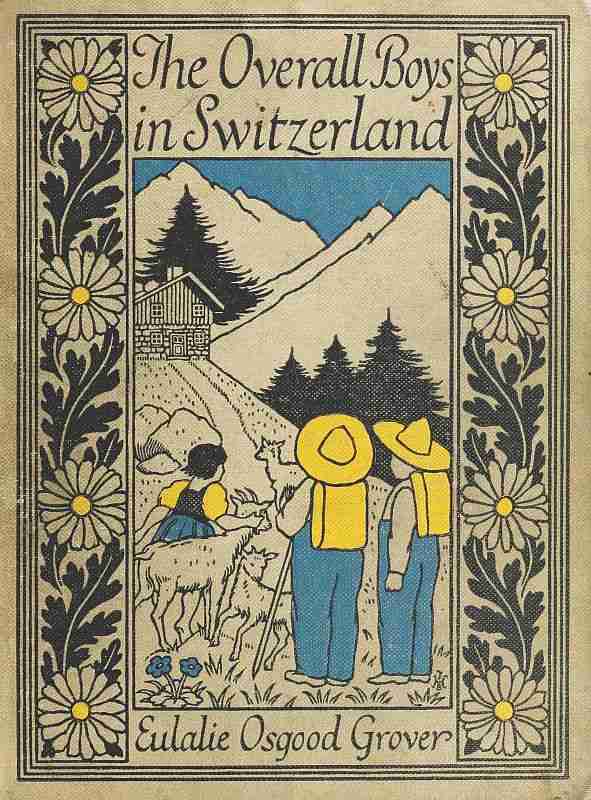
The Project Gutenberg eBook of The Overall Boys in Switzerland
Title: The Overall Boys in Switzerland
Author: Eulalie Osgood Grover
Illustrator: Bertha Corbett Melcher
Release date: March 17, 2014 [eBook #45155]
Most recently updated: October 24, 2024
Language: English
Credits: Produced by Emmy and the Online Distributed Proofreading
Team at http://www.pgdp.net (This file was produced from
images generously made available by The Internet Archive)
SWITZERLAND
The OVERALL BOYS
IN SWITZERLAND
BERTHA CORBETT MELCHER
NEW YORK CHICAGO SAN FRANCISCO
Printed in U. S. A.
Eulalie Osgood Grover
All rights reserved
Entered at Stationers' Hall
| PAGE | |
| Three Cheers for Europe | 9 |
| On the River Rhine | 14 |
| The Bear City | 22 |
| Above the Clouds | 34 |
| On Mount Rigi | 40 |
| Shopping in Lucerne | 50 |
| Saturday Evening on Lake Lucerne | 58 |
| The Birthday Party | 66 |
| William Tell and His Little Son | 78 |
| A Visit To Tell's Country | 88 |
| Over and through the Mountains | 100 |
| Real Trampers | 108 |
| On the Trail | 118 |
| The Herdsman's Cabin | 126 |
| A Summer Blizzard | 136 |
| Exploring a Glacier | 144 |
| Auf Wiedersehen | 150 |
| A Letter | 156 |
| A List of Difficult Words | 159 |
SWITZERLAND
THREE CHEERS FOR EUROPE
It was the first day of summer, and it was the last day of the ocean trip.
Jack and Joe, two Overall Boys, had crossed the big Atlantic. They were now sailing into a strange city, in a strange country, with a strange language.
The city was Antwerp. The country was Belgium, and the language was—well, almost anything one cared to speak, French or German or Dutch or English.
Jack said he should try English first. Then, if people did not understand him, he should use the Dutch words which the Sunbonnet Babies had taught him. But if people did not understand him then, he should have to keep still, or talk with his hands.
"Oh! I shall not keep still," said Joe. "I shall speak everything all at once, French and German and Dutch and English. You just watch me!"
"Ho! ho!" laughed Jack. "We will watch you, and so will all the people in Antwerp. But now watch that great houseboat. I believe it is like the boat Molly and May's Uncle Dirk owns. A family is living on it. They have a canary bird and a dog and a cat and flowers, just as they have on Uncle Dirk's boat."
"I should rather go to Holland than to Switzerland," said Joe. "Let's ask the people on that houseboat to take us up to their Water Land."
"No, sir! I want to go to Switzerland," said Jack. "I want to see the great mountains all covered with snowbanks and forests and flowers. There is not a mountain in the whole of Holland."
"Look!" shouted Joe. "I see the first castle! We are sailing right up beside it. I wonder if a really, truly King and Queen are living in it."
"Of course," said Jack, "unless they have been killed and their castle turned into a prison or a museum."
"Do you suppose it has a dark dungeon under it?" asked Joe. "How I should like to see a real dungeon!"
"Come on, father is calling us," said Jack. "Our boat has stopped. It is time to get off."
"Oh! Perhaps father will take us into that old castle, Jack. Then we can see if it really has a dungeon under it," cried Joe.
So the Overall Boys said good-by to their friends on the ocean steamer. They said good-by to the Captain. They said good-by to the Cook. The Cook and the Captain were their special friends and they were specially sorry to leave them.
But the boys had something very important in their minds.
When the heavy plank was pulled over from the dock to the steamer, the two Overall Boys were the first to step on it. They ran as fast as they could run down the steep plank.
Everybody wondered why those two boys were running so hard. There was plenty of time. No one needed to run. But in a second everybody knew, for Joe was throwing his cap high into the air and shouting, "Hurrah for Europe! Three cheers for Antwerp!" And in half a second more Jack was throwing his cap high into the air and shouting three cheers for Europe, too.
Yes, the Overall Boys were the first in their party to step foot on Europe, and they were the first to give it three cheers.
ON THE RIVER RHINE
The next few days were exciting ones for the Overall Boys.
Joe said he knew that he was dreaming, and his dreams were all about castles and kings and queens and strange languages.
Jack had to tell him very often that he was sailing up the beautiful river Rhine toward Switzerland, that the castles and the kings and the queens and the strange languages were really true.
"I know that the castles are really here," said Joe, "for I am counting them. Look at that great fort on the hill!"
"Yes," said Jack, "the Captain says if we were their enemies, the soldiers in that fort would not let our boat pass up the river."
"Well, I am glad we are not their enemies," said Joe. "I don't like the looks of the big guns peeping through those holes in the fort walls. I like the old castles better."
And so the Overall Boys sailed by castles and still more castles, which were built high on the banks above the river. Most of them were very old, so old they were falling to pieces.
Lower down on the river banks there were large vineyards, where the finest grapes were growing.
Their father told the boys strange stories about the people who once lived in these old castles. He told them about a beautiful sea maiden who used to sit on a high rock above the river combing her long, golden hair and singing sweet songs. He told how brave young men sailed their boats into the dangerous waters to listen to her songs, and were drowned.
Fortunately the maiden did not sing while the Overall Boys were passing her rock, so they went safely on their journey.
A little later Jack cried, "Come, Joe, the Captain is going to tell us a story."
"Is he going to tell it in some dreadful, strange language?" asked Joe.
"No, sir!" said Jack. "This Captain knows how to speak English."
"Hello!" called the Captain. "Do you boys like mice? Both of you do! Well, that is brave. I am going to tell you about a man who did not like mice.
"Do you see that large, round tower just ahead of us? It is built on a rock in the middle of the river. It is called the Mouse Tower. This is the reason why.
"Once upon a time—I cannot tell you just how long ago, but once upon a time—there lived a rich Bishop. He lived in a great castle up there on the river bank. He had fine farms, and he made much money. He filled many barns with his grain, and he kept his gold in strong boxes.
"A great many poor people lived near the rich Bishop. He should have taught them how to work and how to pray, but he did not. He did not even give them grain when they needed it, or gold that they might buy bread.
"One year when the people were very hungry, they begged the Bishop so hard for bread that he could not sleep. He said they were like a pack of hungry mice.
"At last the Bishop told the beggars to go to an empty barn near by, and he would soon satisfy their wants. So the people hurried into the barn, and waited for the Bishop to come. He came, but he did not bring them food or gold.
"Oh, no! The selfish Bishop told his servants to set fire to the old barn, and the poor people who were inside soon stopped crying for food.
"That night while the Bishop was asleep in his castle, he dreamed a strange dream. He dreamed that some hungry mice were eating a fine picture of himself which hung on his bedroom wall. He watched them until they had torn it all to pieces.
"Just then a servant ran into his room and wakened him.
"'O Bishop Hatto! Bishop Hatto!' cried the servant. 'The mice are coming. They are coming out of the hot ashes of the old barn which we burned last night. They have followed me up to your castle. You must run for your life.'
"So the Bishop jumped on his horse and rode down the hill as fast as he could ride, and the mice ran after him. When he came to the river the mice were almost upon him.
"The Bishop left his horse and jumped into a small boat. He rowed very hard until he came to that stone tower in the middle of the river.
"'Now,' said he, 'I am safely away from those miserable mice.'
"But he was not safely away from them, for the mice could swim.
"The Bishop shut himself into the tower and closed the doors and windows. But the mice could gnaw. They ran up the stone walls and gnawed through the wooden doors. Then they ran down the doors on the inside and found the wicked Bishop.
"How the Bishop wished that he had been kind to the poor, starving people. How he wished that he had given them food and gold when they needed it so much. Now it was too late. The hungry people had sent their spirits back in these hungry mice to punish him as he had punished them.
"And so the old stone tower has been called the Mouse Tower, or Bishop Hatto's Tower, ever since. Now, what do you think of that for a story?" asked the Captain.
"I tell you, I hope I never shall be such a mean old Bishop as he was!" said Joe.
"And I am glad he is not living now!" said Jack.
Soon the Overall Boys had sailed as far up the beautiful river Rhine as their big boat would take them. They had seen so many old castles, and they had heard so many strange stories about them, the boys felt as if they had just passed through a really, truly Fairyland—and perhaps they had.
THE BEAR CITY
"Hello, Jack! Hello, Joe!" called the boys' father very early one morning. "Wake up! Wake up and give the bears their breakfast."
"Oh, dear! Where are we?" cried Joe. "I'm so sleepy! Where are the bears? I don't see any."
"I know where we are," said Jack. "We are in the city of Bern, where the bear cave is."
"Good! We are in Switzerland at last," cried Joe, running to the window. "But where is the snow? I thought the mountains in Switzerland were all covered with snow! These mountains are covered with green trees."
"These are not the real mountains, Joe," said Jack. "The great snow-covered mountains are farther away. I guess we shall see them before long. I heard some one say that, on a clear day, the view of the snow-covered Alps from this city is one of the finest in all Switzerland, and that the sunsets here are wonderful. But let's have our breakfast now."
"All right," said Joe. "Then let's be off to hunt for the bears. But why do the people keep bears right in the middle of their city?"
"Father says it is because a bear was killed on this spot just before the city was built," said Jack. "So the people named the city Bern. They have kept a few bears in a large pit here ever since, and that is more than four hundred years."
"Do let's hurry and find their cave!" cried Joe.
So the Overall Boys were soon hurrying through the busy streets of the Bear City. In the middle of many of the streets they saw fine, large fountains. Above the center of some of the fountains were the figures of famous men, while plants and flowers were growing in others.
In a few of the beautiful fountains women were doing their washing. They placed the soiled clothes on boards by the edge of the clear water. Then they soaped the clothes well, and pounded them with flat stones, and rinsed them up and down until they were quite clean.
It was certainly an odd way to do a family washing; at least, so the Overall Boys thought.
There was one fountain which interested the boys more than any of the others. Above the center of this fountain stood the stone figure of a strange looking man, who was holding a stone baby in his hands. He was about to bite the baby's head right off. Other babies were hanging from the ugly man's belt and peeping from his pockets.
It is called the fountain of the Child-eater, and naughty children never like to pass very near it. But the Overall Boys knew that the stone Child-eater could not hurt them, so they laughed at the old fellow and hurried on.
It was not long before the boys were racing across a great stone bridge leading to the deep hole in the ground where the bears lived. Joe reached the pit first.
"Hurrah! I see three of them," he cried, leaning over the high rail above the pit. "See that baby bear beg for something to eat! Go to the fruit stand, Jack, and buy some carrots to feed him. Father says bears like carrots."
So Jack ran to the fruit stand near by and bought a big bunch of carrots. The boys threw the carrots, one at a time, over the wall into the pit, and how they shouted and laughed to see the bears catch and eat them, just like big, brown boys.
Sometimes one bear would catch more than his share of the carrots. Then the other bears would chase him about until they made him climb up a tall tree in the middle of the pit. He did not dare to come down until his bear friends had eaten all they wanted. If he tried to do so, they chased him quickly back again.
"Look!" cried Joe. "I have found an orange in my pocket. I am going to throw it down to the bear that is waving his paw at me. Watch him catch it."
"Watch him!" shouted Jack. "He didn't catch it. The bear near him knocked him over as quick as a wink, and caught the orange himself."
"See, he is climbing up the tree with it! Isn't he a selfish old bear!"
"Look at the bear in the little pond of water," cried Jack. "He is playing ball with the other bear. Now the other bear has jumped into the pond, too. See them box each other's ears! And see them roll over and over in the water! Oh, I never, never saw anything so funny!"
"I believe they are real boys dressed up in bear skins," said Joe. "I never thought bears could act so much like boys."
"Mother says she never thought boys could act so much like bears," said Jack.
The boys watched the bears nearly all the forenoon. Joe said he hadn't laughed so much since his last football game in America. He wished that he could live in Bern always, and feed the bears every morning.
"I'm getting hungry myself," said Jack at last. "Let's buy some gingerbread bears to eat. There is a window full of them over in that store."
Then away the boys ran and bought gingerbread bears of all sizes—father bears and mother bears and little baby bears and dancing bears and stiff soldier bears.
Jack and Joe were sure they had never eaten anything in all their lives so good as those gingerbread bears.
"Come on, now!" cried Jack. "Father has some more fun for us. He wants us to go down the street with him to see a queer old clock tower."
"I know what it is," said Joe. "He told us about it the other day. We can hear the cock crow and see the bears parade, if we are there on time."
"Then let's run!" said Jack. "It is almost twelve o'clock now."
So the boys raced back over the great stone bridge. They raced around corners and under arches and along covered sidewalks, until they came to a low tower which arched right over the sidewalk.
The large round clock near the top of the tower said five minutes before twelve. On the wall below the clock sat a queer little bronze man holding an hourglass in his hand.
At the left of the man stood a bronze cock and at his right a bronze dragon. Suddenly the Overall Boys saw the cock flap his wings and wag his head and cry, "Cock-a-doodle-doo!"
A moment later two bronze giants up in the top of the tower struck the great bell with their hammers twelve times. The cock wagged his head and flapped his wings and again crowed, "Cock-a-doodle-doo!" Then a small clown rang a tiny bell and a procession of bears began marching just below the old man.
Some of the bears carried little guns and swords, and one bear rode on a tiny horse.
When the clock in the top of the tower stopped striking, the procession stopped marching, and the old man turned his hourglass upside down. The dragon wagged his head, and the cock crowed, "Cock-a-doodle-doo!" Then all was still. Yes, it was very still. The Overall Boys were thinking.
At last Joe said, "I wish I could take that clock back to America. I should like to show it to the Sunbonnet Babies. I am sure they didn't see anything half as strange as that in Holland."
"Well, they will have to come to Bern if they want to see it," said Jack. "You can't pack that great tower in your trunk."
"Father is calling us," said Joe. "He says we shall have just time to eat dinner before we must take the train. Where do you suppose we are going next?"
ABOVE THE CLOUDS
"See it pour! And just hear the thunder!" said Joe, looking out of the car window. "It sounds as if giants were rolling rocks down the mountain sides. I hope they will not hit our train."
"Look! The train is stopping," said Jack. "The conductor says we must all get out here and take another train. How can we change while it is pouring so hard!"
The rain was really pouring down so fast that umbrellas were of no use at all. But the Overall Boys ran to the end of the platform and climbed into the high front seat of a queer little car.
It was certainly the strangest car the boys had ever seen. It was built so that one end was much higher than the other end, and people had to go up some steps to get into it.
In a few moments the little train was moving slowly up the steep track.
"Where do you suppose we are going?" cried Joe. "I believe we are climbing right up the side of a mountain. My! How it rains! I guess we are up among the clouds."
"We shall soon be up above the clouds," said Jack. "We are climbing Mount Rigi. We are going to stay all night on the mountain, too."
And so it happened. The train was soon pulled up the steep mountain side until it was above the rain and the wet clouds. The sun was shining brightly up there, but the valleys below were covered with a thick white blanket.
At last the sun and the wind began to carry great pieces of the cloud blanket high into the sky. Through the openings in the clouds, below them the boys could see tiny villages and blue lakes.
And away down below, hanging in the soft white clouds, was a rainbow—all red and orange and yellow and green and blue and violet.
"Look! We are above the rainbow bridge!" cried Joe. "If only I could jump over on it, I could slide right down to the earth again."
"Why, you are on the earth now," said Jack.
"Oh, so I am! But isn't it wonderful up here!"
The boys watched the fluffy clouds blow far away, carrying the lovely rainbow with them. And they watched the great red sun drop down behind the snow-covered mountains in the west.
Suddenly Joe cried, "Those mountains are on fire, Jack! Look! How can they burn when they are all covered with snow?"
"It looks as if the red-hot sun had set the world on fire this time, doesn't it?" cried Jack.
But it hadn't, though the mountains were rosy for a long time after darkness had come in the deep valleys below. The great round moon climbed slowly up the sky, and millions of stars peeped down at the boys.
They had never been so near the stars before. They were almost six thousand feet nearer than they were on the ocean steamer, and six thousand feet are more than a mile.
At last the boys were so tired they went into a small hotel, high on the mountain, and were soon tucked away in two narrow white beds. For a few moments they lay very still, then Joe whispered, "Jack, do you hear those bells tinkling, out on the mountain side?"
And Jack whispered, "Yes, Joe. They are cow bells. You know five thousand cows are pastured on this mountain in the summer time."
"From the sound, I guess they all wear bells, too," said Joe. "Isn't it lovely! The bells make me so sleepy."
ON MOUNT RIGI
So the boys were lulled to sleep by the soft music of the tinkling cow bells. But very early next morning they were wakened by another kind of music. It was the clear call of an alpine horn at four o'clock in the morning.
The horn seemed to say, "Wake up! Wake up and see the beautiful sunrise!"
Although Jack was still half asleep, he shouted back, "All right! We'll be up in a jiffy." And they were.
Everybody hurried out to the mountain top to watch the great sun sail slowly up the sky.
"Look!" cried Joe. "Last night the sun went down behind those mountains over there, but now it is coming up away over here. How did it ever get around here?"
"Oh, you know, Joe!" said Jack. "The sun always sets in the west and rises in the east."
"But how can it go down on one side of the world and come up on the other?" asked Joe.
"Because the earth whirls around every twenty-four hours," said Jack. "In the morning our side of the earth is whirling toward the sun, and in the afternoon we are whirling away from it."
"Oh, dear! Are we whirling now?" cried Joe. "I thought the world was standing still. I thought it was the sun that was going around."
"The sun is going around, Joe, but so are we. Father says that our world is whirling faster right now than the fastest automobile can race," said Jack.
"My!" said Joe. "Is that what makes the wind blow so hard up here? Hold on, or we shall be blown off!"
"Just look at those cows!" shouted Jack. "They are being milked. Let's go and watch."
Then away the boys raced to a group of big, brown cows that were being milked not far away. Great pails full of the rich, creamy milk were carried into a little house near by.
"How good it looks!" said Joe. "Let's ask if they will sell us a drink."
But they did not have to ask, for the old woman who lived in the tiny house saw the boys coming. She knew that they had not had any breakfast, so she filled two tall mugs with warm milk, then she piled a plate with gingerbread cakes, and set before them.
The boys were so hungry they ate two plates full of the gingerbread cakes, and they each drank two tall mugs of the warm milk. They thanked the old woman very kindly, and told her she had given them the best breakfast they had ever eaten.
By this time the sun was quite high in the sky. Large umbrellas were raised over small booths on the mountain top, where men and women were selling picture post cards and all sorts of queer little things—horns and whistles and small carved wooden men and bears.
The boys bought a number of things to take back to America with them, and they bought a dozen or more post cards to send to their friends. The very prettiest of these cards were sent to their own little brothers, Tim and Ted, and to the Sunbonnet Babies.
The boys each bought, also, a fine alpine stock to help them on their long tramps over the mountains.
The first tramp was to be taken that very day. Instead of going down Mount Rigi by train, as they had come up, they were going to walk. They were going to walk away down to the shore of the beautiful lake at the foot of the mountain. It was the large lake of Lucerne, but it looked like only a tiny pond, it was so very far below them. And the busy steamers looked like toy boats sailing on the tiny pond.
"Just think," said Jack, "in a few hours we shall be crossing that very lake in one of those steamers. They don't look large enough to carry people, do they?"
After an early lunch, which was eaten in an outdoor restaurant, they started to walk down the mountain. A part of the way the path was very steep. The boys raced along, for it was easier to run than to walk.
Soon they came to a place where a great mass of rocks had slipped down across the path during the last heavy rain. The boys could see where the rocks had torn up bushes and trees, as they dashed down the mountain side.
The little home of a herdsman, lower down on the mountain, had been completely buried.
When the herdsman came home after the rain was over, he found his house hidden under a load of rocks and trees. Of course, the poor man thought that his wife and six little children had all been killed, but he would not give them up until he had tried to save them.
He saw that one corner of his house was not quite covered, so he dug away the stones as fast as he could. Some friends came to help him, and at last the herdsman could hear his little children crying. This made him work even faster, for he knew that they were alive.
It did not take the men long to make an opening through a broken window. There they found the mother and her six frightened children sitting close together in a corner of the room. The rest of the little house had been crushed in by the heavy rocks. In some way this one corner had been protected, and so the mother and her little family were saved.
Some kind herdsmen were giving the family a home until they could build another house on the mountain side.
Lower down on the trail the Overall Boys met the father and mother and oldest daughter of this family. They were making hay on one of the tiny mountain meadows or alps.
A narrow cart had been filled with the sweet, dry hay, and the father was about to haul it down the trail. He greeted the Overall Boys politely, saying in odd German, "Good evening, my boys. May you return again to our alp."
When their father told the boys what the man had said, Joe answered quickly, "Oh, thank you! May we come up to your alp some day and help you make your hay?"
And so it was arranged that the boys should climb up to the alpine meadow some day very soon, to help the herdsman make his hay.
They were going to spend two whole weeks by Lake Lucerne at the foot of the mountain, so they would have time to do many interesting things.
After leaving the herdsman and his family, the boys hurried on down the trail. It took them nearly three hours to reach the shore of the lake, where a steamer was waiting to carry them across the water to the city of Lucerne.
It was one of the steamers which the Overall Boys had seen from the top of Mount Rigi that very morning. Away up there it had looked no larger than a plaything, but they now found that it was quite a grown-up boat.