
The Project Gutenberg eBook of The Pageant of British History
Title: The Pageant of British History
Author: Edward Parrott
Release date: October 19, 2019 [eBook #60524]
Most recently updated: October 17, 2024
Language: English
Credits: Produced by Al Haines, Cindy Beyer & the online Distributed
Proofreaders Canada team at http://www.pgdpcanada.net
* A Project Gutenberg eBook *
This ebook is made available at no cost and with very few restrictions. These restrictions apply only if (1) you make a change in the ebook (other than alteration for different display devices), or (2) you are making commercial use of the ebook. If either of these conditions applies, please contact a FP administrator before proceeding.
This work is in the Canadian public domain, but may be under copyright in some countries. If you live outside Canada, check your country's copyright laws. IF THE BOOK IS UNDER COPYRIGHT IN YOUR COUNTRY, DO NOT DOWNLOAD OR REDISTRIBUTE THIS FILE.
Title: The Pageant of British History
Date of first publication: 1908
Author: Sir (James) Edward Parrott (1863-1921)
Date first posted: Sep. 11, 2018
Date last updated: Sep. 11, 2018
Faded Page eBook #20180916
This ebook was produced by: Al Haines, Cindy Beyer & the online Project Gutenberg team at http://www.pgdpcanada.net
“History is a pageant,
and not a philosophy.”
Augustine Birrell.
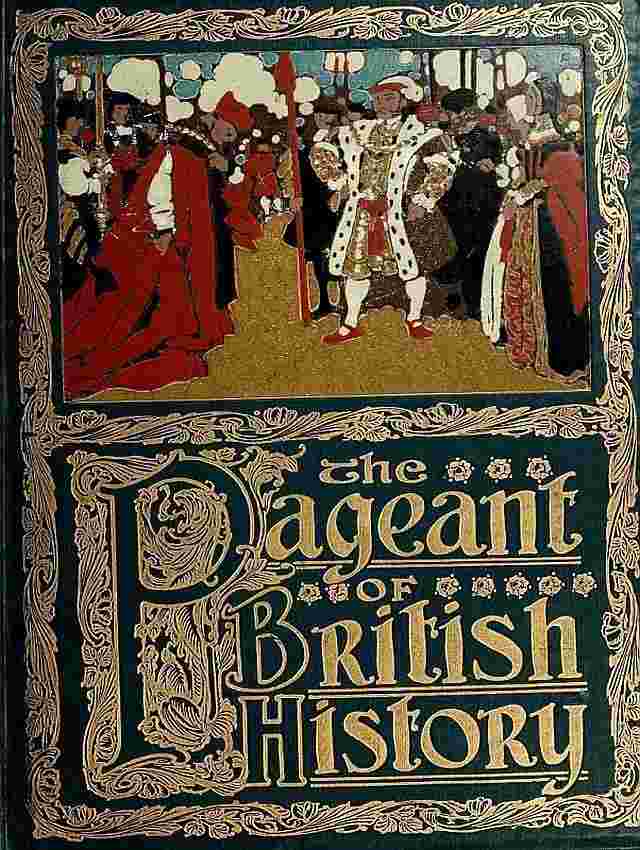
Henry the Eighth and Cardinal Wolsey.
(From the picture by Sir John Gilbert, R.A., in the Guildhall Art Gallery, London.)
THE PAGEANT OF
BRITISH HISTORY
DESCRIBED BY
J. EDWARD PARROTT, M.A., LL.D.,
AND DEPICTED BY
THE FOLLOWING GREAT ARTISTS
J. M. W. Turner, G. F. Watts, Benjamin West, Lord Leighton,
Sir John Gilbert, Daniel Maclise, C. W. Cope, John Opie,
William Dyce, Sir L. Alma-Tadema, Sir John Millais,
Paul Delaroche, W. Q. Orchardson, E. M. Ward,
Stanhope Forbes, F. Goodall, Seymour Lucas,
Ford Madox Brown, W. F. Yeames,
Clarkson Stanfield,
etc., etc.
THOMAS NELSON AND SONS
London, Edinburgh, Dublin, and New York
1908
FOREWORD.
The Master of the Pageant spurs into the arena; he waves his baton, and the trumpets sound. In the distance you see a long procession begin to wind its way across the greensward, and as it draws nearer and nearer you recognize the form and fashion of men and women whose names are writ large in the annals of our land. Here they come—king and queen, statesman and priest, warrior and merchant, poet and man of law, shipman and craftsman, yeoman and peasant—a motley throng, all sorts and conditions of men and women, high and low, rich and poor, gentle and simple, noble and base, hero and craven; yet each in his or her several degree a maker of history. These are the “counterfeit presentments” of the men and women who through twice a thousand years have made us what we are, and our glorious land what it is.
As they troop by, let a humble chronicler—who prays that he may not be considered intrusive—recall the story of their heroisms, their trials, their sufferings, their glories, or, it may be, their failures, their treacheries, and their shames. Perchance ’twill be a twice-told tale, “familiar as household words” yet it is a recital that can never lack hearers while men love the land that bore them, and would fain find example and warning, inspiration and guidance, from the story of the past. The chronicler pretends to no philosophy save this—that since we have, under Providence, been created a “noble and puissant nation” and entrusted with a heritage without peer in the history of the world, we should be false to our sires, false to ourselves, and false to our destiny were we, by selfishness, sloth, or ignorance, to neglect to be great through “craven fears of being great.” And since the best and only true foundation of patriotism is knowledge, he would fain hope that these sketches may stimulate in some who are growing towards manhood and womanhood a humble pride in the greatness of their land and a fervent desire so to play their part that Britain may be what she was meant to be—the Vicegerent of the Almighty in the uplifting and ennoblement of the world. In this belief he echoes the prayer of the poet:—
“Land of Hope and Glory, Mother of the Free,
How shall we extol thee, who are born of thee?
Wider still, and wider, shall thy bounds be set;
God, who made thee mighty, make thee mightier yet.”
| CONTENTS. | |||
| ——••—— | |||
| I. | Britain before the Roman Conquest. | ||
| The Phœnicians | 9 | ||
| The Ancient Britons | 12 | ||
| The Druids | 17 | ||
| The Coming of Cæsar | 20 | ||
| II. | The Shadow of Rome. | ||
| Caractacus | 27 | ||
| A Warrior Queen | 30 | ||
| The Iron Hand | 33 | ||
| III. | The Coming of the English. | ||
| King Arthur and the Knights of the Round Table | 41 | ||
| Hengist and Horsa | 46 | ||
| Ethelbert and Bertha | 50 | ||
| The Singer of the First English Song | 55 | ||
| IV. | The Viking Invasions. | ||
| The Coming of the Sea-Kings | 57 | ||
| Alfred the Great | 60 | ||
| King Canute | 69 | ||
| V. | The Coming of the Normans. | ||
| Harold of England and William of Normandy | 74 | ||
| The Eve of the Invasion | 79 | ||
| The Battle of Hastings | 83 | ||
| Hereward the Wake | 91 | ||
| VI. | England under the Normans. | ||
| William the Red | 96 | ||
| Matilda, “Lady” of England | 100 | ||
| The Great Archbishop | 106 | ||
| Strongbow | 113 | ||
| Richard of the Lion Heart | 118 | ||
| King John and Magna Charta | 127 | ||
| VII. | The Three Edwards. | ||
| The First Prince of Wales | 135 | ||
| William Wallace | 140 | ||
| Robert the Bruce | 149 | ||
| Merciful Queen | 157 | ||
| The Black Prince | 163 | ||
| VIII. | On French Fields. | ||
| King Harry the Fifth | 169 | ||
| Joan, the Maid | 176 | ||
| IX. | The Wars of the Roses. | ||
| The King-Maker | 184 | ||
| The Little Princes in the Tower | 191 | ||
| X. | Tudor Times. | ||
| John and Sebastian Cabot | 195 | ||
| King and Cardinal | 200 | ||
| The New Worship | 207 | ||
| XI. | A Tragic Story. | ||
| Mary Queen of Scots | 210 | ||
| XII. | In the Spacious Days. | ||
| The Spanish Armada | 224 | ||
| Sir Walter Raleigh | 232 | ||
| XIII. | The Great Rebellion. | ||
| Charles the First | 242 | ||
| Oliver Cromwell | 252 | ||
| Robert Blake | 258 | ||
| XIV. | From the Restoration to the Revolution. | ||
| The Restoration of Charles the Second | 268 | ||
| James, Duke of Monmouth | 278 | ||
| XV. | After the Revolution. | ||
| William the Third | 292 | ||
| The Great Duke of Marlborough | 297 | ||
| XVI. | Bonnie Prince Charlie. | 310 | |
| XVII. | Makers of Empire. | ||
| Robert Clive, the Daring in War | 323 | ||
| James Wolfe, Conqueror of Canada | 335 | ||
| XVIII. | Nelson of the Nile. | 347 | |
| XIX. | Wellington. | 363 | |
| XX. | Victoria the Good. | 376 | |
| XXI. | Edward the Peacemaker. | 383 | |
Chapter I.
BRITAIN BEFORE THE ROMAN CONQUEST.
THE PHŒNICIANS.
“The bond of commerce was designed
To associate all the branches of mankind;
And if a boundless plenty be the robe,
Trade is the golden girdle of the globe.”
HE procession advances. Who, you ask, are these swarthy, Jewish-looking men leading the way? They are Phœnicians, the first visitors from civilized shores to our island. These restless wanderers are keen traders, who have sped their barks from distant Tyre or Carthage in quest of merchandise. One of them, urging his ship northward towards this fabled happy land of the western ocean, has sighted through the clearing mists the distant line of an unknown shore. He has landed and come into touch with the natives. Spreading out his tempting treasures of purple cloth, glittering trinkets, and gleaming glass to the astonished gaze of the Britons, he has begun to barter his wares for the native products of the isle.
His keen eyes soon discover that the Britons possess something far more precious than the furs which they proffer. Tin, the most precious metal of the ancient world, abounds here. The Phœnician’s eyes gleam as he makes the discovery; visions of untold wealth flash before him. Tin to him is the most desirable of all metals. In due proportion it will transform soft, yielding copper into bronze, which makes the best weapons of the age. The art of tempering iron is still unknown, and swords and spear-heads of bronze still decide the battles of the ancient world. Alike in peace or war, tin is sought and prized as gold is to-day. The statues of the temples, the urns that hold the ashes of the dead, the ornaments with which men and women delight to adorn themselves, owe their beauty and value to tin. All this the Phœnician knows full well; he has discovered a Klondyke which will make him rich beyond the dreams of avarice.
Again and again he visits this land of Britain, and every voyage he grows richer and richer. He takes infinite precautions lest his secret treasure-house should be discovered. He comes and goes mysteriously. Other traders, greedy for similar gains, follow in his wake and closely beset him; he even runs his ship on a foaming reef, and escapes by swimming, rather than betray the source of his wealth. But all in vain; his secret is discovered, and other barks in quick succession steer for the Tin Islands. An important trade springs up between Britain and Southern Europe. Thus, by means of those mineral treasures which have made Britain what she is, our land becomes known to the civilized world.
Some three hundred years before Christ, an explorer from Marseilles pays the island a visit, and on his return writes a brief account of what he has seen. He tells us of the Kentish farms, with their granaries piled high with golden grain; and he describes the mead of honey and wheat which the islanders drink. More than two long centuries pass away before another explorer arrives to lift the veil still further. He pushes into the interior and makes acquaintance with the rustic Britons, rough and uncouth, the hunters and graziers of the island. He visits the mines of Cornwall, and tells us that the tin is found in earthy veins in the rocks; that it is extracted, ground down, smelted and purified, and exported in knuckle-shaped slabs. Packed into wagons, it is carried during ebb-tide to a neighbouring island, which may be St. Michael’s Mount or the Isle of Wight, and there sold and shipped to Gaul, whence it is carried overland on the backs of pack-horses to Marseilles.
Pass on, ye Phœnicians! We salute you as the fathers of that vast British commerce which has built up the mighty Empire in which we rejoice to-day. Our busy hives of industry with their great factories and roaring looms; our myriad ships that carry, over every sea to every land, the woven fabrics of our workshops, the coal of our mines, and the iron and steel of our furnaces and forges, all owe their beginnings to you who first set ajar for us the golden gates of trade.
Hunters and Traders.
(From the painting by Lord Leighton, P.R.A., in the Royal Exchange, London.
By permission of Mr. Matthews.)
THE ANCIENT BRITONS.
“Where the maned bison and the wolf did roam,
The ancient Briton reared his wattled home;
Paddled his coracle across the mere;
In the dim forest chased the antlered deer;
Pastured his herds within the open glade;
Played with his ‘young barbarians’ in the shade;
And when the new moon o’er the high hills broke,
Worshipped his heathen gods beneath the sacred oak.”
Here come your first Britons, tall, blue-eyed, fair-haired, long of limb, and ruddy of countenance. Some, from the dense forest interior, are clad in the skins of the bears and other wild animals which they have slain; others wear garments of the rough cloth which they have woven on their own rude looms, or have obtained by barter from traders of distant and more civilized lands. None of them are mere yelling savages, bedaubed with blue war-paint; they have long passed that stage. They are all warriors born and bred, fierce in fight but sociable and friendly in peace. They live in tribes under their “kings;” they graze their cattle, till the land, and search the gravels of the rivers for tin.
Let us visit a British “town” of Kent, a century or so before the coming of the Romans, and learn something of the old British mode of life. We plunge into the dark shades of the forest, and follow a narrow track that winds hither and thither through the dense undergrowth. We are armed, for in the thickets and in the caves of the rocky hillocks lurk the gray wolf, the fierce boar, the black bear, and the wild cat. Now and then a startled deer gazes at us for a moment, and bounds away into safety. In the stream which we ford herons are fishing and beavers are building. Overhead the hawks are sailing by, and from a neighbouring marsh comes the boom of a bittern.
On we go, and at length reach a great cleared space. The trees have been felled, and some of the land is under tillage. Horses, sheep, oxen, and swine are quietly feeding, and here and there are strips of grain and barley. Half a mile away is the town. All round it is a moat, with an earthen wall topped by a stockade of oak logs. As we approach the narrow entrance, we see the pointed roofs of many huts, from which thin lines of blue smoke are curling up into the summer air.
We enter the town by a zigzag road, and pass the homesteads, square or round in shape, and built of unhewn or roughly hewn trees placed on end, with roofs of interlaced boughs thatched with rushes or covered with turf. Each homestead consists of one room, large enough to contain the whole family. The floor is of earth, or perhaps covered with thin slates. In the middle of it is the family fire, which continues to burn night and day all the year round; when it dies out, the home is deserted. The smoke escapes by a hole in the roof. Round the fire, along the sides of the room, is a bed made of rushes and covered with hides or coarse rugs. On this the members of the family sit at meals, and sleep at night with their feet towards the fire. The rushes and green grass which are placed between the family fire and the family bed serve as a table, and on this at meal times are placed large platters containing oatmeal cakes, meat, and broth.
In front of the entrance to one of the homesteads a blue-eyed, fair-haired woman, in a tunic of dark-blue cloth, sits grinding corn with a quern or handmill. Little boys, clad in strips of bear-skin, engage in a wrestling match hard by. Sturdy little lads they are, for their rearing has been of a Spartan character; they were plunged into the water of the stream at birth, and they received their first taste of food on the point of their father’s sword. Yonder old woman is boiling water by making pebbles red-hot in the fire and dropping them into an earthen water-pot.
Passing on, we reach a long, low dwelling, which by its size indicates the superior condition of its owner. It is, indeed, the home of the chieftain of the tribe. Big mastiffs and wolf-hounds growl over their bones at the door. Within, the walls are covered with skins. Round shields of hide with shining metal bosses and rims of iron, spears with bronze or iron heads, and bows with quivers of reed arrows tipped with flint adorn the walls. One sword in particular holds the place of honour as a rare prize; it is of iron, with a sheath of bronze studded with red coral.
The chieftain comes forward to welcome us—a tall, well-made man, blue of eye, with long, fair hair and a tawny moustache of which he is vastly proud. Over his flame-red blouse, which is belted at the waist, is a twisted torque of gold, cunningly fashioned and adorned with beautiful tracery; across his blouse is thrown a tartan plaid fastened at the shoulder by a brooch of polished boar tusk. His trousers fit closely to the ankles, and are so characteristic an article of his attire that he is known as “wearer of breeches” in distant Rome. Where his skin is bare, we notice that it is painted with patterns of blue. He greets us heartily, and a slave at his direction hands us a great silver-rimmed horn filled with mead.
His wife shares in the welcome. She is a robust, healthy matron, fit mother of her stalwart sons, who she prays may grow up as heroes, and do ere long some doughty deed which shall entitle them to the heroic names which they have yet to possess. When the day’s work is done, she will gather them about her knees and recite the wild legends of their sires, whose mighty feats of war still inspire young Britons to the fray. She wears a tunic with a scarf of red-striped plaid fastened by a pin of bronze. A string of dusky pearls hangs about her neck, and spiral rings of silver adorn her fingers. The ivory bracelets and the amber beads which she proudly wears have been brought from afar by the traders who visit the town from time to time.
The wife is mistress of the home. She has the management not only of all household affairs, but, as she is the wife of a warrior, the care and direction of the whole concerns of the family both indoors and out. She and her sisters spin, knit, weave, dye, sow, cook, grind corn, and milk the cows—indeed do most of the hard work that is done. Her husband considers field-labour and farm-work entirely beneath his dignity. War and hunting are his work, and right well does he excel in both. Probably safely housed in a hut hard by is his precious scythe-wheeled chariot, in which he goes forth to war when the horn is sounded, the shield is struck, and the cran-tara—the “fiery cross”—is sent through the tribe as a call to arms. He and his fellow-warriors spend much time in their warlike exercises; the slaves, the weaklings, and the old men tend the flocks and herds and conduct the tillage.
Let us continue our tour of the town. Here is a man cleverly weaving baskets of wicker-work; yonder is a fisherman returning from the river, his broad back bearing a coracle, such as you may see on the Dee at Llangollen or on the rivers of South Wales to-day. Not far away is the metal-worker’s hut, where the craftsman is busy mixing his bronze, and moulding it into axes, lance-heads, and sword-blades. Another worker is busy chipping flints brought from the quarry in yonder chalk hills. The potter who labours close at hand kneads out his yellow clay and fashions his pots by hand, ornamenting them by pressing a notched stick or braid against the wet clay. Such is a British town in the most civilized part of the land a century or so before the coming of the Romans.