
IMPRINTED at London in Poules
churcheyarde, at the signe of the Bra-
senserpent, by Reynold Wolfe.
Cum priuilegio ad imprimen-
dum solum.
ANNO DOMINI .M.D.L.I.
Title page:
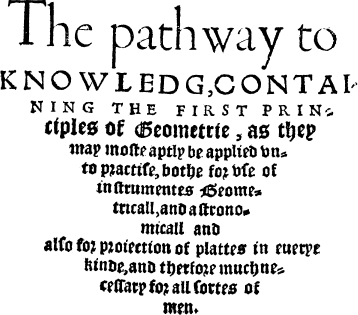
The pathway to
KNOWLEDG,
CONTAI-
NING THE FIRST PRIN-
ciples of Geometrie, as they
may moste aptly be applied vn-
to practice, bothe for vse of
instrumentes Geome-
tricall, and astrono-
micall and
also for proiection of plattes in euerye
kinde, and therfore much ne-
cessary for all sortes of
men.
Dedication:
TO THE MOST NO-
ble and puissaunt prince Edwarde the
sixte by the grace of God, of En-
gland Fraunce and Ireland kynge, de-
fendour of the faithe, and of the
Churche of England and Ire-
lande in earth the su-
preme head.
Title page of Second Book:
THE SECOND BOOKE
OF THE PRINCIPLES
of Geometry, containing certaine
Theoremes, whiche may be cal-
led Approued truthes. And be as
it were the moste certaine
groundes, wheron the
practike cõclusions
of Geometry ar
founded.
[Leaf]
Whervnto are annexed certaine declarations by
examples, for the right vnderstanding of the
same, to the ende that the simple reader
might not iustly cõplain of hardnes
or obscuritee, and for the same
cause ar the demonstra-
tions and iust profes
omitted, vntill a
more conueni-
ent time.
1551.
“Theorems of Geometry”:
The Theoremes of Geometry, before
WHICHE ARE SET FORTHE
certaine grauntable requestes
which serue for demonstrations
Mathematicall.
Transcriber’s Notes
Terminology
Corrections
Illustrations
Notes
Greek
Language and Typography
This information is for readers who know more about geometry than about mid-16th-century English.
The letters u and v follow the conventional “initial v, non-initial u” pattern except in numbers (xv, iv). The lower-case j form occurs only as the last digit of a number (ij, xxj); upper-case I and J share a form, always read as I. Italic double s was printed as an ſ+s ligature, similar to the German ß; it is shown as simple “ss”. Capital and lower-case w were often used interchangeably. Words split across line breaks may or may not have a hyphen.
The word “other” is used interchangeably with both “or” and “either”; similarly, “nother” is used in place of “nor” and “neither”. The expression “an other” is almost always written as two words.
The spellings “then(ne)” and “than(ne)” are used interchangeably; “than(ne)” is rare. The spelling “liyng”, both by itself and as the end of a longer word, is used consistently.
Terminology
Explanations of these terms are scattered through the book. They are grouped here for convenience.
| right line | straight line |
| gemow (line) | parallel |
square |
quadrilateral |
| likeiamme | parallelogram |
| longsquare | rectangle |
| touch line | tangent |
| cantle | segment of a circle |
Corrections
Unless otherwise noted, spelling, punctuation and capitalization are unchanged. Forms were regularized only where there was a very large disparity between the expected form and the apparent errors (for example, a thousand “A.B” against a dozen “A,B”), or a flagrant misprint such as “cnt” for “cut”.
Number forms such as “those. ij. last” or “line. A.B.” were silently regularized to “those .ij. last” and “line .A.B.” Missing sentence-final periods at the end of a printed line were silently supplied.
Unusual forms or combinations—especially phrase breaks where a comma is followed by a capital letter, or a period by a lower-case letter—are unchanged but noted with popups.
Illustrations
A number of illustrations contain errors such as unmarked or mislabeled points (“circle B.C.D” where only C and D are labeled). Labels added by the transcriber are shown in grey; moved or transposed labels are shown in red, with mouse-hover explanation.
Notes
1) if they can with their wysedome ouercome all vyces. Of the firste of those three sortes
Text reads “... their rwysedome ... / ... those th ee sortes ...” on consecutive lines:
2) Pagination as shown by signature numbers demands another leaf (two pages) between the end of the Preface and the beginning of the body text. But no text is missing, and the facsimile has no blank pages.
3) and yet the ij. lesser sides togither ar greater then it.
Text reads “... yet thr / ... ar greate” at consecutive line-ends:
Greek
All Greek is shown as printed. Errors or anomalies include missing, misplaced or incorrect diacritics; the letterform σ for ς; and word-final μ (mu) for ν (nu).
ἐίπερ γὰρ ἀδικεῖμ χρὴ, τυραννΐδος περῒ κάλλιστομ ἀδικεῖμ, τ’ ἄλλα δ’ ἐυσεβεῖμ χρεῶμ
eiper gar adikeim chrê, turannidos peri kallistom adikeim, t’ alla d’ eusebeim chreôm.
Φΐλιππος Αριστοτέλει χαίρειμ.
ἔσθι μοι γεγονότα ὑομ. πολλὴμ οὖμ τοῖσ θεοῖσ χάριμ ἔχω, ὀυχ ὅυτωσ ἐπῒ τῆ γεννήσει του παιδόσ, ὡσ ἐπῒ τῷ κατὰ τὴμ σὴμ ἡλικῒαμ αὐτόμ γεγονέναι ἐλπΐζω γὰρ αὐτὸμ ὑπὸ σοῦ γραφέντα καὶ παιδευθέντα ἄξιομ ἔσεσθαι καὶ ἑιμῶμ καὶ τῆς τῶμ τραγμάτωμ διαδοχῆσ.
Philippos Aristotelei chaireim.
esthi moi gegonota huom. pollêm oum tois theois charim echô, ouch houtôs epi tê gennêsei tou paidos, hôs epi tô kata têm sêm hêlikiam autom gegonenai elpizô gar autom hupo sou graphenta kai paideuthenta axiom esesthai kai heimôm kai tês tôm pragmatôm diadochês.
Ἄλέζανδρος Αρισοτέλει εὖ πράττειμ.
Ὂυκ ὀρθῶσ ἐπόιησασ ἐκδοὺσ τοὺσ ἀκροαματικόυσ τῶμ λόγωμ, τΐνι γὰρ διοισομην ἡμεῖσ τῶμ ἄλλωμ, ἐι καθ’ οὕσ ἐπαιδεύθημεν λόγουσ, ὅυτοι πάντωμ ἔσονταιν κοινόι, ἐγὼ δὲ βουλοί μημ ἅμ ταῖσ περι τὰ ἄριστα ἐμπειρΐαισ, ἢ τὰισ δυνάμεσι διαφέριμ. ἔρρωσο.
Alezandros Arisotelei eu pratteim.
Ouk orthôs epoiêsas ekdous tous akroamatikous tôm logôm, tini gar dioisomên hêmeis tôm allôm, ei kath’ hous epaideuthêmen logous, houtoi pantôm esontai koinoi, egô de bouloi mêm am tais peri ta arista empeiriais, ê tais dunamesi diapherim. errôso.