
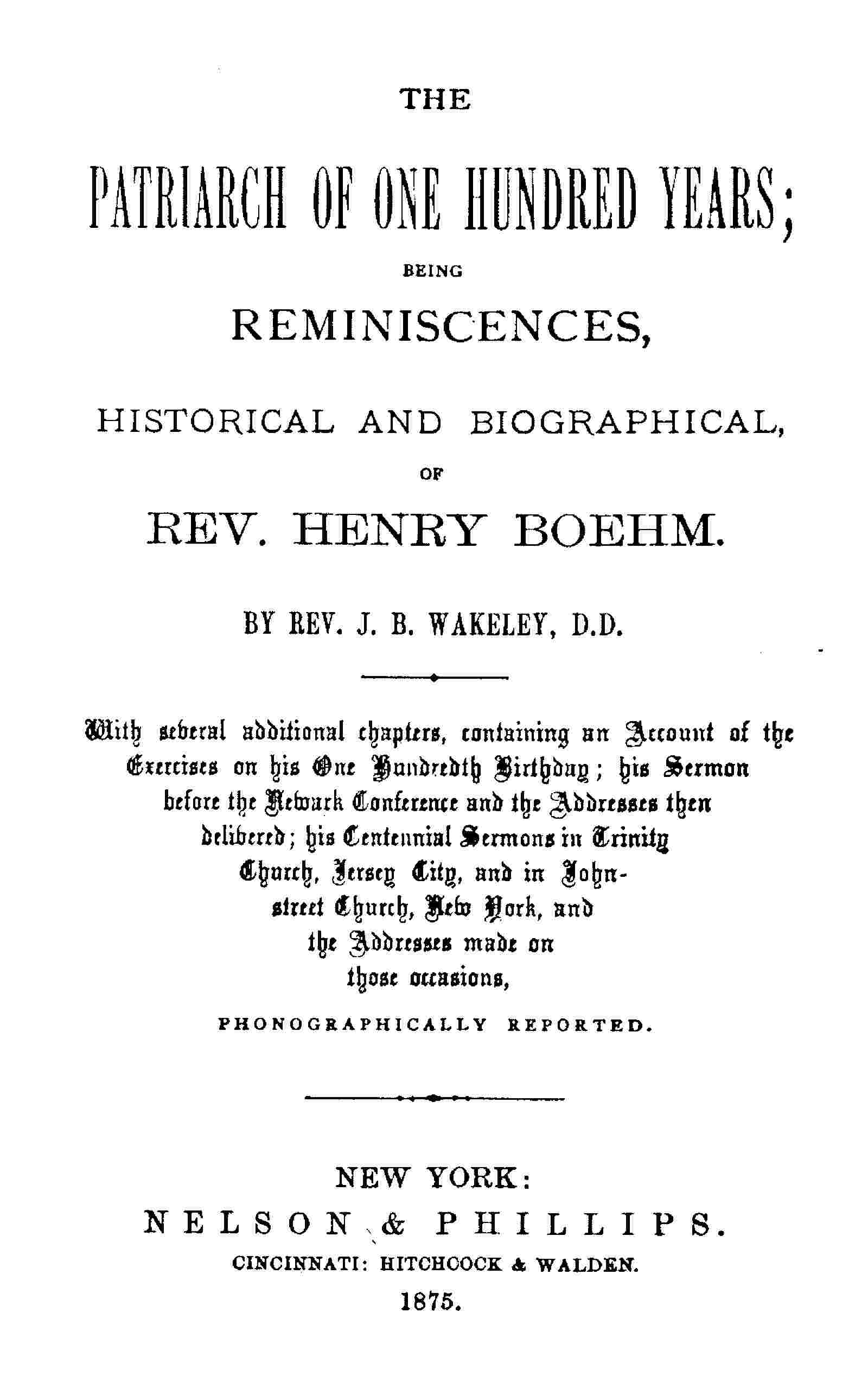
Our venerable Father Boehm belongs to the whole Methodist Episcopal Church, and not to any particular locality. We think of him as the friend and companion of Asbury, the apostle of American Methodism, and, in consequence, feel that the whole country can lay claim to him. We could not localize him if we would, and would not if we could.
I do not know that any particular credit attaches to a locality because a great and good man was born there, for the simple reason that he could not help it. The Hibernian who was born in the country said he could have been born in the city just as well if he had desired, but that he preferred the country. Perhaps if Father Boehm had been consulted he would have preferred the city. But although the place of our birth is purely accidental, there is a mystic cord which binds our hearts to our childhood home through life, such as links us to no other spot on earth. Representing the Philadelphia Conference, within whose bounds our venerated father was born, I, with my fellow-committeemen, Drs. Chaplain and Robinson, feel that our claim is not less, if it be not more, than that of any others present. Usually upon festive occasions the children come back from abroad to the paternal home to do honor to the parents. That order is reversed to-day. We come from the old homestead to seek out our Father Boehm, who has gone abroad, and offer him the congratulations of the Philadelphia Conference upon the one hundredth anniversary of his birthday.
There have been some changes at home since he left: there are more farms in Lancaster County now, and less woods; there are more villages, towns, and cities, and less country. Those who were boys then are tottering upon staffs now. There are many, many more mounds in the grave-yard. The little societies which met in barns and school-houses then, and were called Methodists in derision, have since built themselves houses of worship, and are now a strong and respected Church in the community. The old house, around which in boyhood he played, is gone; but the springs sparkle just the same, and the brooks bubble and flow on as of yore; the sky stretches its big arch overhead, and the stars twinkle, and the sun’s huge disk of burnished gold dazzles, just the same as they did a hundred years ago. The old German Bibles are growing scarce, but English Bibles in greater numbers have taken their places, and the precious truths of God’s revelation remain the same through all languages. The same doctrines are preached, the same hymns are sung, the same experiences are related, and the same prayers are offered, as when he in boyhood first attended a Methodist meeting. Men and their works have all changed; but God, and nature, and the religion of Jesus, are the same yesterday, to-day, and forever.
And Father Boehm has changed some, too, since he left home. He is the youngest man for his years that ever I knew, but still I notice that time has made some deep furrows in his cheeks, and the frost has settled in his hair. That stalwart form which, in other years, bore Bishop Asbury up many a hill and over many a stream, is bent and feeble now; and his voice, which used to ring out loud and clear as he delivered his Gospel message among the mountains of Pennsylvania, now shows signs of faltering and trembling. But these changes are only on the outside; time has not been able to alter him at the core. His memory still is good; his mind is clear; his heart is just as warm, and his faith as strong, as they were in the days long past and gone. The “outward man” may perish, “yet the inward man is renewed day by day.” God’s own image, over which time has no control, is stamped within him, and there are no wrinkles in his soul.
A hundred years have rolled away since he first opened his eyes upon the light of a day in June. It does not seem so long a time in this age of crowding events; yet it takes us back to when the fever of the Revolution was in the blood of our ancestors. The musketry of Concord and Lexington was still echoing in the air when Father Boehm was born; and he was in his cradle when the Declaration of Independence was signed. His childhood heard the tramp of Continental soldiers, and the guns of Valley Forge and Germantown sounded in his youthful ears. American Methodism was only a child of nine years old, and was still unweaned from its mother, when he was born. Why, nineteen such men, the one born upon the day on which the other died, would take us back beyond the birth of Christ! This one life spans a continent of history, arches over the graves of three generations, and bridges a chasm of forgetfulness a hundred years wide; so that over it the memories of long ago can travel down to us.
But a man’s life cannot be measured by the number of seasons that come and go. Some men live more in ten years than others do in fifty. Our lives are measured not by clock-ticks, but by heart-throbs. The excitements of the times, the rush of events, and the activities of the mind, determine a man’s age more than the roll of years. Father Boehm has lived longer than Methuselah, if we reckon time in this way. Within his life-time the application of steam to mechanical purposes has taken place. Instead of the clink on the anvil, which he heard in boyhood, now the heavy thud of the steam trip-hammer shakes the earth; and the old Conestoga wagons of earlier days have almost disappeared from the turnpike, and, instead, the iron horse now tosses his smoky main, and snorts and rushes like the wind through mountains, over valleys, and across the plain. It had taken Methuselah not less than a week—possibly a whole month—to come from Philadelphia to New York. Father Boehm has lived in an age when men breakfast in Philadelphia, dine in New York, and sup again at home. Within the last century the lightning has been harnessed and made to do man’s bidding. By means of the telegraph men are talking across continents and under oceans with each other, as though they stood face to face. Messages are sent and answers received in an hour, which would have required months or years a century ago. He has lived in an age of books and newspapers. Printing was known and practiced long before his time, but never in the world’s history has the press groaned beneath its burden of publications as it has during his life-time. The newspaper has been born in this country—not in the sense of being created out of nothing, but in the sense of being transformed and unfolded into new being. It existed before, but it was only a grub then. It has taken on wings since, and is a different thing altogether. Had the great fire in Chicago occurred a hundred years ago, the city would have been rebuilt before news of its destruction had reached the more remote sections of the country. Now, men see in the morning newspaper, before they get to business, the world’s photograph as it looked at sunset last night. These wonderful facilities for intercommunication have quickened thought, have aroused energy, have stimulated activity. Every thing goes by express now; haste! is the watchword of this age. In an old colonial paper published in Connecticut there is a notice to this effect: “The vessel which was to have sailed from New London for England on next Wednesday will postpone her departure for two weeks longer on account of one of the passengers not being able to get ready before.” Now, if he is two minutes late the plank is drawn, and he is left behind.
If we would measure Father Boehm’s life-time aright we must not forget that he has lived for a century in an age when men talk by lightning, travel by steam, write with a printing-press, and move by the second. He has lived through the best hundred years this world ever saw; he has lived more than the man who was contemporary with both Adam and Noah; there is more of history and religion crystallized in his memory than could have entered into any one experience in any age before. The length of that life is wonderful—but its breadth amazes and overwhelms me!
But it is not so much Father Boehm’s extreme age, nor yet his wide and varied experience, which calls forth our homage to-day. Old age is honorable, and I always take off my hat before gray hairs. I am no advocate for relic worship; and yet there is something in a moss-covered building, in an old mildewed book, or in the ruins of an ancient city, which irresistibly calls forth my veneration. I cannot help uncovering my head and walking with muffled footsteps in the presence of hoary antiquity. By just as much more as a man is greater and better than a book or a building, do I venerate the face seamed and scarred, and the head bleached white with many years. But I have seen older men than Father Boehm. It was my privilege not long ago to see a man die, and afterward to bury him, who was two years the senior of the patriarch of this occasion. There are centenarians to-day living in almost every State in the Union, the return of whose birthday calls forth no such public expression of affection and honor. Father Boehm’s age would command our respect if he had no other claim upon our attention; but that alone had never called this concourse of people together from so many and such distant places.
We cannot help paying deference to knowledge, no matter whether it be acquired through books or experience, or both together. Knowledge is power, and it is a power which makes itself respected every-where. The man who stands before us as a kind of mental reservoir, into which the experiences, observations, and studies of a hundred years have poured their ceaseless streams, is king by virtue of his knowledge; he wears a crown which none will dispute, and holds a scepter before which all will bow. We look upon Father Boehm as an incarnate, living volume of history; his life is a cyclopedia of one nineteenth of the Christian era; he is the embodiment of all the precious memories of Methodism. We value, cherish, and honor him for his ripe experience and well-stored mind. But not for his age and wisdom alone, nor chiefly for these, do the Church and community value his life and treasure his memory. Goodness is better than age—is better than knowledge. It is the sunshine which gilds the mountain of years, and which ripens into sweetness the fruits of experience which grow on the sides of that mountain. The Church has sent her representatives here to-day to emphasize the proverb that “the hoary head is a crown of glory, if it be found in the way of righteousness.”
We forget every thing else while we remember vividly that Father Boehm, though a hundred years old, has a moral character upon which suspicion has never dared to breathe, and that beneath that wrinkled face the religion of Jesus dwells in all the sweetness, freshness, innocence, and simplicity of early childhood. We have come together to-day to offer thanksgiving to God, and congratulations to each other, for this life of a hundred years without one spot or stain. His moral and religious life stands out upon his Christian profession like a white lily upon a field of snow. My hand shall not attempt to paint so pure a picture. “To gild refined gold, to paint the lily, and throw perfume over the violet, or seek with taper light the beauteous eye of heaven to garnish, were wasteful and ridiculous excess.” Were this whole world at Father Boehm’s disposal, with its wealth and its wisdom, he could not from all its stores bestow a richer dowry upon the Church of his love than the record of his own simple, humble, true and untarnished life.
Rev. George Lansing Taylor read the following original hexameter ode, composed by him for Father Boehm’s centennial. Before reading the poem he said, in a good-humored way:—
“I ought to make a remark for the benefit of the least bookish of my hearers, and I will do it in the form of a story. I have heard the anecdote of a young lady fresh from boarding school, who, in a conversation on the subject of poetry, sagely remarked that Shakspeare was not poetry, because it did not rhyme. For the benefit of some members of the same family as that young lady who may yet be living I would insist that the world still continues to call Shakspeare poetry in spite of the absence of rhyme; and if my hearers will listen attentively to catch the swing of the long hexameter line they may find rhythm in what I have to read to them, if not rhyme.”
THE HEROIC AGE.
AN HEXAMETER ODE.
BY REV. GEORGE LANSING TAYLOR, M.A.
HENRY BOEHM, 1775-1875.
Exegi monumentum ære perennius.—Horace, Odes III, 80, 1.
Rev. Cyrus D. Foss, D.D., then responded to the request for some remarks.
Address by Rev. Dr. Foss.
One of the most distinguished advocates in this country is said to have remarked concerning the almost interminable speech of the counsel on the other side: “My learned friend seems to have feared that it would be impossible for him to make his speech immortal without making it eternal.” Now I am very sure that this meeting is in no such peril as that. Each particular part of these proceedings has been quite too short for its abundant merit, and the meeting itself will be all too short to enable us to utter the feeling of all our hearts. But we may be sure that the memory of this meeting will last, and that three quarters of a century hence—and it may be even farther off than that—when there shall be fifteen millions of Methodist communicants on this continent by the blessing of God, this meeting may be remembered by some of the youth here to-day, and it will go down in permanent form in the Methodist records. I will not extend the time of the meeting long, lest I should impose upon your patience; I will not occupy half the number of minutes that the chairman of the committee has requested me to speak.
We have been very eloquently told how grandly full of history this last century has been, and how much more this honored life, which in its earthly form shall soon pass away, contains than the life of any man who has lived in any century before this. I recall the sentiment of Bishop Kingsley, who was asked early in the history of our civil war how old he was, and he promptly answered, “One hundred and forty-six.” “Why,” said his questioner, “how do you make that out?” “Well,” he replied, “I was forty-six years old when the war began, and I have lived a hundred years since.” Now reckoning upon that principle, which is the just one, our venerable Father Boehm might well claim to be a thousand years of age to-day. You have heard in the eloquent address of our brother from Philadelphia some account of the wonderful progress we have made within the last century. He did not tell you what I will add, namely, that since this godly man began to preach the Gospel there have been ten times as many copies of the word of God put into circulation as were circulated before in all the centuries since Moses wrote the Pentateuch; and that within the same space of time there has been a great deal more done in extending the Gospel into the regions beyond, in obedience to that inspiring “Go!” which the Lord Jesus put at the back of his apostles before he ascended into heaven, than in all the other ages before. What a century that makes of the one in which we live! Of this work, by the blessing of God, our honored guest is no small part: and more, that sublime temple, in which he stands so tall and strong a column, the temple of Methodism, is no small part.
My dear friends, I stand here not to attempt what now would be impossible—any thing further in the line of the touching, delicate, and eloquent personalities which have been so fitly spoken here to-day, and which have thrilled our hearts with delight. I cannot pluck another flower from anywhere to adorn the wreath that these brethren have woven for this godly man. I will say a few words concerning that grand system of religious revival and propagandism which he helped to build when it was weak, and which gathers us here to-day. And what is it—this great religious system, so mighty for the world’s evangelization, by God’s blessing? If I had an hour to speak here on this occasion, I would say that the secret of the wonderful success of Methodism is to be sought, in part, in its doctrinal system, in part in its ecclesiastical peculiarities, and still more largely in its religious experience.
Concerning the first of these points, I could not summarize our doctrinal teachings, speaking in this impromptu way, half so well as they have just been stated in the poem. Of course our fathers adhered to all the great truths which the Church had held through all time, but they lopped away some of the errors, and were commissioned by God not to add any new truth, (for the truth was perfect when the canon of Scripture was closed,) but to re-emphasize some of the old and forgotten verities; and so when they went forth into regions in England and America where the dry rot of religious thinking, which men call theology, had misled the minds of the people and had dulled their sensibilities—when they went forth preaching to all men that they were really in peril of eternal death, and that there was offered to them in the Gospel, by their lips, salvation—a present salvation, a conscious salvation, a full salvation—no wonder they found a hearing. That was the proclamation that these men every-where made; and these important truths, hidden in the creeds before, or at least not brought out, held up as flaming torches before the faces of men, needed only to be so presented to light up the dull eye and warm the frozen heart of the world.
Not only in the emphasis which they laid on these truths did our fathers do a grand work for the world. We had also important ecclesiastical peculiarities. The first of these that arrested the attention of men seventy-five years ago in America, and one hundred and twenty-five years ago in England, was our itinerant ministry. The preacher did not stand still in one place and wait for the people to come to him, but went to them with the offer of the Gospel of the Son of God, because he felt within him the pressure of that almighty “Go!” of the Lord Jesus Christ, which impelled him on to preach the word with power. After a man’s attention had been arrested by Methodism, the next thing was to invite him to the class-meeting. The preacher, seeing the tears streaming down his face, and going to him after the sermon, would ask him—not “Do you believe the Thirty-nine Articles?” nor “Are you willing to be damned for the glory of God?”—but he would simply say, “Do you desire to flee from the wrath to come, and to be saved from your sins?” and if he said “Yes,” he would be told, “Here is Brother Jones, a class leader, go to his class next Thursday night.” The people also found that a man who wielded the hammer on the anvil from Monday to Saturday went forth on Sunday and preached the Gospel. So there was a lay ministry, and that was another peculiarity of the ecclesiastical polity of our Church. Concerning these and all the rest I will simply say, that the grand peculiarity of all was, that it was not a man-made system, devised in the brain of John Wesley or any body else, but simply a leading forth, under the providence of God, and by the hand of God, of godly men to bless and save the world. There is not a single peculiarity of Methodism that was not a child of Providence. John Wesley never intended one of them. So we are followers of Wesley when we follow God. To him who would follow the path in which John Wesley trod, if Wesley were alive to-day he would say, “God is our leader, follow him.” And yet in doing this I am persuaded that we should wisely heed the sentiments of that eloquent utterance of Bishop Asbury in the letter that has just now been read to us. Let us hope, and pray, and beseech, clinging to the very horns of the altar, that every change made in the policy of this grandly successful Church may be manifestly “made by God and not by men, who have long been trying to be their own bishops.”
After all, as it seems to me, the greatest thing in Methodism, from the beginning until now, has been its religious experience. Why, my dear sir, God’s way of making any great truth effective is not by writing it in the Bible, but on the fleshly tables of men’s hearts. There is not a single one of those old verities which are vital to our faith but has been in the world, but has been in the Book, for almost nineteen centuries; and yet the Dark Ages passed over the world for all that. Pardon of sin, salvation through faith alone, was already within the Book of God; but the people did not heed it until God put it in the heart of Martin Luther, and when he told it the world believed him, and hence the Reformation.
And so in the time of the Wesleys, and in the time of their followers in England and America, the power of God was made manifest through their experience. It was not simply the ecclesiastical peculiarities that they held to, it was not simply the doctrines they taught; it was those doctrines set on fire in their hearts that made people learn the lesson, and that alone.
My dear friends, there is not a single truth of Christianity which has not been in some age of the world buried, and buried out of sight; and every such truth, when exhumed, has been exhumed in this way: God has taken it and put it into the living soul of a living man, and it has possessed him, and then he has gone forth and declared it, and men have believed him. Look at the old truth of the universality of the offer of the Gospel. The great commission should have taught this to the Apostle Peter. But long after that you find him hiding away from the Gentiles, not holding to their company, until God set him right at last by a vision from heaven, and he came forth and said what one would have thought his personal experience with Jesus should have taught him long before:—Peter came forth and declared, as though he had found something new, “I perceive that God is no respecter of persons.” And away down the ages, until a century ago, the Church was possessed by the same Jewish bigotry. It is within the life-time not only of our venerable patriarch, but of others here to-day, that at a meeting of ministers the question, “Will any young minister suggest to us a subject for discussion?” was asked, and up rose William Carey and said: “Mr. Chairman, I suggest for discussion this theme, ‘The duty of the Christian Church to evangelize the heathen world,’” and the old gray-haired moderator, Dr. Ryland, said: “Sit down, young man, sit down; when God gets ready to convert the heathen he will do it without your help or mine.” But the great truth was hidden in the hearts of William Carey, Adoniram Judson, and Thomas Coke, and they went forth and proclaimed it, and the world is beginning to believe it.
So with the knowledge of sins forgiven; by the witness of the Spirit Methodism has done much to make this precious experience the common heritage of the Evangelical Church of to-day. A century and a half ago I doubt if there were ten men in all England who dared to say they believed that doctrine. When Benjamin Abbott was past thirty years of age, he had never heard a man say he knew his sins forgiven; and when he proclaimed it as his experience a deacon told him it was a dangerous heresy, and every man who held it ought to be put to death. And that within this century! But, my dear friends, after fifteen years of such service of God as few men have ever rendered—after fifteen years of such apostolic zeal for the relief of the poor, and the religious instruction of prisoners, and the bringing to morality and decency of the lowest of the sinful, as few men have ever passed through—a young man of Lincoln College, Oxford, at the age of thirty-three or thirty-four, hearing a Moravian read from one of Luther’s Commentaries about justification by faith alone, says that in that meeting, about half past eight o’clock in the evening, his heart was “strangely warmed;” and then Methodism was born. If it had not been for that strange warming of John Wesley’s heart we would not be here to-day. It was the vitalization, in the experience of the Methodists, of the old, forgotten doctrine that made them mighty, and sent forth this “great religious movement,” as Stevens so well calls it, “of the eighteenth century.”
I must not multiply words, sir. It is my prayer that in all the changes of our Church polity we may “make haste slowly;” that in all matters of Christian doctrine we may follow the word of God, and may have the truth interpreted to us as it was to Wesley, by the illuminating light of the Spirit, and that the great power of Methodism may ever be the power of its scriptural, personal, joyous experience.
Rev. David W. Bartine, D.D., delivered the closing address.
Dr. Bartine’s Address.
I feel weary at this moment with the journeyings of a hundred years—with the reasonings, the preaching, and the toil of a hundred years. And I presume that this congregation is weary too—weary for once with perfect delight in the enjoyment of an entertainment that we shall never forget, with a pleasure that will thrill our hearts till our feet touch the cold waters of Jordan. I am one of Father Boehm’s boys, and I delight in the privilege afforded me to-day, at the closing moments of these profoundly interesting services, to say so. When I was a little babe, (of course I don’t remember the circumstance, but my friends remember it,) Father Boehm, in company with Bishop Asbury, came to my father’s house. (My father, you know, was one of the old pioneers, a plain, grand old man, a hero through and through, who met the heresies to which my brother referred awhile ago and helped to conquer them.) Well, they came to my father’s house, and the bishop baptized me, as Father Boehm remembers and has often told me; and that put me in the succession, and I am as perfectly in the apostolic succession to-day as any man in America or in the world—not simply because the old bishop baptized me, but, my friends, afterward God converted me in the old-fashioned Methodist style. I learned the great principles of this wondrous Church in the company of such learned men as these, (pointing to Father Boehm,) sitting at their feet, listening to their words, and being taught in the schools of which they were the prophets. And I glory to-day that I feel like clinging to the good old-fashioned Methodist style.
In the year 1832, when I was a boy—and I suppose as we sometimes say, in cant phrase, somewhat “green”—I received a message from this venerable father inviting me to attend a camp-meeting; and those meetings were real camp-meetings; the people went there to pray all the time, and to look for the baptism of the Holy Ghost. I went, trembling, fearing, feeling utterly disqualified for the work I had entered on, and which I believe God called me to undertake; and I shall never forget the kindly greeting this precious father gave me as I entered those grounds. He took all the fear from my heart, and greeted me with a cordiality I have never forgotten; he said a few kindly, loving, simple words, that strengthened my heart through and through, and from that day to this I have been blessed and honored with the friendship of this venerable man of God.
If I had time to-day I should like to give a number of reminiscences which I could present, but the time has passed so rapidly that the close of these interesting services is necessarily near at hand. And before we separate this afternoon let us congratulate ourselves that we still have preserved among us such a grand specimen of the Methodism of the olden time. Dr. Foss presented us with some very interesting thoughts upon this subject, and that is one of the points I intended to present. But every one who has spoken to-day has stolen some of my thunders, so that I am compelled to manufacture thunder as I go along; and I find that its manufacture is not so easy a matter when others have used your material so freely as have these brethren who preceded me to-day.
But let me say to you, my friends, that we are not to treat lightly an example such as we find in this venerable man. Concentrated in him is Methodism in its simplest form, in its purest characteristics—Methodism as I pray God it may go down to the ages of the future. And I want it to be distinctly understood that I am not a believer in this modern idea that we are going easily to improve the system of Methodism which this venerable man helped to found. It may be tampered with, its success might be interfered with; but it is not a very easy thing to mend it. I am willing to be led, as my fathers were, where God shall lead; but I want to see the footprints of God where I put my feet, I want to see divine providence indicating the way in all the wondrous march of this form of Christianity.
There is one thing most assuredly a fact, and that is, that our system of itinerancy cannot well be improved. I do not know what Bishop Asbury would say to-day upon this interesting subject: whether it is the true philosophy to so change our ministerial arrangements as to continue a man in one or two appointments during a life-time, and still call it an itinerancy. I want to say, that though I would not be an “old fogy,” you will find it a hard thing to improve in this direction that system which has shaken the world. And the question with me is, whether, with all the improvement that is claimed for it, it is shaking the world to-day as it shook it when this venerable father, with heroic purpose and earnest voice, led on his combined forces on his grand old districts? The world did shake then; hell did shake then; the powers of unbelief and heresy did shake then, as the hosts of God marched on from battle to battle, and from victory to victory. A great many well-polished shafts were then hurled by these men of bluntest speech, with both force and effect, at the heart of the foe; and it is a question worthy of consideration whether, after all our advancement in learning and literature, and every thing of that sort—after all our boasted improvement—there is that real, old, divine unction that shook the dead Churches, and awakened the sleeping multitudes to a realization of their need of the saving grace of our Lord Jesus Christ?
I am reminded of all that, and of the simple effort and simple prayer that took hold of the citadel of death and Satan, and through the high and hidden things of the Gospel saved men by leading them to Christ. In Father Boehm’s early and later days, when persons would come to the altar to seek the Lord Jesus Christ, and it was fashionable to kneel and to throw themselves prostrate upon their faces, they would cry mightily to God and struggle hard for his mercy, and earnest people gathered around them with tears, and finally with songs of joy; and it was not the fashion then to pass around the altar and say, “Sister, do you feel any better?” “Brother, do you think you have found peace?” No; that was not the way. The common way was to pray on until the baptism of the Holy Ghost fell upon them, and without prompting they declared what God had done for their souls. Now there are some little points like that which I don’t think we can improve upon—some points which, if we could retain them in all our efforts to do good, would be better for the Church and the world. The very kind of testimony that this venerable patriarch and his compeers were in the habit of bearing to the world is what still needs to be borne. We should never speak hesitatingly upon the one great subject, “That God for Christ’s sake has pardoned all my sins.” They called it heresy then, they call it heresy now; but it was and it is a blessed truth that Jesus Christ had then, as he has now, power on earth to forgive sins, to change the heart, and make a man to know it.
And then that other doctrine which has not been referred to: it was a doctrine of Methodism—I have heard this venerable servant of God preach it, (for I have heard him preach many a time, heard sweet and precious words from his lips,) the fire of the Holy Ghost within him, the divine unction resting upon him, while he would tell us of the power of Jesus Christ to cleanse from all unrighteousness—it was a doctrine of Methodism that the blood of Jesus Christ cleanseth from all sin. And that precious truth still lives, one of the most beautiful trees of God’s garden. The religion of Jesus Christ found man dead, polluted, corrupted, and that tree has so grown that to-day multitudes are plucking from it the ripe and rich and luscious fruits of living Christianity. All hail to that patriarch who, sitting in his tent door, watches to see how the battle is going! All hail to his heart as it fills to-day with the ancient fire, and flames with the ancient divine patriotism!
I think there was something said about my closing these services. I am very sorry Bishop Simpson is not here. We had hoped to reach the climax of these services in the closing speech of the excellent bishop. But following all the splendid oratory that has thundered in your ears to-day, it is a difficult matter for a small piece of artillery like me to do much on such an occasion as the present. I do honestly feel, my brethren, that I am in a very embarrassing position. Just look at it. Here is a man (Dr. Foss) whom they almost made a bishop at the last General Conference; here is a man (Dr. Todd) whom I found in the mountains of Pennsylvania, and sent him on his way as worthy to be one of the successors of this grand old patriarch; and here is a distinguished Professor, (Prof. Buttz,) just fresh from college, with his laurels thick upon him, a man beloved by every one who knows him. That these brethren have spoken, and spoken so well, only adds to my embarrassment.
As one of the brethren said, we are not here to cry, “My father, my father, the chariot of Israel, and the horsemen thereof!” O no; we are not even where Joash was when he heard of Elisha’s illness, and came down to weep over him and cry, “My father, my father,” etc. But I will tell you where we are. You know it is Christianity that sanctifies the soul, the baptism of love which photographs the image of the Eternal upon the human affections, and extracts the sting from death. Now it seems to me when Father Boehm shall pass away there will not be any death in it. He has been under the experience and power of this saving faith so long, that every thing in that line comes as a matter of course, and after a little while, when his days are numbered, it won’t be dying, but going up in a chariot of fire into heaven. It has seemed to me all the morning as though we were taking the last three miles’ walk that Elijah and Elisha took after they got over Jordan. You remember that last three miles’ walk, perhaps the most delightful incident in the history of the prophet Elijah. Perhaps we are taking that walk this morning—that last three miles’ walk. You know Elijah had said—and perhaps we may imagine Father Boehm saying the same this morning—“Tarry here, I pray thee: while I go over Jordan,” and the answer was, “As the Lord liveth, and as thy soul liveth, I will not leave thee.” No, Father Boehm, these hearts cling to you to-day with all the ardor of youth, and they mean to cling to you until your spirit shall ascend to be forever at rest with God the Saviour. These last three miles—have they not been very pleasant to-day, my brethren, as we talked over the old patriarch’s history, as we talked over the glory that looms up in the future? Have we not rejoiced in it? It has been glorious—this last three miles’ walk! And it may be (though some of us may pass away before him, as the sainted Wakeley went from this pulpit and from the company of his brethren, so unexpectedly and so gloriously to his eternal rest) that many here may receive what Elisha did, a double portion of his spirit at the translation of our Elijah. “Ask,” said the prophet, “what I shall do for thee before I be taken away from thee.” I know Father Boehm’s heart would ask that question if he knew the day of his departure was near at hand; and I know the response of each heart here would be like that of Elisha, “Let a double portion of thy spirit be upon me.” O God, give us a double portion of the spirit of the fathers—their spirit of sacrifice, their spirit of love, their spirit of simplicity, their spirit of holy earnestness in the pursuit of knowledge, their spirit of consecration to their blessed work; and that divine unction that shall make every minister in our Church a power, and every member of our Church a power, thus presenting the banded forces of our Methodism moving on in one solid column against the hosts of this wicked world! That is what we want. May God grant the speedy dawning of that day!
Meanwhile, brothers and friends, the old bark is approaching the haven; the hoary head crowned with glory proclaims the beaming forth of the light of heaven; that venerable countenance is illuminated to-day with a supernatural light; as the bark approaches the haven he is striking his topmast and furling his sails, and after a little while he will drop his anchor in the waters that are never troubled, amid scenes and under skies that are never overcast with clouds. The old pilgrim rests to-day on the top of his staff. O, I am so thankful that a beautiful, calm twilight is shining softly upon his soul as he approaches “that bourne whence no traveler returns”—to that river which, as Payson says, has become a rivulet to him, over which he shall step at any moment when God shall permit! God grant that there may be no shadow on Father Boehm’s life in this world, and if it please God, that he may be permitted to remain among us longer yet as a living example. For we have a century of history, of ecclesiastical policy, and of preaching Christ with saving power, all concentrated in this venerable old man, a monument that stands firm amid passing years, and throws its light upon the traveler to the world of spirits, and the home of the good and the pure.
The quartet choir then sang the closing centennial hymn, written by Fanny Crosby:—