
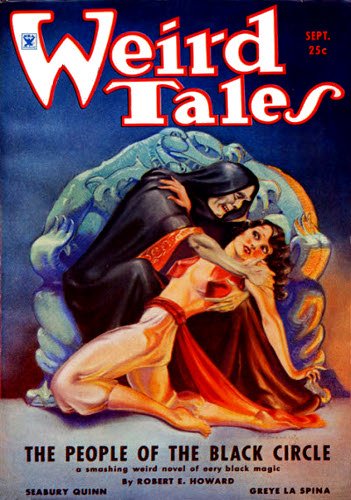
Wheeling the beast around in the stall, Conan called quickly to Yasmina, and the girl came, sidling nervously past the stallion's heels. Conan was working at the stone wall, talking swiftly as he worked.
'A secret door in the wall here, that not even the Wazuli know about. Yar Afzal showed it to me once when he was drunk. It opens out into the mouth of the ravine behind the hut. Ha!'
As he tugged at a projection that seemed casual, a whole section of the wall slid back on oiled iron runners. Looking through, the girl saw a narrow defile opening in a sheer stone cliff within a few feet of the hut's back wall. Then Conan sprang into the saddle and hauled her up before him. Behind them the great door groaned like a living thing and crashed in, and a yell rang to the roof as the entrance was instantly flooded with hairy faces and knives in hairy fists. And then the great stallion went through the wall like a javelin from a catapult, and thundered into the defile, running low, foam flying from the bit-rings.
That move came as an absolute surprize to the Wazulis. It was a surprize, too, to those stealing down the ravine. It happened so quickly—the hurricane-like charge of the great horse—that a man in a green turban was unable to get out of the way. He went down under the frantic hoofs, and a girl screamed. Conan got one glimpse of her as they thundered by—a slim, dark girl in silk trousers and a jeweled breast-band, flattening herself against the ravine wall. Then the black horse and his riders were gone up the gorge like the spume blown before a storm, and the men who came tumbling through the wall into the defile after them met that which changed their yells of blood-lust to shrill screams of fear and death.
6 The Mountain of the Black Seers
'Where now?' Yasmina was trying to sit erect on the rocking saddle-bow, clutching her captor. She was conscious of a recognition of shame that she should not find unpleasant the feel of his muscular flesh under her fingers.
'To Afghulistan,' he answered. 'It's a perilous road, but the stallion will carry us easily, unless we fall in with some of your friends, or my tribal enemies. Now that Yar Afzal is dead, those damned Wazulis will be on our heels. I'm surprized we haven't sighted them behind us already.'
'Who was that man you rode down?' she asked.
'I don't know. I never saw him before. He's no Ghuli, that's certain. What the devil he was doing there is more than I can say. There was a girl with him, too.'
'Yes.' Her gaze was shadowed. 'I can not understand that. That girl was my maid, Gitara. Do you suppose she was coming to aid me? That the man was a friend? If so, the Wazulis have captured them both.'
'Well,' he answered, 'there's nothing we can do. If we go back, they'll skin us both. I can't understand how a girl like that could get this far into the mountains with only one man—and he a robed scholar, for that's what he looked like. There's something infernally queer in all this. That fellow Yar Afzal beat and sent away—he moved like a man walking in his sleep. I've seen the priests of Zamora perform their abominable rituals in their forbidden temples, and their victims had a stare like that man. The priests looked into their eyes and muttered incantations, and then the people became the walking dead men, with glassy eyes, doing as they were ordered.
'And then I saw what the fellow had in his hand, which Yar Afzal picked up. It was like a big black jade bead, such as the temple girls of Yezud wear when they dance before the black stone spider which is their god. Yar Afzal held it in his hand, and he didn't pick up anything else. Yet when he fell dead, a spider, like the god at Yezud, only smaller, ran out of his fingers. And then, when the Wazulis stood uncertain there, a voice cried out for them to kill me, and I know that voice didn't come from any of the warriors, nor from the women who watched by the huts. It seemed to come from above.'
Yasmina did not reply. She glanced at the stark outlines of the mountains all about them and shuddered. Her soul shrank from their gaunt brutality. This was a grim, naked land where anything might happen. Age-old traditions invested it with shuddery horror for anyone born in the hot, luxuriant southern plains.
The sun was high, beating down with fierce heat, yet the wind that blew in fitful gusts seemed to sweep off slopes of ice. Once she heard a strange rushing above them that was not the sweep of the wind, and from the way Conan looked up, she knew it was not a common sound to him, either. She thought that a strip of the cold blue sky was momentarily blurred, as if some all but invisible object had swept between it and herself, but she could not be sure. Neither made any comment, but Conan loosened his knife in his scabbard.
They were following a faintly marked path dipping down into ravines so deep the sun never struck bottom, laboring up steep slopes where loose shale threatened to slide from beneath their feet, and following knife-edge ridges with blue-hazed echoing depths on either hand.
The sun had passed its zenith when they crossed a narrow trail winding among the crags. Conan reined the horse aside and followed it southward, going almost at right angles to their former course.
'A Galzai village is at one end of this trail,' he explained. 'Their women follow it to a well, for water. You need new garments.'
Glancing down at her filmy attire, Yasmina agreed with him. Her cloth-of-gold slippers were in tatters, her robes and silken under-garments torn to shreds that scarcely held together decently. Garments meant for the streets of Peshkhauri were scarcely appropriate for the crags of the Himelians.
Coming to a crook in the trail, Conan dismounted, helped Yasmina down and waited. Presently he nodded, though she heard nothing.
'A woman coming along the trail,' he remarked. In sudden panic she clutched his arm.
'You will not—not kill her?'
'I don't kill women ordinarily,' he grunted; 'though some of the hill-women are she-wolves. No,' he grinned as at a huge jest. 'By Crom, I'll pay for her clothes! How is that?' He displayed a large handful of gold coins, and replaced all but the largest. She nodded, much relieved. It was perhaps natural for men to slay and die; her flesh crawled at the thought of watching the butchery of a woman.
Presently a woman appeared around the crook of the trail—a tall, slim Galzai girl, straight as a young sapling, bearing a great empty gourd. She stopped short and the gourd fell from her hands when she saw them; she wavered as though to run, then realized that Conan was too close to her to allow her to escape, and so stood still, staring at them with a mixed expression of fear and curiosity.
Conan displayed the gold coin.
'If you will give this woman your garments,' he said, 'I will give you this money.'
The response was instant. The girl smiled broadly with surprize and delight, and, with the disdain of a hill-woman for prudish conventions, promptly yanked off her sleeveless embroidered vest, slipped down her wide trousers and stepped out of them, twitched off her wide-sleeved shirt, and kicked off her sandals. Bundling them all in a bunch, she proffered them to Conan, who handed them to the astonished Devi.
'Get behind that rock and put these on,' he directed, further proving himself no native hillman. 'Fold your robes up into a bundle and bring them to me when you come out.'
'The money!' clamored the hill-girl, stretching out her hands eagerly. 'The gold you promised me!'
Conan flipped the coin to her, she caught it, bit, then thrust it into her hair, bent and caught up the gourd and went on down the path, as devoid of self-consciousness as of garments. Conan waited with some impatience while the Devi, for the first time in her pampered life, dressed herself. When she stepped from behind the rock he swore in surprize, and she felt a curious rush of emotions at the unrestrained admiration burning in his fierce blue eyes. She felt shame, embarrassment, yet a stimulation of vanity she had never before experienced, and a tingling when meeting the impact of his eyes. He laid a heavy hand on her shoulder and turned her about, staring avidly at her from all angles.
'By Crom!' said he. 'In those smoky, mystic robes you were aloof and cold and far off as a star! Now you are a woman of warm flesh and blood! You went behind that rock as the Devi of Vendhya; you come out as a hill-girl—though a thousand times more beautiful than any wench of the Zhaibar! You were a goddess—now you are real!'
He spanked her resoundingly, and she, recognizing this as merely another expression of admiration, did not feel outraged. It was indeed as if the changing of her garments had wrought a change in her personality. The feelings and sensations she had suppressed rose to domination in her now, as if the queenly robes she had cast off had been material shackles and inhibitions.
But Conan, in his renewed admiration, did not forget that peril lurked all about them. The farther they drew away from the region of the Zhaibar, the less likely he was to encounter any Kshatriya troops. On the other hand he had been listening all throughout their flight for sounds that would tell him the vengeful Wazulis of Khurum were on their heels.
Swinging the Devi up, he followed her into the saddle and again reined the stallion westward. The bundle of garments she had given him, he hurled over a cliff, to fall into the depths of a thousand-foot gorge.
'Why did you do that?' she asked. 'Why did you not give them to the girl?'
'The riders from Peshkhauri are combing these hills,' he said. 'They'll be ambushed and harried at every turn, and by way of reprisal they'll destroy every village they can take. They may turn westward any time. If they found a girl wearing your garments, they'd torture her into talking, and she might put them on my trail.'
'What will she do?' asked Yasmina.
'Go back to her village and tell her people that a stranger attacked her,' he answered. 'She'll have them on our track, all right. But she had to go on and get the water first; if she dared go back without it, they'd whip the skin off her. That gives us a long start. They'll never catch us. By nightfall we'll cross the Afghuli border.'
'There are no paths or signs of human habitation in these parts,' she commented. 'Even for the Himelians this region seems singularly deserted. We have not seen a trail since we left the one where we met the Galzai woman.'
For answer he pointed to the northwest, where she glimpsed a peak in a notch of the crags.
'Yimsha,' grunted Conan. 'The tribes build their villages as far from the mountain as they can.'
She was instantly rigid with attention.
'Yimsha!' she whispered. 'The mountain of the Black Seers!'
'So they say,' he answered. 'This is as near as I ever approached it. I have swung north to avoid any Kshatriya troops that might be prowling through the hills. The regular trail from Khurum to Afghulistan lies farther south. This is an ancient one, and seldom used.'
She was staring intently at the distant peak. Her nails bit into her pink palms.
'How long would it take to reach Yimsha from this point?'
'All the rest of the day, and all night,' he answered, and grinned. 'Do you want to go there? By Crom, it's no place for an ordinary human, from what the hill-people say.'
'Why do they not gather and destroy the devils that inhabit it?' she demanded.
'Wipe out wizards with swords? Anyway, they never interfere with people, unless the people interfere with them. I never saw one of them, though I've talked with men who swore they had. They say they've glimpsed people from the tower among the crags at sunset or sunrise—tall, silent men in black robes.'
'Would you be afraid to attack them?'
'I?' The idea seemed a new one to him. 'Why, if they imposed upon me, it would be my life or theirs. But I have nothing to do with them. I came to these mountains to raise a following of human beings, not to war with wizards.'
Yasmina did not at once reply. She stared at the peak as at a human enemy, feeling all her anger and hatred stir in her bosom anew. And another feeling began to take dim shape. She had plotted to hurl against the masters of Yimsha the man in whose arms she was now carried. Perhaps there was another way, besides the method she had planned, to accomplish her purpose. She could not mistake the look that was beginning to dawn in this wild man's eyes as they rested on her. Kingdoms have fallen when a woman's slim white hands pulled the strings of destiny. Suddenly she stiffened, pointing.
'Look!'
Just visible on the distant peak there hung a cloud of peculiar aspect. It was a frosty crimson in color, veined with sparkling gold. This cloud was in motion; it rotated, and as it whirled it contracted. It dwindled to a spinning taper that flashed in the sun. And suddenly it detached itself from the snow-tipped peak, floated out over the void like a gay-hued feather, and became invisible against the cerulean sky.
'What could that have been?' asked the girl uneasily, as a shoulder of rock shut the distant mountain from view; the phenomenon had been disturbing, even in its beauty.
'The hill-men call it Yimsha's Carpet, whatever that means,' answered Conan. 'I've seen five hundred of them running as if the devil were at their heels, to hide themselves in caves and crags, because they saw that crimson cloud float up from the peak. What in—'
They had advanced through a narrow, knife-cut gash between turreted walls and emerged upon a broad ledge, flanked by a series of rugged slopes on one hand, and a gigantic precipice on the other. The dim trail followed this ledge, bent around a shoulder and reappeared at intervals far below, working a tedious way downward. And emerging from the cut that opened upon the ledge, the black stallion halted short, snorting. Conan urged him on impatiently, and the horse snorted and threw his head up and down, quivering and straining as if against an invisible barrier.
Conan swore and swung off, lifting Yasmina down with him. He went forward, with a hand thrown out before him as if expecting to encounter unseen resistance, but there was nothing to hinder him, though when he tried to lead the horse, it neighed shrilly and jerked back. Then Yasmina cried out, and Conan wheeled, hand starting to knife-hilt.
Neither of them had seen him come, but he stood there, with his arms folded, a man in a camel-hair robe and a green turban. Conan grunted with surprize to recognize the man the stallion had spurned in the ravine outside the Wazuli village.
'Who the devil are you?' he demanded.
The man did not answer. Conan noticed that his eyes were wide, fixed, and of a peculiar luminous quality. And those eyes held his like a magnet.
Khemsa's sorcery was based on hypnotism, as is the case with most Eastern magic. The way has been prepared for the hypnotist for untold centuries of generations who have lived and died in the firm conviction of the reality and power of hypnotism, building up, by mass thought and practise, a colossal though intangible atmosphere against which the individual, steeped in the traditions of the land, finds himself helpless.
But Conan was not a son of the East. Its traditions were meaningless to him; he was the product of an utterly alien atmosphere. Hypnotism was not even a myth in Cimmeria. The heritage that prepared a native of the East for submission to the mesmerist was not his.
He was aware of what Khemsa was trying to do to him; but he felt the impact of the man's uncanny power only as a vague impulsion, a tugging and pulling that he could shake off as a man shakes spiderwebs from his garments.
Aware of hostility and black magic, he ripped out his long knife and lunged, as quick on his feet as a mountain lion.
But hypnotism was not all of Khemsa's magic. Yasmina, watching, did not see by what roguery of movement or illusion the man in the green turban avoided the terrible disembowelling thrust. But the keen blade whickered between side and lifted arm, and to Yasmina it seemed that Khemsa merely brushed his open palm lightly against Conan's bull-neck. But the Cimmerian went down like a slain ox.
Yet Conan was not dead; breaking his fall with his left hand, he slashed at Khemsa's legs even as he went down, and the Rakhsha avoided the scythe-like swipe only by a most unwizardly bound backward. Then Yasmina cried out sharply as she saw a woman she recognized as Gitara glide out from among the rocks and come up to the man. The greeting died in the Devi's throat as she saw the malevolence in the girl's beautiful face.
Conan was rising slowly, shaken and dazed by the cruel craft of that blow which, delivered with an art forgotten of men before Atlantis sank, would have broken like a rotten twig the neck of a lesser man. Khemsa gazed at him cautiously and a trifle uncertainly. The Rakhsha had learned the full flood of his own power when he faced at bay the knives of the maddened Wazulis in the ravine behind Khurum village; but the Cimmerian's resistance had perhaps shaken his new-found confidence a trifle. Sorcery thrives on success, not on failure.
He stepped forward, lifting his hand—then halted as if frozen, head tilted back, eyes wide open, hand raised. In spite of himself Conan followed his gaze, and so did the women—the girl cowering by the trembling stallion, and the girl beside Khemsa.
Down the mountain slopes, like a whirl of shining dust blown before the wind, a crimson, conoid cloud came dancing. Khemsa's dark face turned ashen; his hand began to tremble, then sank to his side. The girl beside him, sensing the change in him, stared at him inquiringly.
The crimson shape left the mountain slope and came down in a long arching sweep. It struck the ledge between Conan and Khemsa, and the Rakhsha gave back with a stifled cry. He backed away, pushing the girl Gitara back with groping, fending hands.
The crimson cloud balanced like a spinning top for an instant, whirling in a dazzling sheen on its point. Then without warning it was gone, vanished as a bubble vanishes when burst. There on the ledge stood four men. It was miraculous, incredible, impossible, yet it was true. They were not ghosts or phantoms. They were four tall men, with shaven, vulture-like heads, and black robes that hid their feet. Their hands were concealed by their wide sleeves. They stood in silence, their naked heads nodding slightly in unison. They were facing Khemsa, but behind them Conan felt his own blood turning to ice in his veins. Rising, he backed stealthily away, until he could feel the stallion's shoulder trembling against his back, and the Devi crept into the shelter of his arm. There was no word spoken. Silence hung like a stifling pall.
All four of the men in black robes stared at Khemsa. Their vulture-like faces were immobile, their eyes introspective and contemplative. But Khemsa shook like a man in an ague. His feet were braced on the rock, his calves straining as if in physical combat. Sweat ran in streams down his dark face. His right hand locked on something under his brown robe so desperately that the blood ebbed from that hand and left it white. His left hand fell on the shoulder of Gitara and clutched in agony like the grasp of a drowning man. She did not flinch or whimper, though his fingers dug like talons into her firm flesh.
Conan had witnessed hundreds of battles in his wild life, but never one like this, wherein four diabolical wills sought to beat down one lesser but equally devilish will that opposed them. But he only faintly sensed the monstrous quality of that hideous struggle. With his back to the wall, driven to bay by his former masters, Khemsa was fighting for his life with all the dark power, all the frightful knowledge they had taught him through long, grim years of neophytism and vassalage.
He was stronger than even he had guessed, and the free exercise of his powers in his own behalf had tapped unsuspected reservoirs of forces. And he was nerved to super-energy by frantic fear and desperation. He reeled before the merciless impact of those hypnotic eyes, but he held his ground. His features were distorted into a bestial grin of agony, and his limbs were twisted as on a rack. It was a war of souls, of frightful brains steeped in lore forbidden to men for a million years, of mentalities which had plumbed the abysses and explored the dark stars where spawn the shadows.
Yasmina understood this better than did Conan. And she dimly understood why Khemsa could withstand the concentrated impact of those four hellish wills which might have blasted into atoms the very rock on which he stood. The reason was the girl that he clutched with the strength of his despair. She was like an anchor to his staggering soul, battered by the waves of those psychic emanations. His weakness was now his strength. His love for the girl, violent and evil though it might be, was yet a tie that bound him to the rest of humanity, providing an earthly leverage for his will, a chain that his inhuman enemies could not break; at least not break through Khemsa.
They realized that before he did. And one of them turned his gaze from the Rakhsha full upon Gitara. There was no battle there. The girl shrank and wilted like a leaf in the drought. Irresistibly impelled, she tore herself from her lover's arms before he realized what was happening. Then a hideous thing came to pass. She began to back toward the precipice, facing her tormentors, her eyes wide and blank as dark gleaming glass from behind which a lamp has been blown out. Khemsa groaned and staggered toward her, falling into the trap set for him. A divided mind could not maintain the unequal battle. He was beaten, a straw in their hands. The girl went backward, walking like an automaton, and Khemsa reeled drunkenly after her, hands vainly outstretched, groaning, slobbering in his pain, his feet moving heavily like dead things.
On the very brink she paused, standing stiffly, her heels on the edge, and he fell on his knees and crawled whimpering toward her, groping for her, to drag her back from destruction. And just before his clumsy fingers touched her, one of the wizards laughed, like the sudden, bronze note of a bell in hell. The girl reeled suddenly and, consummate climax of exquisite cruelty, reason and understanding flooded back into her eyes, which flared with awful fear. She screamed, clutched wildly at her lover's straining hand, and then, unable to save herself, fell headlong with a moaning cry.
Khemsa hauled himself to the edge and stared over, haggardly, his lips working as he mumbled to himself. Then he turned and stared for a long minute at his torturers, with wide eyes that held no human light. And then with a cry that almost burst the rocks, he reeled up and came rushing toward them, a knife lifted in his hand.
One of the Rakhshas stepped forward and stamped his foot, and as he stamped, there came a rumbling that grew swiftly to a grinding roar. Where his foot struck, a crevice opened in the solid rock that widened instantly. Then, with a deafening crash, a whole section of the ledge gave way. There was a last glimpse of Khemsa, with arms wildly upflung, and then he vanished amidst the roar of the avalanche that thundered down into the abyss.
The four looked contemplatively at the ragged edge of rock that formed the new rim of the precipice, and then turned suddenly. Conan, thrown off his feet by the shudder of the mountain, was rising, lifting Yasmina. He seemed to move as slowly as his brain was working. He was befogged and stupid. He realized that there was a desperate need for him to lift the Devi on the black stallion and ride like the wind, but an unaccountable sluggishness weighted his every thought and action.
And now the wizards had turned toward him; they raised their arms, and to his horrified sight, he saw their outlines fading, dimming, becoming hazy and nebulous, as a crimson smoke billowed around their feet and rose about them. They were blotted out by a sudden whirling cloud—and then he realized that he too was enveloped in a blinding crimson mist—he heard Yasmina scream, and the stallion cried out like a woman in pain. The Devi was torn from his arm, and as he lashed out with his knife blindly, a terrific blow like a gust of storm wind knocked him sprawling against a rock. Dazedly he saw a crimson conoid cloud spinning up and over the mountain slopes. Yasmina was gone, and so were the four men in black. Only the terrified stallion shared the ledge with him.
7 On to Yimsha
As mists vanish before a strong wind, the cobwebs vanished from Conan's brain. With a searing curse he leaped into the saddle and the stallion reared neighing beneath him. He glared up the slopes, hesitated, and then turned down the trail in the direction he had been going when halted by Khemsa's trickery. But now he did not ride at a measured gait. He shook loose the reins and the stallion went like a thunderbolt, as if frantic to lose hysteria in violent physical exertion. Across the ledge and around the crag and down the narrow trail threading the great steep they plunged at breakneck speed. The path followed a fold of rock, winding interminably down from tier to tier of striated escarpment, and once, far below, Conan got a glimpse of the ruin that had fallen—a mighty pile of broken stone and boulders at the foot of a gigantic cliff.
The valley floor was still far below him when he reached a long and lofty ridge that led out from the slope like a natural causeway. Out upon this he rode, with an almost sheer drop on either hand. He could trace ahead of him the trail and made a great horseshoe back into the river-bed at his left hand. He cursed the necessity of traversing those miles, but it was the only way. To try to descend to the lower lap of the trail here would be to attempt the impossible. Only a bird could get to the river-bed with a whole neck.
So he urged on the wearying stallion, until a clink of hoofs reached his ears, welling up from below. Pulling up short and reining to the lip of the cliff, he stared down into the dry river-bed that wound along the foot of the ridge. Along that gorge rode a motley throng—bearded men on half-wild horses, five hundred strong, bristling with weapons. And Conan shouted suddenly, leaning over the edge of the cliff, three hundred feet above them.
At his shout they reined back, and five hundred bearded faces were tilted up towards him; a deep, clamorous roar filled the canyon. Conan did not waste words.
'I was riding for Ghor!' he roared. 'I had not hoped to meet you dogs on the trail. Follow me as fast as your nags can push! I'm going to Yimsha, and—'
'Traitor!' The howl was like a dash of ice-water in his face.
'What?' He glared down at them, jolted speechless. He saw wild eyes blazing up at him, faces contorted with fury, fists brandishing blades.
'Traitor!' they roared back, wholeheartedly. 'Where are the seven chiefs held captive in Peshkhauri?'
'Why, in the governor's prison, I suppose,' he answered.
A bloodthirsty yell from a hundred throats answered him, with such a waving of weapons and a clamor that he could not understand what they were saying. He beat down the din with a bull-like roar, and bellowed: 'What devil's play is this? Let one of you speak, so I can understand what you mean!'
A gaunt old chief elected himself to this position, shook his tulwar at Conan as a preamble, and shouted accusingly: 'You would not let us go raiding Peshkhauri to rescue our brothers!'
'No, you fools!' roared the exasperated Cimmerian. 'Even if you'd breached the wall, which is unlikely, they'd have hanged the prisoners before you could reach them.'
'And you went alone to traffic with the governor!' yelled the Afghuli, working himself into a frothing frenzy.
'Well?'
'Where are the seven chiefs?' howled the old chief, making his tulwar into a glimmering wheel of steel about his head. 'Where are they? Dead!'
'What!' Conan nearly fell off his horse in his surprize.
'Aye, dead!' five hundred bloodthirsty voices assured him.
The old chief brandished his arms and got the floor again. 'They were not hanged!' he screeched. 'A Wazuli in another cell saw them die! The governor sent a wizard to slay them by craft!'
'That must be a lie,' said Conan. 'The governor would not dare. Last night I talked with him—'
The admission was unfortunate. A yell of hate and accusation split the skies.
'Aye! You went to him alone! To betray us! It is no lie. The Wazuli escaped through the doors the wizard burst in his entry, and told the tale to our scouts whom he met in Zhaibar. They had been sent forth to search for you, when you did not return. When they heard the Wazuli's tale, they returned with all haste to Ghor, and we saddled our steeds and girt our swords!'
'And what do you fools mean to do?' demanded the Cimmerian.
'To avenge our brothers!' they howled. 'Death to the Kshatriyas! Slay him, brothers, he is a traitor!'
Arrows began to rattle around him. Conan rose in his stirrups, striving to make himself heard above the tumult, and then, with a roar of mingled rage, defiance and disgust, he wheeled and galloped back up the trail. Behind him and below him the Afghulis came pelting, mouthing their rage, too furious even to remember that the only way they could reach the height whereon he rode was to traverse the river-bed in the other direction, make the broad bend and follow the twisting trail up over the ridge. When they did remember this, and turned back, their repudiated chief had almost reached the point where the ridge joined the escarpment.
At the cliff he did not take the trail by which he had descended, but turned off on another, a mere trace along a rock-fault, where the stallion scrambled for footing. He had not ridden far when the stallion snorted and shied back from something lying in the trail. Conan stared down on the travesty of a man, a broken, shredded, bloody heap that gibbered and gnashed splintered teeth.
Impelled by some obscure reason, Conan dismounted and stood looking down at the ghastly shape, knowing that he was witness of a thing miraculous and opposed to nature. The Rakhsha lifted his gory head, and his strange eyes, glazed with agony and approaching death, rested on Conan with recognition.
'Where are they?' It was a racking croak not even remotely resembling a human voice.
'Gone back to their damnable castle on Yimsha,' grunted Conan. 'They took the Devi with them.'
'I will go!' muttered the man. 'I will follow them! They killed Gitara; I will kill them—the acolytes, the Four of the Black Circle, the Master himself! Kill—kill them all!' He strove to drag his mutilated frame along the rock, but not even his indomitable will could animate that gory mass longer, where the splintered bones hung together only by torn tissue and ruptured fibre.
'Follow them!' raved Khemsa, drooling a bloody slaver. 'Follow!'
'I'm going to,' growled Conan. 'I went to fetch my Afghulis, but they've turned on me. I'm going on to Yimsha alone. I'll have the Devi back if I have to tear down that damned mountain with my bare hands. I didn't think the governor would dare kill my headmen, when I had the Devi, but it seems he did. I'll have his head for that. She's no use to me now as a hostage, but—'
'The curse of Yizil on them!' gasped Khemsa. 'Go! I am dying. Wait—take my girdle.'
He tried to fumble with a mangled hand at his tatters, and Conan, understanding what he sought to convey, bent and drew from about his gory waist a girdle of curious aspect.
'Follow the golden vein through the abyss,' muttered Khemsa. 'Wear the girdle. I had it from a Stygian priest. It will aid you, though it failed me at last. Break the crystal globe with the four golden pomegranates. Beware of the Master's transmutations—I am going to Gitara—she is waiting for me in hell—aie, ya Skelos yar!' And so he died.
Conan stared down at the girdle. The hair of which it was woven was not horsehair. He was convinced that it was woven of the thick black tresses of a woman. Set in the thick mesh were tiny jewels such as he had never seen before. The buckle was strangely made, in the form of a golden serpent-head, flat, wedge-shaped and scaled with curious art. A strong shudder shook Conan as he handled it, and he turned as though to cast it over the precipice; then he hesitated, and finally buckled it about his waist, under the Bakhariot girdle. Then he mounted and pushed on.
The sun had sunk behind the crags. He climbed the trail in the vast shadow of the cliffs that was thrown out like a dark blue mantle over valleys and ridges far below. He was not far from the crest when, edging around the shoulder of a jutting crag, he heard the clink of shod hoofs ahead of him. He did not turn back. Indeed, so narrow was the path that the stallion could not have wheeled his great body upon it. He rounded the jut of the rock and came upon a portion of the path that broadened somewhat. A chorus of threatening yells broke on his ear, but his stallion pinned a terrified horse hard against the rock, and Conan caught the arm of the rider in an iron grip, checking the lifted sword in midair.
'Kerim Shah!' muttered Conan, red glints smoldering luridly in his eyes. The Turanian did not struggle; they sat their horses almost breast to breast, Conan's fingers locking the other's sword-arm. Behind Kerim Shah filed a group of lean Irakzai on gaunt horses. They glared like wolves, fingering bows and knives, but rendered uncertain because of the narrowness of the path and the perilous proximity of the abyss that yawned beneath them.
'Where is the Devi?' demanded Kerim Shah.
'What's it to you, you Hyrkanian spy?' snarled Conan.
'I know you have her,' answered Kerim Shah. 'I was on my way northward with some tribesmen when we were ambushed by enemies in Shalizah Pass. Many of my men were slain, and the rest of us harried through the hills like jackals. When we had beaten off our pursuers, we turned westward, toward Amir Jehun Pass, and this morning we came upon a Wazuli wandering through the hills. He was quite mad, but I learned much from his incoherent gibberings before he died. I learned that he was the sole survivor of a band which followed a chief of the Afghulis and a captive Kshatriya woman into a gorge behind Khurum village. He babbled much of a man in a green turban whom the Afghuli rode down, but who, when attacked by the Wazulis who pursued, smote them with a nameless doom that wiped them out as a gust of wind-driven fire wipes out a cluster of locusts.
'How that one man escaped, I do not know, nor did he; but I knew from his maunderings that Conan of Ghor had been in Khurum with his royal captive. And as we made our way through the hills, we overtook a naked Galzai girl bearing a gourd of water, who told us a tale of having been stripped and ravished by a giant foreigner in the garb of an Afghuli chief, who, she said, gave her garments to a Vendhyan woman who accompanied him. She said you rode westward.'
Kerim Shah did not consider it necessary to explain that he had been on his way to keep his rendezvous with the expected troops from Secunderam when he found his way barred by hostile tribesmen. The road to Gurashah valley through Shalizah Pass was longer than the road that wound through Amir Jehun Pass, but the latter traversed part of the Afghuli country, which Kerim Shah had been anxious to avoid until he came with an army. Barred from the Shalizah road, however, he had turned to the forbidden route, until news that Conan had not yet reached Afghulistan with his captive had caused him to turn southward and push on recklessly in the hope of overtaking the Cimmerian in the hills.
'So you had better tell me where the Devi is,' suggested Kerim Shah. 'We outnumber you—'
'Let one of your dogs nock a shaft and I'll throw you over the cliff,' Conan promised. 'It wouldn't do you any good to kill me, anyhow. Five hundred Afghulis are on my trail, and if they find you've cheated them, they'll flay you alive. Anyway, I haven't got the Devi. She's in the hands of the Black Seers of Yimsha.'
'Tarim!' swore Kerim Shah softly, shaken out of his poise for the first time. 'Khemsa—'
'Khemsa's dead,' grunted Conan. 'His masters sent him to hell on a landslide. And now get out of my way. I'd be glad to kill you if I had the time, but I'm on my way to Yimsha.'
'I'll go with you,' said the Turanian abruptly.
Conan laughed at him. 'Do you think I'd trust you, you Hyrkanian dog?'
'I don't ask you to,' returned Kerim Shah. 'We both want the Devi. You know my reason; King Yezdigerd desires to add her kingdom to his empire, and herself in his seraglio. And I knew you, in the days when you were a hetman of the kozak steppes; so I know your ambition is wholesale plunder. You want to loot Vendhya, and to twist out a huge ransom for Yasmina. Well, let us for the time being, without any illusion about each other, unite our forces, and try to rescue the Devi from the Seers. If we succeed, and live, we can fight it out to see who keeps her.'
Conan narrowly scrutinized the other for a moment, and then nodded, releasing the Turanian's arm. 'Agreed; what about your men?'
Kerim Shah turned to the silent Irakzai and spoke briefly: 'This chief and I are going to Yimsha to fight the wizards. Will you go with us, or stay here to be flayed by the Afghulis who are following this man?'
They looked at him with eyes grimly fatalistic. They were doomed and they knew it—had known it ever since the singing arrows of the ambushed Dagozai had driven them back from the pass of Shalizah. The men of the lower Zhaibar had too many reeking bloodfeuds among the crag-dwellers. They were too small a band to fight their way back through the hills to the villages of the border, without the guidance of the crafty Turanian. They counted themselves as dead already, so they made the reply that only dead men would make: 'We will go with thee and die on Yimsha.'
'Then in Crom's name let us be gone,' grunted Conan, fidgeting with impatience as he started into the blue gulfs of the deepening twilight. 'My wolves were hours behind me, but we've lost a devilish lot of time.'
Kerim Shah backed his steed from between the black stallion and the cliff, sheathed his sword and cautiously turned the horse. Presently the band was filing up the path as swiftly as they dared. They came out upon the crest nearly a mile east of the spot where Khemsa had halted the Cimmerian and the Devi. The path they had traversed was a perilous one, even for hill-men, and for that reason Conan had avoided it that day when carrying Yasmina, though Kerim Shah, following him, had taken it supposing the Cimmerian had done likewise. Even Conan sighed with relief when the horses scrambled up over the last rim. They moved like phantom riders through an enchanted realm of shadows. The soft creak of leather, the clink of steel marked their passing, then again the dark mountain slopes lay naked and silent in the starlight.
8 Yasmina Knows Stark Terror
Yasmina had time but for one scream when she felt herself enveloped in that crimson whirl and torn from her protector with appalling force. She screamed once, and then she had no breath to scream. She was blinded, deafened, rendered mute and eventually senseless by the terrific rushing of the air about her. There was a dazed consciousness of dizzy height and numbing speed, a confused impression of natural sensations gone mad, and then vertigo and oblivion.
A vestige of these sensations clung to her as she recovered consciousness; so she cried out and clutched wildly as though to stay a headlong and involuntary flight. Her fingers closed on soft fabric, and a relieving sense of stability pervaded her. She took cognizance of her surroundings.
She was lying on a dais covered with black velvet. This dais stood in a great, dim room whose walls were hung with dusky tapestries across which crawled dragons reproduced with repellent realism. Floating shadows merely hinted at the lofty ceiling, and gloom that lent itself to illusion lurked in the corners. There seemed to be neither windows nor doors in the walls, or else they were concealed by the nighted tapestries. Where the dim light came from, Yasmina could not determine. The great room was a realm of mysteries, or shadows, and shadowy shapes in which she could not have sworn to observe movement, yet which invaded her mind with a dim and formless terror.
But her gaze fixed itself on a tangible object. On another, smaller dais of jet, a few feet away, a man sat cross-legged, gazing contemplatively at her. His long black velvet robe, embroidered with gold thread, fell loosely about him, masking his figure. His hands were folded in his sleeves. There was a velvet cap upon his head. His face was calm, placid, not unhandsome, his eyes lambent and slightly oblique. He did not move a muscle as he sat regarding her, nor did his expression alter when he saw she was conscious.
Yasmina felt fear crawl like a trickle of ice-water down her supple spine. She lifted herself on her elbows and stared apprehensively at the stranger.
'Who are you?' she demanded. Her voice sounded brittle and inadequate.
'I am the Master of Yimsha.' The tone was rich and resonant, like the mellow tones of a temple bell.
'Why did you bring me here?' she demanded.
'Were you not seeking me?'
'If you are one of the Black Seers—yes!' she answered recklessly, believing that he could read her thoughts anyway.
He laughed softly, and chills crawled up and down her spine again.
'You would turn the wild children of the hills against the Seers of Yimsha!' He smiled. 'I have read it in your mind, princess. Your weak, human mind, filled with petty dreams of hate and revenge.'
'You slew my brother!' A rising tide of anger was vying with her fear; her hands were clenched, her lithe body rigid. 'Why did you persecute him? He never harmed you. The priests say the Seers are above meddling in human affairs. Why did you destroy the king of Vendhya?'
'How can an ordinary human understand the motives of a Seer?' returned the Master calmly. 'My acolytes in the temples of Turan, who are the priests behind the priests of Tarim, urged me to bestir myself in behalf of Yezdigerd. For reasons of my own, I complied. How can I explain my mystic reasons to your puny intellect? You could not understand.'
'I understand this: that my brother died!' Tears of grief and rage shook in her voice. She rose upon her knees and stared at him with wide blazing eyes, as supple and dangerous in that moment as a she-panther.
'As Yezdigerd desired,' agreed the Master calmly. 'For a while it was my whim to further his ambitions.'
'Is Yezdigerd your vassal?' Yasmina tried to keep the timbre of her voice unaltered. She had felt her knee pressing something hard and symmetrical under a fold of velvet. Subtly she shifted her position, moving her hand under the fold.
'Is the dog that licks up the offal in the temple yard the vassal of the god?' returned the Master.
He did not seem to notice the actions she sought to dissemble. Concealed by the velvet, her fingers closed on what she knew was the golden hilt of a dagger. She bent her head to hide the light of triumph in her eyes.
'I am weary of Yezdigerd,' said the Master. 'I have turned to other amusements—ha!'
With a fierce cry Yasmina sprang like a jungle cat, stabbing murderously. Then she stumbled and slid to the floor, where she cowered, staring up at the man on the dais. He had not moved; his cryptic smile was unchanged. Tremblingly she lifted her hand and stared at it with dilated eyes. There was no dagger in her fingers; they grasped a stalk of golden lotus, the crushed blossoms drooping on the bruised stem.
She dropped it as if it had been a viper, and scrambled away from the proximity of her tormenter. She returned to her own dais, because that was at least more dignified for a queen than groveling on the floor at the feet of a sorcerer, and eyed him apprehensively, expecting reprisals.
But the Master made no move.
'All substance is one to him who holds the key of the cosmos,' he said cryptically. 'To an adept nothing is immutable. At will, steel blossoms bloom in unnamed gardens, or flower-swords flash in the moonlight.'
'You are a devil,' she sobbed.
'Not I!' he laughed. 'I was born on this planet, long ago. Once I was a common man, nor have I lost all human attributes in the numberless eons of my adeptship. A human steeped in the dark arts is greater than a devil. I am of human origin, but I rule demons. You have seen the Lords of the Black Circle—it would blast your soul to hear from what far realm I summoned them and from what doom I guard them with ensorcelled crystal and golden serpents.
'But only I can rule them. My foolish Khemsa thought to make himself great—poor fool, bursting material doors and hurtling himself and his mistress through the air from hill to hill! Yet if he had not been destroyed his power might have grown to rival mine.'
He laughed again. 'And you, poor, silly thing! Plotting to send a hairy hill chief to storm Yimsha! It was such a jest that I myself could have designed, had it occurred to me, that you should fall in his hands. And I read in your childish mind an intention to seduce by your feminine wiles to attempt your purpose, anyway.
'But for all your stupidity, you are a woman fair to look upon. It is my whim to keep you for my slave.'
The daughter of a thousand proud emperors gasped with shame and fury at the word.
'You dare not!'
His mocking laughter cut her like a whip across her naked shoulders.
'The king dares not trample a worm in the road? Little fool, do you not realize that your royal pride is no more than a straw blown on the wind? I, who have known the kisses of the queens of Hell! You have seen how I deal with a rebel!'
Cowed and awed, the girl crouched on the velvet-covered dais. The light grew dimmer and more phantom-like. The features of the Master became shadowy. His voice took on a newer tone of command.
'I will never yield to you!' Her voice trembled with fear but it carried a ring of resolution.
'You will yield,' he answered with horrible conviction. 'Fear and pain shall teach you. I will lash you with horror and agony to the last quivering ounce of your endurance, until you become as melted wax to be bent and molded in my hands as I desire. You shall know such discipline as no mortal woman ever knew, until my slightest command is to you as the unalterable will of the gods. And first, to humble your pride, you shall travel back through the lost ages, and view all the shapes that have been you. Aie, yil la khosa!'
At these words the shadowy room swam before Yasmina's affrighted gaze. The roots of her hair prickled her scalp, and her tongue clove to her palate. Somewhere a gong sounded a deep, ominous note. The dragons on the tapestries glowed like blue fire, and then faded out. The Master on his dais was but a shapeless shadow. The dim light gave way to soft, thick darkness, almost tangible, that pulsed with strange radiations. She could no longer see the Master. She could see nothing. She had a strange sensation that the walls and ceiling had withdrawn immensely from her.
Then somewhere in the darkness a glow began, like a firefly that rhythmically dimmed and quickened. It grew to a golden ball, and as it expanded its light grew more intense, flaming whitely. It burst suddenly, showering the darkness with white sparks that did not illumine the shadows. But like an impression left in the gloom, a faint luminance remained, and revealed a slender dusky shaft shooting up from the shadowy floor. Under the girl's dilated gaze it spread, took shape; stems and broad leaves appeared, and great black poisonous blossoms that towered above her as she cringed against the velvet. A subtle perfume pervaded the atmosphere. It was the dread figure of the black lotus that had grown up as she watched, as it grows in the haunted, forbidden jungles of Khitai.
The broad leaves were murmurous with evil life. The blossoms bent toward her like sentient things, nodding serpent-like on pliant stems. Etched against soft, impenetrable darkness it loomed over her, gigantic, blackly visible in some mad way. Her brain reeled with the drugging scent and she sought to crawl from the dais. Then she clung to it as it seemed to be pitching at an impossible slant. She cried out with terror and clung to the velvet, but she felt her fingers ruthlessly torn away. There was a sensation as of all sanity and stability crumbling and vanishing. She was a quivering atom of sentiency driven through a black, roaring, icy void by a thundering wind that threatened to extinguish her feeble flicker of animate life like a candle blown out in a storm.
Then there came a period of blind impulse and movement, when the atom that was she mingled and merged with myriad other atoms of spawning life in the yeasty morass of existence, molded by formative forces until she emerged again a conscious individual, whirling down an endless spiral of lives.
In a mist of terror she relived all her former existences, recognized and was again all the bodies that had carried her ego throughout the changing ages. She bruised her feet again over the long, weary road of life that stretched out behind her into the immemorial past. Back beyond the dimmest dawns of Time she crouched shuddering in primordial jungles, hunted by slavering beasts of prey. Skin-clad, she waded thigh-deep in rice swamps, battling with squawking water-fowl for the precious grains. She labored with the oxen to drag the pointed stick through the stubborn soil, and she crouched endlessly over looms in peasant huts.
She saw walled cities burst into flame, and fled screaming before the slayers. She reeled naked and bleeding over burning sands, dragged at the slaver's stirrup, and she knew the grip of hot, fierce hands on her writhing flesh, the shame and agony of brutal lust. She screamed under the bite of the lash, and moaned on the rack; mad with terror she fought against the hands that forced her head inexorably down on the bloody block.
She knew the agonies of childbirth, and the bitterness of love betrayed. She suffered all the woes and wrongs and brutalities that man has inflicted on woman throughout the eons; and she endured all the spite and malice of women for woman. And like the flick of a fiery whip throughout was the consciousness she retained of her Devi-ship. She was all the women she had ever been, yet in her knowing she was Yasmina. This consciousness was not lost in the throes of reincarnation. At one and the same time she was a naked slave-wench groveling under the whip, and the proud Devi of Vendhya. And she suffered not only as the slave-girl suffered, but as Yasmina, to whose pride the whip was like a white-hot brand.
Life merged into life in flying chaos, each with its burden of woe and shame and agony, until she dimly heard her own voice screaming unbearably, like one long-drawn cry of suffering echoing down the ages.
Then she awakened on the velvet-covered dais in the mystic room.
In a ghostly gray light she saw again the dais and the cryptic robed figure seated upon it. The hooded head was bent, the high shoulders faintly etched against the uncertain dimness. She could make out no details clearly, but the hood, where the velvet cap had been, stirred a formless uneasiness in her. As she stared, there stole over her a nameless fear that froze her tongue to her palate—a feeling that it was not the Master who sat so silently on that black dais.
Then the figure moved and rose upright, towering above her. It stooped over her and the long arms in their wide black sleeves bent about her. She fought against them in speechless fright, surprized by their lean hardness. The hooded head bent down toward her averted face. And she screamed, and screamed again in poignant fear and loathing. Bony arms gripped her lithe body, and from that hood looked forth a countenance of death and decay—features like rotting parchment on a moldering skull.
She screamed again, and then, as those champing, grinning jaws bent toward her lips, she lost consciousness....
9 The Castle of the Wizards
The sun had risen over the white Himelian peaks. At the foot of a long slope a group of horsemen halted and stared upward. High above them a stone tower poised on the pitch of the mountainside. Beyond and above that gleamed the walls of a greater keep, near the line where the snow began that capped Yimsha's pinnacle. There was a touch of unreality about the whole—purple slopes pitching up to that fantastic castle, toy-like with distance, and above it the white glistening peak shouldering the cold blue.
'We'll leave the horses here,' grunted Conan. 'That treacherous slope is safer for a man on foot. Besides, they're done.'
He swung down from the black stallion which stood with wide-braced legs and drooping head. They had pushed hard throughout the night, gnawing at scraps from saddle-bags, and pausing only to give the horses the rests they had to have.
'That first tower is held by the acolytes of the Black Seers,' said Conan. 'Or so men say; watch-dogs for their masters—lesser sorcerers. They won't sit sucking their thumbs as we climb this slope.'
Kerim Shah glanced up the mountain, then back the way they had come; they were already far up Yimsha's side, and a vast expanse of lesser peaks and crags spread out beneath them. Among these labyrinths the Turanian sought in vain for a movement of color that would betray men. Evidently the pursuing Afghulis had lost their chief's trail in the night.
'Let us go, then.' They tied the weary horses in a clump of tamarisk and without further comment turned up the slope. There was no cover. It was a naked incline, strewn with boulders not big enough to conceal a man. But they did conceal something else.
The party had not gone fifty steps when a snarling shape burst from behind a rock. It was one of the gaunt savage dogs that infested the hill villages, and its eyes glared redly, its jaws dripped foam. Conan was leading, but it did not attack him. It dashed past him and leaped at Kerim Shah. The Turanian leaped aside, and the great dog flung itself upon the Irakzai behind him. The man yelled and threw up his arm, which was torn by the brute's fangs as it bore him backward, and the next instant half a dozen tulwars were hacking at the beast. Yet not until it was literally dismembered did the hideous creature cease its efforts to seize and rend its attackers.
Kerim Shah bound up the wounded warrior's gashed arm, looked at him narrowly, and then turned away without a word. He rejoined Conan, and they renewed the climb in silence.
Presently Kerim Shah said: 'Strange to find a village dog in this place.'
'There's no offal here,' grunted Conan.
Both turned their heads to glance back at the wounded warrior toiling after them among his companions. Sweat glistened on his dark face and his lips were drawn back from his teeth in a grimace of pain. Then both looked again at the stone tower squatting above them.
A slumberous quiet lay over the uplands. The tower showed no sign of life, nor did the strange pyramidal structure beyond it. But the men who toiled upward went with the tenseness of men walking on the edge of a crater. Kerim Shah had unslung the powerful Turanian bow that killed at five hundred paces, and the Irakzai looked to their own lighter and less lethal bows.
But they were not within bow-shot of the tower when something shot down out of the sky without warning. It passed so close to Conan that he felt the wind of rushing wings, but it was an Irakzai who staggered and fell, blood jetting from a severed jugular. A hawk with wings like burnished steel shot up again, blood dripping from the scimitar-beak, to reel against the sky as Kerim Shah's bowstring twanged. It dropped like a plummet, but no man saw where it struck the earth.
Conan bent over the victim of the attack, but the man was already dead. No one spoke; useless to comment on the fact that never before had a hawk been known to swoop on a man. Red rage began to vie with fatalistic lethargy in the wild souls of the Irakzai. Hairy fingers nocked arrows and men glared vengefully at the tower whose very silence mocked them.
But the next attack came swiftly. They all saw it—a white puffball of smoke that tumbled over the tower-rim and came drifting and rolling down the slope toward them. Others followed it. They seemed harmless, mere woolly globes of cloudy foam, but Conan stepped aside to avoid contact with the first. Behind him one of the Irakzai reached out and thrust his sword into the unstable mass. Instantly a sharp report shook the mountainside. There was a burst of blinding flame, and then the puffball had vanished, and the too-curious warrior remained only a heap of charred and blackened bones. The crisped hand still gripped the ivory sword-hilt, but the blade was gone—melted and destroyed by that awful heat. Yet men standing almost within reach of the victim had not suffered except to be dazzled and half blinded by the sudden flare.
'Steel touches it off,' grunted Conan. 'Look out—here they come!'
The slope above them was almost covered by the billowing spheres. Kerim Shah bent his bow and sent a shaft into the mass, and those touched by the arrow burst like bubbles in spurting flame. His men followed his example and for the next few minutes it was as if a thunderstorm raged on the mountain slope, with bolts of lightning striking and bursting in showers of flame. When the barrage ceased, only a few arrows were left in the quivers of the archers.
They pushed on grimly, over soil charred and blackened, where the naked rock had in places been turned to lava by the explosion of those diabolical bombs.
Now they were almost within arrow-flight of the silent tower, and they spread their line, nerves taut, ready for any horror that might descend upon them.
On the tower appeared a single figure, lifting a ten-foot bronze horn. Its strident bellow roared out across the echoing slopes, like the blare of trumpets on Judgment Day. And it began to be fearfully answered. The ground trembled under the feet of the invaders, and rumblings and grindings welled up from the subterranean depths.
The Irakzai screamed, reeling like drunken men on the shuddering slope, and Conan, eyes glaring, charged recklessly up the incline, knife in hand, straight at the door that showed in the tower-wall. Above him the great horn roared and bellowed in brutish mockery. And then Kerim Shah drew a shaft to his ear and loosed.
Only a Turanian could have made that shot. The bellowing of the horn ceased suddenly, and a high, thin scream shrilled in its place. The green-robed figure on the tower staggered, clutching at the long shaft which quivered in its bosom, and then pitched across the parapet. The great horn tumbled upon the battlement and hung precariously, and another robed figure rushed to seize it, shrieking in horror. Again the Turanian bow twanged, and again it was answered by a death-howl. The second acolyte, in falling, struck the horn with his elbow and knocked it clattering over the parapet to shatter on the rocks far below.
At such headlong speed had Conan covered the ground that before the clattering echoes of that fall had died away, he was hacking at the door. Warned by his savage instinct, he gave back suddenly as a tide of molten lead splashed down from above. But the next instant he was back again, attacking the panels with redoubled fury. He was galvanized by the fact that his enemies had resorted to earthly weapons. The sorcery of the acolytes was limited. Their necromantic resources might well be exhausted.
Kerim Shah was hurrying up the slope, his hill-men behind him in a straggling crescent. They loosed as they ran, their arrows splintering against the walls or arching over the parapet.
The heavy teak portal gave way beneath the Cimmerian's assault, and he peered inside warily, expecting anything. He was looking into a circular chamber from which a stair wound upward. On the opposite side of the chamber a door gaped open, revealing the outer slope—and the backs of half a dozen green-robed figures in full retreat.
Conan yelled, took a step into the tower, and then native caution jerked him back, just as a great block of stone fell crashing to the floor where his foot had been an instant before. Shouting to his followers, he raced around the tower.
The acolytes had evacuated their first line of defence. As Conan rounded the tower he saw their green robes twinkling up the mountain ahead of him. He gave chase, panting with earnest blood-lust, and behind him Kerim Shah and the Irakzai came pelting, the latter yelling like wolves at the flight of their enemies, their fatalism momentarily submerged by temporary triumph.
The tower stood on the lower edge of a narrow plateau whose upward slant was barely perceptible. A few hundred yards away this plateau ended abruptly in a chasm which had been invisible farther down the mountain. Into this chasm the acolytes apparently leaped without checking their speed. Their pursuers saw the green robes flutter and disappear over the edge.
A few moments later they themselves were standing on the brink of the mighty moat that cut them off from the castle of the Black Seers. It was a sheer-walled ravine that extended in either direction as far as they could see, apparently girdling the mountain, some four hundred yards in width and five hundred feet deep. And in it, from rim to rim, a strange, translucent mist sparkled and shimmered.
Looking down, Conan grunted. Far below him, moving across the glimmering floor, which shone like burnished silver, he saw the forms of the green-robed acolytes. Their outline was wavering and indistinct, like figures seen under deep water. They walked in single file, moving toward the opposite wall.
Kerim Shah nocked an arrow and sent it singing downward. But when it struck the mist that filled the chasm it seemed to lose momentum and direction, wandering widely from its course.
'If they went down, so can we!' grunted Conan, while Kerim Shah stared after his shaft in amazement. 'I saw them last at this spot—'
Squinting down he saw something shining like a golden thread across the canyon floor far below. The acolytes seemed to be following this thread, and there suddenly came to him Khemsa's cryptic words—'Follow the golden vein!' On the brink, under his very hand as he crouched, he found it, a thin vein of sparkling gold running from an outcropping of ore to the edge and down across the silvery floor. And he found something else, which had before been invisible to him because of the peculiar refraction of the light. The gold vein followed a narrow ramp which slanted down into the ravine, fitted with niches for hand and foot hold.
'Here's where they went down,' he grunted to Kerim Shah. 'They're no adepts, to waft themselves through the air! We'll follow them—'
It was at that instant that the man who had been bitten by the mad dog cried out horribly and leaped at Kerim Shah, foaming and gnashing his teeth. The Turanian, quick as a cat on his feet, sprang aside and the madman pitched head-first over the brink. The others rushed to the edge and glared after him in amazement. The maniac did not fall plummet-like. He floated slowly down through the rosy haze like a man sinking in deep water. His limbs moved like a man trying to swim, and his features were purple and convulsed beyond the contortions of his madness. Far down at last on the shining floor his body settled and lay still.
'There's death in that chasm,' muttered Kerim Shah, drawing back from the rosy mist that shimmered almost at his feet. 'What now, Conan?'
'On!' answered the Cimmerian grimly. 'Those acolytes are human; if the mist doesn't kill them, it won't kill me.'
He hitched his belt, and his hands touched the girdle Khemsa had given him; he scowled, then smiled bleakly. He had forgotten that girdle; yet thrice had death passed him by to strike another victim.
The acolytes had reached the farther wall and were moving up it like great green flies. Letting himself upon the ramp, he descended warily. The rosy cloud lapped about his ankles, ascending as he lowered himself. It reached his knees, his thighs, his waist, his arm-pits. He felt as one feels a thick heavy fog on a damp night. With it lapping about his chin he hesitated, and then ducked under. Instantly his breath ceased; all air was shut off from him and he felt his ribs caving in on his vitals. With a frantic effort he heaved himself up, fighting for life. His head rose above the surface and he drank air in great gulps.
Kerim Shah leaned down toward him, spoke to him, but Conan neither heard nor heeded. Stubbornly, his mind fixed on what the dying Khemsa had told him, the Cimmerian groped for the gold vein, and found that he had moved off it in his descent. Several series of hand-holds were niched in the ramp. Placing himself directly over the thread, he began climbing down once more. The rosy mist rose about him, engulfed him. Now his head was under, but he was still drinking pure air. Above him he saw his companions staring down at him, their features blurred by the haze that shimmered over his head. He gestured for them to follow, and went down swiftly, without waiting to see whether they complied or not.
Kerim Shah sheathed his sword without comment and followed, and the Irakzai, more fearful of being left alone than of the terrors that might lurk below, scrambled after him. Each man clung to the golden thread as they saw the Cimmerian do.
Down the slanting ramp they went to the ravine floor and moved out across the shining level, treading the gold vein like rope-walkers. It was as if they walked along an invisible tunnel through which air circulated freely. They felt death pressing in on them above and on either hand, but it did not touch them.
The vein crawled up a similar ramp on the other wall up which the acolytes had disappeared, and up it they went with taut nerves, not knowing what might be waiting for them among the jutting spurs of rock that fanged the lip of the precipice.
It was the green-robed acolytes who awaited them, with knives in their hands. Perhaps they had reached the limits to which they could retreat. Perhaps the Stygian girdle about Conan's waist could have told why their necromantic spells had proven so weak and so quickly exhausted. Perhaps it was knowledge of death decreed for failure that sent them leaping from among the rocks, eyes glaring and knives glittering, resorting in their desperation to material weapons.
There among the rocky fangs on the precipice lip was no war of wizard craft. It was a whirl of blades, where real steel bit and real blood spurted, where sinewy arms dealt forthright blows that severed quivering flesh, and men went down to be trodden under foot as the fight raged over them.
One of the Irakzai bled to death among the rocks, but the acolytes were down—slashed and hacked asunder or hurled over the edge to float sluggishly down to the silver floor that shone so far below.
Then the conquerors shook blood and sweat from their eyes, and looked at one another. Conan and Kerim Shah still stood upright, and four of the Irakzai.
They stood among the rocky teeth that serrated the precipice brink, and from that spot a path wound up a gentle slope to a broad stair, consisting of half a dozen steps, a hundred feet across, cut out of a green jade-like substance. They led up to a broad stage or roofless gallery of the same polished stone, and above it rose, tier upon tier, the castle of the Black Seers. It seemed to have been carved out of the sheer stone of the mountain. The architecture was faultless, but unadorned. The many casements were barred and masked with curtains within. There was no sign of life, friendly or hostile.
They went up the path in silence, and warily as men treading the lair of a serpent. The Irakzai were dumb, like men marching to a certain doom. Even Kerim Shah was silent. Only Conan seemed unaware what a monstrous dislocating and uprooting of accepted thought and action their invasion constituted, what an unprecedented violation of tradition. He was not of the East; and he came of a breed who fought devils and wizards as promptly and matter-of-factly as they battled human foes.
He strode up the shining stairs and across the wide green gallery straight toward the great golden-bound teak door that opened upon it. He cast but a single glance upward at the higher tiers of the great pyramidal structure towering above him. He reached a hand for the bronze prong that jutted like a handle from the door—then checked himself, grinning hardly. The handle was made in the shape of a serpent, head lifted on arched neck; and Conan had a suspicion that that metal head would come to grisly life under his hand.
He struck it from the door with one blow, and its bronze clink on the glassy floor did not lessen his caution. He flipped it aside with his knife-point, and again turned to the door. Utter silence reigned over the towers. Far below them the mountain slopes fell away into a purple haze of distance. The sun glittered on snow-clad peaks on either hand. High above, a vulture hung like a black dot in the cold blue of the sky. But for it, the men before the gold-bound door were the only evidence of life, tiny figures on a green jade gallery poised on the dizzy height, with that fantastic pile of stone towering above them.
A sharp wind off the snow slashed them, whipping their tatters about. Conan's long knife splintering through the teak panels roused the startled echoes. Again and again he struck, hewing through polished wood and metal bands alike. Through the sundered ruins he glared into the interior, alert and suspicious as a wolf. He saw a broad chamber, the polished stone walls untapestried, the mosaic floor uncarpeted. Square, polished ebon stools and a stone dais formed the only furnishings. The room was empty of human life. Another door showed in the opposite wall.
'Leave a man on guard outside,' grunted Conan. 'I'm going in.'
Kerim Shah designated a warrior for that duty, and the man fell back toward the middle of the gallery, bow in hand. Conan strode into the castle, followed by the Turanian and the three remaining Irakzai. The one outside spat, grumbled in his beard, and started suddenly as a low mocking laugh reached his ears.
He lifted his head and saw, on the tier above him, a tall, black-robed figure, naked head nodding slightly as he stared down. His whole attitude suggested mockery and malignity. Quick as a flash the Irakzai bent his bow and loosed, and the arrow streaked upward to strike full in the black-robed breast. The mocking smile did not alter. The Seer plucked out the missile and threw it back at the bowman, not as a weapon is hurled, but with a contemptuous gesture. The Irakzai dodged, instinctively throwing up his arm. His fingers closed on the revolving shaft.