
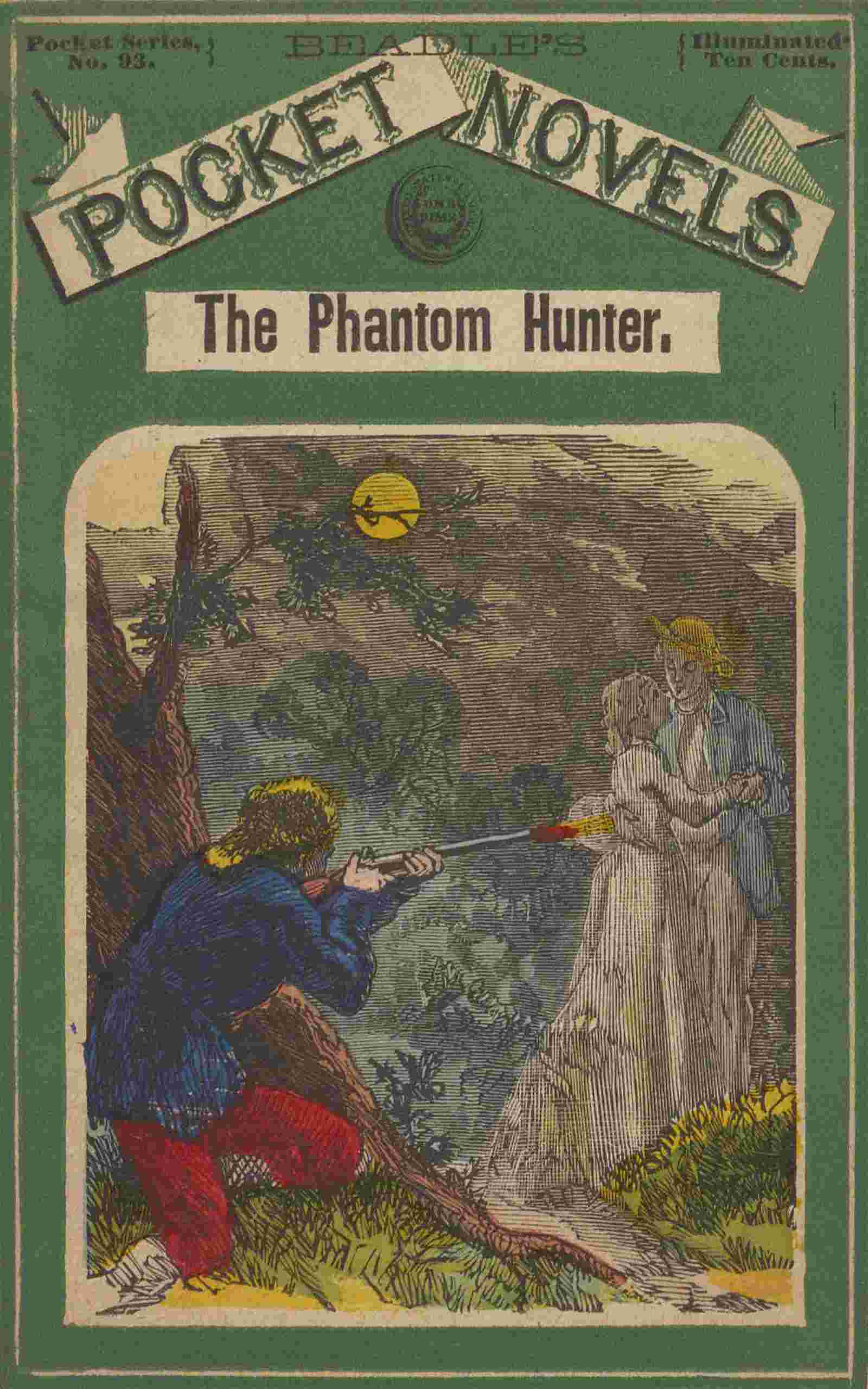
CHAPTER XV.
THE CLOCK PEDDLER’S TRANSFORMATION.
On the following morning our party of voyagers arrived safely at their destination. The men had used their oars so steadily during the night that, by dawn, they were near enough home to have no fears in finishing their journey by daylight.
As they disembarked and approached the settlement, the people came out in crowds to meet them, all surprised beyond measure to see the Morelands coming back so soon, but doubly astonished when they saw Jim McCabe among them a bound and guarded prisoner. Great was the confusion, and numerous the inquiries put to the returned voyagers. But so many questions could not be answered at once, and, answering none, our friends moved on with their captive until they reached the wide clearing just without the fort, where the execution of Russell Trafford had taken place. Here they stopped, and threw McCabe on the ground, where he lay in sullen silence, the object of wondering looks and exclamations. When something like quiet was restored, Mr. Moreland confronted the crowd and explained to them, in a few words, that which they were clamoring to be informed. He told them that the cause of their return was the discovery that McCabe was the real murderer of Doctor Trafford, who had been burned alive in his own house a short time back, and, for which assassination the victim’s nephew had been compelled to suffer. He also told them that the profligate was the friend and ally of that notorious renegade, Simon Girty, and related how the two fiends had hatched a plot to surprise and butcher the party on the island. Then he went on to explain how all this had been found out by the bold and cunning hunter, Nick Robbins; how the latter had dogged him with a perseverance worthy of the cause—thwarted his purpose by the utmost daring and coolness—and led him into a trap, where he exposed the secret of his crime in the hearing of the emigrant party.
Mr. Moreland held the attention of his audience enchained while he was speaking, and his clear, calm voice was the only one to be heard throughout the recital. But no sooner had he finished than the storm broke. Yells of rage made the welkin ring, and, wild with excitement, the men rushed to the spot where the helpless prisoner lay, as though they would annihilate him without a moment’s warning. Shouts of, “Shoot him!” “Knife him!” “String him up!” “Here’s a rope!” etc., were clamorously indulged in. There was scarcely a man present who did not recall the last words of Russell Trafford, as he spoke from the scaffold, and realize that an innocent man had been put to death! The revelation maddened the honest settlers, most of whom had been firm friends of the young man, and, as they thought of the awful mistake they had committed, self-reproach did not satisfy them. Here was the real murderer in their power—the black-hearted wretch who had caused the destruction of those two lives. Should they spare him? Never! Should they submit him to the condign punishment of the rope? Yes! a thousand times, yes! Nothing milder could satisfy their fierce indignation. With shouts and curses they gathered round the prostrate brute with drawn weapons.
In all likelihood the defenseless captive would have been violently dealt with, but for the timely interference of Mr. Moreland, Kirby Kidd and several others, who interposed their bodies and commanded the crowd to move back.
“Men,” shouted Mr. Moreland, “for the sake of heaven calm yourselves, and wait until you hear all. If you harm the fellow in his present helpless condition, you will regret afterward that you did not wait. No punishment is too bad for the wretch, but, whatever is done to him let it be done with due deliberation, remembering the sad result of our hastiness on a former occasion.”
This partially quelled the disturbance. The excited men moved slowly back, though not without murmurs of disapprobation, and more than one deadly weapon was shaken threateningly at McCabe, as they widened the circle around him. The exposure of the fellow’s villainy seemed to have maddened them. To think that he had been living peaceably among them—he, a confederate of Simon Girty, and the murderer of Doctor Trafford—he, who had caused them to make the awful mistake of hanging an innocent man in his stead! Indeed, it was enough to infuriate them.
“It has been irrefragably proved to us,” continued Mr. Moreland, “that our prisoner is guilty of that dark deed, for which we have caused one of our noblest and most inoffensive young men to suffer the worst punishment of the law, but, for all that, we can not see him unjustly dealt with. Whatever we do, I repeat, let us do it in the full possession of our senses. Give him a fair trial. Here’s a boy, the cousin of the prisoner, who has something to say that is quite important.”
As he spoke he lifted Mike Terry above the heads of the assembly, and placed him on his shoulder, that he might be seen and heard by all. At first the boy could not utter a word, but after several attempts he found his voice, and began. There was profound silence while he spoke. He gave his evidence in a remarkably clear and straightforward manner, nor faltered when he observed the black looks that were bestowed upon him, as he told of the part he had taken in the destruction of his master’s life. But as soon as he finished he burst into tears, and told them to hang him if they wanted to, as he deserved it. Mr. Moreland placed him on the ground again, and whispered a few comforting words in his ear, assuring him that he should not be harmed.
To the surprise of all, Jonathan Boggs, from Maine, now stepped out before the people, and cleared his throat as if he were about to make a tremendous speech!
He looked around on the many faces that were turned upon him, with all the gravity and grandeur of a renowned orator. He took a large handkerchief from his pocket, pushed his hat back from his forehead, wiped his face and blowed his nose. Then, clasping his hands behind him, he again cleared his throat, and once more swept his eyes over the staring multitude.
This was too much for those whose susceptibility of titillation was not entirely drowned by the general excitement and anger, and there was an outburst of boisterous laughter at the Yankee’s expense. Some cried, “Give him air!” others, “Don’t crowd the speaker!” while a shrill, piping voice demanded:
“Why don’t he take off his hat and stand on it, so’t we can all see him?”
These and similar sallies were aimed at the luckless New-Englander, and the boys, taking it up, began to hoot at him most unmercifully, one mischievous urchin making so bold as to slip forward and pull one of his long coat-tails.
But all this did not drive Jonathan Boggs from his position. Raising one hand, he commanded, sternly:
“Silence! Hold your goll-darned tongues till you know what you are laughin’ at!”
Strange to say, these words served the purpose. The noisy ones immediately became quiet, and taking advantage of the lull, the clock-vender resumed:
“Hearken unto me, and weigh well my ejaculations. I appear before you this morning to deliver a most important address—or rayther, undress—but, ef you don’t listen, how in the name of Tabitha Simpson do you expect to hear? Look at me! Gaze on me! I’m goin’ to open your eyes with wonder, and relieve your minds of the erroneous conviction that you have hung a man through mistake. Watch my movements, ladies and gentlemen, and mark the transformation!”
Before any one could divine his intention, the Yankee had grasped his swallow-tailed coat by each lapel, and thrown it off, dropping it upon the ground! Then he made another quick movement, and off went the tall, bell-crowned hat, accompanied by a mass of tow-colored hair, and followed by several smaller “fixin’s” that completed the disguise. In less time than it takes to tell it, all that remained of Jonathan Boggs lay in a small heap on the ground!
In his place stood—who but Russell Trafford!
The effect of this transformation on the throng of settlers who witnessed it, may be more easily imagined than described. Everybody in the settlement knew that ludicrous specimen of the Maine Yankee, known by the name of Jonathan Boggs, and to see him change himself into a man whom they had never expected to see again on earth—no wonder every tongue was paralyzed, every form petrified!
For a full minute it was thus. A silence like that of the tomb hung over the spot. It seemed as if the people would never recover from the effects of their amazement. Russell Trafford stood before them, as natural as life, his fine form drawn up to its full hight, and a smile playing over his handsome features as he calmly noted the result of his disclosure. And yet, how could it be he? They thought—nay, they knew he was dead. They had seen him hung, and had followed him to his grave. Surely no man could live after hanging as he had hung; much less leave his grave.
Young Trafford did not wait for them to recover the use of their tongues, but embraced the opportunity their silence afforded to explain to them the mystery. Lifting his rich, manly voice, he began to speak.
“Friends,” he said, “I disclose myself to you to-day, knowing that I am at last out of danger, and once more free to take up my abode among you, in my own name and guise. Until this hour you have supposed me guilty of the murder of my uncle, and also thought you put me to death for the same. I am still alive, as you see. You are struck dumb with amazement, but I will explain all to you in a very short time. I am not a spirit, nor am I other than he whom I now seem to be. I am Russell Trafford, in the full possession of my health. After my conviction and sentence, you all know that I was locked up in the block-house, there to be in durance vile until the day set apart for my execution. Some of you know, likewise, that during my imprisonment, Kirby Kidd, and Wapawah came to the block-house and asked the privilege of a private interview with me. Their request was readily complied with, and the two scouts were shown into my cell. As soon as they were left alone with me, they announced their intention to save my life, if it could possibly be done by artifice. Of course this was wholly unexpected to me, and, at first, I was inclined to be incredulous. But they assured me it was no jest; they had consulted and decided, and they had determined to save me if it lay in their power to do so. Kidd declared that he would not have lifted a hand in my favor, had he thought for a moment that I was the real perpetrator of the crime; but he could not believe me guilty, and knew he was doing right in case I was innocent. He told me his services had already been solicited and engaged for executioner, and that that was vastly in our favor.
“The stratagem resorted to was this: a leather strap was fastened firmly around my shoulders, underneath my clothing, in such a manner that the noose of the rope could be easily and quickly attached to it. By this means the noose would be prevented from closing on my neck, and I would hang by my shoulders instead.
“It is needless to tell you that this plan worked to a charm, for my presence here to-day proves that it did. You will remember that it was Kirby Kidd who proposed using a death-cap, and that he furnished the article himself without consulting any one. This was to conceal my face at the last moment, so that its very lifelike appearance would not betray the ungenuineness of my death-struggles. At the time you thought the last breath was forced from my body, I was suspended in comparative ease, and was breathing as freely as any of you. Pretending to fear that the mob would visit some foul indignity upon my body during the night that followed, Kirby Kidd and Wapawah obtained permission to take charge of the supposed corpse, and guard it until the next day. In the dead hours of night we filled the coffin with a heavy stick of timber and some dirt, and fastened the lid securely over them. Next day the funeral services were performed over this stick of wood, with great solemnity, and almost the entire population of our village followed these remains to their last resting-place! I was kept closely hidden until my two friends procured me the disguise which I have just cast off. On the third day after my would-be execution, I made my appearance among you in the character of a Yankee clock-peddler. I went to the house of Mr. Moreland on that same day, and, finding Isabel alone, I disclosed my identity to her, and explained all. I did not deem it safe to impart the secret to her parents, though I think they had faith in my innocence.
“Isabel promised to meet me that night out in the glade where they had made the grave for me. There I could lay aside my disguise and meet her as of old. At a pretty late hour I repaired to the appointed place, accompanied by Kidd, Wapawah and Robbins, who were to keep watch, and warn us if anybody should chance to come that way during the few short moments of our tryst. These three men stationed themselves in the edge of the woods, while Isabel and I stood by the new-made grave and conversed. It seems that this fellow, McCabe, was hanging about the place at the same time. How he approached without attracting the attention of the guards it is impossible to tell, but he did it somehow or other, unless he was there before our arrival. The first intimation we had of his presence was a loud oath, followed by a vow that somebody should die if he had a hundred lives! I presume the “somebody” was myself, for the next instant he came bounding toward me with pistol in hand. Kirby Kidd was too quick for him, however, and caught him by the collar before mischief could be done. While the scouts claimed his attention, the lady and I quickly ensconced ourselves in a large hollow tree that stood near by, and after trying to make him believe he had seen nothing, they let him depart. We continued our meetings there night after night. I knew the nature of McCabe too well to believe that he would subject himself to ridicule by asserting that he had seen Russell Trafford, when everybody would have sworn that I was dead. So we did not change our trysting-place. Sometimes the three hunters would accompany us, but they were often absent from the fort and could not.
“We did not know that anybody besides McCabe ever saw us there together, but you all know that a report got afloat that Isabel was meeting a stranger in the woods almost every night. Isabel herself was ignorant of the existence of this report until the very last moment, on the evening that she was to be taken away from her home. Noble and self-sacrificing as ever, she suffered herself to be traduced rather than betray me. That night, after the Morelands had gone to the river to embark on their brief voyage, Isabel returned to the house on pretense of having forgotten some small article. Her object in thus deceiving her parents was to keep her appointment with me, and to tell me that she was going away—which she did. But it so fell out that McCabe was again lurking about the glade that evening, and he saw us as we sat side by side on the grave. He discharged a rifle at us, but the ball went wide of the mark, and, under cover of the smoke, we ran to the hollow tree that stands on the edge of the glade, and hastily concealed ourselves in its ample cavity. He searched for us for some time, but in vain. For fear he would find us, I quickly donned my disguise and went forth from my hiding-place, to throw him off the track. As Jonathan Boggs I confronted him, and made him believe they were imaginary beings he had seen. When he was gone Isabel joined me, and together we went to the river where her parents were awaiting her. I obtained permission to make one of the emigrant-party, and that is all I have to tell.”
For a moment after this explanation was ended that deep silence continued. Then Mrs. Moreland clasped her wronged daughter in her arms and began to weep hysterically, while the former friends of the noble girl went forward to crave her pardon, and offer her their congratulations.
This was but a signal for the men. In an instant cheer after cheer rent the air, and the hardy settlers rushed forward in a body. Lifting Russell Trafford upon their shoulders, they bore him round the spot with shouts of joy, and the wildest confusion reigned. A great many, among whom was Mr. Moreland, shook the hands of Kirby Kidd, Nick Robbins and the Wyandott until the arms of the three champions ached from wrist to shoulder.
The tumult soon subsided. Then Russell, after thanking all for their manifestations of renewed friendship, joined the Moreland family and received the blessings of his future parents-in-law. Isabel was once more smiling and happy, and among those who had looked upon her with scorn a few days before, not one asked her forgiveness in vain. Her dark, luminous eyes beamed with unutterable love and tenderness upon her affianced husband, and the rich color stained her beautiful face and neck as he drew her arm through his, and began to walk up and down in the background.
As soon as an opportunity offered, Nick Robbins stepped forward to address the people. All guessed at once that he had something of importance to say, though none could imagine what it was. Every tongue was hushed, and every ear opened, as the grim old hunter took his position. He gazed blankly at his audience for a moment, and then began to speak.
“I ain’t got much to say,” he said, leaning on his rifle, “but I reckon ye won’t ’spect much from sech as me. I’m goin’ to open yer peepers ag’in, same as the young feller did. I don’t like to see ye surprised so powerful bad, but then I calc’late the shock’ll be a leetle milder this time, ’cause yer gittin’ used to it. Prepare yerselves now to see somethin’ wonderful, an’ don’t git it into yer noddles ’ut yer in fairy land, or any sech outlandish place.”
As he uttered the last words he dropped his gun, and straightened up. To the astonishment of the lookers-on he then snatched off his coon-skin cap, together with a wig of long hair and the bandage that had covered his eye! Next he removed the patch from his cheek, the coarse red beard from his chin, and then he quickly threw off his buck-skin garments.
In a single instant Nick Robbins had vanished, and Doctor Trafford stood revealed before the crowd!