
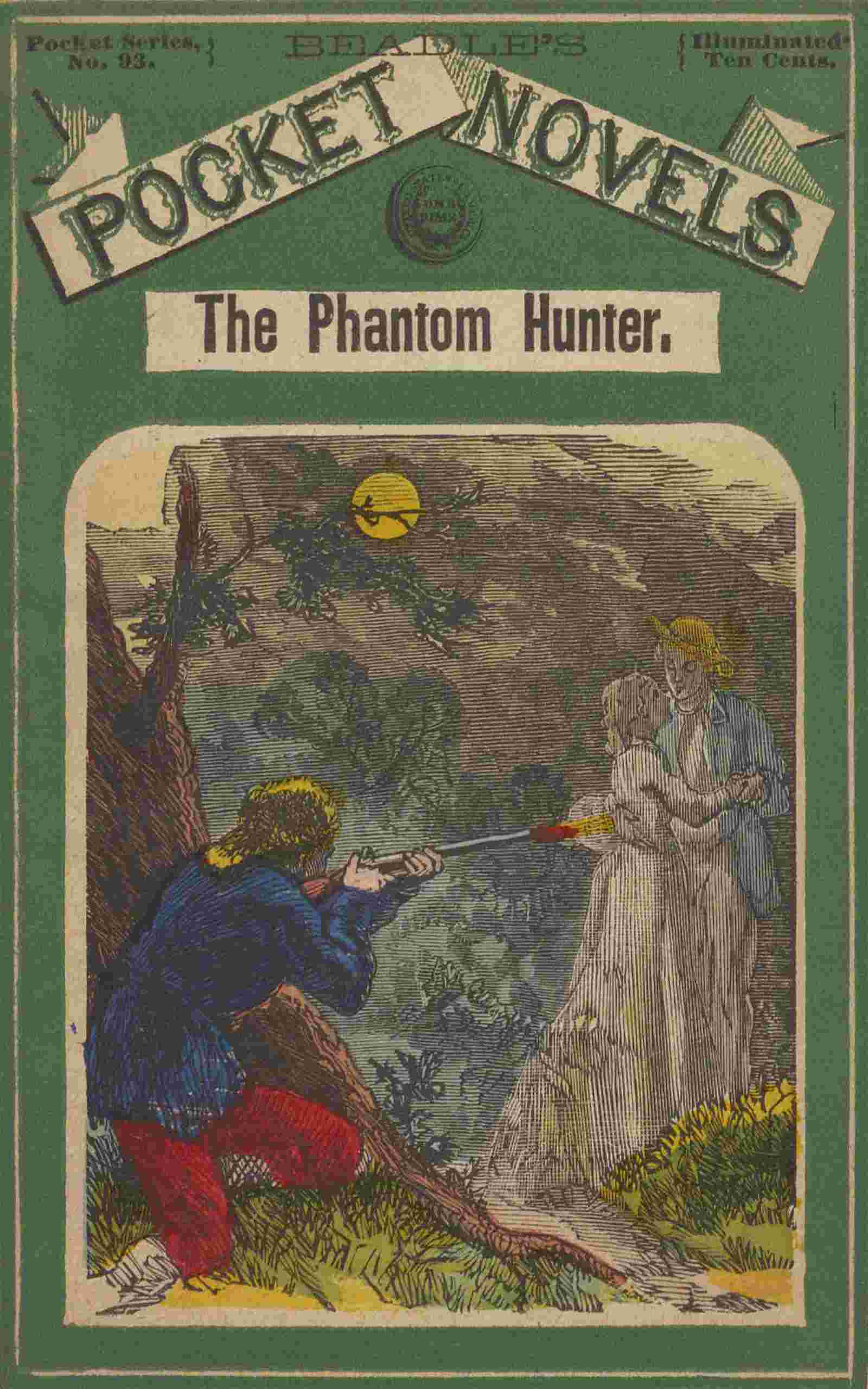
Isabel Moreland stood in the doorway of her father’s cabin one morning, two or three days after the execution of her lover, Russell Trafford. She was very pale, but very calm. The roses, which had been the admiration of all, were gone from her cheeks, and her dark, soulful eyes, which had been the particular admiration of her ill-fated lover, were hollow and unusually large. A sad, pitiful, expression dwelt in their clear depths, and the lines on her forehead told a tale of mental suffering. The settlers who passed that way, seeing her standing there, marveled at the change that had taken place in her since the death of young Trafford, and felt their hearts moved to pity for the broken-hearted girl.
Presently a man sauntered up to the door, attracted thither by the charming one who stood there. He was a big, burly fellow, with the brute plainly stamped on his coarse, red face, and an air of reckless depravity about him that proclaimed him any thing else but a man. He wore a slouched hat, pulled carelessly down on one side of his head, completely hiding his right eye. This was Jim McCabe, the veriest bully and profligate in the settlement, who, it was said, was so devoid of principle that no piece of deviltry was too great for him to commit. He had been one of Russell Trafford’s rivals in love, and of all the rivals he had been compelled to contend with, Russell had regarded Jim McCabe as the most insignificant. But, now that his successful competitor was out of the way, McCabe seemed to think it possible to thrust himself into the vacant place, and seeing her this morning at the door of her home, he determined to seize the opportunity of renewing the contest for the much-coveted hand and heart.
“Good-morrow, Miss Moreland,” said he, with a profound bow, and an attempt to smile pleasantly.
“Well, sir?” returned the girl, coldly.
“Perfectly well, I thank you,” replied the rogue, choosing to misconstrue her words. “But, really, Miss Moreland, you are looking decidedly unwell to-day. What can be the matter, if I may ask? Are you ill?”
“Not particularly.”
“No? Now that is strange. One would suppose that you had just risen from a prolonged illness. You see I am naturally concerned for the health of one so dear to me. By the way, that was a sad affair about Doctor Trafford and his ingrate of a nephew, wasn’t it?—a sad affair all round. As a friend, I feel for you deeply, but I think you were fortunate in thus finding out the character of your intended husband before—”
“Sir, I must trouble you to drop this subject now and forever.”
Isabel Moreland turned her flashing eyes upon the man as she spoke, and gave him a look that made him recoil. But, quickly recovering himself, he replied, in a tone of apology:
“Why, I did not suspect that I was treading forbidden ground. I only wished to express my sympathy for you, and you certainly need it, since your favored suitor has proven himself only fit to grace the end of a rope.”
“Do you persist in talking of this?” demanded Isabel.
“Not at all—not at all,” was the humble rejoinder. “It being your desire, the subject shall be dropped immediately. I would merely observe, what an inhuman wretch that man was to deliberately kill his own uncle, and that in the most horrible manner conceivable.”
“If you have come here to jeer and mock at me, you must continue your insults without my presence,” interrupted our heroine, and so saying she entered the house, and quietly closed the door between her and her tormentor.
Jim McCabe ground his teeth with rage. Was this to be the result of the new game he had so hopefully commenced? Did she, then, hate him so bitterly? and was her love for Russell Trafford so great that his death had produced this marked change in her lovely face? But Jim McCabe was not the man to submit thus tamely. He shook his fist at the door which shut the maiden from his view, and muttered:
“This is all very fine, my proud lady, but the time is not far off when you will look at Jim McCabe with a much softer expression in those eyes. I have played none but my loose cards as yet, but there are trumps to follow that are certain to win, and two weeks shall not pass away before I shall have the pleasure of seeing this haughty jade at my feet.”
He hissed the last words through his clenched teeth, and his usually red face grew still redder with anger.
He was walking away from the spot, when a peculiar voice behind him arrested his footsteps.
“Hello, you! Jest draw rein a minute, ef you please.”
Instinctively guessing that he was the one accosted, McCabe stopped to see who the presumptuous person was. A tall, angular specimen of humanity, with long, dangling legs and ungainly feet, was coming toward him with awkward strides. He was an utter stranger to McCabe, but the latter saw at a glance that he was a Yankee, of the raw sort, evidently just from his native State. His dress alone would have proven that fact, to say nothing of the nasal twang in his voice, and the “down-east” peculiarity of speech. He wore a tall, white hat, the nap of which stuck straight out; a pair of striped trowsers, which clung tenaciously to the awkward members they protected; and a blue, threadbare coat, whose swallow-tails reached nearly to his heels.
“How d’ye dew, stranger?” drawled the specimen, as he came up. “Right nice weather we’re havin’ nowadays, ain’t it?”
“Splendid. But what do you want of me?”
“What dew I want? Law, now, you’re jest like all the rest o’ the western folks—want a feller tew come tew the p’int instanter, without the least bit o’ prevaricatin’ or dodgin’ round the stump, as Tabitha Simpson used to say. Tabitha Simpson was my third cousin, stranger, on my mother’s side, a gal o’ the femenine persuasion, by the way, and I swan tew man, there never was a couple in all Christendom as had more fun than Tabitha and me used to have. There was one time in partic’lar—”
“See here,” interposed McCabe, crustily, “before you continue your nonsense I should like to know who you are?”
“Me? Darn my buttons! mother allus said I was the most forgitful child she had, and I’m forever provin’ the fact to myself in this very way. Me? Why, bless you, I’m Jonathan Boggs, all the way from Maine! Jonathan Boggs, stranger, a first-rate feller on the whole, who was considered the smartest member of his father’s family, until he robbed neighbor Green’s hen-roost and had to turn tail on the old humstead.”
Jim McCabe began to regard the Yankee with some curiosity.
“When did you arrive here, Mr. Boggs?” he inquired.
“I brought up in this hamlet yesterday,” replied the Yankee, squeezing his hands with difficulty into the pockets of his “tights.”
“Yesterday,” repeated the other. “It may seem strange to you, but I really think I have seen your face somewhere.”
“Dew tell? I s’pect you have, mister, for I often go there,” said the “specimen,” with provoking coolness. “As Tabitha Simpson used to say, ‘Cousin Jonathan must be known to be liked,’ and I’m glad to l’arn as how my phiz ain’t unfamiliar tew you—”
But Jim McCabe was too thoroughly exasperated by the sang froid of his interlocutor, to let him go on in this strain.
“Well, well!” he exclaimed, “if you have any thing of importance to say, I wish to hear it at once.”
“Want to know!” returned the stranger, elevating his eyebrows. “Now that’s what I call right down mean, bluffin’ a chap off in that ’ere style when he’s talkin’ ’bout the land of his birth, and old-time associations. I find I can’t talk enough to please you, but I calkilate you’ll ’scuse me on the score that natur’ neglected to put the gift o’ gab in my blamed noddle.
“Now, in that respect, I ain’t one iotum like the old woman, ’cause why? she can talk the ha’r right off o’ your head in three jerks of a possum’s ear, and ef you’s with her from Sunday mornin’ till Saturday night, you wouldn’t find a chance to crowd in a word edgewise. But I did forgit my business, that’s a fact; thereby givin’ further proof that mother told no lie, when she said as how I was etarnally disrememberin’ every blamed thing of importance. But now tew the p’int, as Tabitha allus said, when tellin’ one o’ her long-winded yarns. Tabitha had been childerns’ nuss at some time of her life, and so had acquired a habit o’ story-tellin’ that clung to her through the hull course of her existence—”
“Curse you for an idiot!” growled McCabe, irascibly, and with an oath he started away.
“Hold on, mister,” said Jonathan Boggs, coolly laying his hand on the other’s shoulder. “Don’t go off ’thout hearin’ me through.”
“Hands off, scoundrel!” commanded the settler, fiercely. “I’ll knock you down if you repeat this insult.”
“I wouldn’t dew that, mister, I swow I wouldn’t. It takes such a hard lick to knock me down that ye might cripple your hand for life. Besides, when I was a boy it wa’n’t considered healthy tew undertake sech a rash job, and even now you might not be dewin’ the right thing toward yourself.”
Jim McCabe was a coward, like all other bullies. So these words, and the manner in which they were uttered, alarmed him not a little.
“Who the deuce are you, anyway?” he demanded, sullenly.
“Jonathan Boggs, from Maine,” was the quiet reply.
“And your business with me?”
“Now that’s what I’ve been trying to tell you all along, but you wouldn’t listen. I sell clocks for a livelihood. I’ve rented a room in the block-house yonder, and by Jupiter! it’s e’na’most filled up with my clocks. Reckon you’ll buy a clock, won’t you?”
“Fool!” McCabe stamped his foot with vexation, and again turned on his heel to leave his persecutor. But again that opposing hand was laid on his shoulder, and he was once more detained against his will.
“Ain’t you gwine to buy a clock?” asked the Yankee. “I tell you, mister, they’re the nicest thing under the sun and jest presactly what you want. I swow, by gravy, it’s the most complete invention in existence. Why, the man as made them clocks died. He was tew confounded smart tew live—”
“Stop!” said the settler, imperatively. “I don’t wish to buy, and you will oblige me by discontinuing the subject.”
“You don’t tell me! Wal, I don’t wish to impose on the patience of an indulgent audience. I’ve sold so many clocks since I come, that I ain’t spilin’ for your patronage nohow, so we’ll drap the topic. I say, mister, that was a bad thing ’bout your feller-citizen, Doctor Trafford, bein’ killed in his own house, wa’n’t it?”
“It was indeed,” was the brief answer.
“It was, sure’s shootin’,” continued the Yankee; “but the wust part o’ the hull sarcumstance was the awful mistake of arrestin’ the doctor’s own nephew, and hangin’ him for the murder.”
“Mistake!” echoed McCabe, looking sharply at the speaker. “Why, sir, there was no mistake about it. Russell Trafford was found guilty before he was punished. He did do the deed.”
“Did he though? Now that beats me. I s’pose you was there, and see’d him dew it?”
“Not I, sir, but a small boy, who had been in the doctor’s employ, saw the doctor’s nephew set fire to the building.”
“Wal, the lad might have been bribed tew tell all that, you know. I’ve hearn the hull story two or three times, and I hope I may be shot for a chicken-thief ef the young man done the job.”
“Dare you assert that he did not do it?”
“Yas.”
Jim McCabe started visibly at this cool affirmation, and for an instant his naturally red face was almost pale. But he was quickly himself again, and with an incredulous smile, he muttered:
“Pshaw! the cursed fool don’t know what he’s talking about.”
Then he turned on his heel again, and this time he was off and walking briskly away before the Yankee could detain him. Jonathan Boggs looked after him for a moment with a curious expression on his face, and then turning aside, he boldly entered the house of Mr. Moreland, without so much as knocking at the door.
Jim McCabe had not proceeded far, after leaving his new acquaintance so abruptly, before he met another person who stopped him. This was a small boy, about fourteen years of age, who wore a jaunty cap, a green jacket, and corduroy knee-breeches, which revealed his nationality as plainly as did his face. He was a bright-looking little fellow, with intelligent blue eyes and rosy cheeks, and, in fact, was no less a personage than Mike Terry, the former servant of Doctor Trafford. He it was who had furnished the evidence that convicted his master’s murderer.
“The top iv the mornin’ to yeez, Jamie,” said the young Hibernian, as he met McCabe.
“Well, what do you want?” gruffly demanded the man, as the boy seized his arm to prevent him from passing on.
“An’ is it that same quistion ye’d be askin’, sure? Phat w’u’d I be afther wantin’ but money?”
“I haven’t any money,” declared McCabe, angrily.
“I know yeez have,” asserted the boy, firmly, “an’ be gorra, ef yeez don’t give it to me, sorry the day yer honor iver timpted me to desart me colors, intirely. Av I wasn’t yer cousin, Jamie, I should niver have done that wicked thing, no more w’u’d I. An’ av it was all to do over, it isn’t the likes iv Mike Terry that ’ud play false to a kind masther for love or money. For Doctor Trafford and Masther Russell were good to me, Jamie, an’ but for you—”
“Hush, Mike,” continued the man, glancing uneasily around. “Have you gone crazy, or do you wish to expose me?”
“I ain’t carin’ much phat I do. Av yeez don’t kape me in money I won’t hold yer saycret a day longer; divil a bit will I. Ye’ve med a bad b’y iv me, Jamie, an’ ye’re me own cousin, too.”
“Here; take this, boy,” said the angry man, handing him a coin, “and for heaven’s sake let it seal your lips. I can’t afford to give you money every day. Now go.”
So Jim McCabe and Mike Terry parted, both of them looking very much discontented as they walked away in opposite directions.
When they were well gone, a man rose from behind a pile of logs within a few feet of the spot where they had stood conversing. It was the man of the bandaged eye and red, straggling beard, of whom we made mention in the foregoing chapter, and as he strode away, dragging his gun after him, his face was still expressionless.
The eavesdropper was Nick Robbins.