
The vivid blush that mantled cheek and brow, as her eyes met his, in no way deteriorated from the prettiness of her face, Clancy thought; and when she stepped forward half-shyly and put her trembling little hand in his for a moment, I think he may be pardoned for allowing his heart to look out of his eyes and wishing, as he choked back words that struggled for utterance now harder than they had ever done before, that just a little while his old friend Darke was in China, or Jericho, or anywhere but there, witnessing and, in his quiet way, enjoying the young people’s happy confusion. I am sure any of my readers who may ever have been placed in a similar situation will exonerate him from all blame.
The young hunter looked pale and worn, and Darke noticed that when he came forward to take the seat Vinnie had placed for him before the fire he walked with considerable difficulty.
In reply to the woodman’s inquiries in regard to his jaded appearance and the manifest trouble he experienced in walking, Clancy told the story of his capture by the Indians the day before very substantially as it has already been told the reader in the preceding pages of our story.
It is not necessary that we should weary the reader with a recapitulation of what has already been stated; but taking up Clancy’s narrative at the point where consciousness returned, we will follow it to its close.
“When my senses came back,” said he, “I found myself reclining on a couch of skins and blankets in what appeared to be a very small apartment of a cave. I was watched over by a dwarf, who was not much more than four feet high and as dumb as a door nail. This diminutive watcher strengthened me by a liberal use of spirits, and as soon as I was able to speak, summoned his giant brother, who, unlike himself, was gifted with a ready tongue and introduced himself to me as Leander Maybob, of Maybob Center down in old Massachusetts. He said he was a ‘natural talker,’ and proceeded to substantiate the statement by a very wordy account of the sayings and doings of his uncle Peter and an old Massachusetts minister named Tugwoller, interspersed with snatches of an old love affair between Elder Tugwoller’s niece, Sally Niver, and himself. It seems that the young couple, who were, of a verity, true lovers, were separated for life in consequence of a ludicrous blunder on the part of my giant host.
“After awhile I gathered from his voluble flow of words that he had rescued me from my perilous situation and brought me to his cavern lodge. When I had sufficiently recovered from the effects of my swing, I partook of some strengthening food that my new-found friends prepared for me. That was early this morning. As the day advanced, I found myself rapidly gaining strength; and an hour or more ago I felt myself strong enough to come on here, and, thanking my strange entertainers for their kindness, I took my departure. As I passed out through the cavern I saw that it was also divided into two larger apartments, one of which was used as a sort of home by the two strangely contrasted twin brothers, and the other was fitted up as a kind of store-room for trophies of the chase, for it was well supplied with arms and ammunition, while the skins and pelts of various animals were deposited in piles about the place.”
“How much the latter part of Clancy’s story is like yours!” exclaimed Vinnie to Darke when he had finished. “He was rescued by the same strange person and taken to the same place and nursed back to life in the same manner!”
“Yes,” assented Darke, “it is a singular coincidence.” Then turning quickly toward the young hunter he said, “You must have lain insensible in the smallest part of the place while I was there—I think you did. They did not tell you that I had been there before you came away, did they?”
“No,” said Clancy, who had been wondering all along at the strange words of the woodman, “they did not tell any thing of the kind. I never knew it till now.”
“Strange!” replied the other. “And although I am sure I was there for quite a length of time while you lay unconscious in the little place curtained off at the back end of the cavern, the giant did not tell me of your presence. It can not be that there was any cause for this concealment; and concealment does not seem to be a predominant trait of the big hunter’s.”
“I do not understand you,” said Vere wonderingly. “Do you mean to say that we were both at the cave at the same time? Please explain yourself.”
And Darke told Clancy the story of his accident the day before, and how Leander Maybob had carried him to the cavern lodge of his brother Alonphilus and himself, cared for him till he was able to come home, carefully guarding against any allusion to the oaken chest and its ghastly contents, but telling him of the strange episode of the little apartment, and repeating the mysterious words of the giant hunter, whose meaning he had until now vainly tried to discover. They held no hidden portent now. He knew instinctively that the words he had so vainly wondered at, “Does he show any signs of life yet? Can’t be he is dead!” referred to Clancy Vere.
One mystery was solved!
For several minutes both men remained silent. Darke was ruminating over the discovery he had just made and Clancy was thinking what a lovely picture Vinnie made as she leaned carelessly against the mantle, looking intently into the dancing blaze of the fire, whose red glow lit up her fair face till it seemed fairly radiant in its fresh young beauty.
Was she building air-castles again?
Clancy was!
Raising her long lashes suddenly, she met his ardent, passionate, yet respectful gaze.
Both pair of eyes sought the floor simultaneously; and it would have been no easy task for one to have determined which face flushed the deepest—the maiden’s or her lover’s; for Clancy Vere knew he did love Vinnie Darke with all his heart.
Darke had not noticed this little by-play, and he asked, suddenly, as the pretty air-castles both had been rearing up vanished as air castles are wont to do when they are rudely jarred:
“How long do you think you were at the cavern before your consciousness returned?”
“I am not quite certain—two or three hours I guess.”
“And it was Leander Maybob that rescued you?”
“Yes; but he did not himself carry me to the cave. It was more than a mile away that he found me; and although he is very strong, he could not lug me on his back all that distance. When consciousness returned he told me about it. Alonphilus the dwarf conveyed me to the cave.”
“How?” asked Darke.
“Oh, Leander told me all about that, too. I was brought on a horse—”
“What color was the horse?” interrupted Vinnie.
“On a white horse!” pursued the woodman.
“Yes.”
“You were rolled up from head to foot in a heavy black cloth, were you not?” Darke went on, eagerly.
“I do not know,” said Clancy, surprised at so many questions. “But he carried me before him across the saddle.”
Father and daughter uttered simultaneous cries of surprise.
Another mystery was solved!
CHAPTER XII.
THE FOREST ROSE.
Ku-nan-gu-no-nah walked swiftly away with the deadly rifle of Leander Maybob, the giant hunter, still leveled at his head, fairly demoniac with wild and impotent rage. The workings of his dark face were fearfully suggestive of the denizens of the bottomless pit.
Had he been armed he would not have left the vicinity without first attempting the life of the man who had him in his power and who held his very life at his disposal; but he was powerless, having no weapons except a short, sharp-pointed knife which he always carried in addition to his hunting-knife, and this would be useless, except in a hand-to-hand conflict, which even in his wild passion he had not the hardihood to dare.
In an hour’s time he came to the boundary of the wilderness and the broad prairie stretched its level surface before him as far as he could see. Not a tree or a bush was there visible in all this vast plain; only the tall grasses, beat down and tangled by the fearful tempest that had raged through the afternoon.
Turning from the nearly direct course he had been pursuing, the chief made his way, with long, rapid strides, to the place where, in the midst of a dense growth of bushes in the center of which there was a little plat of smooth, grassy ground, destitute of undergrowth, he had tethered his horse early in the afternoon. In less time than it takes to tell it, he was mounted and galloping away over the plain.
In a little while he struck an indistinct, scarcely worn road, or rather broad track—one of the emigrant routes of the North-west. He followed the track for an hour or more and then making a gradual detour to the left, kept on at a swift rolling gallop which he never slackened till he reached the Indian encampment, situated at the foot of a steep, rocky hill that loomed up through the storm and darkness, in dull relief against the leaden sky. Throwing himself hastily from his horse, he stalked rapidly along and entered a wigwam at the further end of the encampment. An aged Indian sat on a roll of skins at one side of the place, in an attitude of deep grief or despondency. He simply glanced up as the chief entered, then dropping his face again into his hands, sitting silent and apparently in great agony of mind.
“How is the Forest Rose to-night?” the chief asked, glancing toward a couch of skins and blankets on the opposite side of the lodge, on which he could see the form of a female reclining by the dim fire-light that illuminated the wigwam. She lay silent and motionless as though life had fled.
“The Forest Rose is very ill,” replied the old Indian, mournfully, “and she will die! Yon-da-do, the great medicine man, has said so. He has made use of all his ceremonies and mystic arts, but he can not save her. The lovely Forest Rose must die!”
As he ceased speaking he arose, and lighting a small pitch-pine torch in the fire, went over to the side of the couch. Throwing aside the covering from her face, he allowed the light to fall upon it for a moment. It was a beautiful face, darkly lovely—the face of an Indian maiden in the first flush of womanhood. She was rather light for one of her dusky race, with heavy masses of raven-black hair falling in lovely confusion about her statuesque face, in whose contour the hard angularity of the Indian type was not discernible, and down upon her perfectly-shaped neck, and softly-rounded shoulders. Her long, heavy lashes lay upon her cheeks, which were very pale, hiding her dark lustrous eyes, which, when lighted up with health, added not a little to her almost bewildering beauty. But now the lovely Forest Rose lay like one dead.
“Let my father look up and be happy!” said the chief. “Ku-nan-gu-no-nah has seen a medicine-woman to-day, that can surely bring back life to the Forest Rose. The medicine-woman that I saw was a mighty conjuror. The Great Spirit has given her greater power than that of Yon-da-do!”
“Who is this mighty magician?”
“She is a pale-face maiden, as beautiful as the Forest Rose,” replied the chief.
“Would she come?” asked the old Indian, while a hopeful light flashed out of his aged eyes, undimmed by the flight of time. “Would a white medicine-woman come to give life back to an Indian girl!”
“She would not come willingly,” said the crafty chief, “but she must be brought! If she is not, the Forest Rose will die!”
“Then she must be brought!” said the old Indian, decisively. “I will call a council of braves in the morning, and a party shall be sent to bring the white magician. The Forest Rose must be saved!”
The aged Indian was the real chief of the tribe—that is, although he was too old to go on the war-path, leaving the active fighting to the younger and more warlike Ku-nan-gu-no-nah, he was the real moving spirit, always planning and ordering all important movements of the band. The languishing Forest Rose was his daughter.
“It is well,” said Ku-nan-gu-no-nah, as he went away.
“The great medicine-woman will save the Forest Rose, and again she will sing like the birds in the trees to gladden the heart of her father, the great chief.”
Wild Buffalo, the aged sachem, called a council of braves early in the morning, and at midday, the subtle Ku-nan-gu-no-nah, at the head of a dozen picked warriors, was riding over the prairie in quest of “Sun-Hair,” the beautiful magician.
CHAPTER XIII.
THE FACE AT THE WINDOW.
“So the mystery of the disappearing horseman is explained very satisfactorily at last, Vinnie,” said Darke, after their surprise had subsided somewhat.
“Yes,” she replied, “all but the mystery of his disappearance.”
“True,” said her father; “we are still in the dark concerning that. How could it have been accomplished?”
“I know not. It vanished before my very eyes!”
“It was doubtless owing to some peculiar turn of the path he was following, or something of that sort,” reasoned the woodman. “A very sudden turn among the dense growth of shrubbery that is so thick about the place might have concealed the white horse and his rider from view almost instantly.”
“I think very likely it was owing to that or a similar cause,” returned Vinnie. “I suppose we shall have to accept that explanation till a better one presents itself. It is strange that I should have allowed myself to be alarmed at so trivial a matter. I do not think I am superstitious. But that limp, helpless-looking black thing did appear ghastly through the storm!”
It will be remembered that Clancy had not heard of Vinnie’s adventures and perils of the day before; and he did not understand the conversation that the others had kept up for the past few minutes. Noting the questioning look on his face, the woodman said:
“There is still another story of peril and escape that you are yet to hear. I believe I will take a short bout in the forest in search of a turkey; and if I am successful we’ll have a supper fit for the President. Vinnie can tell you the story while I am gone. Be sure you don’t leave out any of the important points, and don’t forget to mention your lover’s visit yesterday. A truthful account of the shocking manner in which you treated him ought to be a caution to sparks! If I was a young fellow, now—”
“There now! stop!” said Vinnie, with a vivid blush. “I think you’re really too bad! And besides, you are not fit to go out to-day, after your hurt, and—”
“That will do,” interrupted Darke, banteringly, examining the lock of his rifle the while. “I am well enough for any thing now, and I mean to take just this one more hunt while I’ve an opportunity. I dare not leave you here any more alone, you know, and I’m going while I’ve got Clancy here to keep guard over you! So good-by, and don’t think of my coming back for two hours at the very soonest!”
She went up to him for her customary kiss.
“There,” said he, as he bent and pressed his lips to hers. “Good-by, little one. And, Clancy, I want you to see that no one repeats this operation during my absence. She’s all I’ve got, and I leave her in your care. Don’t forget the story, Vinnie!” And a moment later he passed out, closely followed by the blood-hound. Vinnie seized hold of one of the great brute’s long ears, and bending low over him, to hide her flushed face from Clancy’s view, said, playfully:
“There, Death, don’t run away from him as you did from me yesterday!”
Then, while the young hunter thought she was putting herself to a great deal of useless trouble, considering that the room was very warm already, she went and busied herself at the hearth, for what seemed to him a very long time, stirring the fire and putting on more wood.
“What story does your father mean?” he asked, when she had at last finished. “I thought from what you said that you saw the dwarf when he was carrying me to the cave. It can not be that you were out in that terrible storm?”
“But I was,” said Vinnie, with a smile, “and I half think I was the victim of almost as serious a series of accidents as yourself. Papa told me to tell you the story, and I suppose I must obey. Are you sure it will be of interest to you?”
“Yes,” he replied, eagerly. “I know it will be of interest to me. Tell it, please.”
And, half shyly at first, Vinnie complied with his request. He interrupted her many times during her recital, with exclamations of surprise and wonder; and when she had finished, and sat demurely before him, with her little hands folded in her lap, and her lovely face sober and thoughtful, he said:
“Heaven be praised for your deliverance! What if you had not escaped?”
“Why, then, I suppose—” she began, surprised at his excited manner. But he cut short what she would have said, by saying, vehemently:
“If you had not, I would not now account my life worth as much as a burnt charge of powder!”
Vinnie glanced up at him quickly, but her long lashes drooped as she met his ardent look.
He arose to his feet, and standing up before her, went on in rapid, eager tones:
“I love you, Vinnie Darke, as I can never love another woman in the whole world! I ask for your love in return. Can you—will you give it to me, Vinnie darling?”
She sat silent a moment—a moment that seemed interminable to the anxious young hunter—with flushed face and downcast eyes. The next, she was clasped in his strong arms, and he pressed a tender kiss on her brow, as he said, in a low voice:
“Do you love me, Vinnie?”
The lovely, golden-brown head bent down until it was pillowed on his bosom, the red, full lips were pressed half timidly to his, the deep, loving blue eyes looked trustfully up into his own, and Clancy knew that she was his till death!
“My own darling Vinnie!” said he, proudly.
“Yes,” she whispered, “yours always!”
I am afraid if the woodman could have seen the little episode that was taking place in the cabin then, he would have thought Clancy just the least bit forgetful of the injunction he had put upon him when he went away—of course he would not willfully ignore it!
There was a slight, almost imperceptible sound outside the cabin, that escaped the young hunter’s usually quick ear, and a dark face was pressed for an instant against one of the lower panes of the little window at the side of the door. It was withdrawn almost as soon as it appeared.
“And you will be my wife, Vinnie—mine to love and cherish always?” Clancy went on.
“Yes.”
“And your father? What will he say?”
“I do not think he will oppose us very strongly,” she said, remembering his words to her that afternoon.
“We will ask him and see, when he comes back.”
Again that dark face peered into the room a moment and then vanished as it had done before.
But so engrossed were they with each other—their minds so filled with their new-found happiness—that they had no time to think of any thing else.
“How hard I shall try to be worthy of your priceless love, and to make your life happy!” said the young hunter, as she released herself from his embrace. As she stood up, her eyes were turned toward the window.
The face was flattened against the glass again!
“Merciful Heaven!” she cried, “there is Ku-nan-gu-no-nah! Oh, Clancy, save me!”
CHAPTER XIV.
VINNIE A PRISONER.
Darke had been gone but a little while from the cabin, before he was startled by the report of fire-arms, and the shrill war-whoop of the band of Indians who, under the leadership of the wily Ku-nan-gu-no-nah, had been sent out to capture Vinnie and bring her to the relief of the suffering Forest Rose, who, although they knew it not, was dead, having dropped quietly and peacefully away soon after they left the encampment.
These sounds came from the direction of the cabin, and by a kind of intuitive perception, he knew in an instant what was taking place there.
He had just discharged his rifle at a fine turkey that the blood-hound had come upon in a dense thicket; and reloading it as he ran, he dashed with his utmost speed through the tangled undergrowth and over fallen trees and heaps of half-decayed brushwood back toward the scene of the conflict, which still continued, as the sharp, oft-repeated reports of guns and the appalling screeches of the Indians attested.
The terrible suspense and agony of mind that he suffered in the few minutes that passed before he reached the edge of the clearing, it would be impossible to depict. He knew that the young hunter was as brave as a lion, and would not give up while life lasted; but he judged from the steady and rapid fire kept up by the savages that the odds against him were fearful.
“My God!” he gasped, as he bounded forward, holding his long rifle ready for use at an instant’s warning, “the bloody fiends will butcher them both! If I could only be there to help them!”
Suddenly, as he ceased speaking, the firing, which for two or three minutes past had been almost incessant, stopped. There was a moment of awful silence to the listening woodman, then there came a loud crash.
Darke knew what this was.
“Heavens!” he cried, “the devils have forced the door! Nothing can save them now! Their doom is sealed! Oh, Vinnie! Vinnie!”
His agony was terrible.
He had reached the boundary of the clearing. It was rapidly growing dark now, and he had little fear of discovery. He paused a moment to reconnoiter. Only two Indians were visible outside the cabin. He raised his rifle to his face; his aim was quick and sure; and an instant later one of the savages threw up his arms, and with an ear-splitting screech of agony, fell on his face, dead.
Almost simultaneously with the report of the woodman’s trusty weapon, another rung out inside the cabin.
“It is Vinnie’s revolver!” muttered Darke as he stepped quickly out of sight behind a clump of bushes and proceeded to reload. “Thank God she yet lives!”
Peering out, he discovered that the remaining Indian had set fire to the cabin and was skulking around the other side, probably to get out of range of his unerring rifle.
It was nearly dark now, but the settler fired again, and a bullet went crashing through the savage’s brain, just as he had almost gained the coveted shelter.
Vinnie’s revolver cracked again inside the cabin as Darke rammed home another load; and he uttered another fervent “Thank God!” as he thought that she had been saved thus far. At his request, she had placed it upon her person that morning, and he had reason to think that it was being fired by her own hands. He could not distinguish the sound of Clancy’s weapon from the Indians’; but he knew him well enough to be certain that he would not yield except with his life.
The fire was creeping up the side of the cabin, gaining ground rapidly in the dry timber of which it was constructed. In a few moments the whole building would be in a light blaze. An attempt to extinguish the flames would, Darke saw, be fruitless.
There was no one to oppose his advance across the clearing since he had slain the two savages left on the outside to fire the cabin and guard against a surprise by any one from without, and closely followed by Death, he dashed over the intervening space to the open door of the cabin.
Looking within he saw, by the light of the fire blazing on the hearth, that Clancy Vere was engaged in a desperate, hand-to-hand struggle with three Indians. His back was against the wall, and with an almost superhuman effort he forced them back and kept them at bay with his clubbed rifle. Their guns were not loaded; but the young hunter detected one of the trio in the act of charging his rifle, while the two others vainly tried to get at him with their knives, and, quickly whipping out his six-shooter, one chamber of which held a leaden bullet that soon proved a quietus to this most dangerous of his assailants, he discharged it and had only two enemies to contend with.
The next moment the young hunter’s clubbed weapon fell with deadly force upon the head of one of the Indians, crushing it like an egg-shell, while at the same instant the other fell, pierced through the brain by a ball from Darke’s unerring rifle.
Clancy had fought like a tiger, and though he had not been dangerously wounded, he had not escaped unscathed. A bullet fired through the window, before the Indians had forced an entrance through the battered-down door of the cabin, had grazed his temple, making an ugly though not dangerous furrow, and carrying away a portion of his ear. The blood was trickling down his face, and dropping upon the floor at his feet.
Darke sprung into the room at a single bound.
“Vinnie!” he cried. “Where is Vinnie?”
“Gone!” gasped Clancy.
“Gone! My God! what do you mean?”
“The Indians made her a prisoner!”
“Vinnie! My Vinnie a prisoner in the hands of those devils! And you let them take her?”
“Stop!” exclaimed the young man, while an expression of keen pain swept across his face. “I could not help it! I would gladly have laid down my life to save hers! For a time we fought them side by side. There are five dead Indians here on the floor. She killed two of them. Only two of the chambers of her revolver were loaded; and after they were emptied I fought them alone, shielding her form with mine. Then I was set upon from all sides at once, and she was snatched away from me. I did all I could. She was my Vinnie, too, Mr. Darke, and I will wrest her from the power of that red demon or die in the attempt! You do me injustice!”
“Pardon me, boy,” said the woodman, extending his hand, which was readily taken by Clancy. “I was mad! I did not mean what I said—please forget it if you can. If we can not get her back, I believe I shall go crazy!”
“Oh, we can get her back—we must!” cried the young hunter. “We must get help and follow them and take her out of their hands or die!”
“How many are there in the party?” asked Darke.
“I am not certain. At the beginning I think there were about a dozen or fifteen—I do not know exactly. Five are dead.”
“There are seven dead!” replied Darke. “I shot two outside!”
“Then there must be a half-dozen, more or less, that have escaped, taking Vinnie with them.”
“They have been gone twenty minutes,” said the woodman; “and we must act at once!”
“We can not follow them to-night,” said Clancy.
“Not to-night! Why?” and Darke evinced disappointment.
“Because they are mounted. They left their horses at the edge of the forest. It is scarcely three miles away. Before we could overtake them they would be miles out on the prairie, riding at their horses’ best speed. We can do nothing alone, and horses are indispensable—we must have them.”
“Where can we get them?” Darke asked, admitting to himself the truth of Clancy’s reasoning.
“At the settlement. We can have every thing ready to-night and start before daybreak.”
“Who do you think we had better get to go with us?” asked Darke. “We must have good men.”
“I think we can do no better than to have Pete Wimple for one,” said Clancy. “A truer and braver man can not be found in the North-west.”
“True,” said the woodman. “And the big hunter for another!”
“If we could only get him!” exclaimed Clancy.
“I’m sure he will go. He hates the Indians with an undying hatred, and is glad of any opportunity to wreak his terrible vengeance on them for the cold-blooded butchery of his aged parents.”
“Yes,” said the young hunter, “he told me his story. What a fiend incarnate the chief is!”
“You mean Ku-nan-gu-no-nah. Was he with the party?”
“He led them,” said Clancy. “I think he instigated the attack to get possession of Vinnie.”
The youth shuddered as he thought what might be her fate in such hands. How he longed for the morning.
Darke remembered the promise he had made to Leander Maybob the day before, and wondered if he could restrain himself from shooting the red demon at sight.
“Do you think we will need any one else?” he asked.
“I think not. There will be four of us; and Pete Wimple and the giant hunter will be a host in themselves.”
“We must make all our preparations to-night,” said Darke, “so as to be far on our way at daylight.”
“Yes. We must— What’s that? It sounds like fire!”
A strange sound had arrested his attention.
“It is fire!” replied Darke. “I saw one of the devils fire the cabin. It must be all in a light blaze before this time!”
“Then it was fired before you came in?”
“Yes. It was set at the rear, and that is the reason you have not seen or heard it till now. The flames were climbing the roof as I crossed the clearing. But we must not stay here. One of us must go to the settlement and the other to the cavern to-night. Do you think you can walk well enough to undertake to get to the settlement? Your ankles must be—”
“Yes,” and the look on his face confirmed what he said, “I could do any thing—brave any thing for her! There is nothing that I would not attempt to save her from pain—nothing that I would not dare, to make her happy! Vinnie is more to me than my life, Mr. Darke! To-day, before those red devils came to tear her away from me, she promised to become my wife.”
“I believe you, boy!” exclaimed Darke. “I could not intrust her to the protecting love of a better man. If we can only save her she shall be yours!”
“Thank you,” said the young man, earnestly. “We must save her from that demon’s power! The thought that she is in his hands is maddening! But we must act. I will go to the settlement and obtain horses and enlist Pete Wimple in our cause, while you proceed to the cave to secure the services of the big hunter. I’m sure he will not refuse us his aid.”
“Right,” assented Darke. “Where shall be our place of rendezvous?”
“Near the big pine tree at the edge of the forest. We must be mounted and on our way before daylight.”
The fire had caught in the great oak trees that had been left close up by the walls of the woodman’s home as a partial protection against wind and storm, and the flames, shooting heavenward, cast a lurid glow over the dark forest for quite a distance in every direction.
The two men hastened away, the burning cabin lighting their way through the wood, Death, the blood-hound keeping close to Darke and manifesting his sense of the calamity that had overtaken them by giving utterance ever and anon to low, sorrowful whines.
CHAPTER XV.
WHAT THE SCOUTS FOUND.
When the sun rose the next morning—for the day broke clear and cloudless with a keen, frosty atmosphere—its rays fell on a heap of smoldering ruins, encircled by a dozen charred trees burnt and blackened to their very tops. This was all that remained of Emmett Darke’s cabin home.
The four men, Darke, Clancy Vere, Leander Maybob, the giant hunter, and Pete Wimple, a tried and trusty scout and Indian-fighter, were at the appointed place of rendezvous at a very early hour, and, well mounted on four fleet, strong horses that Clancy and the scout had obtained at the settlement, they were at daybreak dashing over the smooth, level prairie in pursuit of Ku-nan-gu-no-nah and his party.
For hours they kept on at a rapid, even gallop, which they neither quickened nor slackened. Clancy and the scout, riding side by side and keeping a sharp look-out ahead for any signs of the enemy, while Darke and the giant hunter were ever on the alert to guard against the approach of any hostile party from the rear.
None of the four had spoken more than a few words since they left the big pine, hours before, even Leander Maybob, usually so loquacious, maintaining a thoughtful and unbroken silence.
The day continued as it had dawned, clear and sun-shiny, the pure, bracing air inspiring the little band to more than common vigilance and alertness, while it added fresh vigor to their steeds, and they kept on at the same quick, regular rate of speed until mid-day without meeting with adventure of any kind.
Then Pete Wimple drew his horse up suddenly, and in obedience to his low-spoken command, the three others reined in their horses.
“What is it, Pete?” asked Clancy.
“I don’t know for sartin,” and the scout, shading his eyes with his hand, looked long and earnestly across the wide, grassy plain before them. Following the direction of his gaze, the others saw dimly in the distance a thin blue cloud of smoke rising from the surface of the prairie.
“It’s a fire!” said Darke.
“That it are!” confirmed the big hunter.
“Can it be a camp-fire?” asked Clancy.
“Very likely,” said the scout. “I think as how it’s some-’eres ’long the line of the emigrant trail. We’ll strike it purty quick—it’s jist ahead thar—and we’ve got to foller it for severil hours. We’ve got to pass that fire, and afore we get too cluss, I want to know what it means!”
“It mought be whites, an’ ag’in it mought be reds!” said Leander Maybob, riding to the front and examining the thin, vapory cloud for a moment or two. “It mought be emigrants takin’ thar grub and it moughtn’t, ye see. Prob’ly ’tis and prob’ly ’tain’t, as my uncle Peter said when Elder Tugwoller axed him if his youngest-born son war a boy or a gal!”
The others could not restrain a laugh at this; and when their merriment had subsided Darke asked:
“What do you think is best to be done, Wimple? You and Leander are learned in every department of prairie life and warfare, while Clancy and I are the merest novices. We shall trust ourselves and our enterprise in your hands.”
“I think, as it’s about grub time, you and me had better ride ahead and diskiver, if we can, whether there’s white men or Injuns or suthin’ else around that are smudge, or whether its jest a muskeeter smoke, while Low-lander, as you calls him, and the boy busies ’emselves about gittin’ suthin’ for our appetites ag’in’ our return.”
“I agree with ye thar!” said the giant, “as Elder Tugwoller remarked to my daddy when he expressed his opinion as how donations was a good institution; but my name ain’t Low-lander.”
“What’s in a name?” laughed Darke as he and the scout rode away.
“Thar’s a good deal in names, I notice,” said the big hunter, half musingly, as he swung his long left leg over his horse’s head and slipped to the ground. “I reckon thar’s a sight o’ valler in names. If ’twasn’t for folks bein’ named so’s to tell ’em apart, they’d git all mixed and twisted up so a feller couldn’t tell w’ich from t’uther or t’uther from w’ich! Now I don’t go very strong for seein’ things git all mixed and twisted up so’s ye can’t discrimernate w’ich from w’ich. If it hadn’t been fer jest sich a durn’d mixin’ and twistin’ of two different things together in my head, I’d likely now be a married man, livin’ as happy as a hornet in yer breecherloons, down to old Maybob Center in Massachusetts, the Bay State and capital of Bosting, the hub of the univarsal terry firmy. It’s an awful world we’re livin’ in,” he went on, as he tied his horse, as Clancy had already done, by means of lariats they had brought with them. “It’s an awful world! I never know’d a man to go cl’ar through it ’ithout gittin’ the wind knocked outen him somehow! It’s this mixin’ an’ twistin’ as does it all! It’s that as caused all my misery and pains and heart-longin’s, and sighin’s and so forth and so on. I know folks in gin’ral wouldn’t go for to take me for a lovyer—you, now, youngster, look more like a lovyer than I do; sorter like a despondin’ lovyer, more’n any thing. But don’t ye git down-hearted now. We’re a-goin’ to git yer sweetheart back to-day! I’ll tell you how I found out about it,” he explained, noting Clancy’s look of surprise, “I heerd ye talkin’ about her afore ye come to, fairly, yisterday. I didn’t mean ter hear yer, and didn’t go fer to pry into any of yer secrets; but I couldn’t help hearin’ ye say ev’ry few minits, ‘Vinnie!’ ‘Vinnie!’ I heerd Darke say his gal’s name was that to-day; and so I put this and that together and know’d you was her lovyer. I’ll tell you ’bout my gal an’ my love affair, and then we’ll be even. All our trouble come of this mixin’ an’ twistin’, as I told you afore. Elder Tugwoller’s niece, Sally Niver, as purty a gal as ever wore caliker—she used to live along o’ the Elder and his wife—and me got acquainted with each other to singin’ school, and afore we know’d it we was both on us purty nigh as deep into love as Lord Lovel and the Lady Nancy. The Elder didn’t ’prove of the match, and Sally an’ me uster spark on the sly. The Elder found it out and licked Sally and forbid her ever to speak to me ag’in. She cum right straight and told me, and said as how the Elder and Miss Tugwoller would be away Saturday night over to the widder Mork’s and wanted me to come down an’ see her while they was gone. I rigged up and went down; and jest as I got inside the yard I see Sally cummin, down the path to meet me, and the tears was a-streamin’ down her face. ‘They ain’t gone, deary!’ sez she, ‘and if they see you we’ll be in an awful pickle!’ I couldn’t go away without inquirin’ what was the matter. ‘Oh!’ sez she, ‘I’ve had to take—uncle’s bin a-givin’ me—’ ‘Another lickin’ I’ll be bound!’ sez I. ‘Sally, yer mine, afore Heaven, and I’m a-goin’ to trounce that old cuss within an inch of his life for abusin’ ye so, if he is the preacher!’ ‘Oh dear!’ sez she. ‘You don’t understand he—oh, what’ll you do? Thar he comes now!’ And sure enough, I looked up and thar come the Elder down the path a-makin’ motions and a-swingin’ a big hosswhip. I thought he was a-goin’ to lick Sally ag’in, and she screamed and I jumped afore her. Jest then the hosswhip cracked round my legs. ‘Young man,’ sez the Elder, ‘you’ve got things kinder mixed and twisted up, like, in your mind. Your mind’s considerably mixed and twisted. You don’t understand as how I don’t want ye here at all, and you’ve got mixed and twisted up about the lickin’, like. I hain’t bin a-givin’ my niece a cowhidin’; I jest give her a dose of peppersass for a cold, and that’s what brings the water outen her eyes. I’m goin’ to give the cowhidin’ to you!’ And he axed the blessin’ and commenced. The gad played kinder lively for a minit, then I jerked it outen his hand and throw’d it over into the garden, and sez I, ‘Elder, if you think I’m goin’ to stand sich you must be kinder mixed and twisted up, like, in your idees!’ Then I knocked him down and kissed Sally good-by and walked away. I hain’t never seen her since. The Elder sent her away to school and I come West—and that’s the end on’t all. I s’pose she’s married long ago!” he finished, sadly. “She was jest the sort of gal as ketches men! It was all owin’ to my mixed and twisted state of mind concernin’ the lickin’ and the peppersass!”
By the time they had prepared the noon-day meal, Clancy saw Darke and Wimple coming back; and in less than ten minutes they threw themselves from their horses a few rods away, and after tethering them, came up with rapid strides.
“What did you find?” asked Clancy eagerly; “any signs of Vinnie or her captors?”
“We found some of the devil’s own handiwork!” answered the scout, a dark, fierce look on his usually pleasant face that the young hunter never saw there before.
“The smoke we saw arises from two burning emigrant wagons that the Indians have plundered and then set fire to!” said Darke. “One man, evidently the guide, lay dead and scalped, his body, with those of three savages who had been shot in the affray, half burned up in the fire! The remainder of the party, which I should judge was not very large, have either escaped or been made prisoners.”
“It is Ku-nan-gu-no-nah’s work!” said Clancy.
“I’ve made up my mind to settle with him purty soon!” said Leander Maybob, sternly. “His time’s most up!”
CHAPTER XVI.
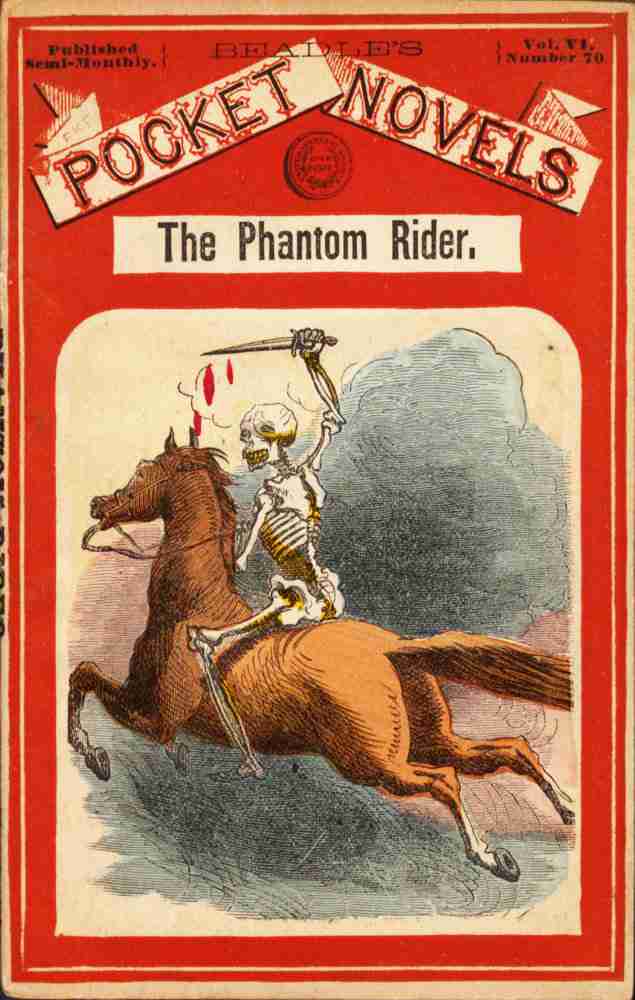
THE PHANTOM RIDER!
Five minutes later the little party was on the move again.
About the middle of the afternoon they halted for a moment’s consultation. Darke was not surprised when the scout informed him that the Indian encampment was not more than a half-dozen miles distant. He had long been anxious to reach the village. The suspense was growing to be almost unendurable to him.
At first, Leander Maybob took little part in the conversation and bent his gaze anxiously every few minutes upon the horizon in the direction whence they had come.
“Would you advise a bold charge through the Indian encampment?” asked Clancy. “Do you think we would be likely to accomplish our object in that way?”
The scout thought not. The savages might be on the look-out for some such movement as that, as they would probably expect that an attempt would be made to rescue Vinnie, in which case they would run great risk of falling into some trap set for them by the Indians, if they approached the encampment boldly and in the full glare of the sunlight. Their party was too small to hazard being taken at so great a disadvantage. They dared not show themselves openly in the camp of their enemies. The odds would be too great against them.
“No!” said Wimple, emphatically. “We mustn’t try such a plan as that. It would be worse than useless! What we do must be done by stratagem. There’s a steep bluff, only ’tain’t a bluff, neither—thar ain’t no river under it—jist back of the Injin camp. This hill’s all grown over with low scrub-oak and other stuff so thick ye can’t see a rod any way. If we could only git up there and hide till arter dark, and then two or three of us jist step quietly down and release the prisoners, leaving some one to have the horses ready to mount at an instant’s warnin’, I think we could git the gal cl’ar without much blood-lettin’, and maybe the other prisoners, whoever they are. It’s the best plan I can think of now.”
Darke agreed with the scout that nothing could be done by daylight, but he was getting very impatient.
“I think,” said the big hunter, “as how ye’re partly right in yer calkerlations and mayhap partly wrong. I don’t believe as how us four rushing into the imps’ nest would do much good. We’d be very likely to git our little lump of lead, every one on us, and that’d be the end on’t all; but instid o’ climbin’ the hill, if ye’ll jist take the advice of one who has fit Injins some, and stop in the border of the wood, down level with the edge of the prairie, and wait and see what happens, I b’lieve we can do suthin’ as ’ll amount to suthin’. I’ve knowed some of the best kind of jobs to be did in gittin’ away prisoners from the reds, jist by watchin’ and takin’ advantage of accidents and the like. If you’ll all do jist as I say and not git flustered or go to gittin’ away up there on top of the hill, I’ll promise that every prisoner in the Indian camp shall be safe before sundown—yes, in less than two hours. You don’t know what amazin’ helps accidents is sometimes, in sich cases as this one!”
“Can you do it?” asked Darke, eagerly.
“Yes.”