
WeRead Powered by ReaderPub
The Philippine Islands, 1493-1898, Volume 30 of 55, 1640 / Explorations by early navigators, descriptions of the islands and their peoples, their history and records of the Catholic missions, as related in contemporaneous books and manuscripts, showing the political, economic, commercial and religious conditions of those islands from their earliest relations with European nations to the close of the nineteenth century cover

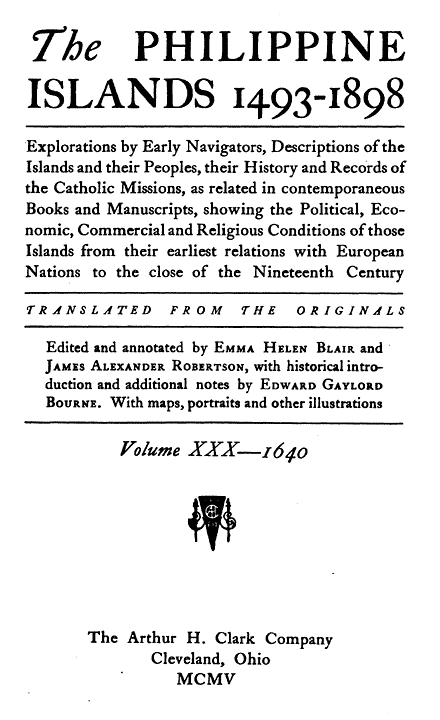
The Philippine Islands, 1493-1898, Volume 30 of 55, 1640 / Explorations by early navigators, descriptions of the islands and their peoples, their history and records of the Catholic missions, as related in contemporaneous books and manuscripts, showing the political, economic, commercial and religious conditions of those islands from their earliest relations with European nations to the close of the nineteenth century

Chapter 22: Chapter IV The experience of these first fathers up to the time of embarcation
Open in WeRead

About This Book

The volume gathers two retrospective seventeenth-century documents: a legal and commercial survey tracing royal ordinances, Council of the Indies debates, and memorials arguing for the maintenance and expansion of trade between the Philippine archipelago and Nueva España up to 1640; and the opening sections of a comprehensive Dominican account of missionary activity in the islands, summarizing the foundation, organization, and religious work of the Dominican province with notes on local conditions. It includes translations, bibliographical data, and facsimile plates such as contemporary maps and title-pages to illustrate sources.

Chapter IV

The experience of these first fathers up to the time of embarcation

[The fathers met with great difficulty in preparing for the embarcation. After making arrangements for their passage, they found the vessel so ill-suited for their purpose, that they were obliged to annul the contract. They were left behind by the fleet with which they were to sail, and endeavored to follow it with a small vessel; but put back and finally obtained passage in a ship of fair size. As this vessel was sailing alone, it was exposed to danger from the Moors and the English. While the fathers were hesitating, the adelantado of Castilla offered them a munificent support if they would remain and give their attention to the spiritual good of his vassals. But overcoming all these alarms and enticements, which were wiles of the devil, the fathers courageously set sail.]