
The Project Gutenberg eBook of The Philosophy of Fine Art, volume 1 (of 4)
Title: The Philosophy of Fine Art, volume 1 (of 4)
Author: Georg Wilhelm Friedrich Hegel
Translator: Francis Plumptre Beresford Osmaston
Release date: August 11, 2017 [eBook #55334]
Most recently updated: October 23, 2024
Language: English
Credits: Produced by Laura Natal Rodriguez and Marc D'Hooghe at
Free Literature (online soon in an extended version,also
linking to free sources for education worldwide ... MOOC's,
educational materials,...) Images generously made available
by the Internet Archive.)
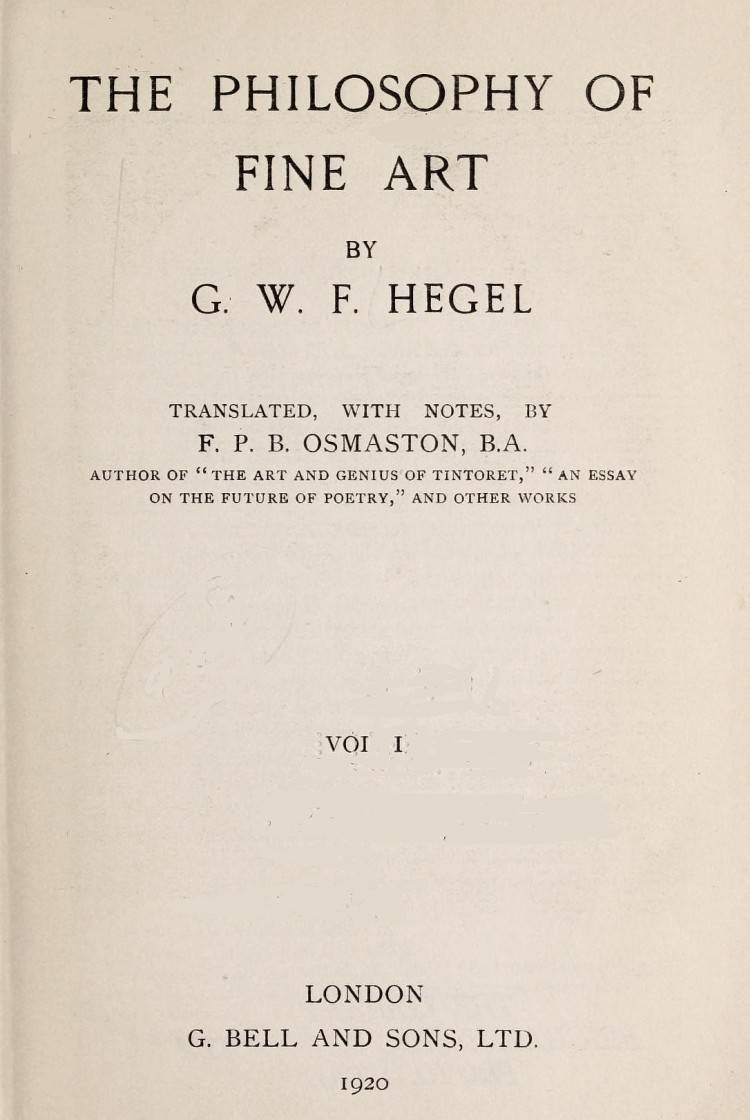
THE PHILOSOPHY OF
FINE ART
BY
G. W. F. HEGEL
TRANSLATED, WITH NOTES, BY
F. P. B. OSMASTON, B.A.
AUTHOR OF "THE ART AND GENIUS OF TINTORET," "AN ESSAY
ON THE FUTURE OF POETRY," AND OTHER WORKS
VOL I
LONDON
G. BELL AND SONS, LTD.
1920
TRANSLATOR'S PREFACE
The translation of Hegel's "Aesthetik" or "Philosophy of Fine Art," which is contained in the four volumes of the present work, is the first complete translation in English of the three volumes devoted to this subject in the collected edition (Berlin, 1835). I know of four partial translations in English of this work and one in French. These are Mr. W. M. Bryant's translation of Part II[1], Mr. Kedney's short analysis of the entire work[2], Mr. Hastie's translation of Michelet's short "Philosophy of Art[3]," prefaced by Hegel's Introduction, partly translated and partly summarized and lastly Professor B. Bosanquet's complete translation of Hegel's first Introduction with notes[4].
The French translation of M. Bénard purports to be more or less a reproduction of the entire work and runs into two large-sized volumes. It also is, however, so far as Hegel's Introduction and the first two Parts are concerned, merely a compressed summary, and only in particular passages is the translation anything but a very free rendering of the original, though there is a far closer approach to this in Part III.
I have not seen Mr. Bryant's translation. As any approach to an adequate reproduction of Hegel's writing Mr. Hastie's translation of Michelet's work and Mr. Kedney's analysis are of very little value[5]. Professor Bosanquet's translation is admirable within the limits imposed. To that extent I have merely followed, as I was able, in my friend's footsteps; but this advance covers little more than one sixteenth part of the entire work of 1,600 pages.
With regard to all such analyses I entirely concur with Professor Bosanquet's view stated in his preface, that such merely mislead if regarded as in any way a reflex of either Hegel himself or the German text. It is true that this work is—as are in their degree other volumes of the collected edition, the "Outlines of the Philosophy of Right" for example—a heterogeneous product, in our own instance not merely lacking the final revision of the author, but rather put together as such a connected treatise by the editor responsible (i) from several autograph MSS. of Hegel[6], some of which were little more than fragmentary notes for lectures, (ii) supplemented further from notes[7] taken by pupils who attended such lectures, the entire conglomerate being (iii) finally dovetailed together with connecting links by the editorial hand much as, to cite his own illustration, a careful picture restorer might do in order to secure the impression of a unified work, the unity aimed at by himself being rather that of a connected literary treatise than a series of lectures.
It is obvious that a product of this nature will vary considerably throughout in the degree that the personality and unique flavour of Hegel himself, whether viewed as writer or thinker, asserts itself.
The introductions[8] have been, it would appear, taken almost exclusively from Hegel's own MSS.; but even these remained unrevised for the press, owing to the premature and sudden death of their author.
Of the greater portion of the work we can merely form our judgment of the nature of its authenticity from the content itself. On the whole I should myself say that the result was more favourable than might under such conditions have been expected. The editor assures us expressly that so far as all illustrations and the substantive content of the work is concerned no attempt has been made whatever to supplement the same. Hegel is throughout here entirely responsible. I think, further, that the endeavour claimed by the editor to preserve the general character and tone (Kolorit) of Hegel's own diction has attained a degree of success that could only have been within the reach of devoted pupils and friends of the man himself, who for many years both attended his lectures and studied his published works. Whatever opinion, however, we may arrive at on this head there can hardly be two opinions as to the sources in which the main interest consists for a modern reader.
First, I should lay particular stress on the forceful and characteristic manner in which the fundamental philosophical conceptions which underlie the entire fabric are worked into and elaborated explicitly, throughout its detail. The very nature of this unwearied and insistent interfusion (Durchdringung) of positive fact, whether historical, scientific, or aesthetic, with the dialectic movement of the Idea is here as essentially the method of Hegel as it is elsewhere. And this is so despite the fact that it is here presented for the most part in a form less repellent to the ordinary reader and less provocative of hostile criticism. Translators therefore, who, following the example of the French translator[9], deliberately seek to lighten the burden of their cargo by throwing overboard what they choose to call the "injurious dialectic," or the "dark labyrinth" of this aspect of our work may reproduce much that is of instruction or interest, but most certainly do not reproduce either the main strength of Hegel as a thinker, or the most characteristic impression—to say nothing of the repetitions—of such style or absence of literary style that he possessed.
Secondly, if there is one feature more striking than any other in this work, which is bound at least to surprise anyone who still harbours the obsolete notion that this philosopher moved in an exclusively abstract region of idea remote from the concrete experience of life and scientific or artistic knowledge, it is the wealth and extraordinary range of the illustrations in these volumes no less than the vigour and freshness of their application. In this respect two translations which merely amount to a summary of theoretical content simply omit the vital or at least the most attractive heart of the interest.
As to the present claim of this laborious work to recognition and study, its historical significance is, I think, admitted by the most acknowledged authorities on the subject. As Schasler has called it, it is the first complete system of a philosophy of Art. The nature of its importance to our own most able and learned historian of the Philosophy of Fine Art may not only be deduced from his own summary of its contents and significance in his invaluable historical survey[10], but is further illustrated by the fact that he has reproduced the concluding portion of Hegel's Introduction in extenso in an Appendix to this work.
Other writers have been less judicious both as hostile critics and in the degree of their praise or enthusiasm. One German authority has called it Hegel's masterpiece. Such a title is, apart from any other ground, sufficiently excluded by its history alone. Whether Hegel might have made it his masterpiece had he lived is of course another question.
Other admirers, such as the late Professor Caird[11], have more legitimately accepted such a distinction for the "Phenomenologie des Geistes." Mr. Hastie will even have it that throughout "All is clear, radiant, harmonious and dim with the things that are a joy for ever." Such an effusive display of abstract Vorstellung reminds one little of either the dour temper of the Swabian philosopher, or the concrete intelligence which most distinguishes him from his rivals now and in his lifetime. I can promise no such garden of Hesperides, or even Platonic banquet, to any of my readers. It is true that we have here, the work being primarily built upon lectures intended to instruct the ordinary student, no such parade of the dialectic method in its formal structure such as constitutes the root of offence in some other works of Hegel. But if we approach it with the belief that all is therefore the plain sailing we meet with in the world of journalistic art criticism and the commonsense conceptions of everyday life, or with the assurance that the work is, or can be, intelligible without some real attempt to grapple with the fundamental ideas of Hegelian metaphysic, we may find our disappointment very considerable. As a humble translator I am bound to say that in a very large number of passages I have by no means discovered immediacy of intelligibility or radiance to be a conspicuous feature of the original. Radiance is indeed, I should say, not an attribute emphatically characteristic of any kind of Teutonic literature, and least of all of its scientific and philosophical literature. The present work is certainly no exception. With its untiring, not to say remorseless, effort to press home in repeated expression, often but slightly varied, the same fundamental points, its dogged and endless persistence in the careful explication through rational definition of every kind of positive material that presents itself from the nature of the divine in man, or the soul of living beast to the accurate determination in the terms of expressed thought of a musical sound or an epigram or simile, with its well-nigh total disregard of the beauty of literary style, and its by no means unfrequent disregard of all principle of proportion in the co-ordination of its varied subject-matter—whatever else such a product may be it is most assuredly not, at least to English apprehension, reminiscent of the radiance either of Homer or Apollo.
But though even sincere admiration may smile over such a description, it does unquestionably reflect to a remarkable extent the thoroughness, tenacity of purpose, the absence of superficial rhetoric, the wide range, the extraordinary combination of constructive idea and detailed knowledge and research we rightly associate with the most valued works of German science and philosophy. It has never been more needful than at this time of day to draw attention to such qualities, when the national bias is to ignore or belittle their presence. It is, moreover, not without passages which attain to a very real elevation of eloquence, eloquence marked by the profoundest earnestness and entirely free from the least flavour of bombast or sentimentalism. To the right kind of reader it can hardly fail to convey a certain fascination which is not merely due to the presence of a powerful and original intellect, but is equally inseparable from the product of a human soul intent upon getting at the heart of its subject, and keeping its vision throughout fixed on that. Nor is the mere breadth of the canvas and the depth of its content its only attraction. The work is indeed full of digressions of exceptional interest to the general reader, and as such bears the indelible stamp of Hegel's manner as a lecturer, which his editor maintains stood out in such marked contrast to his more concise style as an author, drawing as he did when lecturing so largely on his encyclopaedic stores of knowledge.
To treat all the text as we now have it with the same respect may very possibly betoken to some an excess of zeal on the part of the translator; but after all the most important thing for an English reader is to know what the volumes actually contain. In dealing with Hegel the outlined sketch, whether secured through a process of distillation or adulteration, is by no means any compensation for the loss of the complete picture. If we are impatient over many aspects of this philosopher's particularity, we had much better dispense with him altogether.
Sympathetically studied it is hardly too much to say that this monumental work is an education in itself. It is at any rate one which cannot fail to enlarge our conceptions of the significance and dignity of human art. Nor is this by any means impossible, even though we are unable to concur in, or indeed remain insufficiently qualified to express a judgment upon all or even a few of the most important of its conclusions. But it is perhaps not wholly unnecessary to observe that before venturing upon a verdict in our wisdom we must, as Robert Browning submitted in reference to the criticism passed upon his poetry, have awakened both our senses and intelligence "that they may the better judge." It is the modest aim of the present translation to make that preparatory process more easy for the English reader, to assist that intelligent assimilation of the truth as it appears to a great and world-famous thinker, which is the necessary condition of any criticism meriting respectful attention at all. Such assimilation is perhaps impossible in the case of Hegel without effort, and indeed something of sympathy with his general outlook and temper, making as he does little or no appeal whatever to the lover of literature as such, who had consequently far better leave him austerely alone to the consideration of others who are more attracted.
I do not propose in these prefatory remarks to enlarge further on the actual content of the work, or on the nature of the criticism which has been directed either to fundamental positions or matters of detail. Some of these I have referred to in my notes on the text where they are most obviously pertinent. The general reader will find a very useful introduction to some of the more primary difficulties in the study of Hegel in Professor Bosanquet's prefatory essay to his translation. The more serious student can hardly dispense with the perusal of a considerable portion of the same writer's history of Aesthetik, at least that portion which directly deals with the writings of Kant, Schiller, Goethe, Schelling, and Hegel himself on the subject[12].
I hold my translation to be as literal as is possible consistently with an endeavour to render or interpret German philosophical language in the language or idiom of really expressive and intelligible English. It is now generally admitted that all translation is in the nature of an interpretation. However much I may have fallen short of my aim, that aim has been throughout to express the actual ideal content of the German, not merely with all the force and directness I could muster, but with as near an approach to the formal structure of the German text as was consistent with the like condition of really readable English. Above all I have striven to avoid the lassitude of mere paraphrase, that vague generalization of content which conceives itself to possess the right to eliminate from the text pretty much what it pleases.
The Index attached to the final volume is limited in its reference to proper names, and pre-eminently to illustrations in the text of works either of general literature, or other products of art, which I considered of use or interest to the general reader.
In the table of contents to the several volumes I have notified with brackets my own contributions to the German original. In all other respects I have retained the divisions of subject-matter as I found them recorded by Hegel or his editor.
F. P. O.
[1] New York, Appleton and Co.
[2] Chicago, Griggs and Co., 1885.
[3] Edinburgh, Oliver and Boyd, 1886. The translation is literal and of good quality for a little over thirty pages. After that it is a mere summary.
[4] Kegan Paul, Trench and Co., 1886.
[5] Mr. Kedney's volume only amounts to about three hundred small-sized pages altogether.
[6] The most important source were MSS. for lectures given in 1820. This formed the basis of further lectures in 1823, 1826, and 1829.
[7] The notes to which our editor had access referred to the lectures given in 1823 and 1826, with others of those in 1826 and 1829.
[8] The first Introduction is obviously taken from Hegel's MS., the editor not even venturing in this case to obliterate its form as an address in the lecture room. It represents perhaps the nearest approach we possess to the revised MS.
[9] An almost inevitable defect of such a translation is that criticism may be offered without supplying the material necessary for any satisfactory verdict upon its sufficiency. Thus M. Bénard cites with approval an adverse criticism passed upon what is called Hegel's inadequate treatment of the Idea of Beauty as a partial manifestation of the absolute Idea, but barely includes any of the passages which refer to this in his translation (note, p. 36). Such can lead to no conclusion whatever, though it obviously may entirely mislead his readers.
[10] "History of Aesthetik," by Bernard Bosanquet (Sonnenschein, 1892). See in particular pp. 333-362. With regard to the comparative value of the work of Schelling and Hegel on this subject the author says (p. 334): "It may be said that while we prefer Hegel to Schelling this is partly because Schelling is best represented in Hegel." I can claim but a very limited firsthand knowledge of modern German works on Aesthetik. But I may observe that the section of Lötze's history of German works on the subject devoted to Hegel's "Philosophy of Fine Art" appears to me by no means equal in ability to other portions of the work. The aim of the author appears rather that of proving that his own researches occupy a ground wholly unoccupied by Hegel than of defining with any completeness the ground actually appropriated by Hegel.
[11] "Life of Hegel," p. 110.
[12] The most authoritative introduction to the study of the Hegelian standpoint for English readers is, of course, the late Professor Wallace's Prolegomena to his translation of the lesser Logic, and the introduction to his translation of the Philosophy of Mind.
CONTENTS OF VOL. I
TRANSLATOR'S PREFACE v
INTRODUCTION 1
I. The Limits of Aesthetic defined, and certain Objections against the Philosophy of Art refuted 1
[(a) Aesthetic confined to Beauty of Art 2
(b) Is Art unworthy of scientific consideration? 4
(c) Or at least is it incapable of truly philosophical exposition? Negative answer to both these questions] 6
II. Scientific Methods which apply to the Beautiful and Art 17
[1. The Empirical Method 18
2. Abstract Reflection 27
3. The Philosophical Idea of artistic Beauty, that is, the notional concept thereof, provisionally defined] 28
III. The Notion of the Beauty of Art 29
Observations upon the ordinary ideas about Art
1. The art-work is a creation of human activity 33
[(a) Theory of imitation of Art by rule 33
(b) Art as direct inspiration 36
(c) The rank of Art relatively to Nature 38
(d) The nature of the human Art-impulse] 40
2. The art-work is addressed to human sense 43
[(a) Theory that its object is to excite feeling 43
(b) The nature of artistic taste 45
(c) The nature of art-scholarship as contrasted with artistic taste 46
(d) The more philosophical consequences of the fact that Art appeals to sense and requires a sensuous medium for its expression] 47
3. The End or Interest of Art 57
[(a) Is it imitation of Nature? 57
(b) Is the end or content identical with the dictum, "Humani nihil a me alienum," etc. 63
(c) How far it is a mitigation or purification of the passions 65
(d) The higher object of Art which consists in its revelation of truth in itself] 76
IV. Historical Deduction of the true Notion of Art 77
1. The philosophy of Kant 78
[(a) Feeling of aesthetic satisfaction not appetitive 80
(b) Beauty an object of universal satisfaction 80
(c) Teleological aspect of the Beautiful 81
(d) Pleasure in the Beautiful necessary, though felt 82
2. Schiller, Winckelmann, and Schelling 84
3. Irony] 90
V. Division of the Subject 95
[1. Inquiry as to the mode under which the divisions of the subject arise from the notional concept of Beauty 95
2. Part I. The Ideal 99
3. Part II. The particular general types of Beauty 100
(a) The Symbolic type of Art 103
(b) The Classical type of Art 104
(c) The Romantic type of Art 106
4. Part III. The specific arts 110
(a) Architecture 112
(b) Sculpture 113
(c) Romantic art, which includes
(α) Painting 117
(β) Music 118
(γ) Poetry 119
5. Conclusion] 122
FIRST PART
THE IDEA OF THE BEAUTY OF ART OR THE IDEAL
I. The Position of Art relatively to finite Reality, Religion, and Philosophy 125
[(a) Theory that the Beautiful is no intelligible object of thought 125
(b) The relation of the human reason to Nature both empirically and speculatively 126
(c) The realm of Fine Art that of the Absolute Spirit 129
(d) How far Art responds to a genuine spiritual want in man 130
(e) The truth which forms the content of art, religion, and philosophy differs only in the modes under which it is presented] 139
CHAPTER I
THE NOTION OF THE BEAUTIFUL IN GENERAL
1. The Idea 147
[(a) The Idea is concrete, not abstract 149
(b) Objectivity is the real existence of the notion, and the means whereby it is actualized 152
(c) The Idea is the harmonized totality of the two aspects] 152
2. The Determinate Existence of the Idea 153
3. The Idea of the Beautiful 153
[(a) Not apprehended alone by the faculty of the understanding, or the finite categories 154
(b) The nature of finite or abstract apprehension and practical volition considered 155
(c) The object of beauty resolves and the one-sidedness of both standpoints in a free and infinite totality] 157
CHAPTER II
THE BEAUTY OF NATURE
A. The Beauty of Nature as such 160
1. The Idea as Life 160
[(a) The first mode under which the notion is in Nature asserted as objectivity is that of physical matter, the ideal unity whereof is not found as ideality 160
(b) A further step is the integration of natural objects under a unified system, as the solar system 161
(c) The third mode is that of organic Life. This alone is a determinate existence of the Idea] 163
2. The animated life of Nature as Beauty 171
[(a) The motion of life considered in relation to the conception of beauty 171
(b) The nature of organic unity, and the degree it contributes to the beauty of an object 173
(c) The inward unity of soul-life and the degree it contributes to the correlation of parts of an organism, or is asserted in external form to our senses rather than our reflection] 175
3. Modes under which the beauty of Nature is investigated 179
[(a) Where the form is immediately in the materia as its essence or conformative energy, as in crystals, or more concretely as the informing soul through the living organism 180
(b) Mobility in animals as a test of their apparent beauty 180
(c) Self-conscious life the culminating mode] 182
B. The external Beauty of abstract Form viewed as Uniformity, Symmetry, Conformity to Rule, and Harmony. Also Beauty regarded generally as abstract unity of the Sensuous Material 184
C. The Defective Aspects of the Beauty of Nature 196
1. The Inward principle in its immediacy as merely such inwardness 199
[(a) Immediate singularity as conserved in the purely animal organism 199
(b) Of the nature of the contrast between the above and the human body 200
(c) Social organizations viewed in such particularized immediacy, and the defects they betray as such external totalities] 201
2. The Dependence of particular existence as viewed in its immediate singularity 202
[(a) The dependence of animal life upon its natural environment 203
(b) The nature of a similar dependence in the case of the human organism 203
(c) The dependence of human souls, or spiritual interests, on the prose-life of ordinary existence] 204
3. The limitations implied by such conditions 205
[(a) The restriction of species in the animal world, and of the social condition as it affects human individuality 205
(b) The limitation of racial division, or of particular families, or particular professions, and the effect of such upon the aspect of beauty 206
(c) It is the very defects of this finite plane of reality, which stimulates man to recover the vision of his freedom in Art] 208
CHAPTER III
THE BEAUTY OF ART OR THE IDEAL
A. The Ideal as such 209
1. Individuality which partakes of Beauty 209
[(a) The nature of the conditions under which Art can express a profound and infinite spiritual content 210
(b) What Art rejects from natural embodiment in order to effect this revelation, which is also a purification 212
(c) This "referring back" of external form to spirituality, or inwardness, issuing in harmonious individuality, is the very nature of the Ideal 213
(α) The blythe serenity of antique art 214
(β) The treatment of emotion by romantic art 215
(γ) Irony] 217
2. The Ideal relatively to Nature 218
[(a) The formal ideality of a work of art, i.e., the element of poetry therein 220
(b) The creative faculty contrasted with Nature in its power to grasp ideal significance, with illustrations of this power 222
(c) The nature of this spiritual recreation of natural fact by Art originating in the energy of mind. Illustration with the example of Dutch art in its genre painting, also with that of portraiture and classical art] 227
B. The Determinate Character of the Ideal 236
I. Ideal determinacy as such 237
1. Thought apart from the plastic material can only comprehend the Divine in its universality and unity. Mohammedan and Hebrew art 237
2. The polytheistic aspect of Hellenic art considered, as also Christian art 237
3. The relation of the arts of painting and sculpture to the latter. The transition from the principle of spiritual repose to that of development and conflict 238
II. The Action 240
1. The universal World-condition 241
[(a)
(α) The self-subsistency of such a condition as a necessary prius of the embodiment of the Ideal 242
(β) The nature of the reality adapted to artistic treatment as contrasted with what is not so adapted. The fixed order of the State as contrasted with conditions most favourable to free individuality 245
(γ) Further examination of contrast in relation to judicial functions and the ideas of punishment or revenge as we find it in the heroic age. The reappearance of an analogous condition in the Middle Ages 248
(b) Modern prosaic life the condition most favourable to the private or personal life as an object of interest 258
(c) Resistance by individual poets to this process of social change. The permanent demand for the heroic] 260
2. The Situation 263
[(a) The situation that is devoid of situation 267
(b) The situation as defined in its harmlessness or absence of further conflict 268
(α) The movement from pure tranquillity to movement or expression. Illustrations from classical art 269
(β) Movement as related to externality. The initial stage of action. Greek sculpture 269
(γ) Situation in movement presented as an opportunity to further expression. Illustrations from poetry] 271
(c) The Collision 272
[(α) Collisions which arise from wholly material conditions. Only of artistic interest as a consequence of natural misfortune. Illustrations 274
(β) Spiritual collisions dependent on natural conditions. Classified and illustrated. 276
(γ) The above only form the starting-point of the collision of the essential forces of spiritual life. The third and most important type is the collision caused by the disruption of Spirit alone. Illustrations] 283
3. The Action 289
(a) The universal forces operative in the action.
[(α) These forces are the eternally paramount religious and ethical modes of relationship, such as family, fatherland, church, friendship, status, honour, and love. They are children of the one absolute Idea. Illustration of their contention 292
(β) They must not act in discord with the main action. The position of evil powers as confronting them, and its treatment by classic and modern poetry 293
(γ) Such forces must appear in Art as embodied in particular personalities. Contrast between ancient and modern art in this respect] 296
(b) The individuals concerned in the action 299
[(α) The relations between gods and men in classical art, and that between the Divine and the human in Christian art 300
[β] Pathos considered in its relation to various modes of art] 302
(c) Character 313
[(α) Viewed as co-extensive or self-coherent individuality, relatively, that is, to the intrinsic wealth it connotes. Illustrations 315
(β) Viewed relatively to the particular form under which it is bound to appear 317
(γ) Viewed as a concrete unity coalescing wholly with its determinate form and as assured character. Illustrations classified in their stability and lack of such] 320
III. The External Determination of the Ideal. 325
1. The abstract Externality as such. 329
[(a) Spatiality, Uniformity, Figure, Time, and Colour. 330
(α) How far such contribute to artistic production 336
(β) The necessity of clear articulation of form and tone considered] 337
2. The Coalescence of the concrete Ideal with its external Reality 339
[(α) The bond of unity regarded as no positive reality, but as a mysterious or secret connection. The relation of external Nature to the work of art. The Homeric poems contrasted with the "Niebelungenlied" in this respect 340
(b) Where the unity is expressly due to human activity and human adaptation of means to ends 340
[(α) The use made by man of ornament or of anything used for mere show, e.g., precious metals for statuary 340
(β) The question how far objects used for practical purposes are suited for art. The idyllic, civilized and heroic condition compared in the degree they are thus adapted341
(γ) The spiritual environment itself in social institutions, etc., regarded in its relation to ideal character] 355
3. The Externality of a work of Art in relation to a Public 355
(a) What is implied in the assertion by the artist of the particular culture of his own times? 358
(b) What may be regarded as truth when the reference is to a Past, either in an exclusive or objective sense? 363
(c) What may still be regarded as valid in truth though the matter be appropriated from a time and nationality foreign to the artist? All three questions discussed and illustrated] 365
C. The Artist 379
1. Imagination, Genius, and Inspiration 380
2. The objective character of the artistic presentation 392
3. Manner, Style, and Originality. 394
THE PHILOSOPHY OF FINE ART
INTRODUCTION
I
The present inquiry[1] has for its subject-matter Aesthetic. It is a subject co-extensive with the entire realm of the beautiful; more specifically described, its province is that of Art, or rather, we should say, of Fine Art.
For a subject-matter such as this the term "Aesthetic" is no doubt not entirely appropriate, for "Aesthetic" denotes more accurately the science of the senses or emotion. It came by its origins as a science, or rather as something that to start with purported to be a branch of philosophy, during the period of the school of Wolff, in other words when works of art were generally regarded in Germany with reference to the feelings they were calculated to evoke, as, for example, the feelings of pleasure, admiration, fear, pity, and so forth. It is owing to the unsuitability or, more strictly speaking, the superficiality of this term that the attempt has been made by some to apply the name "Callistic" to this science. Yet this also is clearly insufficient inasmuch as the science here referred to does not investigate beauty in its general signification, but the beauty of art pure and simple. For this reason we shall accommodate ourselves to the term Aesthetic, all the more so as the mere question of nomenclature is for ourselves a matter of indifference. It has as such been provisionally accepted in ordinary speech, and we cannot do better than retain it. The term, however, which fully expresses our science is "Philosophy of Art," and, with still more precision, "Philosophy of Fine Art."
(a) In virtue of this expression we at once exclude the beauty of Nature from the scientific exposition of Fine Art. Such a limitation of our subject may very well appear from a certain point of view as an arbitrary boundary line, similar to that which every science is entitled to fix in the demarcation of its subject-matter. We must not, however, understand the limitation of "Aesthetic" to the beauty of art in this sense. We are accustomed, no doubt, in ordinary life to speak of a beautiful colour, a beautiful heaven, a beautiful stream, to say nothing of beautiful flowers, animals, and, above all, of beautiful human beings. Without entering now into the disputed question how far the quality of beauty can justly be predicated of such objects, and consequently the beauty of Nature comes generally into competition with that of art, we are justified in maintaining categorically that the beauty of art stands higher than Nature. For the beauty of art is a beauty begotten, a new birth of mind[2]; and to the extent that Spirit and its creations stand higher than Nature and its phenomena, to that extent the beauty of art is more exalted than the beauty of Nature. Indeed, if we regard the matter in its formal aspect, that is to say, according to the way it is there, any chance fancy that passes through any one's head[3], is of higher rank than any product of Nature. For in every case intellectual conception and freedom are inseparable from such a conceit. In respect to content the sun appears to us an absolutely necessary constituent of actual fact, while the perverse fancy passes away as something accidental and evanescent. None the less in its own independent being a natural existence such as the sun possesses no power of self-differentiation; it is neither essentially free nor self-aware; and, if we regard it in its necessary cohesion with other things, we do not regard it independently for its own sake, and consequently not as beautiful.
Merely to maintain, in a general way, that mind and the beauty of art which originates therefrom stand higher than the beauty of Nature is no doubt to establish next to nothing. The expression higher is obviously entirely indefinite; it still indicates the beauty of Nature and art as standing juxtaposed in the field of conception, and emphasizes the difference as a quantitative and accordingly external difference. But in predicating of mind and its artistic beauty a higher place in contrast to Nature, we do not denote a distinction which is merely relative. Mind, and mind alone, is pervious to truth, comprehending all in itself, so that all which is beautiful can only be veritably beautiful as partaking in this higher sphere and as begotten of the same. Regarded under this point of view it is only a reflection of the beauty appertinent to mind, that is, we have it under an imperfect and incomplete mode, and one whose substantive being is already contained in the mind itself.
And apart from this we shall find the restriction to the beauty of art only natural, for in so far as the beauties of Nature may have come under discussion—a rarer occurrence among ancient writers than among ourselves—yet at least it has occurred to no one to insist emphatically on the beauty of natural objects to the extent of proposing a science, or systematic exposition of such beauties. It is true that the point of view of utility has been selected for such exclusive treatment. We have, for example, the conception of a science of natural objects in so far as they are useful in the conflict with diseases, in other words a description of minerals, chemical products, plants, animals, which subserve the art of healing. We do not find any analogous exploitation and consideration of the realm of Nature in its aspect of beauty. In the case of natural beauty we are too keenly conscious that we are dealing with an indefinite subject-matter destitute of any real criterion. It is for this reason that such an effort of comparison would carry with it too little interest to justify the attempt.
These preliminary observations over beauty in Nature and art, over the relation of both, and the exclusion of the first-mentioned from the province of our real subject-matter are intended to disabuse us of the notion that the limitation of our science is simply a question of capricious selection. We have, however, not reached the point where a demonstration of this fact is feasible for the reason that such an investigation falls within the limits of our science itself, and it is therefore only at a later stage that we can either discuss or prove the same.
Assuming, however, that we have, by way of prelude, limited our inquiry to the beauty of art, we are merely by this first step involved in fresh difficulties.
(b) What must first of all occur to us is the question whether Fine Art in itself is truly susceptible to a scientific treatment. It is a simple fact that beauty and art pervade all the affairs of life like some friendly genius, and embellish with their cheer all our surroundings, mental no less than material. They alleviate the strenuousness of such relations, the varied changes of actual life; they banish the tedium of our existence with their entertainment; and where nothing really worth having is actually achieved, it is at least an advantage that they occupy the place of actual vice. Yet while art prevails on all sides with its pleasing shapes, from the crude decorations of savage tribes up to the splendours of the sacred shrine adorned with every conceivable beauty of design, none the less such shapes themselves appear to fall outside the real purposes of life, and even where the imaginative work of art is not impervious to such serious objects, nay, rather at times even appear to assist them, to the extent at least of removing what is evil to a distance, yet for all that art essentially belongs to the relaxation and recreation of spiritual life, whereas its substantive interests rather make a call upon its strained energy. On such grounds an attempt to treat that which on its own account is not of a serious character with all the gravity of scientific exposition may very possibly appear to be unsuitable and pedantic. In any case from such a point of view art appears a superfluity if contrasted with the essential needs and interests of life, even assuming that the softening of the soul which a preoccupation with the beauty of objects is capable of producing, does not actually prove injurious in its effeminate influence upon the serious quality of those practical interests. Owing to this fundamental assumption that they are a luxury it has often appeared necessary to undertake the defence of the fine arts relatively to the necessities of practical life, and in particular relatively to morality and piety; and inasmuch as this harmlessness is incapable of demonstration, the idea has been at least to make it appear credible, that this luxury of human experience contributes a larger proportion of advantages than disadvantages. In this respect serious aims have been attributed to art, and in many quarters it has been commended as a mediator between reason and sensuous associations, between private inclinations and duty, personified in short as a reconciler of these forces in the strenuous conflict and opposition which this antagonism generates. But it is just conceivable[4] that, even assuming the presence of such aims with all their indubitably greater seriousness, neither reason nor duty come by much profit from such mediation, for the simple reason that they are incapable by their very nature of any such interfusion or compromise, demanding throughout the same purity which they intrinsically possess. And we might add that art does not become in any respect more worthy thereby of scientific discussion, inasmuch as it remains still on two sides a menial, that is, subservient to idleness and frivolity, if also to objects of more elevated character. In such service, moreover, it can at most merely appear as a means instead of being an object for its own sake. And, in conclusion, assuming that art is a means, it still invariably labours under the formal defect, that so far as it in fact is subservient to more serious objects, and produces results of like nature, the means which actually brings this about is deception. For beauty is made vital in the appearance[5]. Now it can hardly be denied that aims which are true and serious ought not to be achieved by deception; and though such an effect is here and there secured by this means, such ought only to be the case in a restricted degree; and even in the exceptional case we are not justified in regarding deception as the right means. For the means ought to correspond with the dignity of the aim. Neither semblance nor deception, but only what is itself real and true, possesses a title to create what is real and true. Just in the same way science has to investigate the true interests of the mind in accordance with the actual process of the real world and the manner of conceiving it as we actually find it.
We may possibly conclude from the above grounds that the art of beauty is unworthy of philosophical examination. It is after all, it may be said, only a pleasant pastime, and, though we may admit more serious aims are also in its purview, nevertheless it is essentially opposed to such aims in their seriousness. It is at the most merely the servant of specific amusements no less than the exceptional serious objects, and for the medium of its existence as also for the means of its operations can merely avail itself of deception and show.
But yet further in the second place, it is a still more plausible contention that even supposing fine art to be compatible generally with philosophical disquisition, none the less it would form no really adequate subject-matter for scientific enquiry in the strict sense. For the beauty of art is presented to sense, feeling, perception, and imagination: its field is not that of thought, and the comprehension of its activity and its creations demands another faculty than that of the scientific intelligence. Furthermore, what we enjoy in artistic beauty is just the freedom of its creative and plastic activity. In the production and contemplation of these we appear to escape the principle of rule and system. In the creations of art we seek for an atmosphere of repose and animation as some counterpoise to the austerity of the realm of law and the sombre self-concentration of thought; we seek for blithe and powerful reality in exchange for the shadow-world of the Idea. And, last of all, the free activity of the imagination is the source of the fair works of art, which in this world of the mind are even more free than Nature is herself. Not only has art at its service the entire wealth of natural form in all their superabundant variety, but the creative imagination is able inexhaustibly to extend the realm of form by its own productions and modifications. In the presence of such an immeasurable depth of inspired creation and its free products, it may not unreasonably be supposed that thought will lose the courage to apprehend such in their apparent range, to pronounce its verdict thereon, and to appropriate such beneath its universal formulae.
Science, on the other hand, everyone must admit, is formally bound to occupy itself with thinking which abstracts from the mass of particulars: and for this very reason, from one point of view, the imagination and its contingency and caprice, in other words the organ of artistic activity and enjoyment, is excluded from it. On the other hand, when art gives joyous animation to just this gloomy and arid dryness of the notion, bringing its abstractions and divisions into reconciliation with concrete fact, supplementing with its detail what is wanting to the notion in this respect, even in that case a purely contemplative reflection simply removes once more all that has been added, does away with it, conducting the notion once again to that simplicity denuded of positive reality which belongs to it and its shadowland of abstraction. It is also a possible contention that science in respect to content is concerned with what is essentially necessary. If our science of Aesthetic places on one side natural beauty, not merely have we apparently made no advance, but rather separated ourselves yet further from what is necessary. The expression Nature implies from the first the ideas of necessity and uniformity, that is to say a constitution which gives every expectation of its proximity and adaptability to scientific inquiry. In mental operations generally, and most of all in the imagination, if contrasted in this respect with Nature, caprice and superiority to every kind of formal restriction, caprice, it is here assumed, is uniquely in its right place, and these at once put out of court the basis of a scientific inquiry.
From each and all these points of view consequently, in its origin, that is to say, in its effect and in its range, fine art, so far from proving itself fitted for scientific effort, rather appears fundamentally to resist the regulative principle of thought, and to be ill-adapted for exact scientific discussion.
Difficulties of this kind, and others like them, which have been raised in respect to a thoroughly scientific treatment of fine art have been borrowed from current ideas, points of view, and reflection, the more systematic expansion of which we may read ad nauseam in previous literature, in particular French literature, upon the subject of beauty and the fine arts. Such contain to some extent facts which have their justification; in fact, elaborate arguments[6] are deduced therefrom, which also are not without their tincture of apparent plausibility. In this way, for instance, there is the fact that the configuration of beauty is as multifold as the phenomenon of beauty is of universal extension; from which we may conclude, if we care to do so, that a universal impulse towards beauty is enclosed in our common nature, and may yet further conceivably infer, that because the conceptions of beauty are so countless in their variety and withal are obviously something particular, it is impossible to secure laws of universal validity either relatively to beauty or our taste for it.