
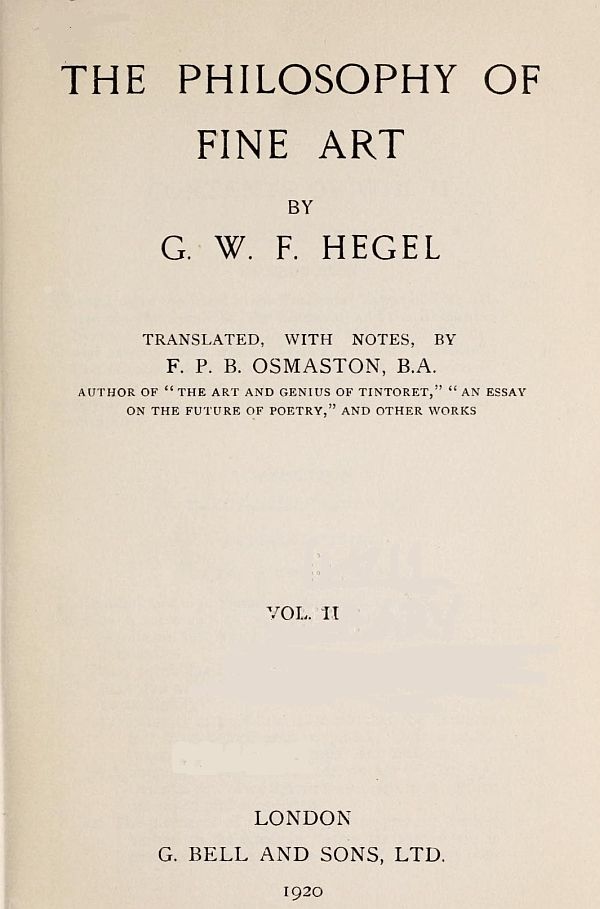
The Philosophy of Fine Art, volume 2 (of 4) / Hegel's Aesthetik
Explore more books like this:
About This Book
The text analyzes how the aesthetic Ideal develops through the symbolic type of art, distinguishing symbols as either arbitrary signs or sensuous forms that embody the qualities they signify. It traces a movement from measureless, sublime symbolism toward the clarity of classical art and the inwardness of the romantic, and it classifies symbolic expression into unconscious, fantastic, and genuine stages. By examining myth, religious imagery, and nonclassical examples such as Oriental, Egyptian, and Hindu forms, the argument shows how art attempts to mediate the spiritual by seeking finite forms that can approximate but often fall short of fully expressing universal meaning.
About the Author
More Books by This Author
6 picks
 Hegel's Lectures on the History of Philosophy: Volume 1 (of 3)
by Georg Wilhelm Friedrich Hegel
Hegel's Lectures on the History of Philosophy: Volume 1 (of 3)
by Georg Wilhelm Friedrich Hegel
 Hegel's Lectures on the History of Philosophy: Volume 2 (of 3)
by Georg Wilhelm Friedrich Hegel
Hegel's Lectures on the History of Philosophy: Volume 2 (of 3)
by Georg Wilhelm Friedrich Hegel
 Hegel's Lectures on the History of Philosophy: Volume 3 (of 3)
by Georg Wilhelm Friedrich Hegel
Hegel's Lectures on the History of Philosophy: Volume 3 (of 3)
by Georg Wilhelm Friedrich Hegel
 Hegel's Philosophy of Mind
by Georg Wilhelm Friedrich Hegel
Hegel's Philosophy of Mind
by Georg Wilhelm Friedrich Hegel
 Phänomenologie des Geistes
by Georg Wilhelm Friedrich Hegel
Phänomenologie des Geistes
by Georg Wilhelm Friedrich Hegel
 Rede zum Schuljahresabschluß am 29. September 1809
by Georg Wilhelm Friedrich Hegel
Rede zum Schuljahresabschluß am 29. September 1809
by Georg Wilhelm Friedrich Hegel
You May Also Like
6 picks
 "Phiz" (Hablot Knight Browne), a Memoir.
by Frederic George Kitton
"Phiz" (Hablot Knight Browne), a Memoir.
by Frederic George Kitton
 "Præterita": souvenirs de jeunesse
by John Ruskin
"Præterita": souvenirs de jeunesse
by John Ruskin
 "The spirit of '76": Some recollections of the artist and the painting
by Henry Kelsey Devereux
"The spirit of '76": Some recollections of the artist and the painting
by Henry Kelsey Devereux
 "Their Majesties' Servants." Annals of the English Stage (Volume 1 of 3)
by Dr. Doran
"Their Majesties' Servants." Annals of the English Stage (Volume 1 of 3)
by Dr. Doran
 A architectura religiosa na Edade Média
by Augusto Fuschini
A architectura religiosa na Edade Média
by Augusto Fuschini
 A Book About the Theater
by Brander Matthews
A Book About the Theater
by Brander Matthews