
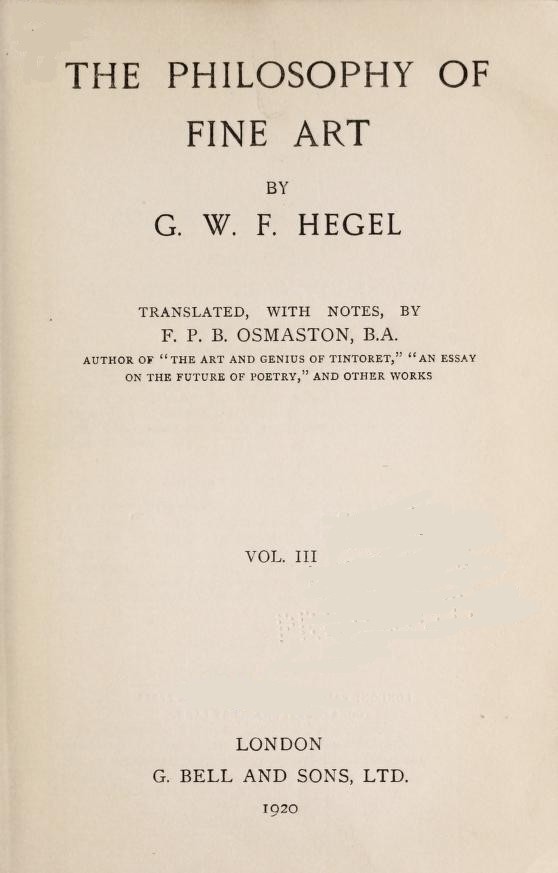
The Philosophy of Fine Art, volume 3 (of 4) / Hegel's Aesthetik
Explore more books like this:
About This Book
The text examines how ideal content is embodied in the particular arts, tracing a developmental typology—symbolic, classical, romantic—that depends on the relation between external nature and human consciousness. It treats architecture as the primary art rooted in material and communal function, sculpture as the classical medium that gives bodily form to spiritual ideality, and painting as the romantic mode that renders inner life through surface, color, and composition. It also discusses principles of differentiation tied to the senses and subject-matter, the origins and transitions among styles, and recurring aesthetic qualities such as grace, charm, and formal severity.
About the Author
More Books by This Author
6 picks
 Hegel's Lectures on the History of Philosophy: Volume 1 (of 3)
by Georg Wilhelm Friedrich Hegel
Hegel's Lectures on the History of Philosophy: Volume 1 (of 3)
by Georg Wilhelm Friedrich Hegel
 Hegel's Lectures on the History of Philosophy: Volume 2 (of 3)
by Georg Wilhelm Friedrich Hegel
Hegel's Lectures on the History of Philosophy: Volume 2 (of 3)
by Georg Wilhelm Friedrich Hegel
 Hegel's Lectures on the History of Philosophy: Volume 3 (of 3)
by Georg Wilhelm Friedrich Hegel
Hegel's Lectures on the History of Philosophy: Volume 3 (of 3)
by Georg Wilhelm Friedrich Hegel
 Hegel's Philosophy of Mind
by Georg Wilhelm Friedrich Hegel
Hegel's Philosophy of Mind
by Georg Wilhelm Friedrich Hegel
 Phänomenologie des Geistes
by Georg Wilhelm Friedrich Hegel
Phänomenologie des Geistes
by Georg Wilhelm Friedrich Hegel
 Rede zum Schuljahresabschluß am 29. September 1809
by Georg Wilhelm Friedrich Hegel
Rede zum Schuljahresabschluß am 29. September 1809
by Georg Wilhelm Friedrich Hegel
You May Also Like
6 picks
 "Phiz" (Hablot Knight Browne), a Memoir.
by Frederic George Kitton
"Phiz" (Hablot Knight Browne), a Memoir.
by Frederic George Kitton
 "Præterita": souvenirs de jeunesse
by John Ruskin
"Præterita": souvenirs de jeunesse
by John Ruskin
 "The spirit of '76": Some recollections of the artist and the painting
by Henry Kelsey Devereux
"The spirit of '76": Some recollections of the artist and the painting
by Henry Kelsey Devereux
 "Their Majesties' Servants." Annals of the English Stage (Volume 1 of 3)
by Dr. Doran
"Their Majesties' Servants." Annals of the English Stage (Volume 1 of 3)
by Dr. Doran
 A architectura religiosa na Edade Média
by Augusto Fuschini
A architectura religiosa na Edade Média
by Augusto Fuschini
 A Book About the Theater
by Brander Matthews
A Book About the Theater
by Brander Matthews