
The Project Gutenberg eBook of The Piccinino, Volume 1 (of 2)
Title: The Piccinino, Volume 1 (of 2)
Author: George Sand
Illustrator: Oreste Cortazzo
Translator: George Burnham Ives
Release date: January 19, 2023 [eBook #69839]
Most recently updated: October 19, 2024
Language: English
Original publication: United States: G. Barrie & son, 1900
Credits: Dagny and Laura Natal Rodrigues (Images generously made available by Hathi Trust Digital Library.)
THE MASTERPIECES OF
GEORGE SAND
AMANDINE LUCILLE AURORE DUPIN,
BARONESS DUDEVANT
VOLUME VII
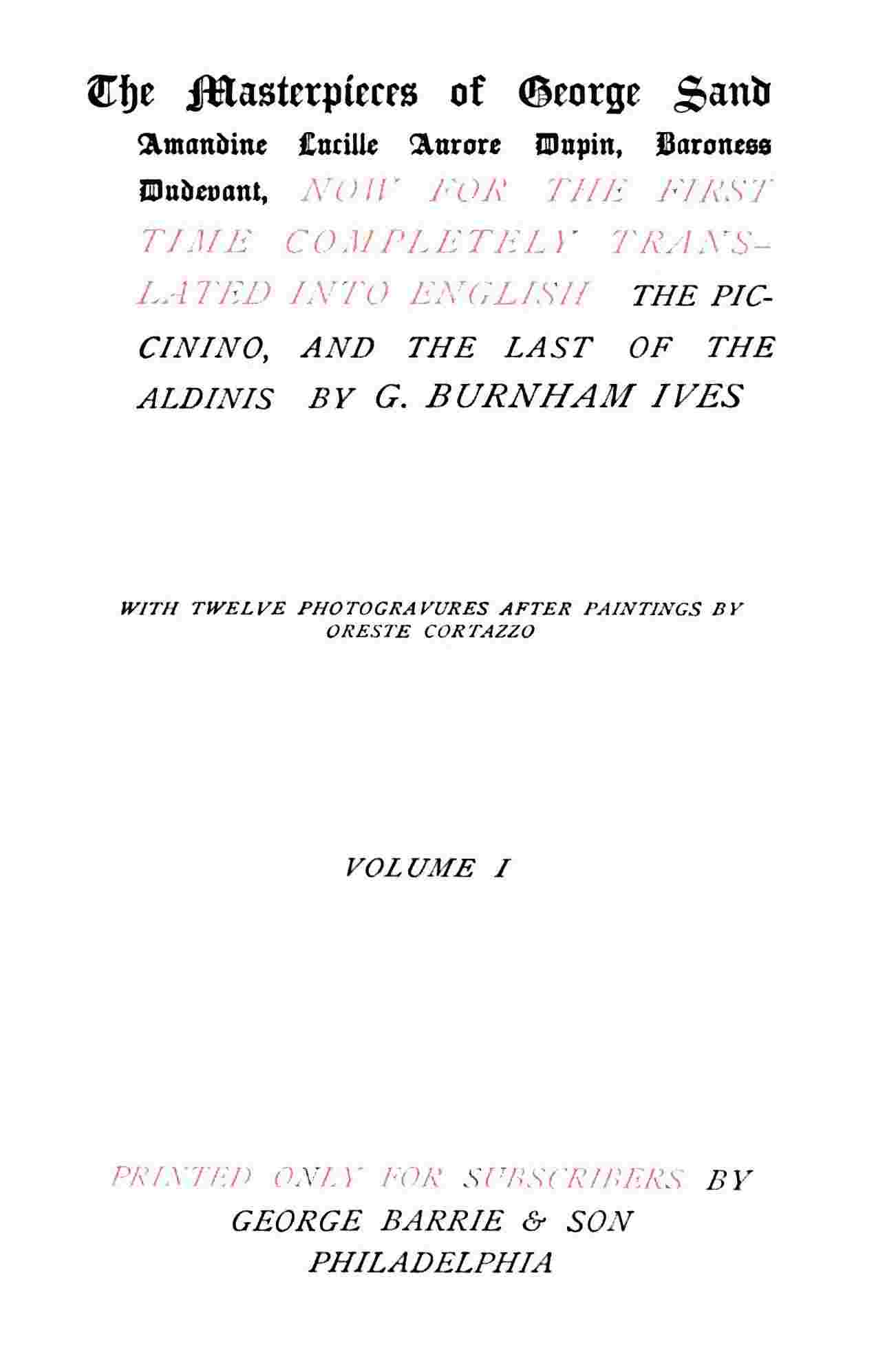
The Masterpieces of George Sand
Amandine Lucille Aurore Dupin, Baroness
Dudevant, NOW FOR THE FIRST
TIME COMPLETELY TRANSLATED
INTO ENGLISH THE PICCININO,
AND THE LAST OF THE
ALDINIS BY G. BURNHAM IVES
WITH TWELVE PHOTOGRAVURES AFTER PAINTINGS BY
ORESTE CORTAZZO.
VOLUME I
PRINTED ONLY FOR SUBSCRIBERS BY
GEORGE BARRIE & SON
PHILADELPHIA
EXAMINING THE ABBÉ'S PAPERS.
He opened and ran through several other papers which mentioned none but unknown names, and which Mila burned without looking at them.
CONTENTS
INTRODUCTION
CHAPTER
I. THE TRAVELLER
II. THE TRAVELLER'S STORY
III. MONSIGNORE
IV. MYSTERIES
V. THE CASINO
VI. THE STAIRCASE
VII. A GLANCE
VIII. THE INTRUDER
IX. MILA
X. PROBLEM
XI. THE GROTTO OF THE NAIAD
XII. MAGNANI
XIII. AGATHA
XIV. BARBAGALLO
XV. ROMANTIC LOVE
XVI. CONCLUSION OF MAGNANI'S STORY
XVII. THE CYCLAMEN
XVIII. THE MONKS
XIX. YOUTHFUL LOVES
XX. BEL PASSO AND MAL PASSO
XXI. FRA ANGELO
XXII. THE FIRST STEP ON THE MOUNTAIN
XXIII. THE DESTATORE
XXIV. IL PICCININO
XXV. THE DESTATORE'S CROSS
XXVI. AGATHA
XXVII. DIPLOMACY
XXVIII. JEALOUSY
XXIX. APPARITIONS
XXX. THE FALSE MONK
XXXI. WITCHCRAFT
XXXII. THE ESCALADE
XXXIII. THE RING
XXXIV. AT THE FOUNTAIN
XXXV. THE COAT OF ARMS
LIST OF ILLUSTRATIONS
THE PICCININO
VOLUME I
EXAMINING THE ABBÉ'S PAPERS
THE CARDINAL'S ESCORT
THE BALL AT THE PALMAROSA PALACE
AFTER THE FÊTE
THE CONFERENCE WITH THE PICCININO
MILA SURPRISED AT THE FOUNTAIN
INTRODUCTION
The Piccinino is an imaginary tale, which does not attempt either to depict any precise period of history or to describe accurately any country. It is a study in color, dreamed rather than felt, wherein correct strokes are few and, as it were, accidental. The scene of this romance might have been placed anywhere else under the skies of Southern Europe, and my sole reason for selecting Sicily was that I happened to have a collection of fine engravings before my eyes at that moment.
I had always been conscious of a longing to draw my little brigand chief, as others have done. The brigand chief who formed the principal motive of so many novels and melodramas under the Empire, under the Restoration, and even in romantic literature, always proved generally entertaining, and the principal interest always attached to that awe-inspiring and mysterious personage. It was most ingenuous on the part of the public, but so it was. Whether the type was terror-inspiring, as in the case of Byron's brigands, or, like those of Cooper, deserving of the Monthyon prize for virtue, it was enough that those heroes of despair should have legitimately earned the halter or the galleys, for every tender-hearted and virtuous reader to love them devotedly from the first page, and to offer up prayers for the success of their undertakings. Why, then, should I, on the pretext of being a reasonable person, have deprived myself of the pleasure of creating one of them according to my fancy?
Being fully persuaded that the brigand chief had become a part of the public domain, and belonged to every novelist, as do all other classical types, I determined to try at least to make that personage, occupying as he does so abnormal a position, possible and true to life in his character. Such a mystery envelops Byron's pirates that one would not dare to question them, and that one fears or pities them without knowing them. Indeed we may as well say at once that it is by virtue of that unexplained mystery that they appeal to us; but I am not Byron, and my novels are not poems. I desired, for my own part, to draw a perfectly intelligible character, encompassed by romantic circumstances, who is somewhat exceptional in himself, but with whom my indulgent reader can become acquainted, little by little, as with any ordinary mortal.
GEORGE SAND
Nohant, April 22, 1853.
THE PICCININO
TO MY FRIEND
EMMANUEL ARAGO
IN MEMORY OF A PLEASANT EVENING
I
THE TRAVELLER
The region called piedimonta, which surrounds the base of Ætna, and of which Catania forms the portion nearest the level of the sea, is, according to the declared opinions of all travellers, the loveliest country in the whole world. It is that fact which impels me to place there the scene of a story which was recently told me, but of which I was forbidden to reveal the real locus or the real characters. Therefore, dear reader, pray take the trouble to transport yourself in imagination to the district called Valdemona, or Valley of the Demons. It is a beautiful spot, which, however, I do not propose to describe in great detail, for a sufficiently good reason: namely, that I am not familiar with it, and one cannot depict very faithfully what one knows only by hearsay. But there are so many excellent books of travel that you can consult! unless, indeed, you prefer to go thither in person, which I would that I, too, might do, to-morrow, provided that it was not with you, reader; for, in presence of the marvellous beauties of that spot, you would rebuke me for having described it so ill, and there is nothing more disagreeable than a travelling companion who is constantly preaching at you.
In default of something better, my fancy is impelled to lead you rather far away, beyond the mountains, and to leave in peace for a time the quiet country districts wherein I usually like to frame my tales. The moving cause of this fancy is exceedingly puerile, but I propose to tell it to you.
I do not know whether you remember, assuming that you do me the honor to read me, that I placed before you last year a novel entitled The Sin of Monsieur Antoine, the scene of which was laid on the banks of the Creuse, and especially among the ruins of the ancient château of Châteaubrun. Now that château exists, and I drive thither at least once in every year, although it is about ten leagues from my own home. This year I was very coldly received by the old peasant woman who has charge of the ruins.
"Look you!" she cried, in her half-Berrichon, half-Marchois patois, "I don't think much of you; my name is not Janille, but Jennie. I haven't got any daughter, and I don't lead my master round by the nose. My master don't wear a blouse; you lied about him. I never saw him in a blouse, etc., etc. I don't know how to read, but I do know that you've been writing lies about my master and me. I have no liking for you now."
This harangue apprized me that there still lives, not far from the ruins of Châteaubrun, an old man named Châteaubrun, who never wears a blouse. That is all that I know about him.
But it proved to me that I must needs be most circumspect when writing of La Marche and Berry. That was at least the tenth time that something of that sort had happened to me, and every time persons bearing the name of some of my characters, or living in the localities I have described, have flown into a passion with me and accused me of slandering them, not deigning to believe that I took their names by chance, and that I did not know of their existence.
To give them time to become calm again, before I return to that region, I propose to make an excursion to Sicily. But how shall I avoid making use of a name that belongs to some inhabitant or some portion of that celebrated island? A Sicilian hero cannot be called Durand or Wolf, nor do I find on the map of the country any name which rhymes with Pontoise or Baden-Baden. I really must baptize my actors and my stage with names that have some rhyme in a, o or i. I will take those which are easiest to pronounce, so far as is possible, without much heed to geographical accuracy, declaring beforehand that I do not know a cat in Sicily, even by reputation; so that I cannot possibly intend to point at any particular person.
Having made this statement, I am free to choose, and the choice of names is the most embarrassing question that confronts a novelist who wishes to become sincerely attached to the characters he creates. In the first place, I need a princess who has a resounding name, one of those which give you an exalted idea of the person who bears it; and there are such lovely names in that country! Acalia, Madonia, Valcorrente, Valverde, Primosole, Tremisteri, etc.—they all ring true on the ear, like perfect chords. But if perchance there has ever happened in any of the patrician families which bear the names of those seignorial localities, an adventure like that which I am about to describe—a delicate adventure, I confess—why, I am sure to be accused once more of evil-speaking or calumny. Luckily, Catania is very far away; my novels do not, in all probability, pass the lighthouse of Messina, and I trust that the new pope will do in charity what his predecessor did without knowing why: that is to say, keep me in the Index; then I shall be entirely at liberty to speak of Italy, certain that Italy, and with still stronger reason Sicily, will never suspect it.
Consequently my princess shall be called the Princess of Palmarosa. I defy you to find sweeter sounds or a more flowery meaning in any name in any novel. And now for her Christian name, we must think of that. We will call her Agatha, because St. Agatha is the revered patron saint of Catania. But I will urge the reader to pronounce the name Agata, even if I should happen inadvertently to write it in French, otherwise he will miss the local coloring.
My hero's name shall be Michelangelo Lavoratori, but we must never confound him with the illustrious Michelangelo Buonarotti, who died at least two hundred years before my man's birth.
As for the period in which the events are supposed to take place—another unpleasant incident of the beginning of a novel—you are entirely at liberty to select it yourself, dear reader. But inasmuch as our characters will be actuated by ideas now in circulation in the world, and as it would be impossible for me to speak to you as I should like to do of the men of past ages, I fancy that the story of the Princess Agatha of Palmarosa and Michelangelo Lavoratori belongs somewhere between 1810 and 1840. Fix the precise year, day, and hour at which we begin our narrative to suit yourself; it is a matter of indifference to me, for my novel is neither historical nor descriptive, nor does it pride itself at all upon being exact in either respect.
On the day in question—it was in autumn and broad daylight, if you please—Michelangelo Lavoratori was descending diagonally across the gorges and ravines which alternate with each other from the slopes of Ætna to the fertile plain of Catania. He was coming from Rome; he had crossed the Strait of Messina, he had followed the highroad as far as Taormina. There, intoxicated by the grandeur of the spectacle which his eyes beheld in all directions, and uncertain whether to choose the seashore or the mountains, he had gone forward to some extent at random, torn between his impatience to embrace his father and sister, whom he had not seen for a year, and the temptation to go a little nearer the gigantic volcano, compared to which it seemed to him, as to Spallanzani, that Vesuvius is simply a parlor volcano.
As he was alone and on foot, he had lost his way more than once in that wild region, intersected by vast streams of lava which form on all sides steep mountains and valleys filled with luxuriant vegetation. One travels far and makes very little progress when he must constantly ascend and descend over a distance quadrupled in length by natural obstacles. Michel had taken two days to travel the ten leagues, more or less, which lie between Taormina and Catania as the crow flies; but at last he was drawing near his journey's end, indeed, he had arrived; for, after crossing the Cantaro and passing through Mascarello, Piano-Grande, Valverde, and Mascalucia, he had at last left Santa-Agata on his right and Ficarazzi on his left. Therefore he was only about a mile from the suburbs of the city; if he had walked a quarter of an hour more, he would have reached the end of the adventures of a pedestrian journey, during which, despite the fascination and the enthusiastic admiration which such natural scenery inspires in a young artist, he had suffered considerably from heat in the ravines, from cold on the mountain-tops, from hunger, and from fatigue.
But, as he skirted the wall of a vast park, on the slope of the last hill which he still had to cross, and as, with his eyes fixed on the city and the harbor, he quickened his pace to make up for lost time, he stumbled over the stump of an olive-tree. The pain caused by the blow was most acute; for, after two days' travelling over sharp slag, and pozzuolana as hot as red-hot ashes, his shoes were sadly worn and his feet cruelly bruised and sore.
Being compelled to stop, he found himself in front of a niche in the wall, containing a madonna. This little chapel, sheltered by a stone projection and provided with a bench, offered a hospitable resting-place to wayfarers, and to beggars, monks, and others a convenient station at the very door of the villa, of which our traveller could descry the handsome buildings through the orange-trees planted in a triple row along an avenue of considerable length.
Michel, more annoyed than cast down by this sudden hurt, dropped his travelling satchel, seated himself on the bench, and rubbed his injured foot, but soon forgot it to lose himself in meditation.
In order that the reader may understand the reflections which his surroundings suggested to the young man, it is essential that I should introduce him somewhat more fully. Michel was eighteen years of age and was a student of painting at Rome. His father, Pier-Angelo Lavoratori, was a mere dauber, a decorator, but very skilful in his line. And, as is well known, in Italy the artisans whose business it is to cover walls and ceilings with frescoes are almost all genuine artists. Whether from tradition, or from natural good taste, they produce some very attractive decorations; and in the most modest abodes, even in wretched taverns, the eye is charmed by wreaths and rosework done in a fascinating style, or it may be by borders simply, the coloring of which is happily contrasted with the dull tints of the panels and wainscoting. These frescoes are sometimes executed as perfectly as our wall-papers, and they are much superior to them, in this respect, that one detects in them the greater ease of manner of work done by hand. Nothing can be more dismal than the stiff and regular decorations produced by machinery. The beauty of Chinese vases, and, indeed, of Chinese work in general, is attributable to that capricious air of spontaneity which the human hand alone can impart to its work. Grace, freedom, boldness, the unexpected, and even ingenuous awkwardness are, in decoration, elements of charm which we are losing day by day, as we depend more and more upon the resources of machinery and looms.
Pier-Angelo was one of the most rapid and ingenious of these decorators—adornatori. He was a native of Catania, and had reared his family there until the period of Michel's birth, when he abruptly left his province and settled in Rome. The reason he assigned for this voluntary exile was that his family was increasing in size, that there was too much competition in Catania, and that consequently his work no longer sufficed for his needs; wherefore he proposed to seek his fortune elsewhere. But people said under their breath that he had fled from the resentment of certain all-powerful patricians who were devoted to the court of Naples.
Everyone knows the bitter hatred of that conquered and down-trodden people for the government on the other side of the strait. The Sicilian, proud and revengeful, rumbles incessantly like his volcano, and sometimes erupts. It was whispered that Pier-Angelo had been involved in an attempt at a popular uprising, and that he had been obliged to fly, carrying with him his brushes and his household goods. To be sure, his social and kindly temperament seemed to contradict such a supposition; but the lively imaginations of the good people of the suburb of Catania must needs devise an extraordinary motive for the disappearance of one so loved and regretted by all his confrères.
At Rome he was hardly more fortunate, for he had the sorrow of losing all his children there except Michel; and ere long his wife died in giving birth to a daughter, whose young brother was her godfather, and who received the name of Mila, a contraction of Michelangela.
Having lost these two children, Pier-Angelo, albeit more melancholy, was much more at ease financially, and by dint of earnest work, he succeeded in giving his son an education far superior to that which he had himself received. He displayed a predilection for that boy which almost amounted to weakness, and Michel, although poor and obscure, was a veritable spoiled child.
Now, Pier-Angelo had spurred on his other sons to work, and had imparted to them early in life the ardor which was consuming him. But, whether because they had succumbed to excessive toil for which they had not received from Heaven the same aptitude and strength as their father, or because Pier-Angelo, finding his family reduced to three persons, no longer deemed it necessary to have assistance, it is certain that he seemed more anxious to handle tenderly the health of his last remaining son, than to provide him betimes with a means of livelihood.
Nevertheless, the child loved painting, and in play produced fruit, flowers, and birds, in which the coloring was exquisite. One day he asked his father why he never introduced figures in his frescoes.
"What do you say? figures?" replied the good man, who had an abundance of common sense: "one must paint very beautiful ones, or else let them alone. Figure painting is beyond such talent as I have been able to acquire, and whereas people think well of my garlands and arabesques, I should be very sure of making connoisseurs laugh if I should attempt to represent limping cupids or hump-backed nymphs dancing on my ceilings."
"Suppose I should try!" said the child, whom nothing daunted.
"Try on paper, and however successful you may be for your years, you will soon see that you must learn before you know."
Michel tried. Pier-Angelo showed his son's sketches to some connoisseurs, and to some painters too, who saw that the child had much talent, and that it would be well for him not to be confined too closely to the drudgery of mixing colors. Thereupon, Pier-Angelo determined to make a painter of him, sent him to one of the best studios in Rome, and relieved him entirely from preparing colors and daubing walls.
"One of two things will happen," he said to himself with good reason; "either the child will become a master, or, if he has only trifling talent, he will come back to the trade of decorating with knowledge that I do not possess, and he will be a workman of the first order in his line. In either case he will have a freer and more comfortable life than mine."
Not that Pier-Angelo was dissatisfied with his lot. He was blest with that improvidence, that recklessness, one might say, which are characteristic of the most laborious and most robust men. He always relied upon destiny, perhaps because he relied most of all upon his strong arms and his courage. But as he was a very shrewd and intelligent observer, he had already detected in Michel the gleam of a spark of ambition which his other children had never had. He drew the conclusion that the measure of happiness with which he had been content would not suffice for that more delicately balanced organism. Tolerant to excess, and thoroughly convinced that every man has aptitudes which no other man can estimate accurately, he respected Michel's impulses and inclinations as manifestations of the will of Heaven, and therein was no less imprudent than generous.
For that blind complaisance was certain to lead, and did in fact lead to this result—that Michelangelo became accustomed never to suffer, never to be thwarted, and to look upon his own personality as more important and more interesting than that of other people. He often mistook his caprices for desires, and his desires for rights. Moreover, he was attacked early in life by the disease peculiar to fortunate mortals, that is to say, the fear that they may not always be so fortunate; and in the midst of his progress he was often paralyzed by the fear of failing. A vague disquietude seized upon him, and as he was naturally energetic and bold, it sometimes made him sullen and irritable.
But we shall obtain a better conception of his character by following him in the reflections he made at the gates of Catania, in the little chapel in which he had taken his seat.
II
THE TRAVELLER'S STORY
I have forgotten to tell you, and it is important that you should know, why Michel had been separated from his father and sister for a year past.
Although he earned his living readily at Rome, and despite his happy temperament, Pier-Angelo had never been able to accustom himself to living abroad, far from his cherished fatherland. Like the genuine islander he was, he regarded Sicily as a land favored by Heaven in every respect, and the mainland as a place of exile. When the Catanians speak of the terrible volcano which overwhelms and ruins them so often, they carry love of country so far as to say: Our Ætna!—"Ah!" said Pier-Angelo, on the day that he passed near the lava fields of Vesuvius, "if you had seen our famous Catanian wave! that was grand and wonderful! You would never dare to mention yours again!" He referred to the terrible eruption of 1669, which sent a river of fire to the very centre of the city, and destroyed half of the population and buildings. The destruction of Pompeii and Herculaneum seemed to him a jest.—"Psha!" he would say proudly, "I have seen bigger earthquakes! You should come to our home if you want to know what an earthquake is!"
In fact, he sighed incessantly for the moment when he could see again his dear furnace and its beloved gate of hell.
When Michel and Mila, who were accustomed to his cheerful humor, saw that he was pensive and downcast, they were grieved and disturbed, as always happens with respect to persons with whom mental depression is a rare phenomenon. Thereupon he confessed to his children that he was thinking of his native land. "If I were not in excellent health," he said, "and if I did not constantly argue with myself, homesickness would have killed me long ago."
But when his children spoke to him of returning to Sicily, he would wave his hands in a significant way, as if to say: "I cannot cross the strait again; I should escape Charybdis only to fall into Scylla."
Once or twice he inadvertently said to them: "Prince Dionigi died a long while ago, but his brother Hieronymo is still living." And when his children questioned him as to what reason he had to fear Prince Hieronymo, he shook his finger and said: "Hush! I should not even have mentioned those princes before you."
But it happened one day that Pier-Angelo, being at work in a certain palace in Rome, picked up a newspaper which he found on the floor, and showing it to Michel, who had looked in upon him on his way from the Museum of Painting, he exclaimed: "What a misfortune it is for me not to know how to read! I will bet that there is news from my dear Sicily in this paper. Look, look, Michel, what is this word here? I would swear that it was Catania. Yes, yes, I can read that name! Come, look and tell me what is going on at Catania in these days." Michel glanced at the paper, and saw that it was proposed to light the principal streets of Catania with hydrogen gas.
"Great Heaven!" ejaculated Pier-Angelo; "think of seeing Ætna by gaslight! How beautiful that will be!"
And he threw his cap up to the ceiling in his joy.
"There is more news," said the young man, looking over the paper. "The Prince-Cardinal Hieronymo of Palmarosa has been obliged to suspend the exercise of the important functions which the Neapolitan government has entrusted to him. His eminence has been stricken by paralysis, and his life is deemed to be in danger. Pending a definite decision from the medical profession concerning the mental and physical condition of that noble personage, the government has entrusted his functions temporarily to his excellency, the Marquis of——"
"What do I care to whom?" cried Pier-Angelo, snatching the paper from his son's hands with extraordinary excitement, "Prince Hieronymo is off to join his brother Dionigi in the tomb, and we are saved!"—Then, after trying to spell out Prince Hieronymo's name for himself, as if he feared that his son might have made a mistake, he returned the journal to him and bade him read the paragraph again, very carefully and very slowly.
When this was done, Pier-Angelo crossed himself devoutly.
"O Providence!" he cried, "Thou hast permitted old Pier-Angelo to witness the extinction of his persecutors, and to return to his native city! Embrace me, Michel! this event is of no less importance to you than to me. Whatever happens, remember that Pier-Angelo Lavoratori has been a good father to you!"
"What do you mean, father? Are you still in any danger? If you must return to Sicily, I will go with you."
"We will talk of that later, Michel. Meanwhile, silence!—Forget everything, even the words that have escaped me."
Two days later, Pier-Angelo folded his tents and started for Catania with his daughter. He would not consent to take Michel, despite the latter's earnest entreaties.
"No," he said, "I am not certain that I shall be able to settle at Catania, for I had the papers read to me again this morning, and they don't say that Cardinal Hieronymo is dead. They don't mention him at all. A personage so favored by the government, and so rich, could not recover or die without a great sensation. So I conclude that he is still alive, but that he is a little better. His temporary substitute is a most excellent nobleman, a true patriot, and a friend of the people. I have nothing to fear from the police so long as we have him to deal with. But if by a miracle this Prince Hieronymo should come back to life and health, I should have to return to Rome at once; and in that case what good would it have done to make you take this journey, which would interrupt your studies?"
"But," said Michel, "why not wait until this prince's fate is decided, before you start yourself? I have no idea what you have to fear from him and from your presence in Catania, father; for you have never chosen to explain yourself clearly in that respect; but it alarms me to have you start, all alone but for this child, for a land where you are not certain of being well received. I know that the police officials of absolute governments are suspicious and troublesome; and if you had nothing worse to fear than a temporary imprisonment, even then what would become of our little Mila, all alone in a city where you no longer have any acquaintances? Let me go with you, in heaven's name! I will be Mila's protector and defender, and when I see that you are comfortably settled and in no danger, then I will return to Rome and resume my studies, if you care to remain in Sicily."
"Yes, Michel, I know, I understand," replied Pier-Angelo. "You have no wish to remain in Sicily, and your youthful ambition would be ill-content with a long stay in an island which you believe to be destitute of all resources and monuments of art. You are mistaken; we have such noble monuments! Palermo fairly swarms with them. Ætna is the grandest spectacle that nature can offer to a painter, and we have painters, too. Morales filled our fatherland with masterpieces worthy to be compared with those of Rome and Florence!"
"Excuse me, father," said Michel, smiling, "Morales is not to be compared with Raphael, Michelangelo, or any of the masters of the Florentine school."
"What do you know about it? That is just like children. You have never seen his great works, his best pieces; you will see them in Sicily. And such a climate! such skies! such fruit! A veritable land of promise!"
"Very well, father, permit me to go there with you," said Michel. "That is precisely what I ask."
"No, no!" cried Pier-Angelo, earnestly. "I forgot myself in sounding the praises of Catania, and I do not want you to go there with me now. I know that your loving heart and your anxiety for us urge you to it; but I know also that your real inclination does not lie that way. I want the desire to come to you naturally, when the hour of your destiny has struck, and when you will kiss the soil of your fatherland with love, instead of treading it, as you would do to-day, with disdain."
"These reasons are of little weight, father, in view of the anxiety I shall feel during your absence. I prefer to be bored and waste my time in Sicily, rather than to let you go there without me and pass my time here dreaming of dangers and disasters."
"Thanks my child, and farewell!" said the old man, embracing him affectionately. "If I must tell you explicitly, I cannot take you. Here is half of all the money I possess; be careful of it until I am able to send you more. You can depend upon it that I shall not waste my time at Catania, and that I will work energetically to procure the means for you to continue your painting. I shall need time for the journey and to get settled; after which I shall find plenty of work, for I had many friends and patrons in my country, and I know that I shall find some of them there still. Do not dream of dangers and disasters. I will be prudent; and although duplicity and fear are not my ordinary failings, I have too much Sicilian blood in my veins not to be able to display the cunning of an old fox, at need. I know Ætna as well as I know my own pocket, and its ravines are deep enough to keep a poor fellow like me hidden for a long while. Besides, I have maintained friendly relations with my kinsfolk, as you know. I have a brother a Capuchin, who is a great man. Mila will find shelter and protection with them, if need be. I will write to you—that is to say your sister will write for me—as often as possible, and you shall not be left long in uncertainty as to our fate. Do not mention the names of the Princes of Palmarosa, unless we mention them to you first."
"And meanwhile," said Michel, "shall I not know what I have to fear or to hope from these princes?"
"You? nothing, upon my word," replied Pier-Angelo; "but you do not know Sicily; you would not have the prudence that is absolutely necessary in countries that are subjected to foreigners. You have the ideas of a young man, all the ardent ideas which circulate here in Rome, under the cloak of lax administration, but which, in Sicily, are hidden and held in reserve under the ashes of the volcanoes. You would compromise me, and they would manufacture a conspiracy against the court of Naples out of a single phrase thoughtlessly uttered by you in your fervent liberalism. Farewell once more; do not detain me. I must see my country once more! You have no idea what it means to me to have been born at Catania, and to have been away eighteen years; or, rather, you do not understand it, for it is true that you were born at Catania yourself, and that the story of my exile is the story of yours! But you were brought up at Rome, and you look upon Rome as your country, alas!"
A month later Michel received, by the hand of a mechanic who arrived in Rome from Sicily, a letter from Mila, which informed him that their journey was most successful; that they had been welcomed with open arms by their relations and former friends; that Pier-Angelo had found work and valuable patronage; but that the cardinal was still living, although not greatly to be feared, because he had withdrawn from the world and from public affairs. However, Pier-Angelo did not wish Michel to join him, for no one knew what might happen.
Until then Michel had been depressed and anxious, for he loved his father and sister dearly; but, as soon as his mind was at rest with respect to them, he involuntarily rejoiced that he was at Rome and not at Catania. His life there had been very pleasant since his father had permitted him to devote himself to painting. Favored by his masters, who were attracted to him not only because of his happy aptitude, but also because of a certain elevation of mind and of language above his years and his condition, received in the society of young men much richer and more aristocratic than he—and we must admit that he was much more accessible to their advances than to those of the sons of artisans, his equals—he devoted his leisure to the cultivation of his brain and the enlargement of his circle of ideas. He read rapidly and greedily, he frequented the theatres, he conversed with artists; in a word, he prepared himself wonderfully well for a free and noble existence, to which, however, he was by no means certain that he could properly aspire.
For the resources of the poor painter in distemper, who sent half of his wages to him, were not inexhaustible. Illness might put an end to them at any time, and painting is so serious and profound an art that one must study many years before one can hope to make profitable use of it.
This thought terrified Michel, and sometimes cast him into the deepest dejection. "O father!" he was saying to himself, when we met him at the gate of a palace near his native town: "Did you not, through excessive affection for me, do yourself as well as me a great injury, by urging me on in the pathway of ambition? I do not know if I shall succeed, yet I feel that it will be very hard for me to resume the life which you lead, and for which fortune destined me. I am not so strong as you; I am a degenerate in the matter of physical strength, which is the stamp of nobility of our race. I cannot walk, I am fatigued beyond measure by what would be simply healthy exercise for you, at sixty years of age. And here am I used up, wounded in the foot, by my own fault, by reason of my absent-mindedness or my awkwardness. And yet I was born among these mountains, and I see children running over these sharp lava beds as I would walk on a carpet. Yes, my father was right, this is a beautiful fatherland; one may well be proud of having issued like the lava, from the sides of yonder terrible mountain! But one should be wholly, not half worthy of such a glorious origin. He should be a great man and fill the world with peals of thunder and lightning flashes; or else he should be a stout-hearted peasant or a determined brigand, and live in the desert, without other resource than a carbine and a pitiless heart. That too is a poetic destiny. But it is too late for me; I have learned too many things, I know the laws, society and mankind too well. That which is heroism in these artless and uncivilized mountaineers would be cowardice and crime in me. My conscience would reproach me for having succeeded in attaining grandeur by genius and the gifts of civilization, and for having relapsed, from impotence, to a condition of brigandage. So I should have to live an obscure, insignificant life!"
Let us leave Michel for a little while to nurse and rub his aching foot, and inform the reader why, despite his love for Rome and the pleasant days he passed there, he found himself now at the gates of Catania.
From month to month his sister had written to him, at her father's dictation: "You cannot come yet, and we cannot make any decision concerning our own future. The sick man is as well as a man can be who has lost the use of his arms and his legs. But his head still lives and retains a remnant of power. Here is some money; be careful of it, my child; for, although I have all the work I want, wages are lower here than at Rome."
Michel tried to be careful of the money, which represented to him the sweat of his father's brow. He quivered with shame and dismay when his young sister, who worked at spinning silk—a very common industry in that part of Sicily,—secretly added a gold piece to her father's remittance. Evidently the poor child subjected herself to great privations to obtain for her brother the wherewithal to amuse himself for an hour. Michel vowed that he would not touch those gold pieces, but would save them and carry back to Mila all her little savings.
But Michel loved pleasure; he craved a certain amount of luxury, and he did not know how to save. He had princely tastes, that is to say, he loved to give, and rewarded handsomely any facchino who brought him a picture or a letter. And then too, painting materials are very expensive. Again, when Michel was in the company of wealthy young men, he would have blushed not to pay his scot like the rest. So that he ran in debt to a small amount, albeit very large for the budget of a poor decorator. There came a time when, the debt imitating the snow-ball, it became necessary for him either to fly in disgrace or to resign himself to take up some more humble occupation than historical painting. Trembling with rage and grief, Michel sacrificed the gold pieces which he had determined to carry back to Mila some day. But, finding that he was still far from solvent, he confessed everything in a letter to his father, blaming himself with something very like despair. A week later a banker forwarded to the young man the sum necessary to pay his debt, and to live some time longer on the same footing. Then came a letter from Mila, who said, still at Pier-Angelo's dictation: "A kind friend lent me the money I have sent to you; but I shall have to work six months to repay the loan. Try, my son, not to run in debt again until then, for if you do we shall have arrears of indebtedness which we can never discharge."
Although Michel had never been reprimanded by his father, he expected something in the nature of a rebuke this time. When he realized the excellent man's inexhaustible kindness and philosophic courage, he was heartbroken, and though unable to blame himself for errors into which his position had irresistibly led him, he did blame himself, as for a crime, for having accepted that too brilliant position. He formed a mighty resolution, and was assisted in carrying it out by the idea that he was consummating a great sacrifice, and that if he had not the making of a great painter in him, he had at all events the heroism of a great character. Thus vanity had much to say in this effort of his will, but it was an ingenuous and noble vanity. He paid his debts and bade his friends farewell, announcing his purpose to abandon painting and to work with his father at his trade.
Then, without informing his father of his coming, he packed in a bag a few choice clothes, a sketch-book, and a number of boxes of water-colors, not realizing that those symbols of luxury and art showed that he carried the thought of luxury and art with him; and he started for Catania, where we have seen him on the point of arriving.
III
MONSIGNORE
Despite this heroic renunciation of all the dreams of his youth, poor Michel experienced at that moment a sort of grief-stricken dismay. The journey had diverted his thoughts from the consequences of his sacrifice. The sight of Ætna had exalted his imagination. The joy he felt at the thought of seeing his excellent father and his dear little sister had sustained his courage. But this unlucky accident of a trifling wound in the foot, and the necessity of halting for an instant, gave him leisure for reflection for the first time since he had left Rome.
Moreover, that was an exceedingly solemn moment to his youthful mind. He saw before him the domes of his native city, one of the loveliest cities in the world, even to him who comes from Rome, and the one of all others whose location is most imposing to the eye.
This city, so many times devastated by the volcano, is not very ancient, and the style of the seventeenth century, which prevails in its buildings, has not the grandeur or the pure taste of earlier periods. Nevertheless, Catania, built upon an extensive plan and of antique spaciousness, is of a Greek type, taken as a whole. The sombre color of the lava from which it has risen again and again after being swallowed up by it, as if it had found the seeds of renewed life in its own ashes, after the manner of the phœnix, the open plain which surrounds it, and the cruel reefs of lava which have taken root in its harbor, as if to darken with their stern shadow even the shimmer of the waves—everything about the city is majestic and melancholy.
But it was not the aspect of the place that engrossed the thoughts of our young traveller. His own plight made it seem to him more gloomy and terror-inspiring than it had been made by the passage of the flames that belched forth from the cave of the Cyclops. He saw before him a place of trials and of expiation, in face of which a cold perspiration burst from every pore. It was there that he was about to bid farewell to the world of art, to the society of enlightened men, to unchecked reveries, and to the studious leisure of the artist summoned to an exalted destiny. It was there that he must resume, after ten years of a highly-favored existence, the artisan's apron, the hateful sizing-pot, the conventional festoon, the decoration of reception rooms and corridors. And, worse than all the rest, it was there that he would have to work twelve hours a day and go to bed exhausted, lacking time and strength to read or muse in a picture gallery; there that he must resign himself to do without other society than that of the Sicilian common people, so poor and so unclean that the poetic charm of his features and his intellect could scarcely penetrate the rags and degradation of poverty. In a word, the gate of Catania was, to that poor exile, the gate of the accursed city described by Dante.
At the thought, a torrent of tears, long held in check or turned aside, rushed from his eyes, and whoever had seen him thus, young, comely, pale, seated outside the gate of a palace, with his hand lying carelessly upon his injured foot, would inevitably have thought of the gladiator of old, wounded in combat, but weeping for his defeat rather than for the pain.