
EDITOR’S PREFACE.
A few words by way of preface to a book on the Plurality of the Human Race are necessary as well as advisable. They are especially so when the Author and Editor differ considerably in their opinions, as in this case; and although it is by no means a sine quâ non that they should always agree, there are certain points on which a few lines may be required.
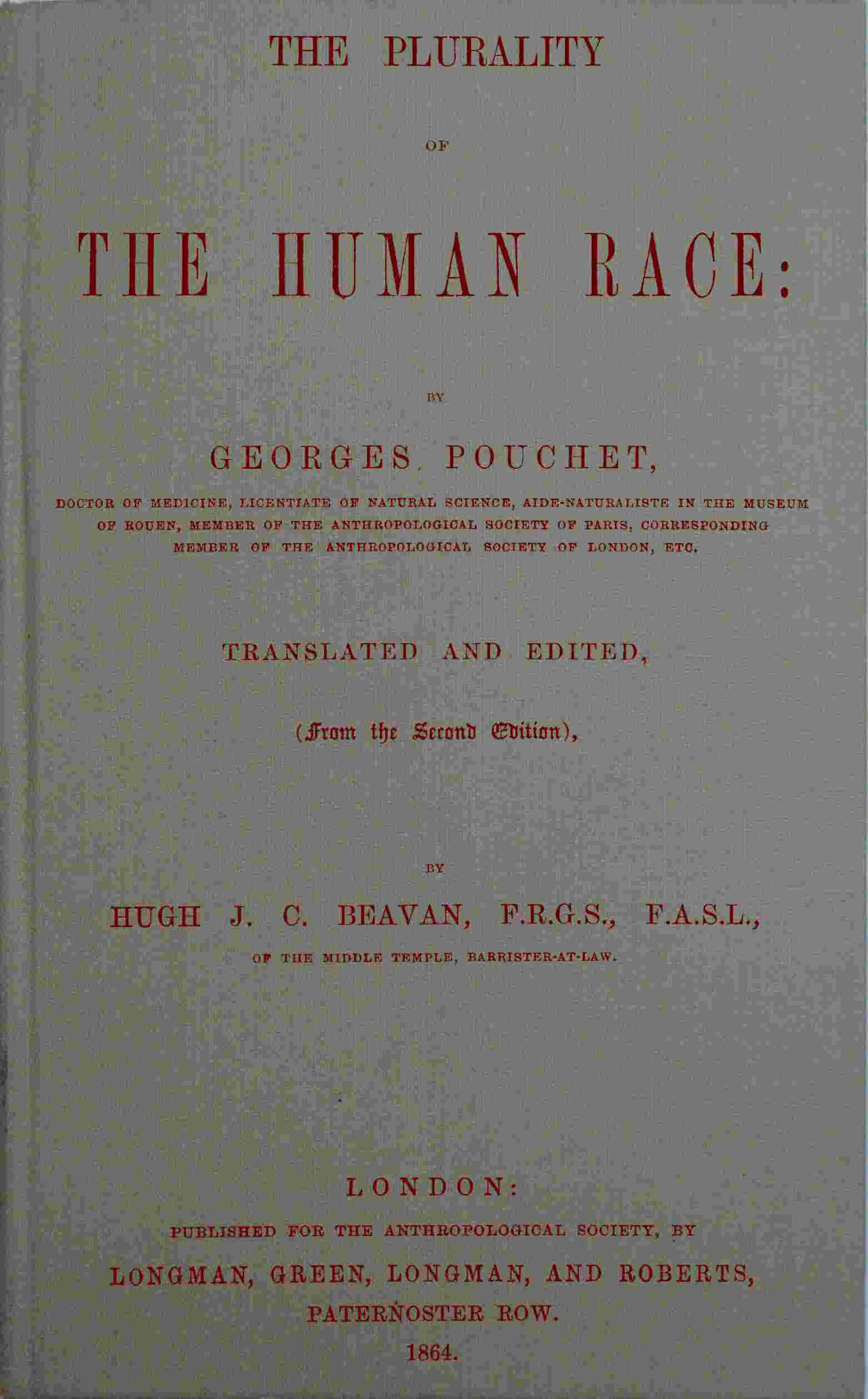
The Publishing Committee of the Anthropological Society of London honoured me by committing the translation and editing of this book to my care, and I set about the task with some diffidence, as this is probably the first work of the kind which has ever been given to the English literary world in a convenient and popular form. Such being the case, there will sometimes be found expressions which may be thought foreign; but I have preferred on these occasions giving the more literal translation, instead of one which possibly might fail to convey the Author’s real meaning. In books containing such very peculiar ideas as those of M. Pouchet, it is requisite to be especially careful on this head.
Of the clever nature and terse expression of the work there can be little doubt, but I am sorry to find in it opinions with which I cannot at all agree, and in order to prove which, or rather endeavour to do so, science is strained in an unnatural manner. The theory of spontaneous generation is by no means a new one; but M. Pouchet can throw very little light on the subject, and leaves it as before—entirely unproved. The extreme sceptical nature of his views is much to be regretted, and in this especially the Author and Editor are in entire disagreement. The former is inclined to go out of his way to bring forward those views, when they were not required, and would have been better left unsaid.
We have, however, a new and extremely interesting field of investigation opened to us; but the more pains our author takes to explain and illustrate the wonders of our physical and psychological nature, the more he seems to disprove his own theory of spontaneous generation. Blackmore said—
But M. Pouchet does find art in nature; he tells us that its ways are intricate and manifold, but still that it all arises from some germ spontaneously generated, he cannot say how.
With this exception, which some may think no fault at all, I recommend this book heartily to the Fellows of the Society and the public generally. The clearness and even brilliancy of M. Pouchet’s very peculiar style are soon discoverable, and it is not astonishing that his book has had a great success in France. That such will be the case in its English form is my sincere wish. I must thank my friend Mr. Carter Blake especially for many kind and valuable hints, and I need scarcely say, in conclusion, that as much care as possible has been taken with the translation and editing. I now commit this little work to the kind consideration of the Society and the world. It is for them to judge how my duties have been performed.
H. J. C. B.