
LIST OF EDITIONS REGULARLY CITED IN NOTES.
1633, 1635, 1639, 1650, 1654, 1669.
1633-69 i.e. All the editions.
Etc.
EDITIONS OCCASIONALLY CITED.
1649, in lists of editions and MSS. appended to poems first published
in that edition.
Textually it is identical with 1650-54.
1719, Tonson's edition.
1855, The Boston edition of that year—cited once.
Grosart, A. B. Grosart's edition of 1872-3.
Grolier, The Grolier Club edition of Professor Norton and Mrs. Burnett, 1895.
Chambers, Mr. E. K. Chambers' edition of 1896.
LIST OF MS. SIGLA
- A10 Additional MS. 10,309, British Museum.
- A11 " " 11,811, "
- A18 " " 18,646, "
- A23 " " 23,229, "
- A25 " " 25,707, "
- A34 " " 34,744, "
- Ash 38 Ashmole MS. 38, Bodleian Library.
- B Bridgewater MS., Bridgewater House.
- Bur Burley MS., formerly at Burley-on-the-Hill House, Rutland.
- C Cambridge University Library MS.
- Cy Carnaby MS., Harvard College.
- D Dowden MS., belonging to Professor Edward Dowden.
- E20 Egerton MS. 2013, British Museum.
- E22 " " 2230, "
- G Gosse MS. of Metempsychosis, belonging to Mr. Edmund Gosse.
- H39 Harleian MS. 3910, British Museum.
- H40 " " 4064, "
- H49 " " 4944, "
- H51 " " 5110, "
- HN Hawthornden MS., Library of Society of Antiquaries, Edinburgh.
- JC John Cave MS., belonging to Mr. Elkin Mathews.
- L74 Lansdowne MS. 740, British Museum.
- L77 " " 777, "
- Lec Leconfield MS., at Petworth House.
- M Monckton-Milnes MS., belonging to the Marquis of Crewe.
- N Norton MS., Harvard College.
- O'F O'Flaherty MS., Harvard College.
- P Phillipps MS., belonging to Captain C. Shirley Harris.
- Q Queen's College MS., Queen's College, Oxford.
- RP31 Rawlinson Poetical MS. 31, Bodleian Library, Oxford.
- RP61 " " " 61 " " "
- S Stephens MS., Harvard College.
- S96 Stowe MS. 961, British Museum.
- TCC Trinity College, Cambridge, MS.
- TCD Trinity College, Dublin, MS. G. 2. 21.
- TCD (II) A second collection of poems in the same MS.
- W Westmoreland MS., belonging to Mr. Edmund Gosse.
The following groups are important:—
D, H49, Lec,
and
A18, N, TC, where TC represents TCC and TCD
THE
PRINTER
TO THE
UNDERSTANDERS.
FOR this time I must speake only to you: at another, Readers may perchance serve my turne; and I thinke this a way very free from exception, in hope that very few will have a minde to confesse themselves ignorant.
If you looke for an Epistle, as you have before ordinary publications, I am sory that I must deceive you; but you will not lay it to my charge, when you shall consider that this is not ordinary, for if I should say it were the best in this kinde, that ever this Kingdome hath yet seene; he that would doubt of it must goe out of the Kingdome to enforme himselfe, for the best judgments, within it, take it for granted.
You may imagine (if it please you) that I could endeare it unto you, by saying, that importunity drew it on; that had it not beene presented here, it would have come to us from beyond the Seas; (which perhaps is true enough,) That my charge and paines in procuring of it hath beene such, and such. I could adde hereto, a promise of more correctnesse, or enlargement in the next Edition, if you shall in the meane time content you with this. But these things are so common, as that I should profane this Peece by applying them to it; A Peece which who so takes not as he findes it, in what manner soever, he is unworthy of it, sith a scattered limbe of this Author, hath more amiablenesse in it, in the eye of a discerner, then a whole body of some other; Or, (to expresse him best by himselfe)
In the
Storme.
—A hand, or eye,
By Hilyard drawne, is worth a history
By a worse Painter made;—
If any man (thinking I speake this to enflame him for the vent of the Impression) be of another opinion, I shall as willingly spare his money as his judgement. I cannot lose so much by him as hee will by himselfe. For I shall satisfie my selfe with the conscience of well doing, in making so much good common.
Howsoever it may appeare to you, it shall suffice mee to enforme you, that it hath the best warrant that can bee, publique authority, and private friends.
There is one thing more wherein I will make you of my counsell, and that is, That whereas it hath pleased some, who had studyed and did admire him, to offer to the memory of the Author, not long after his decease, I have thought I should do you service in presenting them unto you now; onely whereas, had I placed them in the beginning, they might have serv'd for so many Encomiums of the Author (as is usuall in other workes, where perhaps there is need of it, to prepare men to digest such stuffe as follows after,) you shall here finde them in the end, for whosoever reades the rest so farre, shall perceive that there is no occasion to use them to that purpose; yet there they are, as an attestation for their sakes that knew not so much before, to let them see how much honour was attributed to this worthy man, by those that are capable to give it. Farewell.
The Printer &c. 1633-49: om. 1650-69, which substitute Dedication To the &c. (p. 4)
2 you: 1635-49: you, 1633
The Printer to the Vnderstanders. 1635-69: The Printer to the Reader. 1633. See note
28 here 1635-69: om. 1633 (... you shall here finde them in the end,...)
Hexastichon Bibliopolae.
I SEE in his last preach'd, and printed Booke,
His Picture in a sheet; in Pauls I looke,
And see his Statue in a sheete of stone,
And sure his body in the grave hath one:
Those sheetes present him dead, these if you buy,
You have him living to Eternity.
Jo. Mar.
Hexastichon Bibliopolae. 1633-69
Hexastichon ad Bibliopolam.
Incerti.
I N thy Impression of Donnes Poems rare,
For his Eternitie thou hast ta'ne care:
'Twas well, and pious; And for ever may
He live: Yet shew I thee a better way;
Print but his Sermons, and if those we buy,
He, We, and Thou shall live t' Eternity.
Hexastichon ad Bibliopolam. 1635-69
Dedication to the Edition of 1650.
To the Right Honourable
William Lord Craven Baron of
Hamsted-Marsham.
My Lord,
MANY of these Poems have, for severall impressions, wandred up and down trusting (as well they might) upon the Authors reputation; neither do they now complain of any injury but what may proceed either from the kindnesse of the Printer, or the curtesie of the Reader; the one by adding something too much, lest any spark of this sacred fire might perish undiscerned, the other by putting such an estimation upon the wit & fancy they find here, that they are content to use it as their own: as if a man should dig out the stones of a royall Amphitheatre to build a stage for a countrey show. Amongst all the monsters this unlucky age has teemed with, I finde none so prodigious, as the Poets of these later times, wherein men as if they would level understandings too as well as estates, acknowledging no inequality of parts and Judgements, pretend as indifferently to the chaire of wit as to the Pulpit, & conceive themselves no lesse inspired with the spirit of Poetry then with that of Religion: so it is not onely the noise of Drums and Trumpets which have drowned the Muses harmony, or the feare that the Churches ruine wil destroy their Priests likewise, that now frights them from this Countrey, where they have been so ingenuously received, but these rude pretenders to excellencies they unjustly own who profanely rushing into Minervaes Temple, with noysome Ayres blast the lawrell wch thunder cannot hurt. In this sad condition these learned sisters are fled over to beg your Lps. protection, who have been so certain a patron both to arts and armes, and who in this generall confusion have so intirely preserved your Honour, that in your Lordship we may still read a most perfect character of what England was in all her pompe and greatnesse, so that although these poems were formerly written upon severall occasions, and to severall persons, they now unite themselves, and are become one pyramid to set your Lordships statue upon, where you may stand like Armed Apollo the defendor of the Muses, encouraging the Poets now alive to celebrate your great Acts by affording your countenance to his poems that wanted onely so noble a subject.
To the &c. 1650-69
To John Donne.
D ONNE, the delight of Phoebus, and each Muse,
Who, to thy one, all other braines refuse;
Whose every work, of thy most early wit,
Came forth example, and remaines so, yet:
Longer a knowing, than most wits doe live;
And which no'n affection praise enough can give!
To it, thy language, letters, arts, best life,
Which might with halfe mankind maintain a strife;
All which I mean to praise, and, yet, I would;
But leave, because I cannot as I should!
B. Jons.
To John Donne. 1650-69, following the Hexastichon ad Bibliopolam.
To Lucy, Countesse of Bedford,
with M. Donnes Satyres.
L VCY, you brightnesse of our Spheare, who are
Life of the Muses day, their morning Starre!
If works (not th'Authors) their own grace should look
Whose poems would not wish to be your book?
But these, desir'd by you, the makers ends
Crown with their own. Rare Poems ask rare friends.
Yet, Satyres, since the most of mankind bee
Their unavoided subject, fewest see:
For none ere took that pleasure in sins sense,
But, when they heard it tax'd, took more offence.
They, then, that living where the matter is bred,
Dare for these Poems, yet, both ask, and read,
And like them too; must needfully, though few,
Be of the best: and 'mongst those best are you;
Lucy, you brightnefle of our Spheare, who are
The Muses evening, as their morning-Starre.
B. Jon.
To John Donne.
W HO shall doubt, Donne, where I a Poet bee,
When I dare send my Epigrammes to thee?
That so alone canst judge, so'alone do'st make:
And, in thy censures, evenly, dost take
As free simplicity, to dis-avow,
As thou hast best authority, t'allow.
Read all I send: and, if I finde but one
Mark'd by thy hand, and with the better stone,
My title's seal'd. Those that for claps doe write,
Let punees, porters, players praise delight,
And, till they burst, their backs, like asses load:
A man should seek great glory, and not broad.
B. Jon.
To Lucy &c. To John Donne &c. 1650-69, in sheets added 1650.
See Text and Canon &c.
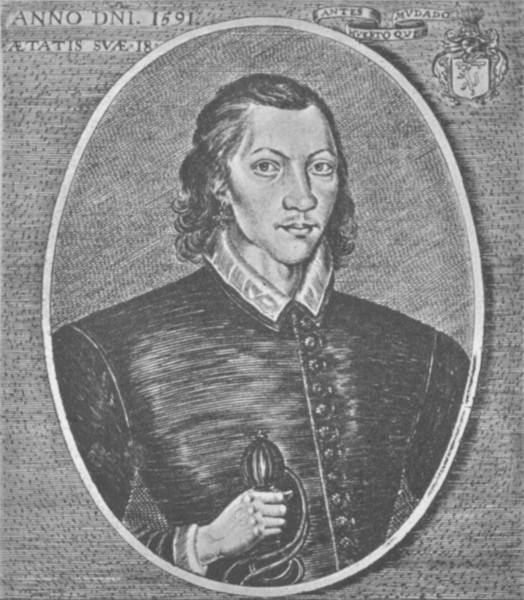
JOHN DONNE
ANNO DNI. 1591. ÆTATIS SVÆ. 18.
ANTES MVERTO QUE MVDADO.
This was for youth, Strength, Mirth, and wit that Time
Most count their golden Age; but t'was not thine.
Thine was thy later yeares, so much refind
From youths Drosse, Mirth, & wit; as thy pure mind
Thought (like the Angels) nothing but the Praise
Of thy Creator, in those last, best Dayes.
Witnes this Booke, (thy Embleme) which begins
With Love; but endes, with Sighes, & Teares for sins.
iz: wa:
Will: Marshall sculpsit
From the engraving prefixed to the Poems in the
Editions of 1635, 1639, 1649, 1650, 1654
SONGS AND SONETS.
The good-morrow.
I WONDER by my troth, what thou, and I
Did, till we lov'd? were we not wean'd till then?
But suck'd on countrey pleasures, childishly?
Or snorted we in the seaven sleepers den?
5T'was so; But this, all pleasures fancies bee.
If ever any beauty I did see,
Which I desir'd, and got, t'was but a dreame of thee.
And now good morrow to our waking soules,
Which watch not one another out of feare;
10For love, all love of other sights controules,
And makes one little roome, an every where.
Let sea-discoverers to new worlds have gone,
Let Maps to other, worlds on worlds have showne,
Let us possesse one world, each hath one, and is one.
15My face in thine eye, thine in mine appeares,
And true plaine hearts doe in the faces rest,
Where can we finde two better hemispheares
Without sharpe North, without declining West?
What ever dyes, was not mixt equally;
20If our two loves be one, or, thou and I
Love so alike, that none doe slacken, none can die.
SONGS AND SONETS. 1635-69: no division into sections, 1633
The good-morrow. 1633-69, A18, L74, N, TCC, TCD: no title, A25, B, C, D, H40, H49, JC, Lec, O'F, P, S: Elegie. S96
2 lov'd? 1639-69: lov'd, 1633-35
3 countrey pleasures, childishly? 1633-54, D, H40, H49, Lec: childish pleasures seelily? 1669, A18, A25, B, JC, L74, N, O'F, P, S, S96, TC
4 snorted 1633-54, D, H40, H49, Lec, O'F, S96: slumbred 1669, A18, A25, JC, L74, N, P, TC seaven sleepers 1633: seven-sleepers 1635-69
5 this,] as 1669
10 For 1633-69, D, H40, H49, Lec: But rest of MSS.
13 to other, worlds on 1633-54: to other worlds our 1669: to others, worlds on D, H49, Lec, and other MSS.
14 one world 1633-69, D, H49, Lec: our world rest of MSS.
17 better 1633, D, H40, H49, Lec: fitter 1635-69, and rest of MSS.
19 was not] is not 1669
20-1 or, thou and I ... can die. 1633, D, H40, H49, Lec: or, thou and I ... can slacken, ... can die. Chambers:
both thou and I
Love just alike in all, none of these loves can die.
1635-69, JC, O'F, P:
or thou and I
Love just alike in all, none of these loves can die.
A18, A25, B, L74, S96, TC
As thou and I &c.
H40:
And thou and I &c.
S
Song.
G OE, and catche a falling starre,
Get with child a mandrake roote,
Tell me, where all past yeares are,
Or who cleft the Divels foot,
5Teach me to heare Mermaides singing,
Or to keep off envies stinging,
And finde
What winde
Serves to advance an honest minde.
10If thou beest borne to strange sights,
Things invisible to see,
Ride ten thousand daies and nights,
Till age snow white haires on thee,
Thou, when thou retorn'st, wilt tell mee
15All strange wonders that befell thee,
And sweare
No where
Lives a woman true, and faire.
If thou findst one, let mee know,
20Such a Pilgrimage were sweet;
Yet doe not, I would not goe,
Though at next doore wee might meet,
Though shee were true, when you met her,
And last, till you write your letter,
25Yet shee
Will bee
False, ere I come, to two, or three.
Song. 1633-69: Song, A Songe, or no title, A18, A25, B, C, Cy, D, H40, H49, JC, L74, Lec, N, O'F, P, S, S96, TCC, TCD
3 past yeares] times past 1669: past times P
11 to see] go see 1669, S, S96: see most other MSS.
20 sweet; 1669: sweet, 1633-54
24 last, till] last so till O'F, S, S96
27 False, ... three] False, ere she come to two or three. 1669]
Womans constancy.
N OW thou hast lov'd me one whole day,
To morrow when thou leav'st, what wilt thou say?
Wilt thou then Antedate some new made vow?
Or say that now
5We are not just those persons, which we were?
Or, that oathes made in reverentiall feare
Of Love, and his wrath, any may forsweare?
Or, as true deaths, true maryages untie,
So lovers contracts, images of those,
10Binde but till sleep, deaths image, them unloose?
Or, your owne end to Justifie,
For having purpos'd change, and falsehood; you
Can have no way but falsehood to be true?
Vaine lunatique, against these scapes I could
15Dispute, and conquer, if I would,
Which I abstaine to doe,
For by to morrow, I may thinke so too.
Womans constancy. 1633-69, A18, L74, N, O'F, TCC, TCD: no title, B, D, H40, H49, Lec, P, S
8 Or, 1633, 1669: For, 1635-54 (ll. 8-10 in brackets)
The undertaking.
I HAVE done one braver thing
Then all the Worthies did,
And yet a braver thence doth spring,
Which is, to keepe that hid.
5It were but madnes now t'impart
The skill of specular stone,
When he which can have learn'd the art
To cut it, can finde none.
So, if I now should utter this,
10Others (because no more
Such stuffe to worke upon, there is,)
Would love but as before.
But he who lovelinesse within
Hath found, all outward loathes,
15For he who colour loves, and skinne,
Loves but their oldest clothes.
If, as I have, you also doe
Vertue'attir'd in woman see,
And dare love that, and say so too,
20And forget the Hee and Shee;
And if this love, though placed so,
From prophane men you hide,
Which will no faith on this bestow,
Or, if they doe, deride:
25Then you have done a braver thing
Then all the Worthies did;
And a braver thence will spring,
Which is, to keepe that hid.
The undertaking. 1635-69: no title, 1633, B, D, H40, H49, JC, Lec, O'F, P, S: Platonique Love. A18, N, TCC, TCD
2 Worthies] worthies 1633
3 And yet] Yet B, D, H49, Lec
7-8 art ... it, 1669: art, ... it 1633-54
16 their] her B
18 Vertue'attir'd in 1633, A18, B, D, H40, H49, JC, Lec, N, S, TC: Vertue in 1635-69, O'F, Chambers
26 did; Ed: did. 1633-39: did, 1650-69
27 spring,] spring 1633-39
The Sunne Rising.
BUSIE old foole, unruly Sunne,
Why dost thou thus,
Through windowes, and through curtaines call on us?
Must to thy motions lovers seasons run?
5Sawcy pedantique wretch, goe chide
Late schoole boyes, and sowre prentices,
Goe tell Court-huntsmen, that the King will ride,
Call countrey ants to harvest offices;
Love, all alike, no season knowes, nor clyme,
10Nor houres, dayes, moneths, which are the rags of time.
Thy beames, so reverend, and strong
Why shouldst thou thinke?
I could eclipse and cloud them with a winke,
But that I would not lose her sight so long:
15If her eyes have not blinded thine,
Looke, and to morrow late, tell mee,
Whether both the'India's of spice and Myne
Be where thou leftst them, or lie here with mee.
Aske for those Kings whom thou saw'st yesterday,
20And thou shalt heare, All here in one bed lay.
She'is all States, and all Princes, I,
Nothing else is.
Princes doe but play us; compar'd to this,
All honor's mimique; All wealth alchimie.
25Thou sunne art halfe as happy'as wee,
In that the world's contracted thus;
Thine age askes ease, and since thy duties bee
To warme the world, that's done in warming us.
Shine here to us, and thou art every where;
30This bed thy center is, these walls, thy spheare.
The Sunne Rising. 1633-69: Sunne Rising. A18, L74, N, TCC, TCD: Ad Solem. A25, D, H49, JC, O'F, S, S96: To the Sunne. Cy, Lec, O'F (as a second title): no title, B
3 call] look 1669
6 and] or 1669
sowre] slowe B, Cy, P
8 offices;] offices, 1633
11-14 Thy beames, ... so long: 1633 and all MSS.:
Thy beames so reverend, and strong
Dost thou not thinke
I could eclipse and cloude them with a winke,
But that I would not lose her sight so long? 1635-69
17 spice] space 1650-54
18 leftst 1633: left 1635-69
23 us;] us, 1633
24 wealth] wealth's A25, C, P
alchimie. Ed: alchimie; 1633-69
26 thus; Ed: thus. 1633-69
The Indifferent.
I CAN love both faire and browne,
Her whom abundance melts, and her whom want betraies,
Her who loves lonenesse best, and her who maskes and plaies,
Her whom the country form'd, and whom the town,
5Her who beleeves, and her who tries,
Her who still weepes with spungie eyes,
And her who is dry corke, and never cries;
I can love her, and her, and you and you,
I can love any, so she be not true.
10Will no other vice content you?
Wil it not serve your turn to do, as did your mothers?
Or have you all old vices spent, and now would finde out others?
Or doth a feare, that men are true, torment you?
Oh we are not, be not you so,
15Let mee, and doe you, twenty know.
Rob mee, but binde me not, and let me goe.
Must I, who came to travaile thorow you,
Grow your fixt subject, because you are true?
Venus heard me sigh this song,
20And by Loves sweetest Part, Variety, she swore,
She heard not this till now; and that it should be so no more.
She went, examin'd, and return'd ere long,
And said, alas, Some two or three
Poore Heretiques in love there bee,
25Which thinke to stablish dangerous constancie.
But I have told them, since you will be true,
You shall be true to them, who'are false to you.
The Indifferent. 1633-69, A18, N, TCC, TCD: A Songe, Songe, or no title, B, D, H40, H49, JC, Lec, O'F, S, S96: Sonnet. P
3 lonenesse] lovers 1669
maskes] sports 1669, S
and 1669: & 1633-39: om. 1650-54
12 spent] worn 1669
15 mee, 1633: me; 1635-69
17 travaile] spelt travell, travel 1635-69
19 sigh] sing 1669
20 sweetest Part,] sweetest sweet, 1669, P, S
21 and that it 1633, B, D, H49, Lec, S: it 1635-69, H40, P: and it A18, JC, N, O'F, S96, TC
Loves Vsury.
F OR every houre that thou wilt spare mee now,
I will allow,
Usurious God of Love, twenty to thee,
When with my browne, my gray haires equall bee;
5Till then, Love, let my body raigne, and let
Mee travell, sojourne, snatch, plot, have, forget,
Resume my last yeares relict: thinke that yet
We'had never met.
Let mee thinke any rivalls letter mine,
10And at next nine
Keepe midnights promise; mistake by the way
The maid, and tell the Lady of that delay;
Onely let mee love none, no, not the sport;
From country grasse, to comfitures of Court,
15Or cities quelque choses, let report
My minde transport.
This bargaine's good; if when I'am old, I bee
Inflam'd by thee,
If thine owne honour, or my shame, or paine,
20Thou covet most, at that age thou shalt gaine.
Doe thy will then, then subject and degree,
And fruit of love, Love I submit to thee,
Spare mee till then, I'll beare it, though she bee
One that loves mee.
Loves Vsury. 1633-69, L74: no title, B, Cy, D, H40, H49, Lec, O'F, P, S: Elegie. S96
5 raigne, 1633, B, Cy, D, H40, H49, L74, Lec, P, S: range, 1635-69, O'F, S96. See note
6 snatch, 1633, 1669: match, 1635-54
7 relict] relique 1669
12 that] her 1669
13 sport; 1669: sport 1633-54: sport, most MSS.
15 let report 1633, 1669, B, Cy, D, H40, H49, L74, Lec, P, S: let not report 1635-54, O'F, S96, Chambers. See note
19 or paine 1633, 1669, and most MSS.: and paine 1635-54, O'F
22 fruit] fruites B, D, H49, Lec, O'F, S96
24 loves 1633, 1669 and all the MSS.: love 1635-54
The Canonization.
F OR Godsake hold your tongue, and let me love,
Or chide my palsie, or my gout,
My five gray haires, or ruin'd fortune flout,
With wealth your state, your minde with Arts improve,
5Take you a course, get you a place,
Observe his honour, or his grace,
Or the Kings reall, or his stamped face
Contemplate, what you will, approve,
So you will let me love.
10Alas, alas, who's injur'd by my love?
What merchants ships have my sighs drown'd?
Who saies my teares have overflow'd his ground?
When did my colds a forward spring remove?
When did the heats which my veines fill
15Adde one more to the plaguie Bill?
Soldiers finde warres, and Lawyers finde out still
Litigious men, which quarrels move,
Though she and I do love.
Call us what you will, wee are made such by love;
20Call her one, mee another flye,
We'are Tapers too, and at our owne cost die,
And wee in us finde the'Eagle and the Dove.
The Phœnix ridle hath more wit
By us, we two being one, are it.
25So to one neutrall thing both sexes fit,
Wee dye and rise the same, and prove
Mysterious by this love.
Wee can dye by it, if not live by love,
And if unfit for tombes and hearse
30Our legend bee, it will be fit for verse;
And if no peece of Chronicle wee prove,
We'll build in sonnets pretty roomes;
As well a well wrought urne becomes
The greatest ashes, as halfe-acre tombes,
35And by these hymnes, all shall approve
Us Canoniz'd for Love:
And thus invoke us; You whom reverend love
Made one anothers hermitage;
You, to whom love was peace, that now is rage;
40Who did the whole worlds soule contract, and drove
Into the glasses of your eyes
(So made such mirrors, and such spies,
That they did all to you epitomize,)
Countries, Townes, Courts: Beg from above
45A patterne of your love!
The Canonization. 1633-39, A18, Cy, D, H49, Lec, N, O'F, P, TCC, TCD: Canonization. 1650-69, S: Canonizatio. S96: no title, B, H40, JC
3 five 1633, 1669: true 1635-54
fortune] fortunes 1669
4 improve, 1650-69: improve 1633-39
7 reall] Roiall Lec
14 veines] reynes 1669
15 more, 1633-54, Lec: man 1669, A18, B, Cy, D, H40, H49, JC, N, O'F, P, S, S96, TC
17 which] whom 1669
18 Though] While 1669
22 Dove. Ed: dove, 1633-69
24 are it. 1633-69: are it; Chambers and Grolier
25 So 1650-69: So, 1633-39. See note
fit, D, H49, Lec: fit. 1633-69. See note
29 tombes and 1633-54: tomb or 1669
30 legend] legends 1633
35 these 1633: those 1635-69
36 Love:] Love. 1633
39 rage; Ed: rage, 1633-69
40 contract] extract A18, B, Cy, D, H40, H49, Lec, N, O'F, S, S96, TCC
41 eyes 1633-69: eyes; Chambers
42-3 brackets, Ed
44 Courts: Beg] Courts Beg 1669: courts beg Chambers. See note
from] frow 1633
45 your 1669, A18, B, H40, JC, N, O'F, P, S96, TC: our 1633-54, D, H49, Lec
love! Ed: love. 1633-69
The triple Foole.
I AM two fooles, I know,
For loving, and for saying so
In whining Poëtry;
But where's that wiseman, that would not be I,
5If she would not deny?
Then as th'earths inward narrow crooked lanes
Do purge sea waters fretfull salt away,
I thought, if I could draw my paines,
Through Rimes vexation, I should them allay,
10Griefe brought to numbers cannot be so fierce,
For, he tames it, that fetters it in verse.
But when I have done so,
Some man, his art and voice to show,
Doth Set and sing my paine,
15And, by delighting many, frees againe
Griefe, which verse did restraine.
To Love, and Griefe tribute of Verse belongs,
But not of such as pleases when'tis read,
Both are increased by such songs:
20For both their triumphs so are published,
And I, which was two fooles, do so grow three;
Who are a little wise, the best fooles bee.
The triple Foole. 1633-69, A18, L74, N, TCC, TCD: Song or no title, B, Cy, D, H40, H49, HN, JC, Lec, O'F, P, S, S96
4 the wiser man, 1669
5 If he should not deny? P
6 narrow om. P: crooked om. B
lanes] vaines Cy, P
9 allay, 1633-39: allay. 1650-69, Chambers
10 numbers] number 1669
11 For, he tames it] He tames it much B
13 and] or 1669
Lovers infinitenesse.
I F yet I have not all thy love,
Deare, I shall never have it all,
I cannot breath one other sigh, to move,
Nor can intreat one other teare to fall,
5And all my treasure, which should purchase thee,
Sighs, teares, and oathes, and letters I have spent.
Yet no more can be due to mee,
Then at the bargaine made was ment,
If then thy gift of love were partiall,
10That some to mee, some should to others fall,
Deare, I shall never have Thee All.
Or if then thou gavest mee all,
All was but All, which thou hadst then;
But if in thy heart, since, there be or shall,
15New love created bee, by other men,
Which have their stocks intire, and can in teares,
In sighs, in oathes, and letters outbid mee,
This new love may beget new feares,
For, this love was not vowed by thee.
20And yet it was, thy gift being generall,
The ground, thy heart is mine, what ever shall
Grow there, deare, I should have it all.
Yet I would not have all yet,
Hee that hath all can have no more,
25And since my love doth every day admit
New growth, thou shouldst have new rewards in store;
Thou canst not every day give me thy heart,
If thou canst give it, then thou never gavest it:
Loves riddles are, that though thy heart depart,
30It stayes at home, and thou with losing savest it:
But wee will have a way more liberall,
Then changing hearts, to joyne them, so wee shall
Be one, and one anothers All.