
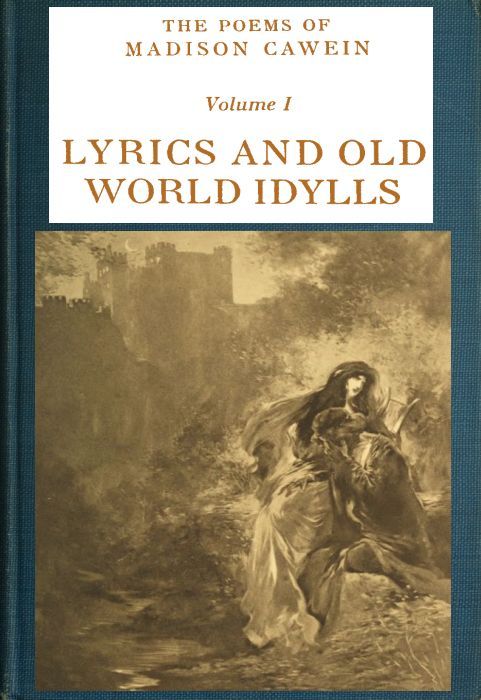
Thus have I pictured her:—In Arden old
A white-browed maiden with a falcon eye,
And rose-flushed face, and locks of wind-blown gold,
Teaching her hawks to fly.
Or, 'mid her boar-hounds, panting with the heat,
In huntsman green, she sounds the hunt's wild prize,
Plumed, dagger-belted, while beneath her feet
The spear-pierced monster dies.
Or in Brécèliand, on some high tower,
Clad soft in samite, last of her lost race,
I have beheld her, lovelier than a flower,
Turn from the world her face.
Or, robed in raiment of romantic lore,
Like Oriana, dark of eye and hair,
Riding through Realms of Legend evermore,
And ever young and fair.
Or now like Bradamant, as brave as just,
In complete steel, her pure face lit with scorn,
At heathen castles, dens of demon lust,
Winding her bugle-horn.
Another Una; and in chastity
A second Britomart; in beauty far
O'er her who led King Charles's chivalry
And Paynim lands to war....
Now she, from Avalon's deep-dingled bowers,—
'Mid which white stars and never-waning moons
Make marriage; and dim lips of musk-mouthed flowers
Sigh faint and fragrant tunes,—
Implores me follow; and, in shadowy shapes
Of sunset, shows me,—mile on misty mile
Of purple precipice,—all the haunted capes
Of her enchanted isle.
Where, bowered in bosks and overgrown with vine,
Upon a headland breasting violet seas,
Her castle towers, like a dream divine,
With stairs and galleries.
And at her casement, Circe-beautiful,
Above the surgeless reaches of the deep,
She sits, while, in her gardens, fountains lull
The perfumed wind to sleep.
Or, round her brow a diadem of spars,
She leans to hearken, from her raven height,
The nightingales that, choiring to the stars,
Haunt with wild song the night.
Or, where the moon is mirrored in the waves,
To mark, deep down, the Sea King's city rolled,
Wrought of huge shells and labyrinthine caves,
Ribbed pale with pearl and gold.
There doth she wait forever; and the kings
Of all the world have wooed her: but she cares
For none but him, the Heart, that dreams and sings,
That sings and dreams and dares.
THE VALLEY OF MUSIC
I
Oh, cool as the flutter of fountains,
And fresh as the fall of the dew,
Wet as the hues of the rain-arch,
In that vale, is the dawn, when, o'er mountains,
Pearl-peaked and hyaline blue,
Through the Memnonian blue,
Her spirit, like music, comes slowly,
A music of light and of fire,
Leaving her footsteps in roses
There on its summits, while holy,
Fair on her brow is her tire,
Gemmed with the morning-star's fire.
II
And still as the incense of altars,
And dim as the deeps of a cloud,
Mystic as winds of the woodlands,
In that vale, is the night when she falters
In the sorrowful folds of her shroud,
The far-blowing dusk of her shroud,
By the scarlet-strewn bier of her lover,
The day, lying faded and fair
In his chamber of purple and vair.—
When, above it, you see her uncover
Her star-girdled darkness of hair—
Gold-hooped with the gold of the even—
And for the day's burial prepare,
The spirit of night in the heaven,
O'er that vale, is most hauntingly fair;
So fair that you wish it were given
That you in the rays of her hair,
Might die! in her gold-girdled hair.
III
There lies in a valley, where mountains
Have walled it from all that is ours,
A garden entangled with flowers;
Where the whisper of echoing fountains
Makes song in the balm-breathing bowers:
Where torrents, plunged down from wild masses
Of granite, from cavern-pierced steeps,
With thunders sonorous cleave passes,
And madden the world with their leaps,
The clamorous foam of their leaps.
IV
And, oh! when the sunlight comes heaping
With glitter the mist of those chasms,
The foam of those musical chasms,
You may hear a lamenting and weeping,
And see in the vastness far sweeping,
In wild and æolian spasms,
Down, down in those voluble chasms,
The Spirits of Light and of Darkness.
And the wave from the gray-hearted granite
In rivers rolls rippling around;
Meanders through shade-haunted forests,
Where many rock-barriers can span it,
And dash it in froth and in sound;
Where the nights with their great moons can wan it,
Or star its dark stillness profound.
V
And here with her harp doth she wander,
That daughter of music, twice kissed
Of the Spirits of Love and of Sorrow:
Yea, here doth she wander and ponder,
That maiden of moonlight and mist,
With starlight on hair and on wrist;
Yea, here doth she ponder and wander
'Mid blossoms with loveliness whist,
'Mid moonlight with fragrances kissed.
And ever her being grows fonder
Of forests where phantoms keep tryst,
The people of moon and of mist:
And often they troop to her singing,
As she sits 'mid the undulant cedars—
All savage of wildness and scent—
Whose tops to her beauty are bent,
Like the pennons and plumes of fierce leaders,
In worship and testament:
Like the pennons and plumes of fierce leaders,
All ragged with battle and rent.
VI
And oft when the moon, like a palace
Of witchcraft, shines white overhead,
Making pearl of the foam of the torrent,
She wakes her wild harp in the valleys
Where the blossoms have built her a bed:
She sits where a fountain of flowers
Rains fragrance from branches around,
The blossomed lianas around,
Keeping time with their petal-sweet showers
To her harp; with its strain interwound;
Unfolding, it seems, to the sound:
While her song is as redolence round her,
And their fragrance as music, it seems,
Whose touch and enchantment have bound her
With shadows and whispers of dreams,
And she seems but a part of her dreams,
A creature created of dreams.
VII
One night as she whispered and wandered
In her garden of music and flowers,
She saw, in a ray of the moonlight,
A youth fast asleep 'mid the flowers;
A youth on a mantle of satin,
A poppy-red robe 'mid the flowers.
VIII
Love housed 'neath his eyelids, that, slender
As petals of roses, were pale:
She bent and she kissed them and, tender,
She murmured and bade them unveil,
The blossoms beneath them unveil.
And he woke and beheld her and panted:—
"At last I behold thee, O Song!
O beautiful, pitiless Song!
Thou, thou, who so wildly enchanted,
And led me, eluded me long!
Evaded and lured me so long!"
IX
Then she knelt on the mantle of satin,
And plunged a long look in his eyes:
She knelt on the mantle of scarlet,
And kissed him on mouth and on eyes,
And mingled her soul with his sighs.
And then in a moment she knew it,—
He deemed her a part of his dream;
And she smiled and she said, "I am Music!
And thy soul—'twas my spirit that drew it,
Thy soul, with a mystical gleam,
A brightness, a glimmer, a gleam."
X
And he gazed at her strangely; and, sobbing,
Cried out, "Yea; thy harp!—is it strung?
Thy harp of wild gold, is it strung?
With fingers of silver set throbbing
Its chords with that song thou hast sung,
So oft in my dreams thou hast sung."
XI
Then he ceased:—and his eyes—how they glistened!
His eyes, that were haunted with pain,
With longing and beauty and pain:
And again he cried out, "Oh, that music!
That proud and that perilous music!
O God! for that tyrannous strain,
To which in my dreams I have listened,
Ah, God! I have listened in vain!"
And he tossed on the mantle of satin
His deep raven darkness of hair;
And the song at her lips was ungathered,
And she sat there to marvel and stare;
Like marble, to wonder and stare.
XII
Then there welled from her lips all the glory
Of music delirious with words;
Of music that told the heart's story,
And trembled with God-given words,
And rang like the crossing of swords.
And it seemed that the spirit of Beauty
Swept through it with farewells and sighs;
The spirits of Beauty and Duty,
And Love with his beautiful eyes;
And Heaven, and Hell with its cries;
Sad Hell with a tempest of cries.
XIII
The rapture was there of all passion;
The heartache of all we have lost:
The sweetness was there that we fashion
From love we have won or have lost,
Its terror, its torment, and cost.
And over it all was a fury
Of wings that seemed beating above,
Of stars and of winds and the glory
Of God and the splendor of love,
The splendor and triumph of love.
XIV
And then, from her poppy wings, Slumber
Dropped petals of sleep on his eyes;
The Spirit of Slumber with pinions
Of vaporous silver, whose flutter
Had mixed with the music's wild number,
Lured down from the shadowy skies;
Lured down from her drowsy dominions,
To nest in his tired-out eyes.
XV
And in sleep he cried out to her,—stilling
A moment the rush of her song,
The rainbowing torrent of song,—
"Cease! cease! for the rapture is killing!
The glory of light is too strong!—
Oh, cease! make an end of thy song!"—
But she, with the frenzy o'erflowing,
Cried out in an anguish of passion,
"Thy soul shall be one with my song,
With me and the soul of my song.
Take my hand! let us walk in the glowing
Sweet heaven and hell of all song;
Where the torrents of music are flowing,
The rivers of music and song.
Take my hand! Dost thou hear? We are going!
We, too, to God's splendor belong!
Let us walk in the light of His song,
The thunder and flame of His song."
XVI
Then she flung in her song the emotion,
Triumphant, of heart and of soul;
Till the passion and pain were an ocean
That swept her with billowing roll,
As it seemed, to abysses of dole,
Abysses of infinite dole.
XVII
And paler than moonlight and marble
He lay on the red of that robe,
Lay white at her feet on the scarlet,
With silence-sealed lips and the glitter
Of tears in each violet globe
Of his eyes.—And she said: "It is bitter
To see him so still on this robe,
Like marble so still on this robe."
Then she knelt and cried out, "Art thou living?
Or dead?—Have I slain thee with song?—
I gave thee the best in my giving,
But all that I gave thee seems wrong!—
No blessing, a curse was my song!
A curse and a sorrow my song!"
XVIII
And she shattered her harp in her madness,
And rent at her breasts and her hair;
Then kissed him on mouth and on temples,
And spoke to him smoothing the sadness,
The calm of his brow that was fair,
Was perfect and hopelessly fair.
Then she wailed to the stars in the heaven,
And railed at her song as a thief,
Calling out, "For a curse wast thou given!
Yea, thou! for a curse and a grief!
A curse and an infinite grief!"
XIX
And the moon, it went down like a broken
Great dagger of gold in the west;
Like a dagger of gold that was broken,
Her dagger of song, that had spoken,
And pierced with its beauty his breast,
Had ravished his soul from his breast.
And she lay with her hair, deep and golden,
Thick showered and shaken on his;
Her arms around him were enfolden;
Her lips clave to his with a kiss,
The love and the grief of a kiss.
BLODEUWEDD
Not to that demon's son, whom Arthur erst,
For necromancy, at Caerleon, first
Graced greatly, Merlin,—not to him alone
Did those lost learnings of white magic, known
As sorcery and witchcraft, then belong.
Taliesin, now, hath told us in a song
Of one at Arvon, Math of Gwynedd; lord
Of some vague cantrevs of the North; whose sword
Beat back and slew a southern king, through wrath
And puissance of Gwydion, whose path
Thence on, with love, he honored.
Now this Math
Was learned in wondrous witchcraft: as he willed,
He wrought the invisible visible, and filled
The sight with seeming shapes, which it believed
Realities, nor knew it was deceived.
For, at his word, the winds were wan with tents,
And armies rose of airy elements;
And brassy blasts of war from bugles brayed,
And armored hosts in battle clanged and swayed,
And at a word were not. And at his nod,
Steeds, rich-accoutered, whinnying softly, trod
The dædal earth; and hounds, of greater worth,
And wirier, too, than dogs of mortal birth,
Rose up, like forest fungus, from the earth
Around th' astonished stag, or flying doe,
Let Math but wish it or his trumpet blow.
But only things that had their counterpart
On earth could he make real through his art.
Now, to his castle, Math, through Gwydion,—
The son of Don,—the daughter dark of Don,
The silver-circled Arianrod, had brought;
A southern rose of beauty, whom Math thought
To wed, in love and friendship, without blame,
And at Caer Dathyl. When the maiden came
Said Math, "Art thou a virgin?"—Like a flame
Mantling, her answer angered, "Verily,
I know not other, lord, than that I be!"—
So wrought he then through magic that the form
Of her boy baby seemed upon her arm,
White as a rose.
"A Mary!—Yea!" laughed Math;
"Forsooth, another Mary!" then in wrath
Laid harsh hands on the babe and fiercely flung
Far in the salt sea. But the strong winds clung
Fast to the Elfin and the lithe waves swept
Him safely shoreward dry; some fishers kept
Him thus unseaed and christened Dylan, fair
Son of the wave, and fostered him with care.
Nor was this really hers. But Gwydion,
Brother to Arianrod, before the sun
Had time to glimpse it with one golden glaive,
Swiftly,—as hoping the real babe to save,—
Some dim small body on the castle pave
In raven velvet seized; and, hiding, he
Stole this from court, to subtly raise to be
A comely youth. In time, to Arianrod
Came, swearing by the rood and blood of God
He brought her back her son.
Quoth she: "More shame
Dost thou disgrace thyself with, and more blame
Dost damn thyself with, thus to mix our name
With this dishonor, brother, than myself!"
Then, waxing wroth, cried Gwydion, "The Elf
Is thine then?—Tell me, wanton! is thy son
Dylan, the fisher, or this fair-haired one,
This youth?—God's curse!"—and daggered her with looks.
And she in turn waxed fiery, saying, "Books
Of magic I have read as well as Math!
And now I tell thee, keep from out my path!
Thou and thy bastard, he as well as thou!
Thou dog! And on thy folly, listen, now
I lay a threefold curse: behold! the first—
Until I name him, nameless be he! Cursed
Be they who give him arms!—the second:—nor
Shall he bear arms until I arm for war.
And, lastly, know, however high his birth,
He shall not wed a woman of the Earth!—
Malignity! to shame me with thy sin!"
Then passed into her tower and locked her in.
But Gwydion, departing with the youth,
Sware he would compass her; if not through truth,
Through wiles and learnéd magic. And he wrought
So that unbending Arianrod was brought
To name the lad. Again he managed that,
Though strange enchantments as of war, he gat
Her to give arms. But then, not for his life,
Howbeit, could he get the youth a wife.
Persisting, desperate, at last the thing
Wrought in him blusterous as a backward spring.
Now Llew the youth was named. And Gwydion
Made his complaint to Math, the mighty son
Of Mathonwy.
Said Math: "Despair not. We
With charms, illusions, and white sorcery
Will seek to make—for mine are wondrous powers—
A woman for him out of forest flowers."
And so they toiled together one wan night,
When the full moon hung low, and watched, a white
Wild wisp-like face behind a mist. They took
Blossoms of briars, blooming by a brook
Shed from the April hills; and phantom blooms
Of yellow broom that filtered faint perfumes;
And primrose blossoms, frail, of rainy smell,
Weak pink, dim-clustered in a glow-worm dell;
Wild-apple sprigs, that tipsied bells of blaze,
And in far, haunted hollows made a haze
Of ghostly, fugitive fragrance; and the blue
Of hollow harebells, hoary with the dew;
The gold of kingcups, golden as low stars;
And white of lilies,—rolled in limpid bars,
Like sleepy foam,—that swayed aslant and spilled
Slim nectar-cups of musk the rain had filled;
And paly, wildwood wind-flowers; and the gloss
And glow of celandine; and bulbs that boss
And dot the oak-roots bulging up the moss;
Last, on the elfin uplands, pulled the buds,
That burn like spurts of moonlight when it suds
The showering clouds, of blossomed meadow-sweet,
And made a woman fair; from head to feet
Complete in beauty. One far lovelier
Than Branwen, daughter of the gray King Llyr;
Or that dark daughter of Leodegrance,
The stately Gwenhwyvar. And young romance
Dreamed in the open Bibles of her eyes:
Music her motion; and her speech, like sighs
Of roses swinging in the wind and rain,
And lilies dancing on the sunlit plain:
And in her eyes and face there bloomed again
The bluebell and the poppy; and fern and bud
Gave grace and glory to her maidenhood:
And all the attributes of all the flowers
Were in her body, that was not like ours
And yet was like: but in her brow and face
Was love alone and beauty, and no trace,
No least suggestion of an earthly pain,
Or hate, or sorrow, or of worldly stain;
But hope, high heart, and happiness of life.
And Blodeuwedd they named her; and, for wife—
Baptizing her with light and dawn and dew—
Gave, that next morning, to the happy Llew.
AMADIS AT MIRAFLORES
I
MORNING
The quickening Day climbs to one star,
That, cradled, rocks itself in morn;
Whose airy opal, flaming far,
Makes fire of the mountain tarn.
The hosts of morning storm the sky
With streaming splendor, their bright lips
Blow laughter wild that shakes the rye,
And, from the bough, the dew that drips
On Oriana walking by.
The calling rooks swarm round the towers:
A heron sweeps through deeps of glare:
And Falconry among the bowers
Whistles his falcon down the air:
While in the woods the bugled Hunt,
With bearded cheeks, blows wild a-mort
As dies the boar; or, front to front,
Upon the baying hounds, the hart
Turns, antlering at the battle's brunt.
The heath-cock, stout amid his dames,
Upon the purple-heathered hill,
With glossy coat the morn enflames,
Sounds to his rivals challenge shrill.
Where, tossing white its plume of foam,
The fountain leaps and twinkles by,
Embodying dawn and all its bloom,
My Oriana draweth nigh,
Sweet as the heath-bell's wild perfume.
The mountain tarn is like a cloud
Of fallen and reflecting blue;
In azure deeps the larks are loud,
The larks that soar through dawn and dew.
A wild-swan, mirrored in the mere,
Moves with its image breast to breast—
As our two souls as one appear
When to my heart her heart is pressed,
The heart of Oriana here.
II
EVENING
O sunset, from the springs of stars,
Draw down thy cataracts of gold;
And belt their streams with burning bars,
Of ruby on which flame is rolled:
Drench dingles with laburnum light;
Drown every copse in violet blaze:
Rain rose-light down; and, poppy-bright,
Die downward o'er the hills of haze,
And bring at last the stars of night!
The stars and moon! that silver world,
That, like a spirit, faces west,
Her foam-white feet with light empearled,
Bearing white flame within her breast:
Earth's sister sphere of fire and snow,
Who shows to Earth her heart's pale heat,
And bids her see its pulses glow,
And hear their crystal currents beat
With beauty, lighting all below.
O cricket, with thy elfin pipe,
That tinkles in the grass and grain;
And dove-pale buds, that, dropping, stripe
The glen's blue night, and smell of rain;
O nightingale, that so dost wail
On yonder branch of blossoming snow,
Thrill, fill the wild hart-haunted dale,
Where Oriana, walking slow,
Approaches thro' the moonlight pale.
She comes to meet me! Earth and air
Grow radiant with another light.
In her dark eyes and her dark hair
Are all the stars and all the night.
She comes! I clasp her! and it is
As if no grief had ever been.
The world takes fire from our kiss.—
There are no other women or men
But Oriana and Amadis!
URGANDA
It is Sir Elid of the Sword,
Of whom his wife, Helis, hath heard
For three long years no wished-for word.
His armor dofft, he comes in fur
And velvet, all the warrior,
And takes her hand and kisses her.
"Thrice have I seen the summer die;
And thrice the autumn, fading, lie:
And heard the weary winter sigh,
"Since last, my lord, my own true heart,
From me, thy wife, with love, didst part,
And rode to war with Lisuarte:"—
So said Helis with many tears:—
"Still welcome, Elid! though long years
Of silence, what with doubts and fears,
"Have made me deem that thou wast dead.—
Why dost thou stare so overhead?—
What is it that thy soul doth dread?"
He said to her: "My own, my best,
To thee alone ... Witch! wilt thou wrest
This hour from me? ... shall be confessed
The thing that will not let me rest.
"It was at Hallowmas I spurred
Through woods wherein no wild thing stirred,
No sound of brook, no song of bird.
"When softly down a tangled way
A dim fair woman, white as day,
Rode on a palfrey misty gray.
"Upon her brow a circlet burned
Of jewels, and the fire, inurned
Within them, changed, and turned and turned.
"I stared like one, who, wild and pale,
Spurs, hag-led, through the night and hail:
When, lo! adown a forest vale
An angel with the Holy Grail.
"It vanishes; but, once beheld,
The longing heart is never quelled,
Its loveliness hath so enspelled.—
"She vanished. And I rode alone,
Save for a voice that did intone,
'Urganda is she, the Unknown.
"'And never shalt thou clasp the form
Of her who leads thee by a charm
To follow her through sun and storm.'
"I can not stay for weal or woe.
E'en now her magic bids me go,
Soft-summoning through wind and snow."
Helis with some old song beguiles
His hollow face until it smiles;
And with her lute shapes sweeter wiles:
Till kingly figures, woven in
The shadowy arras, seem to win
Strange, ghostly life, and slay and sin.
Until her deep hair's golden glow
Sweeps his dark curls as, praying low,
She kneels, a marble-sculptured woe.
And then she left him there to rest,
Aweary with his haggard quest,
All in gray fur and velvet dressed....
At midnight through the vaulted roof
She heard armed steps of ringing proof:
She heard a charger's iron hoof.
The leaded lattice glowed, a square
Of moonlight in the moonlit air:
She flung it wide: what saw she there?
Sir Elid in the moonlight's beam,
Stark, staring as if still a-dream
Rode downward towards the rushing stream.
His helm and corselet had he on,
And, in one gauntlet, silver-wan,
His bugle-horn was upward drawn.
Upon his horn he blew his best;
Then sang, it seemed, his merriest,
"I ride upon my love's last quest:
And on her breast at last shall rest."
Straight onward by some mighty will,
Into the stream below the hill
She saw him ride. Then all was still....
Not wider than her eyes are his
That stare, where icy eddies kiss
His lips. "Urganda's work is this!"
She cries, and where her warrior lies
With horror in his face and eyes,
She bends above his form and sighs.
And then she seems to hear a moan
Beside her;—but she leans alone:—
Then laughter; and a cloud seems blown
Before her eyes, that doth intone:
"Beware, Helis! beware! beware
My curse! my kiss, that is despair!
Kiss not his brow, lest unaware,
Helis, Helis, my curse be there!"
HAWKING
I
I see them still, when poring o'er
Old volumes of romantic lore,
Ride forth to hawk, in days of yore,
By woods and promontories:
Knights in gold-lace, plumes and gems,
Damsels crowned with anadems,—
Whose falcons perch on wrists, like milk,
In hoods and jesses of green silk,—
From bannered Miraflores.
II
The laughing earth is young with dew;
The deeps above are violet blue;
And in the East a cloud or two
Empearled with airy glories;
And with merriment and singing,
Silver bells of falcons ringing,
Beauty, rosy with the dawn,
Lightly rides o'er hill and lawn
From towered Miraflores.
III
The torrent glitters from the crags;
Down forest vistas browse the stags;
And from wet beds of reeds and flags
The frightened lapwing hurries:
And the brawny wild-boar peereth
At the cavalcade that neareth;
Oft his shaggy-throated grunt
Brings the king and court to hunt
At royal Miraflores.
IV
The May itself, in soft sea-green,
Is Oriana, Spring's high queen,
And Amadis beside her seen,
Some prince of Fairy stories:
Where her castle's ivied towers
Drowse above her woods and bowers,
Flaps the heron through the sky,
And the wild-swan gives a cry
By knightly Miraflores.
ORLANDO
SUGGESTED BY ARIOSTO'S "ORLANDO FURIOSO"
I
When southern winds sowed woods and skies,
Angelica!
With bloom-storms of the flowering May;
When hill and battle-field were gay
With peace and purity of flowers,
I sat to dream
Beside a stream amid the bowers,
Clear as the deeps of thy blue eyes:
And near the stream
I saw a grotto banked with flowers,
From which the streamlet fell in showers,
Cool-sparkling through the sunlit bowers,
Angelica!
II
My casque I dofft to scoop the fount,
Angelica!
With liquid pureness bubbling cool
It rose—then clashed into the pool ...
Thy name I saw, hewn in the rock!
And under it ...
Ah no! I dreamed! my eyes did mock
My senses!... Then I seemed to count,
All fire-lit,
The letters! deep, carved in the rock!
Medoro carved in every rock!—
My brain went round like some wild clock,
Angelica!
III
O treachery! O lust of blood!
Angelica!
That one so fair should be so vile!
No more for me again shall smile
The brows of Beauty! As of old,
With clarion call,
No more shall Battle make me bold!
Or Chivalry fire my soul!... The wood,—
Away from all,
From love and lust,—shall house and hold
My misery!... The dawn breaks cold!
And I lie naked on the wold,
Angelica!
YOLANDA OF THE TOWERS
Old forests belt and bar
Her towering battlements;
And all the west, with crest on crest,
The blue o' the hills indents.
Her garden's terrace cliffs
That soar above a sea
Dreamier and fuller of shadowy color
Than sunset's mystery.
And league on league of coast,
Sand-ribbed of wind and wave,
Rolls dim and far with reef and bar
And many an ocean cave.
The morning,—bright with beams
And sea-winds,—wakes the day;
Its breezy lutes and foamy flutes
Make music on the bay.
The deer are roused from rest;
The sea-birds breast the brine;
And from the steep wild torrents leap
Foaming 'neath rock and vine.
But she, in one tall tower,
High built above the tide,
In her heart a thorn, turns from the morn,
Wan-faced and weary-eyed.
Long, long she looks a-sea,
As one who seeks a sail:
But on her view the empty blue
Beats and her eyelids quail.
She turns and slowly goes
Down from her sea-gray towers,
To walk and weep, like one asleep,
Among the salt-slain flowers.
Until the sun is set,
And crocus heavens, grown cold,
Leave all their light to the new moon's white
And one star's point of gold.
Until a breeze from sea
Sets in, of balm and spice
And streams amid the stars, half-hid,
Thin mists as white as ice.
And then her eyes grow large
With hate or one last hope,
And again she bends her gaze where blends
The sea with heaven's slope.
But naught the night reveals,
The night that seems to weep
And shudder down two stars, that drown
Themselves within the deep.
Then to herself she says,
Softly, "Ah God! to know
No death or shame is his, or blame,
Who brought on me this woe!
"What though I know that Hell
At last will have its own;
It will not heal my soul, I feel,
Though there he wail and moan.
"Could I his carrion see,
On yonder crag's wild crest,
Hung up to rot, a traitor's lot,
My soul might find some rest!"...
She raised her oblong lute and smote some chords. Page 230
Accolon of Gaul