
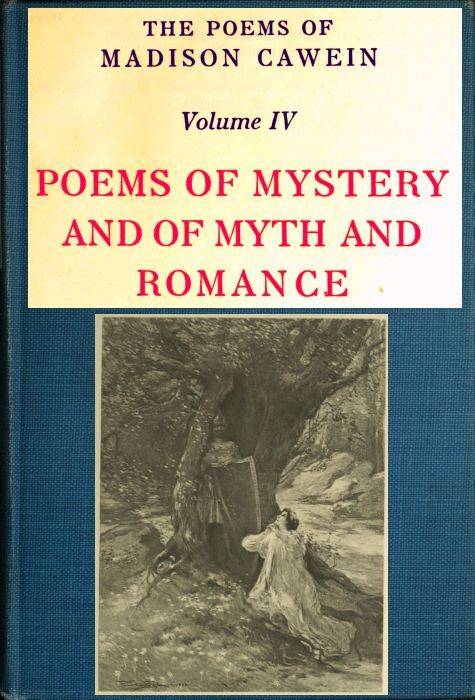
Above her, pearl and rose the heavens lay:
Around her, flowers scattered earth with gold,
Or down the path in insolence held sway—
Like cavaliers who ride the king's highway—
Scarlet and buff, within a garden old.
Beyond the hills, faint-heard through belts of wood,
Bells, Sabbath-sweet, swooned from some far-off town:
Gamboge and gold, broad sunset colors strewed
The purple west as if, with God imbued,
Her mighty pallet Nature there laid down.
Amid such flowers, underneath such skies,
Embodying all life knows of sweet and fair,
She stood; love's dreams in girlhood's face and eyes,
Fair as a star that comes to emphasize
The mingled beauty of the earth and air.
Behind her, seen through vines and orchard trees,
Gray with its twinkling windows—like the face
Of calm old-age that sits and smiles at ease—
Porched with old roses, haunts of honey-bees,
The homestead loomed dim in a glimmering space.
For whom she waited in the afterglow,
Soft-eyed and dreamy 'mid the poppy and rose,
I do not know, I do not care to know:—
It is enough I keep her picture so,
Hung up, like poetry, in my life's dull prose.
A fragrant picture, where I still may find
Her face untouched of sorrow or regret,
Unspoiled of contact, ever young and kind,
The spiritual sweetheart of my soul and mind,
She had not been, perhaps, if we had met.
DOLCE FAR NIENTE
I
Over the bay as our boat went sailing
Under the skies of Augustine,
Far to the east lay the ocean paling
Under the skies of Augustine.—
There, in the boat as we sat together,
Soft in the glow of the turquoise weather,
Light as the foam or a seagull's feather,
Fair of form and of face serene,
Sweet at my side I felt you lean,
As over the bay our boat went sailing
Under the skies of Augustine.
II
Over the bay as our boat went sailing
Under the skies of Augustine,
Pine and palm, in the west, hung, trailing
Under the skies of Augustine.—
Was it the wind that sighed above you?
Was it the wave that whispered of you?
Was it my soul that said, "I love you"?
Was it your heart that murmured between,
Answering, shy as a bird unseen?
As over the bay our boat went sailing
Under the skies of Augustine.
III
Over the bay as our boat went sailing
Under the skies of Augustine,
Gray and low flew the heron, wailing
Under the skies of Augustine.—
Naught was spoken. We watched the simple
Gulls wing past. Your hat's white wimple
Shadowed your eyes. And your lips, a-dimple,
Smiled and seemed from your soul to wean
An inner beauty, an added sheen,
As over the bay our boat went sailing
Under the skies of Augustine.
IV
Over the bay as our boat went sailing
Under the skies of Augustine,
Red on the marshes the day flamed, failing
Under the skies of Augustine.—
Was it your thought, or the transitory
Gold of the west, like a written story,
Bright on your brow, that I read? the glory
And grace of love, like a rose-crowned queen
Pictured pensive in mind and mien?
As over the bay our boat went sailing
Under the skies of Augustine.
V
Over the bay as our boat went sailing
Under the skies of Augustine,
Wan on the waters the mist lay, veiling
Under the skies of Augustine.—
Was it the joy that begot the sorrow?—
Joy that was filled with the dreams that borrow
Prescience sad of a far To-morrow,—
There in the Now that was all too keen,
That shadowed the fate that might intervene?
As over the bay our boat went sailing
Under the skies of Augustine.
VI
Over the bay as our boat went sailing
Under the skies of Augustine,
The marsh-hen cried and the tide was ailing
Under the skies of Augustine.—
And so we parted. No vows were spoken.
No faith was plighted that might be broken.
But deep in our hearts each bore a token
Of life and of love and all they mean,
Beautiful, thornless, and ever green,
From over the bay where our boat went sailing
Under the skies of Augustine.
St. Augustine, Fla., February, 1899.
THE PURPLE VALLEYS
Far in the purple valleys of illusion
I see her waiting, like the soul of music,
With deep eyes, lovelier than cerulean pansies,
Shadow and fire, yet merciless as poison;
With red lips sweeter than Arabian storax,
Yet bitterer than myrrh. O tears and kisses!
O eyes and lips, that haunt my soul forever!
Again Spring walks transcendent on the mountains:
The woods are hushed: the vales are full of shadows:
Above the heights, steeped in a thousand splendors,
Like some vast canvas of the gods, hangs burning
The sunset's wild sciography: and slowly
The moon treads heaven's proscenium,—night's stately
White queen of love and tragedy and madness.
Again I know forgotten dreams and longings;
Ideals lost; desires dead and buried
Beside the altar sacrifice erected
Within the heart's high sanctuary. Strangely
Again I know the horror and the rapture,
The utterless awe, the joy akin to anguish,
The terror and the worship of the spirit.
Again I feel her eyes pierce through and through me;
Her deep eyes, lovelier than imperial pansies,
Velvet and flame, through which her strong will holds me,
Powerless and tame, and draws me on and onward
To sad, unsatisfied and animal yearnings,
Wild, unrestrained—the brute within the human—
To fling me panting on her mouth and bosom.
Again I feel her lips like ice and fire,
Her red lips, odorous as Arabian storax,
Fragrance and fire, within whose kiss destruction
Lies serpent-like. Intoxicating languors
Resistlessly embrace me, soul and body;
And we go drifting, drifting—she is laughing—
Outcasts of God, into the deep's abysm.
THE LAND OF ILLUSION
I
So we had come at last, my soul and I,
Into that land of shadowy plain and peak,
On which the dawn seemed ever about to break,
On which the day seemed ever about to die.
II
Long had we sought fulfillment of our dreams,
The everlasting wells of Joy and Youth;
Long had we sought the snow-white flow'r of Truth,
That blooms eternal by eternal streams.
III
And, fonder still, we hoped to find the sweet
Immortal presence, Love; the bird Delight
Beside her; and, eyed with sideral night,
Faith, like a lion, fawning at her feet.
But, scorched and barren, in its arid well,
We found our dreams' forgotten fountain-head;
And by black, bitter waters, crushed and dead,
Among wild weeds, Truth's trampled asphodel.
V
And side by side with pallid Doubt and Pain,
Not Love, but Grief did meet us there: afar
We saw her, like a melancholy star,
A pensive moon, move towards us o'er the plain.
VI
Sweet was her face as song that tells of home;
And filled our hearts with vague, suggestive spells
Of pathos, as sad ocean fills its shells
With sympathetic moanings of the foam.
VII
She raised one hand and pointed silently,
And passed; her eyes, gaunt with a thirst unslaked,
Were worlds of woe, where tears in torrents ached,
Yet never fell. And like a winter sea,—
VIII
Whose caverned crags are haunts of wreck and wrath,
That house the condor pinions of the storm,—
My soul replied; and, weeping, arm in arm,
To'ards those dim hills, by that appointed path,
IX
We turned and went. Arrived, we did discern
How Beauty beckoned, white 'mid miles of flowers,
Through which, behold, the amaranthine Hours
Like maidens went, each holding high an urn;
X
Wherein, it seemed—drained from long chalices
Of those slim flowers—they bore mysterious wine;
A poppied vintage, full of sleep divine,
And pale forgetting of all miseries.
Then to my soul I said, "No longer weep.
Come, let us drink; for hateful is the sky,
And earth is full of care, and life's a lie.
So let us drink; yea, let us drink and sleep."
XII
Then from their brimming urns we drank sweet must,
While all around us rose-crowned faces laughed
Into our own: but hardly had we quaffed
When, one by one, these crumbled into dust.
XIII
And league on league the eminence of blooms,
That flashed and billowed like a summer sea,
Rolled out a waste of thorns and tombs; where bee
And butterfly and bird hung dead in looms
XIV
Of worm and spider. And through tomb and brier,
A thin wind, parched with bitter salt and sand,
Went wailing as if mourning some lost land
Of perished empire, Babylon or Tyre.
XV
Long, long with blistered feet we wandered in
That land of ruins, through whose sky of brass
Hate's harpy shrieked; and in whose iron grass
The hydra hissed of undestroyable Sin.
XVI
And there at last, behold, the House of Doom,—
Red, as if Hell had glared it into life,
Blood-red, and howling with incessant strife,—
With burning battlements, towered through the gloom.
XVII
And throned within sat Darkness.—Who might gaze
Upon that form, that threatening presence there,
Crowned with the flickering corpse-lights of Despair,
And yet escape sans madness and amaze?
XVIII
And we had hoped to find among these hills
The House of Beauty!—Curst, yea thrice accurst,
The hope that lures one on from last to first
With vain illusions that no time fulfills!
XIX
Why will we struggle to attain, and strive,
When all we gain is but an empty dream?—
Better, unto my thinking, doth it seem
To end it all and let who will survive:
XX
To find at last all beauty is but dust:
That love and sorrow are the very same:
That joy is only suffering's sweeter name:
And sense is but the synonym of lust.
Far better, yea, to me it seems, to die!
To set glad lips against the lips of Death—
The only thing God gives that comforteth,
The only thing we do not find a lie.
THE LAST SONG
She sleeps: he sings to her: the day was long,
And, tired out with too much happiness,
She fain would have him sing of old Provence;
Old songs, that spoke of love in such soft tones,
Her restless soul was straight besieged of dreams,
And her wild heart beleaguered of deep peace,
And heart and soul surrendered unto sleep.—
Like perfect sculpture in the moon she lies,
Its pallor on her through heraldic panes
Of one tall casement's guléd quarterings.—
Beside her couch, an antique table, weighed
With gold and crystal; here, a carven chair,
Whereon her raiment,—that suggests sweet curves
Of shapely beauty,—bearing her limbs' impress,
Is richly laid: and, near the chair, a glass,
An oval mirror framed in ebony:
And, dim and deep,—investing all the room
With ghostly life of woven women and men,
And strange, fantastic gloom, where shadows move,—
Dark tapestry,—which in the gusts—that twinge
A dropping cresset's slender star of light—
Seems swayed of cautious hands, assassin-like,
That bide their hour.
She alone, deep-haired
As golden dawn, and whiter than a rose,
Divinely breasted as the Queen of Love,
Lies robeless in the glimmer of the moon,
Like Danaë within the golden shower.
Seated beside her aromatic rest,
In silence musing on her loveliness,
Her knight and troubadour. A lute, aslope
The curious baldric of his tunic, glints
Pearl-caught reflections of the moon, that seem
The voiceless ghosts of long-dead melodies.
In purple and sable, slashed with solemn gold,
Like stately twilight over slopes of snow,
He leans above her.—
Have his hands forgot
Their craft, that now they pause upon the strings?
His lips, their art, that they cease, speechless there?—
His eyes are set ... What is it stills to stone
His hands? his lips? and mails him, head and heel,
In terrible marble, motionless and cold?—
Behind the arras, can it be he feels,
Black-browed and grim, with eyes of sombre fire,
Death towers above him with uplifted sword?
THE DREAM OF RODERICK
Below, the tawny Tagus swept
Past royal gardens, breathing balm:
Upon his couch the monarch slept;
The world was still; the night was calm.
Gray, Gothic-gated, in the ray
Of moonrise, tower and castle-crowned,
The city of Toledo lay
Beneath the terraced palace-ground.
Again, he dreamed, in kingly sport
He sought the tree-sequestered path,
And watched the ladies of his Court
Within the marble-basined bath.
Its porphyry stairs and fountained base
Shone, houried with voluptuous forms,
Where Andalusia vied in grace
With old Castile, in female charms.
And laughter, song, and water-splash
Rang round the place, with rock arcaded,
As here a breast or limb would flash
Where beauty swam or beauty waded.
And then, like Venus, from the wave
A maiden came, and stood below;
And by her side a woman slave
Bent down to dry her limbs of snow.
Then on the tesselated bank,
Robed on with fragrance and with fire,—
Like some exotic flower—she sank,
The type of all divine desire.
Then her dark curls, that sparkled wet,
She parted from her perfect brows,
And, lo, her eyes, like lamps of jet
Lit in an alabaster house.
And in his sleep the monarch sighed,
"Florinda!"—Dreaming still he moaned,
"Ah, would that I had died, had died!
I have atoned! I have atoned!"...
And then the vision changed: O'erhead
Tempest and darkness were unrolled,
Full of wild voices of the dead,
And lamentations manifold.
And wandering shapes of gaunt despair
Swept by; and faces pale with pain,
Whose eyes wept blood and seemed to glare
Fierce curses on him through the rain.
And then, it seemed, 'gainst blazing skies
A necromantic tower sate,
Crag-like on crags, of giant size;
With adamatine wall and gate.
And from the storm a hand of might,
Red-rolled in thunder, reached among
The gate's huge bolts, that burst—and night
Clanged ruin as its hinges swung.
Then far away a murmur trailed,—
As of sad seas on cavern'd shores,—
That grew into a voice that wailed,
"They come! they come! the Moors! the Moors!"
And with deep boom of atabals
And crash of cymbals and wild peal
Of battle-bugles, from its walls
An army rushed in glimmering steel.
And where it trod he saw the torch
Of conflagration stalk the skies,
And in the vanward of its march
The monster form of Havoc rise.
And Paynim war-cries rent the storm,
Athwart whose firmament of flame
Destruction reared an earthquake form
On wreck and death without a name....
And then again the vision changed:
Where flows the Guadelete, see,
The champions of the Cross are ranged
Against the Crescent's chivalry.
With roar of trumpets and of drums
They meet; and in the battle's van
He fights; and, towering towards him, comes
Florinda's father, Julian;
And one-eyed Taric, great in war:
And where these couch their burning spears,
The Christian phalanx, near and far,
Goes down like corn before the shears.
The Moslem wins: the Christian flies:
"Allah il Allah," hill and plain
Reverberate: the rocking skies,
"Allah il Allah," shout again.
And then he dreamed the swing of swords
And hurl of arrows were no more;
And stranger than the howling hordes
Deep silence fell on field and shore.
And through the night, it seemed, he fled,
Upon a white steed like a star,
Across a field of endless dead,
Beneath a blood-red scimitar
Of sunset: And he heard a moan,
Beneath, around, on every hand—
"Accurséd! Yea, what hast thou done
To bring this curse upon thy land?"
And then an awful sense of wings:
And, lo! the answer—"'Twas his lust
That was his crime. Behold! e'en kings
Must reckon with Me. God is just."
ZYPS OF ZIRL
The Alps of the Tyrol are dark with pines,
Where, foaming under the mountain spines,
The Inn's long water sounds and shines.
Beyond, are peaks where the morning weaves
An icy rose; and the evening leaves
The golden ghosts of a thousand sheaves.
Deep vines and torrents and glimmering haze,
And sheep-bells tinkling on mountain ways,
And fluting shepherds make sweet the days.
The rolling mist, like a wandering fleece,
The great, round moon in a mountain crease,
And a song of love make the nights all peace.
Beneath the blue Tyrolean skies
On the banks of the Inn, that foams and flies,
The storied city of Innsbruck lies.
With its mediæval streets, that crook,
And its gabled houses, it has the look
Of a belfried town in a fairy book.
So wild the Tyrol that oft, 'tis said,
When the storm is out and the town in bed,
The howling of wolves sweeps overhead.
And oft the burgher, sitting here
In his walled rose-garden, hears the clear
Shrill scream of the eagle circling near.
And this is the tale that the burghers tell:—
The Abbot of Wiltau stood at his cell
Where the Solstein lifts its pinnacle.
A mighty summit of bluffs and crags
That frowns on the Inn; where the forest stags
Have worn a path to the water-flags.
The Abbot of Wiltau stood below;
And he was aware of a plume and bow
On the precipice there in the morning's glow,
A chamois, he saw, from span to span
Had leapt; and after it leapt a man;
And he knew 'twas the Kaiser Maximilian.
But, see! though rash as the chamois he,
His foot less sure. And verily
If the King should miss ... "Jesu! Marie!
"The King hath missed!"—And, look, he falls!
Rolls headlong out to the headlong walls.
What Saint shall save him on whom he calls?
What Saint shall save him, who struggles there
On the narrow ledge by the eagle's lair,
With hook'd hands clinging 'twixt earth and air?
The Abbot crosses himself in dread—
"Let prayers go up for the nearly dead,
And the passing-bell be tolled," he said.
"For the House of Hapsburg totters! See,
How raveled the thread of its destiny,
Sheer hung between cloud and rock!" quoth he.
But hark! where the steeps of the peak reply,
Is it an eagle's echoing cry?
And the flitting shadow, its plumes on high?
No voice of the eagle is that which rings!
And the shadow, a wiry man who swings
Down, down where the desperate Kaiser clings.
The crampons bound to his feet, he leaps
Like a chamois now; and again he creeps
Or twists, like a snake, o'er the fearful deeps.
"By his cross-bow, baldric, and cap's black curl,"
Quoth the Abbot below, "I know the churl!
'Tis the hunted outlaw Zyps of Zirl.
"Upon whose head, or dead or alive,
The Kaiser hath posted a price.—Saints shrive
The King!" quoth Wiltau. "Who may contrive
"To save him now that his foe is there?"—
But, hark! again through the breathless air
What words are those that the echoes bear?
"Courage, my King!—To the rescue, ho!"
The wild voice rings like a twanging bow,
And the staring Abbot stands mute below.
And, lo! the hand of the outlaw grasps
The arm of the King—and death unclasps
Its fleshless fingers from him who gasps.
And how he guides! where the clean cliffs wedge
Them flat to their brows; by chasm and ledge
He helps the King from the merciless edge.
Then up and up, past bluffs that shun
The rashest chamois; where eagles sun
Great wings and brood; where the mists are spun.
And safe at last stand Kaiser and churl
On the mountain path where the mosses curl—
And this the revenge of Zyps of Zirl.
THE GLOW-WORM
How long had I sat there and had not beheld
The gleam of the glow-worm till something compelled!...
The heaven was starless, the forest was deep,
And the vistas of darkness stretched silent in sleep.
And late 'mid the trees had I lingered until
No thing was awake but the lone whippoorwill.
And haunted of thoughts for an hour I sat
On a lichen-gray rock where the moss was a mat.
And thinking of one whom my heart had held dear,
Like terrible waters, a gathering fear
Came stealing upon me with all the distress
Of loss and of yearning and powerlessness:
Till the hopes and the doubts and the sleepless unrest
That, swallow-like, built in the home of my breast,
Now hither, now thither, now heavenward flew,
Wild-winged as the winds are: now suddenly drew
My soul to abysses of nothingness where
All light was a shadow, all hope, a despair:
Where truth, that religion had set upon high,
The darkness distorted and changed to a lie:
And dreams of the beauty ambition had fed
Like leaves of the autumn fell withered and dead.
And I rose with my burden of anguish and doom,
And cried, "O my God, had I died in the womb!
"Than born into night, with no hope of the morn,
An heir unto shadows, to live so forlorn!
"O light me a torch in the deepening dark
So my sick soul may follow, my sad heart may mark!"—
And then in the darkness the answer!—It came
From Earth, not from Heaven—a glimmering flame,
Behold; at my feet! In the shadow it shone
Mysteriously lovely and dimly alone:
An ember; a sparkle of dew and of glower;
Like the lamp that a spirit hangs under a flower:
As goldenly green as the phosphorous star
A fairy may wear in her diadem's bar:
An element essence of moonlight and dawn
That, trodden and trampled, burns on and burns on.
Though mortal its structure, material its form,
The spiritual message of worm unto worm.
A FOREST IDYLL
I
Beneath an old beech-tree
They sat together,
Fair as a flower was she
Of summer weather.
They spoke of life and love,
While, through the boughs above,
The sunlight, like a dove,
Dropped many a feather.
II
And there the violet,
The bluet near it,
Made blurs of azure wet—
As if some spirit,
Or woodland dream, had gone
Sprinkling the earth with dawn,
When only Fay and Faun
Could see or hear it.
She with her young, sweet face
And eyes gray-beaming,
Made of that forest place
A spot for dreaming:
A spot for Oreads
To smooth their nut-brown braids,
For Dryads of the glades
To dance in, gleaming.
IV
So dim the place, so blest,
One had not wondered
Had Dian's moonéd breast
The deep leaves sundered,
And there on them a while
The goddess deigned to smile,
While down some forest aisle
The far hunt thundered.
V
I deem that hour, perchance,
Was but a mirror
To show them Earth's romance
And draw them nearer:
A mirror where, meseems,
All that this Earth-life dreams,
All loveliness that gleams,
Their souls saw clearer.
VI
Beneath an old beech-tree
They dreamed of blisses;
Fair as a flower was she
That summer kisses:
They spoke of dreams and days,
Of love that goes and stays,
Of all for which life prays,
Ah me! and misses.
UNDER THE ROSE
He told a story to her,
A story old yet new—
And was it of the Faery Folk
That dance along the dew?
The night was hung with silence
As a room is hung with cloth,
And soundless, through the rose-sweet hush,
Swooned dim the down-white moth.
Along the east a shimmer,
A tenuous breath of flame,
From which, as from a bath of light,
Nymph-like, the girl-moon came.
And pendent in the purple
Of heaven, like fireflies,
Bubbles of gold the great stars blew
From windows of the skies.
He told a story to her,
A story full of dreams—
And was it of the elfin things
That haunt the thin moonbeams?
Upon the hill a thorn-tree,
Crookéd and gnarled and gray,
Against the moon seemed some crutched hag
Dragging a child away.
And in the vale a runnel,
That dripped from shelf to shelf,
Seemed in the night, a woodland witch
Who muttered to herself.
Along the land a zephyr,
Whose breath was wild perfume,
That seemed a sorceress who wove
Sweet spells of beam and bloom.
He told a story to her,
A story young yet old—
And was it of the mystic things
Men's eyes shall ne'er behold?
They heard the dew drip faintly
From out the green-cupped leaf;
They heard the petals of the rose
Unfolding from their sheaf.
They saw the wind light-footing
The waters into sheen;
They saw the starlight kiss to sleep
The blossoms on the green.
They heard and saw these wonders;
These things they saw and heard;
And other things within the heart
For which there is no word.
He told a story to her,
The story men call Love,
Whose echoes fill the ages past—
And the world ne'er tires of.
SPIRIT OF DREAMS
I
Where hast thou folded thy pinions,
Spirit of Dreams?
Hidden elusive garments
Woven of gleams?
In what divine dominions,
Brighter than day,
Far from the world's dark torments,
Dost thou stay, dost thou stay?—
When shall my yearnings reach thee
Again?
Not in vain let my soul beseech thee!
Not in vain! not in vain!
II
I have longed for thee as a lover
For her, the one;
As a brother for a sister
Long dead and gone.
I have called thee over and over
Names sweet to hear;
With words than music trister,
And thrice as dear.
How long must my sad heart woo thee,
Yet fail?
How long must my soul pursue thee,
Nor avail, nor avail?
III
All night hath thy loving mother,
Beautiful Sleep,
Lying beside me, listened
And heard me weep.
But ever thou soughtest another
Who sought thee not;
For him thy soft smile glistened—
I was forgot.
When shall my soul behold thee
As before?
When shall my heart enfold thee?—
Nevermore? nevermore?
PROCESSIONAL
Universes are the pages
Of that book whose words are ages;
Of that book which destiny
Opens in eternity.
There each syllable expresses
Silence; there each thought a guess is;
In whose rhetoric's cosmic runes
Roll the worlds and swarming moons.
There the systems, we call solar,
Equatorial and polar,
Write their lines of rushing light
On the awful leaves of night.
There the comets, vast and streaming,
Punctuate the heavens' gleaming
Scroll; and suns, gigantic, shine,
Periods to each starry line.
There, initials huge, the Lion
Looms and measureless Orion;
And, as 'neath a chapter done,
Burns the Great-Bear's colophon.
Constellated, hieroglyphic,
Numbering each page terrific,
Fiery on the nebular black,
Flames the hurling zodiac.
In that book, o'er which Chaldean
Wisdom poured and many an eon
Of philosophy long dead,
This is all that man has read:—
He has read how good and evil,—
In creation's wild upheaval,—
Warred; while God wrought terrible
At foundations red of Hell.
He has read of man and woman;
Laws and gods, both beast and human;
Thrones of hate and creeds of lust,
Vanished now and turned to dust.
Arts and manners that have crumbled;
Cities buried; empires tumbled:
Time but breathed on them its breath;
Earth is builded of their death.
These but lived their little hour,
Filled with pride and pomp and power;
What availed it all at last?
We shall pass as they have passed.
Still the human heart will dream on
Love, part angel and part demon;
Yet, I question, what secures
Our belief that aught endures?
In that book, o'er which Chaldean
Wisdom poured and many an eon
Of philosophy long dead,
This is all that man has read.