
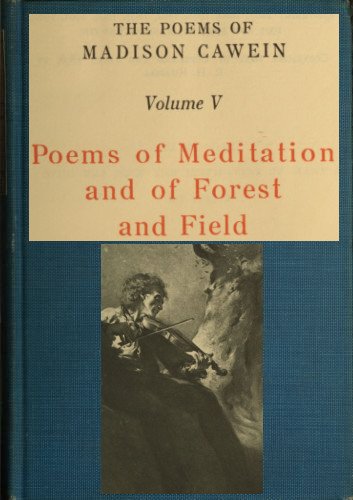
Now in the hollow of a hill,—
Like a glow-worm held in a giant hand,—
Under the sunset’s last red band,
And one star hued like a daffodil,
The windowed lamp of a cabin glows;
The charcoal-burner’s, whose hut is poor
But always open; beside whose door
An oak grows gnarled and a pine stands slim.
Clean of soul, though of feature grim,
Here he houses where no one knows,
His only neighbors the cawing crows,
That make a roost of the pine’s top limb:
His only friend the fiddle he bows
As he sits at his door in the eve’s repose
Making it chuckle and sing and speak,
Lovingly pressed to his swarthy cheek.
Like a glow-worm held in a giant hand,—
Under the sunset’s last red band,
And one star hued like a daffodil,
The windowed lamp of a cabin glows;
The charcoal-burner’s, whose hut is poor
But always open; beside whose door
An oak grows gnarled and a pine stands slim.
Clean of soul, though of feature grim,
Here he houses where no one knows,
His only neighbors the cawing crows,
That make a roost of the pine’s top limb:
His only friend the fiddle he bows
As he sits at his door in the eve’s repose
Making it chuckle and sing and speak,
Lovingly pressed to his swarthy cheek.
And over many a root, through flowers and weeds,
Past lonely places where the raccoon breeds,
By many a rock and water lying dim,
Roofed with the brier and the bramble-rose,
Under a star and the new-moon’s rim,
Downward the wood-way leads to him,
Down where his lone lamp gleams and glows,
A pencil slim
Of marigold light under leaf and limb.
Past lonely places where the raccoon breeds,
By many a rock and water lying dim,
Roofed with the brier and the bramble-rose,
Under a star and the new-moon’s rim,
Downward the wood-way leads to him,
Down where his lone lamp gleams and glows,
A pencil slim
Of marigold light under leaf and limb.
XIV
Ere that small sisterhood of misty stars,
The Pleiadës, consents to grace the sky;
While still through sunset’s golds and cinnabars
The evening-star, like an Aladdin eye
Of bright enchantment, at the day’s last hour,
Looks downward from its twilight-builded tower,
Listen, and you may hear, now low, now high,
A voice, a summons, fainter than a flower.
The Pleiadës, consents to grace the sky;
While still through sunset’s golds and cinnabars
The evening-star, like an Aladdin eye
Of bright enchantment, at the day’s last hour,
Looks downward from its twilight-builded tower,
Listen, and you may hear, now low, now high,
A voice, a summons, fainter than a flower.
There is a fellowship so still and sweet,
A brotherhood, that speaks, unwordable,
In every tree, in every stream you meet,
The soul is fain to dream beneath its spell.—
And heart-admitted to their presence there,
Those intimacies of the earth and air,
It shall hear things too wonderful to tell,
Too deep to interpret, and more sweet than prayer.
A brotherhood, that speaks, unwordable,
In every tree, in every stream you meet,
The soul is fain to dream beneath its spell.—
And heart-admitted to their presence there,
Those intimacies of the earth and air,
It shall hear things too wonderful to tell,
Too deep to interpret, and more sweet than prayer.
And you may see the things that are unseen,
And hear the things that never have been heard:
The whisper of the woods, in gray and green,
Will walk by you, its heart a wildwood bird;
Or by your side, in hushed and solemn wise,
The silence sit; and clothed in glimmering dyes
Of pearl and purple, with a sunset word,
The dusk steal to you with tenebrious eyes.
And hear the things that never have been heard:
The whisper of the woods, in gray and green,
Will walk by you, its heart a wildwood bird;
Or by your side, in hushed and solemn wise,
The silence sit; and clothed in glimmering dyes
Of pearl and purple, with a sunset word,
The dusk steal to you with tenebrious eyes.
Then through the ugliness that toils in night.
Uncouth, obscure, that hates the glare of day,
Dull things that pierce the earth, avoid the light,
And hide themselves in clamminess and clay,—
The dumb, ungainly things, that make a home
Of mud and mire they hill and honeycomb,—
Through these, perhaps, in some mysterious way
Beauty may speak, fairer than wind-wild foam.
Uncouth, obscure, that hates the glare of day,
Dull things that pierce the earth, avoid the light,
And hide themselves in clamminess and clay,—
The dumb, ungainly things, that make a home
Of mud and mire they hill and honeycomb,—
Through these, perhaps, in some mysterious way
Beauty may speak, fairer than wind-wild foam.
Not as it speaks—an eagle message—drawn
In starry vastness from night’s labyrinths:
Not uttering itself from forth the dawn
In egret hues: nor from the cloud-built plinths
Of sunset’s splendor, speaking burningly
Unto the spirit; nor from flow’rs the bee
Makes mouths of musk of, cymes of hyacinths,—
But from the things that type humility.
In starry vastness from night’s labyrinths:
Not uttering itself from forth the dawn
In egret hues: nor from the cloud-built plinths
Of sunset’s splendor, speaking burningly
Unto the spirit; nor from flow’rs the bee
Makes mouths of musk of, cymes of hyacinths,—
But from the things that type humility.
From things despised.—Ev’n from the crawfish there,
Hollowing its house of ooze—a wet, vague sound
Of sleepy slime; or from the mole, whose lair,
Blind-tunneled, corridors the earth around—
Beauty may draw her truths, as draws its wings
The butterfly from the dull worm that clings,
Cocoon and chrysalis; and from the ground
Address the soul through even senseless things.
Hollowing its house of ooze—a wet, vague sound
Of sleepy slime; or from the mole, whose lair,
Blind-tunneled, corridors the earth around—
Beauty may draw her truths, as draws its wings
The butterfly from the dull worm that clings,
Cocoon and chrysalis; and from the ground
Address the soul through even senseless things.
The soul, that oft hath heard the trees’ huge roots
Fumble the darkness, clutching at the soil;
The bird-like beaks of the imprisoned shoots
Peck through the bark and into leaves uncoil;
Hath heard the buried seed split through its pod,
Groping its blind way up to light and God;
The fungus, laboring with gnome-like toil,
Heave slow its white orb through the encircling sod.
Fumble the darkness, clutching at the soil;
The bird-like beaks of the imprisoned shoots
Peck through the bark and into leaves uncoil;
Hath heard the buried seed split through its pod,
Groping its blind way up to light and God;
The fungus, laboring with gnome-like toil,
Heave slow its white orb through the encircling sod.
The winds and waters, stars and streams and flowers,
The very stones have tongues: and moss and fern
And even lichens speak. This world of ours
Is eloquent with things that bid us learn
To pierce appearances, and so to mark,
Within the rock and underneath the bark,
Heard through some inward sense, the dreams that turn
Outward to light and beauty from the dark.
The very stones have tongues: and moss and fern
And even lichens speak. This world of ours
Is eloquent with things that bid us learn
To pierce appearances, and so to mark,
Within the rock and underneath the bark,
Heard through some inward sense, the dreams that turn
Outward to light and beauty from the dark.
XV
Then it came to pass as I gazed on space
That I met with Mystery, face to face.
Within her eyes my wondering soul beheld
The eons past, the eons yet to come
At cosmic labor; and the stars,—that swelled,
Flaming or nebulous, from the darkness dumb,
In their appointed places, world and sun,
I saw were truths made visible, whose sum
Proclaimed one truth, the Word of Him, the One.
That I met with Mystery, face to face.
Within her eyes my wondering soul beheld
The eons past, the eons yet to come
At cosmic labor; and the stars,—that swelled,
Flaming or nebulous, from the darkness dumb,
In their appointed places, world and sun,
I saw were truths made visible, whose sum
Proclaimed one truth, the Word of Him, the One.
And it came to pass as I went my ways
That I met with Beauty, face to face.
Within her eyes my worshiping spirit saw
The moments busy with the dreams whence spring
Earth’s lovelinesses: and all things that awe
Man’s soul with their perfection—everything
That buds and bourgeons, blossoming above—
I saw were letters of enduring law,
Whose chapters make the beautiful book of Love.
That I met with Beauty, face to face.
Within her eyes my worshiping spirit saw
The moments busy with the dreams whence spring
Earth’s lovelinesses: and all things that awe
Man’s soul with their perfection—everything
That buds and bourgeons, blossoming above—
I saw were letters of enduring law,
Whose chapters make the beautiful book of Love.
THE MAN HUNT
The woods stretch deep to the mountain side,
And the brush is wild where a man may hide.
And the brush is wild where a man may hide.
They have brought the bloodhounds up again
To the roadside rock where they found the slain.
To the roadside rock where they found the slain.
They have brought the bloodhounds up, and they
Have taken the trail to the mountain way.
Have taken the trail to the mountain way.
Three times they circled the trail and crossed,
And thrice they found it and thrice they lost.
And thrice they found it and thrice they lost.
Now straight through the trees and the underbrush
They follow the scent through the forest’s hush.
They follow the scent through the forest’s hush.
And their deep-mouthed bay is a pulse of fear
In the heart of the wood that the man must hear.
In the heart of the wood that the man must hear.
A huddle of rocks that the ooze has mossed
And the trail of the hunted again is lost.
And the trail of the hunted again is lost.
An upturned pebble, a bit of ground
A heel has trampled—the trail is found.
A heel has trampled—the trail is found.
And the woods reëcho the bloodhounds’ bay
As again they take to the mountain way.
As again they take to the mountain way.
A rock, a ribbon of road, a ledge,
With a pine tree clutching its crumbling edge.
With a pine tree clutching its crumbling edge.
A pine, that the lightning long since clave,
Whose huge roots hollow a ragged cave.
Whose huge roots hollow a ragged cave.
A shout, a curse, and a face aghast,
And the human quarry is laired at last.
And the human quarry is laired at last.
The human quarry with clay-clogged hair
And eyes of terror who waits them there.
And eyes of terror who waits them there.
That glares and crouches and rising then
Hurls clods and curses at dogs and men.
Hurls clods and curses at dogs and men.
A rope; a prayer; and an oak-tree near,
And a score of hands to swing him clear.
And a score of hands to swing him clear.
THE FOREST OF SHADOWS
Deep in the hush of a mighty wood
I came to a place of dread and dream,
And forms of shadows, whose shapes elude
The searching swords of the sun’s dim gleam,
Builders of silence and solitude.
And there, where a glimmering water crept
From rock to rock with a slumberous sound,
Tired to tears, on the mossy ground,
Under a tree I lay and slept.
I came to a place of dread and dream,
And forms of shadows, whose shapes elude
The searching swords of the sun’s dim gleam,
Builders of silence and solitude.
And there, where a glimmering water crept
From rock to rock with a slumberous sound,
Tired to tears, on the mossy ground,
Under a tree I lay and slept.
Was it the heart of an olden oak?
Was it the soul of a flower that died?
Or was it the wild-rose there that spoke,
The wilding lily that palely sighed?—
For all on a sudden it seemed I awoke:
And the leaves and the flowers were all intent
On a visible something of light and bloom—
A presence, felt as a wild perfume,
Or beautiful music, that came and went.
Was it the soul of a flower that died?
Or was it the wild-rose there that spoke,
The wilding lily that palely sighed?—
For all on a sudden it seemed I awoke:
And the leaves and the flowers were all intent
On a visible something of light and bloom—
A presence, felt as a wild perfume,
Or beautiful music, that came and went.
And all the grief I had known was gone,
And all the anguish of heart and soul;
And the burden of care that had made me wan
Lifted and left me young and whole
As once in the flush of my youth’s dead dawn.
And lo! it was night. And the oval moon,
A silvery spectre, paced the wood:
And there in its light, like snow, she stood,
As starry still as a star a-swoon.
And all the anguish of heart and soul;
And the burden of care that had made me wan
Lifted and left me young and whole
As once in the flush of my youth’s dead dawn.
And lo! it was night. And the oval moon,
A silvery spectre, paced the wood:
And there in its light, like snow, she stood,
As starry still as a star a-swoon.
At first I thought that I looked into
A shadowy water of violet,
Where the faint reflection of one I knew,
Long dead, gazed up from its mirror wet,
Till she smiled in my face as the living do:
Till I felt her touch, and heard her say,
In a voice as still as a rose unfolds,—
“You have come at last: now nothing holds:
Give me your hand: let us wander away.
A shadowy water of violet,
Where the faint reflection of one I knew,
Long dead, gazed up from its mirror wet,
Till she smiled in my face as the living do:
Till I felt her touch, and heard her say,
In a voice as still as a rose unfolds,—
“You have come at last: now nothing holds:
Give me your hand: let us wander away.
“Let us wander away through the Shadow Wood,
Through the Shadow Wood to the Shadow Land,
Where the trees have speech and the blossoms brood,
Like visible music; and, hand in hand,
The winds and the waves go, rainbow-hued:
Where ever the voice of beauty sighs,
And ever the dance of dreams goes on;
Where nothing grows old: and the dead and gone,
And the loved and the lost, smile into your eyes.
Through the Shadow Wood to the Shadow Land,
Where the trees have speech and the blossoms brood,
Like visible music; and, hand in hand,
The winds and the waves go, rainbow-hued:
Where ever the voice of beauty sighs,
And ever the dance of dreams goes on;
Where nothing grows old: and the dead and gone,
And the loved and the lost, smile into your eyes.
“Let us wander away! let us wander away!—
Do you hear them calling, ‘Come here and live’?
Do you hear what the trees and the flowers say,
Wonderful, wild, and imperative,
Hushed as the hues of the dawn of day?—
They say, ‘Your life, that was rose and rue,
In a world of shadows where all things die,
Where beauty is dust, and love, a lie,
Is ended. Come! we are waiting for you.’”
Do you hear them calling, ‘Come here and live’?
Do you hear what the trees and the flowers say,
Wonderful, wild, and imperative,
Hushed as the hues of the dawn of day?—
They say, ‘Your life, that was rose and rue,
In a world of shadows where all things die,
Where beauty is dust, and love, a lie,
Is ended. Come! we are waiting for you.’”
And she took my hand: and the trees around
Seemed whispering something I dared not hear;
And the taciturn flowers, that strewed the ground,
Seemed thinking something I felt with fear—
A beautiful something that made no sound.—
And she led me on through the forest old,
Where the moon and the midnight stood on guard,—
Sentinel spirits that shimmered the sward,
Silver and sable and glimmering gold.
Seemed whispering something I dared not hear;
And the taciturn flowers, that strewed the ground,
Seemed thinking something I felt with fear—
A beautiful something that made no sound.—
And she led me on through the forest old,
Where the moon and the midnight stood on guard,—
Sentinel spirits that shimmered the sward,
Silver and sable and glimmering gold.
And then in a moment I knew.... I knew
What the trees had whispered, the winds had said;
What the flowers had thought in their hearts of dew,
And the stars had syllabled overhead—
And she bent above me and smiled, “’Tis true!
Heart of my heart, you have heard aright.—
Look in my eyes and draw me near!
Look in my face and have no fear!—
Heart of my heart, you died to-night!”
What the trees had whispered, the winds had said;
What the flowers had thought in their hearts of dew,
And the stars had syllabled overhead—
And she bent above me and smiled, “’Tis true!
Heart of my heart, you have heard aright.—
Look in my eyes and draw me near!
Look in my face and have no fear!—
Heart of my heart, you died to-night!”
“ROSE LEAVES, WHEN THE ROSE IS DEAD”
See how the rose leaves fall,
The rose leaves fall and fade;
And by the wall, in shade funereal,
How leaf on leaf is laid,
Withered and soiled and frayed!
The rose leaves fall and fade;
And by the wall, in shade funereal,
How leaf on leaf is laid,
Withered and soiled and frayed!
How red the rose leaves fall—
And in the ancient trees,
That stretch their ghostly arms about the Hall,
Burdened with mysteries,
How sadly sighs the breeze!
And in the ancient trees,
That stretch their ghostly arms about the Hall,
Burdened with mysteries,
How sadly sighs the breeze!
How soft the rose leaves fall—
The rose leaves fall and lie!
While over them dull slugs and beetles crawl,
And, palely glimmering by,
The glow-worm trails its eye.
The rose leaves fall and lie!
While over them dull slugs and beetles crawl,
And, palely glimmering by,
The glow-worm trails its eye.
How thick the rose leaves fall,
And strew the garden way!
For snails to slime and spotted toads to sprawl,
And, plodding past each day,
Coarse feet to tread in clay.
And strew the garden way!
For snails to slime and spotted toads to sprawl,
And, plodding past each day,
Coarse feet to tread in clay.
How fast they fade and fall
Where Beauty, carved in stone,
With broken hands veils her dead eyes, and, tall,
White in the moonlight lone,
Stands like a marble moan.
Where Beauty, carved in stone,
With broken hands veils her dead eyes, and, tall,
White in the moonlight lone,
Stands like a marble moan.
How slow they drift and fall
And strew the fountained pool,
That, in the nymph-carved basin by the wall,
Reflects, in darkness cool,
Ruin made beautiful.
And strew the fountained pool,
That, in the nymph-carved basin by the wall,
Reflects, in darkness cool,
Ruin made beautiful.
How red the rose leaves fall,
Fall, and like blood remain
Upon the dial’s disk, whose pedestal,
Black-mossed, and dark with stain,
Crumbles in sun and rain.
Fall, and like blood remain
Upon the dial’s disk, whose pedestal,
Black-mossed, and dark with stain,
Crumbles in sun and rain.
How dim they seem to fall
Around one where she stands,
Deep in their midst, beyond the years’ recall,
Reaching pale, passionate hands
Into the past’s vague lands.
Around one where she stands,
Deep in their midst, beyond the years’ recall,
Reaching pale, passionate hands
Into the past’s vague lands.
How still the rose leaves fall
Around them as they meet
As oft of old! she, in her gem-pinned shawl
Of white; and he, complete
In black from head to feet.
Around them as they meet
As oft of old! she, in her gem-pinned shawl
Of white; and he, complete
In black from head to feet.
How faint the rose leaves fall
Around them where, it seems,
He holds her clasped, parting from her and all
His heart’s wild hopes and dreams,
There in the moon’s pale beams!
Around them where, it seems,
He holds her clasped, parting from her and all
His heart’s wild hopes and dreams,
There in the moon’s pale beams!
Around them rose leaves fall—
And in the stress and urge
Of winds that strew them wanly over all,
With deep, autumnal surge,
There floats a funeral dirge:—
And in the stress and urge
Of winds that strew them wanly over all,
With deep, autumnal surge,
There floats a funeral dirge:—
“See how the rose leaves fall
Upon thy dead, O soul!
The rose leaves of the love that once in thrall
Held thee, beyond control,
Making thy heart’s world whole.
Upon thy dead, O soul!
The rose leaves of the love that once in thrall
Held thee, beyond control,
Making thy heart’s world whole.
MUSIC AND MOONLIGHT
White roses, like a mist
Upon a terraced height;
And ’mid the roses, opal, moonbeam kissed,
A fountain falling white.
Upon a terraced height;
And ’mid the roses, opal, moonbeam kissed,
A fountain falling white.
And as the full moon flows,
Orb’d fire, into a cloud,
There is a fragrant sound as if a rose
Sighed its sweet soul aloud.
Orb’d fire, into a cloud,
There is a fragrant sound as if a rose
Sighed its sweet soul aloud.
There is a whisper pale,
As if a rose awoke,
And, having heard in sleep the nightingale,
Still dreaming of it spoke.
As if a rose awoke,
And, having heard in sleep the nightingale,
Still dreaming of it spoke.
Now, as from some vast shell
A giant pearl rolls white,
From the dividing cloud, that winds compel,
The moon sweeps, big and bright.
A giant pearl rolls white,
From the dividing cloud, that winds compel,
The moon sweeps, big and bright.
Moon-mists and pale perfumes,
Wind-wafted through the dusk:
There is a sound as if unfolding blooms
Voiced their sweet thoughts in musk.
Wind-wafted through the dusk:
There is a sound as if unfolding blooms
Voiced their sweet thoughts in musk.
A spirit is abroad
Of music and of sleep;
The moon and mists have made for it a road
Adown the violet deep.
Of music and of sleep;
The moon and mists have made for it a road
Adown the violet deep.
It breathes a tale to me,
A tale of ancient day;
And, like a dream, again I seem to see
Those towers old and gray.
A tale of ancient day;
And, like a dream, again I seem to see
Those towers old and gray.
That castle by the foam,
Where once our hearts made moan:
And through the night again you seem to come
Down statued stairs of stone.
Where once our hearts made moan:
And through the night again you seem to come
Down statued stairs of stone.
Again I feel your hair,
Dark, fragrant, deep and cool:
You lift your face up, pale with its despair,
And wildly beautiful.
Dark, fragrant, deep and cool:
You lift your face up, pale with its despair,
And wildly beautiful.
Again your form I strain,
Again, unto my heart;
Again your lips, again and yet again,
I press ... and then we part.
Again, unto my heart;
Again your lips, again and yet again,
I press ... and then we part.
As centuries ago
We did in Camelot;
Where once we lived that life of bliss and woe,
That you remember not.
We did in Camelot;
Where once we lived that life of bliss and woe,
That you remember not.
THE AWAKENING
God made that night of pearl and ivory,
Perfect and holy as a holy thought
Born of perfection, dreams, and ecstasy,
In love and silence wrought.
And she, who lay where, through the casement falling,
The moonlight clasped with arms of vapory gold
Her Danaë beauty, seemed to hear a calling
Deep in the garden old.
Perfect and holy as a holy thought
Born of perfection, dreams, and ecstasy,
In love and silence wrought.
And she, who lay where, through the casement falling,
The moonlight clasped with arms of vapory gold
Her Danaë beauty, seemed to hear a calling
Deep in the garden old.
And then it seemed, through some strange sense, she heard
The roses softly speaking in the night,—
Or was it but the nocturne of a bird
Haunting the white moonlight?
It seemed a fragrant whisper vaguely roaming
From rose to rose, a language sweet that blushed,
Saying, “Who comes? Who is this swiftly coming,
With face so dim and hushed?
The roses softly speaking in the night,—
Or was it but the nocturne of a bird
Haunting the white moonlight?
It seemed a fragrant whisper vaguely roaming
From rose to rose, a language sweet that blushed,
Saying, “Who comes? Who is this swiftly coming,
With face so dim and hushed?
“And now, and now we hear a wild heart beating—
Whose heart is this that beats among our blooms?
Whose every pulse in rapture keeps repeating
Wild words like wild perfumes?” ...
And then it ceased: and then she heard a sigh,
As if a lily syllabled sweet scent,—
Or was it but the wind that silverly
Touched some stringed instrument?
Whose heart is this that beats among our blooms?
Whose every pulse in rapture keeps repeating
Wild words like wild perfumes?” ...
And then it ceased: and then she heard a sigh,
As if a lily syllabled sweet scent,—
Or was it but the wind that silverly
Touched some stringed instrument?
And then again a rumor she detected
Among the roses, words of musk and myrrh,
Saying, “He comes! the one she hath expected,
Who long hath sought for her.
The one whose coming made her soul awaken,
Whose face is fragrance and whose feet are fire:
The one by whom her being shall be shaken
With dreams and deep desire.”
Among the roses, words of musk and myrrh,
Saying, “He comes! the one she hath expected,
Who long hath sought for her.
The one whose coming made her soul awaken,
Whose face is fragrance and whose feet are fire:
The one by whom her being shall be shaken
With dreams and deep desire.”
And then she rose, and to the casement hastened,
And flung it wide and, leaning outward, gazed:
Above, the night hung, moon and starlight chastened;
Below, with shadows mazed,
The garden bloomed. Around her and o’erhead
All seemed at pause—save one wild star that streamed,
One rose that fell.—And then she sighed and said,
“I must have dreamed, have dreamed.”
And flung it wide and, leaning outward, gazed:
Above, the night hung, moon and starlight chastened;
Below, with shadows mazed,
The garden bloomed. Around her and o’erhead
All seemed at pause—save one wild star that streamed,
One rose that fell.—And then she sighed and said,
“I must have dreamed, have dreamed.”
And then again she seemed to hear it speak,
A moth that murmured of a star attained,—
Or was it but the fountain whispering weak,
White where the moonbeams rained?
And still it grew; and still the sound insisted,
Louder and sweeter, burning into form,
Until at last a presence, starlight-misted,
It shone there rosy warm:
A moth that murmured of a star attained,—
Or was it but the fountain whispering weak,
White where the moonbeams rained?
And still it grew; and still the sound insisted,
Louder and sweeter, burning into form,
Until at last a presence, starlight-misted,
It shone there rosy warm:
Crying, “Come down! long have I watched and waited!
Come down! draw near! or, like some splendid flower,
Let down thy hair! so I may climb as fated
Into thy heart’s high tower.
Lower! bend lower, so thy heart may hear me!
Thy soul may clasp me!... Beautiful above
All beautiful things, behold me, yea, draw near me;
Behold! for I am Love.”
Come down! draw near! or, like some splendid flower,
Let down thy hair! so I may climb as fated
Into thy heart’s high tower.
Lower! bend lower, so thy heart may hear me!
Thy soul may clasp me!... Beautiful above
All beautiful things, behold me, yea, draw near me;
Behold! for I am Love.”
THE VALE OF TEMPE
All night I lay upon the rocks:
And now the dawn comes up this way,
One great star trembling in her locks
Of rosy ray.
And now the dawn comes up this way,
One great star trembling in her locks
Of rosy ray.
I can not tell the things I’ve seen,
The things I’ve heard I dare not speak
The dawn is breaking, gold and green,
O’er vale and peak.
The things I’ve heard I dare not speak
The dawn is breaking, gold and green,
O’er vale and peak.
My soul hath kept its tryst again
With her as once in ages past,
In that lost life, I know not when,
Which was my last:
With her as once in ages past,
In that lost life, I know not when,
Which was my last:
When she was dryad, I was faun,
And lone we loved in Tempe’s Vale,
Where once we saw Endymion
Pass passion-pale:
And lone we loved in Tempe’s Vale,
Where once we saw Endymion
Pass passion-pale:
Where once we saw him clasp and meet
Among the pines, with kiss on kiss,
Moon-breasted and most heavenly sweet,
White Artemis.
Among the pines, with kiss on kiss,
Moon-breasted and most heavenly sweet,
White Artemis.
Where often, Bacchus-borne, we heard
The Mænad shout, wild-revelling:
And filled with witchcraft, past all word,
The Limnad sing.
The Mænad shout, wild-revelling:
And filled with witchcraft, past all word,
The Limnad sing.
Bloom-bodied ’mid the twilight trees
We saw the Oread, who shone
Fair as the forms Praxiteles
Carved out of stone.
We saw the Oread, who shone
Fair as the forms Praxiteles
Carved out of stone.
And oft, goat-footed, in a glade
We marked the Satyrs dance, and great,
Man-muscled, like the oaks that shade
Dodona’s gate,
We marked the Satyrs dance, and great,
Man-muscled, like the oaks that shade
Dodona’s gate,
Fierce Centaurs hoof a torrent’s bank
With wind-tossed manes, or leap a crag,
While swift, the arrow in its flank,
Swept by the stag.
With wind-tossed manes, or leap a crag,
While swift, the arrow in its flank,
Swept by the stag.
And minnow-white the Naiad there
We watched, foam-shouldered, in her stream,
Wringing the moisture from her hair
Of emerald gleam.
We watched, foam-shouldered, in her stream,
Wringing the moisture from her hair
Of emerald gleam.
We saw the oak unclose and, brown,
Sap-scented, from its door of bark
The Hamadryad young step down:
Or, crouching dark
Sap-scented, from its door of bark
The Hamadryad young step down:
Or, crouching dark
Within the oak’s old heart, we felt
Her eyes, that pierced the fibrous gloom;
Her breath, that was the musk we smelt,
The wild perfume.
Her eyes, that pierced the fibrous gloom;
Her breath, that was the musk we smelt,
The wild perfume.
There is no flower that opens glad
Wide eyes of dawn and sunset hue,
As fair as the Leimoniad
We saw there too:
Wide eyes of dawn and sunset hue,
As fair as the Leimoniad
We saw there too:
That flower-divinity, rose-born,
Of sunlight and white dew, whose blood
Is fragrance, and whose heart of morn
A crimson bud.
Of sunlight and white dew, whose blood
Is fragrance, and whose heart of morn
A crimson bud.
There is no star that rises white,
To tiptoe down the deeps of dusk,
Sweet as the moony Nymphs of Night
With breasts of musk,
We met among the mystery
And hush of forests, where, afar,
We watched their hearts beat glimmeringly,
Each heart a star.
To tiptoe down the deeps of dusk,
Sweet as the moony Nymphs of Night
With breasts of musk,
We met among the mystery
And hush of forests, where, afar,
We watched their hearts beat glimmeringly,
Each heart a star.
There is no beam that rays the marge
Of mist that trails from cape to cape,
From panther-haunted gorge to gorge,
Bright as the shape
Of mist that trails from cape to cape,
From panther-haunted gorge to gorge,
Bright as the shape
Of her, the one Auloniad,
That, born of wind and grassy gleams,
Silvered upon our sight, dim-clad
In foam of streams.
That, born of wind and grassy gleams,
Silvered upon our sight, dim-clad
In foam of streams.
All, all of these I saw again,
Or dreamed I saw, as there, ah me!
Upon the cliffs, above the plain,
In Thessaly,
Or dreamed I saw, as there, ah me!
Upon the cliffs, above the plain,
In Thessaly,
I lay, while Mount Olympus helmed
Its brow with moon-effulgence deep,
And, far below, vague, overwhelmed
With reedy sleep,
Its brow with moon-effulgence deep,
And, far below, vague, overwhelmed
With reedy sleep,
Peneus flowed, and, murmuring, sighed,
Meseemed, for its dead gods, whose ghosts
Through its dark forests seemed to glide
In whispering hosts....
Meseemed, for its dead gods, whose ghosts
Through its dark forests seemed to glide
In whispering hosts....
’Mid whose pale shapes again I spoke
With her, my soul, as I divine,
Dim ’neath some gnarled Olympian oak,
Or Ossan pine,
With her, my soul, as I divine,
Dim ’neath some gnarled Olympian oak,
Or Ossan pine,
Till down the slopes of heaven came
Those daughters of the Dawn, the Hours,
Clothed on with raiment blue of flame,
And crowned with flowers;
Those daughters of the Dawn, the Hours,
Clothed on with raiment blue of flame,
And crowned with flowers;
When she, with whom my soul once more
Had trysted—limbed of light and air—
Whom to my breast,—(as oft of yore
In Tempe there,
Had trysted—limbed of light and air—
Whom to my breast,—(as oft of yore
In Tempe there,
THE BALLAD OF LOW-LIE-DOWN
John-a-dreams and Harum-Scarum
Came a-riding into town:
At the Sign o’ the Jug-and-Jorum
There they met with Low-lie-down.
Came a-riding into town:
At the Sign o’ the Jug-and-Jorum
There they met with Low-lie-down.
Brave in shoes of Romany leather,
Bodice blue and gipsy gown,
And a cap of fur and feather,
In the inn sat Low-lie-down.
Bodice blue and gipsy gown,
And a cap of fur and feather,
In the inn sat Low-lie-down.
Harum-Scarum kissed her lightly,
Smiled into her eyes of brown,
Clasped her waist and held her tightly,
Laughing, “Lovely Low-lie-down!”
Smiled into her eyes of brown,
Clasped her waist and held her tightly,
Laughing, “Lovely Low-lie-down!”
Then with many an oath and swagger,
As a man of great renown,
On the board he clapped his dagger,
Called for sack and sat him down.
As a man of great renown,
On the board he clapped his dagger,
Called for sack and sat him down.
So a while they laughed together;
Then he rose and with a frown
Sighed, “While still ’tis pleasant weather,
I must leave thee, Low-lie-down.”
Then he rose and with a frown
Sighed, “While still ’tis pleasant weather,
I must leave thee, Low-lie-down.”
So away rode Harum-Scarum,
With a song rode out of town;
At the Sign o’ the Jug-and-Jorum
Weeping lingered Low-lie-down.
With a song rode out of town;
At the Sign o’ the Jug-and-Jorum
Weeping lingered Low-lie-down.
Then this John-a-dreams, in tatters,
In his pocket ne’er a crown,
Touched her saying, “Wench, what matters!
Dry your eyes and, come, sit down.
In his pocket ne’er a crown,
Touched her saying, “Wench, what matters!
Dry your eyes and, come, sit down.
“Here’s my hand: we’ll roam together,
Far away from thorp and town.
Here’s my heart,—for any weather,—
And my dreams, too, Low-lie-down.
Far away from thorp and town.
Here’s my heart,—for any weather,—
And my dreams, too, Low-lie-down.
“Some men call me dreamer, poet:
Some men call me fool and clown—
What I am but you shall know it,
Only you, sweet Low-lie-down.”
Some men call me fool and clown—
What I am but you shall know it,
Only you, sweet Low-lie-down.”
VAGABONDS
I
It’s ho, it’s ho! when haw-trees blow
Among the hills that Springtime thrills;
When huckleberries, row on row,
Hang out their blossom-bells of snow
Around the rills that music fills:
When haw-trees blow among the hills,
It’s ho, it’s ho! oh let us go,
My love and I, where fancy wills.
Among the hills that Springtime thrills;
When huckleberries, row on row,
Hang out their blossom-bells of snow
Around the rills that music fills:
When haw-trees blow among the hills,
It’s ho, it’s ho! oh let us go,
My love and I, where fancy wills.
II
III
It’s ay, it’s ay! when red leaves fly,
And strew the ways where Autumn strays;
When round the beech and chestnut lie
The sturdy burrs where creeks run dry,
And frosts and haze turn golds to grays:
When red leaves fly and strew the ways,
It’s ay, it’s ay! oh, let us hie,
My love and I, where dreaming says.
And strew the ways where Autumn strays;
When round the beech and chestnut lie
The sturdy burrs where creeks run dry,
And frosts and haze turn golds to grays:
When red leaves fly and strew the ways,
It’s ay, it’s ay! oh, let us hie,
My love and I, where dreaming says.
IV
Wassail! wassail! when snow and hail
Make white the lands where Winter stands;
When wild winds from the forests flail
The last dead leaves, and, in the gale,
The trees wring hands in ghostly bands:
When snow and hail make white the lands,
Wassail! wassail! oh, let us trail,
My heart and I, where love commands.
Make white the lands where Winter stands;
When wild winds from the forests flail
The last dead leaves, and, in the gale,
The trees wring hands in ghostly bands:
When snow and hail make white the lands,
Wassail! wassail! oh, let us trail,
My heart and I, where love commands.
REVEALMENT
A sense of sadness in the golden air,
A pensiveness, that has no part in care,
As if the Season, by some woodland pool,
Braiding the early blossoms in her hair,
Seeing her loveliness reflected there,
Had sighed to find herself so beautiful.
A pensiveness, that has no part in care,
As if the Season, by some woodland pool,
Braiding the early blossoms in her hair,
Seeing her loveliness reflected there,
Had sighed to find herself so beautiful.
A breathlessness, a feeling as of fear,
Holy and dim, as of a mystery near,
As if the World, about us, listening went,
With lifted finger and hand-hollowed ear,
Harkening a music, that we can not hear,
Haunting the quickening earth and firmament.
Holy and dim, as of a mystery near,
As if the World, about us, listening went,
With lifted finger and hand-hollowed ear,
Harkening a music, that we can not hear,
Haunting the quickening earth and firmament.
A YELLOW ROSE
The old gate clicks, and down the walk,
Between clove-pink and hollyhock,
Still young of face though gray of lock,
Among her garden’s flowers she goes,
At evening’s close,
Deep in her hair a yellow rose.
Between clove-pink and hollyhock,
Still young of face though gray of lock,
Among her garden’s flowers she goes,
At evening’s close,
Deep in her hair a yellow rose.
The old house shows one gable-peak
Above its trees; and sage and leek
Blend with the flowers’ their scent: the creek,
Leaf-hidden, past the garden flows,
That on it snows
Pale petals of the yellow rose.
Above its trees; and sage and leek
Blend with the flowers’ their scent: the creek,
Leaf-hidden, past the garden flows,
That on it snows
Pale petals of the yellow rose.
The crickets pipe in dewy damps;
And everywhere the fireflies’ lamps
Flame like the lights of fairy camps;
While, overhead, the soft sky shows
One star that glows,
As, in gray locks, a yellow rose.
And everywhere the fireflies’ lamps
Flame like the lights of fairy camps;
While, overhead, the soft sky shows
One star that glows,
As, in gray locks, a yellow rose.
There is one spot she seeks for where
The roses make a fragrant lair,
A spot where once he kissed her hair,
And told his love, as each one knows,
Each flower that blows,
And pledged it with a yellow rose.
The roses make a fragrant lair,
A spot where once he kissed her hair,
And told his love, as each one knows,
Each flower that blows,
And pledged it with a yellow rose.
WHIPPOORWILL TIME
I
Let down the bars; drive in the cows:
The west is barred with burning rose.
Unhitch the horses from the ploughs,
And from the cart the ox that lows,
And light the lamp within the house:—
The whippoorwill is calling,
“Whip-poor-will, whip-poor-will,”
Where the locust blooms are falling
On the hill;
The sunset’s rose is dying,
And the whippoorwill is crying,
“Whip-poor-will, whip-poor-will;”
Soft, now shrill,
The whippoorwill is crying,
“Whip-poor-will.”
The west is barred with burning rose.
Unhitch the horses from the ploughs,
And from the cart the ox that lows,
And light the lamp within the house:—
The whippoorwill is calling,
“Whip-poor-will, whip-poor-will,”
Where the locust blooms are falling
On the hill;
The sunset’s rose is dying,
And the whippoorwill is crying,
“Whip-poor-will, whip-poor-will;”
Soft, now shrill,
The whippoorwill is crying,
“Whip-poor-will.”