WeRead Powered by ReaderPub
The poems of Mary Howitt cover

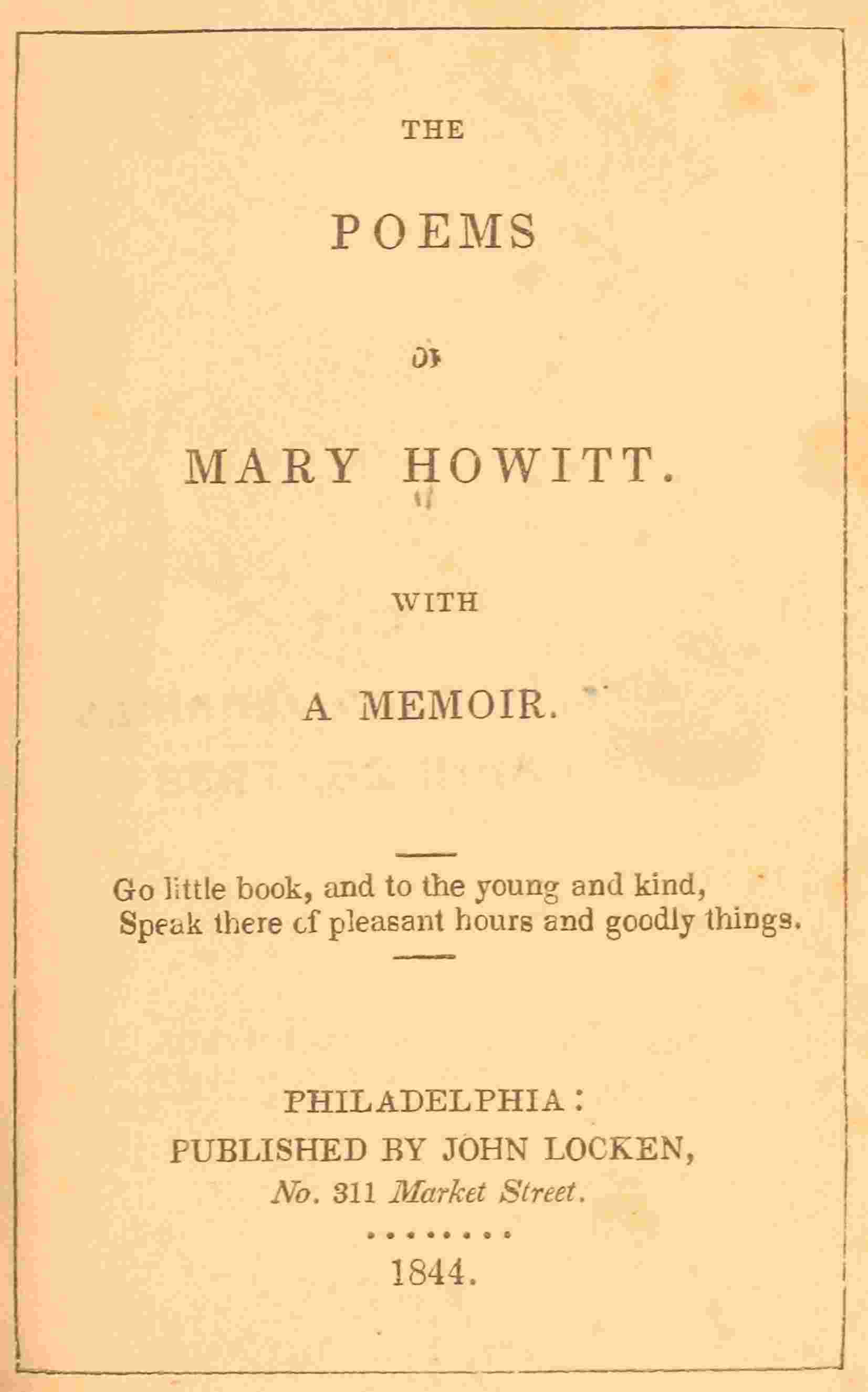
The poems of Mary Howitt

Chapter 22: PART V.
Open in WeRead

Explore more books like this:

About This Book

A varied volume of lyrical and narrative poems, hymns, and moral pieces that blend domestic sentiment, Christian reflection, and close observation of the natural world. Organized into thematic sections—hymns and fireside verses, birds and flowers, sketches of natural history, tales in verse, and miscellaneous pieces—the poems range from gentle meditations on mortality and virtue to ballads and dramatic monologues, often aimed at or suitable for young readers. The collection pairs simple didactic storytelling with vivid rural imagery, and is accompanied by a brief memoir outlining the poet’s upbringing and literary influences.

MARIEN’S PILGRIMAGE.
A FIRE-SIDE STORY.

Christianity, like a child, goes wandering over the world. Fearless in its innocence, it is not abashed before princes, nor confounded by the wisdom of synods. Before it the blood-stained warrior sheathes his sword, and plucks the laurel from his brow;—the midnight murderer turns from his purpose, and, like the heart-smitten disciple, goes out and weeps bitterly. It brings liberty to the captive, joy to the mourner, freedom to the slave, repentance and forgiveness to the sinner, hope to the faint-hearted, and assurance to the dying.

It enters the huts of poor men, and sits down with them and their children; it makes them contented in the midst of privations, and leaves behind an everlasting blessing. It walks through great cities, amid all their pomp and splendour, their unimaginable pride, and their unutterable misery, a purifying, ennobling, correcting, and redeeming angel.

It is alike the beautiful companion of childhood and the comfortable associate of age. It ennobles the noble; gives wisdom to the wise, and new grace to the lovely. The patriot, the priest, the poet, and the eloquent man, all derive their sublime power from its influence.

Thanks be to the Eternal Father, who has made us one with Him through the benign Spirit of Christianity!

PART I.

Through the wide world went Marien
On a holy mission sent,
A little child of tender years,
Throughout the world she went.
And ever, as she went along,
Sweet flowers sprang ’neath her feet;
All flowers that were most beautiful,
Of virtues strong and sweet.
And ever, as she went along,
The desert beasts grew tame;
And man, the savage, dyed with blood,
The merciful became.
Now, if you will attend to me,
I will in order tell
The history of this little child,
And what to her befel.
No friend at all had Marien,
And at the break of day,
In a lonesome place within the world,
In quiet thought she lay.
The stars were lost in coming morn,
The moon was pale and dim,
And the golden sun was rising
Over the ocean’s rim.
With upturned eye lay Marien;—
“And I am alone,” said she,
“Though the blackbird and the nightingale
Sing in the forest-tree:
“Though the weak woodland creatures
Come to me when I call,
And eat their food from out my hand;
And I am loved by all:
“Though sun, and moon, and stars come out,
And flowers of fairest grace,
And whate’er God made beautiful,
Are with me in this place:
“Yet I am all alone, alone,
Alone both night and day!
So I will forth into the world,
And do what good I may:
“For many a heart is sorrowful,
And I that heart may cheer;—
And many a weary captive pines
In dungeons dark and drear;—
And I the iron bonds may loose,—
Then why abide I here?
“And many a spirit dark with crime,
Yet longeth to repent;
And many a grievous wrong is done
To the weak and innocent;—
And I may do the injured right,
May save the penitent!
“Up, I will forth into the world!”
And, thus as she did say,
Sweet Marien from the ground rose up
And went forth on her way.
Through the wood went Marien,
The thick wood and the green!
And not far had she travelled ere
A cruel sight was seen.
Under the green and leafy boughs
Where singing birds were set;
At strife about their heritage,
Two ruffian brothers met.
“Thou shalt not of our father’s land,”
The elder said, “have part!”
The younger brother spoke no word,
But stabbed him to the heart.
Then deep into the forest dark
With desperate speed he ran,
And gentle Marien stood beside
The bleeding, murdered man.
With pitying tears that would not cease,
She washed his wounded side,
And prayed him to have faith in Him
Who for the sinner died.
But no sign made the murdered man,
There stiff in death he lay;—
And Marien through the forest wild
Went mourning on her way.
Ere long, as she went wandering on,
She came to where there sat,
With folded arms upon her breast,
A woman desolate.
Pale was she as the marble stone,
And steadfast was her eye;
She sat enchained, as in a trance,
By her great misery.
“What ails thee, mother?” Marien said,
In a gentle voice and sweet;
“What aileth thee, my mother?”
And knelt down at her feet.
“What aileth thee, my mother?”
Kind Marien still did say;
And those two words, my mother,
To the lone heart found their way.
As one who wakeneth in amaze,
She quickly raised her head;—
And “Who is’t calls me mother?”
Said she, “my child is dead!”
“He was the last of seven sons—
He is dead—I have none other;—
This is the day they bury him;—
Who is it calls me mother?”
“’Tis I,” said gentle Marien,
“Dear soul, be comforted!”
But the woman only wrung her hands,
And cried, “My son is dead!”
“Be comforted,” said Marien,
And then she sweetly spake
Of Jesus Christ, and how he came
The sting from death to take.
She told of all his life-long love,
His soul by suffering tried:
And how at last his mother stood
To see him crucified.
Of the disciples’ broken hearts
She told, of pangs and pain;
Of Mary at the sepulchre,
And Christ arisen again.
“Then sorrow not,” she said, “as though
Thou wert of all bereft;
For still, though they beloved are not,
This blessed faith is left.
“That when thy dream of life is o’er
Thou shalt embrace thy seven,
More beautiful than earthly sons,
With our dear Lord in heaven!”
Down on her knees the woman fell,
And “blessed be God,” said she,
“Who in my sorest need hath sent
This comforter to me!”

PART II.

Now Marien in the woman’s house
Abode a little space,
And comfort to the mother came;
And a dear daughter’s place
Had Marien in the woman’s heart,
Doing the while a daughter’s part.
But now ’twas time that she must go;
For Marien’s duty was not there,
Now grief was past and woe was done;
So, with the rising of the sun,
She rose up forth to fare.
“Nay, bide with me,” the woman said,
“Or, if as thou dost say,
Duty forbids that this may be,
I a day’s journey go with thee,
To speed thee on the way.”
So forth the loving pair set out,
The woman and the child;
And first they crossed the desert heath,
And then the mountains wild.
And in the woman’s arms she lay,
That night within the forest hoar,
And the next morn, with loving heart,
They said farewell, as those who part
To meet on earth no more.
Upon her way went Marien,
From morn till set of day,
And the peace of God that passeth word,
Upon her spirit lay,
And oftimes she sang aloud
As she went on her way.
The joyfulest song sang Marien
That e’er left human tongue;
The very birds were mute to hear
The holy words she sung.
But now the darksome night came on,
And Marien lay her down
Within a little way-side cave,
On mosses green and brown.
And in the deepest hush of night
Rude robbers entered in;
And first they ate and drank, then rose
To do a deed of sin.
For with them was a feeble man,
Whom they had robbed, and they
Here came to foully murder him,
And hide him from the day.
Up from her bed sprang Marien,
With heavenly power endued;
And in her glorious innocence,
Stood ’mong the robbers rude.
“Ye shall not take the life of man!”
Spake Marien low and sweet;
“For this will God take strict account,
Before his judgment seat!”
Out from the cave the robbers fled,
For they believed there stood,
A spirit stern and beautiful,
Not aught of flesh and blood.
And two from out the robber-band
Thenceforward did repent,
And lived two humble Christian men,
On righteous deeds intent.
When from the cave the robber-band
Had fled, the aged man
Rose from the floor where he was laid,
And marvelling much, began.
“Who art thou, child? and those few words
Of might which thou hast spoken,
What may they be? My foes have fled—
And lo! my bonds are broken;
At thy few words my foes have fled,
My rigid bonds have broken!”
Then Marien ’gan to tell him how,
Through her God’s power had wrought;
And him from peril, nigh to death,
Thus wondrously had brought.
She told him how holy Daniel’s faith
The caged beasts disarmed;
How the three righteous children walked
Through raging fire unharmed.
She told how Peter, bound with chains,
Lay in the prison-ward,
How God’s good angel freed him straight,
And the strong prison’s iron gate
Oped of its own accord.
“God knows our wants,” said Marien
“And in our sorest need,
Puts forth his arm to rescue us,
For he is merciful, and thus
It is that thou art freed.”
“Let us go hence!” the old man said,
And o’er the forest sod,
They, hand in hand, with quiet steps,
Went forward praising God.
Ere noontide, to a forest grange
They came, a sylvan place,
Where trooped, no longer fearing man,
The forest’s native race,
The white doe and the antlered stag,
And every beast of chase.
’Twas joy to see them drawing near
The old man as he came;
And this he stroked, and that he called
By some familiar name.
’Twas joy unto the little child
This little pleasant place to see;
“This is my home,” he said, “and here
Thou shalt abide with me.”
“I have no child to be mine heir,
And I am growing old;—
Thou shalt be heir to all my lands,
And heir of all my gold.
“Thou shalt be comfort to mine age,
And here within this wood,
’Mongst faithful, gentle things, shalt thou
Grow up to womanhood!
There dwelt the lovely Marien;
Within the forest wild,
And she unto the lone old man
Was dearer than a child.
There dwelt the lovely Marien,
Yet not long dwelt she there;—
The old man died;—and then came forth
A kinsman for the heir.
A lean and rugged man of pelf,
In wickedness grown old;
From some vile city-den he came
And seized upon the gold;—
He slew the tamed forest-beasts,—
The forest-grange he sold.
And with hard speeches, coarse and rude,
Away the child he sent;
Meek Marien answered not a word,
But through the forest went.

PART III.

Through the wild wood went Marien,
For many a weary day:
Her food the forest-fruits, and on
The forest-turf she lay.
The wildern wood was skirted
By moorlands dry and brown;
And after them came Marien
Into a little town.
At entrance of the little town
A cross stood by the way,
A rude stone cross, and there she knelt
A little prayer to say.
Then on the stone-steps sate her down;
And soon beside her crept,
A pale child with a clasped book,
And all the while he wept.
“Why weep you, child,” asked Marien,
“What troubleth you so sore?”
At these words spoken tenderly,
The child wept more and more.
“I have not heard,” at length he said,
“Kinds words this many a year,
My mother is dead—and my father
Is a hard man and severe.
“I sit in corners of the house
Where none can see me weep;
And in the quiet of the day
’Tis here I often creep.
“The kid leaps by his mother’s side,
The singing birds are glad:
But when I play me in the sun,
My heart is ever sad.
“They say this blessed book can heal
All trouble, and therefore
All day I keep it in my sight;
I lay it ’neath my head at night,
But it doth bring no cure to me:—
I know not what the cause may be,
For I of learning have no store!”
Thereat, like to a broken flower
The child drooped down his head;
Then Marien took the clasped book
And of the Saviour read.
She read of him the humble child
Of poverty and scorn;
How holy angels sang for him
The night that he was born.
How blessed angels came from heaven
To hail the Christmas night,
And shepherd people with their flocks
Beheld the glorious sight.
Then read she how, a growing youth,
His parents he obeyed,
And served with unrepining will
St. Joseph at his trade.
Then how he grew to man’s estate
And wandered up and down,
Preaching upon the lone sea-side,
And in the busy town.
Of all his tenderness, his love,
Page after page she read;
How he made whole the sick, the maimed,
And how he raised the dead.
And how he loved the children small,
Even of low degree;
And how he blessed them o’er and o’er,
And set them on his knee.
When this the little child had heard
He spoke in accents low,
“Would that I had been one with them
To have been blessed so!”
“Thou shalt be blessed, gentle one!”
Said Marien kind and mild,
“Christ, the Great Comforter, doth bless
Thee, even now, poor child!”
So conversed they of holy things
Until the closing day
Then Marien and the little child
Rose up to go their way.
As to the town they came, they passed
An ancient church, and “here
Let us go in!” the pale child said,
“For the organ pealeth over head,
And that sweet strain of holy sound
Like a heavenly vesture wraps me round,
And my heavy heart doth cheer.”
So Marien and the little child
Into the church they stole;
And many voices rich and soft
Rose upward from the organ loft,
And the majestic instrument
Pealed to an anthem that was sent
To soothe a troubled soul.
Anon the voices died away,
The pealing organ ceased,
And through the church’s ancient door
Passed chorister and priest.
And Marien and the little child
Went forward hand in hand
Adown the chancel aisle, and then
At once they made a stand.
Over the altar hung a piece
With holy influence fraught,
A work divine of wondrous skill
By some old painter wrought.
The gracious Saviour breathing love,
Was there like life expressed,
And round his knees the children small
Were thronging to be blessed.
Down dropped the child upon his knees,
And weeping, tenderly
Cried “bless me also, poor and weak,
Or let me go to thee!”
Anon his little head dropped low,
And his white lips ’gan to say,
“Oh kiss me gentle one, for now
Even I am called away—
The blessed mother’s voice I hear,
It calleth me away!”
So died the child;—and Marien laid
His meek arms on his breast,
With the clasped book between his hands:—
Thus God had given him rest!
And Marien, weeping holy tears,
Sate down beside the dead,
And slept that night within the church,
As in a kingly bed.
Scarce from the church had Marien passed,
When came the father there,
As was his wont, though fierce and bad,
To say a morning prayer!
Not seven paces had he gone,
When, heart-struck, he surveyed
Before his feet, that little child
In his dead beauty laid.
At once as by a lightning stroke
His softened soul was torn
With a deep sense of all the wrong
That little child had borne.
And then came back the timid voice
The footstep faint and low,
The many little arts to please,
The look of hopeless woe.
And many a shuddering memory
Of harsh rebuke and blow.
No prayer of self-approving words,
As was his wont, he said,
But humbled, weeping, self-condemned,
He stood before the dead.

PART IV.

Ten long days’ travel Marien went,
O’er woodland and o’er wold,
Teaching and preaching by the way,
Like Jesus Christ of old.
Sometimes within the baron’s hall
A lodging she would find,
And never went she from the door
But blessings staid behind;
Proud foes forgiven, revenge withheld,
And plenteous peace of mind.
With shepherd people on the hills;
With toiling peasant men,
She sate; with women dwelling lone,
On mountain or in glen.
By wayside wells she sate her down,
With pilgrims old and bent;
Or, hand in hand, with children small,
To the village school she went.
She made them spare the singing birds
All in their leafy bowers;
She made them love all living things;
And praise God for the flowers.
But now she came to where there raged
Wild war throughout the land;
She heard the vexed people’s cry;
She saw the ravaged corn-fields lie;
The hamlets smoking to the sky;
And everywhere careering by
The spoiler’s savage band.
All hearts were changed. Like ravening wolves
Men preyed upon each other;
Dead children lay on the bloody mould;
And pitiless had grown, and cold,
The heart of many a mother.
Wild shouts and horrid shrieks around
Filled all the air; the earth
Reeked with the blood that had been spilt;
And man made mockery and mirth
Of agony and mortal woe:—
Yet through all this did Marien go.
Outraged of heart, the child went on,
Weeping upon her way;
And now she soothed a dying wretch;
Then for another ran to fetch
Water; and every day
Did deeds of mercy good and mild:—
Thus journeyed on the pitying child.
On went she,—and as she went on,
Men grew ashamed of blood,
So beautiful did mercy seem;
And the wild soldier rude
Slunk back as slinks a noisome beast;
And to their homes once more
Came mothers with their little ones;
And old men, weak and hoar,
Sate in the sun as they had wont,
Unfearing at the door.
On went the child,—and as she went,
Within the Baron’s hall,
Were hung up helm and mail and sword,
To rust upon the wall.
On went she,—and the poets sung
No longer war’s acclaim,
But holy hymns of love and joy,
To hail her as she came.
On went she, like an angel good;
With bounding steps she went,
Day after day, until she came
To the great Conquerer’s tent.
There sat he, a strong man of blood,
Steel-mailed and scarfed with blue,
Poring o’er charts of distant lands,
For new lands to subdue.
Beside him stood the gentle child;
And now he traced with care,
Measuring from river unto sea,
A fertile region fair.
“’Tis a good land,” said Marien,
“From river unto sea;
And there a quiet people dwell,
Who never heard of thee.
“They feed their flocks and herds in peace;
The fruitful vine they till;
The quiet homes their fathers built
They and their children fill.
“Even now their happy children’s joy
Thee and thy will condemn;
Wherefore should’st thou possess that land?
God gave it unto them!”
Into her face the proud man looked,
Amazed at what he heard;
Then turned unto his charts again,
And answered never a word.
Another land among the hills
He measured with his eye;
“’Tis a stern land,” said Marien,
“A land of liberty!
“There fled the Christians in old time,
And built their churches there;
The bells upon the sabbath morn
Call all that land to prayer.
“Would’st thou God’s people tribulate?
A cursed thing it were
To make that Christian land of love
A bloody sepulchre!”
The proud man turned him round about
And fiercely gazed at her.
“Rivers of blood have flowed for thee!”
Unblenching Marien said,
“And many a Christian land hast thou
With Christian blood made red.
“Up, sin no more! ’Tis coming now,
The day thou canst not flee,
When all the thousands thou hast slain
God will require of thee!
“Thou man of blood, repent, repent,
Repent whilst yet thou may,
And store up deeds of love and peace
Against that awful day!”
Up from his seat the conquerer rose,
And paced the uneasy tent,
And ground his teeth and groaned aloud,
As one that doth repent.
Forth from the tent sped Marien;
And many a summer’s day
Throughout a blessed land of peace
She journeyed on her way.

PART V.

At length, after long travel past,
She came as it grew late,
Along a beaten road, that led
To a vast city gate.
A vast and populous city, where
Rose dome, and tower, and spire,
And many a gilded pinnacle,
Far-seen, as the bright sunset fell,
Like glittering points of fire.
A city vast and populous,
Whose thronging multitude
Sent forth a sound afar-off heard,
Strong as the ocean-flood.
A strong, deep sound of many sounds,
Toil, pleasure, pain, delight,
And traffic, myriad-wheeled, whose din
Ceased not by day or night.
And through the city gate a throng
Passed ever, never spent;
A busy mingling human tide
Of those who came and went.
’Twas a proud city and a rich;
A city fair and old;
Filled with the world’s most costly things,—
Of precious stones and gold;
Of silks, fine woods, and spiceries;
And all that’s bought and sold.
Thither came homeless Marien,
Came there as it grew late,
Foot-sore and weary, friendless, poor,
Unto the city gate.
There found her a poor carpenter
Returning from his trade,
And he, with pitying countenance,
Her weary form surveyed.
“Come!” said he, “thou unto my house,
Shalt go: and of my bread,
And of my cup, thou shalt partake;
Shalt bide with me!” and as he spake
Her weary steps he led.
Unto an humble place that stood
’Mong dwellings of the poor
He brought her; bade her welcome thrice
Unto his lowly door.
The good-wife met her with like cheer,
“And though our fare is scant,
Fear not,” she said, “whilst we have food
It is not thou shall want!”
So dwelt she with this humble pair
In the great city, cherished so,
As parents cherish their first born;
Nor would they let her go.
Thus for a year she dwelt with them;
And that while their abode
Was blessed exceedingly; their store
Grew daily, weekly, more and more;
And peace so multiplied around,
The very hearth seemed holy ground,
As if once more on earth was found
The Paradise of God.
’Twas she that blessed the bread they ate,
’Twas she soothed all their cares;
They knew not that they entertained
An angel unawares.
With simple hearts that had no guile
They of the Saviour heard;
And, weeping tears of joyful faith,
Believed and blessed each word.
No more they marvelled how their board
With plenteous food was spread;
Five barley loaves dispensed by Christ
The famished thousands fed.
With love that would not be repressed,
Their kindling bosoms burned,
And ’mong their neighbours poor they went
To teach what they had learned.
To teach how Christ unto the poor,
The sinner vile, was sent;
How Mary washed his feet with tears,
And wiped them with her golden hairs,
A weeping penitent.
And how the sinful woman stood
Unjudged before his face;
How the poor prodigal sped back
Repentant to his place;
How to the thief upon the cross
He said, thou art forgiven,
And thou shalt be with me this day,
In the paradise of heaven.
So preached the carpenter; and men
Turned from their evil ways,
And Christian prayer was heard around,
And Christian hymns of praise.
Strange seemed these things; and to the rich,
And to the proud, ’twas told,
How many of the meaner sort
Lived like the saints of old.
How holy, blameless, were their lives;
And how poor craftsmen vile,
Amid their fellows, tool in hand,
The gospel preached the while.
’Twas told of Marien; how she came
A wanderer none knew whence;
Friendless and poor, of mind mature,
A Child in innocence;
As thus ’twas told, some blessed God,
But others took offence.
“Why,” said they, “should this simple child,
These men of low degree,
Thus preach and practise? what new faith
Is there, or need there be?
“Bishops have taught a thousand years,
And learned men are they;
These are mad doctrines, false, unfit,
Devised to lead astray.”
Therefore the simple people were
To a full synod brought,
To answer for their altered lives,
And for the faith they taught.
Much marvelled all those learned men
To see them fearless stand,
Calm, unabashed; with ready wit,
And language at command.
And to their taunt of low estate,
They answered, “let alone
All pride of rank; Christ chose the poor,
To make his gospel known.
“And what are we?—Immortal souls,
For whom Christ’s blood was shed;
Children of one great sire, with ye,
Co-heirs of Immortality;
Alike you both in birth and death;
Alone our lot so differeth,
As God shall judge the dead!”
Then were they questioned of old creeds,
By sophistries perplexed;
So that their artless lore might fail,
There simple souls be vexed.
But they were steadfast in the faith
As taught the holy book;
And thence it was adjudged a crime
Upon its page to look.
And the grave synod rose in wrath,
And they were judged blasphemers dire,
And doomed, their daring heresies
To expiate in fire.

PART VI.