WeRead Powered by ReaderPub
The poems of Mary Howitt cover

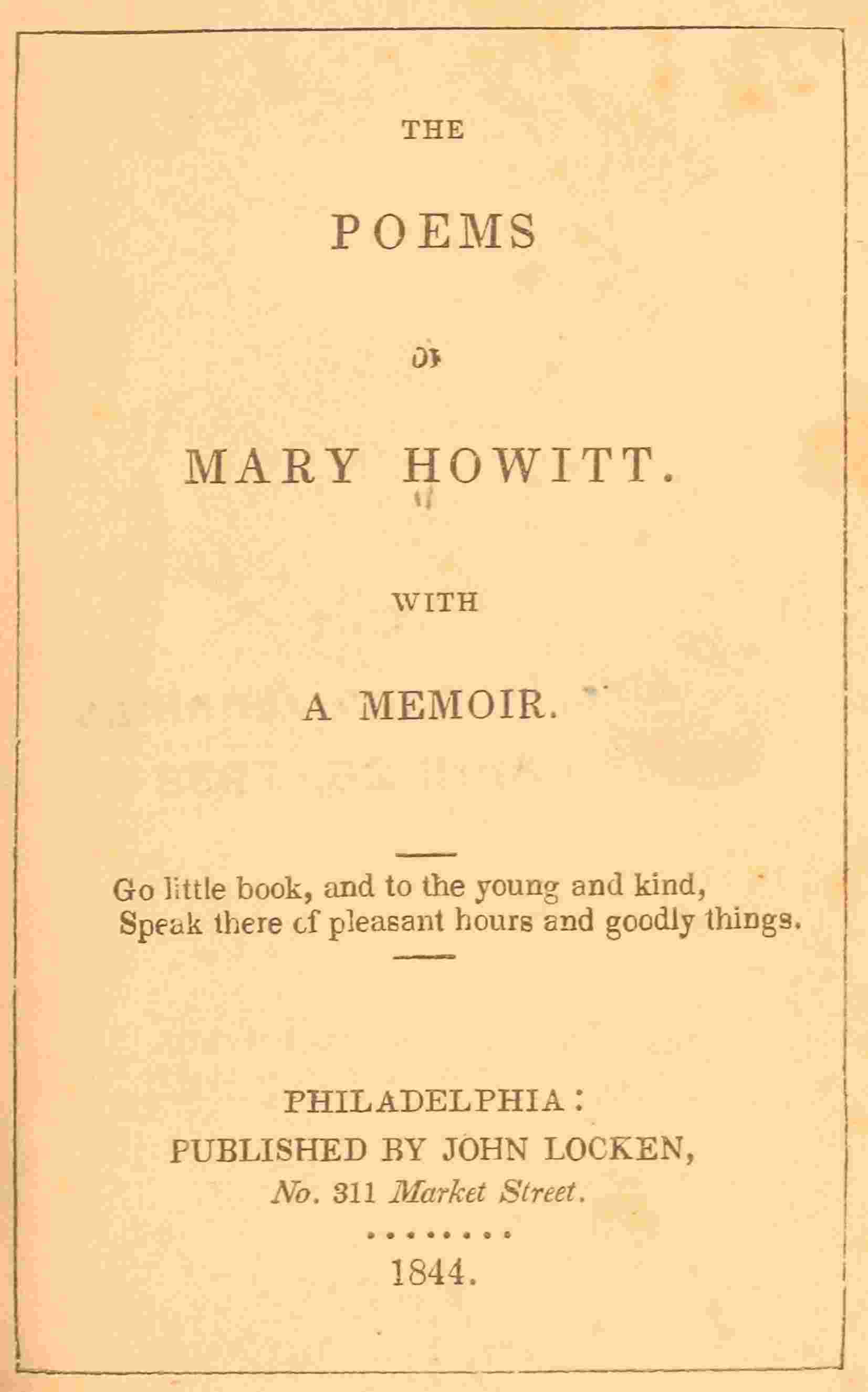
The poems of Mary Howitt

Chapter 4: PERSONS.
Open in WeRead

Explore more books like this:

About This Book

A varied volume of lyrical and narrative poems, hymns, and moral pieces that blend domestic sentiment, Christian reflection, and close observation of the natural world. Organized into thematic sections—hymns and fireside verses, birds and flowers, sketches of natural history, tales in verse, and miscellaneous pieces—the poems range from gentle meditations on mortality and virtue to ballads and dramatic monologues, often aimed at or suitable for young readers. The collection pairs simple didactic storytelling with vivid rural imagery, and is accompanied by a brief memoir outlining the poet’s upbringing and literary influences.

PERSONS.

THE POOR SCHOLAR.
ACHZIB, THE PHILOSOPHER.
THE MOTHER.
LITTLE BOY.


The Scholar’s Room—Evening.

THE POOR SCHOLAR AND LITTLE BOY.

Little Boy, reading. “These things have I spoken unto you, that in me ye might have peace. In the world ye shall have tribulation: but be of good cheer, I have overcome the world.” Here endeth the 16th chapter of the Gospel according to St. John.

Poor Scholar. Most precious words! Now go your way;
The summer fields are green and bright;
Your tasks are done.—Why do you stay?
Christ gave his peace to you: Good night!
Boy. You look so pale, Sir! you are worse;
Let me remain, and be your nurse!
Sir, when my mother has been ill,
I’ve kept her chamber neat and still,
And waited on her all the day!
Schol. Thank you! but yet you must not stay;
Still, still my boy, before we part
Receive my blessing—’tis my last!
I feel Death’s hand is on my heart,
And my life’s sun is sinking fast;
Yet mark me, child, I have no fear,—
’Tis thus the Christian meets his end:
I know my work is finished here,
And God—thy God too—is my friend!
The joyful course has just began;
Life is in thee a fountain strong;
Yet look upon a dying man,
Receive his words and keep them long!
Fear God, all-wise, omnipotent,
In him we live and have our being;
He hath all love, all blessing sent—
Creator—Father—All-decreeing!
Fear him, and love, and praise, and trust,
Yet have of man no slavish fear;
Remember kings, like thee, are dust,
And at one judgment must appear.
But virtue, and its holy fruits,
The poet’s soul, the sage’s sense,
These are exalted attributes;
And these demand thy reverence.
But, boy, remember this, e’en then
Revere the gifts, but not the men!
Obey thy parents; they are given
To guide our inexperienced youth;
Types are they of the One in heaven,
Chastising but in love and truth!
Keep thyself pure—sin doth efface
The beauty of our spiritual life:
Do good to all men—live in peace
And charity, abhorring strife!
The mental power which God has given,
As I have taught thee, cultivate;
Thou canst not be too wise for heaven,
If thou dost humbly consecrate
Thy soul to God! and ever take
In his good book delight; there lies
The highest knowledge, which will make
Thy soul unto salvation wise!
My little boy, thou canst not know
How strives my spirit fervently,
How my heart’s fountains overflow
With yearning tenderness for thee!
God keep and strengthen thee from sin!
God crown thy life with peace and joy,
And give at last to enter in
The city of his rest!
My boy
Farewell—I have had joy in thee;
I go to higher joy—oh, follow me!
But now farewell!
Boy. Kind sir, good night!
I will return with morning light. [He goes out.

[The Poor Scholar sits for some time as in meditation, then rising and putting away all his books, except the Bible, he sits down again.

Schol. Now, now I need them not, I’ve done with them.
I need not blind philosophy, nor dreams
Of speculating men, entangling truth
In cobweb sophistry, away with them—
One word read by that child is worth them all!
—The business of my life is finished now
With this day’s work. I have dismissed the class
For the last time—I am alone with death!
To-morrow morn, they will inquire for me,
And learn that I have solved the last, great problem.
This pale, attenuate frame they may behold,
But that which loves, and hopes, and speculates,
They will perceive no more. Mysterious being!
Life cannot comprehend thee, though thou showest
Thyself by all the functions of our life—
’Tis death—death only, which is the great teacher!
Awful instructor! he doth enter in
The golden rooms of state, and all perforce
Teach there its proud, reluctant occupant;
He doth inform in miserable dens
The locked-up soul of sordid ignorance
With his sublimest knowledge! He hath stolen
Gently, not unawares, into the chamber
Of the Poor Scholar, like a sober friend
Who doth give time for ample preparation!
He hath dealt kindly with me, giving first
Yearnings for unimaginable good,
Which the world’s pleasure could not satisfy;
And lofty aspiration, that lured on
The ardent soul as the sun lures the eagle;
Next came a drooping of the outward frame,
Paleness and feebleness, and wasted limbs,
Which said, “prepare! thy days are numbered!”
And thus for months had this poor frame declined,
Wasting and wasting; yet the spirit intense
Growing more clear, more hourly confident,
As if its disenthralment had begun!
Oh, I should long to die!
To be among the stars, the glorious stars;
To have no bounds to knowledge; to drink deep
Of living fountains—to behold the wise,
The good, the glorified! to be with God,
And Christ, who passed through death that I might live!
Oh I should long for death, but for one tie,
One lingering tie that binds me to the earth!
My mother! dearest, kindest, best of mothers!
What do I owe her not? all that is great,
All that is pure—all that I have enjoyed
Of outward pleasure, or of spiritual life,
I have derived from her! has she not labored
Early and late for me? first through the years
Of sickly infancy—then by her toil
Maintained the ambitious scholar—overpaid
By what men said of him! Oh thou untired,
True heart of love, for thee I hoped to live;
To pay thee back thy never spent affection;
To fill my father’s place, and make thine age
As joyful as thou mad’st my passing youth!
Alas! it may not be! thou hast to weep—
Thou hast to know that sickness of the heart
Which bows it to the dust, when some unlooked-for,
Some irremediable woe befals!
——Surely ere long thou wilt be at my side,
For I did summon thee, and thy strong love
Brooks not delay! Alas, thou knowest not
It was to die within thy holy arms
That I have asked thy presence! Oh! come, come,
Thou most beloved being, bless thy son,
And take one comfort in his peaceful death!

[A slight knocking is heard at the door, and the Philosopher enters.

Philos. Well, my young friend, I’ve looked in to enquire
After your health. I saw your class depart,
And would have conference with you once again.
Schol. To-night I must decline your friendship, sir.
I am so weak I cannot talk with you
On controversial points ever again.
Besides, my faith brings such a holy joy,
Such large reward of peace, why would you shake it?
Or is it now a time for doubts and fears,
When my soul’s energy should be concentrated
For one great trial? See you not, e’en now,
The spectre death is with me?
Philos. Cheer up, friend.
It is the nature of all sickness thus
To bring death near to the imagination,
Even as a telescope doth show the moon
Just at our finger-ends without decreasing
The actual distance. Come, be not so gloomy;—
You have no business to be solitary;
A cheerful friend will bring back cheerfulness.
Have you perused the books I left with you?
Schol. I have, and like them not!
Philos. Indeed! indeed!
Are they not full of lofty argument
And burning eloquence? For a strong soul,
Baptized in the immortal wells of thought,
They must be glorious food!
Schol. Pardon me, sir,
They are too specious;—they gloss over error
With tinsel covering which is not like truth.
Oh! give them not to young and ardent minds,
They will mislead, and baffle and confound:
Besides, among the sages whom you boast of,
With their proud heathen virtues, can ye find
A purer, loftier, nobler character;
More innocent, and yet more filled with wisdom,
Fuller of high devotion—more heroic
Than the Lord Jesus—dignified yet humble;
Warring ’gainst sin, and yet for sinners dying?
Philos. Well; pass the men, what say you to the morals?
Schol. And where is the Utopian code of morals
Equal to that which a few words set forth
Unto the Christian, “do ye so to others
As ye would they should do unto yourselves.”
And where, among the fables of their poets,
Which you pretend veil the divinest truths,
Find you the penitent prodigal coming back
Unto his father’s bosom; thus to show
God’s love, and our relationship to him?
Where do they teach us in our many needs
To lift up our bowed, broken hearts to God,
And call him “Father?” Leave me as I am!
I am not ignorant, though my learning lie
In this small book—nor do I ask for more!
Philos. But have you read the parchments?
Schol. All of them.
Philos. And what impression might they make upon you?
For knowing as I do your graceful mind,
And your profound research beyond your years,
I am solicitous of your approval.
Schol. I cannot praise—I cannot say one word
In commendation of your misspent labors.
Oh, surely it was not a friendly part
To hold these gorgeous baits before a soul
Just tottering on eternity! Delusion,
’Tis all delusion! while my soul abhorred,
My heart was wounded at the traitorous act!
Philos. Come, come, my friend, this is mere declamation;
You have misunderstood both them and me!
Point out the errors—you shall find me ever
Open unto conviction.
Schol. See my state—
A few short hours, and I must be with God;
And yet you ask me to evolve that long
Entanglement of subtlest sophistry!
This is no friendly part: but I conjure you,
Give not your soul to vain philosophy:
The drooping Christian at the hour of death
Needs other, mightier wisdom than it yields.
Oh, though I am but young, and you are old,
Grant me the privilege of a dying man,
To counsel you in love!
Philos. Enough, enough!
I see that you are spent. I have too long
Trespassed upon your time. But is there nought
That I can serve you in? Aspire you not
To win esteem by study? I will speak
Unto the primest scholars throughout Europe
In your behalf. All universities
Will heap upon you honors at my asking.
Schol. There was a time these things had been a snare;
But the near prospect of eternity
Takes from the gauds of earth their temptingest lure;
No, no—it was a poor unmeet ambition
Which then was hot within me, and, thank God,
Affecteth me no more!
Philos. Nay, but my friend,
For your dear mother’s sake would you not leave
A noble name emblazoned on your tomb?
Schol. Can such poor, empty honors compensate
Unto a childless mother for her son?
You know her not, and me you know not either!
Philos. But think you, my young friend, learning is honored
By every honor paid to its disciples:
Your tomb would be a shrine, to learning sacred.
Schol. There is more comfort, sir, unto my soul
To feel the smallest duty not neglected,
And my day’s work fulfilled, than if I knew
This perishable dust would be interred
In kingly marble, and my name set forth
In pompous blazonry.
Philos. Not to be great—
You do mistake my drift—but greatly useful;
Surely you call not this unmeet ambition!
Schol. Sir, had the will of God ordained a wider,
A nobler sphere of usefulness on earth,
He would have given me strength, and health, and power
For its accomplishment. I murmur not
That little has been done, but rather bless Him
Who has permitted me to do that little;
And die content in his sufficient mercy,
Which has vouchsafed reward beyond my merit.
Philos. Nay, I must serve you! Let me but contribute
Unto your body’s ease. This wretched room,
And its poor pallet—would you not desire
A lighter, airier, more commodious chamber,
Looking out to the hills; and where the shine
Of the great sun might enter—where sweet odours,
And almost spiritual beauty of fair flowers
Might gratify the sense—and you might fall
Gracefully into death, in downy ease?
Speak, and all this is yours!
Schol. Here will I die!
Here have I lived—here from my boyhood lived;
These naked walls are like familiar faces,
And that poor pallet has so oft given rest
To my o’erwearied limbs, there will I die!
Philos. But you do need physicians—here is gold,
I know the scholar’s fee is scant enough!
I will go hence, and send you an attendant.
Schol. I cannot take your gold, I want it not.
My sickness is beyond the aid of man;
And soon, even now, I did expect my mother.
Philos. [affecting sorrow.] My dear young friend, I have to ask your pardon;
The letter that I promised to deliver,
I did forget—indeed I gave it not!
Schol. How have I trusted to a broken reed!
Oh mock me not with offers of your friendship,
Say not that thou would serve me!
Oh my mother—
Poor, broken-hearted one, I shall not see thee!

[He covers his face for a moment, then, rises up with sudden energy.

Whoe’er you are, and for what purpose come,
I know not—you have troubled me too long—
But something in my spirit, from the first,
Told me that you were evil; and my thought
Has often inly uttered the rebuke,
“Get thee behind me, Satan!” Leave me now—
Leave me my lonely chamber to myself,
And let me die in peace!

[The Philosopher goes out, abashed. The scholar falls back into his chair, exhausted; after some time recovering, he faintly raises himself.

’Tis night fall now—and through the uncurtained window
I see the stars; there is no moon to-night.
Here then I light my lamp for the last time;
And ere that feeble flame has spent itself,
A soul will have departed!
Let me now
Close my account with life; and to affection,
And never-cancelled duty, give their rights:

[He opens his Bible and inscribes it.

This I return to thee, my dearest mother,
Thy gift at first, and now my last bequest;
And these poor earnings, dust upon the balance
Compared with the great debt I owe to thee,
Are also thine—would I had more to give!
There lie you, side by side.

[He lays a small sum of money with the Bible.

Thou blessed book,
Full of redeeming knowledge, making wise
Unto salvation, and the holy spring
Of all divine philosophy—and thou poor dust,
For which the soul of man is often sold;
Yet wast thou not by evil traffic won,
Nor got by fraud, nor wrung from poverty—
God blessed the labourer while he toiled for thee,
And may’st thou bless the widow!—lie thou there—
I shall not need you more. I am departing
To the fruition of the hope of one,
And where the other cannot get admittance!
And now a few words will explain the rest:—

[He writes a few words, which he incloses with them, and making all into a packet, seals them up.

God comfort her poor heart, and heal its wounds,
Which will bleed fresh when she shall break this seal.

[Shortly after this is done, he becomes suddenly paler—a convulsive spasm passes over him; when he recovers, he slowly rises, and kneels upon his pallet-bed.

Schol. Almighty God! look down
Upon thy feeble servant! strengthen him!
Give him the victor’s crown,
And let not faith be dim!
Oh, how unworthy of thy grace,
How poor, how needy, stained with sin!
How can I enter in
Thy kingdom, and behold thy face!
Except thou hadst redeemed me, I had gone
Without sustaining knowledge to the grave!
For this I bless thee, oh thou Gracious One,
And thou wilt surely save!
I bless thee for the life which thou hast crowned
With never-ending good;
For pleasures that were found
Like wayside flowers in silent solitude.
I bless thee for the love that watched o’er me
Through the weak years of infancy,
That has been, like thine everlasting truth.
The guide, the guardian-angel of my youth.
Oh, Thou that didst the mother’s heart bestow
Sustain it in its woe,
For mourning give it joy, and praise for heaviness!

[He falls speechless upon the bed. His mother enters hurriedly.

Mother. Alas, my son! and am I come too late?
Oh, Christ! can he be dead?
Schol. [looking up faintly.]. Mother, is’t thou?
It is! who summoned thee, dear mother?
Mother. A little boy, the latest of thy class;
He left these walls at sunset, and came back
With me e’en now. He told me of thy words,
And of thy pallid cheek and trembling hand;—
Sorrowing for all; but sorrowing more because
Thou saidst he would behold thy face no more!
Schol. My soul doth greatly magnify the Lord
For his unmeasured mercies!—and for this
Great comfort, thy dear presence! I am spent—
The hand of death is on me! Ere the sun
Lightens the distant mountains, I shall be
Among the blessed angels! Even now
I see as t’were heaven opened, and a troop
Of beautiful spirits waiting my release!
Mother. My son! my son! and thou so young, so wise,
So well-beloved, alas, must thou depart!
Oh, rest thy precious head within mine arms,
My only one!—Thou wast a son indeed!
Schol. Mother, farewell! I hear the heavenly voices,
They call!—I cannot stay: farewell—farewell!
Choir of Spiritual Voices.
No more sighing,
No more dying,
Come with us, thou pure and bright!
Time is done,
Joy is won,
Come to glory infinite!
Hark! the angel-songs are pealing!
Heavenly mysteries are unsealing,
Come and see, oh come and see!
Here the living waters pour,
Drink and thou shalt thirst no more,
Dweller in eternity!
No more toiling—no more sadness!
Welcome to immortal gladness,
Beauty and unending youth!
Thou that hast been deeply tried,
And like gold been purified,
Come to the eternal truth!
Pilgrim towards eternity,
Tens of thousands wait for thee!
Come, come!