
WeRead Powered by ReaderPub
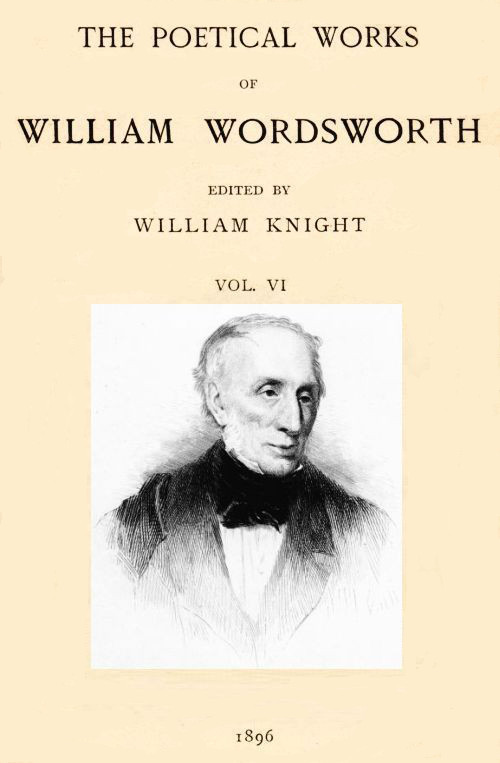
The Poetical Works of William Wordsworth — Volume 6 (of 8) cover

The Poetical Works of William Wordsworth — Volume 6 (of 8)

Chapter 15: III EFFUSION,
Open in WeRead

Explore more books like this:

About This Book

A varied collection of lyric and narrative poems, odes, and meditative pieces that move between intimate responses to particular landscapes and broader classical or historical reflection. Recurring concerns include the relationship between humans and nature, memory and loss, spiritual contemplation, and reactions to public events; forms range from short lyrics and inscriptions to longer blank-verse meditations and dramatic scenes. Frequent classical allusions and moral questioning refract personal feeling into wider imaginative inquiry, while vivid depictions of rivers, hills, storms, and rural life provide concrete settings for elegiac, contemplative, and celebratory moods.

[13] 1820.

ms.

individual, a sketch of whose character is given in the Poem,

[14] 1837.

1820.
To barren heath, and quaking fen,
ms.
To {swampy} heath, and quaking fen,
{sandy }

[15] 1820.

ms.
Dark moor and .    .    .

[16] Italics were first used in 1827.

[17] 1820.

ms.
When on .    .    .

[18] 1820.

ms.
Distempered Power .    .    .

[19] 1820.

Last of an else extinguished Highland clan,
Last glimmering spark, was this rude man;
ms.
Sole remnant of a haughty race,

[20] 1820.

With their perennial hills; but Time
Brought low a power that could not climb,
Though, from its well-defended Home,
When, sword in hand, it chose to roam,
Its warfare's bourne, its travel's belt,
ms.
Was devastation widely dealt.
With their perennial hills; but Crime,
That hastens the decrees of time,
Brought low a Power, which, when it chose
To spurn confinement and repose,
Made devastation widely dealt,
ms.
Its warfare's bourne, its travel's belt.

[21] 1820.

ms.
.    .    . lone .    .    .

[22] 1820.

ms.
For he renounc'd .    .    .
ms.
For less than exiled, .    .    .

[23] 1820.

ms.
Here lodged and fed .    .    .
ms.
In Being's scale .    .    .

[24] 1820.

.    .    .    .    .    . descent;
Till he—half dreaded, half disdained,
The title of a Brownie gained:
{He who} to no malicious taint
{But he}
Was subject—like the Patmos Saint;
His ruling case, his chief delight,
ms.
To pen by day

[25] 1820.

ms.
Nor wanton .    .    .

FOOTNOTES:

[F] Compare Wordsworth's Letter to a Friend of Burns (passim).—Ed.

[G] Diodorus mentions this tradition (see his History, book iii. chap. 4), that the infant Bacchus was carried by Ammon, the Libyan Jupiter, to a cave on an island near Mount Nysa, from fear of Rhea, and that he was handed over to the care and the tuition of Nysa, the daughter of Aristæus. From this mountain the young Bacchus was supposed to have derived his name, Dionysus.—Ed.


II
COMPOSED AT CORA LINN,

In sight of Wallace's Tower

—How Wallace fought for Scotland, left the name
Of Wallace to be found, like a wild flower,
All over his dear Country; left the deeds
Of Wallace, like a family of ghosts,
To people the steep rocks and river banks,
Her natural sanctuaries, with a local soul
Of independence and stern liberty. ms.[H]

Composed 1814.—Published 1820

[I had seen this celebrated Waterfall twice before; but the feelings to which it had given birth were not expressed till they recurred in presence of the object on this occasion.—I.F.]

Lord of the vale! astounding Flood;
The dullest leaf in this thick wood
Quakes—conscious of thy power;
The caves reply with hollow moan;
5
And vibrates, to its central stone,
Yon time-cemented Tower![I]
And yet how fair the rural scene!
For thou, O Clyde, hast ever been
Beneficent as strong;
10
Pleased in refreshing dews to steep
The little trembling flowers that peep
Thy shelving rocks among.
Hence all who love their country, love
To look on thee—delight to rove
15
Where they thy voice can hear;
And, to the patriot-warrior's Shade,
Lord of the vale! to Heroes laid
In dust, that voice is dear!
Along thy banks, at dead of night
20
Sweeps visibly the Wallace Wight;
Or stands, in warlike vest,
Aloft, beneath the moon's pale beam,
A Champion worthy of the stream,
Yon grey tower's living crest!
25
But clouds and envious darkness hide
A Form not doubtfully descried:—
Their transient mission o'er,
O say to what blind region flee
These Shapes of awful phantasy?
30
To what untrodden shore?
Less than divine command they spurn;
But this we from the mountains learn,
And this the valleys show;
That never will they deign to hold
35
Communion where the heart is cold
To human weal and woe.
The man of abject soul in vain
Shall walk the Marathonian plain;
Or thrid the shadowy gloom,
40
That still invests the guardian Pass,
Where stood, sublime, Leonidas
Devoted to the tomb.[J]
And let no Slave his head incline,
Or kneel, before the votive shrine
45
By Uri's lake, where Tell
Leapt, from his storm-vext boat, to land,[K]
Heaven's Instrument, for by his hand
That day the Tyrant fell.[26]

VARIANT:

[26] 1845.

Nor deem that it can aught avail
For such to glide with oar or sail
Beneath the piny wood,
Where Tell once drew, by Uri's lake,
His vengeful shafts—prepared to slake
1820.
Their thirst in Tyrants' blood!

FOOTNOTES:

[H] Compare The Prelude (vol. iii. p. 139), to which may be added the following Wallace Memorials:—"The barrel, or cave, in Bothwell parish; caves in Lasswade, Torphichen, and Lesmahagow parishes; chair at Bonniton, near Lanark; cradle on hill, two miles south by west of Linlithgow; house at Elderslie, in Renfrewshire; larder at Ardrossan; leap in Roseneath parish; monument on Abbey Craig, near Stirling; oaks at Elderslie and at Torwood; seats in Biggar, Kilbarchan, and Dumbarton parishes; statues at Lanark, and adjacent to the Tweed, near Dryburgh; stone in Polmont parish; towers in Ayr town, Roxburgh parish, Auchterhouse parish, and Kirkmichael parish, Dumfriesshire; trench in Kincardine-in-Monteith parish; and well in Biggar parish."—Wilson's Gazetteer of Scotland, 1882 (article, "Wallace Memorials").—Ed.

[I] The "time-cemented Tower" of the old castle of Cora still overlooks the waterfall. Compare the Address to Kilchurn Castle in the "Memorials of a Tour in Scotland," 1803 (vol. ii. p. 400); and, with

The dullest leaf in this thick wood
Quakes—conscious of thy power,

compare the Lines written in Early Spring (vol. i. p. 268).—Ed.

[J] Leonidas, king of Sparta, killed in the heroic defence of the pass of Thermopylæ, B.C. 480.—Ed.

[K] On the western side of the bay of Uri, in the lake of Lucerne, is Tell's Platte, where on a ledge of rock stands the chapel—rebuilt in 1880, but said to have been originally built in 1388—on the spot where the Swiss Patriot leapt out of Gessler's boat, and shot the tyrant.—Ed.


III
EFFUSION,

In the Pleasure-Ground on the Banks of the Bran, near Dunkeld

Composed 1814.—Published 1827

[I am not aware that this condemnatory effusion was ever seen by the owner of the place. He might be disposed to pay little attention to it; but were it to prove otherwise I should be glad, for the whole exhibition is distressingly puerile.—I.F.]

"The waterfall, by a loud roaring, warned us when we must expect it. We were first, however, conducted into a small apartment, where the Gardener desired us to look at a picture of Ossian, which, while he was telling the history of the young Artist who executed the work, disappeared, parting in the middle—flying asunder as by the touch of magic—and lo! we are at the entrance of a splendid apartment, which was almost dizzy and alive with waterfalls, that tumbled in all directions; the great cascade, opposite the window, which faced us, being reflected in innumerable mirrors upon the ceiling and against the walls."—Extract from the Journal of my Fellow-Traveller.[L]

What He—who, mid the kindred throng
Of Heroes that inspired his song,
Doth yet frequent the hill of storms,
The stars dim-twinkling through their forms!
5
What! Ossian here—a painted Thrall,
Mute fixture on a stuccoed wall;
To serve—an unsuspected screen
For show that must not yet be seen;
And, when the moment comes, to part
10
And vanish by mysterious art;
Head, harp, and body, split asunder,
For ingress to a world of wonder;
A gay saloon, with waters dancing
Upon the sight wherever glancing;
15
One loud cascade in front, and lo!
A thousand like it, white as snow—
Streams on the walls, and torrent-foam
As active round the hollow dome,
Illusive cataracts! of their terrors
20
Not stripped, nor voiceless in the mirrors,
That catch the pageant from the flood
Thundering adown a rocky wood.
What pains to dazzle and confound!
What strife of colour, shape and sound
25
In this quaint medley, that might seem
Devised out of a sick man's dream![27]
Strange scene, fantastic and uneasy
As ever made a maniac dizzy,
When disenchanted from the mood
30
That loves on sullen thoughts to brood!
O Nature—in thy changeful visions,
Through all thy most abrupt transitions[28]
Smooth, graceful, tender, or sublime—
Ever averse to pantomime,
35
Thee neither do they know nor us
Thy servants, who can trifle thus;
Else verily[29] the sober powers
Of rock that frowns, and stream that roars,
Exalted by congenial sway
40
Of Spirits, and the undying Lay,
And Names that moulder not away,
Had wakened[30] some redeeming thought
More worthy of this favoured Spot;
Recalled some feeling—to set free
45
The Bard from such indignity!
[M]The Effigies of a valiant Wight
I once beheld, a Templar Knight;
Not prostrate, not like those that rest
On tombs, with palms together prest,
50
But sculptured out of living stone,
And standing upright and alone,
Both hands with rival energy
Employed in setting his sword free
From its dull sheath—stern sentinel
55
Intent to guard St. Robert's cell;[N]
As if with memory of the affray
Far distant, when, as legends say,
The Monks of Fountain's[O] thronged to force
From its dear home the Hermit's corse,
60
That in their keeping it might lie,
To crown their abbey's sanctity.
So had they rushed into the grot
Of sense despised, a world forgot,
And torn him from his loved retreat,
65
Where altar-stone and rock-hewn seat
Still hint that quiet best is found,
Even by the Living, under ground;
But a bold Knight, the selfish aim
Defeating, put the Monks to shame,
70
There where you see his Image stand
Bare to the sky, with threatening bran
Which lingering Nid is proud to show
Reflected in the pool below.
Thus, like the men of earliest days,
75
Our sires set forth their grateful praise:
Uncouth the workmanship, and rude!
But, nursed in mountain solitude,
Might some aspiring artist dare
To seize whate'er, through misty air,
80
A ghost, by glimpses, may present
Of imitable lineament,
And give the phantom an array
That less[31] should scorn the abandoned clay;
Then let him hew with patient stroke
85
An Ossian out of mural rock,
And leave the figurative Man—
Upon thy margin, roaring Bran!—
Fixed, like the Templar of the steep,
An everlasting watch to keep;
90
With local sanctities in trust,
More precious than a hermit's dust;
And virtues through the mass infused,
Which old idolatry abused.
What though the Granite would deny
95
All fervour to the sightless eye;
And touch from rising suns in vain
Solicit a Memnonian strain;[P]
Yet, in some fit of anger sharp,
The wind might force the deep-grooved harp
100
To utter melancholy moans
Not unconnected with the tones
Of soul-sick flesh and weary bones;
While grove and river notes would lend,
Less deeply sad, with these to blend!
105
Vain pleasures of luxurious life,
For ever with yourselves at strife;
Through town and country both deranged
By affectations interchanged,
And all the perishable gauds
110
That heaven-deserted man applauds;
When will your hapless patrons learn
To watch and ponder—to discern
The freshness, the everlasting youth,[32]
Of admiration sprung from truth;
115
From beauty infinitely growing
Upon a mind with love o'erflowing—
To sound the depths of every Art
That seeks its wisdom through the heart?
Thus (where the intrusive Pile, ill-graced
120
With baubles of theatric taste,
O'erlooks the torrent breathing showers
On motley bands of alien flowers
In stiff confusion set or sown,
Till Nature cannot find her own,
125
Or keep a remnant of the sod
Which Caledonian Heroes trod)
I mused; and, thirsting for redress,
Recoiled into the wilderness.

VARIANTS:

[27] The preceding four lines were added in the edition of 1837.

[28] 1827.

c.
Through all thy numberless transitions
c.
Throughout thy infinite transitions

[29] 1832.

1827.
Else surely had .    .    .

[30] 1832.

1827.
Awakened .    .    .

[31] 1837.

.    .    . such array
1827.
As less .    .    .
And so inspired in shape display
c.
That less .    .    .

[32] 1837.

1827.
.    .    . the eternal youth,

FOOTNOTES:

[L] See the Recollections of a Tour made in Scotland, 1803, by Dorothy Wordsworth, p. 210.—Ed.

[M] On the banks of the River Nid, near Knaresborough.—W. W. 1827.

[N] "The cliffs overhanging the Nid have been hollowed out into numerous cavities, some of which serve as dwellings, walled in front, and some having chimneys carried out at the tops; sometimes with windows and doors let into the rock itself. The most remarkable of these is St. Robert's Chapel, scooped out, and inhabited (it is said) by the same St. Robert, whose cave is farther down the river. An altar has been cut out of the rock, and one or two rude figures carved within this so-called chapel. The figure of an armed man with his sword in his hand is sculptured outside, as if guarding the entrance."—Murray's Yorkshire, p. 240 (edition 1867).—Ed.

[O] Fountains Abbey, near Studley Royal, in Yorkshire.—Ed.

[P] The statue of Amenophis in the vicinity of Thebes—called by the Greeks the statue of Memnon—was fabled to give forth a musical strain, when touched by the first ray of sunrise.—Ed.


"FROM THE DARK CHAMBERS OF DEJECTION FREED"

Composed 1814.—Published 1815

[Composed in Edinburgh, during my Scotch tour with Mrs. Wordsworth and my sister, Miss Hutchinson, in the year 1814. Poor Gillies never rose above that course of extravagance in which he was at that time living, and which soon reduced him to poverty and all its degrading shifts, mendicity being far from the worst. I grieve whenever I think of him, for he was far from being without genius, and had a generous heart, not always to be found in men given up to profusion. He was nephew of Lord Gillies, the Scotch judge, and also of the historian of Greece. He was cousin to Miss Margaret Gillies, who painted so many portraits with success in our house.—I.F.]

Classed among the "Miscellaneous Sonnets." In 1815 the sonnet was headed To ——.—Ed.

From the dark chambers of dejection freed,
Spurning the unprofitable yoke of care,
Rise, Gillies, rise:[33] the gales of youth shall bear
Thy genius forward like a wingèd steed.
5
Though bold Bellerophon (so Jove decreed
In wrath) fell headlong from the fields of air,
Yet a rich[34] guerdon waits on minds that dare,
If aught be in them of immortal seed,
And reason govern that audacious flight
Which heaven-ward they direct.—Then droop not thou,
11
Erroneously renewing a sad vow
In the low dell 'mid Roslin's faded grove:[35]
A cheerful life is what the Muses love,
A soaring spirit is their prime delight.

I am indebted to Miss Margaret Gillies—the artist referred to in the Fenwick note—for information in reference to her cousin, the subject of this sonnet. Robert Pearce Gillies was a man of unquestionable talent, but eccentric and extravagant. He inherited a considerable fortune, some £1500 a year, from his father, which he lost. He was editor of the Foreign Quarterly Review, was very intimate with De Quincey, and knew Sir Walter Scott, Wordsworth, and Quillinan well. He translated several German poems and novels, of which Scott thought highly. He was the author of Memoirs of a Literary Veteran (1851), in which (vol. ii. pp. 137-173) there is a sketch of Wordsworth, and several letters from him. He was also an accomplished musician, playing the violin admirably. He lived near Hawthornden.

The expression "faded" or "fading grove," which Wordsworth applies to Roslin, may refer merely to the season of the year, viz. September.—Ed.

A sonnet written by Gillies, and addressed to Wordsworth, may be quoted in this note. It was transcribed by Mrs. Wordsworth into a copy of the 4to edition of The Excursion (1814), which was presented by the Poet to his grandson.

To the Author of The Excursion

Though feebly in my harassed mind the light
Of fancy burn, yet thy inspiring strain
Wordsworth! has power to lull the sense of pain,
And bring long lost illusions to my sight.
Methinks the autumnal fields,—the mist-wreaths white,—
The woods,—the distant waters of the main
Their wonted hues of wild enchantment gain,
And, for a space, my cares are put to flight.
Then, how much more shall this immortal Lay
For the "free Soul" celestial sweets disclose!—
But, thine it is, oh Bard! with magic sway
To charm each meaner passion to repose;—
To guide the faltering pilgrim on his way,
And energise the weak, and soothe the mourner's woes.
R. P. Gillies.

VARIANTS:

[33] 1820.

1815.
Rise,    *   *   *   rise: .    .    .

[34] 1827.

1815.
.    .    . high .    .    .

[35] 1827.

1815.
.    .    . fading grove:

IV
YARROW VISITED

September, 1814

Composed 1814.—Published 1815

[As mentioned in my verses on the death of the Ettrick Shepherd, my first visit to Yarrow was in his company. We had lodged the night before at Traquair, where Hogg had joined us, and also Dr. Anderson, the Editor of the British Poets, who was on a visit at the Manse. Dr. A. walked with us till we came in view of the Vale of Yarrow, and, being advanced in life, he then turned back. The old man was passionately fond of poetry, though with not much of a discriminating judgment, as the Volumes he edited sufficiently shew. But I was much pleased to meet with him, and to acknowledge my obligation to his collection, which had been my brother John's companion in more than one voyage to India, and which he gave me before his departure from Grasmere, never to return. Through these Volumes I became first familiar with Chaucer, and so little money had I then to spare for books, that, in all probability, but for this same work, I should have known little of Drayton, Daniel, and other distinguished poets of the Elizabethan age, and their immediate successors, till a much later period of my life. I am glad to record this, not from any importance of its own, but, as a tribute of gratitude to this simple-hearted old man, whom I never again had the pleasure of meeting. I seldom read or think of this poem without regretting that my dear Sister was not of the party, as she would have had so much delight in recalling the time, when, travelling together in Scotland, we declined going in search of this celebrated stream, not altogether, I will frankly confess, for the reasons assigned in the poem on the occasion.—I.F.]

In 1815 and 1820 this was one of the "Poems of the Imagination." In 1827 it became one of the "Memorials of a Tour in Scotland" of 1814.

The MS. readings to this poem are taken from a copy in a letter by Dorothy Wordsworth to Mrs. Clarkson, dated November 11, 1814.—Ed.

And is this—Yarrow?—This the Stream
Of which my fancy cherished,
So faithfully, a waking dream?[36]
An image that hath perished!
5
O that some Minstrel's harp were near,
To utter notes[37] of gladness,
And chase this silence from the air,
That fills my heart with sadness!
Yet why?—a silvery current flows
10
With uncontrolled meanderings;
Nor have these eyes by greener hills
Been soothed, in all my wanderings.
And, through her depths,[38] Saint Mary's Lake
Is visibly delighted;
15
For not a feature of those hills
Is in the mirror slighted.
A blue sky bends o'er Yarrow vale,
Save where that pearly whiteness
Is round the rising sun diffused,
20
A tender hazy brightness;
Mild dawn of promise! that excludes
All profitless dejection;
Though not unwilling here to admit
A pensive recollection.
25
Where was it that the famous Flower
Of Yarrow Vale lay bleeding?
His bed perchance was yon smooth mound
On which the herd is feeding:
And haply from this crystal pool,
30
Now peaceful as the morning,
The Water-wraith ascended thrice—
And gave his doleful warning.
Delicious is the Lay that sings
The haunts of happy Lovers,
35
The path that leads them to the grove,
The leafy grove that covers:
And Pity sanctifies the Verse
That paints, by strength of sorrow,
The unconquerable strength of love;
40
Bear witness, rueful Yarrow!
But thou, that didst appear so fair
To fond imagination,
Dost rival in the light of day
Her delicate creation:
45
Meek loveliness is round thee spread,
A softness still and holy;
The grace of forest charms decayed,
And pastoral melancholy.
That region left, the vale unfolds
50
Rich groves of lofty stature,
With Yarrow winding through the pomp
Of cultivated nature;
And, rising from those lofty groves,
Behold a Ruin hoary!
55
The shattered front of Newark's Towers,
Renowned in Border story.[Q]
Fair scenes for childhood's opening bloom,
For sportive youth to stray in;
For manhood to enjoy his strength;
60
And age to wear away in!
Yon cottage seems a bower of bliss,
A covert for protection
Of tender thoughts, that nestle there—
The brood of chaste affection.[38a]
65
How sweet, on this autumnal day,
The wild-wood[39] fruits to gather,
And on my True-love's forehead plant
A crest of blooming heather!
And what if I enwreathed my own!
70
'Twere no offence to reason;
The sober Hills thus deck their brows
To meet the wintry season.
I see—but not by sight alone,
Loved Yarrow, have I won thee;
75
A ray of fancy still survives—
Her sunshine plays upon thee!
Thy ever-youthful waters keep
A course of lively pleasure;
And gladsome notes my lips can breathe,
80
Accordant to the measure.
The vapours linger round the Heights,
They melt, and soon must vanish;
One hour is theirs, nor more is mine—
Sad thought, which I would banish,
85
But that I know, where'er I go,
Thy genuine image, Yarrow!
Will dwell with me—to heighten joy,
And cheer my mind in sorrow.

Compare Yarrow Unvisited, vol. ii. p. 411; also Yarrow Revisited, composed in 1831; and Principal Shairp's Essay entitled "The Three Yarrows," in his Aspects of Poetry. "I meant to mention Yarrow Visited, with that stanza, 'But thou, that didst appear so fair'; than which I think no lovelier stanza can be found in the wide world of poetry;—yet the poem, on the whole, seems condemned to leave behind it a melancholy of imperfect satisfaction, as if you had wronged the feeling with which, in what preceded it, you had resolved never to visit it, and as if the Muse had determined, in the most delicate manner, to make you, and scarce make you, feel it. Else, it is far superior to the other,[R] which has but one exquisite verse in it, the last but one, or the last two: this is all fine, except perhaps that that of 'studious ease, and generous cares,' has a little tinge of the less romantic about it." Charles Lamb to Wordsworth, in 1815. (See The Letters of Charles Lamb, edited by Alfred Ainger, vol. i. p. 286.)—Ed.


VARIANTS: