
CHAPTER XXV.
CAPTAIN CORTRELL’S ORDERS.
A short row of high bushes in front of the fortress had supplied the Camera Chap with a clew as to which was the window of President Felix’s cell. Early in his investigation, he had learned from one of the natives of Puerto Cabero that this foliage was of recent planting. It had been put there two years previously, when Portiforo had first taken over the presidency, after the sensational disappearance of Felix.
Hawley had remarked that by its stage of development it appeared to be much more than two years old, and his informant had told him that the bushes had been transplanted from the Botanical Gardens by order of the president himself. Immediately the significance of this had suggested itself to him. He felt sure that they were intended to serve as a screen—to guard against the possibility of some curious person in the bay trying to get a glimpse of the occupant of the cell by means of powerful glasses, and he took it for granted that this precaution indicated that the occupant of that cell was the unhappy Felix.
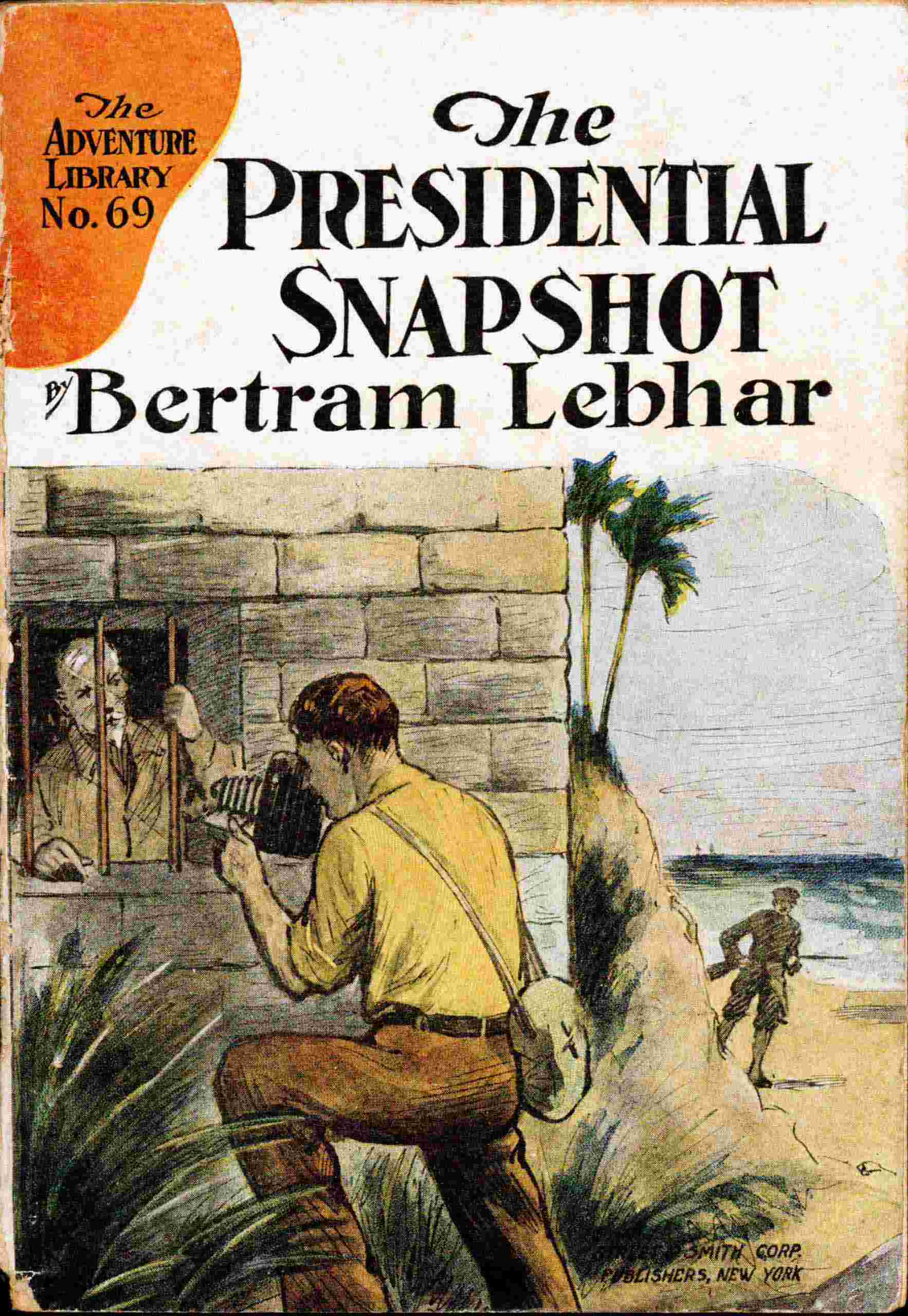
Therefore, when he landed on the beach, he did not have to waste any time in hunting for the captive’s cell. There was only one barred window behind this screen of foliage, and he hastily stepped up to it. By raising himself on tiptoe, he was just able to look into the cell, and he caught sight of a white-haired man seated at a rough wooden table, with his back toward the window, reading a book by the light of a sputtering candle.
“Señor Felix!” he whispered eagerly. “Señor Felix!”
The captive jumped up with an abruptness which upset the table, and extinguished the candle. “Who are you, and what do you wish?” Hawley heard him ask hoarsely.
“I am a friend—from the United States,” the Camera Chap replied, busying himself with the waterproof bag attached to his waist. “I have come to help you, sir.”
“To rescue me?” the other exclaimed, with pathetic eagerness.
“Eventually, yes; but all I can do now is to take your photograph,” the Camera Chap explained. As he spoke, he tugged at one of the iron bars, with the hope that he might be able to wrench it from its fastening, in which case he would, indeed, have essayed a rescue; but, as he had feared, the iron was fastened too securely to the stone to render that possible.
“My photograph!” the occupant of the cell repeated, with a bitter laugh. “What mockery is this?”
“It isn’t mockery. There are plans afoot to bring about your release, if the picture can be obtained,” Hawley explained hurriedly. “I assure you, on my word of honor, that it means your liberty. Drag the table to the window and stand upon it so that your face is against the bars. Quick! There is no time to lose. I beg of you, President Felix, do as I say. You’ve got to trust me.”
With prompt decision the captive complied with this request, and a few seconds later the snapshot was an accomplished fact. Then, for the first time, the Camera Chap found opportunity to glance toward the other end of the beach, where his fair ally was engaging the attention of the sentry. He espied two men rushing toward him, and, swiftly thrusting his camera into its receptacle, he turned and plunged into the sea.
Thus far the carrying out of his daring plan had been effected with an ease and simplicity which exceeded his most sanguine expectations.
As he had stated to Virginia, he had borrowed his idea from the underworld. That is to say, as he had cruised in Puerto Cabero Bay, cudgeling his brains in an effort to find a way of luring the sentry of El Torro from his post, there had come to his mind an effective trick which New York crooks often work when contemplating a robbery on a green policeman’s beat.
He had never seen this trick done, but he had often heard it described by his friends on the force. They had told him that the wily rogues, in order to make sure of being able to commit their crime without danger of police interference, get some of the pals to start a street fight at the other end of the beat. Attracted by the noise of the brawl, the policeman rushes to the spot, and places the rowdies under arrest. And while he is marching his prisoners to the police station to answer to a charge of disorderly conduct, the burglars have a clear field.
The snapshot adventurer had reasoned that a ruse which was clever enough to fool a New York policeman ought to work equally as well on an El Torro sentry. For his study of the garrison of the fortress had convinced him that its members were not an overintelligent lot, and, as for discipline, it was a matter of common knowledge that the army of Baracoa was one of the worst-disciplined military bodies in the world.
The only thing which had bothered him had been the fact that, in order to get his picture, he would have to set off a flash light, which, of course, was bound to attract the attention of the sentry from Virginia to himself, and, probably, bring the whole garrison rushing out of the fortress. He hoped, however, that as soon as the flash light went off, and the picture was taken, it wouldn’t make much difference how much attention he attracted, because he would be able to make his escape before any of them could get near enough to lay hands on him.
Now, as he saw Captain Reyes and the sentry rushing toward him, and threw himself into the sea before they were anywhere near him, it looked as if that hope was going to be fulfilled.
Pursued by the bullets of Captain Reyes, he dived to dodge the deadly hail, and swam under water while his breath lasted. Presently he rose to the surface, and struck out, with the long, vigorous stroke of an expert swimmer, for the battleship, whose lighted hull seemed just then to be miles away.
He encountered no obstacles in his course, and before he had any feeling of exhaustion, so finely trained was he for the task, his hand grasped the starboard accommodation ladder of the warship, and he lifted himself clear of the water.
Five minutes later, white-faced, and somewhat shaky in the legs, hatless and coatless, and dripping water from head to foot, he stood in the presence of the battleship’s commander, who, recognizing him despite his disheveled appearance, stared at him wonderingly.
“You told me to come back to you, captain, as soon as I got the snapshot,” the Camera Chap began.
Captain Cortrell’s face lighted up. “Have you brought it?” he demanded eagerly.
“I have brought the plate. I haven’t had a chance to develop it yet, so I don’t know how it turned out, but I generally have pretty good luck with flash lights. Don’t happen to have a photographic dark room aboard, do you, captain?”
The naval officer shook his head. “I guess we could fix you up a dark room easily enough, but we haven’t the materials for developing a negative, if that’s what you mean. I’m sorry that we haven’t,” he added, “for I don’t mind confessing, Mr. Hawley, that I am impatient to see your picture.”
“I will go ashore at once, develop the plate, and bring you back a print,” the Camera Chap promised. “I have a complete outfit in my room at the hotel. But in the meantime, captain,” he added anxiously, “if you have any instructions which concern me—as I feel confident you have——”
Captain Cortrell cut him short with a curt gesture. “Go ahead and get your plate developed,” he said gruffly. “Whatever instructions I may have concerning you, sir, cannot be discussed until you have brought me the snapshot—a finished picture, not an invisible negative.”
“But it isn’t safe to wait until then. I am afraid you may be too late,” the Camera Chap protested.
“Too late for what, sir?”
“To save President Felix. If you don’t act promptly, I am afraid they will assassinate him. Every minute counts now.”
A slightly bewildered expression came to the naval officer’s face. His demeanor aroused Hawley’s indignation. The latter suspected that his air of mystification was feigned, that his attitude must be due to an excess of caution.
“See here, Captain Cortrell!” he exclaimed impatiently; “there’s no sense in our playing at cross-purposes with each other. There isn’t time for anything of that sort. I am quite sure that you know who sent me to Baracoa, and what I am doing here——”
“I know nothing about it,” the other interrupted, but Hawley impatiently waved aside the disclaimer.
“And therefore I have no hesitancy in talking plainly to you,” he continued. “I don’t know just what your orders are, but if they provide for any protection being extended to Felix—as I trust is the case—I assure you that no time is to be lost. If you land a force of men at the fortress at once you may be able to save him, but if you delay, I fear it will be fatal.”
During this speech the bewildered expression passed from Captain Cortrell’s face, and was replaced by one of great astonishment. “Am I to understand that the man whose photograph you were to bring me is Francisco Felix, the missing President of Baracoa?” he inquired excitedly.
“Why, of course. Didn’t you know that?”
“And he is in El Torro fortress?”
“He was there—half an hour ago,” the Camera Chap replied significantly. “It may be too late, even now, to save him, but if not, you must realize that we can’t afford to beat about the bush. No doubt a report of my visit to the fortress, to-night, and the taking of the flash light, has already been sent to Portiforo. If so, he will probably resort at once to desperate measures.”
The naval officer’s face grew grim. “What do you expect me to do?” he inquired coolly.
The Camera Chap showed his astonishment at the question. “It seems to me that there is only one thing to do, captain—rescue Felix before Portiforo’s assassins can get to him. Why,” he went on eagerly, “the thing could be done in ten minutes without any trouble at all. I don’t know much about military tactics, but I’ve been studying the garrison of El Torro pretty closely for the past few days, and my observations make me feel confident that one boatload of your marines would be sufficient to take possession of the fortress without even a gun being fired. Or if you don’t care to go quite as far as that,” he added, “there is no need for your men to enter the fortress at all. They could rescue Felix from the outside—the same way that I got my picture. All that they’d have to do would be to step up to his window, break down the bars, and lift him through the opening.”
The warship’s commander smiled grimly. “Yes; I reckon it could be done,” he said.
“And you will do it?”
The old sea dog hesitated. The Camera Chap saw a grim expression come to his weather-beaten face. It quickly passed away, however. “I am sorry, my boy,” he said, real regret in his tone, “but, as I said before, I can do nothing until you have brought me the snapshot. You see,” he explained, “I am here under sealed orders—I don’t mind telling you that much in return for the information you have given me. In view of what I have learned from you, I now have what some of my junior officers would no doubt term ‘a good-sized hunch,’ as to the nature of those orders. I think it very likely that when the envelope is opened, it will be found to contain official instructions for me to proceed immediately to take the very action you urge.”
“Then why not open it immediately?” the Camera Chap suggested impatiently.
“I am sorry, but that is out of the question. The conditions must first be complied with. I appreciate the danger of delay, my boy, but orders are orders. I would suggest that the best thing for you to do is to hurry ashore, get that picture finished, and bring it to me as quickly as possible. Then, provided my orders permit it, I will promise you prompt action.”
Perceiving that argument would be useless, the Camera Chap proceeded to follow this advice. The commander of the Kearsarge placed a speedy steam launch at his disposal, and also suggested that it would be a good idea for him to have a naval escort when he went ashore. “We don’t want to have any mishaps,” the captain remarked dryly, “and it is just possible that circumstances might arise in which you would find it mighty convenient to be surrounded by an armed guard.”
Hawley immediately grasped his point, for the possibility of an attempt being made ashore to wrest the precious picture from him had already suggested itself to his mind. “Thank you, captain; I shall be glad to take advantage of your kind offer,” he said. “I think, however, that one of your men will be enough, if you can spare Lieutenant Ridder for a little while. He and I are old friends, and if he were along with me, I should feel perfectly safe.”
This request met with a ready response, and a few minutes later Hawley and the husky young lieutenant were speeding toward the shore of Puerto Cabero.
As they landed from the launch, the Camera Chap caught sight of two men skulking in the shadow of the wharf, and when he and Ridder walked toward the railway station, he observed that these men stealthily followed them. By the light of a street lamp he was able to get a good look at their faces, and he recognized one of them instantly. It was his old acquaintance, Señor Lopez, the mysterious individual who had been his fellow passenger on board the steamship Colombia, and who had displayed such a keen interest in his movements. The Camera Chap had not seen the fellow since the day of their arrival at Puerto Cabero. He was not at all glad to see him, now. He had an uneasy suspicion that Lopez’s presence at the wharf was no mere coincidence—that already the tidings of what had happened at the fortress had been flashed to the capital, and that the spy had been sent to await his landing.
Fearing for the safety of his precious snapshot, he was doubly glad, now, that he had brought Ridder along with him.