
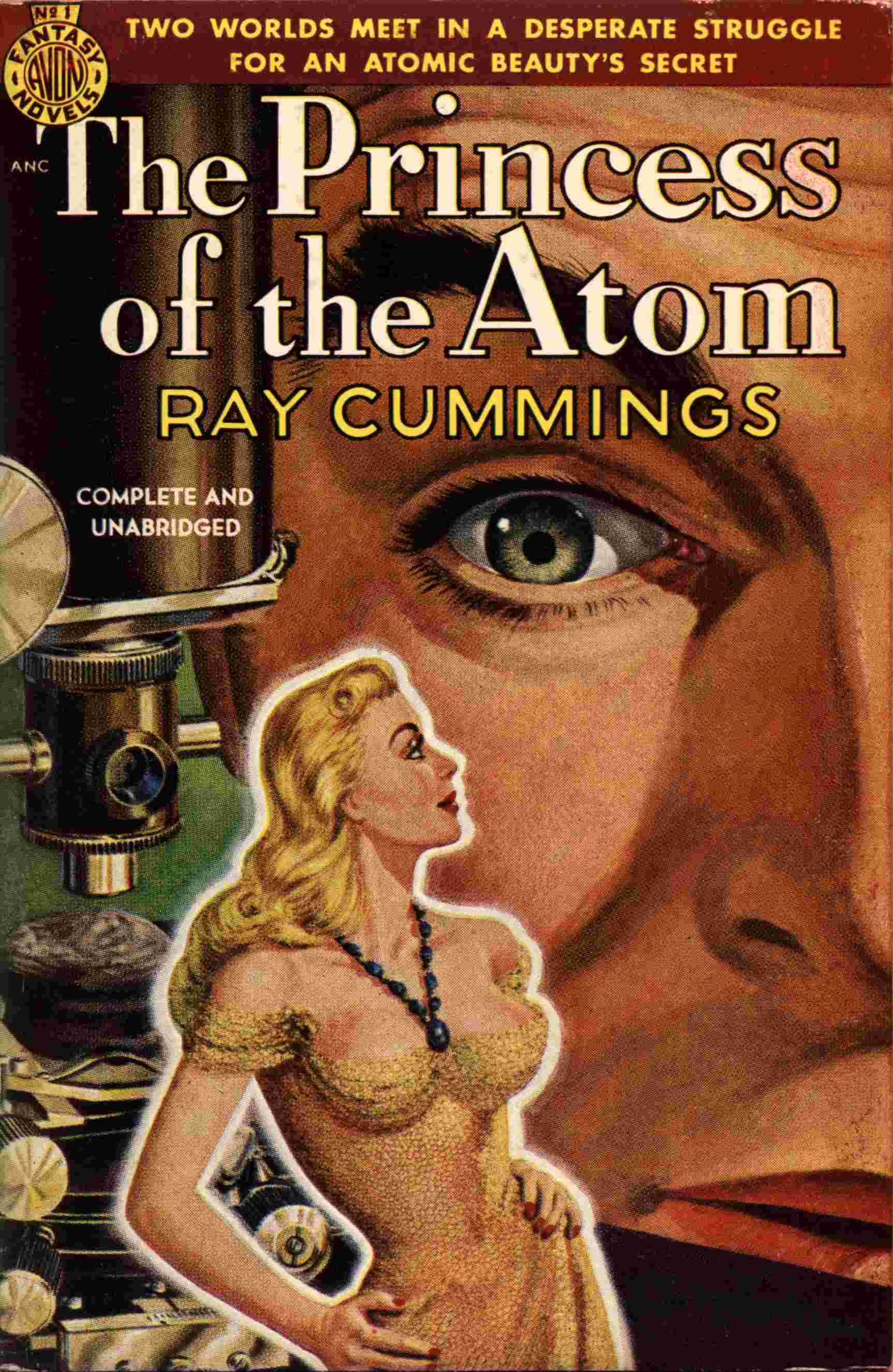
Prologue
I was seventeen years old before I had any idea that there was a mystery in my family. My name is Frank Ferrule. My mother died when I was still a child. There was my father; my older brother, Drake; and my younger sister, Dianne. We had always seemed to me an average little family group, except for Dianne's beauty. That, in truth, was abnormal enough. And upon that, I was to learn, the mystery hinged—tragedy it was for Dianne, striking all unheralded like a bolt from a cloudless sky.
Our life, up to that August when the sudden, inexplicable tragedy came, was perfectly prosaic, uneventful, so that I can find little of it to record here that would be of interest. Father was a consulting chemist. My brother Drake, six years older than I, grew up to be a stalwart blond giant of a fellow—a full six feet two—with a lazy, rollicking good-nature like a huge dog conscious of his own strength. Father often said that; and called me a terrier. I was always small and slender, with dark hair, and by nature excitable.
There was nothing unusual, nothing of particular interest about Drake and me. But Dianne's beauty would have fascinated the world. I can remember that she had always been beautiful. In the advertisements of fashion magazines there are drawings of children—ideally beautiful little girls. Dianne, as a child, was like that, a blue-eyed flaxen-haired doll.
But soon she began to develop character. At sixteen the doll look was wholly gone. Her face bore the stamp of her individuality; but it remained as exquisite, as colorful as a cameo, or like a pastel, so delicately flawless of feature, so perfect of natural coloring that the effect was startling. I have heard people say, meeting her, that she seemed unreal. And certainly, everywhere she went, she attracted unusual attention.
This tragedy came—the mystery began—one August when Dianne was sixteen, I seventeen, and Drake twenty-three. We were at our summer home on the coast of Maine. Father was of a temperament which demanded a quiet life. I think, too, that with such a girl as Dianne, he found seclusion an added advantage.
She could so easily have been spoiled; but she was not. A gentle little thing, sweet in the old-fashioned storied style, with all the sophistication of her age passing her by untouched. Mischievous she had always been since childhood, and she was human enough to be thrilled by the frequent offers of motion-picture tryouts and the like.
Such offers inevitably came. We were not hermits. We spent our winters in New York City. Quietly, but we had many friends and the fame of Dianne's beauty spread.
But father kept her unspoiled, and apart from it all.
We often had friends at our summer home; but it chanced that this particular August there was no one but our family there. I recall the fateful morning of the fourteenth. There was nothing to mark it from any other morning—warm and cloudless, with a fresh breeze that rippled the water of the cove and set the whitecaps running outside.
Father announced that he would be all day at a chemical experiment and not to disturb him. Drake, Dianne and I decided that we would take the dory and row out to Bird's Nest Island; fish a little; have a swim and a campfire lunch. We started soon after breakfast. It was not a long pull, for the island was only some two miles offshore. We found the sea outside smooth running, but brisk. The wide bow of the dory lifted and slapped as we headed into the whitecaps.
Bird's Nest Island had, to my mind, always spelled romance. It was a tiny, rocky peak alone in the sea, an irregularly round island only a few hundred acres in extent. The fifty-foot peak was almost in its center. Gulls often hung around that little naked crag pointing skyward. A rocky, but gently sloping beach encircled all the island. There were trees and underbrush; and, queerly enough, a spring of fresh water.
It was an uninhabited island, with all the romance of Robinson Crusoe hanging over it. From the rock peak one could stand and see all the circular island shore and the sea in every direction. As children we had come here with the grown-ups. We had placed a cairn upon the summit and erected a signal flag, then, ignoring the obvious shore of the Maine coast, had built a signal fire and prayed that its smoke might be seen by some passing ship which would come and rescue us.
We were too old for such fancies now, but the romance clung. We put on our swimming suits, this August morning, and swam from the lee beach. There is only one incident of significance for me to record.
Drake was swimming far out with lusty strokes. Dianne and I not so skillful or daring in the water, were in the shallows of the beach. I recall that I leaped at her and ducked her. She came up gasping, but laughing, and made a rush at me. We mingled in a fight, tumbling each other into the water.
I had always been Dianne's favorite. We were nearer an age, and Drake, when in his 'teens, had looked down upon us as mere children. We wrestled now in the water; and I remember that I found myself clinging to Dianne's hair, up by her forehead.
"Frank, stop that! Let me go!"
The frightened vehemence of her tone made me loose her at once.
"What's the matter?"
"You hurt me."
"Shucks."
A girl growing up with two older brothers gets used to rough treatment. It was not like Dianne to call quits.
"You did hurt me."
"Did I? Sorry, Dianne. Come on, let's swim then. Look where Drake is."
The incident left me puzzled. Dianne had done that before. She did not like her hair touched. It grew down at the center of her forehead in a queer little peak, and she wore it parted far to one side.
Children are not curious about such things, but I was old enough now to wonder why Dianne was annoyed when her hair there was touched.
Drake came ashore, and he and I wandered off to dress. Then we called to Dianne. We had left her only a couple of hundred feet away.
I called, "Oh Dianne, hurry it up. You going to take all day?"
She did not answer. We called again. Drake said, "She's spoofing us. Hiding."
We ran back to where we had left her. The little pile of her clothes lay there untouched.
"Dianne!" Our shouts echoed over the island, but there was no answer.
"Find her in two minutes," said Drake. He shouted, "Watch out, Dianne, we're coming! I'll run around the beach first, Frank. You climb up to the rock—see everything from there—"
I went up to the peak, where I could see all the beach. Our dory was undisturbed, and I could see no sign of a boat leaving the island, or anywhere near it. I saw Drake sprinting around the beach, then plunging off among the trees. I could see his figure occasionally. He called up,
"See her, Frank?"
"No!"
Fear struck us then. We searched, at first laughingly, then with stark horror overwhelming us. The little island was all too easy to search. There were no caves, no cliff over which she could have fallen. We had seen all the beach and the near-by water within a few moments after her disappearance. Surely there had not been time for her to swim out and be drowned. She was a fair swimmer, and cautious for all her youth. And even if she had gone back in the water and got into distress, we were so close we could have heard at once any call she made.
But she was gone. Vanished. No boat had landed that could have taken her. That was impossible without our seeing it over that reach of empty sea.
I recall our frantic search. Then at last Drake and I alone frantically rowed back home to tell father. It was like a dream of horror. Father's white, solemn face. He never once reproached Drake or me. He telephoned the village. Then came another trip to the island in a launch with grave-faced men.
But Dianne was never found. We brought back her clothes that lay untouched there by the underbrush at the beach. I could not look at them, but went into my bedroom and lay on the bed and sobbed. It was the first tragedy that life had brought me.
Night had fallen when Drake came to me. He leaned over me sympathetically.
"Take it easy, kid." His own face was white and drawn; he loved Dianne as much as I did, but he was older, more stoical. "Father wants to see us, Frank. Get hold of yourself." His arm went around my shoulder and I huddled against him, "Take it easy—wash your face and come on down."
It was about Dianne—father had something to tell us. We faced him in the living room. He closed its doors.
"Sit down, lads."
It may have been in Drake's thoughts, certainly it was in mine, that now father was about to blame us. I had felt, those hours sobbing on the bed, that somehow I was to blame. That incident in the water when I had annoyed Dianne about her hair—wild thoughts swept me that I had annoyed her and she had committed suicide. I had already told father about it; told him in the launch. He had listened and waved it away.
He sat facing us now, a slender, solemn man of fifty, with iron-gray hair, and thin, studious face. His eyes behind his big horn-rimmed spectacles seemed unnaturally bright, but gentle.
He said, "Don't look at me like that, lads—I've no intention of reproaching you."
And then he told us, in a burst, without preface, what we had never suspected.
"You were about two years old, Frank—and you, Drake, about eight. It was the year before your mother died. She and I went to Bird's Nest Island, leaving you children at home."
This same island!
"A summer day," he said, "just about like this. We went for a picnic—just as you did today. It was fifteen years ago. We were wandering about the little island—your mother and I. We heard a wailing cry, an infant's. In a thicket we found a little girl baby. Unharmed. An infant, about a year old, who evidently had been asleep and now had awakened and was crying. There was no boat in sight about this island. We concluded that some one had been there, abandoned the baby and departed. We took the baby home. No one ever came to claim her. It was Dianne."
Dianne not our blood sister? A foundling! It struck us amazed.
Father went on gently, "We thought it best, your mother and I, not to tell you children. It would not have been fair to Dianne. There would come a time when you should know, of course—perhaps I should have told you before this—and I don't know, perhaps it was wrong of me to let you go back to that island. But I suppose that's foolish!"
His voice drifted away with his thoughts. Nothing occurred to Drake and me to say; we sat dumbly staring at each other.
Father rose presently and unlocked a drawer of his desk. "I brought this down to show you. There was nothing about the infant to give a clew to its identity. Just the baby lying there, clad in a single garment. This."
He held out a tiny infant robe. Long-sleeved, and with a tiny hood. Strange-looking thing! Even as a lad of seventeen I was at once aware of its strangeness. A gossamer fabric like nothing I had ever seen before. A fabric golden as though its threads were pale spun gold. Or as though it might have been woven of fairy threads of golden hair—like Dianne's.
"Just that robe," he said sadly. "What sort of material it is, no one can say." He took it from us gently and replaced it in the drawer. "And there was one other thing. You, Frank, spoke of Dianne being sensitive about the hair at her forehead. That little peak where the hair grew low, you remember? There was a scar on her forehead. Not exactly a scar—a queer crescent patch of skin. It seemed not white, but almost like the sheen of silver. It looked—well, something like a crescent moon. We hated publicity, your mother and I. We kept the finding of the baby reasonably quiet. We had a medical specialist examine the child. A normal girl baby, promising extreme beauty of body and feature. But the crescent-moon scar was an enigma—the doctor had never seen or heard of anything like it.
"So we called the baby Dianne. Your mother named her that. The crescent, there on her forehead, was really very beautiful when one got used to it. But too unusual. Too—mysterious. And so we trained her hair to cover it up; and I—I taught her—well, perhaps I taught her to be ashamed of it. Or at least, never to mention it to any one—and so she was sensitive about it as though it were a secret blemish to her beauty."
I need not detail that evening with father. But there was one thing he said that I never forgot. He said it half to himself, "Dianne was so abnormally beautiful, and that strange golden dress and the crescent silver scar—I have wondered so many times, all these years, wondered if she were just exactly human like the rest of us." He was sorry at once that he had said it, and he would never explain.
This day that we lost Dianne was five years before the coming of the giants.