
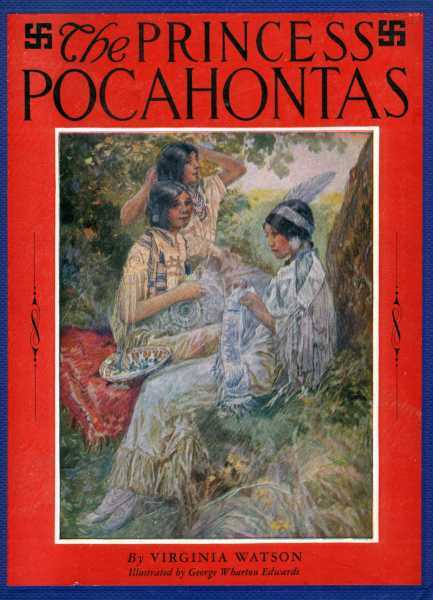
CHAPTER VI
JOHN SMITH'S TEMPTATION
The Discovery, the Godspeed and the Susan Constant, after nearly five months of tossing about upon the seas, were now swinging at anchor in the broad mouth of the River James, which the loyal English adventurers had named after their king. The white sails that had so terrified the Indian maidens now flapped against the masts, having fully earned their idleness. On board the discussion still continued as to the best situation for the town they designed to be the first permanent English settlement in America—in Wingandacoa, as the land was called before the name Virginia was given to it in honour of Queen Elizabeth, "The Virgin Queen."
The expedition had set out from England in December of the year before (1606). Among those who filled the three ships were men already veteran explorers and others who had never been a day's voyage away from their island home.
Among the former were Bartholomew Gosnold, who had first sailed for the strange new world some five years before. He had landed far to the north of the river where the ships now rested—on a colder, sterner shore. There he had discovered and named Cape Cod and Martha's Vineyard. Christopher Newport too had sailed before in Western waters, but further to the southward. He was an enemy of the Spaniard wherever he found him, and had left a name of terror through the Spanish Main, for had he not sacked four of their towns in the Indies and sunk twenty Spanish galleons? And there was John Smith, who had fought so many battles in his twenty-seven years that many a graybeard soldier could not cap his tales of sieges, sword-play, imprisonment and marvelous escapes. And many other men were there whom hope of gain or love of adventure had brought across the Atlantic. They had listened to the strange story of the lost colony on Roanoke Island, English men and women killed doubtless by the Indians, though no sure word of their fate was ever to be known, but fear of a like destiny had not deterred them from coming.
There were many points to be considered: The settlement must be near the coast, so that the ships from home would be able to reach it with as little delay as possible, yet away from the coast in case of raids by the Spaniards.
Again, the location must be healthful, and quite easily defended, for the attack by the natives upon the colonists when they first landed at the cape they called Henry after the young Prince of Wales, had given them a taste of what they might have to expect. It was the rumor of this fight which had reached Opechanchanough at Kecoughtan.
At the prow of the Discovery stood a man who paid no attention to the disputes going on behind him. He was not tall, but was powerfully built, and even the sight of his back would have been sufficient to prove him a man accustomed to a life of action. It was not so easy, however, to guess at his age. His long beard and mustache hid his mouth, and there were deep lines from his nose downward that might have been marked by years. Yet his brow was high and wide and unfurrowed, and his hair was abundant and his eyebrows dark and high. An intelligent, eager countenance it was, of a man who had seen more of the world in his short twenty-eight years than any white-haired octogenarian of his native Lincolnshire. He held a spy glass and, standing by the rail, moved it slowly until he had pointed it in every direction. He had swept the river and both shores as far as his eye could reach and now it rested on an island some little distance above, near the right-hand bank of the newly named river.
A sailor, pushing through the crowd about the cabin door, approached the man at the prow.
"Captain Smith," he said, "Captain Newport bids me say that the Council is about to be sworn in in the cabin and that he desires thy presence there."
John Smith turned and walked slowly aft, wondering what would be decided in the next hour. Was he, who felt within himself an unusual power to organize and to command men, to be given this wonderful chance, such as never yet had come to an Englishman, to plant firmly in a new land the seed of a great colony? From his early youth his days had been devoted to adventure. He was of that race of Englishmen who first discovered how small were the confines of their little island and who sallied gaily forth to seek new worlds for their ambition and energy. Raleigh, Drake, Sir Martin Frobisher, Sir Humphry Gilbert, Sir Richard Grenville and John Smith were the scouts sent out by England's genius to discover the pathways along which she was to send her sons. Bold, fearless, untiring, cruel often, at other times kind and firm, they went into new seas and lands, seeking a Northwest Passage, or to "singe the beard of the King of Spain," or to find the legendary treasures of the New Indies—yet all of them were serving unconsciously the genius of their race in laying the foundations of new worlds. Perhaps of them all Smith saw most clearly the value of the settlement in Virginia, and just as clearly was he aware that the jealousies and avarice of many of his fellow colonists would threaten seriously its growth and indeed its very existence.
Though not one among the curious eyes turned on him, as he walked slowly towards the stem, beheld any trace of emotion on his grave face, he was consumed with the hope that he might be chosen to lead the great work. Yet he feared, knowing that all the long voyage, almost from the time they had sailed from England, his enemies, jealous of his fame and of his power over men, had sought to undermine it and to slander his good name. What lies they had spread through the three ships of a mutiny he was said to be instigating, until orders were passed which made him virtually a prisoner for the rest of the journey. But he would soon find out if they intended to disregard and pass him by.
When he entered the little cabin he saw seated along the transom and in the wide-armed chairs Captain Christopher Newport, Bartholomew Gosnold, Edward Wingfield, John Ratcliffe, John Martin and George Kendall. They greeted Smith as he entered, as did the other gentlemen leaning against the bulkheads, but with no cordiality, and he knew well that they had been talking of him before he entered. He took his seat in silence.
These men composed the Council which had been designated in the secret instructions given them when they sailed and opened after they had passed between Capes Charles and Henry. And this Council now it was which, according to its right, was to elect their president for the year to come. Smith now felt certain that owing to their hostility to him they had already determined among themselves what their votes should be while he was without the cabin. The form, however, was gone through with and the result solemnly announced: Wingfield was to be the first president of the Colony, and Smith found himself not even mentioned for the smallest office. The others for the most part smiled with pleasure as they looked to see his disappointment, but he showed none. Instead he rose to his feet and said:
"Captain Newport and gentlemen of the Council, will ye let me suggest for the name of this new colony that of our gracious sovereign, King James."
Here at last they must follow his lead, and all sprang to their feet and shouted "Jamestown let it be!"
Then began again the discussion of the spot to be chosen for their settlement. There were those who desired a site nearer the bay; one advocated exploring the other rivers in the vicinity, the Apamatuc, the Nansamond, the Chickahominy, the Pamunkey, as the Indians called them, before deciding; but Newport, eager to return to England, would not consent.
"We choose to-day," he cried, bringing his fist down on the table with a bang.
The island that Smith had been examining with his glass was considered. It was large and level and not too far from the sea, said one in its favor. The majority were for it and the others were at last brought round to their point of view. Smith had not put forward any suggestions. He knew whatever he advocated would have been voted down. When asked what he thought of the island his answer, "It hath much to commend it," left his hearers still in doubt as to his real choice.
"Now that we have christened the babe before it is born," said Captain Newport, rising, "let us ashore and get to work to mark out the site of our Jamestown."
All left the ship with the exception of a few sailors who remained on guard. After more discussion the Council picked out the spots for the government house, for the church, for the storehouse, while the artisans busied themselves with no loss of time in cutting down trees and clearing spaces for the temporary tents. The matter of a fort had not been broached, yet Smith, whose military knowledge showed him how vulnerable the island was, made no suggestion for its fortification.
He had strolled alone through the tangle of undergrowth, of flowering vines in which frightened mocking-birds and catbirds were darting, to the side of the island nearest the bank of the mainland.
"Here," he said, speaking aloud as he had learned to do when he was a captive among the Tartars that he might not forget the sound of his own tongue, "here, on this side should be a bastioned wall with some strong culverins. A lookout tower at this corner and, extending around north and south, a strong palisade—that with vigilant sentries would ensure against attack except by water. If I—"
Then he stopped, his brow knitting. His disappointment had been a keen one, his pride was smitten to the quick. Never had he left England, never thrown in his lot with the new colony, had he known how he was to be made to suffer from jealousy, intrigue and neglect. As he stood gazing across into the deeper tangle on the opposite shore his thoughts were occupied with decisions for his future.
"Why should I remain here," he cried aloud, "to be disregarded, when there is many an English ship that would be fain to have me stand on her poop, many a company of yeomen that would be main glad to have me command them? I am not of those men who are wont always to follow orders. I am made to give them. The world's wide and this island need not be my prison. I will sail back on the Discovery and e'en be on the lookout for some new adventures."
A rustling in the bushes behind him made him turn quickly. There stood Dickon and Hugh and Hob, three of the men who had come from his own part of the country, with whom during the long voyage he had often been glad to chat of their homes and the folk they all knew.
"Captain," spake Dickon, "we have followed to have a word wi' thee in secret. 'Tis said they have not given thee a place in the Council. Is't true?"
"Aye," answered Smith calmly.
"'Tis a dirty trick," cried Hugh, and his comrades echoed him. "A dirty trick, but what wilt thou do now?"
"What would ye have me do, men?" asked Smith curiously.
Dickon was again spokesman, the others nodding approval of his words.
"We be thy friends, Captain, and thy wellwishers. We came to this strange land to make our fortunes because of thy coming. We felt safe with one who had already travelled far and knew all about the outlandish ways of queer folks, blackamoors and these red men here. Now if so be thou art not to have a voice in the managing we be cheated and know not what may befall us. There be many of the others who think as we do, not only laborers such as we, but many of the gentlemen who have little faith in them as have been set in the high places. Now I say to thee, let us three go amongst them we knows as are friendly to thee and we will speak in secret with them and we will draw together to-morrow at one end of this island, and there we will all stay until they agree to make thee President. And if fightin' comes o' it why all the better. What sayst thou, Captain?"
Smith did not answer at once. The friendliness of these men touched him deeply just at the moment when he was smarting under the treatment accorded him. He knew they spoke truth; there were a number of the colonists who had shown themselves friendly to him and who would be willing to stand by him. Moreover, he felt within himself the power to use them, to make them follow his bidding as Wingfield could never succeed in doing. It was less for personal gratification he was tempted to consent than for the knowledge that his leadership would benefit the colony as would that of none of his fellow adventurers. He was not a vain man, but one conscious of unusual powers.
"If we were strong enough to gain and hold part of the stores and one of the vessels, would ye let me lead ye away to some other island of our own, men?" he asked, and immediately saw in his imagination the possibilities of such a step.
"Aye, aye. Captain," cried all three, "and we'd be strong enough too, never fear," added Hugh.
The temptation to John Smith was a strong one, and he walked up and down weighing the matter. What consideration after all did he owe to those who had not considered him? He had no fear of failure; he had come safely through too many dangers not to be confident. It was only the first step that he doubted. The men, he could see, were growing impatient, yet he did not speak. Suddenly an arrow whizzed close to his ear and fell at his feet.
"The savages!" cried Dickon.
Smith peered towards the woods beyond the water and imagined he could see half hidden behind a birch tree a naked figure.
"Let us go back and warn the Council," he said, turning towards the way he had come. "I scarcely think that they will attack us, particularly if we stay together."
He stood still a moment lost in thought. Then he said:
"That's the word, Dickon, if we stay together! Nay, frown not, Hugh. Put out of thy mind all that we have spoken of this last half-hour, as I shall put it out of mine. We must stand together, men, here in this new world. Ye three stand by me because we're all neighbors and Lincolnshire-born; but here in this wilderness we're all neighbors, English-born, just like a bigger shire. It's no time now when savages are about us all, to be thinking of our own little troubles. We must e'en forget them and stick together for the good of us all. Will ye promise, men?"
"Since 'tis so thou hast decided, Captain," answered Dickon.
"I'm for or against, as thou wilt," said Hugh, "but I'd been glad hadst thou chosen to fight instead o' to kiss."
And Hob, who had not spoken a word of his own invention up to now, spake solemnly:
"I'll not blab. Captain, how near thou wast to the fightin'."
When they got back to the site of the future Jamestown Smith, who had made up his mind to do what seemed to him right no matter what reception his advice received, told President Wingfield of the hidden bowman and warned him of the danger to those who might straggle away from their companions. But the members of the Council, whether they would be beholden to Smith not even for advice, or whether the friendly attitude of the Indians at first which was now just beginning to change, influenced them, refused to believe that the savages intended to molest them and refused to admit the necessity of putting up a palisade or taking other precautions against them.
Each day the work of clearing the ground and of setting up the tents proceeded apparently more rapidly than the day before, as the results were more visible. Every one was so wearied with the cramped life aboard ship for so many weeks that he was glad to stretch himself on the earth or on improvised beds. Smith, to give an example to some of the gentlemen who stood with folded arms looking on while the mechanics worked, swung axe and wielded hammer lustily. Yet he was very unhappy at the manner in which he was still treated and he eagerly seized an opportunity to leave the island.
With Captain Newport and twenty others, he set out in one of the ships' boats to explore the upper part of the river. They were absent a number of days, after having ascended the James as far as the great falls near the Powhata, a Powhatan village near the site of the present city of Richmond. Then they returned to Jamestown.
On their arrival they were greeted with the grave news that during their absence the Indians had killed a boy and wounded seventeen of the colonists. A shot fired from one of the ships had luckily so terrified the savages that they made off for the woods. Now the Council was forced to recognize the need of some protection and ordered every one to stop work on everything else until a strong palisade and a rough fort had been built.
It was now June. Suddenly, to the astonishment of all, the Indians approached and made signs that they desired to enter into amicable relations with the white men. They jumped out from their boats and fingered the clothes of the colonists, their guns and their food, showing great curiosity at everything. The next day, perhaps because the Council had seen the folly of their suspicions or had realized the value of Smith's military experience and knowledge, the state of his semi-imprisonment, which had lasted since the early part of the voyage, was put an end to. Now that all seemed peaceful, from without and within, as a sign of gratitude and of their brotherly feelings towards each other, all the colonists partook of the Communion together, kneeling in the temporary shed covered with a piece of sail-cloth which served as a church.
Then on the seventh of June they stood on the river bank, looking gravely, with many doubts and fears in their hearts, at the Discovery as she sailed for England, bearing Captain Newport away, and leaving them alone in Virginia.
CHAPTER VII
A FIGHT IN THE SWAMP
Not a day passed without new rumors at Werowocomoco of the white strangers and their curious habits.
Pamunkeys from the tops of swaying trees on either bank watched eagerly the doings of the colonists, and runners bore the word of every movement to both Opechanchanough at Kecoughtan and to The Powhatan at his village. Curiosity and consternation were equally balanced in the minds of the red men. What meant this coming from the rising sun of beings whose ways no man could fathom? Were they gods enjoying a charmed life, against whom neither bow nor shaman's medicine might avail? About the council fires in every village this was debated. The old chiefs, wise in the traditions of their people, spake of prophecies which foretold the coming of heroes with faces pale as water at dawn who should teach to the tribes good medicine and bring plentiful harvests and rich hunting. Others recalled the vague rumors which had come from far, far away in the Southland, from tribes whose very names were unknown, of other palefaces (the Spanish colonists in the West Indies), who had brought fire and fighting into peaceful, happy islands of the summer seas, who like terrible, powerful demons, spread about them death and strange diseases.
Then came to the councils the comforting word of the death of a white boy slain by a Pamunkey arrow. So they were mortal after all, said the chiefs, and they smoked their pipes more placidly as they sat around the fire. Against gods man could not know what action was right; but since these were but men who could hunger and thirst and be wounded, it behooved them to plan what measures should be adopted against them.
Many of the chiefs urged immediate steps.
"It is easy," said one, "to pull up a young oak sapling, whereas who may uproot a full-grown tree?"
Nautauquas, son of Powhatan, was among the most eager for action. He had won for himself the name of a great brave and a mighty hunter though still so young. Many a scalp hung to the ridgepole of his lodge and many a bear and wildcat had he slain at great risk to his life. Now here was a new way to distinguish himself—to go forth against dangers he could not even foresee. What magic these pale-faced strangers used to protect themselves was unknown; therefore if he and his band should overcome them and wipe away all traces of their short stay, it would be a tale for winter firesides and a song for singers of brave deeds as long as his nation endured.
"Let me go, my father," he pleaded. "Thou, who thyself hast conquered thirty tribes, grudge not this fame to thy son."
"Wait!" was Powhatan's only answer.
The shamans and priests had advised the werowance thus. Not yet had they fathomed Okee's intentions in regard to these newcomers, though they had climbed to the top of the red sandy hills at Uttamussack where stood the three great holy lodges filled with images, and they had fasted and prayed that Okee would reveal to them what he desired. Powhatan, in spite of his years, felt the urge of action, and his heart leaped up when his favorite son gave voice to his own wishes. He longed to take the warpath, to glide through the forest, to spy upon the strangers who had dared make a place for themselves in his dominion, and then to fall upon them, terrifying them with his awful war-cry as he had terrified so many of his enemies. Yet he dared not do this yet: he was not only a great war chief, but a leader of his people in peace. Okee had not yet spoken. Perchance the men with strange faces and strange tongues would of their own accord acknowledge his sovereignty, and there might be no need of sacrificing against them the lives of his young men.
All this he was thinking when he bade Nautauquas wait; but there was no one who read his mind, yet no one who dared to disobey him.
When Nautauquas came out from his father's lodge he took his bow and quiver and went into the forest to hunt. In his disappointment he had a hatred of more words and a longing for deeds. He ran swiftly and had reached a spot where he felt sure that he would find a flock of wild turkeys, when he saw Pocahontas ahead of him. She too was hurrying, bent evidently on some errand that absorbed her, for she did not stop to peer up at the birds or to pull the flowers as she was wont to do.
"Matoaka," he called, "whither goest thou?"
"To see the strangers and their great white birds again which I beheld from Kecoughtan, Brother. I cannot rest for my eagerness to know what they are like nearby."
"Hast thou not heard our father's word that no one shall go near the island where the strangers be?" he asked.
"My father meaneth not me," she answered proudly. "As thou knowest, he permitteth me much that is forbidden to others."
"But not this, little Sister. Only just this moment did he forbid me to go thither. His mind is set thereon; tempt not his anger. Even though he loves thee well, if thou disobeyest his command in this matter he will deal harshly with thee. Turn back with me, Matoaka, and thou shalt help me shoot."
Pocahontas was reluctant to give up her long-planned expedition, but she let herself be persuaded. She remembered that Powhatan that very day had ordered one of his squaws beaten until she lay at death's door. Moreover, it was a great joy to hunt with Nautauquas and to see which of them would bring down the most turkeys. They were needed by the squaws who had been complaining that the braves were growing lazy and did not keep them supplied with meat.
While Powhatan's two children were adding to the well-filled larder of Werowocomoco, there was real dearth of food at Jamestown. The stores, many of them musty and almost inedible after the long voyage, were growing daily scarcer. There was fish in the river, but the colonists grew weary of keeping what they called "a Lenten diet," and in their dreams munched juicy sirloins of fat English beef. At first their nearby Indian neighbors had been glad to trade maize and venison for wonderful objects, dazzling and strange; but now, whether owing to word sent by Powhatan or for other reasons, they came no more with provisions to barter. John Smith, seeing that supplies were the first necessity of the colony, had gone forth on several expeditions up the different rivers in search of them. By bargaining, by cajolery, by force, he had managed each time to renew the storehouse. Yet again it was almost empty and starvation threatened.
Something must be done at once, and the Council sat in debate upon the serious matter. Captain John Smith waited until the others had had their say, and nothing practical had been suggested, then he rose and began:
"Gentlemen of the Council, there is but one thing to do. Since our larder will not fill itself, needs must someone go forth again to seek for food. Give me two men and one of the ship's boats and I will set off to the northward, up that river the Indians call the Chickahominy and, God helping me, I will bring back provisions for us all and make some permanent treaty with the savages to supply us till our crops be grown."
President Wingfield agreed to Smith's demand. The barge was got ready with a supply of beads and other glittering articles from Cheapside booths, and Smith set off with the good wishes of the wan-faced colonists.
After they had reached what seemed to Smith a likely spot for trading, he took two men, Robinson and Emery, and two friendly natives in a canoe and set off to explore the river further, bidding the others to wait for him where he left them and on no account to venture nearer shore.
He was glad to be away from the noise of complaining men at Jamestown, many of whom were ill and fretful from lack of proper nourishment and some, who because they were gentlemen, would not labor yet repined that they could not live as gentlefolk at home. On this expedition he was with friends, even though he knew not what enemies might be lurking on the shore; and he realized that the natives were growing less friendly as time went on and they began to lose their first awe of the white men. But he had no fear for himself; he had faced too many dangers in his adventurous life to conjure up those to come.
As they paddled up the Chickahominy the men began to talk of old days in England before they had dreamed of trying their fortunes in a new world, but Smith bade them be silent so that he could listen for the slightest sound to indicate the vicinity of a human habitation.
"Make friends as soon as thou canst with the copper men, Captain," whispered Robinson, "for I be main hungry and can scarce wait till thou hast bartered this rubbish 'gainst good victuals."
"Pull thy belt in a bit tighter, men," suggested the Captain grimly; "if I understand all they tell me, the Indians can beat the most devout Christians in fasting. 'Tis one virtue we may learn from them."
They kept in the middle of the stream to be safe from any arrows that might be shot at them from shore; but after many hours of this caution. Smith determined to explore a little on land. To his practiced eye a certain little inlet seemed so suitable a landing for canoes that he felt sure an Indian village could not be far off.
"Push out into the stream again," he commanded as he stepped ashore, "and wait for me there."
John Smith strode into the forest, ready for friendship or war, since he knew not the temper of the natives of that region. Suddenly, as he came out upon an open space where a morass stretched from a hill to the river, two hundred shrieking savages rushed upon him, shooting their arrows wildly at all angles.
"War then!" cried Smith aloud, and as one young brave in advance of the others stopped to take aim, he leaped forward and caught him. Ripping off his own belt. Smith bound the astonished Indian to his left arm so that he could use him as a living buckler. Thus protected, he fired his pistol and the ball, entering the breast of an older chief, killed him instantly. For a moment the strange fate which had overtaken their leader checked the onslaught, while his companions stooped down, one behind the other, to examine the wound made by the demon weapon. This respite gave Smith time to whip out his sword, and whirling it about him, he kept his enemies at a distance. He might have succeeded in defending himself thus for some time longer, for the savages had ceased to shoot, not certain whether their arrows would not be ineffectual upon an invulnerable body, but all at once he became aware of a new danger. The marshy ground on which he stood had softened with his weight and that of his living shield and he now felt himself sinking deeper and deeper into the morass until he was submerged up to his waist. Still the Indians, doubtless fearing he had some other strange weapons or evil medicines in his power, did not rush forward to attack him.
The day was bitterly cold, and the stagnant water struck a chill to his very bones. His teeth began to chatter with cold, not fright. It was almost with a sense of relief that he saw the Indians start towards him. Carefully treading in their light moccasined feet, they gradually surrounded him and two, taking hold of him, while others loosened the bound brave, they drew him up from the slushy earth by the arms.
He was now a captive, and not for the first time in his life. There was nothing to be gained, he knew, by struggling, and he faced them with no sign of fear. They led him to a fire which was blazing not far off on firmer ground where sat a chief, who, he learned, was the werowance Opechanchanough.
At a word of command from him, the guards moved aside and the huge warrior walked slowly around Smith, examining him from head to foot.
There was a pause which, the Englishman knew, might be broken by an order to torture and kill him. He did not understand their hesitancy, but he meant at any rate to take advantage of it. He must engage the attention of the giant chief before him. Slowly he pulled from his pocket his heavy silver watch and held it up to his own ear.
Never had Opechanchanough and his men experienced such an awe of the unknown. For all they could tell, this small ball in the white man's hand might contain a medicine more deadly than that of his pistol. They stood like children in a thunderstorm, not knowing when or where the bolt might strike.
But nothing terrible came to pass. Then Opechanchanough's curiosity was aroused and he put out his hand for the watch. Smith, smiling, held it towards him in his palm and then laid it against the chief's ear, saying in the Pamunkey tongue: "Listen." Opechanchanough jumped with astonishment and cried out:
"A spirit! A spirit! He hath a spirit imprisoned!"
Then one by one the captors crowded forward to look at the "turtle-of-metal-that-hath-a-spirit," and many were the exclamations of astonishment.
In order to increase this feeling of awe and to lengthen the delay, though he did not know what he could even hope to happen. Smith felt in his pocket again and brought out his travelling compass. It was of ivory and the quivering needle was pronounced by Opechanchanough to be another spirit.
But suddenly, without warning, two of the younger warriors, who had evidently determined once for all to discover if this stranger were vulnerable or not, seized Smith and dragging him swiftly to a tree, threw a cord of deer thong about him, drawing it fast. Then they notched their arrows and took aim at his heart. "In one second it will be over," thought Smith, "life, adventures, my ambitions and my troubles."
Then Opechanchanough called out to the braves, holding up the compass. Frowning with disappointment, the young men loosed their captive and Smith realized that it was again the chief's curiosity which had saved his life. By means of such Indian words as he knew and by the further aid of signs he endeavored to explain its usage.
"See," he said, pointing, "yon is the north whence comes popanow, the winter; and there behind us lies cohattayough, the summer. I turn thus and lo, the spirit in the needle loves the north and will not be kept from it."
When all had looked at the compass, Opechanchanough took it again in his hand, holding it gingerly as he would have held a papoose if a squaw had given one to his care. This was something precious and he meant to keep it, yet he did not know what it might do to him. At any rate, it would be a good thing to take with him the man who did understand it.
"Come," he said, "since thou canst understand our words, come and eat in the lodge of the Pamunkeys."
And Smith, ignorant of when death might fall upon him, followed. That day they feasted him, and the half-starved Englishman ate heartily for the first time since he set foot in the new world. At least he had gained strength now to bear bravely whatever might await him. The next day he was bidden accompany them, and they marched swiftly and steadily for many hours through the forest to Orapeeko. It may be that Opechanchanough's messengers had informed him mistakenly that Powhatan was at that village which, after Werowocomoco, he most frequented; but on their arrival there they found the lodges empty except the great treasure-house full of wampum, skins and pocone, the precious red paint used for painting the body. This was guarded by priests, and while Opechanchanough talked with them. Smith marvelled at the images of a dragon, a bear, a leopard and a giant in human form that ornamented the four corners of the treasure-house.
Evidently the priests were giving the werowance some advice. Smith wondered whether the savages offered human sacrifices to their Okee and if such were to be his fate. But the night was passed quietly there; the next day was spent in marching, and the following night in another village. Everywhere he was the object of the greatest interest: braves, squaws and children crowded about him, fingered his clothes, pulled at his beard and asked him questions. The Englishman observed them with the same interest. He noticed how the men wore but one garment leggings and moccasins made in one piece, and how they were painted in bright colors, many wearing symbols or rude representations of some animal which he learned was their "medicine." He watched the women as they embroidered and cooked, tanned hides and dyed skins, scolded and petted their children. Their lodges were lightly built, he saw, yet strong and well-suited for their occupants. Many of the young men and maidens made him think of deer in the swiftness of their movements and in the suppleness of their bodies.
After many days of travelling, in which Smith believed that they often retraced their steps, they found themselves one afternoon at the outskirts of a larger village than any they had yet entered. Dogs barked and children shouted as they neared the palisade, and men and women came running from every side.
"Certainly," thought Smith, "we are expected. Never in an English village have I seen a Savoyard with a trained bear make more excitement than doth here Captain John Smith."
CHAPTER VIII
POCAHONTAS DEFIES POWHATAN
"Princess, Pocahontas!" cried Claw-of-the-Eagle, as he pointed excitedly to the outskirts of the village, "look, yonder come thy uncle and his men bringing the white prisoner with them."
Pocahontas, who a few moments before had jumped down from the grapevine swing, where she had been idling, to peep into Claw-of-the-Eagle's pouch at the luck his hunting had brought him, now started off running after the son of old Wansutis, who was speeding towards the gathering crowd. Never in all her life had she desired anything as much as she now desired to gain a sight of this stranger.
"What doth he look like?" she called out, panting, to the boy ahead; but her own swiftness answered the question, for she was soon abreast of the procession. There, walking behind her uncle, unbound and apparently unconcerned, she beheld the white man. Her eyes devoured every detail of his appearance. She was almost disappointed to find that he had only one head and two eyes like all the rest of her world. But his beardedness, so unknown among her people, his youth, which showed itself more in his figure and in his step than in his weatherworn features, his cloth jerkin and his leather boots, but above all, the strange hue of his face and hands offered enough novelty to satisfy her.
Smith noticed the Indian maiden, already in her thirteenth year, tall above the average. In his wanderings through the Pamunkey villages he had seen many young girls and squaws, but none of them had seemed to him so well built or with such clean-cut features as this damsel who gazed at him so fixedly. When Opechanchanough, catching sight of her, made a gesture of recognition, Smith knew that she must have some special claim to distinction, since it was unusual, he had observed, for a chief to notice anyone about him while occupied in what might be called official duty. He felt sure too that he had now come to the end of his journeyings. In the other towns through which he had travelled he had heard men speak of Werowocomoco and of the great werowance who held sway there, the dreaded ruler over thirty tribes. This large village he knew must be the seat of the head of the Powhatan Confederacy and he was about to be led before him. What would happen then, he wondered, as he walked calmly through the crowd who eyed him curiously.
And this, too, was what Pocahontas was thinking: what would her father do with this man? Would his strange medicine, which those who had ventured to Jamestown had much discussed, assist him in his peril? She had listened to much talk lately about the necessity of getting rid of all the white faces who had dared come and build them houses on land which had belonged to her people since the beginning of the world. Here was the first chance her father had had to deal with the interlopers. She determined to see and hear all that should take place, so she hurried ahead to the ceremonial lodge, where she was sure to find her father, and entered it unchallenged by the guards.
Once inside, she realized that the stranger's coming had been expected; probably Opechanchanough had sent runners ahead whom she had not chanced to see. All the chiefs were gathered there waiting and there also sat the Queen of Appamatuck, the ruler of an allied tribe. She noticed that her father, in the centre of a raised platform at the other end of the lodge, had on his costliest robe of raccoon skin, the one she had embroidered for him. All the chiefs were painted, as were the squaws, their shoulders and faces streaked with the precious pocone red. She regretted that she had not had time to put on her new white buckskin skirt and her finest white bead necklace, since this was such a gala occasion. On the other side of Powhatan sat one of his squaws, and her brothers and her uncles Opitchapan and Catanaugh squatted directly before him. She herself stood against the wall nearest to the mother of her sister Cleopatra. She wished she had tried to bring in Claw-of-the-Eagle with her. How interested he would have been; but it was not likely that he would manage to get past the guards now, since there were so many of his elders who must be excluded for lack of room.
While she was still looking around to see who the lucky spectators were, the entrance to the lodge was darkened and a great shouting went up from all the braves as Opechanchanough strode in, followed by his prisoner.
Powhatan sat in silence until Smith stood directly before him, and then he spoke:
"We have waited many days and nights to behold thee, wayfarer from across the sea."
Smith, looking up at him, saw a finely built man of about sixty years, with grizzled hair and an air of command. He smiled to himself at the strangeness of his fancy's play, but the air of this savage chieftain, this inborn dignity of one conscious of his power, he had seen in but one other person—Good Queen Bess!
"I too have listened to many voices which have told of thy might, great chief," he answered, speaking the unfamiliar words slowly and distinctly.
Then in the pause that followed the Queen of Appamatuck came forward and held out to Smith a bowl of water for him to wash his hands in. Pocahontas leaned eagerly forward to see whether the water would not wash off some paint from his hands, leaving them the color of her own, for might it not be, she had questioned Claw-of-the-Eagle, that these strangers were only painted white? But even after Smith had wiped his fingers upon the turkey feathers the Queen handed to him, they remained the same tint as his face.
At the command of Nautauquas, the slaves began to bring in food for the feast which preceded any discussion of moment. An enemy, be he the bitterest of an individual or of the tribe, must never be denied hospitality. Baskets and gourds there were filled with sturgeon, turkey, venison, maize bread, berries and roots of various kinds, and earthern cups of pawcohiccora milk made from walnuts. Powhatan had motioned Smith to be seated on a mat beside the fire, and taking the first piece of venison, the werowance threw it into the flames as the customary sacrifice to Okee. Then he was served again, and after him each dish was offered to the prisoner.
There was little talk while the feasting continued. Pocahontas, who did not eat, lost no motion of the stranger's.
"At least," she thought, "he lives by food as we do." And she watched to see whether he would entangle his meat in his beard.
At last every one had eaten his fill and the dogs snarled and fought over the scraps until they were driven from the lodge. Then Powhatan began to question his prisoner.
"Art thou a king?"
"Nay, lord," replied the Englishman when he had comprehended the question; "I but serve one who ruleth over many thousand braves."
"Why didst thou leave him?"
Smith was about to answer that they sought new land to increase his sovereign's dominions, but he realized that this was not a favorable moment for such a statement.
"We set forth to humble the enemies of our king, the Spaniards," he replied, and in this he was not telling an untruth, because the colonization in Virginia had for one of its aims the destruction of Spanish settlements in the New World.
"And why did ye come ashore on my land and build yourselves lodges on my island?"
"Because we were weary of much buffeting by the waves and in need of fresh food."
For a moment at least Powhatan seemed content with this explanation. His curiosity in regard to the habits of these strangers was almost as keen as that of his daughter.
"Tell me of thy ways," he commanded. "Why dost thou wear such garments? Why hast thou hair upon thy mouth? Worship ye an Okee? How mighty are thy medicine-men? And how canst thou build such great canoes with wings?"
Smith endeavored to satisfy him. He dilated upon the power of King James, though in his mind that sovereign could not be compared for regal dignity to this savage; the bravery of the colonists, the wonder of silken garments and jewels worn by the men and women of his land. And remembering his duty as a Christian, he tried to explain the mysteries of the Christian faith to this heathen, but he found his vocabulary unequal to this demand. He could see that he was making an impression on his listeners; the greater their awe for his powers, the more chance that they might be afraid to injure him. Opechanchanough spoke to his brother, telling him of the watch and compass. Powhatan seized them eagerly, turned them over and over and held them to his ear, listening while Smith explained their use.
"I would fain know of those strange reeds ye carry that bear death within them," commanded the werowance again. "By what magic are ye served? Could not one of our shamans or our braves make it obey him also?"
Smith was aware that the Indians' fear of the white man's guns was the colony's greatest protection. So he answered:
"If my lord will come to Jamestown, as we call the island, since we know not by what name ye call it, he himself shall see guns as much greater than this one at my side," and he pointed to his pistol, "as thou art greater than lesser werowances."
This answer moved Powhatan strangely. He spoke rapidly, in words Smith could not understand, to some of the chiefs before him. Then turning to Smith again, and speaking in a tone no longer curious but cold and stern, he asked:
"How soon will ye set forth in your canoes again for your own land?"
The question Smith had dreaded must now be answered. There was danger in what he must say, yet perchance there was also the hope of soothing the fears of the savages. At all events, a lie were useless even if he had been able to tell one.
"The land is wide, oh mighty king, this land of thine, and a fair land with food enough and space aplenty for many tribes. Bethink thee of thine enemies who dwell to the north and west of thee who envy thy corn fields and thy hunting grounds. Will it not advantage thee when we, to whom thou wilt present, or perchance if it please thee better, sell a little island and a few fields on the mainland, shall join with thee and thy braves on the warpath against thy foes, and when we destroy them for thee with our guns? Let us be friends and allies, oh Powhatan. I will speak frankly, as it behooveth one to speak to a great chief, this land pleaseth us and we would gladly abide in it."
The Englishman could not read in the expressionless face of the werowance what he was thinking of this proposition—the first attempt of the colonists to explain their presence in the Indians' domain. But the shouting from all sides of the lodge which followed showed him that the other chiefs were strongly roused by his words. There was a long consultation: Powhatan spoke first, then a priest of many years who was listened to with great consideration, then one of the older squaws expressed her opinion, which seemed to voice that of the braves as well. Smith, knowing that his fate was being decided, tried to catch their meaning, but they spoke so rapidly that he comprehended only a phrase here and there. At last, however, Powhatan waved his hand for silence and issued a command.
It was the death sentence. Every eye was turned upon Smith. Well, they should see how an Englishman met death. He smiled as if they had brought him good news. If only his death could save the colony, it had been indeed a welcome message. Not that he did not love life, but he was one of those souls to whom an ambition, a cause, a quest, is dearer than life. And because of its very weakness, its dependence upon him, the colony had come to be like a child he must protect.
Pocahontas, when she listened to her father's verdict, felt within her heart the same queer faintness she had experienced when Claw-of-the-Eagle was running the gauntlet. And seeing the Englishman smile, she knew him to be a brave man, and somehow felt sorry for him. She was sorry for herself also. He could have told her many new tales of lands and people, far more interesting that those of Michabo, the Great Hare. How eagerly she would have listened to him! Her father was a wise leader and he did well to fear, as she had heard him tell his chiefs, the presence in his land of these white men with their wonderful medicine; but why must he kill this leader of them, why not keep him always a prisoner?
She saw that the slaves had lost no time in obeying the command given them—they were dragging in the two great stones that had not been used for many moons. These were set in the open space before Powhatan and she knew exactly what was to follow.
Was there any possible way of escape? John Smith asked himself. If there had been but one loading in his pistol he would have fired at the werowance and trusted to the confusion to rush through the crowd and out of the lodge. But it was empty. No use struggling, he thought; he had seen men who met death thus discourteously and he was not minded to be one of them. So, when at a quick word from Powhatan two young braves seized him, he made no resistance. They threw him down on the ground, then lifted his head up on the stones, while another savage, a stone hatchet in his hand, strode forward and took his stand beside him.
"Well," thought John Smith, "life is over; I have travelled many a mile to come to this end. What will befall Jamestown? At least I didn't fail them. I'm glad of that now."
He saw Powhatan lean forward and give a sign; then the red-painted face of his executioner leered at him and he watched the tomahawk descending and instinctively closed his eyes.
But it did not descend. After what seemed an hour of suspense he opened his eyes again to see why it delayed. The man who held it still poised in the air was gazing impatiently towards the werowance, at whose feet knelt the young girl Smith had noticed by the palisade. The child was pleading for his life, he could see that. Were these savages then acquainted with pity, and what cause had she to feel it for him?
But the werowance would not listen to her pleadings and ordered her angrily away. His voice was terrifying and the other squaws, fearing his rage might be vented on the child, tried to pull her up to the seat beside them. Powhatan nodded to the executioner to obey his command.
With a bound Pocahontas flung herself down across Smith's body, got his head in her arms and laid down her own head against his. The tomahawk had stopped but a feather's breadth from her black hair, so close that the Indian who held it could scarcely breathe for fear it might have injured the daughter of The Powhatan.
For a moment it seemed to all the anxious onlookers as if the werowance, furious at such disobedience, were about to order the blow to fall upon both heads. There was silence, and those at the back of the lodge crowded forward in order not to miss what was to come. Then Powhatan spoke:
"Rise, Matoaka! and dare not to interfere with my justice!"
"Nay, father," cried Pocahontas, lifting her head while her arms still lay protectingly about Smith's neck, "I claim this man from thee. Even as Wansutis did adopt Claw-of-the-Eagle, so will I adopt this paleface into our tribe."
Every one began to talk at once: "She desires a vain thing!"—"She hath the right."—"If he live how shall we be safe?"—"Since first our forefathers dwelt in this land hath this been permitted to our women!"
Powhatan spoke sternly:
"Dost thou claim him in earnestness, Matoaka?"
"Aye, my father. I claim him. Slay him not. Let him live amongst us and he shall make thee hatchets, and bells and beads and copper things shall he fashion for me. See, by this robe I wrought to remind thee of thy love for me, I ask this of thee."
"So be it," answered The Powhatan.
Pocahontas rose to her feet and, taking Smith by the hand, raised him up, dazed at his sudden deliverance and not understanding how it had come about.