
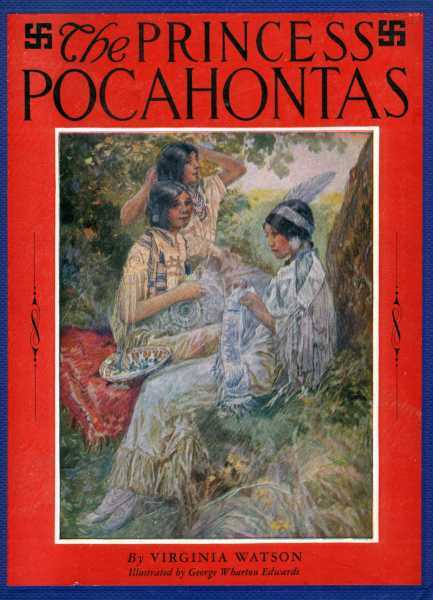
CHAPTER IX
SMITH'S GAOLER
The following morning Claw-of-the-Eagle, passing before the lodge assigned to the prisoner, beheld Pocahontas seated on the ground in front of it.
"What dost thou here?" he asked, "and where be the guards?"
"I sent them off to sleep as soon as the Sun came back to us," she answered, looking up at the tall youth beside her. "I can take care of him myself during the day."
"Hast thou seen him yet? Tell me what is he like. I saw him but for the minute yesterday."
"He sleeps still. I peeped between the openings of the bark covering here and beheld him lying there with all those queer garments. I am eager for his awakening; there are so many questions I would ask him."
"Let me have a look, too," pleaded the boy.
Pocahontas nodded and motioned graciously to the opening of the lodge. It pleased her to grant favors, and Powhatan sometimes smiled when he marked how like his own manner of bestowing them was that of his daughter.
With the same caution with which he crept after a deer in a thicket, Claw-of-the-Eagle moved on hands and knees along the ground within the lodge. Lying flat on his stomach, he gazed at the Englishman. He had heard repeated about the village the night before the details of his rescue as they had taken place within the ceremonial wigwam. Those who told him were divided in their opinions; some looked upon Powhatan's decision as a danger to them all, and others scouted the idea that those palefaces were to be feared by warriors such as the Powhatans. Claw-of-the-Eagle, however, did not waver in his belief: each of the white strangers should be killed off as quickly as might be. His loyalty to his adopted tribe was as great as if his forefathers had sat about its council fires always. He was sorry that Pocahontas, much as she pleased him, had persuaded her father to save the life of the first of the palefaces that had fallen into his power. He believed The Powhatan himself now regretted that he had yielded to affection and to an ancient custom, and that he would gladly see his enemy dead, in order that the news carried to his interloping countrymen might serve as a warning of the fate that awaited them all.
Suppose then—the thought flashed through his brain—that he, Claw-of-the-Eagle, should make this wish a fact! Powhatan would never punish the doer of the deed.
He crept nearer still to the sleeping man, loosening the knife in his girdle. There was no sound within the lodge, only the faint crooning of Pocahontas without; yet something, some feeling of danger, aroused the Englishman. Through his half-closed lids he scarce distinguished the slowly advancing red body from the red earth over which it was moving. But when the boy was close enough to touch him with the outstretched hand. Smith opened his eyes wide. He did not move, did not cry out, though he saw the knife in the long thin fingers; all he did was to fix his gaze sternly upon the boy's face. Claw-of-the-Eagle tried to strike, but with those fearless eyes upon him he could not move his arm.
Slowly, as he had come, he crawled back to the entrance, unable to turn his head from the man who watched him. It was only when he was out in the air again that he felt he could take a long breath.
"He is a good sleeper," was all he remarked.
"And doubtless he is as good an eater and will be hungry when he wakes. Wilt thou not stop at our lodge, Claw-of-the-Eagle, and bid them bring me food for him?"
He did as she asked, and shortly after the squaws arrived with earthen dishes filled with bread and meat. They peered eagerly through the crevices till Pocahontas commanded them to be off. Hearing a noise within the lodge, she was about to bear the food inside when Smith stepped to the entrance.
He was astonished to see the kind of sentinel they had set to guard him. He had expected to find that his unexpected guest would be waiting outside for another chance at his life, and he preferred to hasten the moment. He realized that this maiden, however, would be as efficient a gaoler as a score of braves. Should he dream of escaping, of finding his way without guides or even his compass, back to Jamestown, her outcry would bring the entire village to her aid. He recognized his saviour of the day before and bowed low, a bow meant for the princess and for his protector. Pocahontas, though a European salutation was as strange to her as Indian ways were to him, felt sure his ceremonious manner was intended to do her honor, and received it gravely and graciously.
"Here is food for thee, White Chief," she said, placing it on a mat she had spread on the ground; "sit and eat."
"It is welcome," he answered, "yet first harken to me. I have not words of thy tongue, little Princess, to pay thee for thy great gift, and though my words were as plentiful as the grains of sand by the waters, they were still too few to offer thee."
"Gifts made to chiefs," she answered with a dignity copied from her father's, "can never pay for princely benefits."
Smith could not help smiling at the grandiloquence of the child's language, for in spite of her height, he realized that her years were but few.
"Yet," she continued, seating herself, "it pleaseth me to receive thy thanks."
Now she put aside her grown-up air and her curious glances were those of the child she was. She fingered gently the sleeve of his doublet stained by the morass in which he had been captured and torn by the briars of the forests through which he had been led.
"'Tis good English cloth," he remarked, "to have withstood such storm, and I bless the sheep on whose backs it grew."
"What beasts are those?" she queried, and Smith endeavored to explain the various uses and the looks of Southdown flocks.
"Did thy squaws make thy coat for thee when thou hadst slain that—that new beast?"
"I have no squaw, little Princess."
"I am glad," she sighed.
"And why?"
"I do not know", her brow wrinkling as she tried to fathom her own feelings. "Perhaps it is because now thou wilt not pine for her and to be gone from amongst us."
"But I must leave here soon, little maid; my people at Jamestown are waiting for me."
He said this in order to try and discern what was the intention of Powhatan towards him. Now that his life was saved, his thought was for his liberty.
"Thou shalt not go," she cried, springing up. "Thou belongest to me and it is my will to keep thee that thou mayst tell me tales of the world beyond the sunrise and make new medicine for us. Thou shalt not go."
"So be it," said Smith in a tone he tried to render as unemotional as possible. He sighed inwardly as he thought of his fellows at Jamestown, ill, starving, and now doubtless believing him dead. Perhaps if he bided his time he would find some way of communicating with them. In the meantime, policy, as well as inclination, urged his making friends with this eager little savage maiden.
Now that he did not attempt to oppose her, Pocahontas sank down again beside him. Already there was an audience: braves, squaws and children were crowding about, watching the paleface eat. Smith had learned since his captivity the value the Indians set upon an impassive manner, so he continued cutting off bits of venison and chewing them with as little attention to those about him as King James himself might show when he dined in state alone at Guildhall. But for Pocahontas's presence, whose claim to the captive every one respected, they would have come even nearer. As it was, one boy slipped behind her and jerked at Smith's beard. Pocahontas ordered him away and said in excuse:
"Do not be angry, he wanted only to find out if it were fast."
She shared the child's curiosity in regard to the beard. Might it not be, she wondered, some kind of adornment put on when he set out on the warpath, as her people decked themselves on special occasions with painted masks?
Smith tugged at his beard with both hands, smiling, and his audience burst out laughing. They could appreciate a joke, it seemed, and he was glad to see that their temper to him was friendly, for the moment at least. One of the older men pointed to the pocket in his jerkin and asked what he had in it. Compass and watch were gone, but Smith delved into its depths in hopes of finding something he had forgotten which might interest them. He brought out a pencil and a small note-book. He wrote a few words and handed them to Pocahontas, saying:
"These are medicine marks. If one should carry them to Jamestown they would speak to my people there and they would hear what I say at Werowocomoco."
Pocahontas shook her head as did those to whom she passed the leaf. The stranger might do many wonderful things, but this claim passed the bounds of even the greatest shaman's power.
Smith, however, determined to keep her thinking of the possibility of his return to Jamestown, continued:
"It is possible for me, in truth. Princess, and if thou would'st accompany me thither I could show thee stranger marvels still."
"Nay," she cried angrily, "thou shalt never go there. Thou art mine to do as I will. Is it not so?" she appealed to those about her.
They all shouted affirmation, confirming Smith's belief that his fate had been placed in a girl's hands. It was not the first time such a thing had happened to him; once before in his life a woman had been his gaoler, and he again made up his mind to bide his time. He answered the numerous questions put to him as best he could, about the number of days he had been with the Pamunkeys, his capture, and why he had separated from his fellows. In turn he questioned them about their harvests, the time and method of planting and the moon of the ripening of the maize; but the Indians showed plainly that they liked better to ask than to answer.
As the day advanced the crowd began to dwindle. The captive would not fail to be there whenever they desired to observe him and there was hunting to be done and cooking, and already some of the boys had strolled off to play their ever-fascinating game of tossing plumstones into the air. At last only Pocahontas was left with the prisoner.
Smith glanced about to see what the chances of escape might be should he make a sudden dash, but the sight of some braves at a lodge not more than a hundred feet away busied in sharpening arrowheads made him settle down again.
"Tell me, White Chief," said Pocahontas as she lighted a pipe she had filled with tobacco and gave it now to Smith, "tell me about thyself and thy people. Are ye in truth like unto us; do ye die as we do or can your medicine preserve you forever like Okee? Canst thou change thyself into an animal at will? If so, I fain would know how to do it, too."
Smith looked critically at the girl who sat on a mat beside him. He had never seen a maiden whose spirit was more eager for life. In her avidity for the miraculous he recognized something akin to his own love of adventure and desire to explore new lands and to sample new ways. She could not sail across the ocean in search of them as he had done—he was her great adventure, he realized, a personified book of strange tales to fire her imagination, as his had been stirred as a boy by stories of the kingdom of Prester John, of the El Dorado, of the Spanish Main and of the lost Raleigh Colony. The tobacco, which he had learned to smoke while with the Pamunkeys, soothed him; he was in no immediate danger; the warm sun was pleasant and the bright-eyed girl beside him was a sympathetic audience. He was always fond of talking, of living over the picturesque happenings that had crowded his twenty-eight years, and now he let himself run on, seeing again in his mind's eye the faces and the scenes of many lands, none of them, however, more strange than his present surroundings. The only difficulty was his insufficient vocabulary; but his mind was a quick and retentive one and each new word, once captured, came at his bidding. Also, Pocahontas was a bright listener; she guessed at much he could not express and helped him with gesture and phrase.
"Princess," he began, when she interrupted:
"Call me Pocahontas as do my people. Perchance some day I'll tell thee my other name."
"Pocahontas, then," he repeated slowly, impressing the name on his memory, "I will obey thee. We are but men, as are thy kinsfolk, subject to cold and hunger, ills and death. Yet, as God, our Okee, is greater than your Okee, so our power and our medicine excel those of the mighty Powhatan and of his shamans. Thou asketh for tales of the land whence I come. They are so many that like the leaves of the forest I cannot count them. If we sat here until thou wert a wrinkled old crone like her yonder," and he pointed to old Wansutis who was hobbling by, "I could not relate half of them. Therefore, if it pleaseth thee, I will tell thee of some matters that have affected thy captive."
Pocahontas nodded her approbation.
"Our land, fair England, set in a stormy sea, is a mighty kingdom many, many days' journey over the waters. There all men and women are as white or whiter than I, now so weatherworn, as indeed are those of many other kingdoms further towards the sunrise. Our land, now ruled by a king who wields dominion over hundreds of tribes, was a few years ago under the sway of a mighty princess."
"Was she fair?" asked Pocahontas.
Smith hesitated. The glamour which had once hovered about "Good Queen Bess," obscuring the eyes of her loyal subjects, had since her death been somewhat dispelled. He thought of the pinched face, the sandy hair, the long nose, the small eyes—but then he had a vision of her as his boyish eyes had first beheld her, the sovereign riding her white steed before the host assembled to encounter the forces of the Armada Spain was sending to crush her realm.
"Not beautiful was she," he replied, "but a very king of men!"
He puffed a moment reminiscently, then continued:
"I was born some years ago in a part of our island called Lincolnshire, where it is low and marshy in places like unto the morass where thine uncle took me prisoner. Yet it is a land I love, though it grew too small for me, and when I was old enough to be a brave my hands itched to be fighting our enemies. So I went forth on the warpath against our foes in France and in the Netherlands. Then when I had fought for many moons and had gained fame as a warrior I felt a longing to return to mine own home. I abode there for a time, then I set forth once more and travelled long in a land called Italy and entered later the service of a great werowance, the Emperor Rudolph, to fight for him against the tribes of his foes, the Turks. I cannot explain to thee, Princess, how different are their ways from our ways; perchance theirs were nearer to thine understanding since they are not given to mercy and take to themselves many squaws; but let that rest. I fought them hard and often, and one day before the two armies, that ceased their combat to witness, I slew three of their great fighters, for which the Emperor did allow me to bear arms containing Three Turks' Heads—that is, as if one of thy kinsmen should sew upon his robe three scalps of enemies he had killed. But soon after that was I taken prisoner by these Turks and sold into captivity as a slave."
"Ah!" breathed Pocahontas deeply. For once in her life she was getting her fill of adventures.
"I was given as a slave to another princess—Tragabizzanda—in the City of Constantinople; then I was sent to Tartary, where I was most cruelly used. One day I fell upon the Bashaw of Nolbrits, who ill-treated me, and I slew him. I clothed myself in his garments and escaped into the desert and finally after many strange adventures I reached again a land where I had friends. Then—"
"Tell me of the princess," interrupted Pocahontas. "Did she ill-use thee also?"
"Nay, in truth, she was all kindness to me," replied Smith, his eye kindling at the remembrance of the Turkish lady who had aided him. "She was very beautiful, with lovely garments and rich jewels," he added, thinking to interest the girl with descriptions of her finery, "and I owe her many thanks."
"Was she more beautiful than I?" asked Pocahontas, her brows knitting angrily.
"She was very different," the amused Englishman answered. It was scarcely possible for him to consider these savages as being real human creatures, to be compared even with the Turks; yet he did not wish to hurt the feelings of one who had done so much for him. "She was a grown woman," he added, "and therefore it boots not to compare her with the child thou art."
"I am no child. I am a woman!" cried Pocahontas, springing up in a fury and rushed off like a whirlwind towards the forest.
John Smith looked after her in dismay. If he had turned his only friend against him then was he indeed in a sad plight!
CHAPTER X
THE LODGE IN THE WOODS
Neither the rest of that day nor the next had Smith any speech with Pocahontas. True it was that she came accompanied by squaws and children, all eager to serve as cupbearers in order to observe the paleface closely. But she put down the food beside him and did not linger.
By the middle of the second day Smith found himself less an object of interest. Everyone in Werowocomoco had been to gaze at him and the older chiefs had sat and talked with him; but the Englishman could not discover what their opinion in regard to his coming or his future might be. Now there seemed to be something afoot which was engaging the attention of the braves who congregated together before the long lodge. Had it anything to do with his own fate, the captive wondered. The children, too, had found other things to interest them. He saw them, their little red bodies glistening in the sun, playing with the dogs or pretending they were a war party creeping through a hostile country. Smith missed them peering about the opening of his lodge, half amused, half frightened, when he attempted to make friends.
He leaned idly against the side of the wigwam, watching two squaws not far away who were tanning a deerskin and cutting it in strips for thread. Would the time ever come again, he wondered, when he would behold a white woman sewing or spinning?
He saw Pocahontas leave her lodge, but instead of coming in his direction, she ran towards the wigwams that skirted the forest and was soon out of sight. He could not see that a young Indian boy, astounded to catch sight of her in that unaccustomed part of the village, went to meet her.
"Is Wansutis by her hearth?" asked Pocahontas.
"She is," Claw-of-the-Eagle replied, and walked on beside her with no further word.
Pocahontas's heart was beating a little faster than usual. Wansutis still excited a feeling of awe and discomfort in the courageous child; she could not help experiencing a sort of terror when in her presence. Nevertheless she had now come of her own accord to ask the old woman for aid.
Claw-of-the-Eagle, though he would have bitten his tongue off rather than acknowledge his curiosity, was most eager to learn what had brought the daughter of Powhatan to his adopted mother's lodge. He entered it with Pocahontas and pretended to be busying himself with stringing his bows in order to have an excuse for staying.
"Wansutis," began Pocahontas, standing in the sunshine of the entrance, to the old woman who sat smoking in the darkest part of the lodge, "thou hast the knowledge of all the herbs of the fields and of the forests, those that harm and those that help. Is it not so?"
The wrinkled squaw looked up, a drawn smile upon her lips, and said:
"And so Princess Pocahontas comes to old Wansutis for a love potion."
"Nay," cried the girl angrily, coming closer, "not so; I desire of thee something quite different—herbs that will make a man forget."
"The same herb for both," snapped the squaw; "for whom wilt thou brew it, for thine adopted son, thou who art no squaw and too young to have a son? I have no such herb, maiden, and if I had, thinkest thou I had not given it to Claw-of-the-Eagle to drink. Speak to her, son, and tell her if a man ever forgets."
Pocahontas turned a questioning glance on him and the young brave answered it:
"My thoughts are great and speedy travellers, Pocahontas; they take long journeys backwards to my father's and mother's people. They wander among old trails in the forests and they meet old friends by the side of burned-out campfires. Yet, when like weary hunters who have been seeking game all day, they return at night to their lodge, so mine return in gratitude to Wansutis. For she hath not sought to hinder them from travelling old trails, even as she hath not bound my feet to her lodge pole to keep them from straying."
"And if she had not left thee free," queried Pocahontas, "what wouldst thou have done?" Somehow, captivity and the thought of captives had suddenly become of extreme interest to the girl.
"I know not, Princess," answered the boy after pondering a moment, "yet had not my father and mother been dead I feel certain I should have sought to escape to them, even had thy father set all his guards about the village. But they were no more, and our wigwam afar off was empty; and so my heart finds rest in a new home and I gladly obey a new mother."
"Is it then so hard to forget an old lodge and other ways?" pondered the girl. "It seems to me that each day among strangers would be the beginning of a new life, that it would be pleasant to know I could not foresee what would come to pass before nightfall. Why," she queried, looking eagerly at both the old woman and the boy, "why should this paleface desire to return to the island where they sicken and starve while here he hath food in plenty?"
"Wait till thou thyself art among strangers away from thine own people," cried Wansutis sternly, and then she turned her back upon the young people and began to mutter.
"So thou hast no drink of forgetfulness to give me?" asked Pocahontas, hesitating at the entrance, to which she had retreated; but the old woman did not answer; and Pocahontas walked off slowly, meditating as she went, while Claw-of-the-Eagle, bow in hand, gazed after her.
It had grown dark and John Smith, his legs cramped with long sitting, stretched himself out by the side of the fire in his lodge into which he had thrown some twigs, so that the embers which had smouldered all day now blazed up brightly. The cheerful crackling was welcome, it seemed to him to speak in English words of home and comfort, not the heathenish jargon he had listened to perforce for several weeks. Not only was it a companion but a protection. While it blazed he might be seized and put to death, but at least he should see his enemies. He missed Pocahontas for her own sake, not only because her staying away argued ill for his safety. Gratitude was not the only reason for his interest in her: she seemed to him the freest, brightest creature he had ever come across, as much a part of the wilderness nature as a squirrel or a bird. Like all cultured Englishmen of his day, he had read many books and poems about shepherdesses in Arcadia and princesses of enchanted realms; but never yet had any writer, not even the great Spenser or Sir Philip Sidney, imagined in their words so free and wild and sylvan a creature as this interesting Indian maiden.
His thoughts were disturbed by the entrance of two Indians. "We are come," they said, "at The Powhatan's bidding to take thee to his lodge in the wood."
He knew not what this order might mean, yet he was glad that come what would, the monotony of his captivity was broken. He rose quickly and followed them through the village, each lodge of which had its ghostly curl of smoke ascending through the centre towards the dark sky. Within some of the wigwams he could see the fire and sitting around it families eating before lying down to sleep. Then they left the palisades of Werowocomoco behind them and came out into the forest, to a lodge as large as that in which he had first been led before Powhatan.
This one, however, was differently arranged. It was divided into two parts, separated by dark hanging mats that permitted no light to pass through. Into the smaller apartment, to give it such a name. Smith was ushered, and there the two Indians, after stirring up the fire and throwing on fresh logs, left him alone.
Not long, however, did Smith imagine himself the lodge's only inhabitant. The sound of muffled feet, even though they moved softly, betrayed the presence of a number of persons on the other side of the mat. His ears, his only sentinels, reported that the unseen foes had seated themselves and then, after a short silence, he heard a voice begin a low, weird chant. He could not understand the words, but from the monotonous shaking of a rattle and the steps that seemed to be moving in some dance round and round from one part of the room to the other, Smith was certain that it was a shaman beginning the chant for some sacred ceremony. Then one by one the different voices joined in, uttering hideous shrieks, and the ground shook with the shuffling of many feet. The sounds were enough to terrify the stoutest heart, and Smith had no doubt but that their song was a rejoicing over his coming death. Perhaps Powhatan, he thought, had only pretended to grant his daughter's request, having planned all along to put an end to him, and when the boy, who had doubtless been sent by him, had not succeeded, he had probably determined to kill him here. Or perhaps Pocahontas, now in anger with him, had withdrawn her claims to his life and left him to her father's vengeance.
The noise grew louder and more fiendish in character and the Englishman saw the corner of the mat begin to wave, to bulge as if a man were butting his head against it to raise it. Then he saw it lifted and in came a creature more hideous than Smith ever dreamed could exist. Painted all in red pocone, with breast tattooed in black, wearing no garment save a breech-clout and a gigantic headdress of feathers, shells and beads, he straightened himself to his great height. A horrible mask, distorting human lineaments, covered the face, and a medicine-bag of otter skin hung from his back and dangling from one arm as an ornament hung the dried hand of an enemy long since dead. On account of his stature and in spite of the mask, Smith recognized The Powhatan, and drew himself up proudly to meet his fate.
Behind their werowance now swarmed the other braves and chieftains, two hundred in all, and all with masks that made them as fearful, thought John Smith, as a troop of devils from hell.
To his astonishment, they did not fall upon him and in their shrieking he thought he could even distinguish the word "friend." The Powhatan alone of them all approached him, saying:
"Have no fear, my son; we are not come to harm thee. The ceremony which thou hast heard was to call Okee to witness to the friendship we have sworn thee. Henceforth are we and thou as of one tribe. No longer art thou a prisoner but free to come and go as thy brothers here, aye, even to return to thy comrades on the island if thou so desirest. When thou hast arrived there send unto me two of those great guns that spit forth fire and death that my name may become a still greater terror to mine enemies, and send to me also a grindstone such as thou hast told me of, that my squaws may use it for crushing maize. I ask not these gifts for naught. A great chief giveth ever gifts in return. Therefore I present to thee for thine own the land called Capahosick, where thou mayst live and build thee a lodge and take a squaw to till thy fields for thee. Moreover, I, The Powhatan, I, Wahunsunakuk, will esteem thee as mine own son from this day forth."
It was difficult for Smith during this discourse not to betray his astonishment. First came the relief at learning that he was not to be killed immediately and then the wonderful news that he was free to go to Jamestown. And if The Powhatan and his people had sworn friendship to him, would that not mean that through him the colony should be saved? He longed to know what had brought about this sudden change in his fate, but he could not ask. In as stately a manner as that of the werowance—so at variance with his appearance—and with the best words at his command, he spoke his thanks.
"I thank thee, great Powhatan, for thy words of kindness and the good news thou bringest me. In truth if thou wilt be to me a father, I will be to thee a son, and there shall be peace between Werowocomoco and Jamestown. If thou wilt send men with me to show me the way they shall return with presents for thee."
Powhatan gave certain orders and twelve men stepped forward and laid aside their sacrificial masks and announced themselves ready to accompany the paleface. Smith had not imagined that he could leave that night, but he was so eager to be off that he lost no time in his farewells.
They set forth into the forest which at first was not dense, and along its edge were clearings where the summer's maize had grown. Then the trees grew closer together, and to Smith there appeared no path between them, but his guides strode quickly along with no hesitation, though the night was a dark one. Six of the Indians went in front of him and six behind. There was no talking, only the faint sound from the Englishman's boots and his stumbling against trunks or rocks broke the silence. There was little chance of an enemy's coming so near to the camp of The Powhatan, nevertheless the Indians observed the usual caution.
To John Smith there was something ghostly about this excursion by night, through an unknown country, with unknown men. He could not help wondering whether he had understood correctly all that Powhatan had said, or whether he dared believe he had meant what he said, or if he had not planned to kill him in the wilderness away from any voice to speak in his favor. Even though the werowance himself were acting in good faith, might not others of the chiefs have plotted to put an end to the white man whose coming and whose staying were so beyond their fathoming? In spite of these thoughts he went on apparently as unconcernedly as though he were strolling along the king's highway near his Lincolnshire home.
The call of some animal, a wildcat perhaps, brought the little company to a hurried standstill, and a whispered consultation. The sound might really come from some beast, Smith knew; on the other hand, it might be either a signal made by foes of the Powhatans or the call of another party of their tribe about to join them. In the latter case it boded ill for him. He clasped a stone knife he had managed to secrete at Werowocomoco. He could not overhear what the Indians were saying, but they were evidently arguing. Then when they seemed to have come to some decision, they started on once more.
Though the forest was so sombre. Smith's eyes had grown more accustomed to the blackness and he began to distinguish between the various shades of darkness. Once or twice he thought he saw to the side of them another figure, moving or halting as they halted, but when he looked fixedly he could distinguish nothing but the trunk of some great tree.
On and on they went, mocked at by owls and whippoorwills, crossing streams over log bridges, wading through others when the cold water splashed at a misstep up in his face. At last the blackness turned to grey, in which he could make out the fingers of his hand. Dawn was near. Why, thought the Englishman, did they delay striking so long? If they meant to kill him, he hoped it might be done quickly. The phantom figure which had accompanied them after the halt following the wildcat call must soon act. Even a brave man must wish such a night as this to end.
Then the world ahead of him seemed to grow wider and lighter. The trees had larger spaces between them and the figures of the Indians were like a blurred drawing. Was it a star shining before them, that light that grew brighter and brighter?
"Jamestown!" he cried out in his own tongue. "Jamestown! Yon is Jamestown! God be praised!"
The Indians gathered about him and began to question him eagerly. Would he give presents to them all; would they have the guns to carry back with them?
As they stood in a little knot, each individual of which was growing more distinct, a young man ran up behind them.
"Claw-of-the-Eagle!" they exclaimed.
The boy put into the hands of the astonished Smith a necklace of white shells he remembered to have seen Pocahontas wear.
"Princess Pocahontas sends greetings," he said, "and bids thee farewell for to-day now that she hath seen thee safe again among thy people." His own scowl belied the kindliness of the message.
So John Smith knew that Pocahontas had accompanied him through the forest and that if death had been near him that night, it was she who had averted it from him.
CHAPTER XI
POCAHONTAS VISITS JAMESTOWN
"We have brought the white werowance safely back to his tribe again," said Copotone, one of the guides, as they approached the causeway leading to Jamestown Island.
"Of a surety," remarked Smith, "since thus it was that Powhatan commanded."
It was his policy—a policy which did credit to the head of one who, in spite of his knowledge of the world, was still so young—never to show any suspicion of Indian good-faith.
"Now that we have led thee thither," continued Copotone, who on his side had no intention of betraying any secrets of the past night, "wilt thou not fulfil thy promise and give to us the guns and grindstone?"
"Ye shall take to your master whatever ye can carry," answered Smith, whose heart was beating fast at the sight of the huts and fort before him, the outlines of which grew more distinct each moment with the brightening day. He had answered the hail of the sentry who, when he had convinced himself that his ears and eyes did not betray him, ran out and clasped the hands of one he had never thought to behold alive again.
"Captain!" he exclaimed, "but it is indeed a happy day that bringeth thee back to us, not but that some of them yonder," and he pointed significantly towards the government house, "will think otherwise."
The Indians in the meantime were looking about them with eager curiosity as they strode through the palisades into the fort. It was but a poor affair, judged by European military standards, and absolutely worthless if it should have to withstand a siege by artillery. But to the savages it was an imposing fortress, the very laws of its construction unknown to them, even the mortar between the logs, a substance of which they had no comprehension. Over the bastion as they emerged on the other side they beheld the English flag floating. This they took to be some kind of an Okee, in which opinion Smith's action confirmed them, for taking off his hat, he waved it in delight towards the symbol of all that was now doubly dear to him.
But it was the guns which claimed the chief attention of the savage visitors. There were four of them, all pointing towards the forest, iron culverins with the Tudor Rose and E.R. (Elizabeth Regina) moulded above their breeches.
"Are these the fire-tubes of which we have heard?" asked Copotone eagerly, longing to feel them, but not daring for fear of unknown magic.
"Aye," answered Smith, "art thou strong enough to carry one to Werowocomoco?"
The Indians looked them over appraisingly, wondering if they could drag them through the forest.
"Set the match to this one, Dickon," commanded Smith with a grim smile. "It behooves us to frighten well this escort of mine, or they would be trying to carry off one of my iron pets here to a strange kennel."
Dickon took up a tinder-box that lay on the bench beside him, and in a moment under the fixed gaze of his audience struck a light and applied it to the flax at the breech. There was a flash, then a loud report, and the Indians, as if actually hit, fell to the ground, where they stayed until they gradually convinced themselves that they were unhurt.
"If ye had been in front instead of behind ye had been killed," Smith said solemnly, desiring to impress them with the terrors of the white man's magic.
The Indians got to their feet and, though they said nothing, and did not attempt to run, John Smith knew that they were more terrified than they had ever been in their lives.
"Come," he said, leading the way from the fort to the town. "Since ye find our guns too heavy and too noisy I will seek more suitable presents for Powhatan and for you."
The colonists, roused by the cannon shot, had run out from their doors to see what had happened. They could scarcely believe their eyes, and it was not until Smith called to them by name and questioned them in regard to the happenings at Jamestown since his departure, that they were convinced he was himself. All were thin and gaunt, and they peered hungrily at the baskets of food the Indians bore. Most of them greeted Smith with genuine pleasure; others there were who frowned at the sight of him, who barely nodded a welcome, who answered him surlily and who got together in twos and threes to talk quickly as he passed on.
Smith led the way to the storehouse and bidding the Indians wait outside, he went within and persuaded the man in charge to permit him to take a number of articles. When he came out his arms were full of colored cloths and beads, steel knives and trinkets of many sorts. The Indians gave him their baskets to empty and he filled them with the presents, going back for iron pots and kettles of glistening brass. These he bade them carry to Powhatan. To each of his guides he gave something for himself. Then speaking slowly, he said to Copotone:
"Kehaten Pokahontas patiaquagh niugh tanks manotyens neer mowmowchick rawrenock andowgh (bid Pocahontas bring hither two little baskets and I will give her white beads to make her a necklace)."
He would gladly have sent a message of thanks for her care of him that night, but he thought it best not to do so, since she might not wish it known that she had followed him.
"Pray her to come and see us soon," he added as he bade farewell to his guides whose eagerness to show their treasures at home was even greater than their curiosity to see further marvels.
After he had seen them safely outside of the palisades, Smith stopped to enquire by name for such men as had not come out to greet him.
"Oh! Ralph, he's dead and buried," they answered; and of another: "Christopher? He wore away from very weakness. And Robin went a sen'night ago with a quartain fever. This is no land for white men."
"But thou lookest hale and hearty. Captain," remarked one of the gentlemen, leaning against his door for support. "I'll wager the death thou didst face was not by starvation."
Then Smith learned in full the pitiful story of what the colony had suffered during his absence: lack of food and illness had carried off nearly half the colonists, and those that remained were weak and discouraged. Death had taken both of his enemies and of his friends, but some who had been opposed to him formerly had been brought to see during his absence how with his departure the life and courage of Jamestown had died down. Men there are—and most of them—who must ever be led by some one, and in Smith these adventurers had come to see a real leader of men.
While Smith stood questioning and heartening the downhearted, President Wingfield came out of his house on his way to the Government House. Smith doffed his hat and made a brave bow to honour, if not the man, at least the office he represented.
"So thou art returned. Captain Smith," said the President, coldly. "Methinks thou hast not fared so ill, better belike than most of us. Hast thou brought the provisions thou didst promise? We have been awaiting them somewhat anxiously. But first tell me where thou hast left Robinson and Emery, for the lives of our comrades, however humble, are of more value to us than even the sorely needed victuals."
Now Smith was aware that President Wingfield knew, as every other man in the colony knew, that Robinson and Emery were dead; the others had already discussed their fate with him. Therefore he realized that the President had some policy in putting such a question to him thus in public.
"Thou must have heard, sir, that they are dead," he replied. "Poor lads! Disobedience was the end of them. Had they but followed my commands they had returned alive to Jamestown many days ago; but they must needs land on the shore, instead of keeping in the stream as I bade them, and they were slain by the savages after I was captured."
"That is easily answered, Captain Smith," Wingfield solemnly remarked, and turning his head over his shoulder to speak as he walked off, he added: "The Council will require their lives at thy hands this day. See that thou art present in the Government House this afternoon at three by the clock to answer their questions."
"So that is what their next step is," Smith remarked to his friend Guy, a youth of much promise, as they walked off together. "They will accuse me of murder and try to hang me or to send me back to England in chains. But I have not been saved from death by a young princess to come to any such end, friend."
And as they walked to his house he told the story of his captivity and made plans for getting the better of those who sought to injure him.
The councillors, on their side, were not unanimous as to the course to adopt. Some were for putting him in safe-keeping—they did not mention the word imprisonment—until a ship should arrive and return with him to England. Others, who perhaps felt a doubt of their own ability to manage the settlement, were willing to acknowledge that they had misjudged him and suggested that at least he had better be given a chance to help them; and other timorous members, having witnessed the warmth of the greeting accorded him, advised that it would be wiser not to rush into any course of action which would displease the majority of the colonists. Thus it came to pass that Smith found the three o'clock meeting like a tiger that has had its claws drawn.
In the days that followed his spirit of encouragement, the willingness with which he put his shoulder to the wheel everywhere that aid was needed, his boldness in defying those leagued against him, completely changed the aspect of Jamestown. The gentlemen who had refused to wield axe or spade or bricklayer's trowel because of their gentility were shamed by his example.
Who was then the gentleman?"
he demanded and swung the axe with lusty strokes against some hoary walnut tree.
But though he enjoyed the triumph over his enemies and the knowledge that his return, the provisions he had brought and the inspiration of his courage and activity were of great benefit to his fellows, nevertheless at times he experienced a feeling of loneliness. He thought of Pocahontas and wondered whether she would not come to Jamestown.
It was on a wintry day that Pocahontas made her first visit to the colony. Though they might lack most of the necessities of life, there was no scarcity of fuel. A huge bonfire was blazing at an open space where two streets were destined to meet in the future. Over some embers pulled away from the centre of the flame a pitch-kettle was heating and its owners, while waiting for its contents to melt, were warming a small piece of dried sturgeon. Around the bonfire sat John Smith and several gentlemen. He was pointing out to them on a rough chart the direction in which he thought the town should spread out when a new influx of colonists would need shelter. There were carpenters working on a house a few feet away, but their hammer blows did not ring out lustily as they should do when men are building with hope a new habitation; there was but little strength left in their arms.
When Smith looked up from his chart to indicate where a certain line should run, he saw standing before him the young Indian who had brought him Pocahontas's greeting after the night journey through the forest and who, he now realized, was the same fierce youth who had attempted his life at Werowocomoeo.
Claw-of-the-Eagle spoke:
"Werowance of the white men, Princess Pocahontas sends me to inform thee that she hath come to visit thee. E'en now she and her maidens await thee at the fort."
"She is most welcome," cried Smith, springing up. Then he called out in English: "Come, friends, and help me receive the daughter of Powhatan, who did save me at the risk of her own life. Give her a hearty English welcome."