
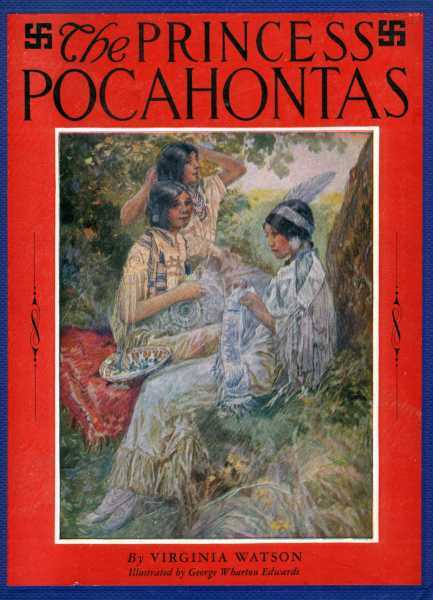
The colonists needed no urging. They were eager to see what an Indian princess looked like. But Smith outran them all and at the sight of the bright girlish face he stretched out his hands towards her as he would have done to an English maiden he knew well.
"Ah! little friend," he said coaxingly, "thou wilt not be angry with me longer. How much dost thou desire to make me owe thee, Pocahontas, my life, my freedom, my return home and now this pleasure?"
Pocahontas only smiled. Smith then turned, waving his hand to the men who had followed him.
"These, my comrades, would thank thee too could they but speak thy tongue."
The hats of cavaliers and the caps of the workmen were all doffed, and Pocahontas acknowledged their courtesy with great dignity.
"Let us show our guests our town," suggested Smith, "even though it lack as yet palaces and bazaars filled with gorgeous raiment. I will lead the princess; do ye care for her maidens and the young brave." As they walked along the path from the fort to Jamestown's one street he asked: "Tell me, my little jailor, how came The Powhatan to set me free? I have wondered every day since, and I cannot understand. Thou didst prevail with him, was it not so?"
"Aye," answered the girl. "First was I angry with thee, then my heart, though I did not wish to hearken to it, made me pity thee away from thy people, even as I pitied the wildcat I loosed from his trap. My father would not list to me at first, but I plead and reasoned with him, telling him that thy friendship for us would be even as a high tide that covereth sharp rocks over which we could ride safely."
"But what meant the songs and dances in the hut in the woods, Matoaka?"
"That was the ceremony of adoption. Thou art now the son of Powhatan and my brother. Thou wert taken into our tribe, and those were the ancient rites of our people."
"And the journey through the woods, didst thou fear for my safety then that thou didst follow all the way?"
But Pocahontas did not answer. She would not tell him that she had still doubted her father, and that she was not sure what instructions he had given the men ordered to guide the paleface.
"Thou art like the Sun God," said Smith with genuine feeling, "powerful to save and to bless, little sister—since I have been made thy brother. And as man may not repay the Sun God for all his blessings, no more may I repay thee for all thou hast done for me."
Pocahontas was on the point of replying when she suddenly burst out laughing at a sight before her. Two men who were rolling a barrel of flour from the storehouse to their own home let it slip from their weakened fingers. It rolled against one of the carpenters who was standing with his back to it, and hitting against his shins, sent him sprawling. It was undoubtedly a funny sight and she was not the only one to be amused. But the man did not rise.
"Why doth he not get up?" asked Pocahontas. "He cannot be badly hurt by such a light blow from that queer-shaped thing."
"I fear me he is too weakened by lack of food," answered Smith, gravely.
"Hath he naught to eat?" asked the girl in wide-eyed wonder. Then as if a strange thought had just come to her: "Is there not food for all? Must thou, too, my Brother, stint thyself?"
"In truth, little Sister, our rations are but short ones and if the ship cometh not soon from England with supplies, I fear me they must be shorter still."
"No!" she cried emphatically, shaking her head till her long braids swung to and fro, "ye shall not starve while there is plenty at Werowocomoco. This very night will I myself send provisions to thee. It hurts me here," and she laid her hand on her heart, "to think that thou shouldst suffer."
Just then President Wingfield and several officers of the Council, having heard the news of Pocahontas's visit, came toward them. They realized that the presence among them of this child, the best-loved daughter of the powerful Indian chieftain, was an important event. They did not quite know what to expect. Vague ideas of some Eastern queenly beauty, such as the Queen of Sheba or Semiramis, had led them to look for a certain royal magnificence of bearing and of garments, and they were taken aback to behold this slim young creature whose clothing in the eyes of some of them was inadequate. Nevertheless, they soon discovered that though she wore no royal purple nor jewels she bore herself with a dignity that was both maidenly and regal. They had hurriedly put on their own best collars and ruffs and to the eyes of the unsophisticated Indian girl they made a brave, though strange, appearance. She listened to their words of welcome and answered them through Smith's interpretation. But all the while she was taking in every detail of their costumes.
"We must give her presents," suggested one of the councillors as if discovering an idea that had come to no one else, and he sent a servant to fetch some of the trinkets which they had brought for the purpose of bartering with the savages.
Pocahontas forgot her dignity at the sight of them and clapped her hands in delight as Smith threw over her head a long chain of white and blue beads. Her pleasure was even greater when he held up a little mirror and she saw her face for the first time reflected in anything but a forest pool.
"Is that too for me?" she asked eagerly and clasped it to her breast when it was put into her hand, and then she peered into it from one side and the other, unwearied in making acquaintance with her own features.
The other maidens and Claw-of-the-Eagle were given presents also, but less showy ones. Smith went into his own little house and after hunting through his sea-chest, brought out a silver bracelet which he slipped on Pocahontas's arm, saying:
"This is to remind Matoaka always that she is my sister and that I am her brother."
It seemed to Pocahontas that she was incapable of receiving any further new impressions. It was as if her mind were a vessel filled to the brim with water that could not take another drop. Like a squirrel given more nuts than it can eat at once, who rushes to hide them away, her instinct made her long to take her treasures off where she could look at them alone.
"I go back to my father's lodge," she said and did not speak again till they reached the fort. Then when Smith had seen the little party beyond the palisades, she called back to him:
"Brother, I shall not forget. This night I will send thee food. I am well pleased with thy strange town and I will come again."
CHAPTER XII
POWHATAN'S AMBASSADOR
Pocahontas was as good as her word. That same evening as soon as she had exhibited her treasures to Powhatan and to his envious squaws and had related her impressions of the town and wigwams of the palefaces, she busied herself in getting together baskets of corn, haunches of dried venison and bear-meat and sent them by swift runners to "her brother" at Jamestown.
In the days following, though she played with her sisters, though she hunted with Nautauquas in the forest, though she listened at night, crouched against her father's knees before the fire to tales of achievements of her tribe in war, or to strange transformation of braves into beasts and spirits, her thoughts would wander off to the white man's island, to the many wonders it held which she had scarcely sampled. The pressure of her bracelet on her arm would recall its giver, and she saw again in her mind his eyes, so kind when they smiled on her, so stern at other times.
She thought too of the man she had seen rolled over by the barrel—of how slowly he had risen. She knew that there was such a thing as starvation, because sometimes allied tribes of the Powhatans, whose harvests had not been successful or whose braves had been lazy hunters, had come to beseech food from the great storehouse at Powhata. But she herself had never before seen any one faint for food, and it hurt her when she thought of the abundance at Werowocomoco, where not even the dogs went hungry, to know that there were men not far away who must go without. Her father made no objection when a day or two later she told him that she wished to take another supply of provisions to the white men.
"So be it," nodded Powhatan. "Thy captive shall be fed until the big canoe he said was on its way shall arrive. He saith—though this be great foolishness, since he cannot see so far—that at the end of this moon it will come safe over the waters. But until the day of its arrival, whenever that may be, thou canst send or carry of our surplus to them. And hearken, Matoaka," he whispered that the squaws might not hear, "thou hast wits beyond thy years, therefore do thou seek to learn some of the white man's magic. There be times when the cunning of the fox is worth more than the claws of the bear."
So every three or four days Pocahontas brought food to Smith, for his own need and for that of his fellows. Sometimes, accompanied by her sister or her maidens, she would go by night to Jamestown, and half laughing, half frightened, they would set down the baskets before the fort and run like timorous deer back to the forest before the sentinel had opened the gate in the palisade in answer to their call. Sometimes, with Claw-of-the-Eagle as her companion, she would walk through the street of Jamestown, greeting, now with girlish dignity, now with smiles, its inhabitants whose thin faces lighted up at sight of her. She came to symbolize to them the hope in the new world they had all but lost; they rejoiced to see her, not only for her gifts, but for herself.
They taught her to say after them a few words such as "Good-day," "food," and "the Captain," meaning Smith; and the possession of this new and strange accomplishment was almost as dear to her as beads or bracelet. The island for her was a place of enchantment. The sunset gun from the fort awoke more thrills of marvel in her than the rages of a thunderstorm; and the strangest medicine of all was the power the white men had of communicating their wishes to others at a distance by means of little marks upon scraps of paper.
One afternoon when she had come, accompanied by Cleopatra, she found the streets and houses of Jamestown deserted. As they wandered about, wondering what had happened to the palefaces, they heard the sound of voices issuing from a rough shed beyond. They seemed neither to be talking nor shrieking but chanting in a kind of rhythm such as she had never heard. Quietly the two maidens followed the sound to the shed. It was made of wood, open at the sides and roofed over with a piece of sail-cloth. Crouched behind some sumac bushes still bearing aloft their crimson torches, the girls looked on in wonderment, themselves unseen. The sun was sinking behind them, behind the backs too of the colonists who all faced the east. Then Pocahontas whispered to her sister:
"See, Cleopatra, they must be worshiping their Okee. Yon man all in white before them must be a shaman."
A keen curiosity kept her there, though Cleopatra pulled in fright at her skirt, whispering entreaties to be gone before some dire medicine should fall upon them. She saw them all, when the chanting had ceased, kneel down on the bare ground and heard them repeat some incantation which she felt sure must be of great strength, to judge by the firmness of the tone in which they all recited it. Their Okee, she thought, must be a very powerful one; and there came to her as she crouched there, the hidden witness of this evening service, the conviction that her father, if he would, and even with all his tribes, could never conquer this handful of determined men.
She was afraid that "her brother" might be angry with her for having looked on at ceremonies that were perhaps forbidden to women or members of other tribes; so, greatly to Cleopatra's relief, they slipped away, leaving at the fort the provisions they had borne on their strong young backs.
A few days later news came from Opechanchanough that the big canoe, so eagerly expected by the strangers, had been seen at Kecoughtan and was now on its way up the river. Powhatan was astounded, for it was the very day the white captain had foretold its arrival. Truly a man who could see so far across the waves of the big water was one to be feared. And from that day the werowance had deep respect for John Smith and his powers.
Now that the ship had brought provisions there was for a time no need of aid from Werowocomoco. But only for a time. One day when Smith had conducted Pocahontas over the ship to show her the wonders of this monster canoe, he asked her to have her people bring food once more to Jamestown.
"The sailors of Captain Newport," he explained, "are staying here too long and are devouring much of the supplies designed for us. A strange mania hath overtaken them, little Sister; they are mad for gold. They believe that the streams about here are full of the dust they and our men of Jamestown value more than life itself. It is more to them than thy precious pocone, and as thou seest, they desert their ship and spend their days sifting sand. If they are not soon gone there will be nothing left for the mouths of any of us."
"Thou shalt not want, Brother," promised Pocahontas, and the next day came the Indians with large stores of provisions. These Smith now bought from them with beads and utensils and colored cloths. But the President and the Council, jealous of the growing importance of Smith's relations with the savages, sought to increase their own by paying four times the amount Smith had agreed upon.
Discouragement met Smith with each morning's sun and kept him awake at night. The colony seemed to take no root in this virgin soil; men who would not work in the fields to raise grain toiled feverishly in search of gold, forgetting that a full harvest would mean more for their welfare than bags of money. Then, to add to the troubles, a fire started one winter night at Jamestown and spread rapidly over most of the town, burning down the warehouse in which the precious grain was stored. From cold and starvation "more than halfe of us dyed," wrote Smith later in his history.
Both with his own strength and by his example John Smith strove to his utmost to rebuild Jamestown and to encourage the downhearted and to make friends for himself among those who had listened to suspicions of his purposes.
For a long time Powhatan had desired to secure weapons such as the white men used, but the colonists had so far refused the Indians' request to barter them. Now he determined to try other methods. He sent twenty fat turkeys—each a heavy burden for the man who bore it across his shoulders—to Captain Newport, asking that in return the Englishman would send him twenty swords. Newport, whose orders from the authorities in London had been not to offend the natives in any manner, had not refused and had sent the swords in return. Then Powhatan, still eager to secure a further store of weapons, had twenty more fine turkeys carried to Smith, asking for twenty swords more. But Smith, who had been taught by experience and insight many things about the relations which should prevail between the colony and the Indians, knew how unwise it was to give to an untried friend the means of turning against the giver. He knew that the Indians respected his sternness with them more than they did the evident desire of Newport and the Council to please them. Therefore he refused. The disappointed savages showed their anger and cried out insolent words against Smith.
Finding they could not weaken his decision, they sought to steal the swords. They were discovered and Smith, realizing that the time had come when a decided stand must be taken, had them whipped and imprisoned. Some of the Council protested, declaring that this was the wrong way to treat the Indians and urged that Powhatan was sure to resent their action. How did Smith know, they asked, that these savages were acting at the command of their chief? Was it not merely a sudden impulse of anger that had led them to take what ought to have been given them?
But the prisoners, who believed in Smith's power to read the past as well as the future, thinking it useless to try to hide the truth from him, confessed that Powhatan had commanded them to secure the swords by any method. Powhatan was now aware that his plan had failed and that it was necessary for him to disavow the deed of his messengers. To convince the palefaces of his good faith he must send some one to talk with them whom they would trust. And so it was that Pocahontas went to Jamestown as ambassadress.
Accompanied by slaves bearing presents of food, seed corn for the spring planting and pelts of deer and bear and wildcat, Pocahontas was received at Jamestown with much ceremonial.
"I bear these gifts from The Powhatan," she said to Smith, who always acted as interpreter. "He begs thee to excuse him of the injuries done by some rash ontoward captains his subjects, desiring their liberties for this time with the assurance of his love forever."
The manner in which she delivered this little speech was so frank that Smith knew she was ignorant of her father's real part in the theft. The men had had their lesson, and Powhatan his warning, therefore clemency might be effectively dispensed.
"Dost thou desire, Matoaka, that these men should be freed?"
"Oh, yes, my Brother," she replied eagerly. "Thou knowest thyself how the trapped man or beast pines to escape. My heart is sad at the thought of any creature kept in durance."
"And yet, little Sister," answered Smith gravely, while he watched her quick change of expression, "I needs must deliver up these prisoners of mine to another gaoler, to one who will treat them as sternly as thou didst treat me at Werowocomoco."
Pocahontas's drawn brows indicated her endeavor to understand his meaning.
"Wilt thou be their gaoler, Matoaka?" he asked; and she, suddenly comprehending his joke, laughed aloud.
The men were given into her custody and on her return home Powhatan was much pleased with his daughter's embassy.
In September of that year Smith at last was made in name, what he had long been in fact, the head of the colony. As President he could now carry out his plans with less opposition. The building of new houses and the church went on briskly; the training of men in military exercises, the exploration of the shores of Chesapeake Bay—all these received his attention. Master Hunt, the clergyman, whose library had been burned in the fire, spent his time in encouraging the colonists, and twice each day he held his services in the church for whose altar he melted candles and gathered wild flowers.
In London the governors of the Colony had decided it would be a wise thing to attach Powhatan still closer to the English settlement. Their ideas of the position and character of an Indian potentate were very vague indeed. They had been told that all savages were fond as children are of bright colored dress and ornaments. So they reasoned that of course this Indian chieftain of thirty tribes would be delighted with the regal pomp of a coronation. They sent orders by the Phoenix—a ship laden with stores which arrived that summer—that Powhatan should be brought to Jamestown and crowned there with the crown they shipped over for that purpose.
Smith, knowing Powhatan as none of the other colonists did, was not in favor of this plan. It did not seem to him that a crown instead of a feather headdress would make any difference to the werowance, whose power among his own people needed no external decoration to strengthen it. But he had no choice but to obey, so he and Captain Waldo and three other gentlemen, went to Werowocomoco to bring Powhatan back with them.
On their arrival they found the werowance absent, whether by chance or by policy. By this time Powhatan had lost some of his first awe of the white men's wits and had concluded it was worth while to try and meet strangers' wiles with wiles of his own.
"Where thinkest thou he can have gone?" asked Waldo. "I like it not. Smith; mayhap he is e'en now preparing some mischief against us."
"I wish we had not harkened to thee. Captain Smith," said one of the gentlemen, glancing nervously over his shoulder; "it was a fool's wisdom to come thus without good yeomen with match-locks to frighten away their arrows."
"Gentlemen," replied Smith, showing his vexation in his tone, "I tell ye ye are in no danger if ye do not yourselves bring it about with your looks of suspicion. Remember that all Werowocomoco is feasting its eyes upon us, and bear yourselves as Englishmen should."
"Where was it they nearly brained thee, Captain?" queried the fourth. "And not even thy friend, the little princess, is here to welcome thee. Doth not her absence cause thee some anxiety?"
It did in truth set John Smith to wondering. He did not fear that any harm was planned, but Pocahontas's absence was unexpected and he wondered what its significance might be. He had been looking forward to seeing his little sister again in her own home and had expected to enjoy a talk with her which would not be interrupted as their conversations in Jamestown always were by the many demands upon his time and attention. Now that he was so much more familiar with her language, it was a pleasure to discover what a maiden of the forests thought of her own world and that strange world he had brought to touch hers.
The Indians who had come forward to welcome the white men now pointed to a small meadow at the edge of the trees. They did not reply to Smith's questions as to what he was to do there, but knowing that this spot was sometimes used for special purposes. Smith led the way.
"Whither are we bound. Captain?" asked Andrew Buckler querulously. "It doth not seem wise to go further off from our boat. If they mean harm to us we shall have all the longer way to fight through."
"There will be no fighting to be done," declared Smith, not deigning even to slacken his gait.
But just then loud shrieks came from the woods, and between the trees dashed out a score or more creatures directly upon them.
CHAPTER XIII
POWHATAN'S CORONATION
The trees grew so close together that it was difficult for the Englishmen to distinguish in the shadows they cast the figures whirling between the trunks. Half naked they were: here a mass of something painted red; there flashed a white arm, of a whiteness such as nature never dyed, and there issued shoulders of a brilliant blue, as they advanced dancing and shrieking.
"All their war paint on!" ejaculated Captain Waldo.
And in that moment John Smith lost his faith in the friendship Powhatan had sworn to him, and he drew his sword, ready to pierce the first oncomer.
Then he looked again ... and hastily thrust his sword back into its scabbard, shouting to his comrades who had also drawn their blades, "Hold!"
For there before him, the first of the dancers who had run out of the forest, advanced Pocahontas! On her head she wore branching antlers, an otter skin at her waist and one across her arm, a quiver at her back, and she carried a bow and arrow in her hand. In a flash she realized what the Englishmen were thinking—that they were caught in an ambush.
"My Brother!" she cried out in a tone that rang with disappointment, "didst thou too doubt me? Tell them, thy companions, that I lay my life in their hands if any harm was intended."
Seldom in his life had John Smith felt so at a loss as to what he should reply. He hurriedly explained to the others that Pocahontas was evidently intending to do them special honour in welcoming them with some kind of sylvan masque. Then facing her, he cried:
"Forgive us, Matoaka, and be not angry that we mistook thy kindness. See, we seat ourselves here upon the ground and we beseech thee that thou and thy maidens will continue thy songs and thy dancing, which will greatly divert us."
Pocahontas's disappointment vanished at once and she sped back with her comrades to the woods, where they repeated their masque, this time to the amusement of the Englishmen, who were somewhat ashamed to think that they had been so frightened by a troop of girls. All of the dancers were horned like their leader and the upper parts of their bodies and their arms were painted red, white or blue. There was a fire blazing in the centre of the field and around this they formed a ring, dancing and singing a song which, while unlike anything Smith's companions had ever heard, affected their pulses like drumbeats. Some of the words they sang Smith was able to catch words of welcome, songs of young maidens in which they told of the joys of childhood and of the days when sweet-hearts would seek them and when they would follow some brave to his wigwam.
Pocahontas, he thought, was as graceful as a young roe; her feet were as quick as the flames of the fire, and every now and then, from the very exuberance of her happiness, she shot an arrow over their heads into the trees beyond. Smith could not help wondering what kind of a husband she would follow home some day.
The masque lasted an hour; all the different motions were symbolic, as Smith had learned all Indian dances were, and much of it he was able to comprehend. In any case he would have enjoyed the masque, knowing that Pocahontas had performed it to honour her father's guests. When it was over, suddenly as they had come, the maidens vanished into the dark forest.
The Englishmen were not left alone, however, for during the dancing a number of braves and squaws had come to look on at the ceremony and even more at the audience. Now Nautauquas came forward and greeted Smith.
"My father hath just returned. He hurried back when he learned that ye were to visit him. He hath had the guest lodge prepared and awaits your coming there."
Powhatan greeted them when they entered the lodge, which Smith recognized at once as the one where his life had been in such jeopardy.
"Tell them they are welcome, thy comrades," he said to Smith, "and thou, my son, art always as one of mine own people."
They seated themselves on the mats spread for them, and the usual feasting began, the Englishmen doing more than justice to the Indian dishes.
"'Tis a strange beast and of a rare flavor withal, this raccoon," said Waldo, "and methinks the King at Westminster hath no better trencher meat. Hath the old savage asked of thee yet our errand, Smith?"
"An Indian never asks the errand of his guest," he replied; "but now we have eaten it is not meet that I delay longer to tell him."
He rose to his feet and began to speak. Pocahontas, who had stood at the entrance looking in, now entered and sat down at her father's feet.
"Ruler of many tribes, Werowance of the Powhatans, Wahunsunakuk, we have come to bring the greetings sent thee from across the sea by our own great werowance, James. With the English, the Spaniards, the French and other great peoples beyond the seas, their greatest chief who rules many tribes is called a 'king.' He is mightier than all other werowances, hath always much riches and honour, and when the time comes that, by the death of an old king or by conquest, a new king takes his place, he is crowned. They put a circlet upon his head and in his hand they place a staff of honour and upon his shoulders they throw royal robes, so that all who see shall know that this is the King and that all must do him fealty. Our own King James, who hath heard of thee, and of the many tribes that are subject to thee, hath desired that thou, too, shouldst be crowned as another king, his friend, so that the English may know that he calls thee 'brother,' and that thine own people shall hold thee in yet greater awe."
Powhatan manifested no sign of interest in these words; but from the eager look on Pocahontas's face Smith was aware that his Indian speech had at least been comprehended.
"Therefore," Smith continued, "it is planned to hold thy coronation at Jamestown upon as near a day as thou shalt see fit to appoint. Our King hath sent presents for thee which await thy coming to us."
Then he ceased and looked to Powhatan for an answer. The werowance thought a moment in silence, then he spoke:
"If your king hath sent me presents, I also am a king, and this is my land; eight days I will stay to receive them. Your Father is to come to me, not I to him, nor yet to your fort."
He spoke with so kingly a dignity that the Englishmen did not seek to dissuade him. They promised to do as he wished and to persuade Newport, whom he called their "father," to go to Werowocomoco, which might be considered as Powhatan's capital. Then they departed for Jamestown, after having thanked Powhatan and Pocahontas for their entertainment.
Pocahontas awaited their return with eagerness. She talked the matter over with Nautauquas. Perhaps, she said, there was some strange medicine in this ceremony which would make their father invulnerable and perchance safe even from death itself.
"I have more faith in the white men's guns than in their medicine," declared Claw-of-the-Eagle. "Ever since one of those fat housebuilders whom they call Dutchmen let me try to fire off one of them, I know now that they are not worked by magic. If we could manage to get enough of them we should be ten times as strong as their starving company and could destroy all of them before another shipload of newcomers arrived."
"Nay," cried Pocahontas, "not as long as our brother, the captain, lives. Thou couldst not even face his eyes when he is angry."
She did not imagine that she was stating an actual fact. Claw-of-the-Eagle had never been able to look Smith in the eye since he crawled away from the lodge where he had meant to kill the white man. It was only Smith himself who awed him so; but he dreamed that some day he might be able to deal a blow in the dark when those terrible eyes could not stop him. In the meantime he felt equal to meeting the other palefaces day or night.
"But," asked Nautauquas slowly and gravely, as if weighing the matter, "why should we wish to destroy these white men? I once had different thoughts, and I have gone alone into the forest and fasted and prayed to Okee that I might know whether to greet them as foe or friend. In some way the white tribes that live across the great waters have found their way westward. Many have come, the rumor is, to the south of us, men of different race and different tongue from these on the island. These others are cruel to the Indians among whom they have settled and have destroyed many villages and made captive their braves and squaws. Now I have talked with our father, Wahunsunakuk, of what I now speak, since we can no longer hope to hide our trail again to these wanderers from the rising sun, that it is better to make friends of these who have come and who seem well-disposed towards us, and to have them for allies rather than enemies."
In spite of himself, Claw-of-the-Eagle was impressed with this reasoning.
"Dost thou then like these paleface strangers and their ways?" he asked.
"There is much about them I do not understand," replied Nautauquas; "how they can wear so many garments; why they build them houses that let in no air; why they come here when they have villages beyond the seas; yet I know that they are brave and that their medicine is mighty."
Pocahontas spoke little. She had never told anyone how much interest she found in all that concerned the white men and their ways.
It was some days later that Smith, Captain Newport and fifty men started to march to Werowocomoco for the coronation of Powhatan. The presents which the King and the governors of the Colony in London had chosen for him were sent by boat up the river. When the company of Englishmen in their farthingale-breeches, slashed sleeves and white ruffs, their swords and buckles glistening, accompanied by a few soldiers bearing halberds and long muskets, arrived, the entire population of the village and those of other villages for leagues about were awaiting them. Braves and squaws had decked themselves out also in their choicest finery—necklaces and beads and embroidered robes.
It was a wonderful picture that the dark surrounding forest looked upon—the group of gaily colored Indians facing the more soberly dressed Europeans. Round them circled children, pushing, peering between their elders that they might miss nothing. And through it all, running from one group to the other, welcoming, explaining, smiling and laughing, flitted the white-clad Pocahontas.
After their greeting, when Powhatan and Captain Newport eyed each other appraisingly, the gifts were brought into the field where Pocahontas had danced her masque and spread out before the curious gaze of the savages. Pocahontas, in her white doeskin skirt and wearing many strings of white and blue beads, went about among her new friends, and laid her hand into that of Captain Newport, as Smith had told her was the manner in which the English greeted one another. Some of the chieftains scowled at the sight and did not relish the friendliness shown by her to the strangers. Several even remonstrated with Powhatan who, however, would not restrain her. After a few words with Smith, she rejoined Cleopatra and others of her sisters at one side of the field.
"What is yon curious thing, Pocahontas?" they questioned of her superior knowledge, as the wrappings were taken off a bedstead that Captain Newport by means of signs presented solemnly to Powhatan.
"That," she answered, having had a glimpse of such furniture at Jamestown, "that is a couch on which they sleep."
"Is it more comfortable than our mats?" asked Cleopatra. "I should fear to fall out of it into the fire."
Plainly Powhatan, too, was at a loss to know what to do with it. The next gifts, a basin and ewer, met with more enthusiasm. The squaws were particularly interested in them when Pocahontas told them that they were made of a substance which would not break as did their own vessels of sun-baked pottery. But it was the red mantle of soft English cloth, in shape like to the one, he was told. King James had worn at his coronation at Westminster, that made Powhatan's grim features relax a little with pleasure. Captain Newport placed it on the werowance's shoulders and held a mirror that he might behold himself thus handsomely apparelled.
Then they proceeded to the crowning. Newport would have liked to have some words of ritual read, even though the principal of the ceremony had not been able to understand them; but the chaplain pointed out that neither the law nor the Prayer-Book made any provision for the crowning of a heathen, and that after all it was the act, not the words, which would impress the savages.
The drummer beat a loud tattoo and the trumpeter blew a call that startled the squaws and the children into shrieks; the braves were quicker in hiding their astonishment. Then Smith and Newport walked forward, Newport holding the crown. Smith said:
"Kneel, Wahunsunakuk, that we may crown thee."
But Powhatan, whose understanding of these strange proceedings was not clear, though he comprehended Smith's words, continued to stand stiff and straight as a pine tree.
"Kneel down, oh, Powhatan," urged Smith. "Mistake not, this act is a kingly one; so do all the kings of Europe."
But Powhatan would not. To him the posture was one unfitting to the dignity of a mighty werowance, ruler over thirty tribes and lord of sixty villages. He would accept presents sent him, and he had no objection to wearing a glittering ring upon his head if the white men chose to give him one; but he would not kneel; that was going too far in his acquiescence to strange ways. Such a position was for suppliants and squaws and children.
Smith was uncertain what to do. The officers of the Colony in London had laid great stress upon a proper crowning, believing, as he did not, that it would impress the Indians as the symbol of an alliance between their people and the English. He thought a moment, then whispered a word to Newport. The two quickly laid their hands on Powhatan's shoulders and pressed down gently but firmly, a pressure which bowed his knees slightly. Then, before he had time to recover himself, Newport had placed the crown upon his grizzled head.
According to orders, two soldiers, seeing that the ceremony was accomplished, fired a salute with their muskets. Powhatan started suddenly; Nautauquas raised his head like a deer scenting danger, and some of the braves started to run towards the knot of white men. But the calm demeanor of Smith showed them their error.
"We are quits," said Captain Waldo to Buckler; "the maids frightened us with their masks and we have frightened their braves with our muskets."
Powhatan in the red robe and crown seated himself upon the mats that were brought out to him, and Smith whispered to one of the gentlemen who had accompanied him:
"In faith, Radcliffe, is he not more kingly looking than our royal James?"
The idea of a coronation had seemed absurd to him, and he had believed that the old chief would appear ridiculous decked out in mock finery, but he admitted to himself that such was far from being the case.
Then the feast was brought on and the Englishmen again did full justice to the Indian dishes. Pocahontas came and sat beside Smith.
"Welcome, little Sister," he said, "and how dost thou like thy father's new robes?"
"He appeareth strange to me," she answered, "but he will not wear them long. It is beautiful, that cloak, but he can paint his flesh as fine a color with pocone, and it will not be so warm nor so heavy."
Smith laughed.
"Wouldst thou not like to try to wear clothes such as our women wear? Perchance thou mayst try what they are like before long, for soon we shall be seeing white squaws come over on the ships."
"Do white men have squaws, too?" asked Pocahontas in astonishment.
"For a surety. Didst thou think Englishmen could live forever without wife or chick at their hearths?"
"And thou, my Brother," she queried eagerly, "will thy squaw and thy children come soon?"
"I have none, Matoaka; my trails have led through so many dangers that I have not taken a squaw."
"But a squaw would not fear danger if thou couldst take her with thee, or if not, she would wait in thy lodge ready to welcome thee on thy return. She would have soft skins ready for thy leggings, new mats for thee to sleep upon; she would point out all the stores of dried venison she had hung on her tent-pole while thou wert gone, and fresh sturgeon would she cook for thee and prepare walnut-milk for thy thirst."
"'Tis a pretty picture thou drawest, Matoaka," he answered, yet he did not laugh at it. "Often I feel lonely in my wigwam and I wonder if some day I shall not bring a wife into it."
"There would be none who would refuse thee," answered the girl simply.
Smith did not take in the significance of her words, yet his thoughts were of her. Suppose he should throw in his lot altogether with this new country and take for wife this happy, free child of the aboriginal forest? It was only a passing thought. He had not time to consider it further, for Newport had risen and gave the signal for them to start on the return march to Jamestown. He rose, too, and bade farewell to Pocahontas.
During the feasting Powhatan had been thinking over what he meant to do. Gravely he presented to Captain Newport a bundle of wheat ears for spring planting; then with the utmost dignity, he handed him the moccasins and the fur mantle he had laid aside when they placed his coronation robe upon him. Newport received them in amazement, not knowing what he was to do with them; but Smith made a speech of thanks for him.
"What did the old savage mean?" asked Newport as they were on their homeward way. "Was it because he wanted to give a present in return?"
"Methinks," answered Smith, "that Powhatan hath a sense of humor and doth wish to show us that his coronation hath so increased his importance that his cast-off garments have perforce won new value in our eyes."
CHAPTER XIV
A DANGEROUS SUPPER
Some months later, the first of the year 1609, there was again grave danger of starvation at Jamestown, and Smith, remembering the full storehouses at Werowocomoco, determined to go and purchase from Powhatan what was needed. Taking with him twelve men, they set out by boat up the river.
"I doubt not," said John Russell as they sailed along the James, now no longer muddy as in the summer but coated with bluish ice in the shallows, "I doubt not that those fat Dutchmen the Council sent over to build a house for Powhatan—what need hath he of a Christian house?—have grown fatter than ever upon his good victuals while we be wasting thinner day by day."
"I have no liking for those foreigners," exclaimed Ratcliffe, watching with greedy eyes a flock of redhead ducks that flew up from one of the little bays as the boat approached, wishing he could shoot them for his dinner. "Were there not enough carpenters and builders in Cheapside and Hampstead that the lords of the Colony must needs hunt out these ja-speaking lubbers from Zuider-Zee? They have no love for us, no more than we for them. If they thought 'twould vantage them, they would not scruple to betray us to the savages."
As they proceeded up the James, away from tidewater, the ice extended farther out into the river, until when they neared Werowocomoco there was a sheet of it that stretched half a mile out from shore. Smith had determined, so desperate was the plight of the colonists, that he would not go back to Jamestown without a good supply of corn and other food. He hoped that Powhatan would consent to his buying it; but he meant to take it by force if necessary. For some time there had been little intercourse between the English and the Indians; the latter had seemed more unwilling to barter stores, and there was a rumor that Powhatan had new grievances against the white men.
The four Dutchmen who for some weeks had been building the house for Powhatan, had discussed amongst themselves the relative advantages of friendship with the werowance or with the English. They decided that to weaken the latter would be their best policy, since they would be content to see the struggling settlement of Europeans destroyed and to entrust their own fate to the savages. There was much in the Indian method of living which pleased them; plenty of good food and full pipes of tobacco and squaws to serve them. So they laid their plans and imparted to Powhatan in confidence that Smith, who they knew must soon appear in search of supplies, was in reality using this need as a pretext and that he meant to fire upon the Indians and do great damage to Werowocomoco.
Pocahontas did not overhear this talk, but she had watched the four strangers together and her sharp ears had frequently caught the word "Smith" repeated. Now when the news was shouted through the lodges that the boat bearing Smith and his companions was approaching slowly through the broken ice, Pocahontas hurried eagerly to the river and waved her hand to her friends. She watched them come ashore but checked herself as she started to run to meet them. She had a feeling that this was not the moment for pretty speeches, and feared that Powhatan's enmity to the English had been fanned by the Dutchmen until it was ready to burst forth. She determined, instead of showing any interest in the strangers, to appear indifferent to them and to let her people think she had grown hostile to them. She would stay close to her father in order to learn what he intended to do.
The werowance as he came towards them did not wear his red mantle nor his crown of English make, but a headdress of eagle feathers and leggings and a cape of brown bear fur. Perhaps he wished to show that he had no need to wear a crown to look a king. He strode slowly to the river and called out in greeting to the white men:
"Ye are welcome to Werowocomoco, my son, but why comest thou thus with guns when thou visiteth thy father?"
"We be come to buy food from thee, oh Powhatan," answered Smith, "to fill thy hands and those of thy people with precious beads and knives and cloths of many colors for thy squaws in exchange for food for to-day and to last till comes nepinough (the earing of the corn), when we shall harvest the fruit of the seed we plant."
"But lay aside first your arms. What need have ye of arms who come upon such a peaceful purpose? Have ye thought to try to frighten my people to sell thee of their stores? What will it avail you to take by force what you may quickly have by love, or destroy them that provide you food? Every year our friendly trade will furnish you with corn, and now also, if you will come in friendly manner to see us, and not thus with your guns and swords as to invade your foes."
Many of the English, when Smith had translated word after word of the chief's discourse, felt shamed at the show of force their weapons manifested, and would have been willing to lay them by while they were upon the land of this friendly chieftain, whom, they felt, they had misjudged. But Smith was not deceived. He was learning to read the signs of Indian ways, and he knew that the chief had reasons for desiring to see them unarmed. So he called out in answer:
"Your people coming to Jamestown are entertained with their bows and arrows without any exceptions, we esteeming it proper with you as it is with us, to wear our arms as part of our apparel."
There followed more words between the two and much talk of "father" and "son"; but Pocahontas, who listened to it all, was not easy. She had given her affection to Smith since the day she saved his life, and now she was sure that her father planned to harm him. Nautauquas was away with Claw-of-the-Eagle on a foray against the Massawomekes, the latter having sworn to her that he would now accomplish deeds to make the chiefs of his tribe declare him worthy to be called a real Powhatan brave. Had her brother been at Werowocomoco, she might have confided her fear to him; as it was, she realized that she alone must discover her father's intentions.
She saw that Powhatan had withdrawn on some pretext she did not overhear and that Smith, standing at the entrance of the lodge which Powhatan had assigned to the English, was chatting with some of the squaws he remembered from the time of his captivity, while the rest of the white men were busy in carrying the objects they had brought for bartering from the boat to the lodge.
Suddenly a number of Indian braves rushed towards him, arrows notched in the bowstrings. The foremost savage let his arrow fly; it was aimed a few feet too high and, grazing Smith's steel morion, hit the bark of the lodge-covering above his head. The squaws, shrieking loudly, took to their heels. Smith, before another arrow left its bow, whipped out his pistol and pointed it at the advancing crowd. Then John Russell, hearing the commotion, rushed from the lodge. Pressing the snaphance of his musket, he fired into the oncoming savages, but failed to hit one.
Nevertheless, the Indians, seeing that the Englishmen were still armed, turned and fled, disappearing into the forest. Pocahontas, trembling with anger, ran through the trees to find her father to ask him what was the meaning of this treacherous treatment of his guests.
After she had run some little distance she caught sight of Powhatan approaching and, hiding behind a rock, she waited to see whither he was bound. To her amazement, she saw that he was turning to the strangers' lodge and that behind him followed slaves bearing great baskets of food and seed-corn. What could he mean, she wondered, by first trying to kill and then to feast the white men? She followed, herself unseen, while Powhatan approached Smith without the slightest hesitation.
"It rejoiceth my heart, my son," she heard him call out when he was within one hundred feet of where Smith was standing, watching him with puzzled eyes, "to know that thou art unharmed. While I was gone to see that provisions were provided for thee, even according to my word, my young men who were crazed with religious zeal and fasting they have undergone in preparation for a great ceremonial planned by our priests, knew not what they were doing. See, my son, think no evil of us; would we at one moment seek to harm and to help thee? Behold the supplies I, thy father, have here for thee."
And Smith, though he doubted somewhat, did not feel certain that Powhatan was not speaking the truth. But Pocahontas, still in hiding, knew well that no man in Werowocomoco would have dared shoot at the white men except by direct order of their werowance.
Perhaps, however, all was now well; perhaps her father had at least realized that the Englishmen were not to be caught napping. She looked on while Powhatan and Smith superintended the placing of the great piles of stores in the boat and the refilling of the baskets with the goods with which the Englishmen paid for them.
Then, their work over, the Indians began to deck themselves out in the beads and cloths. While they were thus occupied a man came running and dropped down exhausted before Powhatan, able to gasp out a couple of words only. Though the messenger had not breath enough to cry them out, they were heard by the Indians standing nearby and shouted aloud. Immediately the crowd jumped to their feet and uttering loud shrieks, danced up and down and around in circles, to the sound of rattles and drums.
"What is the meaning of all this, Smith?" asked Russell, who with the other white men stood watching the strange performance.
"Tell them, my son," said Powhatan, understanding from the tone of the Englishman's voice that his words were a question, "that two score of my braves, among them Nautauquas and Claw-of-the-Eagle, have won a great victory over one hundred of our enemies, and that this is our song of triumph."
The old chief's eye shone more brightly than ever, and his back was as firm and straight as that of one of his sons.
"I shall soon have witnessed all their different dances," John Smith confided to Russell, when he had repeated Powhatan's explanation. "There lacks now only the war dance."
There was a pause in the dance; then Powhatan gave a signal. Drums and rattles started up once more. The rhythm was a different one, even the white men could tell this; and they noticed that the savages moved more swiftly as if animated by the greatest excitement. Fresh dancers, their faces and bodies painted in red and black, took the places of those who fell from fatigue, and the woods resounded with their loud song.
"It must have been a great victory," suggested Ratcliffe, "to have excited them in this manner."
But Pocahontas's heart beat as if it were the war drum itself, for she knew what the white men did not know, that this last was a war dance; but she was not yet certain against whom her tribe was to take the war-path. She must wait and see.
At last the dancing ceased and the feasting began, and the Englishmen still watched with interest the "queer antics" of the savages, as they called them. All was now so peaceful that they laid aside their weapons, setting a guard to watch them, and sitting about the great fire they had built in the lodge, waited for the morning's high tide to lift their boat out of the half-frozen ooze in which the ebb had left it. Powhatan and the Indians had withdrawn, but the werowance had sent a messenger with a necklace and bracelet of freshwater pearls with words of affection for "his son" and to say that he would shortly send them supper from his own pots, that they might want for nothing that night.
The darkness had come quickly and the woods that stretched between the lodge and the centre of Werowocomoco were thick and sombre. Through them Pocahontas sped more swiftly than she had ever run a race with her brothers. She did not trip over the roots slippery with frost nor, though she had not taken time to put a mantle over her bare shoulders, did she feel the cold. For she knew now that the war dance had been danced against the English.
She was all but breathless when she reached the lodge near the river's edge, but rushing inside, she seized a musket from the pile on the ground, to the astonishment of the guard, who recognized her in time not to hurt her, and thrust it into Smith's hands, crying:
"Arm yourselves, my friends. Make ready quickly," and as Smith would have questioned, she panted: "When your weapons are in readiness then will I speak."
Smith gave hurried orders, reproaching himself for his false confidence. The men sprang up from the fire, seized their long-barrelled muskets and their halberts; and a few who had laid aside their steel corselets hastily fastened them on again, and threw their bandoliers, filled with charges, over their shoulders. The merry, careless party was now quickly converted into a troop of cautious soldiers. Then Smith turned to Pocahontas, whose breath was coming more quietly as she beheld the precautions taken for defence. She answered his unspoken query:
"I overheard the words of the treacherous Dutchmen to my father even now. I feared when I heard the war song and saw them dancing the war dance. Woe is me! my Brother, that I should speak against my own father, but I listened to the plans he hath made to take you here unawares, your weapons out of your hands. For this moment he hath waited all day and he hath sought to deceive you with fair words. They are now on their way with the supper he promised thee; then when you are all eating he hath given orders to his men that they fall upon you and slay all, that none may escape. And so as soon as I learned this, that thou to whom he had sworn friendship and thine were in dire peril, I hastened through the dark forest to warn thee."
Smith was deeply touched by this manifestation of her loyalty. He knew the danger she ran if Powhatan should learn of what she had done.
"Matoaka," he cried, clasping her hand, "thou hast this night put all England in thy debt. As long as this Virginia is a name men remember, so long will men recall how thou didst save her from destruction. In truth, thy father had lulled my suspicions to sleep, and hadst thou not come to warn us we had surely perished. The thanks of all of us to thee. Princess," he continued, when he had turned and told his astonished men the gist of her words, "and to my little Sister my own deep gratitude again."
He loosened a thick gold chain from about his neck, one that he had brought back from the country of the Turks, and put it about her bare neck.
"Take this chain in remembrance," he said. Then his comrades pressed forward, each with some gift they emptied into the maiden's hands.
She gazed at them all lovingly, but she shook her head slowly, the tears falling as she said:
"I dare not, my friends; if my father should behold these gifts he would kill me, since he would know that it was I who had brought ye warning."
Slowly she took off the chain and reluctantly placed in it Smith's hand, and let gently fall the other treasures she longed to keep. Smith bent and kissed her hand as reverently as he had once kissed that of Good Queen Bess.
Pocahontas started. "I hear them coming," she cried, and with one bound she had sprung forth again into the night, skirting the river until she was sure of reaching her lodge without running into the troop of Indians advancing with dishes and baskets of food, who, however, were not slaves but braves and armed.
When these reached the stranger-lodge they brought in the supper and laid it down with apparent great heartiness that is the few who actually bore the baskets. The others found themselves somehow halted by Smith at the entrance and engaged in ceremonious conversation. When they suggested that the white men lay aside their weapons and seat themselves the better to enjoy their food, Smith replied that it was the custom of the English at night always to eat standing, food in one hand and musket in the other. For a long time this parleying went on; Smith would not show that he had discovered their perfidy.
Then the baffled Indians retired to the forest, to await the moment when they could catch the white men off guard. But though all night they spied about the lodge, not once did they find the sentinels away from their posts, and they had too much fear of the "death tubes" to attempt an onslaught on men so well defended.
So, thanks to Pocahontas, the morning dawned on an undiminished number of English, and at high tide they embarked in their boat and returned to Jamestown with their provisions so precariously won.