
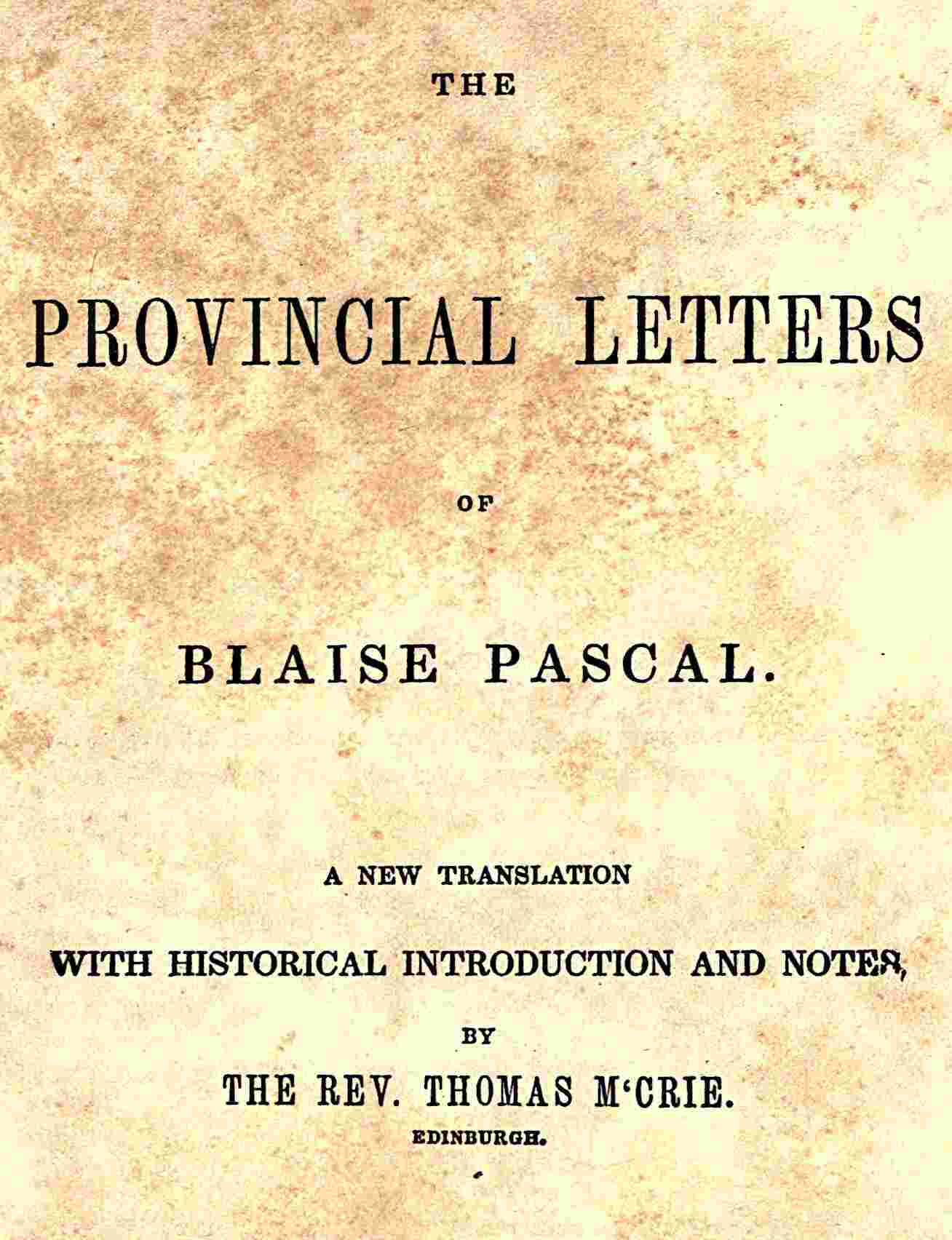
THE TRANSLATOR’S PREFACE.
The following translation of the Provincial Letters was undertaken several years ago, in compliance with the suggestion of a revered parent, chiefly as a literary recreation in a retired country charge, and, after being finished, was laid aside. It is now published at the request of friends, who considered such a work as peculiarly seasonable, and more likely to be acceptable at the present crisis, when general attention has been again directed to the popish controversy, and when such strenuous exertions are being made by the Jesuits to regain influence in our country.
None are strangers to the fame of the Provincials, and few literary persons would choose to confess themselves altogether ignorant of a work which has acquired a world-wide reputation. Yet there is reason to suspect that few books of the same acknowledged merit have had a more limited circle of bona fide English readers. This may be ascribed, in a great measure, to the want of a good English translation. Two translations of the Provincials have already appeared in our language. The first was contemporary with the Letters themselves, and was printed at London in 1657, under the title of “Les Provinciales; or, The Mysterie of Jesuitism, discovered in certain Letters, written upon occasion of the present differences at Sorbonne, between the Jansenists and the Molinists, from January 1656 to March 1657, S. N. Displaying the corrupt Maximes and Politicks of that Society. Faithfully rendered into English. Sicut Serpentes.” Of the translation under this unpromising title, it may only be remarked, that it is probably one of the worst specimens of “rendering into English” to be met with, even during that age when little attention was paid to the art of translation. Under its uncouth phraseology, not only are the wit and spirit of the original completely shrouded, but the meaning is so disguised that the work is almost as unintelligible as it is uninteresting.
Another translation of the Letters—of which I was not aware till I had completed mine—was published in London in 1816. On discovering that a new attempt had been made to put the English public in possession of the Provincials, and that it had failed to excite any general interest, I was induced to lay aside all thoughts of publishing my version; but, after examining the modern translation, I became convinced that its failure might be ascribed to other causes than want of taste among us for the beauties and excellences of Pascal. This translation, though written in good English, bears evident marks of haste, and of want of acquaintance with the religious controversies of the time; in consequence of which, the sense and spirit of the original have been either entirely lost, or so imperfectly developed, as to render its perusal exceedingly tantalizing and unsatisfactory.
It remains for the public to judge how far the present version may have succeeded in giving a more readable and faithful transcript of the Provincial Letters. No pains, at least, have been spared to enhance its interest and insure its fidelity. Among the numerous French editions of the Letters, the basis of the following translation is that of Amsterdam, published in four volumes 12mo, 1767; with the notes of Nicole, and his prefatory History of the Provincials, which were translated from the Latin into French by Mademoiselle de Joncourt. With this and other French editions I have compared Nicole’s Latin translation, which appeared in 1658, and received the sanction of Pascal.
The voluminous notes of Nicole, however interesting they may have been at the time, and to the parties involved in the Jansenist controversy, are not, in general, of such a kind as to invite attention now; nor would a full translation even of his historical details, turning as they do chiefly on local and temporary disputes, be likely to reward the patience of the reader. So far as they were fitted to throw light on the original text, I have availed myself of these, along with other sources of information, in the marginal notes. Some of these annotations, as might be expected from a Protestant editor, are intended to correct error, or to guard against misconception.
To the full understanding of the Provincials, however, some idea of the controversies which occasioned their publication seems almost indispensable. This I have attempted to furnish in the Historical Introduction; which will also be found to contain some interesting facts, hitherto uncollected, and borrowed from a variety of authorities not generally accessible, illustrating the history of the Letters, and the parties concerned in them, with a vindication of Pascal from the charges which this work has provoked from so many quarters against him.