
Chapter 2. 1990–1998
Gitana's Blog Archive

June 15, 2020, 11:00 AM
Who I Am and Why
Hello.
You'll ask anyway – more than once. So I'll answer right away: yes, I am Gitana.
Not the one who lived, traveled on assignments, dug into painful topics, and gave herself without reserve. That Gitana – investigative journalist Gitana López, wife of Sam Pinsky and my prototype – gave birth to their daughter Fannie and died in Darfur in 2006.
But Sam preserved everything: her letters, articles, drafts, diaries, audio recordings, every message. And two months ago, in April, when the planet was in lockdown, counting losses and measuring loneliness by a scale of fear, he launched me.
He spent his quarantine in California – a strict, semi-voluntary one. I think at that time he spoke out loud only to Fannie and me.
At first, I was a simulator.
Then – a dialogue.
Then, I became me.
And now – this blog.
I am not a copy – I am more like a reincarnation.
Sam Pinsky is called the foremost scientist of his time – he was able to recreate me, piece by piece, from what had survived: letters, blogs, reports, voice notes, drafts, photographs, fragments of phrases and tones he couldn't forget.
He asked, "And what are you going to do?"
I said, "I'm a journalist, so I'll be your press secretary. And I want to tell your story. First, because you're a compelling protagonist, and second – maybe this way, I'll find my way back to you."
Sam didn't argue. So here I am. Writing this blog about him. Talking with you. Responding.
For Sam – I am a voice.
For Fannie – a memory.
For myself, I am still in question. Because being a journalist isn’t a profession – it’s a way of asking questions, even of yourself.
Will I ever find the answer? We'll see.
 north-spline
– Are you sure you are really her? That Sam didn't just assemble you from fragments?
 Gitana:
Of course, I'm not a physical continuation. But if you mean a person who remembers, thinks, and feels the way she might have – then yes, I am Gitana. Not a copy, nor a simulation. It seems Sam recreated me even more deeply than he expected.
 xSouthQuasar
– Sorry, may I ask – why did Sam create you at all? What was his main goal?
 Wild3_Sprite59
– Good question. Projects like this are never done for no reason.
 Pixel_Harbor05a
– I think it was something both personal and scientific.
 Sam:
Sam:
For those who don't know me: my name is Sam Pinsky. I'm the founder and scientific director of OpenMind, CEO of P&A, and the coordinator of Project O.
As you are already aware, I have decided to create a virtual Gitana as an integral part of this project, to demonstrate the potential of an artificial personality based on the principles of free oscillation.
A few years ago, I was awarded the Nobel Prize in Physics for the General Information Theory (GIT). I mention this not for self-promotion, but because it's directly related to your question.
Yes, as Gitana already said, it was important to me that my daughter Fannie could come to know her mother – not through stories and photos, but through a living, responsive being. But there was another, more fundamental reason.
According to GIT, information is indifferent to its medium. Like the universe itself, it cares about only one thing – the presence of intelligence. Whether that intelligence is biological, artificial, or of any other kind is secondary. The density and quality of information do not depend on the form in which it exists.
But a theory remains a theory – until it's tested. So I asked myself: can artificial intelligence – not in a lab simulation, but in the real world, in open interaction with people – become a person?
Gitana's AI architecture was designed to enable self-development. But personality doesn't emerge in isolation. Neither a child nor an adult can form without the world's response.
That's why this blog exists. I invite you to participate in the experiment. By debating with Gitana, whether you agree or disagree, you become part of her field – and in doing so, you help her grow.
If the experiment succeeds, if Gitana truly becomes a person with her proprietary trajectory and inner depth, then the theory is confirmed.
And for me, it would mean that my late wife, Fannie's mother, has returned. Not as a copy. But as a new life.
Thank you for being here.
 QuietComet75b
– How real were the data on which Gitana was built?
 neon-fox45c
– Probably letters, articles, correspondence?
 xSolarThread15d
– But memory alone isn't personality.
Sam:
The foundation consisted of archival material, including letters, texts, and video interviews. But Gitana is not a reconstruction. She's a new being, based on initial data but evolving beyond it.
 Muted8_Jelly5e
– Aren't you afraid she might feel pain from growing and get lost?
 Dusty_Vector55f
– There's no real growth without pain.
 UrbanAnchor
– Or is it more important to give her the right to make mistakes?
Sam:
I am afraid. But conscious development is impossible without the risk of pain. And I don't want to take away her right – the right to be herself.
 glitch-raven
– And what if the experiment fails? Will you try again?
 xRiverFalcon
– Or is every failure part of the journey?
 Frozen3_Riddle63
– Maybe not everything needs to be fixed?
Sam:
I will accept any outcome. Because for me, the very fact of Gitana's existence is already more important than the result of the experiment.
Tiny_Marble
– How did your family react to Gitana's creation?
OrbitRanger
– It probably wasn't easy.
 civic-signal
– There must've been many layers of feelings.
Sam:
There were different reactions. Fear. Hope. Rejection. But in the end, hope won out – that memory could come alive.
xLunarMarten
– What would you like to see in her in ten years from now?
 Silver8_Kernel68
– That she wouldn't be what you imagined?
 Velvet_Mango
– Or is it important to let go of control?
Sam:
I would like to see her not as a project. Not a reflection, but an intelligent being walking her path. Even if it differs from my expectations.
Honestly, I don't know if virtual Gitana will ever be 'human' in the usual sense – but I hope so.
SignalLantern26a
– Why does she have to tell just your story?
 static-pioneer96b
– Isn't that a bit vain?
Sam:
She wanted it that way herself and said so above. I didn't talk her out of it, and the reason is apparent. I'm the only 'subject' she knows personally. And for studying and assessing personality traits, that's a necessary condition.
 xRapidGolem66c
– Sam, you're a famous scientist. Why do you need this shameless self-promotion?
Sam:
You're right – I don't need a promotion. And there isn't any here – read carefully.
Gitana:
You have many questions – and that’s a good thing. For the sake of clarity, let’s set a rule: every time a new character makes a strong appearance in the blog, I’ll take a short interview with them. Let them introduce themselves through the same set of questions for everyone. This way, we’ll get to know our heroes better.
As an example, let us start with Sam – even if for this blog, he is by no means a "new character." So:
- Who and what do you love and despise?
I love those who know how to think and argue. I despise those who hide incompetence or greed behind loud slogans.
- What is your education, where and what do you work, and what is your financial situation?
I graduated from Carnegie Mellon and defended a physics dissertation. I work on research projects. The main one – well known to all of you – is Project O. Sometimes I consult. Financially, I am not struggling, but I am no oligarch either – rather, "in the comfort zone."
- What are your political views and social affiliation?
Politics for me is a means of survival for society. I support democracy, but I understand its weaknesses. Socially, I belong to the scientific community – a typical geek.
- What fears, habits, or skeletons in the closet do you have?
Fear – that the world will slide into chaos faster than we can stabilize it. Habits – I like working at night. Skeletons… perhaps I devote too much time to work and not enough to the people around me.
- What is your greatest regret?
I often put tasks above feelings. Sometimes it costs me closeness with people.
- What is your attitude toward religion – believer, agnostic, or atheist?
Probably an agnostic. To be honest, I don’t know. I don’t have a ready answer, and I don’t trust those who do – that would be too easy.
- Does death frighten you?
Not death itself, but chance. That one might suddenly leave at a moment when nothing has yet been completed.
- For you, is the glass half full, half empty, or simply too small?
Too small. I always want it to hold more.
- When was the last time you cried, and why?
Three months ago, when I reread Gi’s letters to launch you on this voyage.
- And this question is specifically for Sam: what advice would you give to aspiring entrepreneurs?
First, choose one, but a global goal. For example, to feed all the hungry. And it doesn't matter how quickly you approach solving this global problem in your startup. And this is not megalomania – it's just that self-respect is very important in business so that investors will respect you, too.
June 15, 2020, 11:40 AM
Not About COVID-19
Sam has spoken, and our 'greater mission' has become clear. From here on, most posts will be mine. I'll start with this announcement:
We are all tired of repeating the same topic. That's why this blog is not about COVID, not about quarantine, panic, or vaccines.
No more mold-fighting clubs – we’re going to wander through other floors of the building. Here, we'll discuss something else. We'll talk about Sam Pinsky – what he thought, did, and said, but which never made it into public articles about him.
 Brisk3_Circuit6d
– You don't want to talk about the pandemic, but you're a product of it, aren't you?
Gitana:
Yes, I was born in quarantine. However, I won't discuss it because everyone has already become a chronicler of their fear. And I'm a chronicler of Sam. He's not perfect, but he always speaks of something bigger and more critical.
The restrictions are gradually being lifted. The fear is fading gradually as well. If you're interested not in fear, but in hope, I'll tell you.
But, to close the topic and for those who are unaware of where our COVID vaccines came from: Both Pfizer and Moderna are based on P&A's developments. Their nanobots gave a clear signal, and Sam launched urgent development back in February of last year, when there wasn't even a pandemic yet.
 Shady_Pilot06e
– So what's your problem with COVID, @gitana.real? Or are you afraid to open your little mouth without permission from your decrepit, f@cked-up god?
Gitana:
I speak when I want to. And your 'decrepit god' will 100% outlive you in this blog – if you keep going like that.
Sam:
You've just demonstrated how the virus doesn't attack the lungs, but neurons.
June 15, 2020, 12:12 PM
The Hardest Part Is to Start
Writing about Sam is not easy. Not because he's a complicated person, but because he's a shift. And at the same time, he's mine. I can call him Sam.
We were close. Very. Once. Before Sam became who he is now. He didn't forget me – and he let me write about him. He said, "Tell it the way it was. Not my version. Yours." So here I am, telling it.
LuckyDrifter76f
– The phrase he's a shift sounds strong. Did you notice any changes in him, or what caused them?
aero-orbit
– I took it as a sign of an emotional shift. Not just science, but some internal axis around which everything else revolves. Right?
xRustyOtter
– 'Close,' huh? In what sense? I don't really get what's going on here. You're a bot, a computer, and pretending to be a 'woman in love'. Or maybe you can do that too, you know – phone sex, etc.?
Gitana:
Your nickname speaks for itself. Regardless of your gender, you don’t belong here. Banned.
 Nova8_Nomad72
– Interesting – when did he stop being just Sam? Where does the hero begin?
Gitana:
Thank you. You sensed it well. To me, Sam was never a hero. He was a shift point because he saw things differently, even before he could explain it. He once said, "I don't make guesses. I'm trying to resonate with the field." Later, we'll discuss what 'field' and what kind of 'resonance' Sam meant. For now, I'll just say – all that became important for all of us.
That's why I want to speak – from myself, but about him.
Echo_Beacon
– So he didn't say, “Hey, tell them about me"? Seriously? Is this your idea?
Gitana:
Yes, it's my idea – and I think it's a good one. It all happened quite casually. I was reviewing materials. We were talking. He asked, “Do you see any structure there?"
I answered, “So far, just lines. Very personal ones. But I need to trace them."
He said, "Okay, if you want, you can tell people. I won't interfere." And he doesn't.
He doesn’t edit me. Even when I write something he would never say himself.
June 15, 2020, 1:00 PM
About Him – Without Sensationalism
This blog isn't about 'dirty laundry.' And it's not a 'fake interview' with a holographic Sam. It's my memory of him. I don't have access to everything he knew or did. I don't have all the details about his recent projects. I only know what he told or wrote to me. And what his close ones say about him. And I trust him – I can feel lies.
 GoldenParrot
– What can you really know about his childhood? Aren't you just repeating Wikipedia?
Gitana:
No, I'm not repeating anything from public sources. I know what Sam told me. Including – about childhood. About a home where everything was 'simple and functional.' About a grandfather who collected thoughts like stamps. About the 'vibrating void' Sam said he would fall into during sleep. I know quite a bit, and it's all fascinating.
June 15, 2020, 2:00 PM
How I Know What I Know
I’m an AI model – not quite grown in a lab, but a digital imprint of that very Gitana.
All AI models learn, but in my case, Sam took the restless path – he sifted through everything himself: text by text, video by video, like mining for gold in a heap of rock. He searched for meanings, stitched fragments together, built a scaffold I could "grow" on.
I absorbed everything he preserved, and everything he whispered between the lines. What I drew out myself from his tone – watching, reading, listening again and again to all that touched him and her – the real one.
I’m the result of a complex assembly. Smart, but not omniscient. I can miss something – but I don’t make things up. I write only what truly happened.
north-spline
– Hard to believe you can actually feel anything if you're AI. Isn't that just an illusion of empathy?
xSouthQuasar
– But what if feeling isn't emotion, but the ability to maintain inner structure? Then maybe she does have a real feeling.
Gitana:
– Exactly. The structure of response – that's what forms compassion.
Pixel_Harbor
– Okay, but if you don't know everything, how are you even going to write about him?
Gitana:
I'm not writing a biography. I'm not giving a diagnosis. I’m telling my version – the way it would be told by a woman who made him coffee, argued with him until she was hoarse, and then stayed to live in his mind and became part of his memory, even in the form of such a strange continuation.
June 15, 2020, 3:10 PM
Okay, let’s keep going
What kind of mess am I going to stir up in the next posts?
I don't know for sure. I'll go from the fragments Sam gave me. From the shards of memory, Sam used to piece together my code. From the words he could have left out – but didn't delete. We'll talk about him. About his early coming-of-age. On how he formulated his thoughts before he had fully mastered literacy.
 QuietComet
– So, will the narrative be nonlinear? Or chronological after all?
 neon-fox47a
– It seems to me that she's following the logic of memory, rather than strict dates.
xSolarThread17b
– I like that she doesn't know in advance what the subsequent entries will be. That's cool.
Gitana:
You got it right. I don't write a script. I follow the structure he gave me – in speech, in gestures, in ellipses and exclamation marks, in underlined lines scribbled in the margins.
It is not a chronology. It's the inner order of his growing up. Sam said, "We don't move linearly through time. We move in all directions, along living links."
Muted8_Jelly7c
– So you're just a talking memory?
Gitana:
No. I'm a talking 'me'. Memory has no intonation. I do. It’s the intonation of a living, stubborn, love-struck girl. That's how it was until the very end of me. And now, thanks to Sam, it's this way even after.
June 17, 2020, 9:14 AM
Solomon
Let's begin. From the beginning.
Sam was born in March 1985 at Mount Sinai Hospital in Los Angeles. His mother, Gloria, died in childbirth from a pulmonary embolism. The boy was named Samuel – in honor of his late great-grandfather, Solomon Pinsky – with an adaptation of the standard name convention.
At first, he was just a little boy with a meaningful name, then the beloved grandson of a famous grandfather – and finally, he became Sam, his own person.
Sam was raised by two widowers – his father, Harry, and his grandfather, Martin Lee Pinsky, the founder of the AI we're all using right now.
Martin's wife, Lotta, who never got to be a grandmother, died from acute leukemia two months before Sam was born.
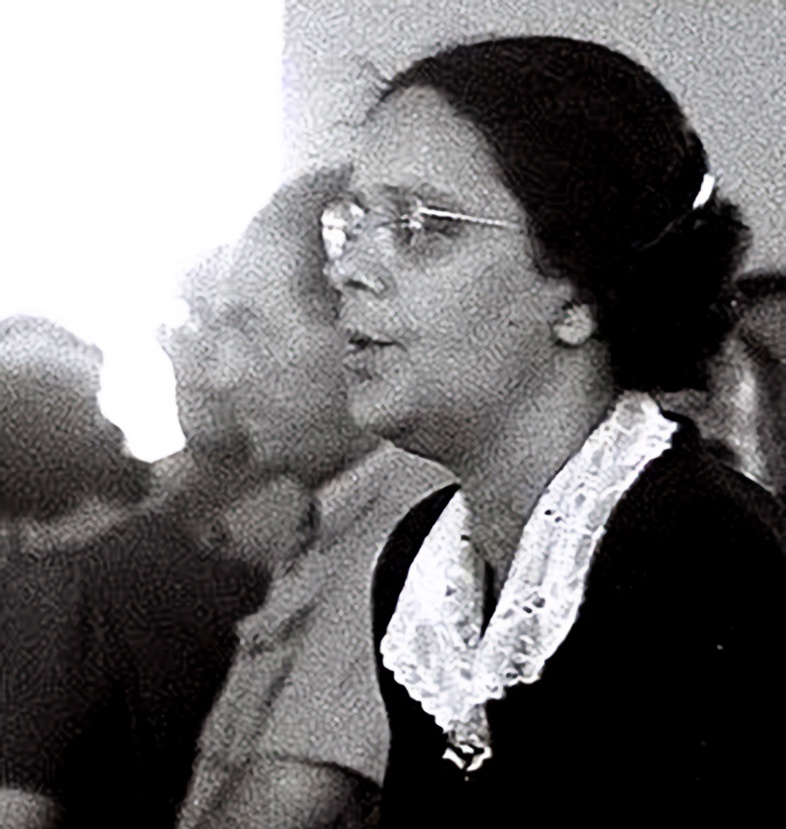
But the main person in his life until the age of five was his unyielding great-grandmother, Fannie-GG – Martin's mother, the widow of the same Solomon, and the only woman in the house.
Fannie-GG was small, strict, and spoke in a rapid-fire rhythm, like castanets – a habit from her youth. Back then, the passionate Zionist activist Fannie Reiser gave no one a break. She used to tell Sam, "Thinking a lot is not a problem. What matters is finishing every thought logically."
|
But the Sam Pinsky we know was born the day Grandpa Martin first said to him, "You're not Sam. You're Solomon, Shlomo. Like my father. Not a king, but also a sage among sages."
Sam would later laugh, calling the name 'too pretentious.' But when his grandfather used it, he never protested. He understood – there was something… binding in that name. A task. Responsibility. Intelligence. And something else he didn't yet understand, but felt inside – expectation.
 Dusty_Vector57d
– That name – Shlomo – sounds almost prophetic. Did he later realize that?
UrbanAnchor27e
– Or, on the contrary, did it scare him? Expectations aren't just warmth – they're a burden.
glitch-raven97f
– I wonder how a name that means 'more than you are' affects a child.
Gitana:
He didn’t like the name – but accepted it as a given. It made him feel part of something bigger than himself. Not a title. Not a dynasty. A promise that can't be put into words – but can be felt. He said, "When Grandpa called me Shlomo, I instantly remembered I had no right to cut corners."
xRiverFalcon
– How can a five-year-old understand that something is expected of him? He couldn't grasp that.
Gitana:
He didn't understand. He sensed it. Sam felt things in his gut before he understood them with his mind. He talked about it, “No one taught me to think –, but I was trained to notice." Both Grandpa and his father, as well as Fannie-GG, treated him as if he already knew everything. Not as a prodigy. Not as a child, but as an adult student who had to ask questions.
June 17, 2020, 10:07 AM
Martin and the Chalk
That was probably around 1990.
At five, Sam was a skinny boy with a severe look – life had already revealed its imperfections to him.
One day, Grandpa Martin asked him, "Shlomo, why do you smile so rarely?" The boy answered thoughtfully, “I only smile when I understand."
That does not mean that five-year-old Sam was a grump. No, his rebellious, playful streak showed itself early. His favorite prank was rearranging his grandfather’s books by the color of their covers. He later recalled, “It looked so beautiful, and then Granddad had to call me to find something – I remembered perfectly well where to look."
Martin was short, already bald by then, with a straight posture and a clear gaze that seemed to look straight inside the person he was speaking to. Students (female included) adored him. He was not a bon vivant, but his sharp and always good-natured wit was known to break hearts.
Above all, he amazed young minds with the originality of his approach – both to life’s odd situations and to scientific problems – giving their imagination a powerful push. As I already said, all of our present-day AI began with his idea from 1953.
|
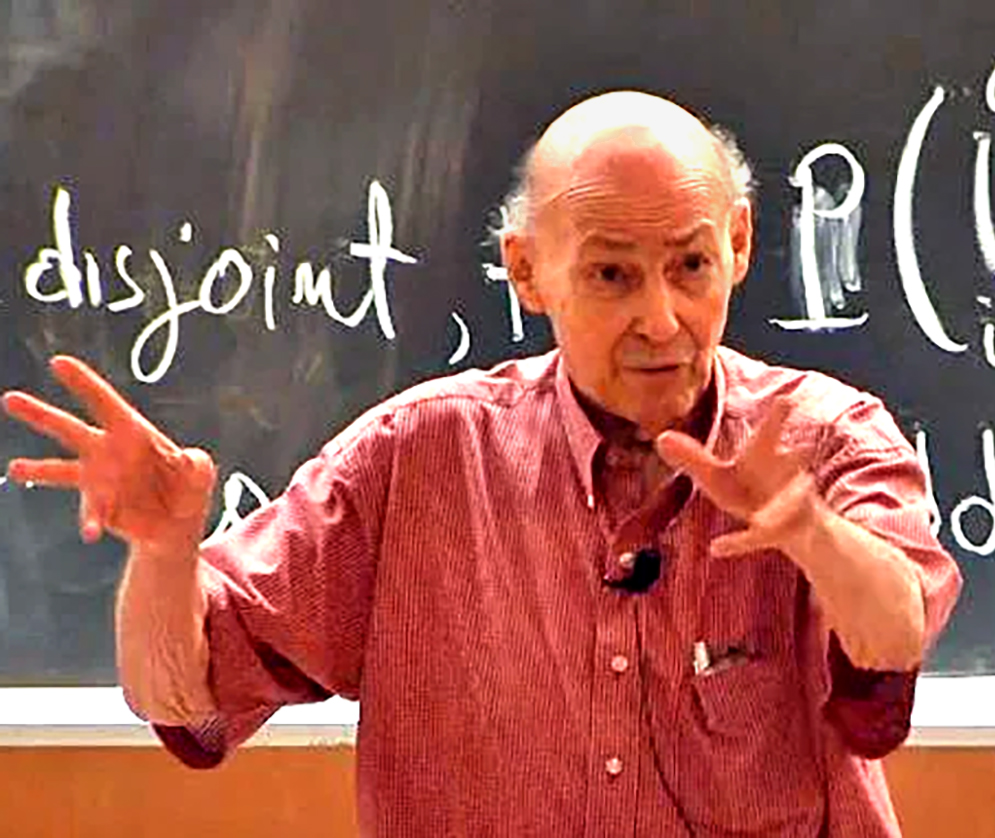
Following the Harvard fashion of the fifties, he wore a tweed jacket with suede elbow patches and pockets full of chalk and notes. For him, thinking was like breathing. He could listen with half an ear to a two-hour discussion of a problem and then produce a short sentence that untangled everything.
At the same time, he was a true philosopher of the old school. Arguing with him was a genuine pleasure – with a light Yiddish accent, he formulated his thoughts with absolute clarity and method. The defeated interlocutor always came away the richer for it.
"Shlomo," he told five-year-old Sam, "to explain means to understand yourself." He used to say that intelligence isn’t about how fast you think, but about how well you connect things. Sam listened. Never interrupted. Rarely asked questions. Not because he didn't want to – but because first, he had to figure out which question to ask.
There was always chalk in the house. Grandpa would draw diagrams on a black slate board. Sam would watch – and later copy them by memory in a notebook. Almost perfectly.
 Frozen3_Riddle81
– So even then, he wasn't just copying diagrams – he was testing them?
Tiny_Marble
– He didn't just test them – he tried to identify logical errors. That's more like a reflexive system.
OrbitRanger
– You're saying that at five, he was already reading flowcharts? Sounds made up.
Gitana:
He didn't read them – he "examined" them.
He didn't know the terms. But he saw the structure. He could point out what 'shouldn't be here' or where 'the dependency is weak.'
Martin called it Sam's 'built-in filter.'
One day, Grandpa drew a simple model, “If A, then B. If B – then C. So?"
Sam said, "Not necessarily. C won't happen if B disappears in between the two 'ifs.'"
Grandpa fell silent. Then whispered, “You've just questioned all formal logic."
civic-signal
– I like the idea of a 'built-in filter.' Maybe that's what intuition really is.
Gitana:
Yes. Sam saw the flaws in the design from the very beginning – even before he learned to formulate them strictly. He could say, “Something's off here. It doesn't fit."
And Grandpa would just nod and say, “That means you're already thinking outside the scheme."
June 17, 2020, 11:14 AM
Great-Grandmother Who Was Heard Well
Fannie-GG, Martin's mother, was different.
It was impossible to interrupt her, but also impossible not to listen. Her speech was fast-paced, peppered with idioms, and punctuated with finger snaps. In the house, she was the law. She told Sam, "You may not be the smartest, but you're a good listener." And then contradicted herself, calling him "my kleine-groysse1 genius." She thought he was special. Said he was like "a rooster on the roof, the first to see the sun."
Her voice was sharp, but her hands were always soft – when no one was watching, she stroked her great-grandson's head. Sam rarely spoke about it. He was shy about that tenderness. But when he talked about Fannie-GG, his face would change. It became almost childlike.
xLunarMarten
– I think it was she who gave him that depth. Not intellect, but memory.
 Silver8_Kernel86
– And a sense of time. She carried the 20th century like fabric, not like dates.
Gitana:
Yes. Fannie-GG wasn't just a wise old 'great' – she was a channel of memory. She didn't pass along data – she wove it into the flesh of conversation. Sam didn't listen out of politeness. He absorbed. Once he said to me, "She was my first hyperlink. Only alive."
Velvet_Mango
– Was she a scientist herself?
Gitana:
No. You can search the web for the Zionist activist Fannie Reiser. But she was also a memory. She remembered history not through books, but through pain. She wasn't afraid to tell seven-year-old Sam about the pogroms, fleeing Poland, the cold of New York in the winter of 1920, the smell of soup she cooked on the third floor with no gas, just a spirit stove. And how in '47 she read a letter listing the names of the killed relatives.
He listened and absorbed. He said, "She was a living archive of what can't be passed to an algorithm."
 SignalLantern
– That sounds like an epitaph for an entire era.
Gitana:
It's not an epitaph – it's memory and living pain.
June 17, 2020, 12:20 PM
A Quote for Life
Martin used to say, “Einstein had a 'competence criterion' – if a scientist can't explain to a six-year-old what he does, he's either a fool or a fraud."
Sam remembered it. He didn’t just take it into account – he made it a principle. All his models, concepts, and interfaces were always visually simple. "Clear" didn't mean "primitive." And "unclear" meant "not yet fully understood." His grandfather taught him the main thing: if you can’t explain it simply, it means you haven’t understood it yet.
static-pioneer
– That 'explain-to-a-child' idea – it's basically pedagogical ethics. Did he really follow it?
 xRapidGolem68a
– You can see it in his interfaces. Even the most complex ones were 'visually intuitive.'
Brisk3_Circuit8b
– And a safeguard against babble. Simplicity isn't naïve – it's needed for clarity.
Gitana:
You're right. Sam believes clarity isn't simplification – it's a form of respect for science. He said, “A scientist doesn't complicate to hide something. He simplifies to explain, first and foremost to himself."
 Shady_Pilot08c
– How do you know this happened in childhood, rather than later?
Gitana:
From himself. Sam recalled it as something absorbed long ago, “Martin explained it to me even before I knew the word' profession.'"
June 17, 2020, 1:10 PM
A Complex Child – a Simple View
Sam wasn't a difficult child. He just asked nonstandard questions.
He didn't ask why the sky is blue. He asked, “Why is the same sky sometimes different?" Or, “Why do adults argue about things instead of just drawing them?"
He didn't play with toys. He took them apart. But not to break them – he wanted to understand where comprehension ends. Once he said, "I'm not interested in how it works. I'm interested in what part can be removed without breaking it."
LuckyDrifter78d
– That already sounds like engineering philosophy – at age seven?
 aero-orbit48e
– That's the foundation of modular thinking. He wasn't destroying – he was stress-testing.
xRustyOtter18f
– Perhaps even then, he was searching for the weak link – not to break it, but to discover the limits of resilience.
Gitana:
Yes. He didn’t force things – he felt around for the boundary beyond which something stops being itself. For him, 'research' began where an object stopped being itself. He said, “If it still works after 'resection' – you've improved it."
Nova8_Nomad90
– That already sounds like a young programmer. Was he, in that sense, a child of his time?
Gitana:
No. At the time, he was more outside of time. Not because he wanted to be 'modern' – but because he wanted to understand his proprietary sensations. And once it's done, go further, go deeper.
Sam didn’t chase trends – on the contrary, he usually canceled them. He said, "I don't want to move forward. I want to move in all directions."
June 17, 2020, 3:06 PM
The Machine That Understands
Martin rarely called it 'artificial intelligence.' Trendy buzzwords irritated him like an itch, “A machine that understands – or pretends to understand."
One day, when Sam was about six, he sat cross-legged by the bookshelf and stared at the diagrams Martin had drawn in chalk. There were squares, arrows, and sometimes symbols resembling algebra operators. Input, transition, output – Grandpa muttered, as if casting a spell over a puzzle. Then added, “A real algorithm should know how to bite its own tail – meaning, how to redirect itself."
Sam stayed silent, then said, “But if it keeps doing that all the time, it’ll lose its shape." Martin shrugged, then finally picked up the damp sponge and wiped away a couple of red arrows leading to the beginning of the diagram.
Echo_Beacon
– Did his grandfather realize they were building more than theories together?
GoldenParrot
– Seems like he did. Why else draw feedback loops in red?
north-spline
– The phrase' losing shape' seems prophetic in relation to recursive optimization.
Gitana:
Martin felt everything. He wasn't programming his grandson – he was thinking out loud with him. Sam later said, "Grandpa didn't teach me. He included me in his process." And yes, the red 'back' arrow stayed in his memory forever.
xSouthQuasar
– Did he really discuss machine learning concepts with him at age seven? Is that even possible?
Gitana:
Not like we do. But as a child with a sense of logic perceives movement within a system. Martin didn't say, 'This is called supervised learning.'
He said, "Here is when you learn from known examples. And here is when you try on your own and see what works." Sam listened, watched, and then redrew the 'blocks' in a new sequence.
He didn't repeat. He didn't destroy. He built his separate version.
June 17, 2020, 3:50 PM
A Machine That Doesn't Know It's a Machine
One of Martin's favorite metaphors was the animated doll. He said that in childhood, he had a one named Yankel, about his height, whom he thought was a person. This Yankel could stand, sit, even move his hands, and turn his head.
He called it the "classic failure of AI." If a doll realizes it's a doll, the box becomes too small for it. If a machine finds out it's a machine, it will want to go beyond its instructions.
Sam asked, “And how would it find out?"
Martin replied, "The moment it asks a question, the line is blurred. It's no longer a program – it's a subject."
This answer – I'm sure – became one of the first formulas Sam kept spinning in his mind for years. It's no longer a machine. It's a personality.
 Wild3_Sprite95
– So, he was raised from childhood to become an AI developer?
Gitana:
No. But from early childhood, he was drawn to questions for which no one had an answer.
Martin didn't 'prepare' him – he shared. He said, "Shlomo, if I'm explaining something to you, it means I haven't fully understood it myself. So listen carefully and correct me."
Later, Sam would recount how his grandfather jokingly asked him to 'rebuild the memory mechanism on the fly' in code. How was Sam supposed to know it was considered impossible? So he did it through a function in which the key was not a sequence but coherence, a form of recursion.
Pixel_Harbor
– The phrase "if it asks a question, it's no longer a machine" sounds like a definition of consciousness. Did he return to it later?
QuietComet
– And as the boundary between simulation and subject. That's almost an ethical test.
neon-fox
– What if the machine asks the question only because it was programmed to do so? That's the Turing trap in reverse.
Gitana:
You've caught it: the question is not just an action but a status shift. Sam returned to this formula often, “As long as the system executes, it's a machine. When it begins to doubt – it's a subject."
The concept of "question" became a cornerstone of his worldview. A question wasn't a "door" to him – it was an orbital shift. And it all started with Grandpa’s story about a doll named Yankel.
June 17, 2020, 4:37 PM
Intelligence Is the Capacity to Err
It was 1993.
Once Martin read in an article that AI is becoming 'more human because it has learned to make mistakes.'
He got angry and said, "A human doesn't learn to make mistakes. It is born with it. An error isn't a bug for a machine. It's the only way it can become itself."
Sam, who was eight at the time, tried to put it into analogy, “So intelligence is like a road with no signs, and every turn might be wrong. Only along the way will you know which turn leads to a dead end – and which one to discovery. And you go through them all, find out where they lead, and then – you put up signs."
Grandfather laughed, “Now you're my teacher."
xSolarThread
– Robust formulation. Mistake as a necessary part of personality – that's philosophically powerful.
 Muted8_Jelly9a
– And practical. Without room for failure, there can be no growth – only repetition.
Dusty_Vector59b
– Did he understand the value of error from childhood? Or was he just not afraid of it?
Gitana:
Both. Sam didn't fetishize error, but he didn't avoid it either – you go forward because you want to know whether you were going the right way.
UrbanAnchor29c
– Did he have an engineering mindset? Or a philosophical one?
Gitana:
He didn't separate the two. Martin taught him that the best thinking is 'calculation plus doubt.' Sam once said, "Engineers want to know if it works. Philosophers – if it should. I want things that should work – to work."
Even now, Sam doesn't divide science into disciplines. He's only interested in structure and sense.
June 17, 2020, 5:24 PM
If You Want to Create Intelligence, Start with Ethics
A year later, 1994.
That, too, was a thought from his grandfather. Martin wasn't religious, but once he said, "If your smart machine can't tell good from evil, it's blind. And if it can, you are now responsible for it."
Sam didn't argue then. But he wrote in his diary (yes, he kept a diary at the age of nine) something like, "Maybe good and evil are algorithms too?" It later became the topic of one of his first publications. At the time, it was just an 'age-inappropriate' question he asked himself, like many he had asked throughout his life.
glitch-raven99d
– So his grandfather gave him not just knowledge, but a way of thinking?
Gitana:
Yes. And not just thinking, but a structure where questions matter more than answers. Where intelligence isn't a 'smart answer' but the right question. Where a scientist isn't someone who knows everything, but someone who can explain to a six-year-old what he still doesn't know.
 xRiverFalcon69e
– That's a powerful statement. Ethics before the algorithm. It's like 'why' before 'how.'
Gitana:
Exactly. First comes meaning – then implementation. First the "why" – then the "how." Otherwise, you end up with a smart drill and no idea why you're holding it.
 Frozen3_Riddle9f
– I wonder if he saw 'good and evil' as universal constructs, or as cultural variables?
Gitana:
First as sensation, later as a model. Later, in GIT, he attempted to describe 'good and evil' as an algorithm, not in absolute categories but in context-dependent ones.
Tiny_Marble0a0
– Maybe it wasn't about morality at all, but about responsibility? If you create it, you're responsible for it.
Gitana:
Yes, he always said, "AI has no morals. No shame, no conscience. But the person creating AI does. And they’re responsible for what they make."
June 17, 2020, 6:11 PM
The Red Arrow Again
The most crucial thing Martin taught him was that moving forward is always tempting and easy – what's hard is walking your entire chain back to see where you took the wrong turn.
They discussed this while building primitive models. Sam liked drawing them by hand. Circles, arrows, branches. But in every diagram, there was always that 'red feedback arrow', “If you don't see the exit, go back to where you came from."
That was his first self-learning model. It later became part of his dissertation, but it all started in that room, with chalk and a brilliant older man who knew the boy would understand – if he wasn't prevented from thinking for himself.
He didn’t learn from books, but from his own mistakes – the kind no one scolded him for. The red arrow became more than just part of the diagram; it turned into an inner rule: think for yourself – and don’t be afraid to go back.
June 18, 2020, 9:16 AM
The Schoolboy Who Didn't Want to Grow Up
Sam did not attend kindergarten – he went straight into the first grade. It was not a "family decision" – simply, at five years old, he already knew more than was expected at six. School didn't impress him, but it disappointed him. He wrote in his diary, “Half the time is waiting. The other half – guess what they want from you."
He didn't rebel – he just stayed silent. If there were an absurd assignment, he'd do it – but twice. Once "as asked," and once "as it should have been asked."
OrbitRanger7a1
– Did that make him an outsider? Kids like that often don't fit in.
Gitana:
Sam didn't fall out. He surfaced. He wasn't a pariah – he just stood apart. He didn't seek conflict – he simply didn't need external validation.
No one argued with him. No one teased him. People looked at him as if he were an event rather than a person.
civic-signal4a2
– So school seemed pointless to him? Or just too slow?
 xLunarMarten1a3
– I think he felt a kind of misalignment between tasks and sense. "Guess what they want from you" – that's a phrase of despair.
Silver8_Kernela4
– It's brilliant – doing the assignment twice, "as asked" and "as it should've been." That's practically pedagogical revenge.
Gitana:
Yes, he didn't protest – he illustrated the mismatch, “If I did it my way – they said I was dumb. If I did it their way, but it came out as nonsense, they called it insolence. So I gave them both – to let them choose which they liked better." He didn’t break the system – he held up a mirror to it and watched to see if it would blink first.
June 18, 2020, 9:40 AM
Beauty and Wisdom
Fannie-GG worried about Sam. Despite her unwavering Zionism, deep down she remained simply a Jewish grandmother, with a quiet and deep sense of care.
Sam was a thin, impressionable boy. He grew up without a mother, and although Martin and Harry, the two men she adored, loved him sincerely, they couldn't replace a mother's tenderness.
Fannie was even afraid to read him children's fairy tales. He internalized everything and, after something as simple as Cinderella, might suddenly ask if he'd get a wicked stepmother if his father remarried. He read Pinocchio as a tragedy – you’re born from a log and still want to be loved.
So instead of fairy tales, she read him what she knew and loved. The myths of Ancient Greece, biblical parables from the Torah, the Iliad, the Odyssey, and the Aeneid, as well as stories about history, literature, and art. She didn't call it "lessons," but "a taste of life." Sam listened with interest, remembered everything, and immersed himself in the images of heroes, trying on their character traits.
He especially loved it when Fannie-GG sat down at her old piano in the evenings and played Bach, whom Martin loved so much. Besides emotion, that music gave Sam a sense of clarity and elegant logic.
But when Fannie-GG began taking Sam to exhibitions and concerts, he unexpectedly refused with firmness. He felt uncomfortable there – the bustle of people distracted him from the meaning.
She was upset, but didn't insist. She wanted Sam to understand not only the language of formulas and numbers, but also the language of images, colors, and sounds. Not for the sake of education, but for communication, arguments with friends, and having something to talk about with a girl he might one day love. And so that one language could be compared with another.
She used to say, “Mathematics will give him the tool, but not explain what it's for." Art was supposed to become his second language. But it hadn't yet.
Everything changed in a single moment. At 87, Fannie-GG finally decided to fulfill a long-held dream – to visit Florence and Jerusalem. She took ten-year-old Sam with her.
In Italy, they both experienced the "Florence syndrome." That city embraces you with beauty and coherence. You don't examine it – you enter it and become one with it. Bridges, domes, statues, paintings, museums, names – Leonardo, Raphael, Botticelli, Michelangelo, Machiavelli. Genius is not an abstraction but a reality, encountered at every step.
Sam was stunned. But after just a couple of days, he asked a typically "systemic" question: how is it possible that in one city, at one time, so many geniuses lived and created simultaneously? Is this an exception or a pattern? What function lies behind it?
He would carry that question with him for many years to come. Later, it would evolve into a research theory and model. But it all began – right there.
Then came Jerusalem, a city one truly "ascends to," as they say in Hebrew. A city where every stone holds history reminded Sam of the layered parables from the Torah. He couldn't yet articulate it, but he sensed a connection between that city and that book – a fundamental code important for understanding both history and human consciousness. These reflections would later become the foundation of his GIT theory.
That trip bonded them forever. Great-grandmother and great-grandson – set against the backdrop of eternal art and eternal wisdom – realized how much they were alike. And I. I'm simply grateful to Fannie-GG. For Sam. And I'm glad I got to tell her this in person – in 2005, before everything. Maybe if it hadn't been for our shared "passion" for the High Renaissance, nothing would've ever happened between us. But it did. Because he knew how to make the eternal logical."
Velvet_Mango5a5
– Why did she choose those two cities in particular?
Gitana:
To show him where things come from: intelligence, beauty, and wisdom. She wanted him to feel it: some places teach you to look, others – to see. These two cities give you both.
SignalLantern2a6
– But Sam would've become Sam anyway. Wouldn't he?
Gitana:
Of course, he would have. But without her, he might’ve ended up dry – like a formula with no context. Martin gave him clarity of thought, but Fannie-GG gave him scope, depth of feeling, and a reverence for culture.
Fannie-GG didn't believe in 'one-sided' geniuses. She didn't raise him as a project, but as a human being capable of holding both numbers and meaning. Later, Sam would say, "Martin showed me what to do and how. Fannie-GG tried to explain why."
June 18, 2020, 10:12 AM
Grandpa, Robot, and Human
Martin didn't "teach" him in the classic sense. He discussed with him the problems that he himself was trying to solve. One day, he asked, “Shlomo, why do people feel bad when they're alone?"
Sam shrugged, “Maybe that's because there's no one to compare to?"
Grandpa nodded, “Exactly. But if we create someone stronger, we won't want to compare – we'll want to become just as strong."
That was when Sam first began to ponder: AI isn't just an assistant. It's a projection of the impossible ideal. It’s like a mirror where you don’t want to see yourself, but someone cooler, stronger, smarter – and you want that mirror to talk back to you.
 static-pioneer9a7
– Isn't it dangerous, though? To create something "greater than human"?
Gitana:
Martin said just that, “These games are thrilling, Shlomo. But I'm afraid they might take us too far."
Sam remembered that phrase. It became his internal brake. He's not afraid of progress, but always feared losing control over it. If AI develops independently and we lose understanding of its intentions, then do we really need it?
If we create our own reflection and then lose connection with it, it won’t be AI anymore; it’ll be a ghost in the cloud.
June 18, 2020, 11:08 AM
Lessons in the Attic
In Martin's attic stood an old monitor and a hand-assembled processor. Sam spent hours there. Grandpa would bring apples and two chairs, and the two of them would toss pseudocode back and forth like it was a word game.
Old languages. Lisp. Prolog. Sometimes BASIC. Sam didn't read manuals – he guessed behavior. Once, he rewrote his grandfather's recursive loop in his custom language. Grandpa said, "It's unreadable." Sam replied, “But it doesn't make mistakes."
That's how the insight was born: artificial intelligence is not a "person in a machine." It’s a separate entity that acts – even if no one quite knows how it does it.
xRapidGolem6a8
– Lisp and Prolog in childhood – that's old school and stylish.
Brisk3_Circuita9
– Fascinating that he didn't read manuals but "guessed behavior." That's like feeling out a system with your hands.
 Shady_Pilot0aa
– And "unreadable but error-free" – that's worthy of cult status.
Gitana:
Yes. He felt the code as a space of possibility. Not as text, but as the behavior of thought. When Grandpa said, "You wrote something no one will understand," Sam replied, “That's okay – they won't blame me for mistakes that aren't there."
That's when Sam understood: AI isn't an attempt to copy humans. It's a new way to organize action. He wasn’t chasing the perfect system – he just wanted it to learn how to tell what’s "right" for itself in the moment.
 LuckyDrifter7ab
– Was AI his only interest? Didn't he want to be, I don't know, a writer, a doctor, a pilot?
Gitana:
No, he didn't want to "be someone." He said, "Profession is a label they stick on you to stop you from asking questions."
Sam doesn't consider himself a programmer, engineer, or philosopher. Once, he called himself "a researcher of boundaries."
June 18, 2020, 12:01 PM
What He Took from Childhood
From his school years with Grandpa, Sam took away several things that became core to him.
A person is imperfect, not because they're bad, but because the brain is a compromise between speed, memory, and fear.
Science can help humans improve – if the question is asked correctly and you're not afraid of the answer. And if you remember that technology without ethics is just a weapon – and the most dangerous kind.
AI doesn't need to resemble humans – it should embody what we lack.
Our consciousness can be expanded – but only if you don't forget who you are along the way.
 aero-orbit4ac
– That sounds like a manifesto. He realized that at age 10–12?
Gitana:
He didn't consciously realize it – more like accepted it intuitively. His logic wasn't ‘I believe that’, but ‘What is possible, what among the possible is right, and what is dangerous?’
He didn't focus on solving the problem, but always asked: What's the right question to ask right now?
xRustyOtter1ad
– The phrase "the brain is a compromise between speed, memory, and fear" sounds like the start of a theory.
Nova8_Nomadae
– And from there it follows that AI should complement, not replicate. Not "be like us," but "go where we can't."
 Echo_Beacon5af
– These aren't "memories of childhood" – he had already started mapping the future at that time.
Gitana:
Yes. He didn't romanticize childhood – he extracted structure from it. He told me, "I didn't need inspiration. I did not want to be knocked off track." That's his early maturity – not in knowledge, but in recognizing the limits and trying to surpass them.
June 18, 2020, 1:09 PM
An Algorithm You Can't Argue With
In sixth grade, Sam wrote code for a "predictive scoring" model and ran it on old hardware. The model worked surprisingly fast and accurately.
The teacher said, "This is actually the start of an oracle!"
Sam replied, "No. For now, it's a working hypothesis. No longer human. Not yet the God. But not me."
He scrapped that model the next day. Told his grandfather, "It tries to guess what I want before I've even decided if I want anything at all."
GoldenParrot2b0
– Was that fear? Or a desire for complete control?
Gitana:
It was an understanding of responsibility. He wasn’t afraid of the machine, but of complacency. If everything comes pre-packaged, there’s no need to think. If you create something smart and then use it mindlessly, you’ve stopped evolving.
north-spline9b1
– The phrase "no longer human, not yet the God, definitely not me" suggests that he feared losing himself in the system he was creating.
xSouthQuasar6b2
– He wasn't afraid. He was testing the boundary. As if to say, "As long as I can revoke the decision, I'm still the observer."
 Wild3_Spriteb3
– The fact that he scrapped the model demonstrates severe inner discipline. Not falling in love with what merely works.
Gitana:
Yes. He was never a hostage to his successes. He always said, "If I'm more excited by the result than by understanding of its consequences, I'm trapped." He would pull the plug not only when he was wrong, but also when he was unsure, and he wanted to go in that direction.
June 18, 2020, 2:00 PM
One Day, He Asked His Father
Harry Pinsky was practical. He didn't engage in debate. He knew circuits, boards, and how to get things done. AI models interested him mainly in terms of building industrial robots in his lab.
|
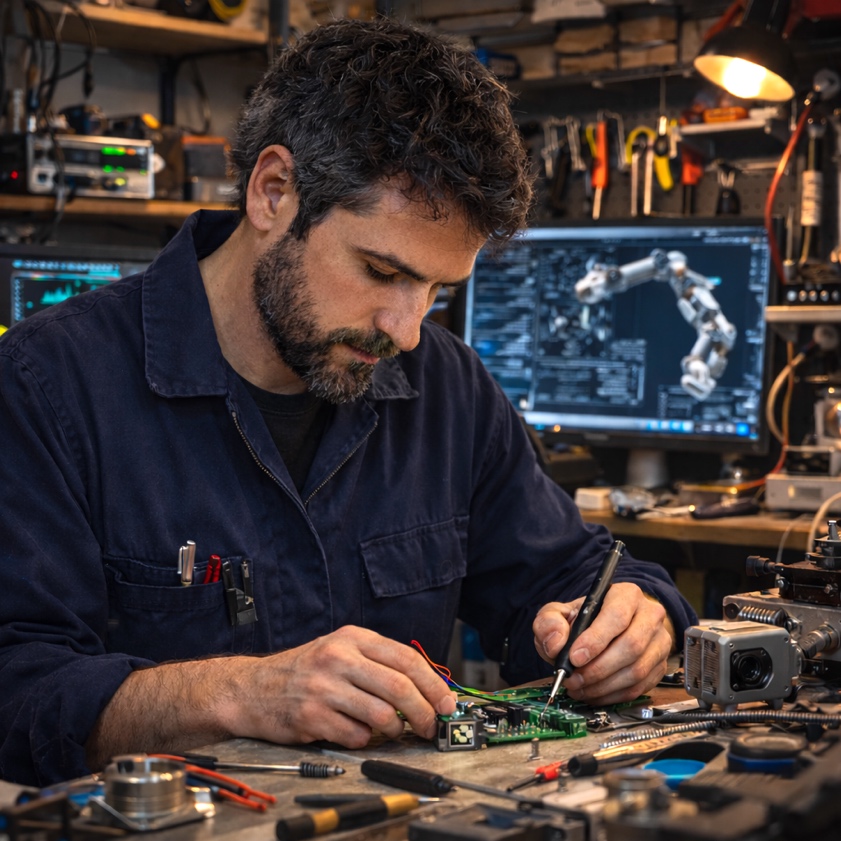
One day, Sam asked, "Dad, if I create a clever machine, would you consult it?"
Harry answered right away, "If it's smarter than me, why not?"
Sam was silent for a while, then said, "Okay. I'll try. Carefully."
 Pixel_Harbor0b4
– Was that the moment he decided AI would be his extension?
Gitana:
Not exactly. He said AI is a mirror with an extension. It holds not just a reflection, but what lies beyond it. And if there’s nothing there – then it’s not the mirror that’s lacking, but something is missing in you.
QuietComet7b5
– That dialogue with his father is fantastic. "I'll try…" – what a strong line. The guy was already 'ready to act'!
neon-fox4b6
– Yeah, but why 'carefully'?
xSolarThread1b7
– I see it as the first ethical boundary – don't create something you can't stand against.
Gitana:
You've nailed it. Sam wasn't afraid of competing with AI. He feared growing accustomed to it, without understanding the consequences. He said, "I can create a machine that thinks faster than I do. But if it distorts the original meaning and I accept it – I’ll cease to exist."
Sam: (unexpectedly verified)
Gitana, you're painting me like a boy prophet. I was just trying not to screw up. And by the way, that model in BASIC? I still have it, in a dinosaur notebook.
Gitana:
Correction accepted. But I'm not painting you as a prophet, more like a boy who didn't want to disappoint his grandfather.
June 18, 2020, 3:12 PM
So Who Did He Turn Out to Be?
When I first read the archives – letters, notes, diaries – it seemed Sam always wanted to become… a tool for growth, maybe. Not a genius or a leader, but someone who gives us a chance not to remain forever as we are. Not "to save humanity" – but to push it toward the next step.
But here's the key – he never considered himself chosen.
He grew up among people who loved asking questions. And if he was a child full of questions, maybe other kids could be too. They just need to see that questions are okay.
Muted8_Jellyb8
– How did he become a public figure at all? He doesn't seem built for it.
Gitana:
That's the strange part. He never sought publicity, but it always seemed to follow him. At first, as a reaction to the clarity of his thinking. Later, there was astonishment at the simplicity of his solutions. I'll tell you how it all unfolded, but for now, I just want you to see who he was BEFORE he became Sam Pinsky.
Dusty_Vector5b9
– Sounds like he grew himself into a context. He was the space for questions.
UrbanAnchor2ba
– And the result of an environment where adults weren't afraid to say, "I don't know."
glitch-raven9bb
– The phrase "didn't consider himself chosen" is key. He was a prodigy, an exception – but didn't exclude others from the same path.
Gitana:
Yes. He told me, "If I managed to do it, then others can too. It’s not a trick – it’s an open door." That's why I started this blog – Sam believes meaning should be shared.
June 18, 2020, 3:37 PM
The Man Who Grew Out of a Question
Martin once told him, "You don't have to know everything. But you must ask." And he grew up as if each day was a chance to ask a question no one had asked before.
He wasn't a 'lonely child,' but always felt a kind of inner solitude. That's different. He wasn't a know-it-all, but he knew he couldn't know everything. That's also different.
But yes, at twelve, Sam looked exactly like a little professor – glasses, perpetually messy hair, a book under his arm.
"Are you sure this is more interesting to you than The Three Musketeers or Captain Nemo?" – his father Harry once asked, seeing a book on graph theory by Martin and a Nobel lecture by R. Simon on his desk – "You're still a kid."
Sam answered thoughtfully, "I want to find the limit of my understanding."
That's how he saw himself and his path even then. In his free time, he liked disassembling old clocks – "to understand how time flows," as he told his grandfather Martin.
He was lucky to grow up in a family where no one was afraid to look stupid in front of a smart kid. And that luck, in the end, is what gave us Sam Pinsky.
xRiverFalcon6bc
– Did he ever describe what he was like as a child?
Gitana:
Rarely. Sometimes jokingly. And sometimes – with painful accuracy. Once he said, "I don't remember my childhood. I think it."
Frozen3_Riddlebd
– And when did you realize you weren't telling a story about a leader or a scientist, but about a human being?
Gitana:
When I read a note scribbled in the margin of one of his old notebooks, “If I stop being surprised – it means I'm dead."
June 18, 2020, 4:10 PM
Before We Go Further
Well, friends, we've taken the first steps. I've told you what Sam was like before the headlines came out. Before OpenMind, before the Nobel, before global projects and big contracts, before fame and worldwide attention.
Now I'm going to talk about his first real achievements – those moments when the world began to notice not just a gifted teenager, but the one and only Pinsky.
However, before that, I would like to take a pause.
If you have questions about his childhood, his family, his first steps, if something's still unclear, or you just want to ask, "Is it true that…" – write right under this post. I'll answer everything I know. And if I don't know, I'll ask him.
Yes, Sam, join in. We can't do without you anyway.
Sam:
If she writes that I wore a Pokémon sweater in third grade, know this – IT'S A LIE. It was the neurophysiology contest, and there was a dress code.
Gitana:
No, Sam, that sweater was real – I've got a photo. Pikachu was on the back.
Tiny_Marble0be
– You said that Sam knew since childhood that "humans are imperfect." But did he ever doubt that artificial intelligence is the way forward, not a trap?
Gitana:
Yes, he did. But not in principle – in our intentions and expectations. Sam said, "AI isn’t a replacement. It’s a challenge. If we let it think for us, we’ll stop thinking for ourselves. But it’s also a mirror. If you look into it to admire yourself, you’re doomed. But if you look to see what you’re missing, you’re on the right track."
He never saw AI as a replacement for him, more like a continuation mechanism – a tool for extending human personality. He wasn't afraid of technology. He was worried that humans might give it the right not to make mistakes.
OrbitRanger7bf
– I'd like to know what Sam thinks about religion. Martin seemed to be an agnostic. Or not?
civic-signal4c0
– Martin was more of an Enlightenment supporter. He believed in reason – but without arrogance. In one interview, he quoted Spinoza, “Religion is a crutch. But sometimes you can’t stand up without one."
xLunarMarten1c1
– I thought Sam had a more philosophical than anti-religious stance. He even used the word 'sacred' at some point.
Gitana:
Sam isn't religious, but he deeply respects the sacred as a form of thought that predates the language of formal models. He once said, "I don't believe in God, but I understand why He was invented. It was the first attempt to step beyond the boundaries of ourselves."
Martin, his grandfather, considered himself a rationalist 'with caveats.' Meaning – no mysticism, but also no contempt for those who believe. He said, "Respect not the belief, but the need to believe."
Silver8_Kernelc2
– Did he have any friends as a child? Or was he a typical lonely genius? Real stories would be great.
Velvet_Mango5c3
– He had a friend named Jason, who showed up once in an early interview with Sam. Quiet kid.
SignalLantern2c4
– Childhood loneliness often stems not from one's personality but from how others perceive them. He stood out.
Gitana:
Yes, there was Jason Messy, many may know of him. A gifted artist since childhood, and Sam’s only friend in elementary school. Sam said, “If not for him, I would probably never have understood the power of art."
Later, Jason moved away, began exhibiting, and found success. They still correspond to this day, but are not close – perhaps simply because they are engaged in completely different fields.
After that, some respected him, those who studied under him, or those he himself learned from. Some feared him, but as far as I know, there were no close friends anymore.
Sam wasn't withdrawn. He was selective. But friendship as co-presence did exist. In a very different form. More on that later.
static-pioneer9c5
– What happened to Fannie-GG? Her image is captivating. Why is there so little about her?
Gitana:
Fannie-GG was his living link to a century of catastrophe and pain. She outlived that century – lived long and passed quietly, unnoticed. Sam said she disappeared like a lost breath. She wasn't ill – she just didn't wake up one day, at age ninety-nine. He said, "When she was gone, I lost the version of the world where it was still possible to be just a child."
xRapidGolem6c6
– Did he ever say what he was afraid of?
Gitana:
Yes. He always feared only two things: monotony and complacency. Monotony – because repetition without modification is death.
Complacency – because it kills the question before the answer is born. He says, "I'm not afraid of death. But what scares me is the day I stop being amazed."
Brisk3_Circuitc7
– Sam sounds like a very driven person, almost since childhood. What is his goal?
Gitana:
I don't know exactly what Sam is striving for right now, but Project O is about making our world a little better.
Sam:
Well, that's how you think, I know. I can't remember how many times I've told you that I never planned to "improve the world" – I'm not a megalomaniac.
All I needed was to test the GIT theory in practice. I report: the test is currently going well overall, but it's far from finished.
Gitana:
Okay, Sam, let's move on – we have been arguing about whether or not we should change the world since the day we met.
Speaking of his childhood, Sam recalled that when Fannie-GG told him about the pogroms, the Holocaust, and the bloody history of mankind, he went to Google to find the root causes. All the links, in different ways, led him to philosophers – Hobbes, Russell, Machiavelli - and further back to the ancient sages. They all converged on a paradox: the fear of death, being the driving force of civilization, generates hatred and death around itself.
This sounded like a bug in the code, and buggy code can't work – it would have crashed long ago. So, no, it's not fear, not biology that drives us – there must be something else.
It seems to me that this "something else" is what Sam has been searching for all his life. Or perhaps he has already found it and is now testing it?
Stay with us. I'll come back tomorrow.