
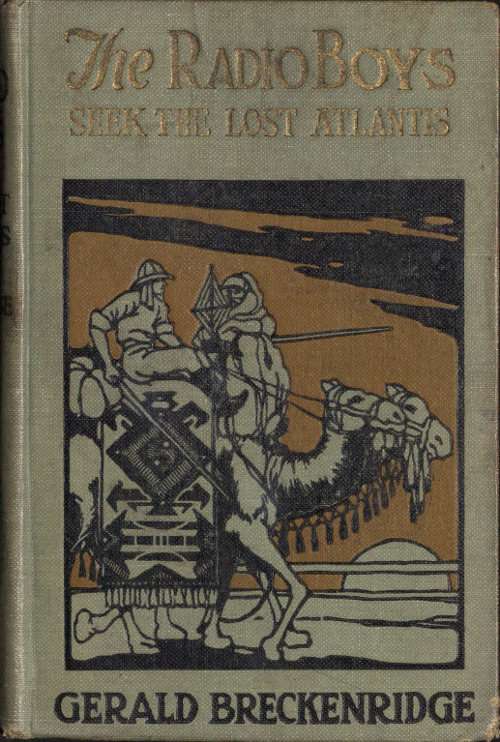
The Project Gutenberg eBook of The Radio Boys Seek the Lost Atlantis
Title: The Radio Boys Seek the Lost Atlantis
Author: Gerald Breckenridge
Release date: March 28, 2017 [eBook #54446]
Most recently updated: October 23, 2024
Language: English
Credits: Produced by Stephen Hutcheson and the Online Distributed
Proofreading Team at http://www.pgdp.net
“Suddenly I heard the Professor’s voice just as if he were right out there on the desert.”
THE RADIO BOYS
SEEK THE LOST ATLANTIS
By GERALD BRECKENRIDGE
Author of
“The Radio Boys on the Mexican Border,” “The Radio Boys with the Revenue Guards,” “The Radio Boys on Secret Service Duty,” “The Radio Boys Search for the Inca’s Treasure,” “The Radio Boys Rescue the Lost Alaska Expedition,” “The Radio Boys in Darkest Africa.”
Frontispiece
A. L. BURT COMPANY
Publishers New York
THE
RADIO BOYS SERIES
A SERIES OF STORIES FOR BOYS OF ALL AGES
By GERALD BRECKENRIDGE
- The Radio Boys on the Mexican Border
- The Radio Boys on Secret Service Duty
- The Radio Boys with the Revenue Guards
- The Radio Boys Search for the Inca’s Treasure
- The Radio Boys Rescue the Lost Alaska Expedition
- The Radio Boys Seek the Lost Atlantis
- The Radio Boys In Darkest Africa
Copyright, 1923
By A. L. BURT COMPANY
Made in “U. S. A.”
PREFACE
Dear Boys:
One of the greatest, if not the greatest story of all the ages, is the legend of Atlantis. According to this legend, there existed at one time a great continent in the Atlantic Ocean not far west of the Pillars of Hercules, those two great rocks of Gibraltar in Spain and Jibel Kebir in Morocco which guard the entrance to the Mediterranean.
The legend says that this continent was the first region in which man rose from barbarism to civilization, and that in the course of ages it became a populous and mighty nation from whose shores immigrants went out to settle the shores of the Gulf of Mexico, the valley of the Mississippi, the valley of the Amazon, the Pacific coast of South America, the shores of the Mediterranean, of the Baltic, the Black Sea and the Caspian and the western coast of Europe and Africa.
From this continent, continues the legend, the first colonists penetrated western Africa clear to Egypt where they took root in the Nile valley and developed what is today conceded to be the earliest known civilization.
Many other startling statements are made in this legend. For instance, it is said that the civilizations of the Incas in Peru and the Mayas in Central America, like the civilization of Egypt, were derived from Atlantis through immigration; that the Atlanteans were the first manufacturers of iron, and that the implements of the “Bronze Age” in Europe were derived from them; that the Phoenician alphabet, parents of all European alphabets, was derived from Atlantis, bearing a startling resemblance to the alphabet of the vanished race of the Mayas in Central America, whose ancient cities are just this very day, as you can read in your papers, being unearthed; that the gods and goddesses of the ancient Greeks, the Phoenicians, the Hindus and the Scandinavians were merely the kings and queens and heroes of Atlantis, about whose real historic actions the migrating Atlanteans remembered stories which eventually went to create the mythology of their descendants.
There is much else of this sort, all culminating in the great outstanding feature of the legend which is that Atlantis was destroyed in a terrible convulsion of nature, and sank beneath the ocean with almost all its inhabitants, leaving only a few of the loftiest peaks sticking above the water, which today comprise the islands of Madeira, the Azores and the Bermudas.
From this cataclysm a few Atlanteans, it is related, escaped to neighboring shores in rafts and ships, bearing their tale of horror. And from these tales arose the legend of a great Flood or Deluge, which has survived to our own time in the Book of Genesis in the Bible and in the mythologies of all peoples of both the Old and the New Worlds.
This is the legend, then, and that for thousands of years it was regarded as a fable proves nothing.
People used to believe the legends of the buried cities of Pompeii and Herculaneum were myths. They believed so for a thousand years, before archaeologists exposed the ruins. The historian Herodotus was called “the father of liars” for a thousand years, because he wrote of the wonders of the ancient civilizations of the Nile valley and of Chaldea. But now it is known he spoke the truth.
It is so with this legend of Atlantis, of which the great Greek, Plato, has left us the most detailed account. All these thousands of years since Plato wrote his account of Atlantis, 400 years before the Birth of Christ, he has been regarded as a poetizer. But in the light of recent researches, which really are just beginning, it appears as if what he wrote was not legend but history, and as if, indeed, his story is one of the most valuable documents which have come down to us from antiquity.
Some day you must hunt up and read for yourselves a book entitled “Atlantis or the Antediluvian World.” Written by Ignatius Donnelly, it was published by Harper & Brothers in 1882. In it are collected Plato’s story of Atlantis and a wealth of evidences which go to prove, in the author’s opinion, that Atlantis did actually exist, that it was the home of the white race, the Semitic race and, perhaps, the Turanian, and that it was destroyed by a convulsion of Nature.
Since Donnelly’s book, investigation has gone further. Savants uncovered near the southern edge of the Sahara Desert about the time of the outbreak of the Great War the ruins of two great cities of an unknown civilization, believed to have been seats of a migration from Atlantis. The war, however, halted their research, and up to a recent period the investigation had not been resumed. In one of these cities, people of an unknown white strain resided in a semi-savage state. I, therefore, have made them the background for this story, and that you will like it is the hope of
THE AUTHOR.
- Emerson Hill,
- Staten Island, N. Y.
- 1923.
CONTENTS
- I. Introduction. 3
- II. A Cry for Help. 11
- III. The Mystery at the Oasis. 17
- IV. The Mystery Deepens. 23
- V. Allola’s Story. 32
- VI. The Tale of the Slave Trader. 41
- VII. Chasing Ostriches. 50
- VIII. Bob’s Fight Against Odds. 58
- IX. A Puzzling Prophecy. 67
- X. Squelched by an Ostrich. 76
- XI. The Stranger Revives. 85
- XII. Amrath Speaks. 94
- XIII. Korakum Reached. 101
- XIV. A New Radio Station. 110
- XV. Meeting the Revolutionists. 119
- XVI. Revolt of the Exiles. 129
- XVII. The Fight for the Pass. 136
- XVIII. A Dark Hour. 147
- XIX. At Low Ebb. 153
- XX. An Old Friend Appears. 159
- XXI. Reunion. 166
- XXII. Frank to the Rescue. 176
- XXIII. The Fliers Warn Korakum. 182
- XXIV. Into the Coliseum. 190
- XXV. A Surprise for the Janissaries. 199
- XXVI. The Revolutionists Succeed. 207
- XXVII. Athensi Falls. 213
- XXVIII. Conclusion. 219
THE RADIO BOYS SEEK THE LOST ATLANTIS
CHAPTER I.
INTRODUCTION.
Jack Hampton wearily passed a hand across his eyes. Would they never sight the oasis at which Ali had promised they would arrive at the end of the day’s march? Even after many days of travel on camel-back, Jack had not become sufficiently accustomed to the soft-footed swaying brute to make a long day’s ride a pleasure.
And this was a long day’s ride indeed. Except for a brief halt at noon the caravan had been on the march across the lifeless sand dunes of the desert, unbroken by trees, rocks, animals or human beings, unbroken by anything, in fact, except occasional stunted bushes, since dawn. In another half hour the sun would descend, and if the promised oasis were not sighted by then, they would be forced to spend another night on the desert.
Looking back from his position at the head of the column, Jack could see Bob Temple and Frank Merrick, both mounted as was he, behind them a half dozen shuffling camels with astride each among the bundles a swarthy Arab enfolded in the inevitable jillab, from the folds of which stuck out a long-barrelled rifle, and bringing up the rear Jack’s father and Ali, his head man, both engaged in conversation.
The loop aerial rigged up on Frank’s camel caught Jack’s gaze, and his eyes brightened. He decided he would break the monotony of this desert travel by kidding his friend. And with that purpose in view, he halted his camel, to await Frank’s approach.
To himself Jack chuckled as he thought of the bewilderment and wonder which Frank had aroused amongst the camel drivers by his aerial. Attached to a light frame strapped to the camel’s hump, ground wire trailing between the animal’s feet, Frank had rigged up the set the day before upon Ali’s declaration that another day would see them at the Oasis Aiz-Or. He wanted to be in a position to receive any message which Professor Souchard, a Swiss savant, who awaited their coming, might send out. For with him Professor Souchard had a duplex radio apparatus for both sending and receiving, which the boys jointly had devised.
Many months before Professor Souchard had entered the Sahara to prepare for their coming. Not that it was his first visit to the Great Desert, however. On the contrary, twenty years of his life had been spent in poking about its endless reaches in search of the ruins of an incredibly ancient city which he had reason to believe had been founded in prehistoric times by colonists from the lost continent of Atlantis, that fabled land in the Atlantic ocean which had been the seat of all civilization and had been swallowed up in a tremendous cataclysm of Nature giving rise to the universal legends of The Flood.
Toward the end of his period of explorations, Professor Souchard had come to an oasis lying far from the few known routes, the Oasis of Aiz-Or, inhabited by a small desert tribe. From it he had glimpsed far to the southward the peaks of a mountain range. When he asked the Arabs what mountains lay there, they had replied it was the Land of Shaitun, which in English means Satan. The mountains were accursed said the Arabs, and all who ventured near were never heard of again.
At least five days’ travel intervened, said Professor Souchard’s hosts, with no water holes in the direct route, although three small springs bubbling from beneath great rocks lay somewhere between the oasis and the mountain wall. But without guides, a traveller would be unable to find them.
Nothing daunted, Professor Souchard accompanied by his faithful companion, Ben Hassim, had set out. For the mountains of Shaitun, he believed, were unknown to geographers. And the ancient Egyptian inscriptions which spoke of the great city of the past for which he had been searching through the years referred to the mountains surrounding it. Perhaps, therefore, the city he sought was within that mountain wall.
The scientist and Ben Hassim finally did manage to attain to the foot of the mountain wall, which rose unbroken from the plain, on the fifth day. But their supply of water was exhausted, they were semi-delirious. For two days they travelled along the base of the wall, seeking some pass or valley which pierced the barrier.
At length on the seventh day they came upon a stone-paved road and, scarcely able to believe the evidence of their senses, they began to follow along it into the mountains. Before proceeding far, however, they were overcome by fever and thirst and fell insensible. In this condition, they were found and rescued.
Upon recovery they found themselves amidst great stone ruins of ponderous architecture, in the midst of a luxuriant valley watered by a broad stream encircling one side, which emerged from a tunnel in the mountains and disappeared again into the mountains, not to reach the surface more.
Their rescuers were kindly men, several of whom possessed a good command of English, and they were white. But as Professor Souchard’s knowledge of English was strictly limited, they could not understand each other well.
However, while being nursed back to strength, the scientist managed to make out that his rescuers were political refugees from another city in the heart of the mountains known as Athensi, and that in this city and the plateaus surrounding it dwelt a white race of semi-civilized people ruled over by a religious Oligarchy. His rescuers were men of superior intelligence and a high state of culture and that they had travelled about the world was apparent. With his slight knowledge of English and a smattering of their tongue which he picked up, he was able to come to that conclusion.
To him it became apparent that the ruined city of Korakum, overgrown by rank jungle growth and in the midst of which the Athensian exiles cultivated little patches of garden, was the city he had been seeking. But the little he could learn of Athensi fired his imagination. Apparently, at some dim age in the past the settlers of this ruined city which had been called Korakum had withdrawn into the mountain country and built Athensi, where were palaces, temples, a vast Coliseum, above all, a great Library housing thousands of papyrus rolls.
If he could only gain access to Athensi, thought Professor Souchard, what wonders and mysteries of the ancient world, perhaps of a civilization existing in Atlantis before the Flood, would be revealed.
However, on his recovery, the exiles told him it was best for him to depart before the Athensian authorities discovered his presence, as they wished to preserve isolation from the outside world and did not want their secret discovered. Therefore, after supplying him with water and food, they started him and Ben Hassim on the return journey.
Well did Jack recall the arrival of Professor Souchard at his father’s home on Long Island with this tale. Mr. Hampton, himself an explorer and engineer of wide reputation, had been enthusiastic. He had promised the scientist, whose funds had become exhausted and who was unable to obtain backing for further explorations in war-exhausted Europe, to finance an expedition to Athensi.
With this promise, Professor Souchard had returned to Africa, and as soon as he could put his affairs in shape for prolonged absence, Mr. Hampton had followed. With him he had taken Jack and the latter’s close chums, Bob Temple and Frank Merrick.
Those of our readers familiar with the three Radio Boys by reason of following their adventures chronicled in “The Radio Boys on the Mexican Border,” “With the Revenue Guards,” “On Secret Service Duty,” “In Search of the Inca Treasure” and “Rescuing the Lost Expedition,” will realize that three more reliable young fellows in just such a situation could not be found.
Jack and Bob were both six feet tall, and Bob in addition was possessed of extraordinary strength. As for Frank, an orphan, who made his home with Bob on the Temple estate, adjoining that of the Hamptons’ near Southampton, Long Island, what he lacked in inches and girth, was made up in quickness of intellect. All three were students at Yale.
This was the way matters stood, with the party at length after its trip across the Sahara from Khartum drawing near the Oasis Aiz-Or, when Jack paused to await the approach of his comrades.
As Frank drew nearer, Jack smiled. He was thinking of the other’s comical appearance. Wrapped in the voluminous jillab which all wore as it provided greater protection against sand and heat than European clothing, Frank was crowned by a sun helmet, startling by contrast, and beneath it wore headphones clamped over his ears.
Jack was on the point of calling out some laughing remark about the latter’s vain wait for a message from Professor Souchard, when Frank’s face suddenly betrayed alarm. And with a shout he tore the headset from his ears, sending the sun helmet spinning out on the floor of the desert. Turning about, he beckoned wildly for Mr. Hampton and Ali to approach.
“What is it?” shouted Jack. “What did you hear?”
For, that Frank had received some message filling him with alarm was apparent.
Frank did not reply. His face grew pale beneath the heavy tan.
CHAPTER II.
A CRY FOR HELP.
The long rays of the setting sun, which almost touched the horizon, were flung across the desert, turning it into dazzling gold, as Mr. Hampton and Ali pushed their camels close to where the three boys had come together. The camels stood with feet spread apart, seemingly asleep. Jack and Bob, who also had drawn close, were bombarding Frank with questions and, almost inarticulate at first, he had just begun to answer when Mr. Hampton and Ali arrived.
In the background crowded the half dozen Arab guards, sensing something amiss.
“A cry for help,” Mr. Hampton heard Frank say. “The Professor was sending out an appeal to us.” Frank looked wildly around at the group. “Great Scott, can’t we do something?” he appealed.
“Calm down, Frank,” said Mr. Hampton. “Tell us about it, and then we can decide what to do.”
Frank nodded as he got a grip on his emotions.
“Well, maybe, I was a little inarticulate,” he said, with a rueful smile. “But, just think. Here I was, bumping along on my camel, and half asleep. I had the headpiece on, the phones to my ears. But I hadn’t any real idea I’d hear anything. What’s there to hear, way out here, away from all the world? The only chance was that Professor Souchard would take a notion to broadcast something for our benefit.
“Then it happened.”
He paused and looked at the others, before swallowing and resuming, with his face still pale.
“Suddenly I heard the Professor’s voice, just as if he were right out there on the desert.”
Frank pointed off into the sunset, and involuntarily, so strong was the impression created by his words, the others stared, too. All, however, in a moment restored their gaze to Frank’s face—that is, all except Ali. He continued to stare through the sun wrinkles about his sharp, dark eyes. He even raised a strong brown hand to shield his eyes from the sun. The others, however, paid him no attention. They had eyes only for Frank.
“Yes, sir,” re-iterated Frank, “it sounded as if the Professor were right out there on the desert. His voice was agonized, he was stammering as if in a frenzy of terror.
“‘If you hear me, my friends, come. This is Souchard. I have run fast to get to this little instrument. It is a raid. I think they are white. I think they are Athensians, and——’”
Dramatically, sensing the breathless interest of his auditors, Frank paused.
“And,” he said slowly, “that was all. No, not really all, for there was a sudden sharp crash that almost broke my ear drums. Then silence.”
He stopped. They continued to gaze at him. Nobody spoke for a long minute. Every face was pale. Every one of Frank’s three white auditors breathed faster. Even the Arab guards, bunched in the background, unable to understand Frank’s rapid narrative in English, still understood something was amiss. Only Ali paid no attention.
“This is terrible, Frank,” said Mr. Hampton, breaking the weighty silence. “You’re sure you could not have been mistaken?”
Frank shrugged his shoulders under the flowing burnoose such as they all wore, finding it more effectual to keep out the heat and wind-whipped sand than any European costume.
“Just as I told you, Mr. Hampton,” he said. “The Professor’s voice might have been coming from no farther than you.”
“Ah, I thought so.”
The interruption came from Ali, whose command of English was fluent. Ali was a cosmopolitan from the teeming streets of Cairo, a man of many languages.
Now he turned to Mr. Hampton, pointing off to the west, straight into the eye of the sinking sun, which now was half below the horizon.
“See,” he said.
Faintly limned against the shining disk of the sun, yet as clear as an etching, could be seen a tracery of lines that might, by active stretch of the imagination, be considered palm trees.
“The Oasis of Aiz-Or,” said Ali.
“What. That close,” cried Mr. Hampton. “Come, perhaps, we can still be in time to help. That cannot be far.”
“Five miles at least,” said Ali. “But we shall hurry.”
Turning, he addressed the Arabs in their own tongue. On each face came a gleam of determination. These were men who could be depended upon, men, moreover, not only ready but eager, in all likelihood, for a fight.
Those whose only knowledge of camels has been gleaned from circus or zoo cannot appreciate the speed of which these desert travellers are capable under urging. A clatter of grunts, punches and camel cries succeeded Ali’s command to his men, and then the caravan was under way.
Lurching this way and that, clinging for dear life, the boys and Mr. Hampton managed not only to retain their seats, but also to keep up with the others. On galloped the camels, every moment exhorted to further efforts. For a few minutes, while the sun still held, the trees of the oasis outlined against it seemed literally to hurl themselves forward, so rapid was the pace of the approaching party. Then the sun dropped out of sight, literally fell away, and was succeeded at once by darkness.
Still the party kept on without abating its pace, the long legs of the camels eating up the miles at an unbelievably rapid rate. Jack, Bob and Frank had no time for thought. They were wracked in every limb. They felt as if they were being torn apart on a torture machine. Still they clung, while their camels surged forward with the rest.
Then Ali’s voice was raised in a sharp command, and at once the other Arabs repeated certain cries to their camels which slowed them down. The boys had the good sense to realize what was wanted, and they, too, emitted the necessary grunts which seemed to constitute the language of camels.
What was the explanation of this maneuvre? Simply that Ali saw looming ahead the shadowy outlines of the tall feathered palm trees constituting the little oasis, and had no desire to charge blindly without preparation or plan.
Mr. Hampton urged his camel alongside that of Ali, and the boys also approached. Although twenty-five years older than his son, Mr. Hampton had an iron frame inured to fatigue through years of roughing it in the out-of-the-way places of the world. He was less blown as a result of the wild ride than the young fellows.
Long since he had given up any idea of keeping the boys out of danger. All were strong and cool-headed in emergencies, and he had received plenty of evidence during recent years that they could take care of themselves.
Rapidly he outlined what was to be done. Let all dismount, hobble the camels and leave them in charge of two of Ali’s men, and the balance of the party, consisting of Ali, four Arabs, the three boys and himself, nine in all, would advance afoot. In this way, the noise of their approach could be minimized. Besides, so far as four of their number were concerned, they would be better able to render a good account of themselves than if on camel back.
Ali acquiesced, the necessary commands were given, and all caused their camels to kneel while they dismounted. Then two of the number were left adjusting hobbles and guarding the animals, while the others spread out a yard apart, and began to steal forward.
CHAPTER III.
THE MYSTERY AT THE OASIS.
There is something wonderfully exhilarating in night on the open desert. The boys felt it, so did Mr. Hampton. Who knows? Perhaps Ali and the Arabs were subject to this mysterious influence, too. Shortly, a little after seven as they knew from experience, the moon would be up, silvering the plain. All now, however, was in darkness except for the dim light of the stars. Yet it was a darkness filled with caressing breezes and the feeling of beauty.
Despite the adventurous quest upon which they were embarked, despite the possibility, nay, the probability, that in a moment the night would be shattered with strife and death, each found himself yielding insensibly to this softening influence.
Suddenly the howling of a dog broke the stillness. It was a long wailing cry that made the nerves quiver and caused each member of the party to grow tense. When does a dog howl like that? Ali and the Arabs knew. The rest, with their sensitive intelligences, guessed at the meaning. That howl meant mourning over a fallen master.
As if it were a signal, other dogs joined in. A whole chorus of wailing notes effectively shattered the stillness of night.
“Forward.”
Mr. Hampton’s whisper ran along the ragged line.
Again they advanced. Still not a sound from the oasis except the howls of dogs.
The trees were closer now. Their leafy tops stood out stark against the sky. Abruptly as the seashore meets the land and ends, sand, the desert sand, met the thick grass of the oasis and ended. They were under the trees, in the grass, pushing forward.
Suddenly the moon rose, and a new weird light fell over everything, bringing out the outlines of the trees, shedding a silver radiance between their tall trunks. Jack, who was in the middle of the advancing line, paused, startled. Some huge objects, black and indefinite in shape, seemed to rise out of the ground in front of him.
What were they? He glanced hastily at the shadowy forms of his companions, whom he could discern among the trees right and left of him. Evidently, they, too, had seen, for they also had paused.
The line moved forward, Ali and the Arabs taking the initiative. Jack advanced, too. If Ali felt no alarm, certainly he was not going to exhibit any. Bob and Frank experienced similar feelings.
Then, in a moment, the nature of those strange objects became apparent. They were tents—great rambling horsehair tents of the Bedouins or desert Arabs.
The howling of the dogs continued, at no great distance now, seeming to come from the other side of the tents which were a half dozen in number. Not a light was apparent. Not a human sound fell on their ears. A low command from Ali to his Arabs, from Mr. Hampton to the boys, drew in the scattered members of the line to a central group. They were at the rear of one of the Bedouin tents, the largest of all, probably that of the tribal sheik. So close were they that they could have put out their hands and touched it.
“Strangest thing I ever saw,” muttered Mr. Hampton. “Not a soul around apparently. Out with your flashlights now, fellows, and we’ll make a search. Keep your rifles ready to deal with emergencies.”
Around to the front of the tent they stole. The trees were thinned out. In the weird glow of the moon which penetrated to this open space, everything was plain to be seen. The five tents stood a little apart from each other, clustered to one side. On the other side could be seen a well, its water gleaming in the moonlight.
Not a soul advanced to meet them. Not a light showed in any tent.
The howling of the dogs continued, Ali with a muttered word of command to his Arabs strode forward, passing the well on his left. Two of his followers went at his heels. In a moment he was among the dogs, kicking them aside, as their sharper yelping testified.
Before Mr. Hampton or any of those left behind could begin an investigation of the tents, Ali came flying back, leaving his two Arabs behind him.
“Three men dead,” he declared tersely. “One the Professor, another Ben Hassim, the third a strange white man in strange clothes.”
“I’ll have a look,” said Mr. Hampton. “In the meantime, do you investigate the tents to see if there is anybody here.”
Ali nodded and Mr. Hampton strode away, calling the boys to follow. Jack turned as he passed the well. Already Ali, flashlight in hand, was diving into the biggest of the tents, with an Arab at his heels, while another was stationed in the open space on guard. The cautious Ali was taking no chance of being surprised in the rear.
A little beyond the well, they came upon the two Arabs left in charge of the dead by Ali, while the dogs, reduced to low whines, crouched or circled at a distance. The bodies of the fallen men had been straightened. They lay on their backs, their faces upturned to the moonlight.
Mr. Hampton knelt beside the body of the Professor, placing one hand on his forehead and the other on his wrist. He shook his head sorrowfully and raised a heavy glance toward the boys.
“Dead,” he said.
No sign of life could be discovered, either, in the body of Ben Hassim.
Then that of the third man was approached. As Ali had said, he was a white man, of medium height, with a sharp, hawk-like cast of features. Even in the weird moonlight, the strangeness of the white toga-like garment, belted in at the waist with a dark heavy cord, falling to a little below the knees and leaving the legs bare, could be seen. Unlike the others, whose eyes were opened in death, this man lay with his eyes closed. Mr. Hampton bent forward with a sharp exclamation.
After making a quick examination, during which the boys whispered to each other in comment on the man’s unusual dress and appearance, Mr. Hampton got quickly to his feet.
“This man shows signs of life,” he said. “Two of you carry him back to the tents.”
He turned to the Arabs and directed them to take up Ben Hassim’s body. Then he and Jack lifted that of the Professor. Bob and Frank, bearing the body of the third man, led the way, and the little procession moved back to the clearing.
They were met by Ali, who in the short time of their absence had managed to search all the tents, and had succeeded in finding neither living nor dead except for one old woman who could hardly be said to be either. Although alive, she was half dead from fright.
CHAPTER IV.
THE MYSTERY DEEPENS.
The old woman was given in charge of the Arabs to be questioned later. She was so old that she went without a veil when in the presence of men. Reduced to a state of abject fear by events yet to be learned, she was left in charge of two Arabs placed on guard by a fire lighted in the middle of the open enclosure.
The first thing to be done was to look after the wounded man. Mr. Hampton ordered him carried into the large tent, which had been that of the Sheik Abraham, leader of this little tribe of Arabs which inhabited the Oasis Aiz-Or. Grass mats were scattered about the roomy interior, and there was a divan covered with faded rugs. On a little tabouret burned a lamp of palmolive oil which gave off a not unpleasant odor.
The boys who followed close at the heels of the Arab bearers looked around with curiosity, while the body of the wounded man was laid on the divan and Mr. Hampton began making a critical examination to determine the extent of his injuries.
Casting their flashlights into the shadows not penetrated by the feeble rays of the lamp which Ali had found and lighted, the boys discerned a heavy curtain cutting off one part of the tent. Ali came up to them.
“That is the women’s quarters,” he said. “Sheik Abraham kept his three wives there. I have never been here before. The oasis is far from all travel routes and Sheik Abraham rarely, if ever, got to the bigger desert towns and villages. But I believe he must have had three wives, for there are that many divans. Ordinarily it would be death for an unbeliever to penetrate into the women’s quarters. Sheik Abraham is a Mohammedan, of course.” He shrugged. Ali was a cosmopolite and to the boys spoke cynically of all religion. Yet they had seen him spread his prayer mat and perform his devotions night and morning with the other Arabs.
“Now,” said Ali, lifting the curtain, “you can see an Arab sheik’s selemlik without fear. Behold.”
After all, the boys were disappointed. Desultory reading about Arab sheiks had led them to expect they knew not what. Certainly, handsome tents, softly carpeted, filled with silks and perfumes, with shining lances and silver-mounted rifles. As for the selemlik, or women’s quarters, they believed such a place would be a nest of beauty.
Instead, there were three or four divans covered with rugs of faded patterns and colors, a cheap cracked mirror hanging askew on one wall of the tent, a veil thrown awry over one divan, and that was all.
Ali explained.
“The women left in haste,” he said. “Perhaps, they were carried off by the attackers. Yet they had time to bundle their clothes and take them along.”
Questions burned on the boys’ lips, and they flung them at Ali. Who had attacked? Had the whole tribe been carried off into captivity? Why had the Professor and his faithful servant, Ben Hassim, alone been killed?
Ali shook his head. They must wait until the old woman was in a state to be questioned. Perhaps, too, some information could be wrung from the lips of the wounded captive, although it was possible from his appearance that he did not speak Arabic. Never had Ali seen a man dressed as he, and a white man, too. It was all a nightmare, non-understandable. Let the boys wait until Allah sent an interpretation.
With this they had to be content. Dropping the curtain, they emerged into the main portion of the tent, finding Mr. Hampton absorbed in his attempt to revive the wounded prisoner. He looked up only long enough to explain he had been unable to find any wound from bullet, sword or spear. The man had been felled by a blow on the head. Mr. Hampton was not certain whether concussion of the brain had followed.
One of the Arabs he had despatched to bring up the two guards and the camels, left in the desert. When the caravan arrived, he would be able to get his medical and surgical supplies. Then he would see what further could be done. Possessed of a knowledge of rude surgery acquired in his out-of-the-way expeditions, Mr. Hampton was able to set broken limbs and perform minor operations, but trepanning was beyond him. Should that prove necessary, he would be helpless to aid the fallen man.
“We’re going to have a look at the Professor’s tent, Dad,” explained Jack, following his father’s remarks. “We’ll be back soon. Want to see what happened to his radio outfit, for one thing.”
Mr. Hampton nodded, and the boys trooped out at Ali’s heels. Three Arabs hunkered over the fire, for the night had turned chill, as it invariably does on the great desert. Beside them was the figure of the old woman. They were not speaking, but sat motionless, staring into the flames. The fourth man had gone for his two comrades left in charge of the camels.
Ali led the way into another tent. While the boys played their flashlights about the interior, he found and lighted an oil lamp, a shallow copper vessel with a spout that held a wick. When this was lighted, they examined the place more closely.
Smaller than Sheik Abraham’s tent, there was no dividing curtain, as here was no need for a selemlik. On two divans had slept the Professor and Ben Hassim. Everything was in wildest confusion. Three long narrow trunks were broken open and their contents of clothing, books, maps and scientific instruments were scattered about. These things the boys put aside for later inspection.
“Where was his radio?” asked Jack.
A cry from Bob answered.
“Look here, fellows,” called the big husky. “Smashed as if with an ax. A perfect ruin if ever I saw one.”
They hastened to his side. The broadcasting set which the boys had made themselves and which had been their gift to Professor Souchard, had been made to fit into one—the smallest—of the three shallow trunks. It had included a folding table on which it was to be mounted.
The table had been set up in one corner of the tent. Instead of dry cells, the current was supplied by a motor. Everything had been properly set up in the method into which the boys had drilled the Professor. The key had been screwed to the middle of the table and near the front edge. Back of it had been placed the high tension condenser, with the oscillation transformer still farther in the rear. To the left of the oscillation transformer had been placed the alternating current transformer and in front of it was the quenched gap.
Even though the table and its contents had been smashed, as if with an ax, this much could be seen. Doubtless, too, the wiring had been done according to directions. Otherwise, the Professor would not have been able, of course, to communicate with Frank. But the wrecking of the station had been so thoroughly carried out that it was impossible to tell.
Where the wires from the motor had been connected with a single-throw, double-pole switch, which in turn was connected with the primary coil of the alternating power transformer and with one post of the key, the other post of which was connected with the switch, there was now only a mass of tangled and chopped wires. As for the connections between the motor of the rotary spark gap to the power circuit, and between the secondary coil, the quenched spark gap, the condenser and the primary coil of the oscillation transformer, thus completing the closed oscillation circuit, they too, were a tangled mess.