
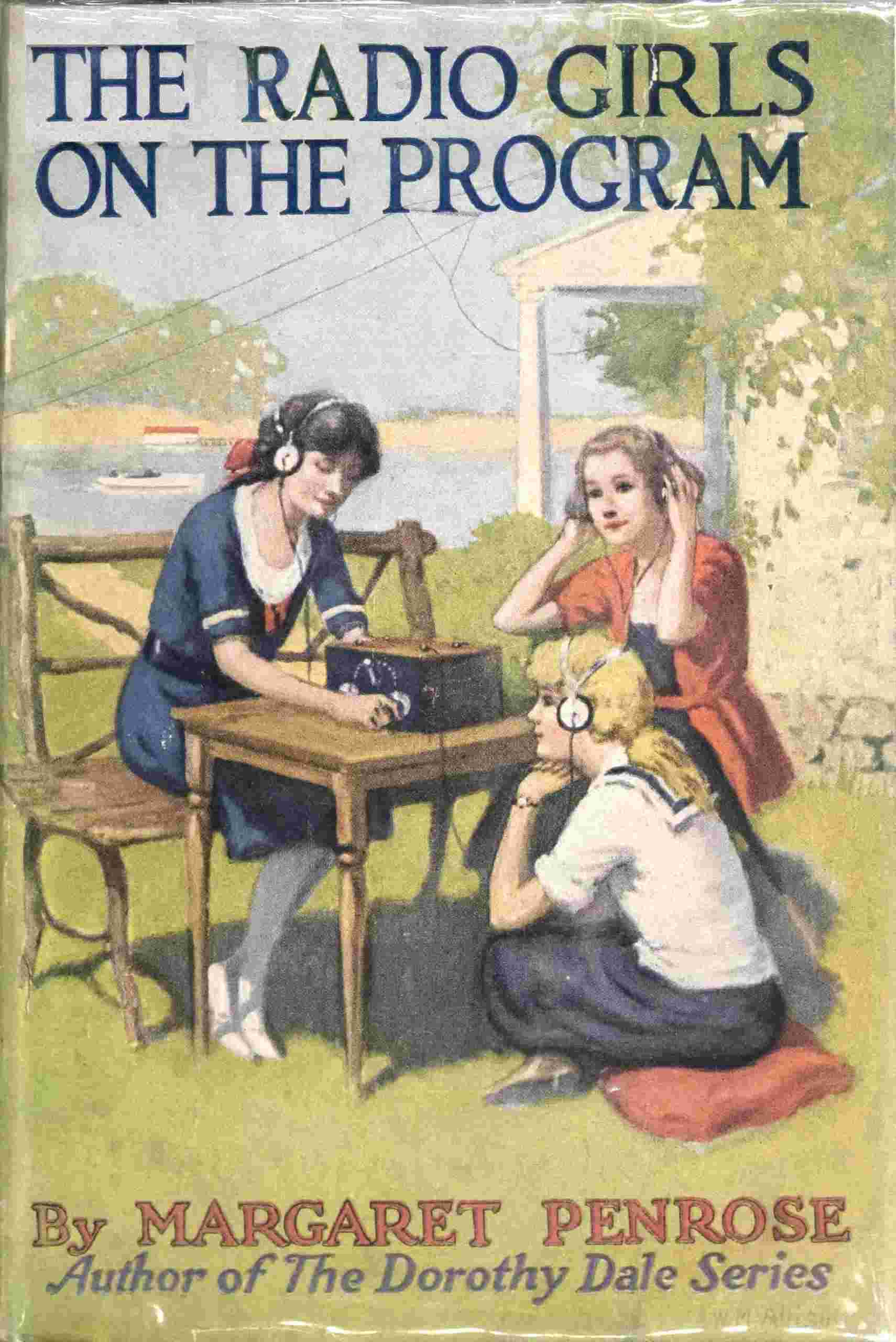
CHAPTER XX
THE RIVAL ENTERTAINMENT
Amy Drew’s confidence was communicated, in part at least, to her chum and to the minister’s daughter. The three really did sing very well in spite of the fact that it had been some months since they had sung together in public.
But they tried the number over and over before Monday and on that day, when the three rode over to the Stratford Electric Company, they were able to please Mr. Blair and the ladies who listened in.
“I must say that I was afraid of that large chorus, Mrs. Norwood,” the superintendent said. “It takes a well-trained group of professionals to stand before the cone and broadcast successfully. Now, these three young ladies do very well—very well indeed.”
“And there is another you might try, Mr. Blair,” said Jessie, diffidently. “She was here to speak with you the other day, and I believe she has a sweet voice. She might want to help the hospital fund, too.”
“Who is that, Miss Norwood?” he asked.
“Bertha Blair.”
“What?” he exclaimed. “I never heard of her. Who are you talking about?” and he stared at Jessie wonderingly.
“Oh, yes, Mr. Blair. You have seen her,” said Jessie eagerly. “Perhaps you did not know her name. She came here to see if you could not use her in the corporation broadcasting.”
“It might be,” he said thoughtfully. “Many amateurs come to ask for a chance to sing or speak at our concerts. I certainly should remember that name,” and he smiled faintly.
“Perhaps you remember how she looked. She was here when we all came over from Roselawn the other day, talking with you. I had known about her before. She is a nice girl, Mr. Blair—a working girl,” and she described Bertha’s dress and appearance.
“And you say her name is Blair?”
“Bertha Blair.”
“Can you find her, Miss Jessie?” he asked, with growing interest.
“I am sure I can. She is out at service. She works for a lady here in Stratfordtown. I’ll run right away now and look for her. Perhaps she can sing something good enough to get upon this program. I’ve spoken to Momsy about it.”
Amy Drew ran out with her chum on this errand. They chanced upon Mark Stratford in the main office, and he immediately joined them and found out what they were after.
“Get into my car,” he said. “I know where that street is, and the house too. Run you around there in a jiffy.”
“Dear me! How handy you are, Mr. Stratford,” remarked Amy. “You are a lot nicer to us than Darry and the other boys.”
“You cover me with confusion, Miss Amy,” chuckled Mark. “I’ll begin to believe that I am almost as fine a fellow as this little chap who wrote in to the corporation about a radio set he wants to buy. Some kid, he is! See here.”
He turned around in the driver’s seat and pulled a letter from his pocket. He was still chuckling, but he said:
“Honest little chap this, I tell you. One of the bookkeepers showed the letter to me, and I fell for the kid at once. I mean to look him up.” Then he began to read the letter in question:
“Stratford Electric Company,
“Stratfordtown,
“Dear sirs:
“I just got your letter about my order for radio set to be shipped c.o.d. but I find you will have to give me Terms if you are to sell me. Ime only 12 years old, as I told you before, and I saw your advertisement in a boy’s paper some time ago but I did not have so much money just then. But I got my antenna strung right and a man said he would give me some money for my rabbits. He was to come for them last week and pay me cash for them rabbits. But he didn’t come so I cannot pay the c.o.d.
“If you would accept Terms (say one dollar down) and a month to pay the ballens, I could sell my rabbits to the Butcher, all but one pair to keep for good. I am sending a dollar, which is all I got just now, and hope you will accept Terms. Please tell the Post Office to keep the set at the Post Office until I can come in for it and pay the c.o.d.
“Yours respectfully——
“Well, never mind the name,” Mark said, still laughing. “But isn’t that some kid? I’m going to look him up and tell him he can have the radio set. I’ll assume his debt until he can sell the rabbits.”
Amy laughed delightedly; but although Jessie was amused, too, she spoke thoughtfully.
“I think that is funny, Mark. I do! And it is nice of you to give a boy like that so much attention.”
“The kids are all crazy about radio,” he rejoined. “But you don’t often find an honest little fellow like this,” and he put the letter back into his wallet.
They drove around into Mellen Street, where Bertha Blair lived with a very nice family. Jessie ran up to the side door of the house and found Henrietta’s cousin at some light work. Of course the girl from Roselawn had to speak to the lady of the house before she could get permission for Bertha to go over to the sending station for rehearsal.
“Bertha is crazy about that singing,” said the woman, when the girl had gone up to her room to change her dress. “She is a good girl, but not just like any other I ever had to help me.”
“I believe she is a thoroughly good girl,” Jessie said. “And she is very fond of little Henrietta, her cousin.”
“That child!” and the mistress laughed. “She was here once. Bertha wants her little cousin with her. But I am not sure I could stand that.”
Bertha reappeared, and Jessie thanked the woman for allowing the girl to go. Mark and Amy received Bertha cordially, and they got back to the plant in a hurry. Jessie took Bertha at once up to Mr. Blair, who was listening in on the rehearsal of other members on the hospital fund program.
“So this is Bertha Blair, is it?” he asked, curiously examining the young girl. “I remember that you were good enough to offer your services for some program, my dear. Suppose you go up to the sending room, along with Miss Jessie, and sing for us. Have you your music?”
“Yes, sir,” Bertha said composedly.
The superintendent still watched her curiously. “I don’t suppose that I have ever met you before?”
“Not before the other day, sir,” returned Bertha.
“No. I thought not. Well, go up and try it. I hope you will succeed. And if you suit Mrs. Norwood and the ladies in this concert I will make use of your voice again.”
Bertha was delighted with this promise. Jessie wondered if the girl did not think that Mr. Blair might be related to her, but the excited Bertha said nothing about it.
Bertha’s try-out was perfectly satisfactory. There is an art in being able to sing or speak into a sending horn, but the girl was intelligent and quick to learn. Mr. Blair telephoned up from the receiving room that Bertha’s song was satisfactory.
Then Jessie and Amy and Nell tried their trio again, and that went better the second time even than it had the first. When the girls saw Mrs. Norwood down in the offices, after the rehearsal was over, her pleasant face was illuminated with a smile.
“I am sure of one thing, anyway,” she said, kissing them all, not forgetting Bertha Blair. “The entertainment is going to be perfect. Those other women may hurt our fund with their party at Carter’s Grove. Indeed, I am very sure they will. But the broadcasted entertainment will be as good as has ever been sent out from Stratfordtown.”
“I’d just like to know what they mean to do down there at Carter’s place on Wednesday,” Amy said, on the way back to Roselawn in the car. “What do you say if we go down to-morrow and look on, Jess?”
“If Momsy doesn’t need me for anything,” her chum agreed. “But we have nothing but the little canoe.”
“We’ve got the Water Thrush, haven’t we? Darry and Burd are going over to Crompton to the ball game. They said we could go along. But I hate to be always tagging. I know they don’t really want us.”
“Wise child,” laughed Jessie. “But I don’t know about going with you in the Thrush.”
“Don’t be absurd!” cried Amy. “I can run that boat just as good as Darry.”
“And he ran it into a log the other night,” chuckled Jessie. “Anyway, I shall have to ask Daddy Norwood.”
But Mr. Norwood had looked over the revamped launch himself after the boys had got through with it, and had tried out the engine. He was convinced that it was in better condition than before. He believed, too, in the girls being independent of the boys in their out-of-door activities.
“Jess and Amy should know all about such things,” he said to his wife when she expressed some faint objection. “Girls should be independent in everything. If they are going to work to earn their own support—as most of them do—why shouldn’t they be perfectly able to manage their other affairs?”
“I hope Jessie will not have to go to work.”
“I don’t know about that. I have some young women in my offices that I respect because of their ability to buff for themselves. I guess they are domestic enough for all purposes; but they will never be helpless, no matter what situation they may be placed in. I want our Jessie to grow up like that.”
In any event Mr. Norwood would not stand in the way of his daughter and her chum having a good time. He observed Amy handling the mechanism of the Water Thrush, and so consented to the two going out alone in the launch.
Monday evening, however, the girls were not on the lake. They would not have missed the broadcasting from Stratfordtown for anything! At eight o’clock, or a few moments before, they were up in Jessie’s room with the phones to their ears.
With the receiving switch open the girls soon heard the tones of Mr. Blair’s voice as he opened the hour’s entertainment.
“Stratfordtown Station to announce: On Thursday at two and again at eight p. m. our radio audience will be afforded a special entertainment of two hours’ duration arranged by the foundation fund committee of the New Melford Women’s and Children’s Hospital. This entertainment will engage both professional and amateur talent of a high standard, and will likewise include a brief talk by the Reverend Doctor Stanley of New Melford on the needs and hopes of the new hospital. I thank you.”
“He has a soothing voice,” said Amy thoughtfully. “Don’t you think so, Jess?”
“Did you ever notice that it sounds like Bertha’s?” her chum returned.
“Hen’s cousin?” gasped Amy. “Well, now! Aren’t you the greatest girl? Because Bertha’s name is the same as the superintendent’s! Well, what do we know about him? It would be romantic if Bertha found rich relatives, wouldn’t it? Then she could have little Henrietta with her all the time.”
“It would not need such dreadfully rich relatives at that,” rejoined the other Roselawn girl.