
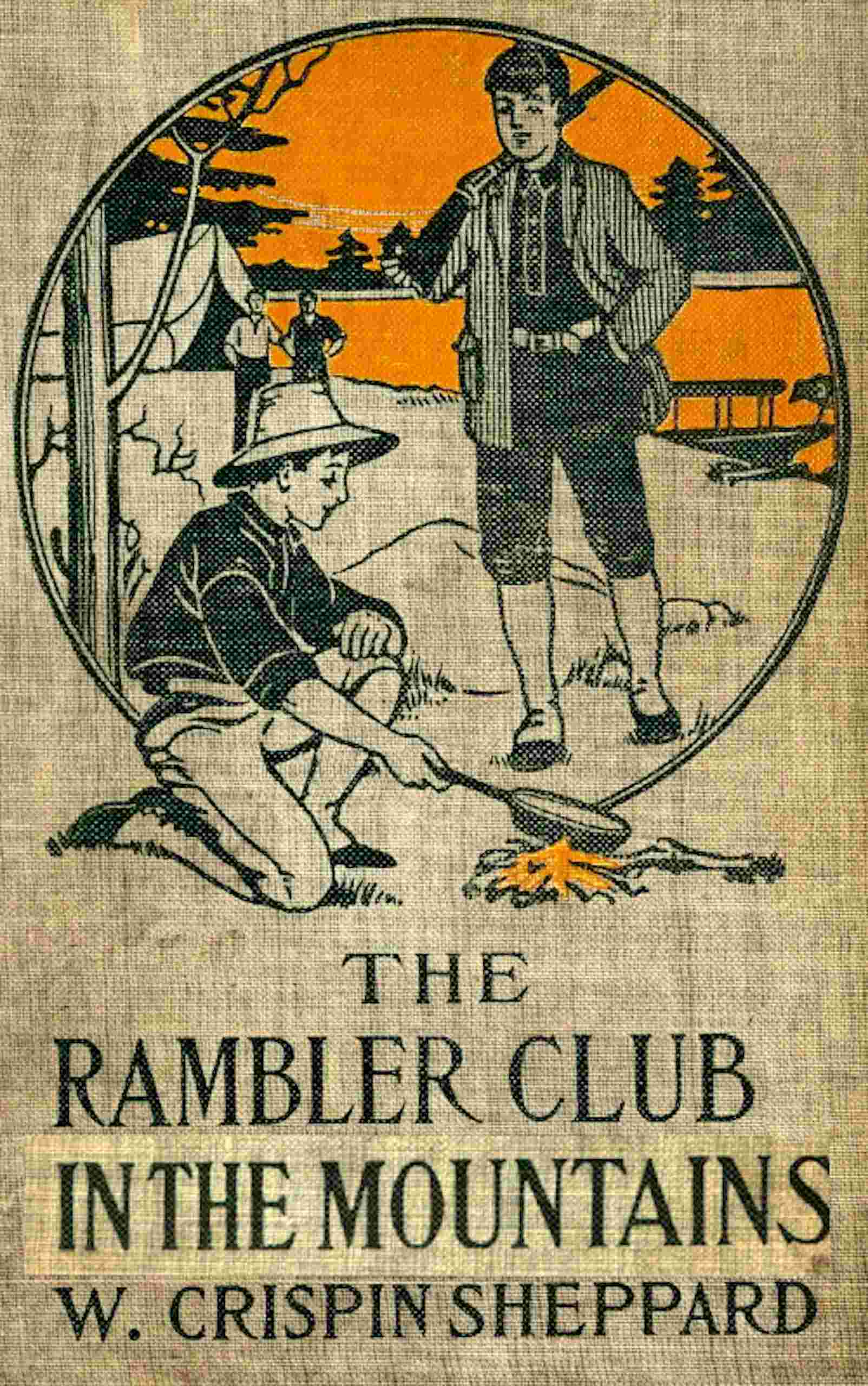
The Project Gutenberg eBook of The Rambler club in the mountains
Title: The Rambler club in the mountains
Author: W. Crispin Sheppard
Release date: September 27, 2022 [eBook #69054]
Most recently updated: October 19, 2024
Language: English
Original publication: United States: The Penn Publishing Company, 1910
Credits: David Edwards, Mary Meehan and the Online Distributed Proofreading Team at https://www.pgdp.net (This book was produced from images made available by the HathiTrust Digital Library.)
A BOY STEPPED FORWARD.
From among the group, a boy stepped forward, looking inquiringly from one to another.
CHAPTER II
HOWARD FENTON
His general appearance indicated at once that he was not a native of that region. His neat blue suit, of the latest cut, set off a slight, boyish figure to advantage, and seemed more appropriate to Fifth Avenue than to a small mountain village. A shock of chestnut hair, in defiance of comb and brush, swept across a white forehead, and his frank blue eyes were pleasant to look upon. Below them, a coat of tan told of his outdoor life.
Bob Somers held out his hand.
"I'll bet you're Howard Fenton," he said, warmly.
"You've struck it," laughed the other, accepting the proffered hand and giving it a hearty shake. "And mighty glad I am, too, that you chaps have arrived," he went on, totally ignoring the presence of many interested listeners.
"My uncle spoke to me about you," said Bob. "Fellows, this is Howard Fenton."
"Feels good to meet some one," laughed Dave. "Takes off some of the strangeness of landing in a strange place. How do you like it out here?"
"For a while, not at all," replied Fenton, lowering his voice. "You see," he added, confidentially, "I was always used to the city, and the strangeness you speak of—well"—he drew a long breath—"it hit me pretty hard, at first. Silly, I know, but the pater—he's out here with me—thought he knew what kind of a vacation I'd enjoy."
"And he wasn't mistaken, after all," interrupted Bob; "I can see that by your face."
"I should say not. A few days, and I began to like it immensely."
"See here," broke in Dugan's rough voice, as its owner stepped out of the post-office, "I'm going to take your truck over to the house. If you're goin', jump in;" and, without waiting for a reply, he mounted to his seat.
"Coming along, Fenton, aren't you?" inquired Bob, cordially.
The New York boy nodded.
"Sure," he answered. "We'll get better acquainted on the way. Maybe I can help you to get things started."
As the coach whirled along, Fenton told them that he intended taking a scientific course in Columbia University and had brought a few text-books along to study between times.
"And I haven't opened one of them yet," he added, with a laugh.
"Best plan for vacation," said Dave Brandon, lazily.
"Mr. Barton told me that you fellows have formed a club."
"That's right—and we've seen some great times, too," responded Somers.
"Go in for parliamentary procedure and all that, do you—whereas, etc., etc., be it therefore resolved that——"
"Not much," grinned Sam Randall. "Hunting, fishing, and having a good time generally is what we're after. That stout boy opposite is our poet laureate and artist in chief; Dick, here, is photographer; Bob's captain, and Tom Clifton and I are just ordinaries."
Fenton laughed.
"Do you really paint?" he asked, with interest, turning toward Dave.
"Oh, yes—a little," admitted the latter. "Just took it up last winter, though."
"Are you going to make any sketches out here?"
"It would take an awful lot to keep me from it. I have a stack of canvas that has to be daubed up. And talk about fine views, never saw anything to beat 'em."
"I met Mr. Barton several times," went on Fenton. "He sort of took to me because I came from New York."
"Yes, that's where he used to live," said Bob. "Uncle Isaac came out here a good many years ago. He has some big orchards a few miles away—grows all sorts of fruits, you know. He bought this house because it's right near the lake."
"Mighty good of him to invite us out here, wasn't it?" put in Sam Randall.
"Uncle got the idea of going to Europe," added Bob, by way of explanation, "so he suggested that the whole crowd come over. And he left a colored boy to do the cooking, too."
Fenton nodded, and Bob went on, "The Rambler Club rendered father a big service not long ago. We took a trip for him, and on the way some fellows blew up our motor boat."
"Blew it up?" gasped Fenton.
"Yes—into a thousand bits. I'll tell you about it some time. Well, dad insisted upon making up the loss in some way, and when Uncle Isaac proposed this jaunt, I didn't have any trouble in fixing it up. Uncle Isaac and his wife left a bit sooner than they expected, and hustled us out here."
"Nothing could have suited me better," declared Fenton, warmly. "I guess you won't mind my mixing in with you once in a while. Most of the visitors in town are elderly people, and the boys," he lowered his voice, "well, they're good enough chaps in their way, but not just the sort I like. Jim Havens and Tom Sanders are the two I know best."
"Why do they call Dugan 'Big Bill'?" asked Tom Clifton. "He isn't big."
Fenton grinned.
"Has a nephew of the same name," he explained. "He's smaller, so it's 'Big Bill' and 'Little Bill.' Fine pair they are, too. Hello—here we are."
This announcement interested the boys immensely. The coach was turning into a private road, which led toward a substantial two-story building. Standing some distance back of the main thoroughfare, its graceful white outlines could be seen, surrounded by beautiful trees and shrubbery. To its left was a stable.
"Not a bad looking place, eh, fellows?" observed Bob, with satisfaction.
"It's dandy," put in Dick Travers, enthusiastically. "And so close to the lake."
"Yum—yum, I can't see anything, I'm so hungry," sighed Dave. "Thank goodness—no more traveling to-day."
As Dugan brought up his horses before the entrance, a smiling colored lad rushed out.
"I 'clar' to goodness, the boys has come at last, eh? Mistah Dugan!" he exclaimed. "I certainly is glad, for suah."
"Show it then, Sam Bins, by helpin' to git this here truck off the rattleboard," growled the driver.
"So you is Mistah Somers, an' party," went on the lad. "I've been a-lookin' for yo' every day. Yo' sho must be hungry, gemmen. All right, Mistah Dugan, I'll help yo'. Step inside, Mistah Somers an' fren's, an' I'll git a meal that'll do yo' a power of good."
"Glorious words," murmured Dave, "to be followed by glorious action."
Ten minutes later, the "rattleboard" had disappeared, and the boys were busily engaged in removing the dust and stains of travel.
The rooms of Rickham House were large and furnished more for comfort than appearance. As the boys collected in the large, square dining-hall, they examined with interest the old-fashioned fireplace, substantial oak furniture and numerous engravings of hunting scenes which hung upon the walls.
Sam Bins had disappeared, but occasionally sounds from the open door indicated that something was happening in the kitchen.
"Did you ever think how much we owe to cooks?" said Dave, as he settled down in a comfortable chair. "Why——"
"Huh, cut it out, Chubby," admonished Dick Travers. "Let's talk about something worth while."
"Won't do it now, after being sat on like that," sighed the poet. "Wake me up, fellows, when dinner is ready," and he closed his eyes.
Sam Bins was a good cook and had a proper appreciation of the size of a hungry boy's appetite. The meal was therefore a bountiful one.
Between talking over their plans, relating stories and listening to Fenton's description of New York, the Ramblers passed a very pleasant time.
The meal at length having been concluded, Sam Bins took them to the stable and exhibited a pair of fine saddle-horses.
"Yo' fellahs know how to ride, ob course," he said, with a huge grin.
"Not I," responded Fenton, decidedly, as the others nodded. "Never was on a horse in my life."
Sam Bins was profoundly astonished.
"Then I wouldn't advise yo' to try either of dese," he said, rather scornfully. "Dey's got a lot ob spirit—dey has."
Fenton laughingly assured him that he wouldn't.
The rest of the day was spent in arranging their rooms. Dave and Sam took one, Tom and Dick another, while Bob Somers used a smaller one at the western end.
Since leaving their homes in Wisconsin, they had been almost constantly traveling, and the whole of the previous night was spent on the cars. This, with the journey on the stage-coach, had fatigued them greatly. But in spite of eyes that persisted in blinking, they bravely kept at work until their belongings were arranged to suit them.
Fenton, the city boy, had a wholesome respect for firearms, and the Ramblers, as they exhibited their brightly polished shotguns and rifles, filled him with apprehension.
"I'd be afraid of my life to handle one of those things," he admitted, candidly. "You see," he grinned, "I never had any occasion to use 'em in New York. But there are two things I've learned pretty well out here—sailing a boat and handling a canoe—what's the matter with taking a sail day after to-morrow?" he rattled on. "The pater has a good boat, the 'Dauntless,' and, if you like, we'll explore Promontory and Hemlock Islands. They camp out there once in a while. Tom Sanders and Jim Havens, the fellows I spoke about, are over there now."
"You can just bet we'd like it," declared Bob, enthusiastically.
"The lake is perfectly safe as far as the passage between the islands," went on Fenton. "I won't take you into any danger."
"You are not going to find us a scary crowd," laughed Bob; and the matter was arranged then and there. Fenton soon after took his departure.
"A nice chap, that," observed Dave, as his slight figure grew small in the distance.
"Awful glad we got acquainted so soon," said Tom. "Somehow or other, he doesn't seem like a stranger. A smart fellow, too."
"He's in good company, then, Tom," was Dick Travers' rejoinder.
That evening, the Ramblers sat on the wide veranda, enjoying the pleasant air.
The moon was mirrored in shining streaks on the breeze-swept waters of the lake, and its light played hide-and-seek on the mountain crags beyond. Several peaks gleamed ghostly white against a greenish sky, while the valley appeared gray and mysterious.
"Some of those mountains look like volcanoes," observed Tom.
"When did you ever see a volcano?" laughed Dick.
"In books, smarty."
"Some of them were volcanoes at one time," declared Dave Brandon, "and there must have been terrible eruptions. I've read that there's lots of lava and basaltic rock to be seen, and——"
"Basaltic rock? Excuse me, Chubby, but don't spring anything like that so suddenly. Basaltic—wow!" and Dick's companions joined in the laugh that followed.
"Oregon is a great state," went on Dave, with a twinkle in his eye. "There's a lake—Crater Lake they call it—an awful big sheet of water, right in the crater of an extinct volcano, away up in the air, with high walls all around."
"Nice place to drop in," commented Sam.
"Canyon River interests me a whole lot," observed Bob. "Of course most of the rivers here are swift-flowing, and there are many canyons—but that waterfall—great to get a look at it, eh?"
"Yes, if we could soar above it in a flying machine," drawled Dave. "Even the thought of climbing a mountain makes me tired. Fellows, I'm going to turn right in."
And the others decided to follow his example.
CHAPTER III
ON THE "DAUNTLESS"
Breakfast on the following morning was quite late. Only a series of wild whoops and yells, which almost scared Sam Bins out of his senses, had served to awaken Dave Brandon, and he protested vigorously.
"Why can't you let a fellow sleep?" he grumbled. "It's only eleven hours ago that I tumbled into bed."
"Nine o'clock, nine o'clock!" called Sam, laughingly. "Do you want to sleep all day?"
"Yes, Sam—you've struck it exactly. Think I will," and Dave tried to lock the door.
But three sturdy shoulders proved too much, and he capitulated.
A tour of the grounds followed their meal. To the east of Rickham House was a large, level field, and on reaching it Sam Randall uttered an exclamation.
"As I live, a regular diamond!" he said. "Crickets, isn't this fine?"
"Well, I should say so," put in Dick.
"Uncle Isaac was always great on baseball," explained Bob. "Played a good bit himself—centre field, I think. Well, I suppose he managed to have a game here, once in a while. But, come on, fellows, let's take a look at the boats."
Right across the road, which followed the course of the lake, and almost directly opposite the house, was Mr. Barton's private wharf. Besides several canoes, he owned the sailboats "Speedy" and "Spray." Both were about twenty feet long, but the former was narrow of beam and built mainly for the purpose which its name implied.
"What a grand summer we'll have," cried Tom Clifton, enthusiastically, as he stooped over to examine the trim-looking craft.
"Well, I rather guess so," said Sam. "But it's time now to get over and see Fenton."
Back to the yellow road they trudged. It led past farmhouses, and fields with growing crops, or orchards containing many kinds of fruit trees. It was a rich and fertile valley. Here and there, flowers grew in rich profusion, roses, lilac and rhododendrons mingling their color in harmonious contrasts.
The village was about half a mile from Rickham House. It had enjoyed a boom as a health resort, on account of newly-discovered springs near by, and the Resort House was one of the results which followed. Another hotel was in the near future.
The boys found a few loungers on the porch of the hotel. They stared at the Ramblers curiously. One in particular—a typical mountaineer—seemed the most interested. He was a tall, thin man, with deeply wrinkled face, scraggly brownish beard, and wore an expression which Dick Travers declared "made 'Big Bill's' face seem positively mirthful."
"Wal, wal! what's all this?" he growled. "Where did this parcel of boys drop from?"
"Not from an air-ship, that's sure," replied Dick, flippantly.
"That ain't answerin' my question, youngster. Be you a-goin' ter stay long?"
"Long enough to knock over a grizzly or two," laughed Dick. "Ever see any?"
"Did I ever see any?" snorted the tall man. "Boys—you hear that? Askin' old Joe Tomlin sich a question."
"He's makin' fun of ye, Joe," said some one, with a sly wink.
"No one kin do that," exclaimed the other, fiercely. "See here, kid——"
But the Ramblers had entered the hotel.
They soon found Howard Fenton, who introduced them to his father, a slender, grave-looking gentleman wearing a beard.
But they soon found that Mr. Fenton's cold appearance belied his nature. He entered into their talk with almost the zest of a boy, and all were really sorry when he declined an invitation to accompany them.
"Just the kind of weather for a sail," observed Howard, as they walked out upon the wharf.
The sky was partly overcast and the low clouds scudded before a breeze that deeply rippled the surface of the lake. Several boats moored to the pilings were lazily rocking or straining at their ropes. The largest was the "Dauntless," a staunch boat, built both for speed and safety.
"It's mine, boys," said Fenton, with a smile. "Jump in, and let me show you what a good sailor I've become."
The lines were cast off and the sail run up. In an instant it filled out. Careening over, under the full force of the wind, the "Dauntless" plunged her bow into the choppy water, and a cloud of spray dashed over the rail. Soon she was fairly racing toward the islands, Promontory rising grim and majestic against the lowering sky.
"Isn't this grand?" cried Bob. "See how fast we're leaving the shore. Where are you going to land us, Fenton?"
"On Promontory Island. But we have to go through the passageway and around on the other side."
It seemed but a short time before they were skirting the shore of Hemlock Island, while a little way off the more rugged sides of the other rose, in places, almost perpendicularly. Here and there, stunted growth struggled for existence, but the summit was crowned with a thick growth of trees. Hemlock Island was flat, and almost entirely wooded.
"Look alive, fellows!" warned Fenton, at length.
The boom swung around, the "Dauntless" shivered and shook, then, righting herself easily, sent the spray flying again, as she came about and headed for the passageway.
"What whopping big trees," cried Tom Clifton, admiringly, noticing the giants that rose here and there among the dark firs.
"Redwood," said Fenton. "This is a glorious country for trees and plant life generally. There are oaks in there, besides wild cherry and many other kinds. Of course some parts of the state are barren, with salt marshes and plains covered with sage-brush."
"Give me this part every time, then," said Bob. "Doesn't it look inviting in there, fellows? Imagine a nice little camp, and dinner under way."
"Wait until you see the other side of Promontory," put in Fenton; "it beats this all hollow."
At the proper time, the course of the boat was again changed slightly, and they entered a wide channel.
The passageway was almost in the shape of a letter V, with irregular sides.
In the shelter of the great crags, the speed of the "Dauntless" was considerably checked, indeed, within the channel, she was almost becalmed.
"Think of trying to climb that cliff, Chubby," exclaimed Sam Randall, glancing aloft. "Whew, wouldn't it be awful?"
"Makes me nervous to think of it, even," broke in Tommy Clifton.
"I can show you a way to reach the top without danger," laughed Fenton. "From there, you get a good view of Canyon River."
In a short time the "Dauntless" swung around a point.
On this side, the character of the island was different. In parts there were rocky cliffs, while elsewhere thickly-wooded slopes led upward. They were steep, but easily climbed.
Now and then they passed picturesque coves and wooded points, and the newcomers were thoroughly charmed.
"Hello, I see a boat!" exclaimed Bob, suddenly.
"And by the flying partridge, the smoke of a camp-fire," laughed Dave.
"And a tent," chimed in Sam Randall.
"Probably Jim Havens and Tom Sanders," put in Fenton. "Might as well land;" and so speaking, he headed the "Dauntless" toward the shore.
As they approached the camp, which was built on a knoll, three young men were seen lazily reclining on the ground. They sprang to their feet and walked forward.
CHAPTER IV
THE ISLAND CAMP
"Havens, Sanders and 'Little Bill' Dugan," added Fenton, quietly, as a hail came from the shore.
"A jolly good place for a camp," observed Bob.
"But no game around worth shooting at," objected Sam. "Hello, look at that sign they've got."
On a strip of canvas, stretching from one tree to another, was painted in rude black letters, "Idleman's Club."
"Hello there, Fenton," came from the shore; "what crowd is that you've got?"
"Wait and see, Havens," replied Howard, smilingly.
The sail rattled down and the "Dauntless" glided slowly over the transparent water toward a boat moored close by. Havens caught a rope, and, in a moment, the boys were scrambling ashore.
Jim Havens was a sturdy-looking boy, with a rather pleasant face and manner, while Tom Sanders, slimly built, had sharp features and a loud voice. The Ramblers did not need to be told which was "Little Bill." That lad had the same aquiline nose, gray eyes and sour expression which characterized his uncle, the stage-driver.
"Come over to the camp, fellows," invited Havens, pleasantly. "This is a surprise, all right."
The Idleman's Club had chosen a most inviting situation. Not far away was a thick grove of trees, while the heights which rose back of them formed a most pleasing picture.
As the group walked toward the camp-fire, "Little Bill" trailed in the rear. He did not seem glad to see the visitors, and on learning who Bob Somers and his friends were, his manner became even less cordial.
Before the tent a brisk fire was burning. Suspended above it several pots were steaming merrily and sending forth a delicious odor.
The boys examined the camp with interest, peeped into the tent, and then looked at the game which the Idleman's Club had bagged the day before.
"Havens," said "Little Bill," suddenly, "I want to go over and see Mr. Barton this afternoon, an'——"
"Didn't you know he had gone?" asked Bob, in surprise.
"Gone?" echoed Dugan; "yer don't mean ter say so." A blank look came over his face. "Gone," he repeated, "since when?"
"About five days ago," answered Bob.
"Little Bill" made an angry gesture.
"An' I thought he wasn't a-leavin' till next week."
"Changed his mind," said Bob.
"Wal, wal—an' me here without known' a thing about it. Ain't that luck?"
Dugan seemed much perturbed.
"An' didn't he say nothin' 'bout me?" he demanded.
"Why, no," replied Bob. "Not in any of his letters."
"Mighty funny, for a fact. I've done odd jobs over at Rickham fur a long spell, now, an' I was powerful sure he'd give me the job of lookin' after his horses this summer. Ask Sanders if I wasn't."
"Sure you were," said the thin boy.
"He always called me 'Bill'—old Barton did. He says ter me, 'Bill, I'll see about it.' Say, why didn't Sam Bins go with him?"
"I don't know," said Bob.
"An' there's another thing. Seein' as how he wouldn't be here this summer, I wanted ter use the 'Spray.' I spoke to him 'bout that, too."
"Would he agree to that?"
"He didn't say nothin'," admitted Dugan, reluctantly, "but I'm powerful sure he intended to. Didn't tell me no. Anyway, I suppose it'll be all right, eh?" and "Little Bill" looked eagerly at Captain Bob.
"I'll write my uncle and find out. I'd like to oblige you, Dugan, but I'm responsible for things just now. Of course, if he says the word——"
"Guess anybody kin tell what that means," interrupted Dugan, fiercely. "Talk about the meanest luck yet—lose a job an' all the sport I was a-goin' ter have this summer—the whole business busted ter bits! Can you beat it? Mebbe you don't believe what I says, eh?"
Bill raised his voice—his eyes began to snap.
"Certainly I do," laughed Bob.
"Then won't yer let me have the boat like a good feller?"
"Honest, Dugan—I can't, 'til I hear. You can go out with us any time."
"Oh, ain't that partic'lar nice?" sneered "Little Bill." "Eh, Sanders, did you hear him?"
"Some people's middle name is meanness," was Sanders' diplomatic response.
Dugan was fast working himself into a passion.
"Old Barton intended to let me use that boat," he cried. "Onct he says ter me, 'Bill,' he says——"
"Here, here!" interrupted Havens; "you're raising an awful holler over nothin'."
"I'm standin' up fur me rights'. He says, 'Bill'——"
"Don't get mad, Dugan," said Bob, soothingly. "Come now—be sensible."
"Oh, ho, glorious views around here," broke in Dave. "Going to stay long, Havens?"
Dugan took a searching look at the poet's smiling fare, sniffed audibly, and then lapsed into silence.
"Don't know exactly," said Havens, in reply to the question. "There's plenty of small game, an' fishin' is great. A feller gets sick of the village."
"Sick of it?" echoed Sanders. "Worse'n that—eh, Dugan?"
The latter nodded.
"I can't git away often enough," he said, sourly.
"Well, fellows," asked Bob, "what do you say to climbing the hill?"
"Count me out of it," said Dave, promptly.
"Oh, you won't find it hard," exclaimed Havens, reassuringly.
"I feel uncommonly sleepy," declared the poet, and he ambled leisurely toward a mossy bank.
"What will you do when we get to the mountains, Dave?" asked Bob.
"You fellows going there?" asked Havens.
"We certainly are."
The sour expression left Dugan's face. He looked interested and exchanged glances with Sanders.
"That's where you will find the big game," said Havens, "and I know how to pilot you around, all right."
"Great!" exclaimed Dick.
"It's pretty risky, though, if you're not good shots."
"We're not so bad at it," laughed Bob; "eh, Chub, over there? But say, fellows, come on. Let's get our legs in training," and he started off.
Fifteen minutes later, Bob sat down by the side of a huge boulder to rest. The others were some distance below.
"Little Bill" and Sanders, who had been conversing in low tones, were the first to approach.
"See here," began Dugan, in a whining voice, "yer ain't riled at the way I talked, a spell back, are ye? I'm an outspoken feller, I am."
"No, I'm not a bit mad, Dugan," assured Bob.
"Wal," "Little Bill" looked cautiously around, "there ain't nobody here who knows the mountains better'n Sanders an' me. Don't need ter go no further fur a guide. Yer couldn't never go there alone. Somebody out of the crowd would sure git lost, or fall down a precerpice, or be drownded in one of them mountain streams. It's certain as your name ain't Willie. Say—is it a go?"
"I'll have to talk to the other chaps, Dugan," answered Bob, evasively.
"But it's only right to take me, after what I've lost," persisted the other. "Ain't that so?"
"I'll talk to you about it later."
Captain Bob's manner was not encouraging, and Dugan's expression began to change.
"I suppos'n you'll have Havens," he snapped, "an' is skeered ter say so."
Bob made no answer, but a faint smile flitted across his face, and Dugan was quick to notice it. Two lines, rivaling those on his uncle's forehead, appeared, and he turned away abruptly.
"Wal, I don't keer what yer does," he snapped.
Stalking down the hillside, he rejoined Sanders, who had paused a short distance away, and the latter was heard to exclaim in a stage whisper, "Some people's middle name is meanness."
A moment later, the two were lost to view amidst the shrubbery.
When at length the tired boys reached the hilltop, a beautiful view repaid them. Patches of blue sky appeared between dazzling white clouds and straight ahead rose the frowning walls of Crescent and Round Mountains, with the gorge of Canyon River at the base of the former.
Making their way past a small cabin which stood in an open space, the boys walked out as far as they dared.
Exclamations of wonder and admiration escaped their lips. Far below them, the water foamed and madly tossed, as it rushed into the narrow confines of the gorge. For a long distance it stretched ahead, dark and gloomy, then disappeared behind a jutting crag at a point where the walls separated, leaving a grassy strip on each side of the river. To the left, at a great height, the weather-beaten summit of Crescent Mountain was partially obscured by a slowly-moving cloud.
"I never saw anything finer," declared Bob Somers, at length.
"Think of getting spilled into that current," murmured Dick, whose thoughts turned in another direction.
"You'd be a goner," said Havens, dryly.
"Suppose, after all, we won't see that waterfall," continued Bob, in a tone of regret, "eh, Sam?"
"Not much danger of seeing it, but lots trying to," grinned Havens. "I've climbed most of the mountains around, but I let those two fellows alone."
As they turned away, a flock of screaming crows circled close overhead.
"Let's take a look at the cabin," suggested Sam. "Seems most as old as the cliff."
"Nothing left of the door, and window isn't much better," said Tom. "Wonder who could have lived here."
"Most likely some old crank," put in Dick, as he peeped inside.
The cabin contained a shaky table, a stool with one leg missing and an empty box, all thickly covered with dust.
"Interesting, but it smells kind of musty," said Sam. "Let's skip."
The descent was made quickly.
"Well, well—what boat is that?" cried Fenton, suddenly.
The group, at that moment, had come in sight of the camp.
"As I live, the 'Dauntless'!" exclaimed Dick. "Doesn't that beat all?"
Sure enough, the graceful sailboat was slowly swinging out from the shore, and the grinning faces of Sanders and "Little Bill" could be plainly seen.
"Never heard of such a cheeky pair," put in Bob, indignantly.
"Good-bye, little boys," yelled Sanders. "We've borrowed yer boat fur a spell." Then, with derisive shouts, they waved their arms, pulled away at several ropes and the "Dauntless," catching the breeze, rapidly receded.