
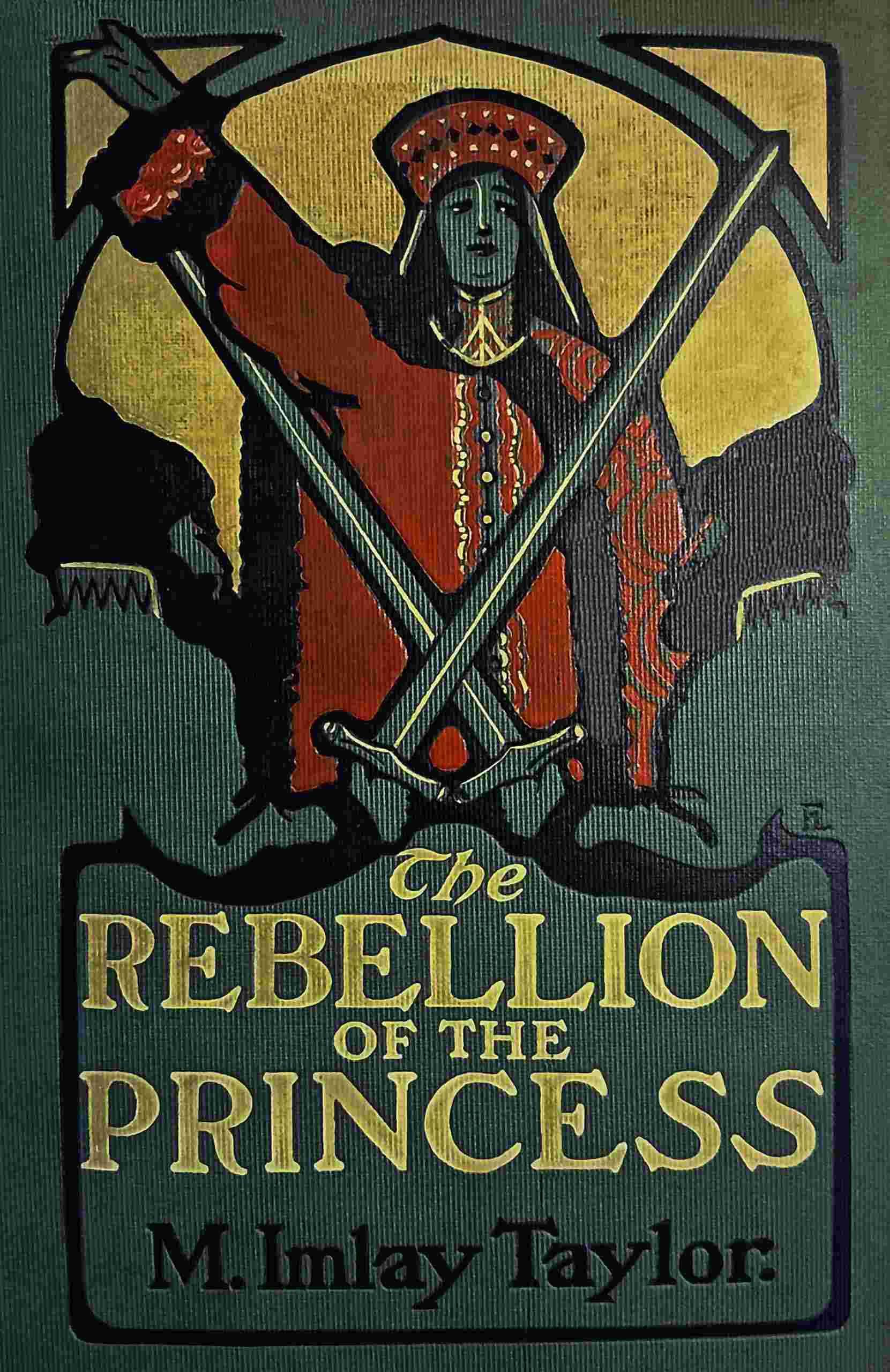
XXIX: A DUEL WITH SWORDS
THERE is nothing in the world more beautiful than the dawn—the birth of a new day—the resurrection of the light. Darkness rolling away like a vapour, lying low on the earth, dropping away into its valleys; above, the firmament is radiant, an arch of glory, of tender colour, of soft white clouds, transcendently lovely, and the very air is sweeter, fresher, full of musical sounds—life stirring gently out of silence and sleep.
As the Princess Daria and I rode from the hut by the wayside, such a dawn was breaking; the sky was faintly luminous, the earth dark and level, and we could see, across the wide sweep of the plain, the river of light begin to flow, wider and wider, between earth and sky, rippling and radiating, as it spread, until the shadows fled away from the face of the steppe and we saw the ground green and fragrant and in the distance a herd of cattle grazing, for it was spring and there was pasturage. It was still and peaceful and lonely, as a vast plain is ever lonely.
The horses had rested too, and were fresh, travelling briskly along the highroad; not a habitation was in sight before us, no sign of man, but here and there, a shrine; for the Russian loves to pray, and his saint is ever close at hand.
The princess, repentant for the loss of time, was in a softer mood, and rode beside me quietly. She had not muffled her face, and the air brought a freshness to her aspect. I noticed, too, again that she rode like a Frenchwoman, and not as the Russians commonly did, astride like men.
“You ride like my countrywomen, madame,” I said, “and you speak French well.”
She could not hear “madame” from my lips without changing countenance, and she blushed divinely now.
“My mother was a Pole, monsieur,” she replied simply, “and hers a Frenchwoman; I am not all Russian.”
“Ah,” I said softly; “I thought there was a tie of sympathy between us. After all—you are a little French.”
She cast a shy look at me, from under her long lashes, and would not answer me. A conversation in one voice goes but lamely, as I found, yet something in her manner elated me. A long pause ensued, and I fell to wondering in what light she regarded me—as her husband or her groom?
Of one thing, however, I felt certain; she no longer feared me; indeed, I thought she began to trust me; but as Maître le Bastien quoted the proverb, “Souvent femme varie,” and I was to find it so.
There were few trees in the landscape, but some twenty or thirty paces ahead of us, in an elbow of the road, was a clump of sycamores, and behind the land dropped into a hollow, where water lay in a reedy pool and some cattle stood there, knee-deep, drinking. Away off, beyond the plain, the river of light was a molten sea of gold, where the sun was rising before us, for we rode northeast from Moscow.
“Madame, do you know of what this scene reminds me?” I asked her quietly.
We had been so long silent that she started at the sound of my voice—flushing as she always did.
“Nay, monsieur, I know not,” she replied.
I pointed at the steppe, and at the far east, where the sun shone in a narrow rim above the world, like the broken half of a lover’s gold piece.
“Of my life, madame, level and barren as this, until the sun rose on it,” I said softly, “the sun of my love for you.”
She met my eyes fully for an instant, a look of wonder in hers, and then she turned her face proudly away, but I saw her hands tremble.
“Believe me,” I continued gently, “I would not have forced myself upon you, save to keep you from a fate you hated.”
She dropped the horse’s bridle on his neck, and covered her face with her hands.
“Do not speak of it!” she cried passionately; “do you think I am less than other women? that I do not feel it? That cruel czarevna! How dared you, sir?”
I bit my lip; to her I was the goldsmith’s apprentice. So be it, I thought; if she despised the man, she may also despise the marquis. I had meant to tell her, but now I would not.
“Are Russian men then cowards, madame?” I asked drily.
She did not reply; she had no time, for we had come to the clump of trees, and as we turned them, a horseman suddenly barred our way with a drawn sword. She recognised him first, with a little cry of horror, and then I, too, looked into the flushed face of the Boyar Kurakin. My first impulse was to draw my pistol and shoot him down, and then I saw that the man had no weapon but his sword, and was alone. He looked at her, more than at me, and I knew then how near akin such love as his is to hatred.
“Well met!” he cried savagely; “well met, Daria Kirilovna; you ride early with your lover, but you ride no further—by Saint Nikolas of Mojaïsk!”
He meant to say more, and to insult her, but I forced my horse between and he found my sword-point at his throat.
“Back, monsieur,” I said pleasantly, and smiled; “back, or you will drink blood for your breakfast!”
But he was no coward, and rode like a Cossack.
“To the devil with you, you French smith!” he cried contemptuously, and our swords crossed, the sparks flying as the steel ground. His horse, a fiery beast, plunged and I missed giving him a thrust over his guard, as I had given M. d’Argenson, on the Place Royale. Then he wheeled quickly, and tried to stab me in the side, and I parried, my beast answering the bit well, but I saw I had my match, not trained in a Parisian school, but a born swordsmen, as I think some men are. Moreover, the thought of his humiliation in the painted gallery, of his stolen bride, stung him to fury: he would have torn me to pieces with the joy of a savage. We fought desperately, therefore, and the horses, plunging and backing, kept us whirling in a circle, thrusting here and missing there, and then clashing fiercely; once he drew blood on my arm and once I touched his throat.
The Princess Daria’s horse had carried her a few yards away, and there she held him, looking back, rooted, as it seemed, to the spot, though I shouted to her to ride on. The swords whirled and ground together, and in a flash I saw the whole scene and remembered it; the glory of the sky, the wide sweep of land, the shadows of the sycamores, and the sharp outline of her figure and her face, white as a pearl. But, all the while, I had much ado to keep his steel from my heart, and verily, I think the man fought more like a fiend than a human. The sun had risen and sometimes it shone in my eyes, sometimes in his, as our beasts moved to and fro, and sometimes the flash and sparkle of it on our blades was blinding and once—when he almost thrust me in the breast—I heard the princess cry out sharply.
Then I rose in my stirrups and he in his, and for a moment our steels ground out fire. I saw his bloodshot eyes and heard his laboured breathing; the man was tired and so was I, and yet I must wear him out or give her up to him, and he—the barbarian devil—he knew that he must kill me or give her up to me!
I had the longer sword, and once I thought I had him, but he parried and well-nigh caught me under the arm-pit, and then I wheeled my horse quickly and lunged at him, our swords clashed, and at the sound, his beast plunged widely from me, reared up and pawed the air, while I saw Kurakin’s face turn pale as ashes, and then the beast fell over backward and rolled on his rider. My own horse careered wildly, and the other brute turned over and got to his feet and was running with an empty saddle, before I could approach his master. Kurakin lay in a heap on the ground, and I leaped down and turned him over; his neck was broken and he lay there, in the mire, stone-dead.
I turned and saw the princess holding in her horse, for he, too, was restive, and her face was perfectly colourless.
Without a word I mounted and rode forward, and she sat looking back with dilated eyes.
“Will you leave him so?” she cried; “is he dead?”
“Quite dead, madame,” I answered.
She made the sign of the cross, and I laid my hand upon her bridle, guiding her frightened horse.
“We must ride,” I said. “We can send others back from Troïtsa for the body—if it is safe to do so.”
For ten minutes we galloped on and then she spoke.
“Why did you not use your pistol?” she asked.
“In France a gentleman takes no advantage of his adversary in weapons,” I replied courteously.
She bit her lip, and then, “But if he had killed you!” she cried.
Then I had my revenge. “Then, madame, instead of the goldsmith you would have had a boyar,” I said coldly.
She looked at me a moment in sheer amazement, and then she turned crimson, and rode on ahead of me without a word.