
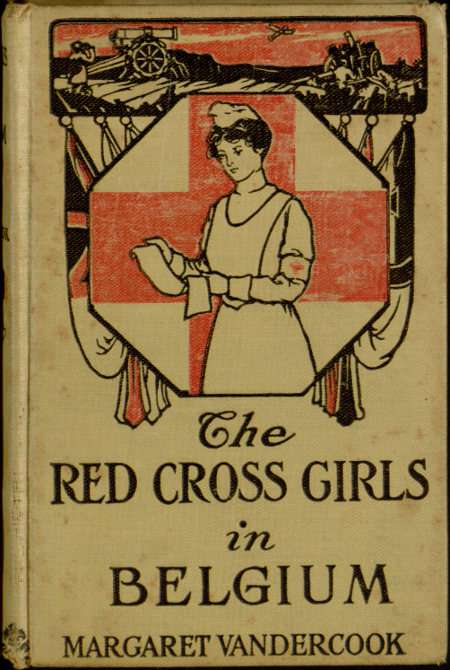
CHAPTER X A Discussion, not an Argument
"But very probably you were mistaken in thinking it was Lieutenant Hume," Nona announced. "I am sure he had not been taken prisoner when we left France."
Barbara raised herself on one elbow in her small bed and answered irritably:
"I most certainly was not mistaken, Nona Davis. I ought to know Robert Hume perfectly well after our meeting in Paris and his visit at the chateau. Besides, though he dared not speak, he showed that he recognized me. I even promised him that you would write him a note to the prison if it were possible." Then Barbara relaxed and sank down on her pillow again.
She and Nona and Mildred were in her small room at the hospital. It was time for them all to have been in bed and asleep, since they chanced not to be engaged in night nursing. But Barbara had retired early, as she was extremely tired. Then, some time after, Nona and Mildred had crept in to find out what had become of her. They had missed her during the afternoon, but had not known of her expedition with Dr. Mason.
Now Nona looked annoyed.
"What an extraordinary thing, Barbara, for you to promise! I am sure I see no reason in the world why I should write Lieutenant Hume. We are only acquaintances. Of course, I am sorry to know he is in hard luck. But for me to begin writing him under the circumstances would look as if we were intimate friends."
Barbara slipped her arms up over her head, making a kind of oval frame for her face.
Nona and Mildred were seated on either side the foot of her bed.
"I think you are absurd, Nona," she commented, in the frank fashion which was not always either advisable or pleasant. "I really don't believe I did say you would write, only that one of us would. Naturally, I thought as you knew Lieutenant Hume best you would prefer it. I don't consider he would think you were being too friendly with him. He is too much of a gentleman. He would understand that you were sorry for his hard luck and pitied his loneliness. I wonder if it was because you were brought up in the south that you are so conventional? You don't seem to be so all the time, only when it suits you. I am sure I will write the note to Lieutenant Hume with pleasure if I find he is allowed to receive letters except from his family."
Evidently Barbara was in a mood when it made but little difference to her whether or not she made Nona Davis angry. Yet she and Nona had once seemed to be devoted to each other and appeared to be friendly now.
Nona, however, was not given to quarreling. So, although she flushed uncomfortably, she made no immediate answer.
Mildred, however, broke into the conversation hastily.
"Well, you did have an extraordinarily interesting afternoon, Barbara, though it must have been a trying one. I confess Nona and Dick and I were all hurt when we found you had gone out without even speaking of your intention. We have asked you to go with us any number of times. Dick said he did not suppose you knew any one in the hospital well enough to have accepted an invitation."
At this Barbara rose up to a half-sitting position, still with her arm-encircled head leaning against her pile of pillows.
"Was Dick here this afternoon?" she inquired, wondering within herself why she felt pleased over Dick's hearing of her departure.
"Oh, he only stopped by for a moment to bring Nona a book," Mildred added. "I just chanced to see them as I was passing by in the hall. But you look very tired, Barbara. Would you like Nona and me to leave you? You can tell us more of your experiences another time. But I advise you to ask Dick if he can make any suggestions about the poor little Frenchman. Monsieur Bebé sounds so pathetic. You know Dick may have something worth while to propose. He is doing such splendid work with the Relief Committee."
Barbara patted Mildred's hand gently and, it must be confessed, a little condescendingly.
"You are apt to think Dick does everything well, Mill, aren't you," she announced, "whether it is looking after the starving Belgians or leading a dance in a ball room? Still, I don't think I shall trouble him. I have a plan of my own in mind for the boy and I am going out to see Eugenia to ask if she thinks it feasible. Then if she thinks it is, I shall go ahead and see what can be accomplished."
"And leave all of us completely in the dark," Nona added. "I must confess, Barbara, I don't think it kind of you to speak to Mildred about Dick in such a superior, almost scornful, fashion. In the last few weeks we have both been aware that you did not care to be intimate with us. But whatever we may have done, I can't see how Dick Thornton can have merited your disapproval. I don't believe you have even seen him alone."
Barbara's cheeks flared. "And I wonder how you formed that opinion, Nona? However, it strikes me as none of your business."
The instant Barbara had made this speech she was sorry. One was always at a disadvantage in a quarrel with Nona Davis. For Nona never for a moment forgot her dignity or breeding. She was white now, while Barbara was crimson. Her lips were curling a little scornfully, but she answered quietly, "I am sorry to have made you angry; that was not my intention."
However, in spite of her apology, the younger girl remained absurdly aggrieved. Yet she had the grace to turn to Mildred.
"I am sure you understand, Mildred, that I never intended to be disagreeable about Dick. You must know that I admire him very much."
Mildred leaned over and deliberately pinched Barbara's flushed cheeks. "I know you are a little goose," she asserted, "to be quarreling with Nona as though you were two badly brought up children."
But Barbara was not to be appeased. She made no answer, and the next moment Nona slipped off the bed and knelt on the floor beside her.
"What is the matter, Bab? What is it that has been making you feel and behave so differently toward me lately? If I have been to blame in any way I apologize with all my heart. I confess I was absurd about Lieutenant Hume. I liked him very much the few times we met. I might at least be willing to do the poor fellow a kindness when he is in hard luck. But you see, he does not belong to a very good family in England. Though he behaves like a gentleman, after all he is only a gardener's son."
It was not Barbara who interrupted this time, but Mildred Thornton.
"That is nonsense, Nona," she protested. "I have heard you say something of that kind two or three times. Anyone who has traveled in the least knows that no gardener's son in England is educated as Lieutenant Hume is, nor has such perfectly self-possessed manners. Besides, he is a lieutenant."
Nona shook her head. "Yes, I know it does sound impossible," she returned. "But Lieutenant Hume told me himself that he was the son of the gardener when I first met him in Surrey. He was at home then, recovering from a wound in the leg and was lying asleep near the gardener's cottage. It has often struck me as queer since, but I have worked it all out. Lieutenant Hume must have been educated by some one who considered him unusual. And commissions have been given in the British army in this war for merit as well as for family reasons."
But Nona was evidently weary of the subject of the young English lieutenant. She had remained kneeling on the floor and she now took hold of Barbara's somewhat limp hand in a very sweet fashion.
"But you haven't said what the trouble is between us, Bab, or whether you are willing to forgive me?" she continued. "I should feel very unhappy if anything serious interrupted our friendship. Eugenia seems so far away these days and I don't believe she is anxious to have us come to see her often."
"Oh, Eugenia is busy," Barbara answered carelessly. "But it is all right, Nona; of course I am not angry with you. I was vexed for a moment, but I expect that was because I am tired. It is ridiculous to suggest that there could be any serious trouble between us."
To the best of her ability Barbara tried to speak with sincerity. Nona looked exquisitely pretty and appealing as she knelt beside her. One would have forgiven her almost any offense. Yet Barbara could not truthfully convince herself that Nona had committed an offense against her. Nevertheless, she did not feel a return of her affection, although she struggled to have her manner at least appear unchanged.
But Nona was conscious of the difference, for she rose immediately to her feet.
"I am sorry we disturbed you tonight when you were so tired," she said, holding her chin just a little higher than usual. There was no change in the soft inflections of her voice. "Good night."
Then Nona left the room without looking back. But Mildred stopped to kiss Barbara. "You haven't been any too nice to me either, Mistress Barbara," she asserted. "If you don't reform I shall tell Dick and make him find out the reason why."
Of course Mildred made this speech without in the least meaning it. Nevertheless, after both girls had left the room and she should have been asleep, Barbara remembered. She sincerely hoped that Mildred would not be so tiresome as to tell Dick of their personal differences. But what was the root of the trouble between her and her two former friends?
For the life of her Barbara could not decide. Or, if at the depth of her heart she knew, she was not brave enough to confess the truth to herself.
CHAPTER XI Monsieur Bebé
One sultry August afternoon Barbara went again to see Eugenia. This time she went alone.
According to his usual custom Bibo met her at the end of the car line with his ancient horse. Owing to his lameness perhaps, he was head coachman to Eugenia's establishment, which Barbara still insisted upon calling "L'Hotel des Enfants."
Bibo was looking extremely well. He had on long trousers of blue cotton and a blue cotton smock with a round collar. He had lost the frightened, starved look which Barbara remembered seeing on the evening of his rescue. The boy's face was round, there was a dimple in one corner of his brown cheek. His eyes were serene save for his sense of responsibility as Barbara's escort.
It is true that Bibo's mother was still held a prisoner in Brussels because of an act of disrespect to a German officer. But children's memories do not harass them so long as they are happy.
"How are things going, Bibo?" Barbara asked in French, as soon as she was seated beside her driver. Fortunately, French was the language of Eugenia's Belgium family rather than Flemish.
Bibo first flapped his reins and then nodded enthusiastically. Words at the moment appeared to fail him, although he was usually voluble.
"Then Gene is well?" Barbara continued. For after many difficulties Eugenia had acquired this informal title. In the beginning the children had struggled nobly with her name, but Miss Peabody was too much for them. Then "Miss Eugenia" was equally difficult for little Belgian tongues, so it became Madame Gene. Later, since Eugenia did not enjoy being called Madame, nor was she more fond of Mademoiselle, her name attained its simplest form among the younger children.
But Eugenia was Bibo's altar saint and he was not inclined to take liberties. Saint Gene she had been to him in truth!
"She is well," he answered briefly. Then he allowed his round eyes to leave his horse and turn ecstatically toward Barbara.
"In a few days my mother is to be with us. She wrote that she need stay no longer in prison and that she wished to see me, but alas, there was no place for us to go! Our home near Louvain was burned and my father—" The tones of the boy's voice expressed his uncertainty of his father's fate. "But my friend has written that my mother may come to our home; she will help us look after the other children. All will be well!"
Bibo's tone was so grown-up and he was so evidently quoting Eugenia that his companion smiled. But the smile was because Bibo could not possibly understand how one could cry over good news. How big was Eugenia's house and her sympathy these days? Certainly she seemed to wish it to include all who needed her help.
"And Monsieur Bebé?" Barbara next queried. "Does he appear more cheerful since I left him with you a week ago?"
The boy hesitated a little. "He laughed twice this morning and he sits all day in the sun and smiles now and then when Nicolete is beside him. But no one can be cheerful and blind."
This was spoken with conviction. Of his own affliction Bibo seldom thought, but indeed his lameness troubled him very little now. He could run and walk almost as well as the other boys. It had been hard at first, for until the day when their house had burned and they had been forced to escape, he had been exactly like other boys. But he had been stupid then and fallen. There had been no time to heal the hurt in his leg, so Bibo must hobble as best he might through an indifferent world.
But Barbara seemed extraordinarily well pleased by her companion's information. Poor Monsieur Bebé had been so far from smiling even once during his weeks in the prison hospital. And Barbara felt that she could claim some of the credit along with Eugenia for his release and better fortune.
Soon after her visit to the prison she had secured a prominent surgeon to go and look at the young Frenchman's eyes. The man could offer him little comfort. There was every chance that Monsieur Bebé, whose name was Reney, must continue blind. A little hope he might have, but hope was not encouragement.
In the depression that followed this announcement Barbara did her best to help the boy. But it was plain to his fellow prisoners and to the prison officers that the news had broken his health and spirit. He had no wish to live. He would not eat and after a time made no effort to get out of bed. He would lie all day without speaking, but rarely uttering a complaint.
Everybody was sorry for him, the big German nurse, the German guards, even the commandant of the prison. It was one thing to kill an enemy in the passion of battle, but another to see a boy, who had done one no personal harm, slowly passing away in darkness.
So when Barbara came to the German commandant with her plea for his prisoner's parole, he was willing to listen to her.
"What possible harm could be done if Monsieur Bebé, in reality Albert Reney, be transferred to Eugenia's home in the woods? She had offered the French boy shelter and care. He would make no effort to escape, but even if he should, a blind man could never again fight for his country. Moreover, Germany was arranging with the Allies for an exchange of blind prisoners. It was possible that Monsieur Reney might later on be sent home."
Eugenia was waiting this time near the place where Barbara was compelled to descend from Bibo's wagon. She had only one of her children with her, which was unusual, since she ordinarily went about with five or six. But Jan and Bibo were her two shadows. They were marked contrasts, since Bibo was so plainly a little son of the Belgian soil, the child and grandchild of farmers. Jan came of the men and women who have lived among pictures and books and helped make the history of his now tragic land.
The boy Jan was so instinctively a gentleman that, although he was not ten years old, he immediately upon Barbara's arrival slipped behind the two friends. For his happiness' sake he wished to keep his eyes fastened upon his Gene, but he must not be close enough to overhear conversation that would not be intended for him.
Eugenia took Barbara's face between her beautiful, firm hands and gazed at her closely. Although in the first instant she saw that the girl wore the same look of the past few weeks, she said nothing. Only she put her arm about her as they walked toward the house.
Barbara did not feel like talking at first. She had been coming every week recently to the house in the woods and the visits always rested her. It did not seem possible that a few months could make so great a change as they had in Eugenia. One could scarcely have recognized her as the same girl who set sail from New York City a little more than a year before. But she was also changed from the girl who had crossed over from France earlier in the summer. In spite of her responsibilities Eugenia had grown ever so much larger; all the angular curves were gone, her chin was softly rounded. Beneath her pallor there was now a soft glow of pink, and best of all, the severe lines about her mouth had almost completely vanished. They could return if she were displeased, but the children rarely saw them.
"Something very worth while has come to you, Gene," Barbara whispered. "I wish you felt you could tell me what it is. Is it because you enjoy looking after the Belgian children?"
Eugenia nodded. "It is that and something else, but I don't feel that I can ever explain to any one."
Then Barbara and Eugenia were interrupted by two persons coming toward them from the opposite direction.
One was a splendid, big blond fellow whose eyes were bandaged. He was being led by a girl of about sixteen with jet-black hair which she wore short to her shoulders. She had dark eyes and crimson lips. Nicolete's costume and manner had both changed since her departure from France. But it was not possible to change the vivid coloring of her face.
Both the girl and boy were chattering rapidly, and both of them seemed happier than Barbara had lately seen them.
"The truth is all French people are homesick outside of their beloved France," Barbara thought to herself. "So it must be a consolation to have a fellow countryman for a companion."
But Monsieur Bebé was tremendously pleased to hear Barbara's voice. He asked her to take his hand and lead him back to his chair in the garden before the once deserted house. There, as a small chair chanced to be beside his, Barbara sat down. Then Nicolete and Eugenia went away to prepare tea.
Monsieur Bebé did his best to express his thanks to Barbara and he had the Frenchman's grace and choice of words. He was of course still desperately sad over his affliction, but meant if possible to meet it like a man. He had been willing to die for his country, but perhaps it took more courage to go on living for her. Miss Peabody had promised that as soon as possible he should begin to learn a trade.
After a quarter of an hour's talk Barbara felt in better spirits than she had on her arrival. Perhaps this was the secret with Eugenia. She was feeling that she was being useful to some one. It might help heal another kind of hurt. Certainly Barbara could feel that her interest in the young Frenchman had been worth while.
The two friends saw little of each other during the rest of the afternoon. But this was the usual thing and Barbara did not mind. She continued to stay out in the yard, sometimes watching the children play and at other times leading the games herself.
Eugenia came and went, now and then stopping for a few words of conversation. "Louise," the maid, rarely appeared. In all Barbara's visits she and "Louise" had not exchanged a dozen sentences. Indeed, it was self-evident that the woman did not wish to be noticed. Barbara respected her desire.
However, she understood perfectly by this time that "Louise" was not a servant, but some one who was living in Eugenia's house in order to conceal herself and her children. Jan had forgotten instructions and several times spoken to "Louise" as mother. There was also a little girl who was with her the greater part of the time.
But Barbara asked no more questions. So far no trouble had come from Eugenia's kindness. Perhaps this "Louise" was a person of no especial importance, whom the German authorities would not take the trouble to seek.
Of the person behind the locked door, nothing more had been seen or heard. Only Barbara had never been allowed to go into that particular room.
None of these things were troubling her this afternoon. Possibly she might try and talk them over with Eugenia later, although she really did not expect to. But she meant to stay all night and Eugenia had promised to spend an hour or so before bedtime alone with her.
It was a marvelous August night with the most perfect moon of the year.
The day had been hot, but the coolness came, as it nearly always does, toward evening. Nevertheless, Eugenia and Barbara decided to leave the house for a short walk. There was little chance for privacy indoors, as every room was now occupied and Eugenia had been compelled to take Nicolete in with her.
So at about nine o'clock, when most of the members of the household had retired, Eugenia and her guest started out. Eugenia wore a dark red sweater and cap and Barbara white ones, which she kept in the country for the purpose.
Neither girl intended to go far from home. Eugenia's house was in a comparatively deserted part of the countryside. There were no other places near. But for that very reason in case of difficulty there would be no one to offer aid.
To the left of Eugenia's was a big, uncultivated field. On the other side was the woods with the path which connected with her yard. The children often played in the woods near by, but in taking a walk persons were compelled to follow the traveled path. If one wandered away for any distance there was danger of getting lost. Not that the woods were particularly thick, but because they had been neglected and underbrush had grown up between the trees.
Therefore, as soon as the two girls walked the length of their yard they turned into the usual path. The woods were in reality only another portion of the abandoned estate. The moonlight was so bright that the path looked like a strip of white ribbon ahead. Then, though the foliage of the trees made beautiful, dense shadows, one could see distinctly in between them.
CHAPTER XII The Ghost
The girls had been talking over certain details in connection with the management of Eugenia's establishment. She found it extremely difficult to buy provisions. But neither one of them was giving thought to what she said.
It was Eugenia, however, who offered the interruption.
"Please let's don't talk about things that are of no importance, Bab, when I see you so seldom," she protested. "Tell me, please, about Dick Thornton and Mildred and Nona. Dick and Nona were out here a few moments the other day, but I had no chance to have any conversation with them. I thought they both looked extraordinarily well to be working so hard. I never believed Nona as strong as you, Barbara, so why do you seem so used up? Is your work at the hospital more difficult than hers?"
"Certainly not," the other girl answered. "Really, Eugenia, I don't think it kind of you, or of other people, to keep on telling me I don't look well. I have assured you a dozen times I am all right. If you continue suggesting the other thing I shall probably fall ill. But Nona and Dick do seem well and cheerful, and so is Mildred for that matter. I think it is because they are all very happy over something. No one has spoken of it to me so I am only guessing. But it is true, isn't it, Eugenia, that if one is happy oneself, it is not hard to bear the sufferings of other people? Yet it seems to me that Belgium is scarcely the place to make one cheerful."
Instead of replying Eugenia laughed. The cynicism in Barbara's tone was so unlike her. Yet one could realize that she did not mean to be disagreeable. Really she was confused and needed information.
"Oh, I suppose one's own happiness is of chief importance," Eugenia finally returned. "It isn't human to expect people to be utterly wretched over others' sorrows. One can be sympathetic, of course, and depressed now and then, but that is about all."
Then they walked on a few yards in silence before the older girl added:
"Are you speaking of the same thing, Bab, that we discussed one night in the moonlight a good many weeks ago? I believe it was the first evening after Dick Thornton arrived in Brussels? Because if you are, I still don't agree with you. Of course, I have been separated from the rest of you most of the time lately, yet I don't think I am mistaken. What makes you believe as you do, Barbara?"
The older girl put this question in as careless a tone as possible. Then, although she and her companion were walking arm in arm, she did not glance toward her. She did not even try to get an impression of her expression in the moonlight.
Barbara shrugged her shoulders. "There are many signs, Eugenia, and they cannot always be defined. But I don't think you would ever see or understand them."
The slighting emphasis upon the pronoun was unmistakable; nevertheless, Eugenia only smiled. Once Barbara's point of view might have hurt her, but tonight she was not thinking of herself. She had something else upon her mind, but was uncertain whether it would be wise to discuss the subject, or leave it still in darkness.
"Well, perhaps you are right, Barbara," she admitted. "I had a note from Nona yesterday, but she made no reference to Dick. She wanted me to ask you a question for her, which perhaps neither of us has the right to ask. I don't know, it has worried me a good deal——"
She stopped because Barbara had turned in the path and was facing her half belligerently and half affectionately.
"Don't be a goose, Eugenia, ask me anything you like. Certainly I have bored you enough recently with my bad tempers and complaints to have you say whatever you wish to me. It's funny, Eugenia, but when we started for Europe I was sure I was going to like you less than any one of the girls. Now you are the only one I care very much about."
With this Barbara laughed, pretending that she was not altogether in earnest. But there was no humor in her laughter.
Eugenia received her information gravely.
"That may be good of you, dear, but I don't believe you," she returned. "Still I am glad you made the remark just at this minute. It helps me with what I wish to say to you. Nona wanted me to find out what it was that had changed your feeling for her. She says she has done her best to discover for herself and has asked you to tell her, but without success. She seems much distressed and is anxious to make amends if she has injured you."
The older girl had to cease talking because Barbara had pulled away and was walking on ahead without pretending to answer.
She was being rude and was aware of it. But it was better to be rude than to have any human being discover how crimson her face had become and how her lips were trembling. Eugenia's question had taken her so by surprise. Several weeks before she had gone through much the same kind of conversation with Nona and Mildred. But the subject had never been mentioned again and she hoped was happily over. It was too stupid to have Nona go on dwelling upon the matter in this way and utterly pointless. She had told her that she had nothing in the world against her. Surely one had the right to one's likes and dislikes!
Quietly Eugenia continued after her guest. She made no effort to stop her, although she realized that they were walking farther than they had intended.
Finally Barbara must have appreciated the fact, because she stopped and turned around.
"Let's go back home, I am dead tired," she murmured.
Of course Eugenia complied, and they continued in single file on the return journey.
Walking alone, Barbara once or twice thought that she heard some one tramping about in the underbrush not far away. But although she glanced over in that direction she saw no one.
After five minutes more of silence Barbara caught up with Eugenia, who was in the lead on the way home.
"Can we stop a minute somewhere, Gene, before we get back to the house? I have something I want to tell you. I believe I'll feel relieved once I have made a plain statement of a fact to myself as well as to you. And it will be easier to say it out here in the moonlight than in the light of day."
This time it was the older girl who hesitated.
"You said you were tired, Bab, and it is getting late. Besides, I am not sure it is wise for us to be so far from the house alone." She turned her head uneasily toward the left side of the woods. It was on the same side that Barbara had believed she heard a noise. But at present she was paying no attention.
"Please do as I ask you; a few minutes more cannot make any difference."
Then, just as they had two months before, the girls found a fallen tree and seated themselves on the trunk. But Barbara turned around so that she could look directly at her companion. A shaft of light shone straight across her face. Eugenia could see that the characteristic little frown was there as well as the slight wrinkling of the short, straight nose. Also that Barbara's eyes were serious, although the expression of her mouth was partly humorous. She looked very young and charming. Perhaps she was not so beautiful as many other girls. Yet she had a kind of mocking grace, an evanescent, will o' the wisp quality that was more fascinating than ordinary beauty. Then beside this, she was so thoroughly human.
"Yes, I have a grievance against Nona, a perfectly dreadful one. When I told her I didn't have, I just lied," she began directly. "Fact of the matter is, I can't forgive Nona for being more attractive than I am. I can't tell her this to her face though, can I, Eugenia? Nor can I see exactly how I can let you tell her."
Barbara clasped her hands together. They felt very warm, although the evening was cool. But then her cheeks were even hotter. Nevertheless, a smile at herself, perhaps the best smile there is in the world, flickered around the corners of Barbara's mouth.
"I know perfectly well what you are thinking, Eugenia. Nona has not changed recently. If I cannot like her now because she is prettier and more charming than I am, then why did I like her at the beginning of our acquaintance? She was both those things then. But the fact is, I didn't care then, because, because—Oh, why is it so hard to get it out, Gene? I don't see why girls need always be ashamed of caring for people who don't care for them? I didn't know at first how much Dick Thornton was going to be interested in Nona Davis, nor how much I cared for Dick. There, the worst is out and I am glad of it!"
Then Barbara dropped her chin into her hands and sat staring at the moon up over the top of the trees, waiting for her companion to answer. Eugenia remained silent.
"Are you disgusted with me, Gene?" the younger girl asked the next moment. "Goodness knows, I have been with myself, though I never confessed the truth to any one, not even to Barbara Meade, until this second. I haven't any right in the world to like Dick except as a friend. He has always been only ordinarily nice and polite to me. I really never thought of him seriously until after we left Paris. Then when I found out he was writing to Nona and never to me, I was terribly hurt. I had believed we were better friends than he and Nona. At first I didn't see why I should mind so much, then by degrees I suppose I began to find out. Anyhow, the only reason I have for not liking Nona at present is jealousy. It is about the ugliest fault there is, so I'm not very proud of myself. But as I intend to make a clean breast of the subject tonight and then never mention it again, you might as well hear the rest. I don't like Mildred so much as I used to, because she evidently prefers to have Nona for Dick's friend than to have me. And there are times when I'd like to pinch her."
It was so absurd of Barbara to end her confession with this anti-climax. Yet the older girl was not deceived. Because she endeavored to make fun of herself and of the situation, she was no less in earnest.
"Why don't you say something, Gene?" she pleaded the next instant. "What shall I do? Am I ever going to be sensible again?"
Perhaps it was because Eugenia had been devoting herself to caring for children for the past two months, or perhaps it was because she had so strongly the mother feeling. For at this moment she wanted to take Barbara in her arms. Really, there was not very much for her to say under the circumstances. Should she insist that Dick was not in love with Nona when she knew absolutely nothing about it? This would, only make things harder for the other girl in the end. Barbara was not a foolish, sentimental person; she was usually clear-sighted, with sound common sense. Of course, she would stop caring for Dick Thornton after a time if he felt no affection for her. But how convince her of this at the present moment?
"I had been fearing something like this, Barbara," Eugenia said finally. "I don't mean in connection with Nona. I never dreamed of her entering into the situation. Dick is a splendid fellow, but after all he has only one arm. Besides, I don't think Judge Thornton is really wealthy. They spend a great deal of money. I know from all I have heard that Judge Thornton makes a great deal, but that Mrs. Thornton is very extravagant and very ambitious."
Barbara got up. "Let's go to bed, Gene dear. Of course, nothing you can say will make any difference. But I promise to turn over a new leaf. Away with all human weakness!"
Barbara started to wave her hand, but instead clutched at Eugenia's arm frantically.
"Great heavens, who was that, Gene?" she whispered. "I am sure I saw some one sliding along between the trees. He was crouched over as if he feared we might see him."
Eugenia took the younger girl's arm. "It was no one, my dear. But remember, this is a haunted house and a ghost is supposed to wander all over the estate. Keep hold of my hand and we'll run to the house. Perhaps we may get there before the ghost does."
CHAPTER XIII An Arrest
"I want you to know that I understand who the ghost was last night, Eugenia," Barbara said unexpectedly next morning.
Eugenia was just about to leave her bedroom, Nicolete having gone downstairs half an hour before.
At these words the older girl turned and stood straight and severe with her shoulders braced against the wall as if for support.
"What do you mean?" she inquired slowly.
Barbara had not finished dressing. Indeed, she was in the undignified attitude of sitting on one side of the bed putting on her stockings. Nevertheless, she gazed at Eugenia squarely.
"I mean just what I said," she answered. "That is, of course, I don't know the name or the age or the identity of the man I saw by accident in the woods last night. But I realize that he must be the same person you have been concealing ever since you took this house. Naturally he must grow weary of the long confinement and be obliged to go outdoors now and then at night."
Eugenia had not replied, so Barbara went on thinking aloud.
"Or else some one may have been coming to the house with a message for the person in hiding. Of course, I don't know whether your refugee is a man or woman. But whoever he or she may be, goodness knows, I'll be grateful enough when the escape is over and this house left behind!"
Eugenia's face whitened at the younger girl's words. Nevertheless, she again turned as if she meant to leave the room without an answer.
Barbara was too quick for her.
She took hold of both her shoulders and pulled her gently around.
"I would rather you would say something, Gene. I have been doing all the talking ever since I arrived. One minute I can't decide whether I ought to try and find out who this person is you have in hiding, or what your reason is. Then I wonder if it is best I should leave you alone? But please, please don't run any risks. You know that if you are defying the German authorities and are found out, what your punishment may be. What could I possibly do to help you? I feel so powerless. I can't tell you how I have longed to confide my suspicion to Dick Thornton or the girls and ask their advice. But I have kept absolutely silent."
"Thank you," Eugenia said, and then waited another moment. "Sit down, please, Barbara," she added. "I suppose it is only fair that I offer you some explanation. You have been so good."
Barbara did as she was requested. But Eugenia continued to stand. Her level, dark brows were drawn close together and her face was pale. Otherwise she looked entirely self-possessed, sure of herself and her position.
"I am not going to tell you that I have any one in hiding here, Barbara. If questions are ever asked of you, you are to know absolutely nothing. But I want you to understand that I appreciate perfectly the danger of what I have undertaken and have done it with my eyes open. If I am punished, well, at least I have always faced the possibility. But after today, dear, if things go as we hope, you need no longer worry over me. So far I feel pretty sure the Germans in command of this part of the country have not suspected our house in the woods of being anything more than a shelter for defenseless Belgian children. And really that has been my chief motive in all that I have done."
Barbara sighed. "God keep us through the day," she murmured, quoting a childish prayer.
Then Eugenia went downstairs to her work and a short time later the younger girl followed her.
Barbara was to remain until after lunch. But at her friend's request she spent most of the time in the yard with the children and Monsieur Bebé. Whatever went on inside the house neither she nor any of the others were to be allowed to know.
As a special pleasure the children were to be permitted to eat their luncheon under an old tree in the one-time garden. This garden now held no flowers except two or three old rosebushes and overgrown shrubs.
The heat of yesterday had returned and with it even more sultriness. There were heavy clouds overhead, but no immediate sign of rain. It was one of those days that are always peculiarly hard to endure. The air was heavy and languid with a kind of brooding stillness that comes before the storm.
The nerves of everybody seemed to be on edge. Monsieur Bebé had lost his courage of yesterday and sat silent in his chair with his head resting in his hand. Was he dreaming of Provence before France was driven into war? Or was he hearing again the cracking of rifles, the booming of cannon, all the noises of the past year of life in a trench?
Several times Barbara did her best to distract his attention, but the French boy could do nothing more than try to be polite. It was evident that he hardly heard what she said to him. Nicolete was too engaged with her duties in the house to offer companionship. Nevertheless, she came back and forth into the yard. Now and then she would stop for a moment to speak to Monsieur Reney, who was Monsieur Bebé only to Barbara, who had so named him.
Nicolete was busy in arranging the outdoor luncheon for the children. For she it was who brought out the dishes and the chairs. Only once did she have any assistance and then the maid from the kitchen helped her with the luncheon table. Neither Eugenia nor the woman whom they called "Louise" was seen all morning.
So to Barbara fell the entire task of looking after the children. Perhaps it was the weather, perhaps they too were vaguely conscious that something unusual was going on about them, for they were extremely difficult.
Not once, but half a dozen times, each child insisted upon going into the house to search for Eugenia. She could not be busy for so long a time that she could not come out to them, they protested. This had never happened before.
Jan and Bibo were particularly sulky, nevertheless Barbara continued firm. Jan had been made her especial charge. Whatever happened he must be kept away from all knowledge of what was transpiring in the big house only a few yards off.
This world is ever a double mask with the face of tragedy painted upon one side and of comedy upon the other.
So often Barbara thought of this during the long hours of the morning.
Sometimes she was whirling about with the children in a ring, singing at the top of her voice to keep their attention engaged. Yet at the same moment her thoughts were all concentrated upon what was going on in the house with Eugenia. Whom had she in hiding all these weeks, risking her own liberty for his or her safety? And how was it possible that any human being could escape from Belgium whom the Germans wished to detain?
Yet not a carriage nor a human being approached the house from the front. Of this Barbara was absolutely certain. Always when it was possible she had kept a watchful lookout. Besides, there was Jan who had appointed himself sentinel.
The boy could not consciously have been expecting disaster. Not a human being had given him a hint of what was to take place. Yet he simply refused to play when the other children invited him.
When Barbara explained that Eugenia insisted he remain out of the house, he made no effort toward disobedience. He merely took up a position as far away as possible, but one where he could still see the house and at the same time keep a lookout ahead. For his quiet gray eyes would study the landscape beyond him sometimes for five minutes, then he would turn his head and gaze toward the house. Satisfied that he could discover nothing wrong there, he would again begin his former scrutiny.
He was an interesting figure; Barbara studied him whenever she had a chance. Here was a child whom the war had not so far injured physically. Although ill some weeks before he had since recovered. Yet he would bear the scars that the war had made upon his spirit so long as he should live. Bibo's lameness was as nothing to this boy's hurt. There was a look of abnormal gravity in his eyes, of an understanding of sorrows that a child of ten should know nothing of. He was fearful and frightened and yet there was something indomitable in the child's watching.
He recalled the gallant army of children crusaders who, led by Stephen of France, went forth to wrest Jerusalem from the infidels. So their little sentinels must have waited wide-eyed and courageous, yet sick with dread, for the ravenous hosts to overpower them.
Another possibility worried Barbara and the children all morning. There was a prospect that rain might come and so spoil their luncheon party. Suppose they should be compelled to scamper for shelter just at the critical moment in Eugenia's plans?
The rain did not come. It must have been just a little after twelve o'clock when Eugenia finally walked down the front steps into the yard. She did not look toward Barbara, but her appearance was enough. Whatever she had wished to accomplish was now over.
Although at the moment she was engaged in learning a new Belgian game, Barbara had to suggest that she be allowed to sit down for a time. Eugenia might be able to look as calm as an inland lake, but she felt uncomfortably agitated.
First Eugenia spoke to Monsieur Bebé. Then she walked down to where Jan was standing. She said nothing to the boy, but put her arm on his shoulder. Afterwards they walked back together toward the other children. But Jan's expression had entirely changed. He was smiling now and his cheeks were happily flushed, yet he kept his hand tightly clutched in his friend's.
Soon after Nicolete came out of the house with a great tray of sandwiches. There was real ham between some of them and peanut butter between the others. Moreover, there was an enormous dish of baked potatoes and another of beans. For some reason the children did not understand, for it was neither Sunday nor a saint's day, they were to have a feast.
The table, which had been easy enough to arrange, since it was only a couple of boards laid upon carpenter's horses, was set in the middle of the garden, partly shaded by an old elm tree. The garden was just a few yards to the left of the house and in plain view of any one approaching.
Naturally Eugenia took her place at the head of the table, with Nicolete at the other end. Barbara was on Eugenia's right, with her eyes on the scene ahead. She could see the edge of the woods with the path that connected the house with the outside world. Jan was next her with the same outlook upon the surroundings.
It was Jan who saw the two German officers approaching with a guard of eight soldiers behind them a few moments later.
The boy had just lifted a sandwich to his lips when something in his rigid attitude first attracted Barbara's attention. She then let her knife drop onto the table.
The noise startled Eugenia, for she too looked up. Instantly Barbara explained what was happening.
"Don't stir and please don't appear to be frightened before the children," Eugenia ordered. "I must go and meet the officers, but I'll wait until they are nearer."
So the German soldiers had a clear vision of Eugenia and the children as they approached. The rough board table had no cover, but in the center was a bunch of wild flowers that the children had gathered in the neglected fields.
In order to keep them from seeing too soon what must inevitably happen, Eugenia started the singing of a Belgian translation of the Russian "Prayer for Peace."
It was perhaps the song that came most from her heart at the moment, although she and her little companions had been trying to learn it for several weeks past.