
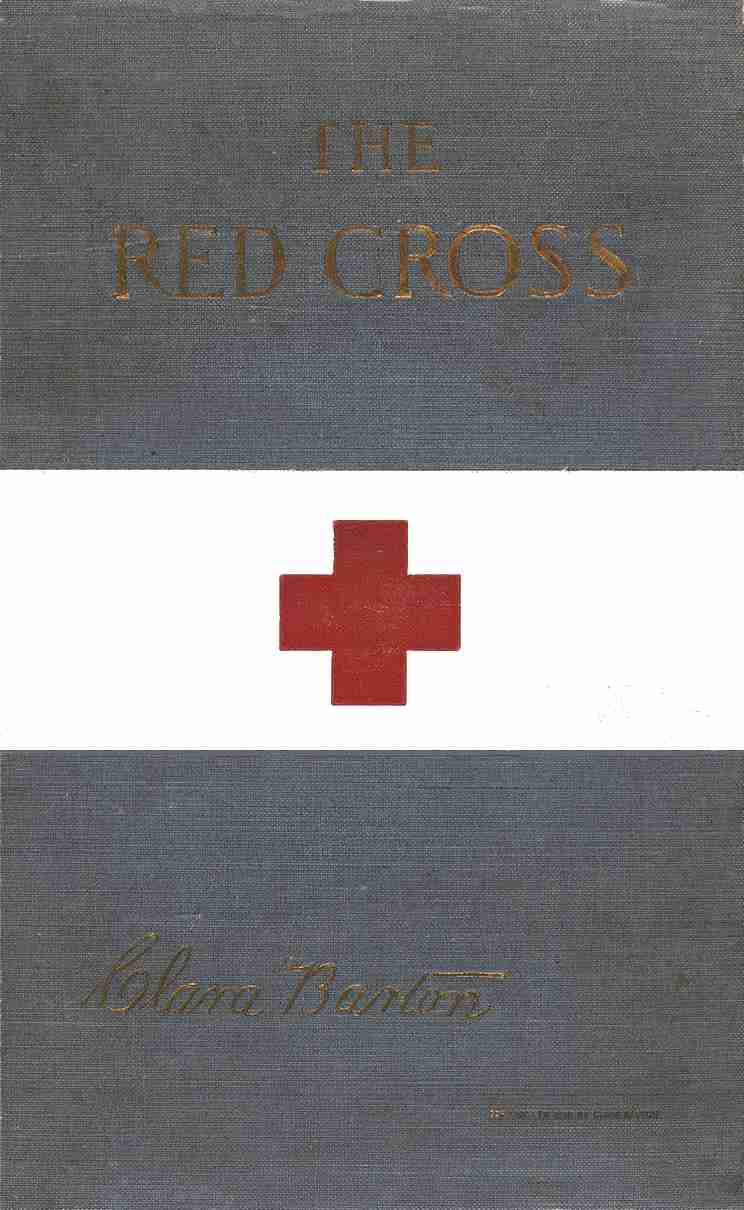
The Project Gutenberg eBook of The Red Cross in Peace and War
Title: The Red Cross in Peace and War
Author: Clara Barton
Release date: November 17, 2013 [eBook #44202]
Most recently updated: October 23, 2024
Language: English
Credits: Produced by KD Weeks, David Edwards and the Online
Distributed Proofreading Team at http://www.pgdp.net (This
file was made using scans of public domain works put online
by Harvard University Library's Open Collections Program,
Women Working 1800 - 1930)
Transcriber’s Notes
Autograph letters and similar documents which were presented only as images in the original have been transcribed here, and can be found at the end of the text. The captions of those images will serve as links to their transcriptions.
The lists of Illustrations and Contents have several anomalous, though accurate, entries. For example, the section on the re-incorporation of the Red Cross, beginning on page 94, appears in the Contents between sections on p. 184 and p. 197, for no apparent reason. The reference has been placed in its proper position in the Contents. Also, please note that the entries in the Contents do not always refer to formal sections of the text. They sometimes direct one to a change of topic otherwise unmarked in the text itself.
Several of the photographs associated with the Spanish American War, which were included at the end of the volume on pp. 675 and 676, are listed in the Illustrations where their subjects would appear.
Illustrations have been moved to avoid breaking paragraphs. On occasion, they may appear out of the normal page order.
The opening of the section on General History is labeled “Chapter I”, the only use of that designation in the volume.
Footnotes have been consolidated at the end of the volume, and linked for convenient reference.
Please see the Transcriber Notes at the end of the text for more details about the preparation of this text.
THE RED CROSS
IN PEACE AND WAR
By Clara Barton
AMERICAN HISTORICAL PRESS
1906
Copyright 1898, by Clara Barton
From the President of the United States
In his Message to Congress December 6, 1898.
It is a pleasure for me to mention in terms of cordial appreciation the timely and useful work of the American National Red Cross, both in relief measures preparatory to the campaigns, in sanitary assistance at several of the camps of assemblage, and, later, under the able and experienced leadership of the president of the society, Miss Clara Barton, on the fields of battle and in the hospitals at the front in Cuba. Working in conjunction with the governmental authorities and under their sanction and approval, and with the enthusiastic co-operation of many patriotic women and societies in the various States, the Red Cross has fully maintained its already high reputation for intense earnestness and ability to exercise the noble purposes of its international organization, thus justifying the confidence and support which it has received at the hands of the American people. To the members and officers and all who aided them in their philanthropic work, the sincere and lasting gratitude of the soldiers and the public is due and freely accorded.
In tracing these events we are constantly reminded of our obligations to the Divine Master for His watchful care over us and His safe guidance, for which the nation makes reverent acknowledgment and offers humble prayers for the continuance of His favors.
Illustrations.
| Clara Barton, from a portrait taken about 1875 | Frontispiece. |
| The International Committee of the Red Cross, Geneva, Switzerland | opp. 16 |
| Clara Barton, taken about 1885 | opp. 17 |
| The First Red Cross Warehouse, Washington, D.C. | 21 |
| National Red Cross Headquarters in Washington, from 1892 to 1897 | 22 |
| Some of the First Members of the American National Red Cross | 43 |
| A Group of American National Red Cross Members | 44 |
| A Group of American National Red Cross Members | 55 |
| Suburban Headquarters, American National Red Cross | 56 |
| Some Red Cross Decorations Presented to Clara Barton | 83 |
| Chronological Historic Tree | 84 |
| Clara Barton, taken about 1884 | 113 |
| “Josh V. Throop” | 114 |
| Camp Perry | 143 |
| Red Cross Headquarters | 144 |
| Johnstown, Pa., before the Flood of 1889 | 155 |
| Red Cross Hotel, Locust Street, Johnstown, Pa. | 156 |
| Red Cross Furniture Room, Johnstown, Pa. | 163 |
| Typical Scene after the Flood at Johnstown, Pa., May 30, 1889 | 164 |
| In Memoriam | 174 |
| Typhus Fever Patients in the Russian Famine, 1891–92 | 181 |
| Count Lyoff Tolstoi | 182 |
| Women Cutting Potatoes for Planting—Sea Island Relief, S.C., February, 1894 | 199 |
| A Windfall for St. Helena | 200 |
| Testimonial from Russian Workmen for American Help and Sympathy in the Famine of 1892 | 217 |
| A Russian Peasant Village | 218 |
| Receiving Room for Clothing, S.C. Island Relief, 1893–94 | 235 |
| South Carolina Sea Island Relief | 236 |
| The Island District from Savannah to Beaufort | 251 |
| Sick with the Famine Fever | 253 |
| Hunger-Stricken | 254 |
| Miss Barton’s Room | 271 |
| In the Old Schloss of Baden | 272 |
| Red Cross Headquarters, Constantinople | 281 |
| View from Red Cross Headquarters, Constantinople | 282 |
| Turkish Cemetery | 282 |
| Chief of the Dersin Kourds and His Three Sub-Chiefs | 291 |
| Chief of the Dersin Kourds | 292 |
| Decoration of the Royal Order of Melusine | 300 |
| Tower of Christ, Constantinople | 301 |
| W.W. Peet, Esq. | 302 |
| Rev. Henry O. Dwight, D.D. | 302 |
| Rev. Joseph K. Greene, D.D. | 302 |
| Rev. George Washburn, D.D. | 302 |
| Signature of the Sultan | 303 |
| Turkish Dispatches | 306, 307 |
| Map of the Country traversed by the Red Cross Expeditions carrying American Relief to the Victims of the Armenian Massacres in 1896 | 309 |
| Interior of Gregorian Church at Oorfa | 308 |
| American College Buildings, Aintab | 311 |
| American and Armenian Quarters, Harpoot | 311 |
| Marash | 312 |
| Red Cross Caravan | 312 |
| A Bit of Palou | 318 |
| Rev. C.F. Gates, D.D., Harpoot | 321 |
| Miss Caroline E. Bush, Harpoot | 321 |
| First Expedition Embarking on Ferryboat, Euphrates River | 321 |
| A Turkish Teskere or Passport | 322 |
| Diarbeker, Vilayet of Diarbeker | 331 |
| Ruins of an Old Gateway at Farkin | 332 |
| Some Methods of Work | 340 |
| Salemlik | 341 |
| Pera Bridge, Constantinople | 341 |
| Turkish Coffee House | 342 |
| Hamalls—Showing Manner of Carrying Heavy Burdens | 342 |
| Red Cross Expeditions Passing through the Valley of Catch Beard | 348 |
| A Turkish Procession in Arabkir | 349 |
| Judge Alexander W. Terrell, United States Minister to Constantinople during the Armenian Troubles | 351 |
| Armenian and Turkish Decorations | 352 |
| Group of Armenian Teachers and Pupils, Harpoot American Missionary College | 357 |
| Clara Barton, taken in 1897 | 358 |
| A Part of the American National Red Cross Fleet in the Spanish-American War of 1898 | 371 |
| Officers of the Executive Committee American National Red Cross | 372 |
| Admiral William T. Sampson | 381 |
| Governor-General’s Palace, Havana | 382 |
| Entrance to Harbor of Havana—Punta Park | 391 |
| John D. Long, Secretary of Navy | 392 |
| On San Juan Hill, Santiago | 407 |
| Spanish Guerillas | 409 |
| A Mounted Advance, Reconnoitring | 410 |
| United States Steamship “Oregon” | 413 |
| “Almirante Oquendo,” after the Engagement | 419 |
| United States Warships before the Entrance to Santiago Harbor | 421 |
| “Marie Teresa” after the Engagement | 424 |
| Chickamauga Camp | 427 |
| Camp Thomas, Headquarters American National Red Cross | 428 |
| Fortifications of Manila | 440 |
| Red Cross Dining Room for Convalescents, Fort McPherson, Ga. | 445 |
| Dining Tent Attached to Red Cross Kitchen, at Camp Hobson, Ga. | 446 |
| Panorama of Manila | 451 |
| In the Trenches before Santiago | 453 |
| A Soldier Funeral | 463 |
| McCalla Camp—Early Morning Attack | 454 |
| A Typical Cuban Camp | 464 |
| A Cuban “Block House,” Garrisoned | 481 |
| A View of Eastern Cuba | 482 |
| A Part of the Red Cross Corps | 499 |
| “I Am with the Wounded.”—Clara Barton’s Cable Message from Havana | 500 |
| Wreck of the Battleship “Maine,” Havana Harbor | 517 |
| The Prado—Principal Street in Havana | 518 |
| Havana Harbor | 535 |
| Captain C.D. Sigsbee | 536 |
| Street in Cavite | 539 |
| Citizens of Jaruco Presenting a Memorial for the Victims of the “Maine” | 553 |
| Little Convalescents in Hospital | 554 |
| Location of Shore Batteries, Santiago | 556 |
| July Fifth in Rifle Pits | 558 |
| Scenes on the “State of Texas” and in Siboney | 570 |
| The Physicians and Nurses of the Orphanage and Clinic in Havana | 571 |
| A Cuban Thatch Hut | 581 |
| A Battery of Cuban Artillery | 582 |
| A Group of Red Cross Sisters | 591 |
| Diploma of Gratitude for Miss Clara Barton from the Red Cross of Spain | 592 |
| View of Santiago de Cuba from the Harbor | 675 |
| View of Morro Castle, Santiago de Cuba | 676 |
| The Burning of Siboney | 597 |
| Annie E. Wheeler | 609 |
| The Youngest Red Cross Nurse | 610 |
| Scenes in Siboney | 627 |
| Scenes in Santiago | 628 |
| Refugees from Santiago | 636 |
| Santiago Refugees at El Caney | 639 |
| Establishing Headquarters Ashore | 640 |
| Starving in the Plaza | 647 |
| Los Fosos | 648 |
| Bringing in the Wounded | 657 |
| Clearing for a Cross Road | 658 |
Contents.
| PAGE | |
| To the People | 13 |
| Introduction | 17 |
| The Red Cross. General History | 23 |
| Organization and Methods of Work | 27 |
| Occupation in Times of Peace | 29 |
| Services in Time of War | 30 |
| Neutral Countries in Time of Peace | 34 |
| International Correspondence. M. Moynier’s First Letter | 36 |
| American Association of the Red Cross. Constitution and Original Incorporation | 46–47 |
| First International Conference | 48 |
| The Treaty of the Red Cross | 57 |
| Governments Adopting the Treaty | 58 |
| Address by Clara Barton | 60 |
| Action of the United States Government | 72 |
| The “Additional Articles” Concerning the Navy | 74 |
| International Bulletin, Extract from | 77 |
| Accession of the United States to the Treaty and “Additional Articles” | 80 |
| Proclamation of President Arthur | 85 |
| International Bulletin. Concerning Adhesion of the United States | 87 |
| International Committee. Letter Acknowledging Notice of Adhesion by United States | 90 |
| International Committee. Fiftieth Circular Announcing Adoption of Treaty by United States | 91 |
| The Reincorporation of the American National Red Cross | 94 |
| Significance of “Red Cross” in its Relation to Philanthropy. Address by Clara Barton | 97 |
| Michigan Forest Fires | 107 |
| Mississippi and Ohio River Floods | 111 |
| Mississippi and Louisiana Cyclone | 112 |
| Ohio River Flood | 115 |
| Down the Mississippi | 121 |
| “The Little Six” | 130 |
| Texas Famine | 136 |
| The Mount Vernon Cyclone | 145 |
| Yellow Fever Epidemic in Florida | 147 |
| The MacClenny Nurses | 150 |
| The Johnstown Flood | 157 |
| Arrival at Johnstown | 158 |
| Appointment of Committees | 160 |
| The Work of Relief | 161 |
| Farewell to Miss Barton | 169 |
| “The Dread Conemaugh” | 170 |
| In Memoriam | 174 |
| The Russian Famine | 175 |
| Count Tolstoi on the Character of the Peasants | 176 |
| Beginning of American Relief | 177 |
| Appreciation of American Sympathy | 180 |
| Dr. Hubbell’s Report | 184 |
| Sea Islands Hurricane | 197 |
| Coast of South Carolina | 197 |
| Admiral Beardslee’s Description of the Hurricane | 203 |
| Relief Work South of Broad River | 211 |
| Report by John McDonald | 211 |
| Hiltonhead District Clothing Department. Report by Mrs. MacDonald | 220 |
| Medical Department. Report by Dr. E.W. Egan | 222-228 |
| Relief Methods in Field. Dr. Hubbell’s Report | 232 |
| On the Charleston Group. Report by H.L. Bailey | 244 |
| The Clothing Department. Mrs. Gardner’s Report | 252 |
| The Sewing Circles | 257 |
| A Christmas Carol | 261 |
| Mrs. Reed’s Report | 263 |
| Leaving the Field | 268 |
| Letter to Charleston News and Courier | 268 |
| Circular to Clergymen and Committees | 273 |
| Armenia | 275 |
| Distance and Difficulties of Travel and Transportation | 305 |
| Funds | 307 |
| Committees | 310 |
| To the Press of the United States | 313 |
| To Contributors | 313 |
| To the Government at Washington | 314 |
| To Our Legation in Constantinople | 314 |
| To the Ambassadors of other Nations | 315 |
| Commendatory | 315 |
| “Marmora.” Poem by Clara Barton | 319 |
| Report of Financial Secretary | 324 |
| General Field Agent’s Report | 334 |
| Medical Report | 350 |
| The Spanish-American War | 360 |
| Home Camps and American Waters | 361 |
| The Central Cuban Relief Committee, Appointment of | 362 |
| The Red Cross Requested to Administer Relief in Cuba | 365 |
| Taking Command of the “State of Texas” | 368 |
| Relief Work at Tampa and Key West | 368 |
| Feeding Spanish Prisoners of War | 369 |
| Correspondence with Admiral Sampson | 370 |
| Appointment of the Executive Committee of the Red Cross and the Relief Committee of New York | 375 |
| Communication from Secretary of State Acknowledging Official Status of the American National Red Cross | 377 |
| The Modus Vivendi with Spain | 384-394 |
| Services of the Red Cross accepted by the Government | 395 |
| Appointment of Red Cross Field Agents for the Camps | 395 |
| Camp Alger, Washington, D.C. | 397 |
| Camp Thomas, Chickamauga Park | 408 |
| Jacksonville and Miami, Florida | 414 |
| Fort McPherson, Atlanta, Ga. | 420 |
| Camp Hobson, Lithia, Ga. | 422 |
| St. Paul Red Cross | 425 |
| Montauk Point, Long Island | 426 |
| Pacific Coast | 431 |
| The Red Cross of California | 433 |
| The Red Cross of Oregon | 441 |
| The Red Cross, Seattle, Wash. | 452 |
| Porto Rico | 460 |
| Report of Horace F. Barnes | 460 |
| Shipments by United States Transports | 470 |
| Relief Committee of New York, Report by | 473 |
| Women’s Auxiliaries of the Red Cross | 491 |
| “Women who went to the Field.” Poem by Clara Barton | 509 |
| Cuba and the Cuban Campaign | 514 |
| Havana | 520 |
| Los Fosos | 521 |
| The Orphanage | 522 |
| Destruction of the “Maine” | 524 |
| Jaruco | 527 |
| Matanzas | 531 |
| Senator Redfield Proctor’s Speech in United States Senate | 534 |
| Artemisa | 540 |
| Sagua La Grande | 542 |
| Cienfuegos | 544 |
| Back to Havana | 545 |
| Leaving Havana | 549 |
| On Board the “State of Texas” | 550 |
| Tampa | 552 |
| Arrival at Santiago | 555 |
| Siboney | 557 |
| Hospital Work at Siboney | 560 |
| Relief Work at the Front | 566 |
| Entering the Harbor of Santiago | 576 |
| Unloading the “State of Texas” | 577 |
| Feeding the Refugees | 577 |
| Relief Work in Santiago | 578 |
| Departure of the “State of Texas” | 580 |
| The Transport “Clinton” at the Disposition of the Red Cross | 583 |
| Leaving Santiago for Havana | 584 |
| Departure from Havana | 585 |
| Reports. | |
| Report of Dr. A. Monae Lesser | 587 |
| Report of Financial Secretary, Mr. C.H.H. Cottrell | 600 |
| The Schooner “Mary E. Morse.” Distribution of Ice | 624 |
| Letter of Santiago Committee | 637 |
| Medical Report by E.W. Egan, M.D. | 642 |
| Clothing Department. Report by Miss Annie M. Fowler | 656 |
| The Red Cross of Other Nations | 662 |
| To the Congress of the United States. Address by Clara Barton | 666 |
| To the Committees on The Red Cross | 674 |
| To the Auxiliaries of the Red Cross and the Nurses Who Went to the War | 677 |
| Unwritten Thanks | 680 |
| A Word of Explanation | 680 |
| Conclusion | 681 |
| Notes | 682 |