
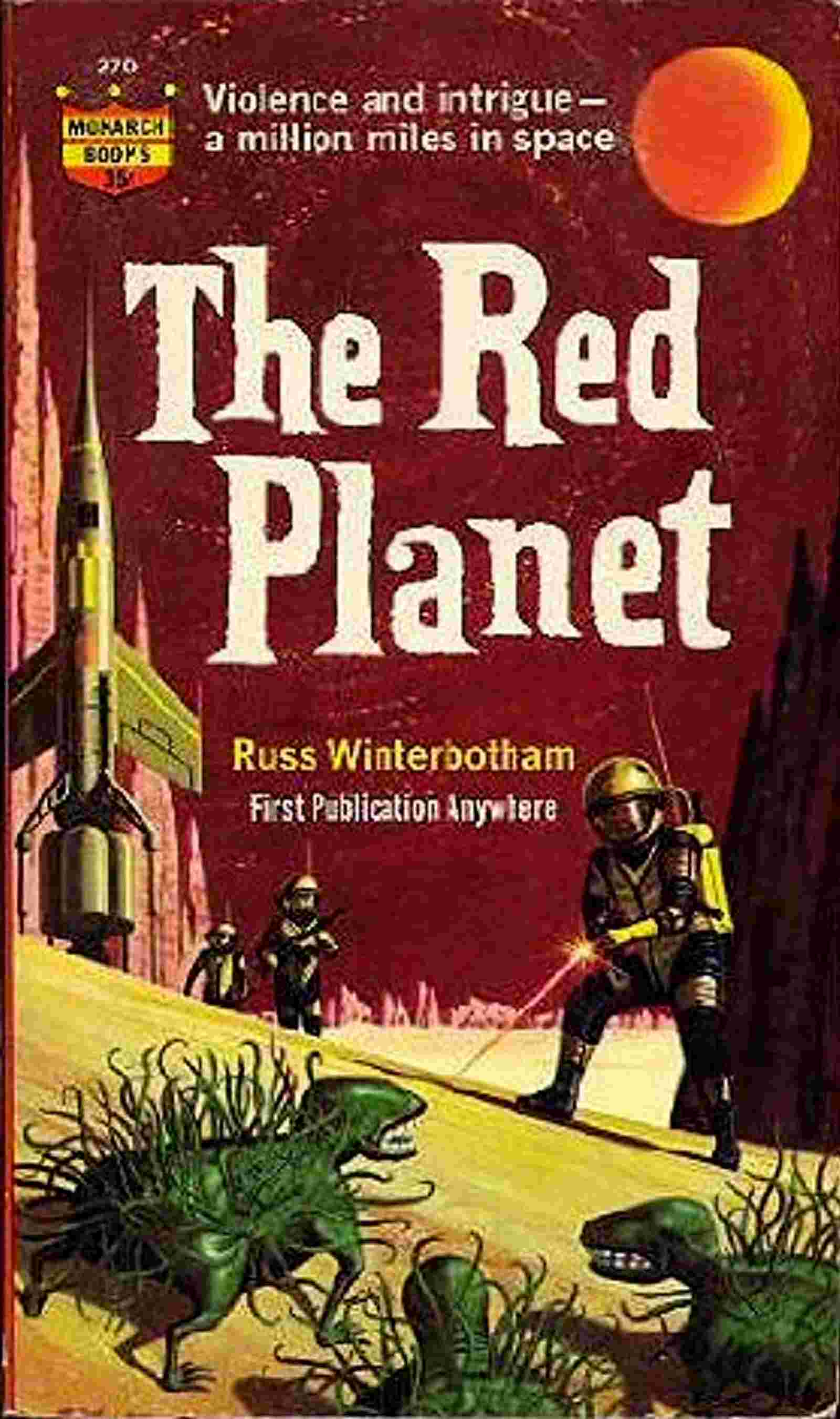
There was a sort of timberline, about fifty feet above the level of the stream. Beyond that no vegetation grew. Below, the ground was covered with all kinds of plants. That is the best name I could give them. They really were vegetable, but they weren't like any plants I'd ever seen.
Some were tall, like trees. Others were round, hugging the ground and looking like brownish cabbages. There were some that looked like toadstools, except that they were branched and had several caps. Nearly all the plants were branched, and a few had flowers ranging from delicate pink to deep purple. None seemed to have leaves.
The largest looked like the Giant Cactus—the saguaro—of Arizona, although it was not spined.
I found a place where none of the plants looked big enough and tough enough to impede the Mars-car and headed for the stream, which now appeared to be about twenty feet wide and very stagnant. I picked up my mike to tell Axel what I saw.
Then my wheels touched the stem of a Martian saguaro shoot. I heard a whiplike crack and the whole car was enveloped in blue flame.
I pressed my foot down on the accelerator and rolled over the plant. Looking back, I saw that it had fallen across another plant, a woody, slender type that was jointed like bamboo. Both of the plants were smoking. Sparks were flying from the saguaro with all the deadliness of a high power line.
"What's the matter, Bill?" Axel called back.
I realized that I must have shouted with surprise at the display.
"These damned plants are charged with electricity, Axel. At least, one of 'em is. It just unloosed a bolt of lightning."
"The hell you say! Are you hurt?"
"No, the car grounded the charge," I said, "but it gave me one big scare."
"Think you can bring in a sample?" he asked.
"What the devil, Axel! Do you want me to be electrocuted?"
"It's just an idea I had. Remember, you'll be safe in your spacesuit. It'll ground the charge, just like the Mars-car did."
"Well, I'll try."
I put on my helmet and got out of the car. First I walked carefully toward the banks of the stream. I avoided the saguaro-type plants, but I noticed that when my boots struck shoots and stalks of some of the other plants, sparks flew. More than half of the plants had the characteristics of an electric eel.
The stream, while stagnant, was steaming. It wasn't hot water, for the temperature must have been in the low forties, but the atmospheric pressure was so light that water was evaporating in great quantities.
It was difficult to see how the stream was supplied with water, since it extended between two oases, both apparently fed by the same stream. And there didn't seem to be very much flow, although after watching the stream for a few minutes I decided it was moving in the direction of Major.
Then I saw tiny springs along the bank, sending little rivulets of water into the canal. It was so simple that I should have guessed where the water came from. It all came from the polar caps, of course, but the water flowed underground. The Martians had simply cut their canals to feed on the artesian supply from the North Pole.
I took the can Axel had put in the locks and filled it. Then I lugged it back to the Mars-car. After I stowed the water in the locks I walked gingerly back to the saguaro I had knocked down a few minutes before. It was somewhat charred, but the fire had gone out. Apparently the air would not support much combustion. Using my knife I gingerly cut off one of the branches. No sparks flew, but I noticed that instead of sap, there was a thick, pasty pulp inside. It was acid, because before I could wipe my knife on the ground, the substance had etched itself slightly into the surface.
I carried the stalk back to the car and tossed it into the locks. I'd stepped inside myself and had just closed the door when I saw movement to my right—on my side of the canal, in the direction of Solis Lacus Major.
A small creature, a little larger than a St. Bernard, was approaching the Mars-car. It looked like a dwarf camel, except that it was headless. And the hump wasn't a hump, but a shiny bump with a metallic luster.
I said it had no head, but it did have a mouth—gaping, grinning and full of pointed teeth. It had four legs and many arms—long, sinuous, many-jointed, with two fingers at the end—growing like a fringe around that bump in the middle of the creature's back.
Then I saw that the vegetation in its path was smoldering. The animal had only to move a small black thing that sprouted on a stem from the top of its hump, and whatever lay in front of it started to smoke.
"Axel!" I screamed into my helmet transmitter. "There's a Martian down here!"
No one had told me what it was and none of its acts had shown that it had intelligence, but some instinct told me this creature was the highest form of life on Mars.
Chapter 13
The machine in which I traveled made no distinction between forward and reverse. You set a hand throttle in one direction to go forward, and in another to go back. It went just as fast one way as the other and there was no need to turn it around. I started back up the incline without turning anything but my seat, so anxious was I to get away from that Martian.
I'd started up the incline before I glanced back in my rear-vision mirror and saw that this creature had been joined by a companion, identical in every detail to my indiscriminating eyes, although I suppose their mothers could have told them apart.
Axel's voice jabbered in my ears but I wasn't listening. I wanted to get out of this canal and away from these horrible creatures. I didn't like their teeth, I didn't like their black humps or radar antennae, or even their padded feet. That destroying heat ray was radar.
"What's that about radar, Bill?" came Axel's voice. I knew I'd spoken aloud.
"They've got built-in radar instead of eyes!" I said. "It's so powerful it sets fire to things." Radar could do that. Strong stations on earth could literally cook a man unfortunate enough to get within close range. Even weak stations could set off flashlight bulbs in a photographer's camera. The walls of the car had protected me. Even my spacesuit probably would have been sufficient protection. But I didn't like all this power in a living body.
The Martians, apparently startled as much by me as I had been by them, hesitated before starting in pursuit. I was hitting the steep grade up the wall of the canal before they came after me. But they ran slowly and gracefully, in no hurry to catch me. They kept a reasonable distance.
"Did they do anything to you, Bill?" Axel asked. "Are you all right?" There was a worried note in his voice.
"I'm okay," I assured him, "but these—these monsters are following me. Two of them. They look awful. No eyes, not even a head, just a hump on their backs like a camel and a fringe of arms on each side—" I glanced back. "Eight arms," I told him, counting them. "Stay where you are and I'll pick you up. Main thing is to get back to the ship. They don't run very fast and I think I can outdistance 'em on level ground."
Then Dr. Spartan, who had heard our radio conversation, interrupted. "Why didn't you shoot them, Drake?"
"I was in the car," I told him. "And they're two to one."
He hesitated, then said, "Don't try to outrun them. Lead them slowly. Give me a chance to get there."
"Yes, sir," I said.
You don't argue with Spartan and I was too busy guiding the car over the rocky slope to answer anyhow. I don't think I could have outdistanced the Martians going uphill as I was. On level ground though, it would be different.
My radio suddenly started to chatter with a series of strange noises. The Martians seemed to have discovered my wave length. It was a sound the like of which I'd never heard before. It's hard to describe it. The nearest comparison would be a cricket singing bass. Or perhaps the dah of dit-dah Morse on a code transmitter. But the Martians had demonstrated that they could change frequencies, and vaguely I wondered how they'd do on television and FM channels.
Suddenly they seemed to be trying to imitate my voice.
"Yessir—yessir—yessir—"
They were like talking crows.
Finally I reached the lip of the canal and, rolling over the ridge, saw Axel standing beside a pile of light crates he'd stacked up beside the rocket ship. He waved his hands and I steered toward him.
Beyond him came Spartan, in the other Mars-car, hitting high speed on the sand. I thought of the garrison rushing to rescue the besieged wagon train in the woolly frontier days.
"Bill Drake!" Axel called, his voice wedging into the chattering Martian voices.
"Billdrake—billdrake—" mocked the Martians.
I braked the car and Axel scrambled toward the locks as the Martians appeared on the rim of the canal behind me.
Axel took one apprehensive glance in that direction before he climbed aboard.
"Tain't human!" he gasped, which was the understatement of the solar system.
Dr. Spartan's Mars-car halted about two hundred yards south of us. I saw him climbing out of the locks, his rifle in his hand.
"Tanetooman," chanted the Martians.
"This way, Drake!" Spartan signaled with his arms that I was to pass to his left.
"Thiswaydrake—" screamed my earphones in raucous echo. "Billdrake—tanetooman—yessir—"
"Aw, shuddup," said Axel to the Martians.
"Shuddup—"
Axel looked at me and shook his head at the Martian reply.
I wheeled the Mars-car around behind Spartan's, halting in a position which would allow me to watch.
The Martians were loping casually toward the two cars, seemingly in no rush to get there. And it was then I suddenly realized that their actions weren't hostile. I'd been frightened when they'd set fire to the Martian saguaro in the canal, but I realized that this had been defensive. They had been as afraid of me as I had been of them. Nothing in the world panics a man as does a situation he's never encountered before and does not know how to handle. And I suppose, in this respect, the Martians were human.
In fact, I was soon to learn that although physical bodies were apt to assume strangely different shapes, the psychology of the Martians was as human as intelligence. And it was a logical thing, too. After all, most of life's actions, possibly all, are aimed toward a double purpose—preservation of the individual and of the race. This fact is as basic as Newton's laws governing the physical actions of the universe.
In fact, the two kinds of matter in space, animate and inanimate, may not be so different, after all. The energy that is in all matter, may be seeking to control its destiny, and life may be a basic property of the power that exists in every atom.
But it was no time for philosophy. I didn't think these thoughts then—it was not until long afterwards that they occurred to me.
I was watching the Martians who now had slowed to a lazy canter, focusing their biological radar on the two similar objects parked in the desert.
As they came abreast of the spaceship, they looked at that too. I expected to see the pile of supplies Axel had stacked near the ship to go up in smoke—flames being highly unlikely in thin air like this. But the Martians were no longer frightened. The enemy had fled at their approach. They assumed, no doubt, that we were no match for them. And this is another trait that has proved the undoing of many a human being—to suspect weakness where it does not exist.
Dr. Spartan dropped to a prone position and raised his rifle. Apparently the Martians had not noticed him because they were too busy examining the rocket ship, the supplies and the two Mars-cars. Perhaps they mistook the cars for earthlings. They'd never seen us before.
As they looked, their chattering ceased, so engrossed had they become in the sights before their antennae.
"Don't shoot, Dr. Spartan," said Axel. "They're not acting hostile."
The Martians picked up the last words, "Nottacking hossile."
"Bah!" said Spartan. And he fired.
An explosive bullet struck the Martian on the right. We didn't hear the crack of the rifle or the blast of the bullet as it struck the poor creature. But we saw the smoke and flying flesh. What remained of the beast collapsed in a heap on the sand.
The second Martian, not having seen Spartan, seemed to freeze in terror for an instant. Possibly there had been some sort of a dying scream from his companion—one that could not be heard on the wave length of our helmet receivers. At any rate, it took only a split second for Martian No. 2 to realize we were neither weak nor harmless, as we had seemed. He turned and fled toward the canal at full gallop.
His speed was astonishing.
Dr. Spartan fired again. His shot missed and sent a geyser of sand skyward, ahead of the fleet monster. He swore and fired again. But the next shot was not an explosive bullet. It missed, too, and he switched his weapon to automatic and emptied the magazine with rapid fire. I saw the path cut across the sand and intercept the Martian. The creature staggered, then sank to the ground.
"Hah!" Spartan exclaimed triumphantly. "Let's take the dead creature to the ship! I'd like to see how he's constructed."
It was a gruesome business, but we loaded the scaly body into the locks of our car. The one Spartan had shot first was too torn and shattered to be worth transporting. Besides, the fluid that might be called blood, or sap, looked like acid and I was afraid it might damage the floor of the locks. My judgment turned out to be correct, for when Gail, our biologist, examined the beast we brought back, she announced that he was a mass of deadly poison and so were the plant samples I'd brought back from the canals.
"What kind of poison?" Spartan asked.
"I'm not sure, but Bill Drake can tell with a few tests," she said.
Spartan gestured to me. "Go ahead, Drake."
I got chemicals from the supplies Axel brought from the overturned ship and set to work.
It was fortunate that I made these tests. The Martian plants and the dead Martian were very similar chemically, giving rise to speculation that the evolution of life on Mars had taken place about the time the planet had stabilized into its present state. On earth, life began while the planet was evolving from an earlier form and the changes continued while life developed. The changes probably brought about the division of the animal and vegetable kingdoms and they might have continued until sixty million years ago when the giant reptiles were wiped out, or even later through the glacial ages.
But on Mars there was only one kingdom. It wasn't wholly animal, or wholly vegetable, although it was more the latter than anything else. And the tissues were formed from a very deadly series of molecules which had cyanide as their base. In other words, Martians were poison to us, and very likely we were poison to the Martians.
Furthermore, the water we had brought from the Martian canal was impregnated with ammonium hydroxide, in large enough quantities to cause serious illness should we be foolish enough to drink it. However, it was very useful for washing the cyanide from our gloves and spacesuits after we performed the autopsy.
And the autopsy, beyond determining that the Martians probably obtained chemicals and oxygen by chewing up the soil, which contained many oxides, was bewildering. Spartan made pictures and microscope slides which could be studied if or when we got back on the earth.
All we know was that on Mars, life was a sort of mobile vegetable which wasn't really a vegetable; and it was decidedly poisonous. We didn't know how these creatures reproduced, but Gail expressed the opinion that some of the "arms," all of which seemed to have different uses, might be sex organs and that Martians gave birth to their young by a kind of "budding," which exists among lower forms of life on earth. "Probably every Martian is both male and female," she said, "like some worms."
Like the electric eel, they had organs which produced a strong electric current. But their radar equipment—the metallic hump and the black spot on top of it—baffled us all. Nature had done the job compactly and bewilderingly, with cells.
"Those teeth look vicious," said Gail.
"I wonder if their owners are," said Joel. "They spied on us during the entire trip from earth. They clouded our scope so we couldn't use radar. They chased Drake. That's an indication that they might be vicious."
Axel shook his head. "They were just cautious," he said. "We'd have been just as cautious if Martians had come to the earth. And they didn't really seem to be chasing Bill. He was frightened and ran. They saw no reason to fear him, so they followed, possibly trying to establish communication."
"Yes," I said. "They tried to imitate our language. Did a pretty good job, too." There had been nothing vicious or hostile in that.
"But one thing we can be sure of," said Axel, "is that the next time they see us, they will attack us. We have lost our chance to be friends of the Martians. I'm sure the two who saw Bill had seen sent to spy on us and they must have notified others, by radio, that they had made contact. Now they are missing. Only one conclusion could be drawn. We killed them. And this is an act they'll demand revenge for."
"Bah!" said Spartan. "There's nothing to worry about. We've shown them we are the ones to fear. We have strength. These lower forms of life understand strength—they'll leave us alone."
"Lower forms of life?" said Axel. "And what makes a creature a higher form? I'd say we're the lower forms on Mars, because we have difficulty living here. We're not successful in this environment. We'd become extinct in a short time if we were transplanted here permanently."
Dr. Spartan's face grew dark inside his helmet. His words were spoken in a manner implying threat.
"You're forgetting, Ludson," he said, "that I'm the commander here. I'm not to be contradicted or spoken to in the way you've just done. I'll do all the thinking for this group."
He rinsed off his gloves with the water from the canal and went into the ship.
Chapter 14
If Spartan was doing all the thinking, his mental processes were similar to Axel's, or perhaps Axel's stated ideas had taken root. He ordered Joel and me to get the ship ready for a lift-off, in the event of a Martian attack. This would cut down our exploration time on Mars, but we already had made a successful landing, and we had determined a few facts about life on Mars. Naturally, we still would try to push forward with our mission until the Martians drove us off. This would include the exploration of a considerable area of the planet in our vicinity. Later, while the Jehad was circling Mars, we would be able to take pictures of the rest of the surface features. Later expeditions, which would follow someday, could do the rest.
All of our supplies had been piled inside the moat and those we needed were taken into the headquarters rocket. Spartan and Axel dismantled the overturned rocket and obtained enough metal to construct a scaffold and ramp from the ground to the locks, eliminating the necessity of using a ladder to enter and leave the ship.
During the time we prepared our living quarters and defenses, all of us were engaged in the task of learning as much as we could about Mars. We made analysis of the soil and rocks, studied the weather and took countless photographs. Gail made a trip to the canal, unmolested by Martians, and brought back additional samples of Martian vegetation.
The water problem still confronted us. There were many things in the Martian water that could not be removed by distillation. However, the water was an excellent solvent and was used for our cleaning and sanitary purposes.
Spartan and Axel made a short trip to Lacus Minor, which was 150 miles west of our ship. Gail and I were left behind to analyze the plants she had found, while Dr. Joel was picking up rock samples along the rim of the canal.
We finished our analysis and when we'd cleaned up and disposed of the poisonous substances we had examined, I said, "It's time to do something about Spartan, Gail."
She gave me a sharp look. "I thought we decided the expedition came first, Bill Drake."
"It's a matter of survival now," I said. "We all know we're in a worse situation than before as far as the water is concerned. There's only enough for three. Spartan needed a six-man crew mainly to get things organized here on Mars. Now the worst is over. Even if he gets a chance to do some more exploring, four can do it all. There are only two cars anyway. Come to think of, two people would be enough—one to a car. There's no reason for Spartan to delay his plans any longer. He'll start expending the expendables."
"What of the Martians?"
I shrugged. "We've made enemies of the Martians by killing two of them. I doubt if they'll forgive us for that. They've shown too many human qualities—curiosity, fear, bravado, for example. They probably have the ability to be angry and to extract an eye for an eye. So we're fighting a whole planet. Whether there are five of us or three wouldn't make much difference. But Spartan has us prepared for a lift-off and I don't think he intends to wait for an attack to trim down our numbers."
She looked thoughtful, then said, "Bill, are you suggesting we murder Dr. Spartan?"
I hadn't suggested it. All I was thinking of was saving my life and hers. Self-protection. But that included killing in self-defense. Possibly I'd had murder in the back of my mind. But when she said it in so many words, I was revolted.
"Not if we can avoid it," I said.
"But there isn't enough water for five, you said. That means—" She stopped.
"I'm willing to try it on rations," I said. And I was. "Spartan isn't. Spartan planned to get rid of us anyhow."
Slowly she shook her head. "No, I don't believe even Spartan could be like that. I'll admit I did think it once. But he'd have too much to explain when he got home. Still, if he could arrange an accident—"
"He's arranged two of them. Willy and Morrie. What's to stop him from getting rid of Axel and me? Perhaps you, if you were likely to be a witness against him."
"We can't be a party to murder, Bill Drake," she said.
She was right. I knew that even if I had carried the idea around in my head, I couldn't kill in cold blood. If Spartan tried to kill me and I had to stop him, it would be a different matter. But even though I knew he had no intention of letting me live, had already tried to kill me once, I couldn't deliberately plan his death.
"But we can restrain him," I said. "Take him prisoner."
"That would be mutiny," she said.
"No. We have evidence that he murdered Morrie Grover," I said. "We'd be putting him under arrest."
"But the mission!"
"The rest of us could do what has to be done. The main thing is to prevent more killings. Arrest would make it unnecessary to kill Spartan."
She sighed and said nothing.
"Axel will help," I said. "Joel won't interfere, either way; there's even a possibility that he might join us once he's made to understand what's been going on."
She sank down on a packing case we'd been using as a chair. "All right, Bill Drake. But please be careful," she said.
That night Spartan called us by radio. He and Axel had run into a terrific storm just as they left Lacus Minor. Red dust had practically overwhelmed them, and winds up to 75 miles an hour had thrown the Mars-car into a marsh. However, there had been no serious damage and they'd return the following day.
When Joel came in, and after we had eaten our evening meal, I told him bluntly what we'd found out about Spartan.
"He murdered Zinder and Morrie Grover," I said in conclusion. "He means to kill two more of our party in order to insure enough water for the return trip. You could easily be a candidate."
Joel listened, bewildered, to all I said, about finding the paper in Morrie's helmet air valve, about Axel knowing he had tampered with the machinery in Willy's capsule, and how Spartan had unfastened my safety line when I brought Morrie's body from the top of the Jehad.
"I—I can't believe it," he said. "You're making it up."
"Why should I?" I asked.
"For the same reasons you're attributing to Dr. Spartan," he said. "You want to kill him so there'll be enough water. Maybe you want to kill me, too."
"Damnit," I said, "we don't want to kill anybody. There may not be enough water to keep us from being thirsty, but there's enough to keep us from dying. I'm willing to suffer to avoid murder. That's why I'm planning to arrest Spartan."
"Arrest! It's mutiny! When you get back to the earth there'll be a lot to answer for, Drake."
"Then we'll have to arrest you, too," I said. "The rest of us—Axel, Gail and I—know the score, Warner. I've tried to explain it to you. If we can't trust you—"
"Now just a minute! I didn't say that."
"Not in so many words," I told him. I put my hand on the butt of my automatic pistol.
His eyes followed the move. There was fear in his face. "I don't know what to do," he confessed.
"Do nothing," I said. "That's all I ask."
He gulped. He seemed a little relieved. "I don't see how I can do anything," he replied.
"Stand up!" I said.
He looked frightened again. "What are you going to do?"
"I'm taking your gun," I said. "Just to make sure you won't try anything."
He stood up and I made him turn around. Then I took his gun. "You'll sleep in the lower cabin tonight," I told him. "Gail and I will take turns doing guard duty."
The next morning, Dr. Joel was a very subdued man. He ate breakfast silently and then volunteered to tidy up the cabin. He went about his tasks eagerly, anxious to please. All of the truckling he had done for Dr. Spartan now seemed to be transferred to Gail and me.
About noon the Mars-car rolled in. I had been waiting for the arrival in my spacesuit and, as soon as it came within view, I slipped my helmet over my shoulders, sealed it and went out to meet them.
The car bumped over the causeway and came to a stop at the base of the ramp. Spartan, holding the rifle in his hand, was standing in the locks. Axel was at the controls, putting on his helmet.
Presently Axel entered the locks. Then both men jumped out to the ground.
"Help Ludson with the samples, Drake," Spartan ordered.
As he turned his head to gesture, I brought my automatic into view.
"You're under arrest, Dr. Spartan," I said.
Axel's mouth, which I could see through the glass of his helmet, gaped with surprise as he heard my words in his earphones.
"What's the meaning of this?" Spartan cried.
"Just what I said, Dr. Spartan," I told him. "You're under arrest for the murder of Morrie Grover. And if that isn't enough, for killing Willie Zinder and trying to kill me."
"You're talking nonsense, Drake. This is mutiny, punishable by death, Axel!"
I don't know what he expected Axel to do. I think he wanted me to turn my head so he could attack, or draw his own pistol, but I refused to be taken in by that old dodge.
"He's right, sir," said Axel. His habit of addressing Spartan by the title "sir" couldn't be shaken in a moment. "I found the paper in the valve of Morrie's helmet before you removed it."
"Lies!" said Spartan. "Now listen. If you put away that gun, Drake, I'll forget this. It's just another case of over-wrought nerves—the same thing that affected Grover—"
"And cause you to kill him because that was the easiest way to handle him?"
This seemed to hit Spartan because he didn't realize how well we knew his motives. He seemed to quiver. "I'm to be killed so you'll have enough water—"
"That's one reason you would have killed me, probably," I said, "but we're a different sort, Spartan. We're taking you back to the earth. And you'll share our rationed water all the way. We won't kill you. What happens to you after your trial on earth is not up to us."
His shoulders seemed to sag. "And I was the first man to walk on Mars!" He seemed to think that ought to atone for everything. "Now you're gutting the whole expedition."
"You're wrong on that score, Spartan," I said. "We'll complete the mission. You'll be under guard, but the rest of us can carry it out. We're doing this now to defend ourselves."
I heard Axel's sigh in my earphones. "I'm glad you said that, Bill," he said. "I didn't quite know what was coming off."
We took Spartan into the ship after disarming him. We removed his helmet and spacesuit and tied his hands. He said nothing, showed no emotion except anger.
Dr. Joel came into the room. He saw Spartan and avoided his eyes. "You're in on this too, Warner?" Spartan asked. "You, the one man I believed was my friend?"
Joel turned to me without answering his former chief. "There's quite a bit of Martian chatter over the radio, Drake. I got a directional fix. It's coming from the south."
"South?"
"Yes, and it's strange, too. There's nothing but sand in that direction."
"There's Pnyx," said Axel.
"We thought Umbra was the nearest city," I said. "That's east, in Lacus Major."
Joel shook his head. "I tried to pick up the jargon from Major. Not much sound there."
Axel stared at the floor for a moment. "Doc and I saw some things at Minor that may be the answer. There was a big area where the vegetation had been cut away. We decided that the Martians had been there and harvested a crop. If that's true, Umbra might be a farming town and, like most farming communities, a peaceful place. Pnyx, on the other hand, is larger and might be a place where troops could be assembled. A sort of military base. See what it means?"
He didn't have to draw a picture. Mars was mobilizing to defend itself against the invaders from Earth.
"Ah!" said Spartan. "What you need is an astute leader. Release me. I'll take charge in this emergency and we'll forget these silly things you've been saying—"
"Shuddup," said Axel. He turned to me. "What does a good commander do in a case like this, Bill?"
Even though I'd been in the Army, the generals had never confided their methods to me. But you do pick up a few military principles, even as a buck private. "Send out a patrol," I said.
"What good does that do?"
"Well, if we sit here like lame ducks, we won't know when they're coming, how many, and we certainly won't find out what they have in mind," I said. "But if we scout them, and view their potential, maybe we could figure out some way of defending ourselves."
"You don't think we could fight a whole planet? Or even a small company of armed soldiers, do you?" Joel asked nervously.
"If it looks like they're coming to get us real quick, we can lift off," I said. "Maybe they figure they'll need a pretty big force which will take a couple of weeks to organize. If that's the case, we can do a lot of scientific work before we leave."
"Okay, Bill," said Axel. "You're the patrol."
"Now?"
"The sooner the better," said Axel.
I got my helmet. Then I picked up the rifle Spartan had carried on his trip. It was loaded with two rounds of explosive shells and eighteen rounds of ordinary bullets. I slipped a couple of spare clips for my automatic into my pocket. Then I went into the locks.
Axel followed me. "Just a minute before you put on your helmet, Bill," he said.
I gave him a curious look. "Okay. What's on your mind?"
"Take Gail with you," he said.
"But this will be a dangerous mission," I told him.
"Not half as dangerous for all of us if you leave her behind."
"Why?"
"I don't trust Joel," said Axel. "If he turned the tables and got the drop on Gail and me, nothing could keep Spartan from blasting off, leaving you behind and probably me, too, if I lived that long. But Spartan has his plans for Gail. He won't leave without her. If she's with you, he won't do anything till you get back."
"And if he's in control, what chance would we have?"
Axel shrugged. "As long as there's life there's some kind of chance," he replied. "But if Gail were aboard the ship, you wouldn't have any chance. Spartan could go back to earth, report a mutiny and subsequent casualties that occurred in quelling it. Nobody could prove anything different. But with Gail gone, I think Spartan will postpone any moves he might make until she returns."
I thought it over. Gail, being one of us, would never live to reach the earth, that was certain.
The thought decided me. She would be safer with me, facing all of the Martians on Mars, than in Spartan's hands.
"Tell her she's on this patrol, too," I told Axel. "I'll get some grub and water aboard the Mars-car."
Chapter 15
Our chart which was very spare of detail since it was made from the maps drawn by Percival Lowell many years ago, showed Pnyx as the junction point of two large canals. One, called Agathedaemon, ran southeast from Oasis Erithraeum to another junction point, Messeis Fons. The other ran southwest from Lacus Major and ended at Pnyx, which seemed to be at the edge of a small oasis.
I set my compass due south, deciding to travel in that direction until I reached the canal from Lacus Major, which Lowell called Chalus.
Gail was happy to be making the extensive land trip over the surface of Mars. Pnyx was at least three times as far as Lacus Minor, but since the Mars-cars could easily maintain a speed of 150 miles an hour over the desert, we expected to reach it in a little over three hours, if nothing interfered.
"If there were only some way of communicating with the Martians," she said. "If we could only explain to them that the man who murdered the other two is in custody and will be punished and that the people of the earth didn't come to this planet to kill Martians!"
"It would solve everything but I'm afraid it's impossible," I said. "There was a big gulf between Martians and earthmen to start with. Now this thing has spread them farther apart."
"You mean they're poison to us and all that? We've demonstrated that we have some things in common, psychologically speaking."
"That could turn out to be the main stumbling block," I said. "Remember when you, Axel and I talked about personal selfishness and race selfishness? How a person would kill to save himself and die for an ideal that was important to the race?"
"Yes. Are you suggesting the Martians want to become martyrs?"
"No. Race-preservation or race-selfishness exhibits itself in other ways besides that of dying for principles. One manifestation is intolerance. There's a hatred for anything that is different or nonconformist. Martians and earthmen seem to have the same psychology, but we're different in looks so we repel each other, just as do certain elements. Maybe intolerance and hatred have their roots in the chemistry of an atom. Be that as it may, most creatures of the earth tend to destroy what they don't understand."
"But we don't hate Martians!" Gail insisted.
"Maybe hatred is too strong a word. However, for want of a more accurate one, let's considered the difference between the hatred we feel for, say, a Dr. Spartan, and the kind we feel for Martians. One stems from self-preservation, and one from race-preservation. This scouting trip, for example, is hate motivated. We're trying to get the best of the Martians without getting hurt ourselves. And they want to destroy us with a minimum of casualties."
"I suppose, as you've hinted, this hatred of differences is the foundation of racial intolerance?"
"Basically," I said. "Racial differences on earth—between men, I mean—are so slight they don't actually matter. Some people are a little darker or lighter, with maybe a few differences in features. But the Martians are so different that you can hardly find any resemblance except in psychology. The gulf is just too big to cross."
"Even if we're intelligent?"
"Perhaps intelligence can cross the barrier, but there are bound to be different levels of Martian intelligence. The ignorant Martians would heap indignities on us because we're a different minority."
"You have it all figured out, haven't you, Bill Drake?" she asked, leaning back in her seat. We had removed our helmets—they weren't necessary in the car—and her hair, beautiful and now grown out from the mannish bob she'd worn when she left the earth, fell nearly to her shoulders. "I suppose you are insecure because we're in an environment so utterly strange and unreal that we can hardly convince ourselves we're living in it."
"I'll admit that sometimes I think I'm in a dream world," I said, "and I'd like to be surrounded by things I'm used to. But I have confidence in myself to pull through. I like self-confidence. It's something you can have in yourself, which nobody else may have in you."
"But some things are the same," she said quietly. "The very things I didn't want to bring along with us. And I don't mean self-confidence."
I glanced in her direction. Her eyes were closed, her lips looked soft and her body yielding. "Such as?" I asked.
"Morrie mentioned it," she said.
Now I knew what she was talking about. I took a mental grip on myself. Morrie went off his rocker. I'd stay sane. It'd be a tough fight but—
"Did you say something, Bill?" she said, opening her eyes.
I hadn't said anything. She went on:
"Morrie said he was a man and I was a woman. That's something that exists on earth and it existed in space. You are a man and I am a woman here, Bill."
"Damnit, we agreed—"
"Bill Drake," she said. "Let's just say the agreement was made years ago and the statute of limitations has caught up with it. To hell with the agreement. In those bygone days I thought a trip to Mars was a career. I'm a woman, Bill Drake. That's my real career."
I braked the car, stopping in the middle of the big, red desert. There, millions upon millions of miles from that little planet where we had been married, I took her in my arms. My lips tasted hers and we clung to each other.
The damned spacesuits bothered us. I fumbled with hers and then with my own, and finally we shed them.
A long time later, we remembered we still had a job to do and we went on our way again. We reached Chalus, as deep as the Lacus canal, but containing more water—it was half as wide as the Hudson.
As we paused on the rim, looking toward the deep channel, Gail seized my arm and pointed. I'd seen it, too, about the same time—a long, flat barge, heaped with what looked like hay. It wasn't hay, of course, but Martian vegetation, cut and stacked on the barge. It was being taken by canal in the direction of Pnyx. And Martians, pulling ropes tied to the barge, were the motive power. There were slaves on Mars.
"Martian commerce," I said.
We rolled on, paralleling the canal until suddenly, ahead of us, lay another deep cut, branching out from Chalus and running almost directly west.
We had no idea how long it was, for there was no sign of it on maps. And when we decided to try to cross it in our machine we saw the reason why. The canal was empty. It was half-filled with sand from countless dust storms, and there was not a blade of Martian grass in the bottom.
It was an abandoned canal.
And on the other side was an ancient road.
It was paved with some kind of material that resembled concrete, although it was cracked and looked as if it had not been used for years.
"Do you suppose the Martians had cars?" Gail asked as we stopped on the road.
I shook my head. "I have some ideas about the Martians," I said. "They're probably far ahead of us in some ways—they are built for radar and they may have other senses we know nothing about—but that barge we saw was the first actual tool I've seen. If you can call a boat a tool."
"They must have had machines to build the canals," she said.
"Yes, but not a wheeled machine," I replied. "I don't think they have wheels on Mars. You see, the wheel was an invention man stumbled onto when he noticed that logs roll. The plants which grow on Mars, unlike our trees, have some sides that are flat. Consequently, Martians never got onto the idea of wheels."
"Then what's this road doing out here?" Gail asked.
"The material is pretty smooth, even though it's been etched by sandstorms," I said. "Possibly it was used to drag things over. It would be easier than dragging things over the sand."
The road angled south, in the direction we were going. I hoped that all roads led to Pnyx and followed it, even though it led away from the canal.
Beyond the canal we saw a round, symmetrical mound on the horizon, looking like half an overripe tomato sticking out of the sand.
It was the dome of some Martian city stuck out here by a dry canal. But it wasn't Pnyx and we saw no sign of life around the town.
We approached the city apprehensively. Possibly we would have avoided it altogether had we seen some sign of life, but the city looked as if there was no one at home. And the highway showed no signs of travel. In places where it was covered with sand, there were no tracks of padded Martian feet.
I saw that the road led through a large arched door.
"A ghost town!" Gail whispered. "An ancient, abandoned city!"
"I hope it's abandoned," I said.
We rode on. We had to find out, even at the risk of our lives.
The archway was just wide enough for the car. Still seeing no signs of life, we drove through it. Then we found that it had not been necessary to go through the arch at all. Above us was only half a dome. Beyond the gate we could see where it had been smashed and broken. Overhead, the cover ended with a jagged edge, as if some giant hammer had struck it with a terrific, shattering blow.
Before whatever disaster had struck the city, it had been a thriving community, at least a square mile in area. There were ruins of buildings, columns, monuments and narrow streets. The buildings were not like those on earth; they had ramps for entering and leaving the upper floors. The structures had no spires or architectural flourishes, but were strictly utilitarian—plain walls, narrow windows, and doors. Whatever had been used for glass was gone now, probably shattered when the city met its fate.
"Wonder how they raised that dome," said Gail.
"It might have been blown, like a bottle," I said.
We crossed the city and resumed our southward trip. Looking back at the dome, I noted that it was constructed of a shiny, glasslike substance which probably had been transparent at one time. But now it was coated with a fine layer of reddish dust. Centuries had passed since Martians lived here.
At the edge of the city stood a monument—a headless camel, a Martian, with his eight arms raised proudly above his spine.
"Glory wasn't unknown to the Martians, either," I said.
"A trait that springs from the urge to self-preservation," said Gail. "An individual, seeing a glorified image of himself, feels more secure."
We left the city after taking photographs. A minute or two later our Geiger counter began buzzing wildly. I slammed on the brakes just as we approached a terrific crater.
And now I knew why the city was no longer lived in, why there was no water in the canal, and why the road wasn't used.
"The bomb!" I said, almost in a whisper.
Mars had its own nuclear war! How long ago, I didn't know. Had I the time I might have measured the amount of radiation and determined approximately when the explosion had occurred. The radiation was not dangerously strong now and I knew the blast had taken place many, many years ago.
"You know," said Gail quietly, "maybe this is why the Martians were afraid of us."
"They knew we had the bomb and might use it on Mars?" I asked.
She nodded her head soberly. "I think the Martians must know a great deal about the earth. More than we ever knew about Mars."
"The question is," I told her, "whether they still have the bomb and if they're likely to use it on us."
"Maybe they've outlawed it," she said.
"If so, they're more civilized than we are."
"Maybe the Martians have had more time in which to become civilized," she replied.
"Civilization has a way of turning back," I said. "If they had the bomb once, they can build it again."
As we continued southward, we saw another domed city raise above the horizon. This was no ghost town. The dome was whole, larger than the one we had seen by the dried-up canal. It stretched across the horizon for five miles, at least, for the horizons of Mars seemed to be shorter than those of the earth.
I flipped the switch of the transmitter and called our base. Axel answered.
"We're not far from Pnyx," I told him.
"Have they spotted you yet?"
"No, but I haven't seen anything to report, either," I said. I squinted toward the city for a couple of minutes before I saw there was movement on what seemed to be an east-west highway running past the dome. A cloud of dust hung there and I thought I saw figures moving.
"It's too far off to see clearly," I said, "but there seems to be a lot of traffic on the main highway."
"Highways yet? You got money for toll?"
"Not funny, Ax," I said. "They got paved roads, but no cars that I've seen. We followed an old road part of the way. It's worn out and unused. I'll tell you about it later."
"See what's going on, if you can, Bill," said Axel. "We're still getting a lot of radio from Pnyx."
"I came here for information and I'll find something to report," I said. "Keep listening."
I slipped on my helmet, picked up my rifle and went through the locks.
I could feel the city as I stepped from the Mars-car. There's a kind of sensation you get when you're approaching a large metropolis, and it holds true on earth as well as on Mars. It's much different from the way you feel in the wide open spaces—on the prairie or in the mountains. Maybe it's extrasensory perception. Or maybe the soles of our feet transmit seismic vibrations of living people to our nerves. I had the feeling now.
Gripping my rifle I moved toward a little ridge just ahead of where I'd stopped the car. This ridge, I'd hoped, would protect the car from radar detection on the part of the Martians, but I believed I could risk a glance at the highway over the top of it without exposing our location.
I was about a half mile from the road and, from the ridge, I could see it, crowded with Martians, trotting in formation eastward toward the canal. They walked five abreast and there must have been hundreds of them.
I didn't have to be a Martian to recognize that this was a military group. Soldiers. Ants march to war like humans do. It's another fundamental that may have its roots in atomic energy, or in the nuclear intelligence that has formed all life so that atoms can control their destiny.
No local war was to be fought by these troops. They were off to meet the earthlings, in the first interplanetary war of the solar system.
So interested was I in watching the Martians that I didn't realize I was standing in full view; and I'd been seen, but not by the marching Martians, of which there were at least fifteen hundred.
A small patrol probably had been put out to protect the flanks of the main army, or even to look for us, since my approach probably hadn't been as concealed as I'd thought.
Three Martians of this patrol had started toward me, joining "hands" as they charged. And behind them were a dozen others.
Chapter 16
The Martians came galloping toward me, each grasping the extended trunklike appendages of the creatures on either side. I didn't notice now, but when I saw them in this kind of formation later, I noted that it was the second pair of appendages used for this particular business, the reason for which soon was to become apparent.
They were about sixty feet from me when the Martian on the extreme left raised his second appendage, which of course was unattached to any other Martian. From the end flashed long, crackling flame, the nearest thing I'd seen to lightning since my last thunderstorm on the earth.
It wasn't quite as good as a lightning bolt, however, because it fell short of my position by about six or eight feet.
Now I knew why they grasped "hands." Each Martian was, for all practical purposes, an electrical cell, and the three of them joined together were in series. If one Martian could produce a hundred volts, three Martians could produce three hundred. This voltage is for illustration purposes, of course. I don't know how much they produced and quite probably it was more than one hundred volts, in view of what happened later. It may have been a thousand.
But, although I knew the Martians were trying to electrocute me, I felt safe. My spacesuit had enough metal in it to carry a pretty good size charge to the ground and, since I was inside it, I could suffer no harm.
I raised the rifle to fire and they flashed another jarring charge at me. This time it hit. The blue flame licked down the barrel of my rifle, shot to my suit and, as I expected, grounded itself through my boots. I felt no shock, but I noticed with alarm that my rifle was suddenly so hot that I felt it burn through my gloves. Then I realized the danger. They could, literally, cook me inside my spacesuit by making it red-hot.
Before they could use their bizarre natural weapon again, I fired. The bullet hit the center Martian when he was less than thirty feet from me. He exploded as if he'd had dynamite for lunch and that broke the circuit.
The other two Martians dug their feet into the ground and slid to a stop. As I lifted the gun again, their radar apparently detected the motion. They broke and fled, unashamed, back to their flanking patrol. I didn't shoot after them. I had only one explosive shell left, plus eighteen nonexplosive standard rifle shells. I might need 'em, I thought.
And I was thinking right for a change. The two survivors were screaming in AM or FM, whatever they used for private conversation and cuss words. I could see their antennae waggle, but I wasn't tuned in on their network. The other twelve seemed to understand. They all joined appendages and started toward me.
It looked like the camel corps storming Khartoum, except that these weren't camels and they were slinging enough electricity to light a small city. I hated to think of the heat that would be generated if a bolt hit me. Even if they didn't get enough of a charge into me, my Achilles heel would be obvious once they saw that voltage, continually applied to a resistance unit, will make it rosy red-hot.
On came the Martians. Their soft, padded feet, looking so much like those of camels, sent a dust cloud rolling behind them. I lifted my rifle and aimed carefully at the middle of the line. This was my last explosive bullet and it had to produce spectacular results. I pressed the trigger and a flash of flame marked the spot where one of their number had ended his last charge.
The line was broken, the others hesitated. But six or seven Martians could swing heavy lightning and I had to break the two segments again. Had they attacked in two groups they could have fried me where I stood, but they didn't realize it.
I flipped my gun to automatic while the two groups consolidated. Now I cut loose. I didn't aim. Who knows what's a vital spot in a Martian? I just held down the trigger and swept the line from left to right. Half the Martians fell thrashing to the ground.
But my magazine was empty. I transferred the rifle to my left hand and pawed at the automatic in the holster at my side. The seven or eight uninjured Martians were trying to consolidate, and I wasn't having any of it.
Again I aimed at the center, to cut the voltage in half. The Martians had just managed to form a series again and flame lashed into the ground at my feet, but they were crazy with fear or rage or some Martian version of a terrestrial emotion and they didn't aim true. Then I banged at them until my pistol was empty. The line was chopped in three places but there were still five Martians left.
They were game creatures, for they came on desperately. Self-preservation, race-preservation, all the things we talked about including heroes and martyrs, were in this final charge. My pistol was empty, my rifle was empty and I was a sitting duck with no time to reload.
But I worked at it and as I did I heard a faint puffing sound, like the pop of popcorn. Mars is almost silent, but not quite. There is enough air to transmit the sound of a loud noise near at hand. Even though every split instant was precious, I glanced quickly to my right.
Gail Loring was there, clad in a spacesuit, holding her automatic pistol with both hands. The gun was bucking and kicking and making that puffing noise.
I glanced back. Two of the five Martians were on the ground. It wasn't luck, it wasn't good shooting, it was a goddamn miracle.
Gail broke up the party.
The three surviving Martians had had enough and, as Gail emptied that enormous .45 without hitting anything, they broke and ran in all directions, waving their trunklike arms in sheer terror. My earphones gave the cricket-burp. Martian cuss words, no doubt.
Still holding my rifle in my left hand and my pistol in my right, I clasped Gail in my arms, yelling things like "sweetheart, darling, angel."
"Sweetheart—darling—angel!" screamed the Martians.
I tried to kiss Gail through my helmet and hers, too. And we laughed and cried as we ran back to the Mars-car. Tears were streaming down her cheeks as I helped her into the locks.
As we entered the car again, we stopped laughing. A half mile away fifteen hundred Martians were leaving the highway and advancing toward us with joined arms.
My earphones screeched with Mars talk: "Ha-ha! Ha-ha! Sweetheart!"
They'd interpreted our cries of relief as battle cries.
Without removing my helmet, I put the car into high speed, away from the advancing Martians, and headed northward. The desert lay ahead of us, rolling and vacant, its wide expanse broken only by outcroppings of smooth rocks. I advanced the throttle till the car was traveling as fast as it would go. But as I worked up to that speed, the Martians had gained a little. Now they galloped in pursuit like race horses, except that they were faster than any Derby winner I ever saw. The gravity had something to do with that.
But it wasn't fast enough to catch us, although I knew now that the Martians Spartan had shot hadn't been really pursuing me. They'd been loping along, believing I was frightened and harmless, and they'd assumed they had nothing to fear from me. Possibly, if Spartan had not fired, Mars men and earthmen might have co-existed, in spite of their basic differences and the fact that they were deadly poison to one another.
Then the radio crackled with Axel's voice. "What's your trouble, Bill?"
Our helmet radios, being short wave, don't carry very far on a spherical planet, the signals tending to shoot over the horizon into space. However, Mars must have some kind of a heavy side that caused freak reception just as the same thing happens on the earth. Axel had heard the gist of our cries and laughter in the Battle of Pnyx. I switched on our transmitter to reply, since the Mars-car radio was powerful enough to carry quite a distance and, besides, its wave length was longer.
"We just won the first battle of an interplanetary war, Axel," I said, "but a million Martians are chasing me. They've just begun to fight."
"You must have found a bar at Pnyx. Talk sense, will you?"
"Fifteen hundred Martians, anyway, Axel, and I'm not kidding. They're running, really running, and they've shown no signs of tiring after more than twenty miles of it, even though they're not catching me."
"Where are you headed?"
"North. Toward you."
"Tell me what happened, Bill, and talk sense."
I told him briefly of my encounter with the patrol and how the main body of Martians was on my trail. I was miles ahead of the Martians who were on the horizon back of me. I even explained how the Martians fought, and how I was a nasty little circuit breaker. Axel listened without interrupting. When I finished, he said, "I guess you can beat 'em here. Once you get aboard the ship, we can blast off if we can't handle 'em with guns."
"Good heavens, Axel," I said, "you don't expect to fight 'em, do you? You've no idea how big a wallop these Martians carry. You and Warner Joel couldn't possibly battle fifteen hundred Martians. Even if Gail and I were there to help."
"We've got another rifle, plenty of explosive bullets and pistols to go around," said Axel.
"They might use the bomb," I said.
"What bomb?"
"The atom bomb. Mars had it once," I said. "Gail and I found evidence that it destroyed a city north of Pnyx."
"You don't make an atom bomb like you bake a cake," said Axel. "And I doubt if they've got one. If we can't lick 'em, we'll just leave this stinkin' planet—begging your pardon, Miss Loring." He paused. "And we've got Spartan—he'll fight with us."
"Don't turn him loose, Axel. Don't give him a gun."
"This is us against Mars, Bill. Spartan has to help out. He's got no choice. And if he helps, we'll go less hard on him when we get home."
"We'll talk it over when I see you," I said.
I glanced back. The Martians were not in sight. I slowed and waited. They did not reappear over the horizon. And then I saw the reason. Ahead of us was the bomb crater. These Martians, so sensitive to radiation, could not stand the radioactive ground of the area, even though it was harmless to Gail and me who came from a planet which is continuously bathed in radiation of all kinds, from gamma rays to radio. No Martian would come to the bombed-out city. This explained why it was desolate, why it was a ghost town, and why the canal which brought water to the place was dry and half-filled with sand.
I brought the car to a halt and let the motors cool and the batteries charge.
Gail brought out some food and water from the locker and we had a little lunch. In the west, the Martian sun was sinking toward the horizon. Soon it would be night and we would have to make the rest of the trip in darkness. Mars had the blackest nights I'd ever seen. The moons are not large enough to cast much of a glow—in fact Jupiter was brighter than Phobos and Jupiter was millions of miles away. Earth and Saturn were not visible at this season, but I have a hunch that Earth was much brighter to Mars than any other object in the sky. Venus could be seen occasionally, but Mercury was never visible because it is too close to the sun.
We finished our meal and Gail slept while I watched. Then she roused up, told me to get a couple of hours sleep and sat by the radio.
Shortly after midnight I was awakened by Gail.
"I've just been talking to Axel," she said. "He believes there are Martians near the spaceship."
I was wide awake instantly. I turned some switches and checked our power. The sun hadn't been up very long after we stopped for the night, but the solar cells had recharged the battery sufficiently for us to resume our trip, providing we conserved our power.
I took my position at the controls. "Axel," I called. "Have you seen 'em?"
Axel's voice came over the radio. "No but I hear them. They're using some English words. Thiswaydrake. Tanetooman. The things you yelled that day when you flushed Martians in the canal. Some of them must have overheard you."
If that was the case, this wasn't the bunch that had been chasing me. Another attacking force must have come down from the north—or possibly from Umbra. They were closing in from two directions and if fifteen hundred were behind me, heaven knows how many were on the other side of the ship.
I started the Mars-car forward. "We're on our way, Axel. It's dark but there shouldn't be any trouble, if we keep from running into a large rock in the desert. If you can't hold 'em, blast off. Forget about us."
"Don't talk like a lunatic, Bill."
"Don't think about me!"
"Hell, I'm not thinking of you. I'm thinking of Gail. And I don't want a year-long ride in space with Doc Spartan and only Joel to help keep him from killing me."
"All right," I said, "I'll try to make it—"
"Tend to your driving," said Axel.
I laughed without humor. It was ironic that after all our talk about cowards, selfish men, heroes and martyrs, not one of us—not even Dr. Spartan—had a choice in the matter now. We all had to be heroes and, perhaps, martyrs. We were going to be attacked by a whole planet and the only course open was to fight for our lives.
The starlight was hardly any help but I was able to make out the vague shapes of rocks in the desert after we had crossed the abandoned canal. I couldn't go fast, but I was making time.
The radio was not silent. There were explosive, bass cricket noises of Martian talk from time to time. Nothing further was heard from Axel, even though his transmitter had been left open. And I had nothing to say—I was too busy driving.
The first streaks of dawn were appearing in the east when at last I heard a shout in the squawk box. It was Dr. Joel yelling at the top of his lungs.
"Ludson! Wake up! Martians are attacking."
I heard a startled grunt. Then Axel's voice came to my ears.
"Untie Dr. Spartan and give him a gun."
It was light enough to see now, and I pushed the Mars-car's throttle to its peak.