
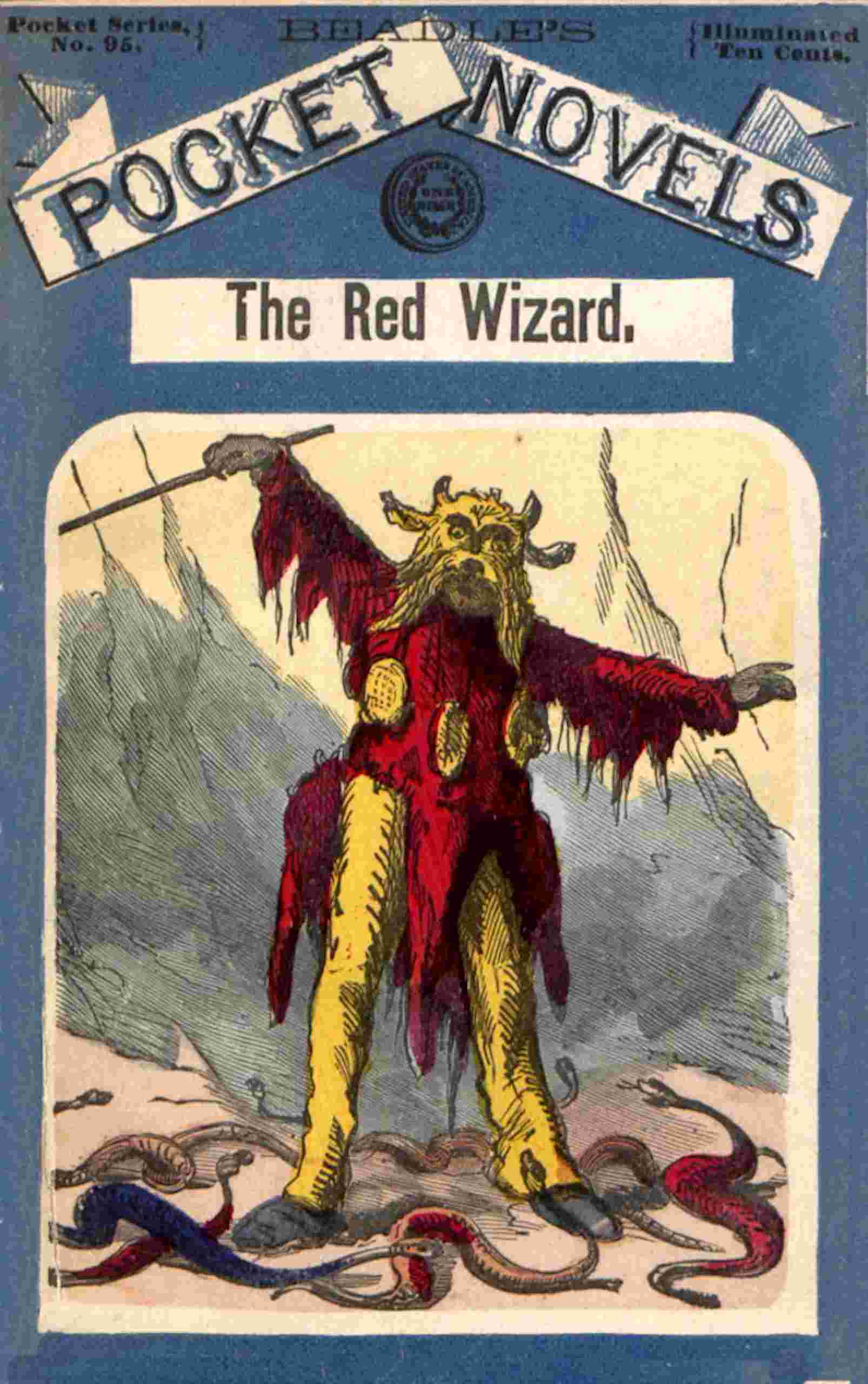
The Project Gutenberg eBook of The red wizard, or, the cave captive
Title: The red wizard, or, the cave captive
Author: Edward Sylvester Ellis
Release date: July 28, 2022 [eBook #68625]
Most recently updated: October 18, 2024
Language: English
Original publication: United States: Beadle and Adams, 1872
Credits: David Edwards, Mary Meehan and the Online Distributed Proofreading Team at https://www.pgdp.net (Northern Illinois University Digital Library)
THE RED WIZARD:
OR,
THE CAVE CAPTIVE.
BY LIEUT. NED HUNTER.
NEW YORK:
BEADLE AND ADAMS, PUBLISHERS,
98 WILLIAM STREET.
Entered according to Act of Congress, in the year 1872, by
FRANK STARR & CO.,
In the office of the Librarian of Congress, at Washington.
THE RED WIZARD;
OR,
THE CAVE CAPTIVE.
CHAPTER I.
THE YOUNG SQUAW.
"Ef yer strike that gal, by ther heavings erbove I'll send er bullet through yer skull or bury my knife in yer heart," and the speaker's demeanor told that the words were not idle ones.
"You are uncommonly tender of a squaw!" was the sneering reply, though the man drew back and restored the hatchet he had drawn to his belt.
"Am I?" and his black eyes flashed fire.
"Yes, for I have heard that you trappers and scouts make it a point to kill every Indian you come across."
"It may be the case with some, but it hain't my way, man. When it comes ter fightin' I always try ter do my share of ther killin', but murder in cold blood ain't in my line. No, sir! An' what's more, no man ain't er goin' ter do it while I am erround, without he calkerlates ter fight with Wash Lawton."
"Lawton is right and you wrong, Parsons," said a third man, breaking in upon the conversation. "The squaw has done us no injury, and the wholesale butchery that so many appear to delight in, is not only against reason but the most common humanity."
"Yes, I know I'm right," answered the confident scout. "Ef it war er spy now, and thar war er party of Injuns out-lyin' eround, ther case would be different. But this am er gal, and er young and pooty one fer her tribe, and I hain't goin' ter see her erbused, nohow."
"And I am on your side," chimed in the physician.
"You'll see what will come of it," growled Parsons, as he turned sulkily away. "Even if it is nothing but a girl, she has eyes and ears and feet, and can carry the news far. You might just as well spare a rattlesnake because it was little. They all have poison."
"Wal," returned the unabashed scout, "I never knew any harm ter come by doin' er good action even ter er Injun. And, let me tell yer one thing, mister; those who are ther most bloody-minded always come ter thar worst and most sudden end."
"And now," continued the doctor, as Parsons disappeared, "suppose you talk to the girl and tell her she shall not be injured. I presume you understand the lingo?"
"Thar isn't one between heah and ther mountings that I hain't had somethin' ter do with, fust or last. Ther gal am er Sioux."
"How can you tell that?"
"Jest as easerly as kin be," and he turned to and began addressing her in her native tongue.
The little train of emigrants had been about camping for the night in a little belt of timber by the side of a river when George Parsons had come suddenly upon a young squaw lying, ambushed as he presumed, in a thicket, and the girl would have been brained had not the scout interposed.
When spoken to in her mother tongue, by the scout, she arose and conversed freely, and for the first time the physician saw one with a red skin that had some claims to beauty; for her form was straight, her eyes soft in expression, though fire was hidden in them, her hair long but finer than the generality, and of intense blackness, her features regular and the mouth small and lips thin, her complexion a light olive. To add to all, she was neatly dressed.
Her story, as told to the scout and interpreted by him, was a simple one. Traveling alone from one village to another, her pony had fallen and escaped from her, and after following the trail until night was at hand, she was preparing to camp when she was surprised.
"Ask her if she isn't hurt," suggested the doctor; "it strikes me that she is in pain and trying to conceal it."
The scout did so, and for answer the squaw let her blanket slip from one shoulder.
"Great heaven!" shouted the doctor; "arm broken and no fuss made about it!"
He drew near and was about to lay his hand upon the injured limb, but the squaw drew back, and, with her remaining hand touched her knife in a significant manner.
"He is a medicine," explained the scout.
In an instant the girl became calm and submitted to the manipulations of the physician. The fractured member was set and bandaged in the most approved fashion. She evidently experienced great relief, and though she could not thank the doctor with her tongue, she did with her eyes in a very forcible manner.
"Now tell her," continued the doctor, "that she will have to keep quiet. I have known slighter fractures result dangerously—inflammation set in, and all that sort of thing. And tell her, too, that you and I will protect her and see that she has a comfortable place to sleep, and something to eat, and that she shall ride with us as far as she pleases."
The information was duly given, and received with unconcealed pleasure, though with little of demonstration, save the simple words:
"Washtado Chemockomaun."
"And that is?" asked the doctor of the scout.
"Good white-man."
"Well, it is something to receive praise from one of her race. And now, Wash, you take care of her. I will see her again in the morning and try to have her comfortable before she leaves us. I never saw one so patient before under suffering in all my practice."
"It is thar nature. But I want to see ther leetle blue-eyed gal in ther camp that—"
"Hush! What noise was that?"
It proved that some of the men who had been scouting about had caught a pony and brought him in. It was the squaw's own beast. Wash, at her request, saw that he was fastened at a little distance and properly fed. Then he turned his attention again to its mistress.
She followed him, partook thankfully of food, and though she declined to accept of his offer to sleep in one of the wagons, she crept beneath, did not refuse an extra blanket, and when he last looked at her she was apparently enjoying a healthy slumber.
But, how long she remained no one could say. Just before dawn there was an alarm of Indians, and when matters again became quiet they looked and found that both she and her pony had disappeared.
"It am ther nature of ther beast," said the scout. "But she will not ferget our kindness, doctor, and ef ever she kin do us er good turn yer kin safely bet yer life that she will."
"And bring the whole tribe down upon us," suggested George Parsons.
"Then mind yer hain't ther fust ter lose yer scalp," rejoined the scout.
The little caravan started again and journeyed until the western sun warned them to prepare for the night. This took place in nearly the center of a considerable prairie, with nothing worthy of the name of timber in sight. It was then noticed that Parsons—who had ridden ahead during the afternoon—had not returned, and it was suggested by some that he might have been captured by the Indians.
"I don't think it likely," replied the scout, "fer I hain't seen no signs. When er man starts on er huntin'-trail he never kin tell whar the end will be. But all we've got to do am ter keep er sharp look-out."
Midnight came and the missing man had not returned. But their own fate was on trial, and in what followed the missing man was forgotten.
CHAPTER II.
THE SUDDEN AWAKENING.
"Listen to me, Olive, and believe that I feel very deeply the words my tongue utters. You have become very dear to me—dearer than any thing else of this world—and I love you, Olive."
The girl glanced swiftly up from under her long lashes, then dropped her eyes again and her face was crimsoned with blushes, and the little hand he had obtained and was holding firmly, though tenderly, trembled fitfully, and nothing save a sigh escaped her lips.
"Olive," he continued, drawing still nearer to her, "it can not be that I am mistaken—that you look coldly upon me—that you take no pleasure in my society—can not be that you have not seen the true state of my heart? Tell me, am I disagreeable to you?"
"Oh! no, no," she murmured, in deep agitation.
"Then, darling—may I not call you so? Give me hope for the future. When we have finished our journey and the shores of the Pacific are reached, may I not believe you will become mine—be my wife?"
As actions speak even louder than words, so hers told him all he desired to know, and with the clouds of doubt drifted away from their souls, peace came, and love given and returned made them very happy.
Like all unmarried men who cross the plains, when there are pretty women in the company, the doctor, Ernest Mayo, soon found that he had a heart, and that its longings took but one direction.
He met Olive Myers for the first time—a girl slightly his junior, with a fair, pure face, laughing blue eyes, hair of the color of the ripe chestnut when just bursting from the shell, and a mouth that appeared to woo kisses. She was of good parentage (though now an orphan) and well educated.
She was drifting California-ward with an uncle and his family, and as Mayo was a gentleman, gladly accepted his company and protection.
More secure from molestation during the lonely night-watches than at any other time, she was accustomed to keep him company, and this night, when no one was within hearing, the intensity of their hearts strung to passion found vent for the first time.
With his arm around her waist, with one hand clasped in his, with her head resting on and showering down its wealth of chestnut curls upon his shoulder, they remained whispering such impassioned words as only lovers use until near the hour for changing the guard. Then the girl suddenly asked if Parsons had returned.
"No, dearest," he answered. "Do you take an interest in him?"
"I have no interest in any one but you," she answered, turning her blushing face to him and proffering her lips for a kiss. "But I fear him."
"Fear him? On what account?"
"Not for myself, but you, darling."
"I can not understand why, Olive."
"Because, he is envious—jealous!"
"Of me?"
"Yes. He once offered me his love and I refused it, and no later than yesterday he accused me of loving you."
"Which you denied, of course," he replied with a smile.
"I neither denied nor admitted. But I fear when he learns the truth, he will seek an opportunity to injure you," and the bare anticipation made her shudder.
"Don't tremble, little one," he answered, glad of an opportunity to again kiss the red lips. "No harm will come of it. He is a coward."
"But if he should. Oh! heaven!" and her beautiful eyes became misty with tears.
"He will not, be assured. Yet I can pardon him for something of his feelings, in being robbed of so great, so lovely a prize. Olive, darling, what would I have done without you?"
"And I without you?" she murmured in response, as she gave and returned his passionate caresses.
"Indians! Indians!"
They sprung apart, and the scout, who had been sleeping, as he was wont to say, 'with one eye open,' was instantly upon his feet and by their side. But "wolf," had been cried so often that he was disposed to doubt its truth, and springing upon a wagon he looked abroad. The prairie lay as dead and silent as when he last looked upon it, and he would have laughed at their fears had not something in the actions of the horses arrested his attention.
"Thar's something not exactly right thar," he muttered, "for stock don't ginerally make a fuss at this time of the night."
"What do you think can be the cause?" asked the doctor, who, with the girl he loved so tenderly, had drawn near.
"That's mighty hard to tell. It may be a pack of wolves have come between them and ther wind, or ef we war near the timber I should say a b'ar, but that couldn't well be ther case heah. Howsomever, I'm goin' to find out."
"Let me go with you," suggested the doctor.
"For the love of heaven, no!" whispered the distracted Olive, clinging to his arm. "If any thing were to happen to you, darling, I should die."
"The gal am right," replied the scout, sedately, though there was a merry twinkle in his eye. "I had better go alone. Hark!"
He dropped to the ground as suddenly as if felled by a blow, and remained for some time unstirring. His entire manner had changed; all of recklessness departed, and his movements became as cunning as those of a serpent. Still keeping his recumbent position he motioned the physician and said:
"You go and put out ther fires, and mind yer don't git in the light on 'em any more than you kin help."
"But I hear nothing but some wolves whining and howling."
"Yes, wolves. That am ther very name, fer that's what Sioux stands fer. Yes, wolves. Two-legged ones, whose bite ar' death!"
"You can not mean that those sounds are counterfeit?"
"It war well done—very well done—and would have deceived most any one, but, it can't me, by er long shot."
"For goodness sake tell me what you think."
"That ther red-skins am eround—am er callin' ter one enuther, and that they'll most proberbly be down upon ther wagons like er drove of bufflers, that's all!"
"Then do not venture out. Your rifle might be worth a hundred men."
"It kin do some good shootin', that am er fact. But I must try and gather in ther hosses. They am ther fust thing ther red devils will be arter. Ther hosses must be saved or we am lost. Hist! No more talkin'. Get ther gal inter ther most likely place fer safety, and then out with ther fire and see that every one am ready fer fight. Ef I shouldn't ever come back, good-by, and may ther Lord take a likin' ter yer and—and yer sweetheart, and say that Wash Lawton did his dooty, and died like er man."
He crawled swiftly away toward the horses, and it was time some controlling spirit was among them. A few had already broken loose and were running hither and thither, with heads and tails erect, eyes wild with terror, snorting and whistling, while the remainder were straining at their halters and threatening instant stampede.
"Thar am deviltry afoot," he whispered to himself, "and ef I can't save all ther horses I'll try and git one fer ther gal ther doctor loves. Ef ther watch had been good fer any thin' it wouldn't have happened, but it is too late now."
Indeed it was. At that very instant the terrible war-whoop of the Indians rung on every side, and almost countless dark forms skulked in every direction toward one common center. Then all further attempts at concealment were useless, and, with an answering shout, the scout arose and dashed forward, determined—as he had said—to secure at least one steed.
He reached the nearest, cut away the rope, struggled to get within mounting distance, was dragged along in the mad race, nearly trampled under foot, hurried into the tall grass, lifted from his feet and thrown headlong into an ambush of his enemies. Then he was instantly bound and left helpless until the battle was over.
The war-whoop had aroused those about the wagons to a sense of danger. They crowded together like sheep when encircled by enemies—evidently wanting a head. Like painted demons the villains crowded around the doomed emigrants, dancing, leaping, shouting and making the most frantic gestures, accompanied by a shower of arrows, that were answered by the sharp ringing of rifles.
Then the savages rushed forward en masse, and the battle became hand-to-hand. The massacre of men and helpless women and innocent children followed, while the air rung with shrieks for mercy and the groans of the dying as they were cut down, hewed by hatchets, pierced by arrows, crushed by clubs, scalped and hurled into the plundered and burning wagons, even before life was extinct.
An hour after, three wretched prisoners—all that survived of the band of emigrants—were dragged along with ropes around their necks—tied to the horses' tails of the exultant Indians—three only—Olive, the doctor and the scout.
A forced march brought them to a village of the Indians, and the two men were bound and thrown into a wigwam, while the girl was given into the care of the squaws.
What a sudden and bitter awakening from dreams of safety and of love!
CHAPTER III.
WHAT HATE WILL MAKE A MAN DO.
Stung to the quick by the refusal of his love, and still more so by the somewhat tyrannical conduct of the scout, seconded by the physician, George Parsons suddenly determined upon a bitter revenge.
A frontier born and bred man, he had from childhood been brought in association with the Indians, and knew their ways. Under pretense of hunting, he deserted from the little band to whom he had sworn fealty, and immediately sought for the enemies of the white man.
Fortune favored him. He came across an outlying spy—trailed his rifle, and turning the open palms of his hands toward him, advanced. It was a sort of freemason sign, well known to all the dwellers of the prairies, and it was not long before he and the Indian reached the main body of the savages, and he was soon seated in council with them.
But the Indians, crafty as treacherous, inquired deeply into the motives that made a man thus turn against his own people, and give them to the tomahawk and scalping-knife, or to torture.
"There is a girl among them whom I would make my wife," was the answer.
"Then why does the pale-face not take her?" questioned the chief.
"Because they are too many, and she will have nothing to do with me—loves somebody else."
"Why, then, is not the scalp of the lover at the belt of the brave?"
"That's just what I want, but I have never had a fair chance. Then, too, there is the guide of the party who has more than once insulted me—a trapper who has been here before—knows every foot of the ground, and I presume you know him."
"What sort of a man is the scout?"
Parsons described him minutely, and the Indians looked quickly from one to the other, and though there was no intimation given in words, yet it was evident that they both knew and feared him.
"How many of the pale-faces?"
Parsons enumerated them, and gave an inventory of the train and its means of defense.
"Will the pale-face fight?"
"No. I don't owe any of them a grudge, except as I have told you, and it wouldn't look well for me to be murdering my own people."
"Tell the red-man how the girl looks, that she may not fall by the arrow or the knife."
He did as requested, and found himself forced to endure a searching cross-questioning, for the Indians still feared treachery.
"If the tongue of the pale-face travels the short trail of truth," continued the chief, "he shall be as a brother to the red-man. But if his talk twists as the path of the serpent, then he shall die the same death of torture that he would give to his enemies."
"You will find every thing as I have said."
"Then it will be well. Let him give his weapons to the red-man."
"But I might want to use them."
"Until the braves return from the dogs of the pale-faces, he will be taken care of—be a prisoner."
This was very much more than he had bargained for. But resistance would have been useless, and with any thing but pleasant feelings he handed over rifle, knife, and hatchet.
"I will go with you and show you the way," he said, seeking to gain their favor.
"The red-man needs nothing but the stars to guide them at midnight—nothing but the smoke of the pale-man's fire to tell them where he lies hidden. Let the braves take him to the Medicine and tell him to keep him safe until they return. If his words are true he has nothing to fear. If not, he will learn what it is to be treacherous to the red-man. The Sioux are great warriors and they laugh at the traps of their enemies."
At a signal from the chief the arms of the white renegade were bound behind his back, and accompanied by half a dozen stalwart braves, he was led through and beyond the group of wigwams, out into the forest, and when he questioned where they were going, the only answer he could obtain was:
"To the Medicine."
A short journey and they reached a bluff by the side of a stream that found its way through a rocky cañon. A low, peculiar whistle called from a well-concealed opening the old trickster, who was supposed to hold communion with the moon and stars, the dead, and the great Manitou.
"The great Medicine of the Sioux," said the leader of the party, "will take care of the pale-face until the warriors return."
"It is well. Follow me."
Unable to resist, the already frightened man followed his appointed keeper into the rocky cavern, and by his direction took a seat at the extreme rear. And as his eyes became somewhat accustomed to the darkness, saw that he was surrounded by every thing that was devilish and horrible—by the bones and skulls and scalps of dead men—by bats and owls—by a hideous living bear and a grinning, snarling, spitting wildcat, that exerted all their monstrous strength to tear loose and spring upon him.
"The pale-face will be safe here," said the Medicine, with an almost fiendish smile. "No one will come to do him any harm while I am gone. The air is strong with blood. I can smell it—the blood of the miserable pale-face. I must go and prepare for the torture."
"For the sake of mercy do not leave me alone."
"These," pointing to the savage animals, "will keep you company. But you shall be doubly guarded."
He disappeared for a few moments. Then returned with a handful of brush with the green leaves still clinging to them. These he spread across the cavern, then tore away a stone, and instantly a dozen great, hideous, crawling, hissing rattlesnakes wriggled forth.
"Oh, God!" burst in accents of agony from the lips of the tortured prisoner, as he sunk back to the uttermost limit that was possible.
"These will keep guard over you—see that no one enters and that you do not go out," replied the Medicine, with a devilish grin.
The serpents coiled, twined, twisted, reared their heads, clashed their scales, shook their rattles, darted out their forked tongues and flashed their eyes, that looked like great balls of fire. And momentarily he expected them to creep toward, to coil around, to sting him to death!
"These," repeated the Medicine, "will be your guard."
"And when, in the name of heaven, will you come back?"
"Perhaps to-night—perhaps to-morrow. But, fear not, for you will be safe as long as you remain quiet. If you attempt to escape, a dreadful death will follow."
From the moment the reptiles had been set free, the Medicine had stood at the door of the cavern, through which a little light came in. Now he quickly retreated, shutting the entrance after him, and, more dead than alive, George Parsons was left to the most horrid companionship that the mind can think of. Every moment he expected would be his last, and hours passed of sufficient misery to have driven him stark mad.
He knew not the serpents could not reach him—knew not that the subtle power of the white-ash leaves the Medicine had scattered controlled the serpents far more effectually than fire would have done.
CHAPTER IV.
THE TEST OF LOVE.
"Wal," was the characteristic exclamation of the scout, though in a low, cautious whisper, as soon as they were alone, "ef this hain't er finishin' er trail about as suddint as any thin' I ever heard tell on."
"And my poor Olive," groaned the physician. "If it were not for her I could face death without a tremor."
"That hain't 'tall likely," was the reply. "Ther best on us can't do that. I've tried it more'n once—hain't no coward—and I know. But that isn't ther thing to be looked arter now, and thar hain't no use mournin' till ther time comes, nuther. Yet I hope ter heaven ther red-skins won't know me, fer it will go hard ef they do."
"Is there no way in which we can save the life of the poor girl?" continued his companion, his thoughts being intent upon her and not giving the slightest heed to what was being said.
"I don't know yet. Ther first thing ter be done is tew git ourselves clear. Ther red devils have tied me fer sartin, and they'll have er high old time ter-night."
"Do you think we shall be molested before morning?"
"It hain't likely, onless ther cussed whisky should drive them so mad that ther elders can't control them. Then thar's no tellin' what mought happen."
"And no one will come to visit us?"
"I reckon not. But it won't matter. Thar never war wolves in a tighter trap."
"You are mistaken. See."
In a few minutes, by some juggling operation the scout had no idea of, the doctor had entirely freed himself, and also released his companion, and they could stretch their limbs at ease. Then they drew still nearer together and the conversation was continued.
"When the whisky has done its work, do you think we can get away?" asked the physician.
"That's mighty hard ter tell."
"And poor Olive, is there any hope for her?"
"I'm goin' ter see."
The scout laid his ear to the ground and remained silent for some time. Then he gently raised one side of the curtains of the wigwam and crept out into the darkness, and the doctor remained alone until the sun was well up.
Then he was dragged forth to the council of braves!
But astonishment was painted upon the faces of all as they saw that his hands were free, and that the scout had disappeared.
"Some traitor has done this!" thundered the chief. "What has become of the other prisoner?"
"That is more than I can tell," responded the physician, who had determined upon his line of conduct. "As to my being untied it was done by spirits. Ask your great Medicine. He will tell you, for he is familiar with them."
"The pale-face talks like a squaw!" sneered the chief.
"What says the great Medicine of the Sioux?"
At the command of the old trickster other ropes were brought. With these he fettered the prisoner in the most complex manner, and he was again thrust into the wigwam. Then wild and dismal groans were heard, low whisperings and frantic laughter, and the physician stepped forth free again, carrying his bonds in his hands!
Although far less superstitious than the majority, the chief was nonplussed—knew not what to say. It was a thing that had never occurred before, and he was at a loss how to act. But, something must be done, and he drew the old Medicine aside and consulted with him. The latter was pale with rage, not unmingled with fear. He had been fairly beaten with his own weapons—fooled before all the tribe. Then he thundered forth:
"Let the pale-face tell who was concealed within the wigwam and untied his bonds, or his tongue shall be torn from his mouth and trampled under foot."
"No one but spirits."
"Foo! Let my brothers go and look."
A number of Indians rushed to do his bidding, but returned with faces that told of being baffled. No one was to be found.
"Did not the Medicine of the Sioux hear me talking to them?" questioned the prisoner.
There was another whispered conversation, and then the Medicine resumed: "I know how to unlock his lips and make him cease his lies," and he gave some command in a very low tone.
In an instant after, the doctor, strong man as he was, trembled, reeled and groaned aloud. Dragged along between two of the most brutal-looking warriors, with their hatchets whirling about her head and threatening death in case of resistance, was the girl he loved!
"For Heaven's sake save me!" she screamed, as soon as she saw him, and rushing forward threw her arms around his neck and fell almost fainting upon his bosom.
"My life for yours—a thousand deaths of torture to save you a single pang," he murmured, as he pressed her to his heart.
"Tear them apart," yelled the chief, and then turning to the Medicine he asked under his breath, "Where is your prisoner?"
"Safe in my cave."
"There let him stay until this trial is over. Then he must be released and the girl given to him. I have so promised. Now to find out what we wish to know."
The doctor and Olive were standing a little apart, her beautiful eyes streaming with tears, and his face convulsed with anguish.
"You love this squaw," continued the chief, "and if you do not want to see her tortured, tell us how you managed to escape."
"I have nothing to tell more than I have already done," he replied. "Oh Olive, Olive!"
"Then let the squaw be prepared for death!"
In an instant she was surrounded by knives—walled in so that the slightest movement would bring her soft, fair flesh against some sharp point. Her lover trembled like one with the ague, then nerved himself with a mighty effort, and returning the defiant looks around him, answered:
"Is it well, great Medicine, that I should tell to other ears than your own the secrets that are whispered by the dead?"
"The pale-face is a dog," commenced the old man, but before he could finish the sentence, a voice was heard coming from the wigwam in which the prisoner had been confined, forbidding that any thing should be told.
Then it was the Medicine's turn to tremble. He looked at the prisoner—at the wigwam—at the sky—at the earth; listened to the waving of the trees and the low whistling of the wind through the branches. But as the voice was not repeated, he, after a time, gathered courage and said:
"It is nothing. Unless the pale-face confesses, let the torture of the squaw go on."
"Oh, heaven!" shrieked the girl, "do you love me and condemn me to this when a single word would save me?"
Every accent—every glance of her eyes went to his heart far more keenly and deeper than a knife would have done, but if he failed in a single point of what he had undertaken, the rest would fall to the ground. So he kept back his own tears, choked down his grief, and endeavored to inform the wretched girl, by signs, of his purpose.
Little time, however, was given him. Indeed, before reflection could come, Olive was dragged along to where a fire-blackened post stood, bound, and half a hundred pair of hands were busy piling bark and kindling, and pitchy fagots around her.
His head fell upon his breast. He became as one numbed—helpless—powerless. Then, again, the screams of the beautiful sufferer rung upon his ears:
"Darling, I die for you. Oh, God, have mercy."
In an instant he had burst through trammel, piled in a heap those who would have restrained him, seized a brand from the pile around his loved one, beating back those who would have opposed, had Olive again locked fast in his arms! Their lips met once—twice, and then they were torn apart, and he fettered so that a single motion was an impossibility.
"Let the hound of a pale-face untie himself now if he can," screamed the old Medicine, frantic with rage, "and the squaw sing her death-song."
"My trust is in God," replied Olive, turning her beautiful but pale face heavenward. "Darling, I pray for you."
"Then let her call upon the Manitou of her people, and see if he will come. He will not, and we will send her to him in ashes!"
The signal was given to fire the pile, and the warriors sprung forward, torch in hand. Like demons let loose they danced around, and as the lurid light flashed into the eyes of the poor girl, and the hot flames touched her skin, she fainted—sunk limp and would have fallen, had it not been for her bands. Her lover could not endure the sight, turned his head, and as he was dragged away, saw the flames rising, and believed the black smoke was wrapped like a shroud around his beautiful one—that she had passed from earth in a pillar of fire!
It was just such an ending as the Indians desired; for, failing to accomplish their purpose of forcing confession, they would have him think her dead.
CHAPTER V.
TEMPTATION.
Unmanned, shaken to the very innermost part of his nature, and faint both from the stench of the cavern and lack of food and water, the wretched George Parsons waited the return of the Medicine until hope gave way entirely to despair.
Then a light broke in upon him; he saw the old trickster enter, take the poisonous serpents in his hands as if they had been sticks, toss them back into their dens and close the opening, drive bear and wildcat out of sight and advance toward him with a most sardonic smile.
"The pale-face has been well guarded," he said, as if his keepers had been of the most pleasant kind.
"As I never wish to be again. God only knows what I have suffered. I expected the snakes would crawl upon me and sting me to death—expected that every moment would be my last."
"And so it would have been had I not charmed them. But come."
Never did a man get more quickly out of a hateful place. So great was his anxiety to be beyond the horrors he had endured that it forced a smile from even the grim lips of the Medicine, as he led him to a wigwam, where he was treated as a welcome guest might have been.
Relieved from terror, and with his bodily wants supplied, the first thought of the renegade was for the girl, her lover and the scout. The latter he was told had fled like a coward, but swift-footed warriors had started upon the trail and it was more than probable that his scalp was even then hanging at their belts. The lover was in confinement and would die by torture, and the girl he could see at any time.
That time with him was then!
The sufferings he had undergone, in place of softening his heart and bringing pity, had made him still more revengeful, and when he was led into her presence his face was as black as a thunder-cloud.
"Great Heaven!" she exclaimed, instantly surmising the part he had played in the terrible drama, "you here—miserable traitor?"
"Leave us," he said to the Indians. "I would talk to her alone."
"As the pale-face wills. When he is tired of the squaw the red warriors would talk to him also."
His request having been complied with, he hissed:
"Traitor? Better that you use soft words, my lady. Do you know that both yourself and your lover are in my power?"
"But for the love of mercy do not let any harm come to him," and she flung herself upon her knees and raised her clasped hands to him.
"His life is in your hands."
"And you will help me save it?"
"You can do so."
"How? Tell me how. I will do any thing—give my own for him."
"Let us then be friends."
"I have never felt otherwise toward you."
"Give me your hand."
She laid her little trembling fingers gently within his proffered palm, and as he drew her nearer to him, he continued:
"Now a kiss, Olive."
"No, no," she murmured, drawing back.
"You are keeping them for your lover," he sneered. "Have you forgotten that I told you his life was in your hands?"
"No, but—"
"Will you not give me a kiss?"
"If you are a man you would not ask me, knowing what you do."
"Ay, knowing what I do," he replied, bitterly, and fast losing control of his temper. "This I do know, that you scorned my love and—"
"As God is my judge I was sorry to do so and—"
"As he is my judge you shall be sorry almost unto death that you ever did. But a kiss I will have."
"Oh! heaven, are you a man or—"
"Beast?" he said, finishing the sentence for her, with a mocking laugh, and he exerted his superior strength to draw her to him.
Her quickness baffled him. She tore loose, retreated as far as possible and buried her face in her lap. But it was in vain she did so. He lifted her up again—held her hands so that she was powerless, and forcing her to look in his face, continued:
"You must and shall kiss me."
"Never!"
"It is the first move toward friendship."
"Then we shall never be friends."
"Then you are cold-hearted toward Mayo."
"Cold-hearted? God alone knows how I love him."
"And will not give even a kiss to keep him from suffering?"
"He would scorn me—would have a right to do so if I should consent—did not battle for his honor as well as my own."
"But I love you just as well."
"It can not be. You have plotted my destruction."
"With love turned to hatred and vengeance for the moment, by black despair, I might have sought to destroy. Now I would save all."
"Can you do so?" she asked, doubtfully.
"Yes—yes."
"Save him—him, as well as me?"
He knew that every word was a lie, but went recklessly on, determined to carry his point, cost what it might.
"Yes. I can and will save you both—upon one condition—that you will fly with me."
"Fly with you?" she repeated, slowly, and as if not fully comprehending. "Fly with you?"
"And be my wife."
"Coward, traitor, fiend!" she exclaimed, struggling with almost superhuman strength to get free from him. "Your wife? You, the betrayer of your own race—the murderer of those who trusted you! A thousand times would the grave be more welcome."
"But you shall, willing or unwilling. And thus I seal the compact."
He drew her still more closely to him and leaned down his face to kiss, but, in the fierceness of her utter detestation, she struck him with her little clenched hand upon his mouth until he could not restrain an expression of pain.
Then, all of restraint was thrown aside, and standing forth in his true colors, he was revealed before her with every black passion starting from his face.
"Now, by heaven! you shall be mine, and, as for your lover, he shall die with red-hot flames around him—die amid the most horrid of tortures, and even while his screams for mercy are ringing in your ears, I will clasp you to my heart and take a hundred kisses for every one you refuse me now."
"Horror!"
"That will be no name for what he shall suffer, and all your tears and prayers and sorrow shall be of no avail toward his release, but his horrible groans be sweet music in my ears as well as those of the Indians."
"Oh, God! spare him. Oh! why has Heaven abandoned him to one whose heart is flint?"
"You have rightly named it, but you have made it so. It was as wax in your hands, but you taunted, mocked, and repulsed me. As I loved, even so can I hate."
"It shall not, must not be. I will appeal to the Indians themselves," she replied, wringing her hands in agony. "Even they must be less brutal than you."
"I have bought you of them," he answered with a smile of gratified malice. "You are mine, body and soul. Do you hear? body and soul! My wife you have got to be, and if it will make your future more happy to have your lover first burned at the stake, why, be it so. But remember now, as you will have to do in the hereafter, that his life is in your hands—that you send him to destruction when you might have saved him even from pain."
"Oh, God! save him—pity me—guide me."
"Think well and decide."
The terrible words almost drove her to distraction. She remembered with fearful minuteness how the great flames leaped, roared, danced, circled, and was rapidly giving way, when his hand touched the naked flesh of her shoulder and she instantly nerved herself, and with the stony countenance of despair, answered:
"I have decided!"
"How?"
"That I will never be your wife."
"And let your lover perish in the flames?"
"Even that were better than to stain my soul, and I can meet him in heaven, as pure as now."
"It will be long before you do so! I shall take care that you do not have an opportunity to lay violent hands upon yourself," and happy that the words would pierce her heart like a knife, "you will be a wife without even the ceremony of marriage. Even the miserable apology the Indians sometimes indulge in shall be denied you."
"Your wife I will never be."
"I swear that you shall."
"And I, before heaven and the holy angels, that I will not. I would dash my brains out against a stone first."
"We will see whose oath is kept. Now I go to complete the means for getting rid of your lover. Then I will come and woo you for the last time."
She sunk upon her knees as he released her, and raised her hands on high while her thoughts were breathed forth in the most agonizing prayer. But even as she was doing this—even as he was unfastening the curtains of the wigwam, an Indian warrior dashed up, waving a bloody scalp.
"God! Heaven! Mercy!" burst from the lips of the heart-broken girl. "It is that of—"
She could not finish the sentence, feeling that her lover had been murdered, and fell senseless to the ground.
"It is that of the scout, thank God!" said Parsons, feeling sure that the one he stood most in dread of was forever out of the way.
CHAPTER VI.
IN PERIL.
It was a terrible temptation to the scout when he crawled forth from the wigwam, to endeavor to find some weapon and at once attempt to inflict condign punishment upon the Indians, for the unprovoked murders they had been engaged in. But the folly of the proceeding when their numbers was taken into account, as well as the fact that the doctor and the beautiful girl were at their mercy, restrained him.
And what next was to be done was very difficult to determine. But the physician having thrown out a hint during their whispered conversation, that, if he could secure his medicine-chest, he might be able to work upon the superstition of the Indians, so as to make them afraid of him, he at once took the back-track to make an investigation concerning it.
But, the journey resulted in nothing, save that he gathered the mangled bodies that had been left to the mercy of the wolves, scooped out a rude grave, placed them within, covered it with earth and sod, leveled and stamped it down, and dragging the remnants of the wagons together, kindled a fire, that would keep away the animals and obliterate the marks of what he had done.
Then he returned toward the encampment, and began spying around for something that would be of advantage, and to learn where the girl was concealed, and to take measures to steal her away, if such a thing should prove to be possible.
Chance brought him to the vicinity of the cave of the Medicine, at the very moment when he was releasing the traitor Parsons, and when the twain had departed, he could not resist the temptation to explore the bowels of the earth, and learn what it contained. But he very soon paid the penalty of his folly, and death had laid his iron hand upon him.
Not being familiar with the locality, and the mysteries contained within, he stumbled along in the darkness, came suddenly upon the hissing, snarling wildcat, and as it sprung fiercely toward him, he leaped to avoid it, and fell directly into the clutches of the huge bear that had been watching him with open jaws and snapping eyes, and was instantly imprisoned by its mighty arms!
Had he been possessed of any weapon, even a knife—the battle would have been short and decisive. But he had nothing save his naked hands to fight with, and it would have been madness to attempt such a thing, for the brute was of monstrous size.
"Ef I don't play 'possum I'm a gone sucker," muttered the scout as he relaxed his muscles, fell to the rocky floor, held his breath, and remained motionless.
It was a difficult task, however, to remain so, for the bear was moving him around, and its long sharp claws scratching his flesh, and any instant his heart might be torn out. A very difficult task indeed, and nothing but the frontier training and strong self-command of the scout enabled him to counterfeit death. Yet he did so, until almost exhausted, and then as a favorable opportunity presented itself, he rolled swiftly away, and as soon as out of reach, grunted forth, as if in answer to the astonished and angry brute:
"You hug most mighty clus, that am er fact. Er leetle too much so fer friendship, and I rayther reckon once will do me fer er lifetime. No, I shan't fergit yer—shall remember yer at least ontil I git short of meat and want er roast or er steak."
A few moments given to rest, and he dodged between the watching animals, and was about to pass out when the hissing of the snakes (that had been aroused by the noise) caught his ear, and he stopped, listened and gave vent to his surmises:
"Here's more deviltry. But the old humbug knows what he am erbout, and keeps a supply of ash leaves on hand. Perhaps I'll come and see ye ag'in, ladies and gentlemen," making a bow in the direction of the den, "but I hain't got time now—have rayther pressin' business on hand." And he went out and carefully closed the opening to the cave in the same manner as he had found it.
And as he dared not venture near the wigwams until night came, he crawled into a neighboring thicket through which the trail to a spring passed, and covering himself with brush and leaves, waited very anxiously for the darkness.
Very frequently the sound of voices reached his ears, and he learned enough to satisfy him of the treachery of Parsons, and swore a deep oath that the scoundrel should suffer for his villainy.
Satisfied that no actual harm had come to either of the prisoners, this greatly relieved his mind, and gave him patience to wait until the hour came when he could continue his scout.
It came at last, and fortunately the night was dark and stormy. Almost with the going down of the sun the clouds had begun to gather, the wind to blow and the rain to fall, and, knowing that the Indians would not long remain from under shelter, he watched yet a little and then drew more near.
An hour passed. Then some brute of an Indian, who had managed to conceal a portion of the fire-water that had been taken from the wagons of the emigrants, came staggering along and fell over him—saw him, and drawing his knife attacked and at the same time endeavored to give the alarm.
The situation of the scout became desperate. If the noise reached the wigwams—if the warriors learned that a white man was skulking so near, there would be no possibility of escape, and if he attempted to strangle the Indian his knife would not be idle. Indeed, he had already been slightly wounded.
But there was no time for thought. With a mighty blow he felled his assailant to the earth, and before he could recover sprung upon him, falling so that his knees struck full upon his breast and completely taking away his breath. That accomplished, the rest was easy. He immediately obtained possession of the knife that had been aimed against his own life, buried it in the heart of the Indian, left it sticking there, and, finding that he was quivering in death, coolly turned him upon his face, arranged him so that it would appear as if his life had been accidentally taken, and retreated to the opposite side of the village.
The temptation was very strong to supply himself with weapons, but he could only gratify it at the expense of the danger of detection, and was forced to wait a better opportunity.
Driven by the storm, the Indians left the camp-fires early, save the few who were detailed to watch the male prisoner—the female one being secured by the attendance of squaws—so that, with the exception of numerous dogs, the coast was clear, and the scout no longer hesitated to enter the village, though his movements were of the most crafty kind.
Fortune was in his favor, for, even as he came near where the physician was confined, the discovery of the dead Indian was made, and the guards rushed thither—at least he fancied so—and was about to enter the wigwam, when two of them, who had been concealed, sprung upon him, and a desperate struggle ensued. And very hard would it have been for him had he not been fertile in expedients. Shaking loose, he dodged between the legs of the foremost and threw him like a bombshell into the face of the other, darted to the nearest fire, caught a handful of blazing brands, and whirled them, as he ran, into the wigwams, causing screams and dismay, and forcing the majority to stop and put out the flames.
Still a few swift-footed ones followed; the race was rapid, and, to the scout at least, over unknown ground. But on he dashed until his progress was suddenly stopped. A wall of rock rose in his path—the fierce cries of the savages were ringing in his ears like a death-knell—there was not a single instant for delay. He gave one swift glance and boldly leaped. At some distance below he had seen a tree, and calculated to alight in its branches, trusting to luck for what should follow. He did so, but luck was against him. The impetus was too great—he whirled entirely over—caught his foot in the forks and hung suspended between heaven and earth, without the possibility of release.
The Indians flung over torches and saw his desperate situation—some watched till the light, saw him still hanging there, and foul birds fluttering around and picking at him—knew he was dead and carried the good news to the village.
CHAPTER VII.
KNOWLEDGE IS POWER.
The old Medicine of the Sioux, when he came to reflect upon the manner in which the prisoner had repeatedly untied himself, was mystified, and though he determined to have no rival yet he believed he might learn some things he could turn to account before the white man was put to death by holding out false ideas of safety and life. To that end he had the prisoner brought to his wigwam, and to his great joy he found his chest there and uninjured.
"Is the pale-face a medicine?" asked the red one.
"A little," was the cautious reply.
"And the spirits taught him to untie ropes and set himself free?"
"Yes."
"Do they whisper other things in his ears?"
"Many."
"Will he tell them to his red brother?"
"They are the gift of the great Manitou, the same as in life."
"The life of the pale-face is in the hands of the Medicine of the Sioux. One word from his lips, and death would follow—another and the path would be open for him to return to his people. Which shall it be? What would the pale-face give for freedom?"
"Very much."
"Will he teach the wonders that were whispered to him by the lips of the departed and the unseen voices of the winds?"
"What he may he will tell."
"It is well. The ears of the red-man are open. He will drink in the words as the dry ground the warm spring rains. Let the fetters be taken from his tongue."
"First he must go and bring the skull of one who has long slumbered in death. It is the only means by which the secrets of the grave and the other world can be told."
"My brother, for he shall be as a brother to me, will wait?"
"As he now is, even so shall he be found."
With his greatest speed the old trickster departed, and returned after the lapse of a few minutes with the desired article. But, long before, the white man had opened the coveted chest and secured several small bottles and other things about him—things valuable in chemistry and scientific experiments, but far beyond the comprehension of the nomadic children of the wilderness. Time also had been given him to somewhat arrange the plan he intended to follow, and when the Indian entered with the grinning skull, he held it for a few moments, then placed it at the further end of the wigwam, and drew the curtains so as to secure almost total darkness.
"Now," he continued, "let the Medicine of the Sioux look and ask what he would know."
The Indian turned his eyes upon the skull and shrunk back with a groan of horror and intense alarm—shrunk back, and had not the white man held him, would have fled shrieking, for never had his superstitious mind dreamed of any thing one half as horrible.
Around the fleshless lips—from the long, yellow, rattling teeth—from the cavernous sockets of the eyes—dropping from the threads of hair that still clung to the moldering bone, pale blue flames appeared to creep and dance and drip, and sulphurous fumes to fill the air! And even as he gazed in terror, out from the hollow skull resounded the words in echo to those of the white man:
"Let the Medicine speak."
The result would have been just the same if a stone had been commanded to give utterance to words, for the trickster was beaten, awed, incapable of either motion or sound. He could not do any thing more than gasp.
The affrighted victim motioned to his companion to do so for him, and the physician asked:
"What would the dead?"
"In the dark caverns of the earth where the worm crawls, and the spotted toad breeds, where bones molder, and the scaly serpent distills poison—in the far-away country of souls the wish of the red-man was heard, and we have come at his bidding. Let him answer!" came in still more startling tones from within the flaming skull.
"You must answer," whispered the doctor. "Must ask what you wish to know."
Still the old man was dumb—sat with open mouth and staring eyes, shivering in every limb and vainly endeavoring to command himself.
"Will you not speak?" questioned the voice. "Then pale-face come hither."
Obey the red-man could not, and the white one stepped forward, raised the skull, and after holding it for a moment, held it toward the Medicine, who saw that the unnatural light had faded away, but reeled back again as from the fleshless lips came the words:
"Coward, you have lost the opportunity to learn wisdom. Take me back and bury me. Never again will I come at your bidding. But remember this, and if you dare to disobey me I will come in the red forked lightning and earth-rocking thunder—remember, the pale-face must be free."
The Medicine bowed his head, took with trembling hands the ghastly skull that was held toward him, and with all possible speed restored it to the earth. But as soon as relieved from what he believed to be great danger, the humiliation he had passed through in the presence of the prisoner awoke all his enmity against him, and stopping upon his way he urged the chiefs to immediately put him to torture.
To that they were more than willing, and as the doctor issued from the wigwam where he had been amusing himself at the expense of the old Medicine, he was seized, dragged forward and bound to a post of torture. But he had no intention to give up life without a struggle, and the articles he had taken from his chest having prepared him in a great measure, he believed he could so awe them that no one would dare to lay violent hands upon him, or at least so lengthen the time that the scout would be able to come to his relief and eventually save him.
Acting upon this plan he watched his opportunity, and, with little difficulty, loosened his bonds so that he could throw them off at any time, and waited until the fagots were piled around him ready for the lighting. And, even as the grim old Medicine gave orders for the consummation of his wishes, the same voice that he had heard in the wigwam came once more to his ears as if from the bowels of the earth, and made him tremble again.
"Has the Medicine of the Sioux forgotten," it said, "that I commanded him to let the prisoner go free?"
"Such is my orders," replied the red liar, shrinking back out of the circle, though secretly motioning that the torture should continue.
"Then why is it not done?" questioned the voice, and its deep tones startled even the most hardy of the warriors, while the squaws fled screaming away.
"Ask of the chiefs. I—I have nothing to do with it."
"Beware! If any harm should come to him, my wrath would fall upon you as it never has done before."
There was a brief council, and then the great war-chief of the nation took command, and having heard a garbled story from the Medicine of what had transpired, and seeing nothing in it to excite particular terror, especially as the old humbug had intimated that the voice was his own work, he stepped forward, and striking his broad hand upon his breast in defiance, exclaimed:
"The great Manitou is ever the friend of the red-man, and when a pale-face dies his laughter can be heard shaking the hills. It is no good spirit that would have him go free, but an evil one that wishes harm to the Sioux."
The speech was received with applause, and those who had trembled saw in it a solution of the difficulty and became tenfold as anxious for the torture to begin. But, before the fiendish work could be commenced, the voice was heard again in contradiction:
"The words of the chief are false. His tongue is traveling a crooked trail. It is the good spirit—the friend of the nation that speaks. He would save them from lightning and tempest, the ice and snow, from famine and the black death."
"Then he can save the pale-face as well!" was the sneering reply.
"He can."
"Let him release him."
"It is done!"
"And save him from fire?"
"Fire can not harm him."
"That shall be seen."
A dozen brands were hauled into the pile that had been cast around the prisoner, but, before the inflammable material could ignite, he kicked them aside and walked forth unharmed!
"What said the Great Spirit?" he asked of the wondering savages. "Was it not that no bands could ever fetter him?"
"But," grunted the chief, "fire would have burned had he not got out of the way."
"No more than ice would have done. See!"
He stepped back to where the flames were now burning rapidly, picked up the most intense coals, held them in his naked hands until they went out, and then procured others and tossed them into his mouth, and chewed them down with as much ease as if they had been pleasant food.
"What do you think now?" he asked.
What could they think? They knew that fire sorely burned their own flesh, and why should it not his? Still they urged each other on—whispered of trickery, and relying upon the supposed supernatural power of the Medicine, demanded that he should exercise his enchantments, and try if he could not light a fire that would burn the white devil, as it was beginning to be believed he in reality was.
"Will the Medicine dare disobey my commands?" thundered the mysterious voice.
He most certainly would not, had he not been so well backed up and literally driven forward, and was about to raise a burning brand to hurl into the face of the prisoner, when he stepped directly in front of him and asked:
"Will the great Medicine of the red-man show me the arm he would dare to raise contrary to the will of the Manitou?"
Scarcely knowing what he did, the wrinkled, skinny arm was thrust out, and the prisoner looked at it attentively—made a few mysterious passes over it and retreated. But even as he did so, the awful voice, coming from whence no one could tell, was heard yet again:
"Now let him light a fire around the pale-face, if he can."
That was impossible. The hitherto supple arm, that had ever worked the diabolical will of the owner, was completely paralyzed—had become as iron. He had no more power to bend it than if it belonged to another man thousands of miles away. And thus he stood until the pale-faced man took pity upon him, released him, and hoped he had made a friend.
Though this was not the case—never could be—yet he had completely subdued him, and the warriors gathered in groups, wondering what kind of a man this could be who handled living fire as if it had been cold clay. And very long would have been their council had not the renegade Parsons obtained means to summon the chief privately to him, and explain, as far as he was able, the mysteries that had transpired—that such things were not uncommon among the white men—that he had seen many do the same—that he was simply cheating them—had no more power than any other man, and that the voice they had heard was not that of any spirit, but simply a gift of nature that enabled him to disguise his own, so that it sounded as if coming from a distance.
But if fire would not harm him, what would? To what torture could they put him that would be equal to it, and how could they secure him beyond the possibility of escape, when he could untie knots as rapidly as they fastened them?
The renegade, prompted by his master, the devil, was equal to the occasion—soon settled the difficulty, and the prisoner was led—driven on by sharp knives and spears to a distance from the village into a deep valley, whose huge walls of rock arose abruptly upon either side.
It was a dismal place as could be conceived—enough to make a man shudder of itself, but the physician did still more so when he saw a man swinging between heaven and earth, suspended by one foot, head downward, with hundreds of foul birds pecking at and no doubt tearing his eyes out.
"Thus perish the enemies of the Sioux," said the old Medicine, triumphantly.
"Great heaven! is it—can it be the scout?" gasped the prisoner, who knew far better than any one not of his profession, how the blood would settle into the head and a most slow and horrible death follow.
"It is the dog of a pale-face!" was the savage response. "He thought to escape from the red-man, but the great Manitou brought swift destruction."
"May the fall have instantly deprived him of life!"
It was the only and best wish the prisoner could breathe for one in so desperate a situation, but to increase his mental agony and without knowing any thing of the matter, the Medicine replied:
"While he was yet alive, he was devoured piecemeal by buzzards and crows—is yet alive, see."
The prisoner strained his eyes and was certain he could see the arms uplifted as of one struggling in pain, and it made his very flesh creep to think of such a death. But the Medicine quickly recalled him to a sense of his own situation by saying:
"The torture of the pale-face will be no better. He will wish for death for hours and days before it comes—will not even have carrion birds to help bring it, and though wolves will howl around and serpents hiss, they will not come near enough to destroy, beg as he may the Manitou for them to do so."
But there was a single morsel of comfort—a single ray of sunshine amid all the darkness. His darling Olive was spared the pain of knowing his fate. Her sufferings, heaven be thanked, were ended. She could never be tortured more, in mind or body, and would be standing a bright-winged angel, to welcome him to the shining shore.
But the last drop of agony was quickly distilled into his cup of life. Dragged along still deeper into the noisome valley, a cavern was reached, and even as he was about to enter it he saw the renegade seated at a little distance holding his loved one in his arms and forcing her to submit to his hateful caresses.
To mourn her as dead would have been heaven when compared to this, and the fancied torture of hell could not, he believed, be more an incarnation of suffering. The cries of the wretched girl came to his ears, mingled with the hoarse, triumphant laugh of the renegade, and he struggled like a mad-man to get free—struggled until the leathern thongs cut deeply into his flesh and the blood started from beneath them.
But it was useless. His every effort was pleasure to the savages—his curses music to their ears. Yet, regardless of what terrors were in store for him, he shouted forth his never-dying love as he was hurried into the cavern and flung rudely upon the stone floor a helpless prisoner, and yet comparatively at liberty to what he soon would be.