
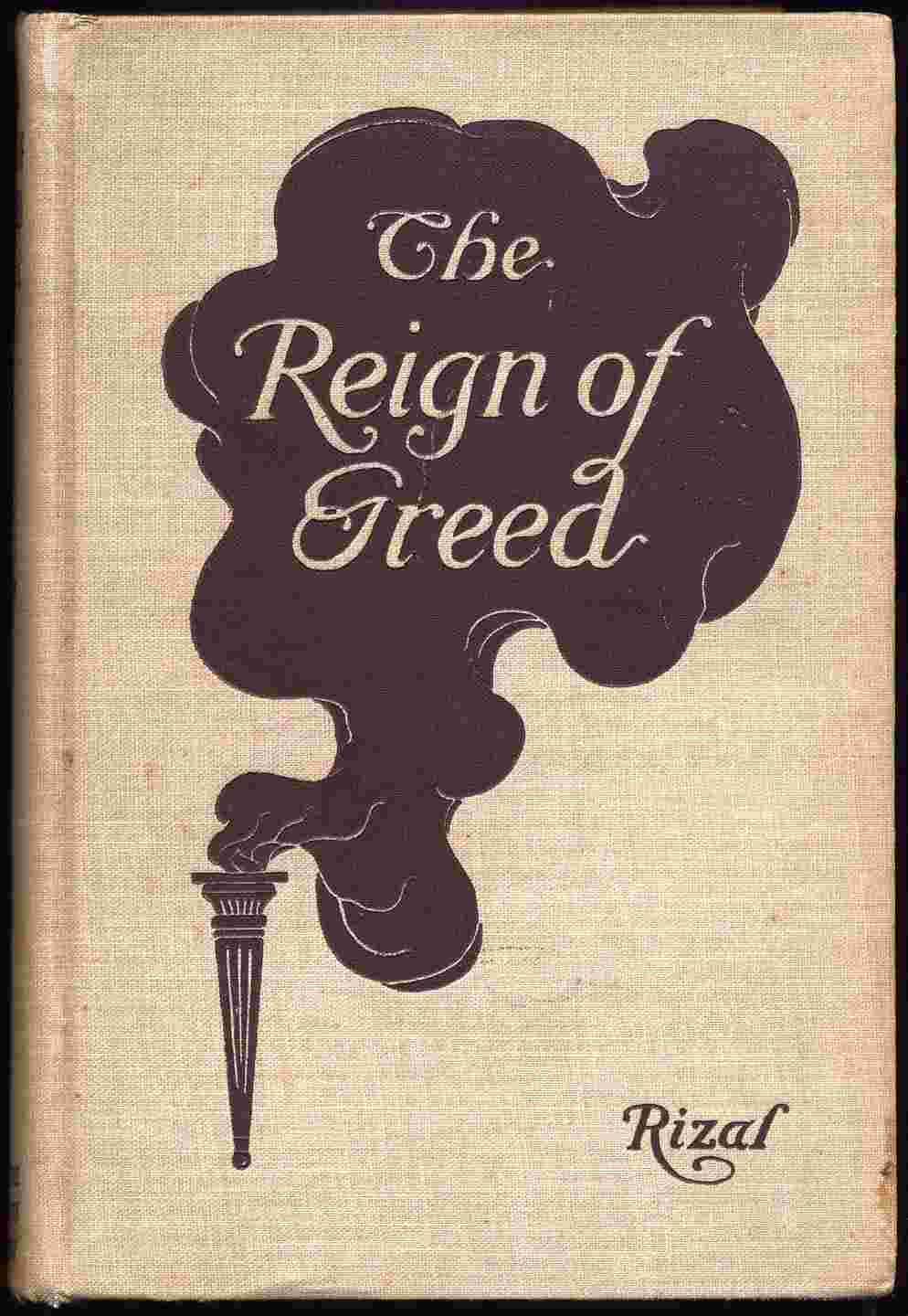
The Project Gutenberg eBook of The Reign of Greed
Title: The Reign of Greed
Author: José Rizal
Translator: Charles E. Derbyshire
Release date: January 1, 2004 [eBook #10676]
Most recently updated: October 28, 2024
Language: English
Credits: Produced by Jeroen Hellingman and the Online Distributed Proofreading Team at https://www.pgdp.net/ for Project Gutenberg.
The Reign of Greed
Philippine Education Company
1912
[iv]
Copyright, 1912, by Philippine Education Company.
Entered at Stationers’ Hall.
Registrado en las Islas Filipinas.
All rights reserved.
[v]
Translator’s Introduction
El Filibusterismo, the second of José Rizal’s novels of Philippine life, is a story of the last days of the Spanish régime in the Philippines. Under the name of The Reign of Greed it is for the first time translated into English. Written some four or five years after Noli Me Tangere, the book represents Rizal’s more mature judgment on political and social conditions in the islands, and in its graver and less hopeful tone reflects the disappointments and discouragements which he had encountered in his efforts to lead the way to reform. Rizal’s dedication to the first edition is of special interest, as the writing of it was one of the grounds of accusation against him when he was condemned to death in 1896. It reads:
“To the memory of the priests, Don Mariano Gomez (85 years old), Don José Burgos (30 years old), and Don Jacinto Zamora (35 years old). Executed in Bagumbayan Field on the 28th of February, 1872.
“The Church, by refusing to degrade you, has placed in doubt the crime that has been imputed to you; the Government, by surrounding your trials with mystery and shadows, causes the belief that there was some error, committed in fatal moments; and all the Philippines, by worshiping your memory and calling you martyrs, in no [vi]sense recognizes your culpability. In so far, therefore, as your complicity in the Cavite mutiny is not clearly proved, as you may or may not have been patriots, and as you may or may not have cherished sentiments for justice and for liberty, I have the right to dedicate my work to you as victims of the evil which I undertake to combat. And while we await expectantly upon Spain some day to restore your good name and cease to be answerable for your death, let these pages serve as a tardy wreath of dried leaves over your unknown tombs, and let it be understood that every one who without clear proofs attacks your memory stains his hands in your blood!
J. Rizal.”
A brief recapitulation of the story in Noli Me Tangere (The Social Cancer) is essential to an understanding of such plot as there is in the present work, which the author called a “continuation” of the first story.
Juan Crisostomo Ibarra is a young Filipino, who, after studying for seven years in Europe, returns to his native land to find that his father, a wealthy landowner, has died in prison as the result of a quarrel with the parish curate, a Franciscan friar named Padre Damaso. Ibarra is engaged to a beautiful and accomplished girl, Maria Clara, the supposed daughter and only child of the rich Don Santiago de los Santos, commonly known as “Capitan Tiago,” a typical Filipino cacique, the predominant character fostered by the friar régime. [vii]
Ibarra resolves to forego all quarrels and to work for the betterment of his people. To show his good intentions, he seeks to establish, at his own expense, a public school in his native town. He meets with ostensible support from all, especially Padre Damaso’s successor, a young and gloomy Franciscan named Padre Salvi, for whom Maria Clara confesses to an instinctive dread.
At the laying of the corner-stone for the new schoolhouse a suspicious accident, apparently aimed at Ibarra’s life, occurs, but the festivities proceed until the dinner, where Ibarra is grossly and wantonly insulted over the memory of his father by Fray Damaso. The young man loses control of himself and is about to kill the friar, who is saved by the intervention of Maria Clara.
Ibarra is excommunicated, and Capitan Tiago, through his fear of the friars, is forced to break the engagement and agree to the marriage of Maria Clara with a young and inoffensive Spaniard provided by Padre Damaso. Obedient to her reputed father’s command and influenced by her mysterious dread of Padre Salvi, Maria Clara consents to this arrangement, but becomes seriously ill, only to be saved by medicines sent secretly by Ibarra and clandestinely administered by a girl friend.
Ibarra succeeds in having the excommunication removed, but before he can explain matters an uprising against the Civil Guard is secretly brought about through agents of Padre Salvi, and the leadership is ascribed to Ibarra to ruin him. He is warned by a mysterious friend, an outlaw called Elias, whose life he had accidentally saved; but desiring first to see Maria Clara, he refuses to make his escape, and when the outbreak [viii]occurs he is arrested as the instigator of it and thrown into prison in Manila.
On the evening when Capitan Tiago gives a ball in his Manila house to celebrate his supposed daughter’s engagement, Ibarra makes his escape from prison and succeeds in seeing Maria Clara alone. He begins to reproach her because it is a letter written to her before he went to Europe which forms the basis of the charge against him, but she clears herself of treachery to him. The letter had been secured from her by false representations and in exchange for two others written by her mother just before her birth, which prove that Padre Damaso is her real father. These letters had been accidentally discovered in the convento by Padre Salvi, who made use of them to intimidate the girl and get possession of Ibarra’s letter, from which he forged others to incriminate the young man. She tells him that she will marry the young Spaniard, sacrificing herself thus to save her mother’s name and Capitan Tiago’s honor and to prevent a public scandal, but that she will always remain true to him.
Ibarra’s escape had been effected by Elias, who conveys him in a banka up the Pasig to the Lake, where they are so closely beset by the Civil Guard that Elias leaps into the water and draws the pursuers away from the boat, in which Ibarra lies concealed.
On Christmas Eve, at the tomb of the Ibarras in a gloomy wood, Elias appears, wounded and dying, to find there a boy named Basilio beside the corpse of his mother, a poor woman who had been driven to insanity by her husband’s neglect and abuses on the part of the Civil Guard, her younger son having [ix]disappeared some time before in the convento, where he was a sacristan. Basilio, who is ignorant of Elias’s identity, helps him to build a funeral pyre, on which his corpse and the madwoman’s are to be burned.
Upon learning of the reported death of Ibarra in the chase on the Lake, Maria Clara becomes disconsolate and begs her supposed godfather, Fray Damaso, to put her in a nunnery. Unconscious of her knowledge of their true relationship, the friar breaks down and confesses that all the trouble he has stirred up with the Ibarras has been to prevent her from marrying a native, which would condemn her and her children to the oppressed and enslaved class. He finally yields to her entreaties and she enters the nunnery of St. Clara, to which Padre Salvi is soon assigned in a ministerial capacity. [x]
O masters, lords, and rulers in all lands,
Is this the handiwork you give to God,
This monstrous thing distorted and soul-quenched?
How will you ever straighten up this shape-;
Touch it again with immortality;
Give back the upward looking and the light;
Rebuild in it the music and the dream;
Make right the immemorial infamies,
Perfidious wrongs, immedicable woes?
O masters, lords, and rulers in all lands,
How will the future reckon with this man?
How answer his brute question in that hour
When whirlwinds of rebellion shake the world?
How will it be with kingdoms and with kings—
With those who shaped him to the thing he is—
When this dumb terror shall reply to God,
After the silence of the centuries?
Edwin Markham [xi]
Contents
| Chapter | Page | |
| I. | On the Upper Deck | 1 |
| II. | On the Lower Deck | 14 |
| III. | Legends | 23 |
| IV. | Cabesang Tales | 30 |
| V. | A Cochero’s Christmas Eve | 41 |
| VI. | Basilio | 48 |
| VII. | Simoun | 56 |
| VIII. | Merry Christmas | 69 |
| IX. | Pilates | 73 |
| X. | Wealth and Want | 76 |
| XI. | Los Baños | 88 |
| XII. | Placido Penitente | 104 |
| XIII. | The Class in Physics | 114 |
| XIV. | In the House of the Students | 127 |
| XV. | Señor Pasta | 139 |
| XVI. | The Tribulations of a Chinese | 148 |
| XVII. | The Quiapo Pair | 160 |
| XVIII. | Legerdemain | 166 |
| XIX. | The Fuse | 175 |
| XX. | The Arbiter | 187 |
| XXI. | Manila Types | 197 |
| XXII. | The Performance | 210 |
| XXIII. | A Corpse | 225 |
| XXIV. | Dreams | 233 |
| XXV. | Smiles and Tears [xii] | 245 |
| XXVI. | Pasquinades | 254 |
| XXVII. | The Friar and the Filipino | 261 |
| XXVIII. | Tatakut | 273 |
| XXIX. | Exit Capitan Tiago | 283 |
| XXX. | Juli | 288 |
| XXXI. | The High Official | 299 |
| XXXII. | Effect of the Pasquinades | 306 |
| XXXIII. | La Ultima Razón | 311 |
| XXXIV. | The Wedding | 320 |
| XXXV. | The Fiesta | 325 |
| XXXVI. | Ben-Zayb’s Afflictions | 334 |
| XXXVII. | The Mystery | 341 |
| XXXVIII. | Fatality | 346 |
| XXXIX. | Conclusion | 352 |
[1]