
The Project Gutenberg eBook of The Reign of the Manuscript
Title: The Reign of the Manuscript
Author: Perry Wayland Sinks
Release date: April 27, 2014 [eBook #45510]
Most recently updated: October 24, 2024
Language: English
Credits: Produced by Chris Curnow, Charlie Howard, and the Online
Distributed Proofreading Team at http://www.pgdp.net (This
file was produced from images generously made available
by The Internet Archive)
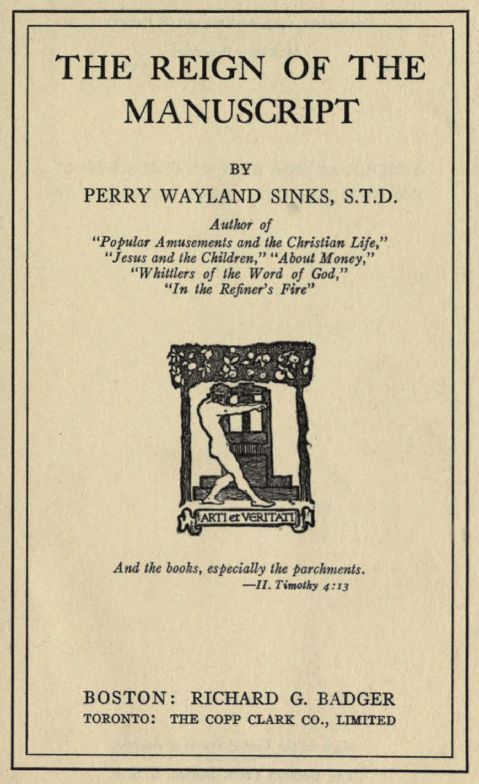
THE REIGN OF THE
MANUSCRIPT
BY
PERRY WAYLAND SINKS, S.T.D.
Author of
"Popular Amusements and the Christian Life,"
"Jesus and the Children," "About Money,"
"Whittlers of the Word of God,"
"In the Refiner's Fire"
BOSTON: RICHARD G. BADGER
TORONTO: THE COPP CLARK CO., LIMITED
Copyright, 1917, by Richard G. Badger
All Rights Reserved
Made in the United States of America
The Gorham Press, Boston, U. S. A.
TO OUR BELOVED SONS AND DAUGHTERS
OUR EARNEST CARE AND CROWN OF JOY
AN APPRECIATION
I have examined the manuscript of your book with care. The conception seems to me to be admirable, and new in form of presentation. There is a great deal of valuable material for which one would search a long time and then not find it in the orderly and compact form which you have given it. It seems to me that Sunday school teachers would welcome it especially, and leaders of teacher-training classes would desire to use it as an auxiliary text book. I trust it will be widely read.
ERNEST BOURNER ALLEN
The Washington Street Congregational Church.
Toledo, 1917
CONTENTS
| CHAPTER | PAGE | |
| I | The Epochal Invention of Printing | 11 |
| II | The Importance of the Printing Press | 16 |
| III | The Period of Manuscript Literature | 19 |
| IV | The Amplitude of the Bible in Manuscript | 33 |
| V | The Human Element in Literature | 40 |
| VI | Materials Embodying Literature | 46 |
| VII | Varieties and Chances in the Materials of Books | 55 |
| VIII | Parchment and Vellum | 59 |
| IX | Papyrus | 66 |
| X | Paper and Its Manufacture | 72 |
| XI | Other Materials of Literature | 78 |
| XII | Inks | 83 |
| XIII | Implements of Writing | 87 |
| XIV | The Art and Science of Palæography | 89 |
| 1 The Hieroglyphic Writing | 92 | |
| 2 The Cuneiform Writing | 99 | |
| 3 The Alphabetic Writing | 104 | |
| 4 The Classic Writing | 112 | |
| 5 The Two Great Stages of Classic Writing | 113 | |
| 6 The Anglo-Saxon Writing | 115 | |
| 7 Palæography and the Date of Literary Productions | 117 | |
| XV | Mechanical and Artificial Devices of Literature | 120 |
| XVI | Sources of the Book-making Industry | 127 |
| XVII | The Literary Preëminence of Alexandria | 133 |
| XVIII | Varying Fortunes of the Alexandrian Library | 143 |
| XIX | Constantinople the Later Center of Literature | 146 |
| XX | Monasteries and the Monastic Institution | 154 |
| Index | 172 |
THE REIGN OF THE
MANUSCRIPT
I
THE EPOCHAL INVENTION OF PRINTING
The invention of printing at about the middle of the fifteenth century marks an epoch in the world's literature and in the history of the human race. Previous to this invention were spread out the events, the scenes, and the achievements of ancient and medieval times; after it came the marvelous unfoldings of the modern age.
The introduction of typography or the art of printing by means of movable types set in operation an instrumentality which, for multiplying the effectiveness of all literary productions, is far beyond all adequate conception;—and this all apart from the time of its origin and the person of its originator.
Printing as an invention and an art—for it is both—has been ascribed to the Chinese, and is said to have been known from, or from before, the dawn of the Christian Era. Mr. George H. Putnam states it as a fact that "Printing from solid blocks was done in China as early as the first century A. D.," and credits the art of printing from movable types to a blacksmith who turned out books in China toward the close of the tenth century, A. D., or early in the eleventh. And a writer in the Encylopedia Britannica (Eleventh Edition) asserts that printed books were common in China in the tenth century, and that examples of xylographic or block printing in Japan date from the period of 754 to 770 A. D. However this may be, it remains true that, in relation to the spread of literature and the development of civilization, typography is occidental rather than oriental. Furthermore, we need to distinguish between the block printing of China and the great invention at the middle of the fifteenth century. Comparing impressions from engraved blocks of wood with the type-printing of Gutenberg, Professor Dobschütz says: "People had used woodcuts before his time. Engraving large blocks of wood with pictures and letters, they printed the so-called block-books as a cheap substitute for illuminated manuscripts. Gutenberg's great idea was that instead of using a woodcut block for the page one might compose a page by using separate movable letters, putting them together according to the present need, then separating them again."1 It is generally conceded that the invention of printing from movable types, as an epoch of human history, had its real beginning in Germany, dates from the middle of the fifteenth century, and is associated with one named Johannes Gutenberg.
Gutenberg was of patrician parentage and was born at Mainz (the modern Mayence), Germany, about 1400 A. D. His life was a prolonged struggle with adverse circumstances. He died in 1468, poor, childless, and almost friendless—scarcely dreaming that he had laid the foundations of a benefaction which chronicled the turning-point of universal history, set a permanent guide-post in the world's progress, and proclaimed a new era in civilization. But so it was.
While we are without definite information as to how the first copies were printed, yet it is obvious from Gutenberg's famous forty-two line Bible that they used a mechanical press. The earliest picture of a printing-press shows an upright wooden frame with a screw post attachment by means of which the required pressure for impression was obtained and then reversed to release and remove the printed sheet. This screw post was operated by a movable bar. This kind of press continued to be used for a hundred and fifty years. The first types were cut from wood, but the ink used had a softening effect thereupon and lead was substituted. Lead, in turn, was found to be too soft a metal to resist the pressure requisite for printing. After experimentation, an alloy of antimony and lead proved to have the adaptable strength and softness; it was also capable of delicate and clear-cut manipulation. These metal types were first cast in sand and, later, in clay molds. The ink used for printing with the Gutenberg press was a mixture of linseed oil and lamp-black and was applied to the type-form by means of a "dabber" made of skin and stuffed with wool. It is stated that the first types as used in China were made of plastic clay; later, of copper; and then of lead, inasmuch as copper had come to be utilized as coin. (Putnam.)
It is worthy of our note in this connection that the first important product of the printing-press was the Bible;—was devoted, as has been said, "to the service of heaven." This first "production" was on 641 leaves of vellum, two columns to a page, and forty-two lines to each column. "Probably," says Professor Dobschütz, "not more than 100 copies of the Bible were printed, a third of these on parchment. Out of thirty-one copies which have been preserved, or, to speak more accurately, are known as such, ten are luxuriously printed on parchment and illuminated, each in a different way, but all very fine and costly."2 (One copy of Gutenberg's first printed Bible was sold for $20,000.) The first copy of this edition known to scholars—the Latin Vulgate—was discovered long after (in 1760) in the library of Cardinal Mazarin, whence its designation, "the Mazarin Bible." Nine other copies which were upon vellum and a score that were printed on paper (two of which are in New York City) are all that are known to the bibliographers of the first "edition" of the printed Bible. While engaged in the production of this first book (which required four years, 1453–1456, to complete) Gutenberg printed smaller works—school books and the like—for immediate financial returns. In this first edition of the printed Bible the initial letters were not struck off by press but were left, together with the marginal decorations, for after illumination by hand. A Bible printed at Mainz in 1462 is the first printed book that bears the date of its production.
II
THE IMPORTANCE OF THE PRINTING PRESS
The printing-press, in many essential respects, is the most significant invention of all human history. It has touched and vitalized civilizations, countries, nations, languages, and dialects. As an invention it has contributed immeasurably to the currency and the perpetuity of all literature. It also sounded the doom of the written book. Hallam, the Historian of the Middle Ages, says: "Since the invention of printing the absolute extinction of any considerable work seems a danger too improbable for apprehension. The press pours forth in a few days a thousand volumes, which, scattered like seeds in the air over the Republic of Europe, could hardly be destroyed without the extirpation of its inhabitants." And, concerning the exposure to which the manuscript production of all previous history was subjected, he says: "In the times of antiquity manuscripts were copied with cost, labor, and delay; and if the diffusion of knowledge be measured by the multiplication of books (no unfair standard) the most golden ages of ancient learning could never bear the least comparison with the last three centuries. The destruction of a few libraries by accidental fire, the desolation of a few provinces by unsparing and illiterate barbarians, might annihilate every vestige of an author, or leave a few scattered copies, which, from the public indifference there was no inducement to multiply, exposed to similar casualties in succeeding times."3 In a word, printing has the double advantage over writing of a more rapid multiplication of copies and their increased accuracy. But even with the increased accuracy of printing, few books of considerable size are issued in which errors are not to be found. It is said to be the fact that, after incredible care on the part of editors and professional proofreaders, the offered reward of a guinea for each detected error in the Oxford Revised Version of the Bible brought several errors to light. (International Stand. Bib. Encyclopedia.)
The invention of printing, through its associated process of proof corrections, has virtually exempted books from the mundane laws of decay and has greatly aided as well in their preservation and their widest circulation. This invention has made definite and immutable the records of the world since then and it has contributed also to the purification and renewal of the more ancient literary productions. Printing as an invention has given to an edition of a particular work a measure of importance hundreds or thousands of times greater in every respect save one, viz., the labor of transcription, than that which had previously attached to the production of a single book. The invention has therefore involved and necessitated a proportionately larger consideration in the making of a printed book, lest defects and errors in the type-plates from which the book is printed should become permanently fixed in a thousand or ten thousand impressions therefrom. (Isaac Taylor.) And it was printing that made uniformity of text possible. Guizot estimates the importance of this invention thus: "From 1436 to 1452, printing was invented:—printing, the theme of so much declamation, and so many commonplaces, but the merit and the effect of which no commonplace nor any declamation can ever exhaust."
The invention of printing has peculiar significance within the realm of religious life and knowledge; for, in relation to the scripture text, to the spread of religious intelligence and the progress of Christianity, and to the growth and stabilization of the individual character,—in a word, in relation to Redemption itself, who can apprehend, much less measure, the significance of this invention? Truly, the Bible which enfolds the basis of our faith as the bud does the blossom and the fruit, as well as unfolds the way of life as the guide-post directs the traveler on his journey, has come into the world for man, and has come to stay. For the great discoveries and inventions, in wide areas of human investigation, but brighten its pages and multiply its capacity to fulfill the purposes of God on the earth.
III
THE PERIOD OF MANUSCRIPT LITERATURE
The age in which literature was disseminated and preserved extended from the time of the earliest intellectual compositions designed for communication—as the papyri hieroglyphics of ancient Egypt and the leather and parchment rolls of the early Persian and Jewish peoples; and included also those compositions which had a limited circulating character, like the tablets and cylinders of ancient Assyria—down to the time when the printing-press was invented. This, inclusively, is the period of the manuscript literature. Throughout this entire period of the world's ongoing, for many hundreds or some thousands of years, each and every kind of production, whether in hieroglyph, cuneiform, or alphabetic characters, was made by itself—the producer inscribing, painting, or printing (letter by letter or character by character) through hundreds and thousands of pages. "To the time of the invention of printing, and until the printed book had driven it out of the field, the manuscript was the vehicle for the conservation and dissemination of literature and discharges the function of a printed book."
A book has been defined as "any record of thought in words." This may be a correct definition as far as it relates to literature but not as it relates to the "record of thought." There is a "record of thought" independent of words and, perhaps, long antedating the record in words of any language. A word has been defined as "the sign of an idea." But were there not "ideas" long before they were communicated by words? If there are "songs without words" may there not be, or, at least may there not have been, "ideas without words"? An affirmative answer is admirably illustrated—and the illustration is confirmatory—by a group of six great mural paintings by Mr. John W. Alexander, in the Library of Congress at Washington. These pictures illustrate historically the probable genesis and evolution of the "book." The first painting is of the rude Cairn or heap of stones piled up on the seashore or elsewhere by prehistoric man in order to commemorate some event or achievement, and thus to stand as a "record" or landmark of a fact or truth. The second picture is illustrative of Oral Tradition, and represents the "narration" of facts or doings by the word of mouth. The third is called the Pictograph which consists in delineations of events or experiences as drawn by some implement upon the surface of skins, or on the leaves or bark of trees or plants, and by means of which there was created a kind of permanent "record" of past "happenings" or doings. The fourth is the Hieroglyphics—which brings us to the historic period—in which there were carved on the face of cliffs, on the walls of structures of any kind, or on wood, the pictured and, may be, progressive delineations of events or ideas. The fifth is the Manuscripts or the record contained in written language and which was phonetic, syllabic, or alphabetic,—the end toward which all earlier stages of "record" tended. The sixth and last picture is the Printing Press, the embodiment and consummation of all the earlier phases and stages in the "records of the past." It is the obvious lesson from these great paintings that a "record of thought" by means of "words" was not fully achieved until the manuscript entered upon its world-wide and enduring career, or, in which "words" became the embodiment and depository of permanent and communicable "ideas." The words of Mr. E. C. Richardson are quoted as bearing upon the period of manuscript literature: "Some of the pictures on the cave walls of the neolithic age seem to have the essential characteristics of books and certainly the earliest clay tablets and inscriptions do. These seem to carry back with certainty to at least 4,200 B. C. By a thousand years later, tablet books and inscriptions were common and papyrus books seem to have been well begun. Another thousand years, or some time before Hammurabi, books of many sorts were numerous. At the time of Abraham, books were common all over Egypt, Babylonia, Palestine, and the eastern Mediterranean as far at least as Crete and Asia Minor. In the time of Moses, whenever that may have been, the alphabet had perhaps been invented, books were common among all priestly and official classes, not only in Babylonia, Asyria, and Egypt, but at least in two or three scores of places in Palestine, north of Syria and Cyprus."4
The earliest literature of the ancient Greeks was first preserved in oral traditions, folk-lore, and legendary minstrelsy, and not in written language. It is possible, nay, probable, that in Greece, Egypt, China, Japan, and Persia also, folk-lore and folk-tales were perpetuated through memory by means of recitations, as in the instances of the rhapsodists—the class of professional reciters who publicly declaimed the Homeric literature and the folk-lore of the ages with more or less artistic inflection or intonation of the voice. The proclamations of rulers, the compositions of poets and historians, and the oracles of religion were anciently published orally, often, by heralds, minstrels, and prophets. The great Hebrew Lawgiver embodied a wide-spread principle and practice in his final injunction to the Hebrew nation: "Now therefore write ye this song for you and teach it to the children of Israel; put it in their mouths, that this song may be a witness for me against the children of Israel." (Deut. 31:19.) Aside from narrower applications of this practice, the great achievements and deliverences of the Israelitish people were celebrated and perpetually memorialized in song and psalm. On the shores of the Red Sea, Moses and his people sang their song of deliverance from the hand of their enemy. And when, at a later age, the Ark of the Covenant was borne to its resting place within the Sacred City, it was amidst the antiphonal chanting of the psalm which David, himself, had composed for the occasion. The psalms in themselves—as one of the purposes of their composition—were a partial witness to the place and prominence of song and chant in teaching religious truth and thus in keeping faith alive on the earth. Plato states that the first laws of all nations were composed in verse and sung. There is a remembrancer in Plato's statement concerning the first laws of nations of our own primitive pedagogical methods within certain departments of learning. And so, by tradition, recitative, minstrelsy, and psalmody—of wide application in the early ages—both a wider currency and a more tenacious hold was taken by these laws, proclamations, and truths upon the popular mind. Especially so as the popular mind was deficient in the art of reading, even when literature had been embodied in writing. And this was true in both sacred and profane history. Thus, minstrelsy, chant, and tradition have performed an important function in the beginnings of many ancient peoples. And, strange as it may seem to us, Plato, notwithstanding his voluminous writings and his place in the literary world for nearly three thousand years, put a low estimate on the importance of written as compared with oral teaching.
The Greek classics—the matchless monuments of ancient literature—as represented in the Iliad, the Odyssey, and the Homeric Hymns were preserved, perpetuated, and disseminated for generations if not for centuries, not by written records—as later literature has been handed down by the written or printed page—but through ballads, minstrelsy, and recitation. "The Æolic emigrants who settled in the north-west of Asia-Minor brought with them the warlike legends of their chiefs—the Archæan princes of old. These legends lived in the ballads of the Æolic minstrels, and from them passed southward into Ionia, where the Ionian poets gradually shaped them into higher artistic form."5 "Mahaffy and Jevons are in accord," says Mr. Putnam, "in pointing out that the effort of memory required for the composition and transmission of long poems without the aid of writing, while implying a power never manifested among people possessing printed books, is not in itself at all incredible. Memory was equal to the task, and the earlier Greeks poems, memorized by the authors as composed, were preserved by successive generations of bards." And again he says, "It is to be borne in mind that the (to us) extraordinary extent to which the Greeks were able to develop their power of memorizing enabled them often to trust their memory where modern students would be helpless without the written (or printed) word.... The boys in school were given as their daily task the memorizing of the works of the poets, and what was begun under compulsion appears to have been continued in later life as a pleasure."6 And in the preface of the book from which the foregoing statements are quoted, the author says, "It is evident that there were literary productions in advance, and probably very far in advance, of the discovery or evolution of literary characters, and also long after the use of script by authors, the greater portion of the public in all ancient lands received their literature, not through their eyes, but through their ears,—not by reading the text, but by listening to reciters, story-tellers, and 'rhapsodists.'" (P. xiv.) We quote the following from Mr. E. C. Richardson: "The Vedas were, it is alleged, handed down for centuries by a rigidly trained body of memorizers. The memorizing of Confucian books by Chinese students and of the Koran by Moslem students is very exact."7 "The office of reading," says Professor Dobschütz, "was esteemed so highly that it was regarded as based on a special spiritual gift.... The reader had to know his text almost entirely by heart to do it well. From the 'Shepherd of Hermes,' a very interesting book written by a Roman layman about 140 A. D., we learn that some people gathered often, probably daily, for the special purpose of common reading and learning. But even granted that the memory of these men was not spoiled by too much reading, as is ours, so that by hearing they were able to learn by heart (it is said of some rabbis that they did not lose one word of all their master had told them, and, in fact, the Talmudic literature was transmitted orally for centuries), nevertheless, we must assume that these Christians had their private copies of the Bible at home."8 Prescott says of the pre-historic Mexico: "Besides the hieroglyphic maps, the traditions of the country were embodied in songs and hymns.... These were various, embracing the mystic legends of a heroic age, the warlike achievements of their own, or the softer tales of love and pleasure."9 Of the early times of English literature, D'Israeli states that "before the people had national books they had national songs," and that "these songs and these fables, these proverbs and these tales,—all these were a library without books."10 And an anonymous author, recently traveling in a remote portion of northern Albania, records it that "the wild, inaccessible country is under various independent tribes, ruled by a chieftain according to unwritten laws handed down orally from remote ages." He also states that "the country has no written language and no literature."11
Thus, from very early if not from pre-historic times, down to the present moment there have been repeated if not continuous examples, and widespread on the earth if not universal, of the place and importance of oral tradition as a datum of history and source of literature. Says Professor Sayce: "Archæological research is constantly demonstrating how dangerous it is to question or deny the veracity of tradition or of an ancient record until we know all the facts."12 This much must be conceded, in holding that oral tradition is secondary to written records. The reason for their secondary value is obvious from the fact that "ear impressions tend to be less exact than eye impressions because they depend on a brief sense impression, while in reading the eye lingers until the matter is understood. Memory copy tends to fade away rapidly. This is shown by the great variety in the related legends of closely related tribes."13
But from very early times—just how early cannot be determined, inasmuch as historiographers and chronologists differ as to the beginning-times of written literature in the respective civilizations—literary compositions of every sort, both sacred and profane, were recorded and disseminated, so far as they were recorded and disseminated, by the tedious and laborious process of writing or carving or impressing by hand. Literature, almost entirely, throughout this long period was contained in and continued by the manuscripts. The cuneiform writing on tablets and cylinders, though so voluminous in quantity, seems to have been lost sight of and disregarded for millenniums of years while they were a sealed literature; and the hieroglyphic writing of Egypt remained undeciphered for, perhaps, an equal period of time, down to the close of the eighteenth century.
It is the obvious fact, then, that, in an age of the world's history when the printing-press with its almost limitless capacity for extending and preserving literature was yet unknown, all literary productions of all kinds—including the Bible—must have been meager in the extreme as compared with the present rapid increase of the printed page when steam and heat and electricity are motive powers. A present-generation occurrence will fitly and forcefully illustrate this proposition: It will be recalled to mind that the Revised New Testament was issued simultaneously by the Oxford Press in both London and New York on a designated day of 1881; it may not be remembered, however, that an enterprising Chicago daily had the entire New Testament telegraphed from New York, immediately at its issue in that City, in order that it might be secured and printed in Chicago in an enormous edition a few hours in advance of the mails and express, put into circulation and sold to the financial advantage of that newspaper. Compare that achievement of printing hundreds of thousands of the New Testament, accomplished within a few hours' time, with the transcription of a single copy of a book, and you must have a new sense of the importance of the printing-press in relation to all literature. And contrast, if you will, the slow and inadequate composition and dissemination of intelligence by the laborious process of handwriting with the present-day marvelous facilities for publication when the linotype is mostly employed in setting the type-plates for periodicals and books, and when a single press will print and fold about thirty thousand copies of a metropolitan journal in one hour's time, and, from both comparison and contrast, you must have a higher appreciation for the printing-press as an instrumentality for the spreading of intelligence and the progress of civilization.
Consider, too, the all but prohibitive cost of books, when made by hand and estimated by the labor of their making, and you must have a new and a truer basis of valuation for manuscript literature. A few facts and incidents will illustrate and enforce the foregoing observation: It required nearly three years in the time of Wycliffe (who died in 1384) for a copyist to transcribe the entire Bible, and this labor cost the equivalent of $1,500. Even tracts of Wycliffe, containing isolated texts of scripture, were sold for forty or fifty dollars as the money of that day would be estimated in our currency. (Christ in the Gospels.) It is credibly stated that, in the century before Wycliffe's time, "an ordinary folio volume probably cost 400 to 500 franks," or the sum of eighty to a hundred dollars in present values. Very few books could be bought at all, at some periods of time, for less than the equivalent of one hundred dollars; and illuminated or illustrated and embellished books, of which there then were and there yet remain exquisite examples, cost much more than this amount. And yet books never seem to have been a "drug" upon the market. And while it required four years for Gutenberg to print his first edition of the Bible (consisting of a hundred copies) yet the time employed in its making, if compared with the time and labor requisite for the transcription of a hundred copies of the Bible by hand, would represent a net gain or saving, in time, of nearly seventy-five years and, in money, of more than a hundred thousand dollars. It would represent other values: as uniformity of text, economy of material, and larger aggregate immunity from error. It is stated that the common price of a Bible in the thirteenth century ran as high as $300, and that in the fourteenth century Bibles were sold for as much as $2,000. It is said that Bibles were left as precious bequests to relatives and friends and that they were even given as security for large debts.
The cost of materials and of the transcription of books added immensely to their appraised valuation in the different ages. We quote from a volume by Mr. Geo. H. Putnam concerning books and their making in pre-Christian times: "It appears from such references as we find to the prices paid that, as compared with other luxuries, books remained very costly up to the time of the Roman occupation of Greece, or about 150 B. C. ... Plato is reported to have paid for three books of Philolaüs, which Dion bought for him in Sicily, three Attic talents, equal in our currency to $3,240,—and the equivalent, of course, of a much larger sum, estimated in its purchasing power for food.... The cost of books depended, of course, largely upon the cost of papyrus, for which Greece was dependent upon Egypt. An inscription of the year 407 B. C., quoted by Rangabé, gives the price of a sheet of papyrus at one drachma and two oboli, the equivalent of about twenty-five cents."14 Ptolemy Philadelphus is said to have authorized the giving of fifteen talents of silver, the equivalent of about $16,200, in addition to a shipment of corn, to the famishing Athenians for certain authenticated copies of the tragedies of Æschylus, Sophocles, and Euripides for the Alexandrian Library. (Putnam.) And, later, in the early part of the Christian Era, the price of copying books was estimated by the number of lines they contained. Diocletian, it is said, fixed the wage of the copyers of his time at forty denarii or at about twenty-five cents per one hundred lines. Late in the thirteenth century, the price of transcribing a Bible containing a commentary thereon, written in a fair hand, ranged from one hundred and fifty to two hundred and fifty dollars, though earlier in that century the purchasing power of money was so great and labor so cheap that two arches of London Bridge were built for the equivalent of a hundred and twenty-five dollars, or less than the cost of transcribing a Bible with a commentary. In 1272 the wages of a laboring-man were less than four cents a day, while the price of a Bible at that time was about one hundred and eighty dollars. (The Book Record.) In other words, a common laborer must then have toiled for thirteen years, according to the current labor values of the time, in order to secure the purchase-price of a Bible; though in an age when few could read, this was not so large a deprivation. Now, the American Bible Society can furnish the entire Christian scriptures, creditably bound in cloth with fair and readable type, for less than twenty-five cents. A common laborer, who generally has a rudimentary education at least, can now secure the Bible at the purchase-price of two hours' toil, or the New Testament for less than a half-hour's toil; and, what is more, the common laborer can, in most instances, not only read the Bible but has the respite from excessive labor to do so.
IV
THE AMPLITUDE OF THE BIBLE IN MANUSCRIPT
Notwithstanding the more limited and the less reliable sources of literature (including the Bible) there was, nevertheless, substantial and even abundant material of a historical character from which to construct a bridge of the-continuous-history-of-literature over and beyond the gulf of the Dark Ages. The preservation and circulation of literature, not only sacred but profane as well, by means of written symbols, is not limited to one language, nor to mediæval times,—nor to the Christian Era—but reaches back into a remote age. Considering the slow and laborious process of book-making and the generally low stage of interest in literature throughout wide areas of the earth and for lengthy periods of time, the amplitude of the manuscript productions of the world, as evidenced in the ancient libraries and religious "houses" with their various utilities, is one of the marvels of history—a veritable wonder of the world.
Note an incident of the New Testament record which, within the realm of sacred literature, illustrates the process by which literature in general has been disseminated: We are informed in one of the books of the New Testament that, early in the fourth decade of the first century (on the first Pentecost after the crucifixion of Jesus), "there were dwelling at Jerusalem, Jews, devout men out of every nation under heaven." And in the effusion of the Holy Spirit which came upon them then and there, they exclaimed—amazed and bewildered—"How hear we every man, in our own tongue, wherein we were born? Parthians, and Medes, and Elamites, and the dwellers in Mesopotamia, and in Judea, and Cappadocia, in Pontus, and Asia, Phrygia, and Pamphylia, in Egypt, and in the parts of Libya about Cyrene, and strangers of Rome, Jews and proselytes, Cretes and Arabians, we do hear them speak in our tongues the wonderful works of God." (The Acts 2:8-11.) As many as fifteen distinct nationalities and races were represented in this assemblage. It was, indeed, a cosmopolitan congregation and was composed of inhabitants from the then known world; and nothing is more probable than that representatives of those gathered at Jerusalem were among the "three thousand" added to that primitive company of believers on that occasion and that, when many of them went back to their native lands, they returned instinct with devotion to their new-found Master, and that, in their own respective and widely separated countries—under the impact of this new and inspiring hope which had been begotten within them at Jerusalem—they sowed the seed which bore the precious fruitage of evangelism in many lands throughout the early centuries of our Era. Indeed, the wide dispersion of the first Apostles and disciples of Jesus to the East, to the West, and to the South—into eastern Asia, into Europe, and into northern Africa—in the face of efforts to repress, and over obstacles and against contending forces everywhere, can best or only be accounted for on some such historical presupposition as is brought to our notice in the book of The Acts.
The first Apostles, in accordance with the terms of the Great Commission, were supernaturally endowed with "the gift of tongues" in order to be the message-bearers of the truth unto the nations. But this special endowment of Apostles did not extend to the peoples unto whom the revealed truth was sent nor, indeed, to their successors in commission. The recipients of the gospel message wrote and spoke in many languages and dialects, and thus there was created a need and demand for the word of God in the vernacular of many peoples. The many versions made, soon afterwards, into the different languages and dialects were the evidences of this demand and of its urgency and pertinency when the Apostles with their supernatural endowments were no longer accessible or available. In evidence of this fact we cite the career of the Apostle Paul. It is an established fact of history that the propagandist labors of Paul, within a little more than a quarter of a century, extended from Jerusalem, the capital of the religious world, to Rome, the seat of world-empire. This fact witnessed, indubitably, to the westward growth of the Christian Church. And we have traditions, literary, historical, and archæological evidences which indicate, conclusively, that others of the Apostles and early Christian teachers went eastward and southward from that common center at Jerusalem to Egypt and the shores of the Mediterranean and the Euxine; toward, if not unto, Babylon, Armenia, Hindustan, and the coasts of Ceylon. And in all these sections, over what may be called "the known world" of the time, these Christian propagandists—Apostles and disciples of Jesus—planted churches which, many of them for long after, became centers of evangelizing power.
The Apostles spoke and wrote in Greek, save as they were moved by the Holy Spirit and prompted by the needs of the people at Pentecost. But in every place whither the Apostles were sent and where converts to the Christian faith were gathered through their preaching, there remained the opportunity for and the need of the scriptures which had been the burden of the apostolic message, when these first propagandists of Christianity had passed on to other needy places. The after decline of the Greek language as the spoken tongue and the development or adoption of other tongues facilitated in consequence the multiplication of the scriptures or parts thereof, or communications from leaders and teachers, in the vernacular of different races or families of mankind. It is an interesting fact that, during the first three centuries of the Christian Era, and even when the Bible was interdicted, every Christian who could possess it tried to own at least some one book of the New Testament.
Furthermore, it is the fact sustained by scholarship and history that numerous versions of the scriptures were made, in the early Christian centuries, into other languages and dialects;—the Slavonic, Arabic, Persic, and Armenian tongues; earlier still into the Gothic tongue and the Ethiopic dialects of Abyssinia; and still earlier into the Coptic, Latin, and Syriac dialects. [It was the estimate of Gibbon, the historian of the Roman Empire, that there were probably six millions of avowed Christians when Constantine began to patronize Christianity in 313 A. D. And, allowing that there was one copy of the scriptures (of the New Testament or one of its books) to each three hundred Christians—not an extravagant supposition, considering what the sacred writings were to the early believers—there were probably not fewer than twenty thousand copies of the New Testament or individual books or their parts scattered throughout the world when Christianity came into royal favor in the Roman Empire.] These unnumbered copies in Greek—which long continued to be the spoken language for a large part of the world's population—together with the vast number of versions made from the original Greek into the languages and dialects of adjacent and contemporaneous peoples in order to meet the need of the first Christian Churches in wide areas of the Roman Empire, down to and after its fall, suggests the amplitude of the sacred writings in manuscript during the early centuries of our Era. This is proclaimed as from the house-top in the large and constantly increasing number of manuscripts, in different languages, which have been rescued as relics from an otherwise chaotic era. It is the estimate of Dr. Marvin R. Vincent that no fewer than 3,829 manuscripts have been discovered and catalogued. These have been gathered from many lands—Turkey, Egypt, the Ægean region, Cyprus, Greece, Italy, ancient Macedonia, Palestine, Africa, Spain, the Sinaitic Peninsula, Asia Minor, and in fact, from all Bible lands, and are preserved in the world's greatest libraries.
Professor Dobschütz summarizes the history of the versions and translations of the Bible, throughout the centuries to the invention of printing, as follows: "In the first period we found the Bible translated from the Greek into Latin, Syriac, Coptic; in the next period Gothic, Armenian, Georgian, Libyan, and Ethiopic were added, not to mention several revisions of former translations. About 600 A. D. the Bible was known in eight languages; in each of these there had been several attempts at translating. There were different dialects, too; in Coptic no less than five. The spread of Christianity in the next period is shown by the fact that the Bible is translated—and this again several times—into Arabic and Slavonic from the Greek, and into the German, Anglo-Saxon, Celtic, and French from the Latin—rather should I say, parts of the Bible, for it was only parts which people at this period tried to translate."15 And he shows us how this movement to give the Bible to the people in their own vernacular spread—from the thirteenth century on until the invention of printing—into south-eastern France, over Italy and Germany, into England and Bohemia, and, possibly, into Scandinavia; and declares, truly, "it is like a net thrown all over Europe."
V
THE HUMAN ELEMENT IN LITERATURE
The Bible even as literature—and both in its origin and history—is a human as well as a divine book. It is human in that it is to man and for man, and not to and for supernatural intelligences or the conceived populations of other planets; it is divine in that it is of God and from God. There is a real sense in which the definition of the Bible as given by Frederick W. Robertson is correct, "The Bible is the thoughts of God in the words of men." And we would hold that the Bible must be studied, if in a scientific, intelligent, and reverent spirit, under the two-fold conception that it is both a human and a divine book. And we believe also that nothing can ever be gained for the Bible, considering it a supernatural book, by setting up any erroneous or untenable hypotheses concerning its origin, character, or history on its behalf. And, moreover, the Bible nowhere and never makes any such an appeal on its own behalf, or pleads for exemption from the accepted principles of historical criticism. "The written word of God, like the Word which became flesh," says Professor G. F. Wright, "must be human in its manward aspect; for the written word is divine thought manifest in human language as Christ was God manifest in human flesh. As the compound personality of Christ was conditioned by the flesh, so the compound character of a written revelation is conditioned by the nature of language. As God in becoming incarnate did not take upon Himself the form of angels but the seed of Abraham, so a written revelation is not sent in a form adapted to heavenly beings but in a form suited to men."16 And if the Bible, while it is from God, is for man then it must be adapted to man's receptive condition. If the Bible is truly a "revelation" then it must "reveal"; which is only to say that it must be given in terms or modes of expression adapted or accessible to the human capacity;—it must meet man's condition at the time when the revelation is given as well as his condition a thousand or ten thousand years later; or, in other words, "revelation" must "reveal." Revelation has thus been progressive up to the period of its fulness or up to the cycle of its completion, with an expansive capacity for all future time. Progressive capacity is essential to the conception of a revelation that is universal and final. Borrowing the fine expression of Professor A. B. Bruce, revelation "must take the recipients of benefits along with it, and move at a pace with which they can keep up." Thus, revelation in its methods accords with nature in that it took the form of an historical movement and was subject to the laws of periodic development. "The redemptive purpose of God," declares Professor Bruce, "was not ushered into the world a full-grown fact; it evolved itself by a regular process of growth, and the process was marked by three salient features: slow movement, partial action, and advance from the more or less imperfect, not only in knowledge, but also in morality." And he says, further, "God had to teach Israel to walk in the paths of righteousness like a nurse taking a child by the arms, and had to exercise a nurse-like condescension and patience in connection with the self-imposed task of Israel's moral education, and to become as a child Himself, speaking in broken language and giving laws of a very rude and primitive character adapted to the condition of the pupil."17
The Bible is, truly, a supernatural book. One once confessed to an abounding confidence in the plenary inspiration of the scriptures in that he "accepted the Bible from 'lid' to 'lid'—and including the 'lid.'" But the supernaturalism which we believe belongs to or inheres in the Bible does not attach to the "lids"—to the materials by means of which the scriptures, as literature, have been communicated and preserved from age to age. (The fact which is here suggested is all apart from the question of inspiration.) God wastes no energies in a miraculous preservation of the materials of books,—not even of the materials of the "good Book." God does not violate, we think, the great law of "parsimony" by exerting either superfluous or supernatural energies for the accomplishment of His purposes. It was only when King Jehoiakim in his blind rage and folly cut the "roll" in pieces and burnt its mutilated fragments, that the supernatural energies were called into requisition to restore the "words of the book, which Jehoiakim, king of Judah, had burned with fire." (Jeremiah 36:32.) God has, however, guarded, preserved, and treasured—and in a marvelous, not to say supernatural manner—the "revelation" contained in the "good Book" so that no age has been left without its ample and unimpeachable witness. And this is all that we may reasonably demand for a revelation that is intended and destined to be authoritative, universal, and final. The destruction of the materials of books does not weigh if the contents are preserved. The impious King of Judah did not destroy the holy law of God when he utterly destroyed the parchment upon which it was inscribed. What mattered it if the "roll" was consumed since God had His faithful prophet and his scribe to produce another and ampler roll? And what matters it if a given copy, or any number of copies of a book, or of the Bible, be lost or destroyed so long as other unnumbered copies of the same are preserved beyond the reach of bad men or the destructive forces of corroding and destroying time? It does not matter, supremely, since it is the contents and not the materials of a book that claims the supreme consideration.
The materials which embody the divine revelation have ever been subject to precisely the same exposures and vicissitudes of alternating fortune and misfortune as those to which all other literary productions have been subjected. And, furthermore, it is the well-known fact that the "autograph" copies or the first writings of the New Testament are all lost, and, probably, without the remotest hope of recovery. They are not even mentioned by the authors and writers who succeeded the Apostles as having ever been seen by them. The conclusion is forced upon us that these first copies of the New Testament writings probably all perished before the close of the first century. [The "paper" then in common use was that made from the Egyptian papyrus plant, and this all perished except that which had been fortuitously (but not miraculously) preserved in Egyptian tombs and mummy-cases or under lava-beds at Pompeii and Herculaneum. The oldest of the existing copies of the scriptures are the Sinaitic and the Vatican Manuscripts which were written in the Greek language on vellum parchment at about the middle of the fourth century, and are thus above fifteen and a half centuries old.] In view of this destruction and loss of the originals of the New Testament writings, we may "restore" the "autographs" of our scriptures only by the methods which apply equally to all literature, and which are adequate to the approximate "restoration" of the scripture text, viz., by the translation or counter-translation of later copies and the versions, back to the earlier sources; and thus come, substantially, to the original writings.
VI
MATERIALS EMBODYING LITERATURE
The substances upon which literature has been embodied and by means of which has been preserved and disseminated are matters of far more importance than would be supposed at a superficial reflection. They call for a larger consideration than the modern state and stage of the book-making industry might seem to warrant. Now, if a book is worn out, accidentally destroyed, or "borrowed" by some "good book-keeper" and not returned, it is usually an easy and simple matter to secure another. Not so, previous to the invention of printing. For then, the cost and time required to make a book "by hand" gave to each single copy a distinct individuality and also a correspondingly increased importance.
The two chief desiderata of a manuscript book—of a written production which was intended to give currency to a writer's thoughts and at the same time to serve as a more or less permanent depository of them—are legibility and durability. He who writes for the publicity of his ideas will not write on stone nor on clay; and he who writes for the preservation of his ideas will not write on ice or dust. And he who writes that his thoughts may be read and understood will not write with a scrawl nor in an illegible "hand."
The foregoing observations prompt to the suggestion that not only the materials upon which a literary production is impressed or imprinted must be capable of easy conveyance or circulation but also that the writing itself must be legible, and that the materials employed must be proof to the utmost attainable extent against the obliterations of use and time. Necessarily, therefore, an achievement so laborious as the transcription of a written volume of whatever form (and especially of the Bible by reason of its size, character, and importance) called for a correspondingly larger concern and care as to the materials employed (including both the ink and the substance written upon) than would be required in the making of a printed book wherein each separate volume but duplicates hundreds and thousands of other volumes made from the same plates. This requirement partly explains the care with which the ancient manuscripts were made or copied. It was this fact that made every copyist's work distinctively individualistic.
The permanency and durability of books is largely a matter of relativity and fortuity. We quote from Mr. E. C. Richardson concerning the factors affecting the survival of books: "The average chance of an individual book for long life depends (1) on the intrinsic durability of its material, or its ability to resist hostile environment, (2) on isolation." He says, further: "The enemies to which books are exposed are various: wind, fire, moisture, mold, human negligence, vandalism, and human use. Some materials are naturally more durable than others. Stone and metal inscriptions survive better than wood or clay, vellum than papyrus or paper. On the other hand, however, if isolated or protected from hostile environment, very fragile material may outlast more substantial. Papyrus has survived in the mounds of Egypt, and unbaked clay tablets in the mounds of Babylonia, while millions of stone and metal inscriptions written thousands of years later have already perished. Here the factor of isolation comes in. Fire and pillage, moth and rust, and the bookworm destroy for the most part without respect of persons.... An unbaked tablet which has survived 5,000 years under rubbish may crumble to dust in five years after it has been dug up and exposed to air. The general law is that value tends to preserve, and it has been remarked that all the oldest codices which have survived in free environment are sumptuous copies. Literary value on the other hand is, on the whole, a factor of destruction for the individual rather than for survival. The better a book is the more it is read, and the more it is read, the faster it wears out. The worthless book on the top shelf outlasts all the rest."18
There is a department connected with some of the libraries of this or other countries devoted to the specific mission of repairing dilapidated or time-worn manuscripts or documents which, for one reason or another, it is desirable to preserve. The following is reported to be the method followed at the Wisconsin Historical Library: The first thing done is to place the document between wet newspapers under weight and leave them for several hours. This removes the creases and the dirt. They are then put between wood pulp boards and left for a day and then between blotters to complete the drying process. The next step is to repair the paper. The paper in some of these documents is so old and fragile that rough handling will destroy. Therefore it is strengthened by a sort of transparent cloth on both sides of the paper. With some, letters need to be mended along the edges with parchment paper. To cover holes a piece of paper is glued over the edges and is left larger than the holes until dry. It is then cut down to the proper size, and the edges sandpapered until it is smooth. It is then ready for mounting or filing for a continued lease of existence.
The world is greatly indebted to the early Jewish teachers for the survival of ancient written documents. The ancient Jew brought a religious devotion to the production of his sacred books—a devotion bordering on veneration, as is shown conclusively by the "rules" which governed him in their transcription. These are indicated in the following "directions" to copyists, quoted from an old volume: "A book of the law wanting but one letter, with one letter too much, or, with an error in one single letter; written with anything but ink; or made from the skin of an unclean animal; or on parchment not purposely prepared for that use, or prepared by any but an Israelite; or on parchment tied together by 'unclean' strings, shall be holden to be corrupt. It was the rule that no word should be written without a line first drawn on the parchment; no word to be written 'by heart,' or without having been first orally pronounced by the writer; that no letter should be joined to another letter; and that, if the blank space cannot be seen all round each letter, the roll shall be 'corrupt.' There were settled rules as to the space to be left between each letter, and word, and section."19 In addition to these rules we learn from another and authentic source that there were special regulations for the margins, and for the number of lines to the page, or to the column of the roll; that the sheet of the book must be sewed together with threads made of the dried tendons of clean beasts; that every sheet of the roll must be sewed to the next—that even one loose sheet makes a roll "unfit";—and that care must be taken that the needle does not pierce the letters. It is a requirement that when a scribe has begun to write the name of God he must not be interrupted till he has finished it; that a writing, when set aside to dry, should be covered with a cloth to protect it from dust; and that to turn a writing downward is shameful. It was the emphatic injunction that scrupulous care must be taken in writing the Names of God: before writing every name of the Deity, the scribe must say, "I intend to write the Holy Name"; otherwise the roll would be unfit.20
Scarcely less of concern was displayed by the early Christians in copying their sacred books and even the classic literature. In certain periods of the Middle Ages the value and sanctity attributed to the transcription of a book is set forth in the fact that in many abbeys every 'novice' "was expected to bring on the day of his profession as a 'religious' a volume of considerable size which he had carefully copied by his own hands," somewhat as a "thesis" is a requirement for graduation by some modern institutions of learning.
This deep concern which a copyist felt for his work—for he had a solicitude that his copy might endure both time and use and long remain as a monument to himself—lent an artistic taste and, often, a religious devotion to the creditable transcription of a book, especially to the copying of the Bible or a part of the Bible. This devotion and concern (often witnessed unto in annotations in the margin or at the close of the transcribed portion of the Bible) made a copyist scrupulously honest and painstaking in his task, and was often disclosed in beautiful ornamentation and artistic embellishments. As a "royal" example, the Codex Rossanensis, a manuscript containing the gospels of Matthew and Mark, made, possibly, in the sixth century, though discovered in Calabria only in 1879, is written in silver characters on purple-colored vellum and has twelve miniatures of great interest in the history of Byzantine art. Another manuscript of the gospels (Codex "N"), the leaves of which are scattered in London, Rome, Vienna, Petrograd, and its native home (Patmos), is also written on purple-dyed vellum in silver and gold. There are fragmentary remains of a sumptuous volume of the Eusebian Canons which are written on gilt vellum and beautifully ornamented. In Trinity college, Dublin, there is a famous volume—the Book of Kells. This is conceded to be in some respects the finest ancient manuscript in Europe, having no equal as a specimen of Irish illumination and writing. It is a copy of the Gospels, written, it is believed, about the sixth century and was the possession of the Church of Kells until it came into the custody of Trinity college in 1661. A space of this book measuring three-quarters of an inch by one-half an inch, examined under a powerful microscope, was found to contain no fewer than one hundred and fifty-eight interlacements of a slender ribbon pattern formed with white lines edged by black. Professor George F. Wright refers to a remarkable Spanish manuscript for which the late Mr. J. P. Morgan paid the sum of $30,000 in 1910. It is an Old Latin manuscript of the New Testament, the work of a Spanish Presbyter named Beatus, and by whose name the codex is known, written in the latter part of the eighth century. What attracted Mr. Morgan was the size and beauty of the work. It was a large folio containing 184 leaves of thick vellum, each leaf measuring 21 by 14 inches; its binding was elaborate; and it contained 110 richly colored miniatures.21
Various factors—religious, artistic, and commercial—contributed to this movement toward embellishment. The growing wealth, at times, and the higher standards of civilization at certain stages of the Middle Ages created new demands for illuminated and embellished manuscripts. There were manuscripts with representations in water-colors in the lower margin; little pictures were inserted into the text of books; and initial letters of books or of their chapters not only reflected the writer's artistic accomplishments but also served as expository teaching upon the text itself. Of early achievements in this direction, Professor Dobschütz tells us that there were examples of sumptuous books of finest parchment in which the text was not only written in gold and silver letters but with margins covered with beautiful paintings, as in the "Beatus" manuscript, and cites as a conspicuous example, "A copy of Genesis in Greek at the Vienna library has forty-eight water-colors, one at the bottom of each page, telling the same story as the text.... And this manuscript does not stand alone; it is but one of a large group of illuminated manuscripts. This sumptuous appearance may be taken as a sign of the value attached to the Bible. Persecuted hitherto, it became the ruler of the Christian empire, invested with all the glory of royalty."22 It has been said concerning manuscript books that "the missals and office books, and the prayer books made for royal personages at this time" (during the thirteenth century) "are yet counted among the best examples of book-making the world has ever seen." Of a rare and very valuable collection of books and manuscripts assembled by the late Mr. J. P. Morgan under the discriminating and painstaking direction of a Columbia University professor, a writer in a New York daily says: "Massive jeweled manuscript covers, a thousand and more years old, are there, and marvelous hand-illuminated manuscripts, their gorgeous colorings and exquisite workmanship, the result of years of toil by ancient monks and mediæval artists. Many of them were once the dearest pride and delight of kings and emperors and popes. Only potentates such as these could command the services of the men who produced most of the collection."