
CHAPTER XXV
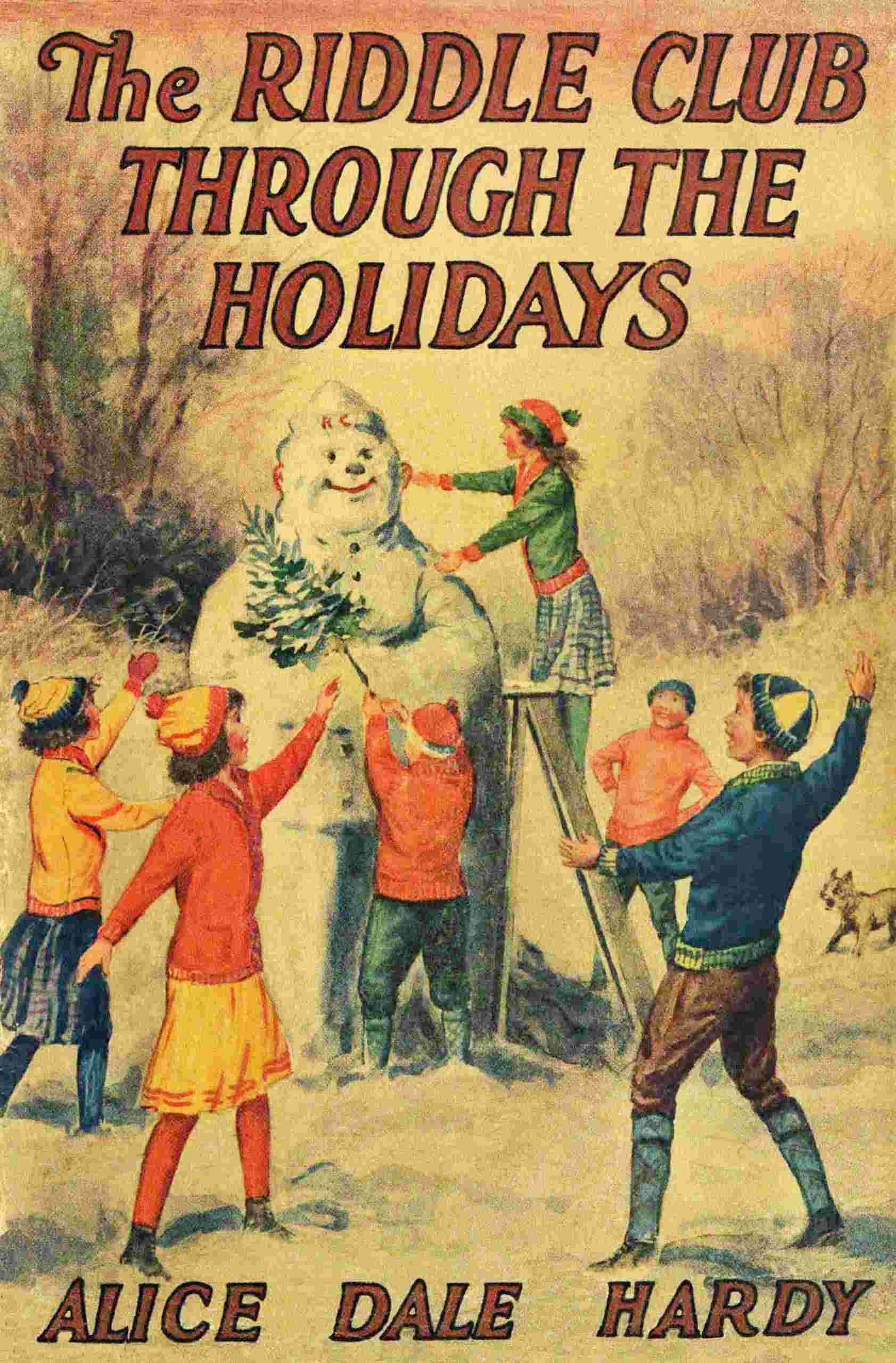
THE LAST OF THE SNOWMAN
It seemed like another Christmas to the members of the Riddle Club, the day after their experience in getting home. Every one was so glad to see them that they were allowed to please themselves pretty much, till Ward made himself sick with too much candy and Margy and Fred quarreled because they wanted to go skating and coasting at the same time; that is, each wanted the other to do his or her way.
“Say, it’s beginning to melt,” Fred reported, coming into the house for lunch. “Hear it drip!”
Mrs. Marley had invited Jess and Ward, and the six chums were together at the table.
“Thawing!” cried Polly. “It will spoil the skating.”
“But it will take a lot to spoil the coasting,” said Artie. “Let’s go this afternoon.”
Mr. and Mrs. Williamson were expected back on New Year’s Day, early in the morning, so Fred and Margy were still staying with the Marleys.
As soon as lunch was over, they got the sleds out and set off for the hill.
“Gee, when it begins to melt, it sure does start!” observed Ward.
Little rivers of water were running off the roofs and householders were out opening the gutters.
“It’s the January thaw,” said Margy, wisely.
“It isn’t January till to-morrow,” retorted Jess.
“Does it always thaw in January?” asked Artie, athirst for information.
“Yes, of course,” said Margy. “Some time in January it will thaw. Always. Mattie Helms told me.”
“Well, I guess it thaws some time in every month,” declared Fred. “Every winter month, that is,” he added, remembering the changing seasons.
“Well, this is the January thaw,” insisted Margy. “It will be January to-morrow, and so it is really time.”
When they reached the hill, they found a number of coasters, though it was more slush than snow. The runners sent up fine streams of water as the sleds raced down, and in the ditches on either side of the road a rushing stream of snow water was pouring.
“Maybe it’s spring,” gasped Jess, as a splash of water struck her in the face.
“No, we’ll have lots more snow and ice yet,” said Fred. “But I don’t call this much fun, do you? Let’s go home and go up in the clubroom.”
They were half-soaked already, and no one made any objections to returning home. Mrs. Marley made them take off their wet shoes and put on dry ones, and then they went upstairs to play parcheesi in the clubroom.
“There won’t be much left of Riddle Chap after this,” remarked Polly, happening to glance from the window while waiting her turn to play.
“Say, he has gone down, hasn’t he?” said Jess, in surprise.
“He’s wasting away,” giggled Polly. “Poor old Riddle Chap! But he’s had a pretty long life for a snowman.”
The poor snowman was visibly melting. Trickles of water ran over him and he seemed to be sinking into the ground.
“I’ll be glad when he’s gone,” said Jess. “He brought me bad luck—made me lose my glove.”
“There’s no such thing as good luck or bad luck,” declared Fred. “You lost your glove because you didn’t take care of it. Don’t blame that on poor old Riddle Chap.”
“Don’t you call it bad luck that you lost the bank?” asked Jess, heedless of Polly’s warning frown.
“No, of course that wasn’t bad luck,” said Fred, stoutly. “That was my own fault. I put it down somewhere, but I’ll never tell you where. And Dad wanted me to open a savings-bank account with it, too. I ought to have taken his advice.”
“You haven’t lost the new bank,” said Artie, who meant to be comforting.
“No, I haven’t,” agreed Fred. “And that isn’t good luck, either. It’s good care. I look at the bank first thing every night and morning, to make sure it is in the right place.”
“Perhaps some one took the other bank,” suggested Margy.
Fred glanced at her sharply. She was watching the board and apparently had just said that without thinking.
“I don’t see how any one could have taken it,” said Fred, and then it was his turn to play.
He still thought, now and then, that Carrie Pepper knew more about the bank than she cared to tell. But Fred had made up his mind not to say anything until he had more than suspicions to back him, and he resolutely refused to put his thought into words.
That night it turned a little colder, as it usually does, and the melting snow froze in little lace ruffles on the edges of the roofs. Riddle Chap had an icicle on what was left of his nose, and Polly was hopeful that he would stay as he was and not shrink any more. Alas! New Year’s Day dawned with a burst of sunlight that started the little streams running again, turned the coasting hill to a sea of slush, and hastened the sure disappearance of the once handsome Riddle Chap.
“It’s a good thing we have his picture,” said Polly, mournfully, at breakfast.
“You can build another snowman, when another snow comes,” said Mr. Marley, cheerfully.
But Polly said it wouldn’t be Riddle Chap, and of course no one could deny that.
However, it was impossible to feel sober on such a bright morning, and “Happy New Year!” sounded up and down Elm Road as the children greeted each other. School would open the day after to-morrow, and they were determined to have as much fun as possible before the holidays were definitely over.
Breakfast was barely finished when the Williamson car came down the road, bringing Mr. and Mrs. Williamson back to their home. They had much to tell about their visit in Rye and messages from “the old hermit,” as the youngsters still called Mr. Field, as well as from his sister, whom they had never seen, but who knew them quite well through Mr. Kirby’s and Mr. Adams’ descriptions. The two cousins had sent a large box of chocolates to be shared by the six chums.
“Mother thinks,” said Mr. Williamson, watching Artie trying to swallow a chocolate covered cherry that threatened to drown him in syrup, “that, since it is so warm to-day, we might drive out and see Mrs. Wicks.”
“Come on! Let’s go!” cried Fred. “We’ll take her some of the chocolates—maybe she likes candy.”
Mr. Williamson laughed.
“I don’t doubt it,” he said. “But, Fred, stop and consider the car a moment. It is a seven-passenger, but how am I going to pack twelve into the space reserved for seven?”
“It would be kind of crowded,” admitted Fred. “I’m willing to stay at home, Dad. Let the others go.”
“Suppose we arrange it this way,” said Mrs. Williamson: “You children all stay at home this time—you’ll find plenty to do to amuse yourselves. We won’t go till after lunch and we’ll be back in time for supper. We feel that we’d like to visit with Mrs. Wicks and take her a little something, and it really wouldn’t be very interesting for you. Then next time Daddy will take the whole Riddle Club, and we grown-ups will stay at home.”
So that was the way the plan was finally made, and after an early lunch the fathers and mothers drove off with baskets and boxes of goodies for Mrs. Wicks, including some of the delicious chocolates the children had insisted on sending her.
“Let’s tip old Riddle Chap over,” proposed Artie, aching for a little exercise. “There’s no use in waiting for him to melt away. Doesn’t he look seedy, though?”
In truth, the old snowman did look seedy. He had long ago lost his hat and his pine tree lay on the ground at his feet. Gone were the letters, R.C. In fact, he looked like a regular tramp of a snowman.
“One, two, three!” called Fred, as the boys leaned against the rapidly melting wreck.
At “three!” they gave a mighty push. Over went the ball that had formed the snowman’s body.
“Look how soft it is!” cried Polly, poking it with her toe. “It’s nothing but slush and water.”
“What’s that?” Jess’s sharp eyes had caught a glimpse of something dark.
She swooped down upon the pile of soft snow and seized the something. A sharp tug, and she had pulled out—her missing glove!
“Look! Look!” she shouted. “Look! Here’s the glove I lost! It was in the snowman all the time!”
The same thought came to Polly and Fred, and they leaped for the fallen snowman’s body.
Fred reached it first, and his shoe hit something that gave back a metallic sound.
He stooped and cleared away some of the slush. Slowly he straightened up, something in his hands.
“It’s the bank!” screamed Margy. “Fred found the bank! Look! Polly! Jess! Ward! Artie! Look! Fred’s found the bank!”
Her excited clamor brought Carrie Pepper from her house. As they crowded around him, Fred saw Carrie come running through the snow.
“So she didn’t know a thing about it,” he thought. “I’m glad I didn’t say anything.”
“Is the money there?” Ward kept asking. “Are the dues inside, Fred?”
Well, the money was safe enough, Fred soon discovered. And Jess’s glove, dried carefully behind the kitchen range, was pronounced as good as new.
While Fred wouldn’t say that good luck had brought the bank back, he said he was willing Jess should say good luck brought back her glove.
When the grown-ups came home at dusk, they were astonished to have the car surrounded by six dancing Indians who came tumbling out of the Marley house without hats or coats. These Indians danced madly around the car, singing a chorus that at first could not be understood.
“The bank! The bank!” warbled the singers. “Fred found the bank! And Jess’s glove—that’s found, too! And the money is all right! And the glove is dry and it isn’t hurt a bit!”
But when they finally understood, the fathers and mothers were almost as excited as the members of the Riddle Club.
The next morning Mr. Williamson took Fred and the recovered bank and the other five members of the club down to the bank, where an account was opened in the name of the Riddle Club.
“And wait!” said Fred, when he was the proud custodian of the green-covered bankbook. “Wait till the Conundrum Club hears of this!”
THE END