
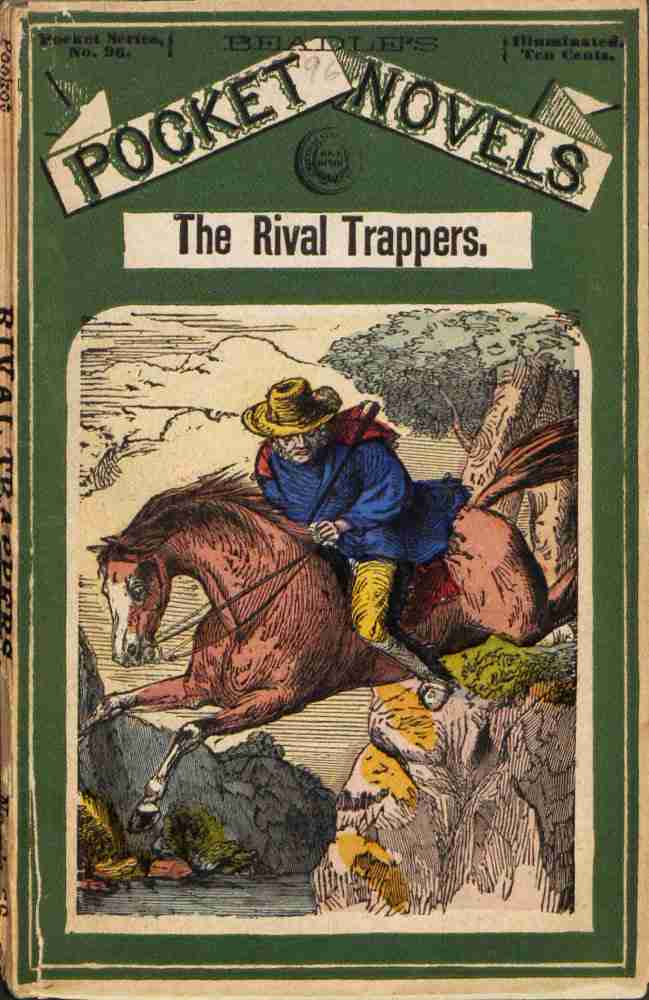
The Project Gutenberg eBook of The Rival Trappers: or, Old Pegs, The Mountaineer
Title: The Rival Trappers: or, Old Pegs, The Mountaineer
Author: Albert W. Aiken
Release date: January 15, 2022 [eBook #67169]
Most recently updated: October 18, 2024
Language: English
Original publication: United States: Beadle and Adams, 1876
Credits: David Edwards, Stephen Hutcheson and the Online Distributed Proofreading Team at https://www.pgdp.net (Northern Illinois University Digital Library)
THE RIVAL TRAPPERS;
OR,
OLD PEGS, THE MOUNTAINEER.
BY LEWIS W. CARSON.
NEW YORK:
BEADLE AND ADAMS, PUBLISHERS,
98 WILLIAM STREET.
Entered according to Act of Congress, in the year 1874, by
FRANK STARR & CO.,
In the office of the Librarian of Congress, at Washington.
CONTENTS
- I Old Pegs 9
- II Old Pegs’ Treasure 15
- III Dave Farrell. Bruin Scouting 23
- IV Whirlwind 31
- V A Coward’s Deed 38
- VI A Great Surprise 46
- VII Catching a Tartar 53
- VIII A Border Battle 60
- IX Unbidden Guests 67
- X On the Trail. A Treacherous Act 72
- XI The Heroine a Captive 82
- XII Dropping the Mask 88
- XIII A Dreadful Ordeal—Finis 94
THE RIVAL TRAPPERS;
OR,
OLD PEGS, THE MOUNTAINEER.
CHAPTER I.
OLD PEGS.
Hush! Is that a footstep coming up the canon? It came nearer and nearer, and a man of strange appearance suddenly stepped into view, rounding a bend in the canon. At the first glance it seemed that he was a dwarf in stature, but as he advanced, it was plainly to be seen that this was a mistake, for those broad shoulders and herculean arms never belonged to a dwarf. In hight he would scarcely have reached five feet, but his girth of shoulder and hip was something wonderful. In short, he had the body of a giant, set upon a pair of legs so crooked and misshapen that it seemed as if he had borrowed those limbs from some one else.
He came on with a peculiar, sidelong, hitching gait, swinging out his left leg and throwing forward the shoulder upon that side in an irresistibly ludicrous way, but getting over the ground at a very fair pace.
His dress was that of the mountainman, of greasy buck-skin, yet showing the careful hand of woman in the manner in which it was made. He wore fringed leggins, moccasins of ponderous size, and a high bear-skin cap, which added considerably to his ludicrous “make-up.” His weapons were a carefully-polished rifle, a pair of splendid revolvers, a knife and a hatchet.
His face was broad, ruddy and good-natured, fringed by a russet-brown hair and beard, slightly sprinkled with gray. A single look at the high forehead, merry brown eyes and smiling mouth, about which a whimsical look would linger in spite of himself, showed that he was a merry, reckless soul, but a man of undaunted courage.
“Hyar we come and hyar we go, pegging along the canon,” he half-sung. “Thar was some mistake in my make-up, I reckon, or I’d be a different man. But who keers, ez long ez I am happy ez a buck Digger in grasshopper time? Oh, Lordy, yes.”
He stopped and cast a penetrating glance about him, at the same time dropping one leg a little, showing that it was shorter than the other by some two inches. He seemed to listen, and his leonine head was thrown to one side in an attitude of profound attention. The next moment, by a movement of wonderful rapidity, he threw himself out of sight into one of the crevices with which the ravine abounded, and dropping to the earth behind a bowlder, awaited the event.
To the casual observer there had been no break in the usual sounds in mountain and forest, but a moment more showed that the wanderer was not at fault, for the sound of hoofs could be plainly heard, coming up from the east. Nearer and nearer they came, and the rapidity of the hoof-beats showed that the horseman, whoever he might be, was coming at the top of his speed; and directly the head of a horse appeared, and a single rider came thundering down the pass, half-lying on the animal’s back, and urging him on with knife and spur, while behind him sounded other hoof-beats, showing that he was pursued.
It was a white man, and that was enough for the old hunter, who started out from his place of concealment and checked the flying steed.
“Hi, thar, stranger—what’s up?”
The rider reined in his furious horse and grasped a weapon, but, seeing that it was a white man who barred the way, dropped his hand and answered, hurriedly:
“Indians!”
“After you?”
“Looks like it, old man.”
“Get down quick, then—take yer weepens, and send the hoss on. You’ve got ter lose him, or yer sculp.”
The man did not hesitate, but flung himself from the saddle and scored his knife-point sharply across the flank of the horse, which fled on lightly, being freed from its rider, and without a word the hunter led the way into the crevice which he had just left.
The horse had just made the last turn in the canon when about twenty of those Arabs of the plains, the Blackfeet, suddenly came in view, riding with loosened reins, their mustangs scrambling like cats along the bed of the canon, and the riders, bending forward like huntsmen in the chase, urging them on by word and blow. They passed like a whirlwind, and were gone; then the hunter bounded to his feet.
“Thar they go, the painted riptiles, like bed-bugs armed fur war! Come on, stranger; the quicker we git up these yer rocks the better.”
“I am a poor footpad,” said the stranger, with a light laugh; “but lead the way, old True Blue, and I’ll follow. That was a close shave, I tell you.”
“Clust enuff fur comfert,” replied the hunter. “This a-way.”
He began to climb the rugged side of the ravine with the agility of a cat, swinging his huge body from ledge to ledge by the power of his gigantic arms, and then turning to assist his companion, who, although younger, was by no means so agile.
Again and again, but for the timely aid of those muscular arms, the younger man would have fallen headlong into the gulf below, but at last they reached the top of the ledge, fifty feet above the canon bottom.
“Down—fur yer life—down!” hissed the hunter, as they reached the top of the ledge.
Both men fell prostrate, and not a moment too soon, for the Indians were coming back at a flying gallop, leading among them the horse which had so lately been abandoned by the rescued man. They came to a halt directly beneath the ledge, sitting erect and grim upon their panting mustangs, without uttering a word.
No body of men on earth can present a more warlike appearance than the Blackfeet—a nation brave even to desperation. Their bronzed bodies, shimmering ornaments and flaunting feathers; their long lances glittering in the sun; the ease and grace with which they sat their horses, as if horse and man were one piece, combined to make the appearance of this body at once imposing and threatening.
The chief was a man of gigantic size, armed with lance, hatchet, knife and a sort of mace—which he carried slung at the pommel of the high Mexican saddle, with which he rode. He spoke, and at the sound of his sonorous voice the hunter started, for he knew the voice well. It was that of Whirlwind, a chief who had made himself a terror throughout that region, and the deadly enemy of white men, under all circumstances.
“Let the braves scatter and search the canon,” cried Whirlwind. “The white dog has leaped from his saddle and is hidden among the rocks like a rabbit. We must have his scalp, for he has killed Flying Cloud the son of Natal—Nemissa. Can we return to the Blackfoot lodges with empty hands?”
The majority of the warriors, leaving their horses in charge of the rest, sprung down and began the search, but the feet of their flying steeds had obliterated all signs of a trail, had there been one, and the place where the white men had ascended was a rock which would not leave the mark of a foot. The old hunter was lying on the earth, literally convulsed with laughter at the manner in which he had outwitted Whirlwind, an enemy to the death, when, turning his eyes upon the man he had saved, he saw him in the act of thrusting forward the rifle with the intention of killing the chief. Rolling over quickly the hunter grasped the rifle, and after a struggle succeeded in tearing the weapon from the young man’s grasp. In doing so, however, a small piece of rock was detached and fell over the cliff upon the head of an Indian below, who was knocked senseless by the blow. The chief started and cast a quick glance upward, but at this moment the hunter while holding his companion down, managed to give an exact counterfeit of the bleat of a Bighorn. So perfect was the imitation that the chief at once concluded that the Bighorn in moving about had knocked down the stone upon the head of the stricken warrior, and seeing that his men were puzzled he called them in and they moved up the pass together searching every crevice for the man who had escaped them. When the sound of hoofs came faintly back from the upper part of the ravine, the hunter released his companion and stood up while the other bounded to his feet, flushed and excited.
“It is a good thing for you that you have just saved my life, old man, or we should quarrel. What did you mean by stopping me when I was going to shoot that old thief, Whirlwind?”
“Look yer, young ’un,” demanded the hunter, “d’ye know who I am?”
“No.”
“Mebbe you don’t want to?”
“Of course I wish to know the name of the man who has just saved my life, but let me warn you never to attempt again what you did just now.”
“You’d mount me ez a spider mounts a fly, I ’spose?” said the hunter, coolly. “My young fr’end, never let yer angry passhins git the best ov you, and by all means never hop on a man untel you ar’ tollable sartin you kin lick him. I don’t want to put you in mind ov the fac’ thet I hev just saved yer life—I’d do that ag’in, any way—but, what was you going ter do ef you hed killed Whirlwind?”
“There would have been one less scoundrel on the face of the earth.”
“Sartin; I agree; but, look yer, my lad; kin we two lick nineteen Blackfeet?”
“I don’t suppose we could.”
“No, sirree! I’ve fou’t Injuns ever sence I was knee high ter a grasshopper, and I want ter hev it sot down thet an Injun in his own kentry and well fixed, is an or’nary and orkard cuss to manige; he is, by thunder! I’ve hern tell ov one man sending ten or twelve to grass, but he can’t do it every day, bet yer life.”
“But they could not get at us here—”
“I ’spose not. An Injun can’t climb ez well ez the next man, I ’spose. Now did ye ever hear tell ov Old Pegs?”
The young man started and looked at him keenly.
“Old Pegs the guide—Old Pegs the hunter, Old Pegs the Indian terror? I should think so.”
“Them’s my handles, stranger; I’m Old Pegs.”
“I beg your pardon for saying what I did then, for I have no desire to quarrel with a man of your reputation. Perhaps it is for the best that Whirlwind should escape at this time, but my hour will come, and when it does—let him beware of me.”
“All hunky; rub him out the fust chaince you git. Now what’s your handle, young man?”
“People who know me well, call me Rafe Norris.”
“I don’t keer what people call you. Is Rafe Norris yer handle?”
“Yes.”
“What’s yer biz?”
“I can’t tell you that just now, my good friend. I—”
He did not finish the sentence, for Old Pegs caught him by the shoulders and flung him heavily to the ground, falling beside him from the impetus of his own exertions. The hand of the old guide was outstretched, and catching up a heavy stone he flung it with deadly aim at the feathered head of an Indian which at this moment rose above the ledge and who was poising a lance for a throw. Straight between the eyes the heavy stone struck, and, spreading his arms abroad, the Indian plunged head-foremost into the depths below, where his skull was shattered out of the semblance of humanity upon the rocks. So quickly was it done that Rafe Norris had no idea why he had been so rudely assailed, and seizing upon Old Pegs, began to pommel him about the head and shoulders.
“See yer, my boy,” said Old Pegs, “ef you hit me and I find it out, I’ll be darned ef I don’t send fer ye once, jest fer fun—now you hear me. Confound each individual wolverine in these tempestuous wilds ef I knows what’s the matter with you.”
“What did you pitch into me for?” hissed Rafe, in an angry tone.
“Come hyar, you fool, ef I must say it,” replied Old Pegs. “Creep to the edge of the cliff and look over.”
Considerably awed by the manner of the hunter, Rafe crawled to the edge of the cliff, and looking down cautiously saw the dead form of the savage below, while the rattle of hoofs told that some of the Indian’s comrades were coming back to look for him. The unfortunate savage, suspecting something wrong and desirous of distinguishing himself, had come back to search again for Rafe Norris, and hearing voices, had scaled the cliff unheard just in time to meet his fate.
“Come along,” whispered Old Pegs. “Show a leg and foller me.”
CHAPTER II.
OLD PEGS’ TREASURE.
The country through which Old Pegs led his new friend was one of the most difficult and dangerous in the portion of the foothills in which they were placed. No one, save a man who loved solitude, and would have chosen it from all others as a home, would have thought of spending so many years of his life in this lonely place. They passed through defile after defile, clambered over ridges and forded mountain streams in which the trout were so abundant that their feet touched them as they passed.
On the march, Old Pegs had a chance to observe his companion closely, and he did so without allowing him to think that he was watched. Rafe might have been thirty years of age, of an erect, stately figure, with very black hair and eyes. His hair was suffered to grow long, and curled slightly at the ends; he wore a heavy mustache—the point dropping nearly to his collar as he stood erect—and a long imperial. His eyes were of that vivid black so seldom seen, and looked wicked and bold. Although in mountain garb, there was a sort of dandyism even in this dress which did not strike Old Pegs favorably.
“I don’t know whether I’m doing the right thing in showing you this road,” said the hunter. “I’m a plain man and in a humble station, and I’ve got a treasure to guard.”
“A treasure?”
“You bet!”
“Have you found a gold-mine?”
“No; gold ain’t no use ter me, or I could find it soon enough.”
“It can not be diamonds?”
“Better’n diamonds, young ’un; better’n gold; better’n beaver, even.”
“What can you be talking of?” said Rafe, impatiently.
“Never you mind about that. I know what I’m talking about, and when I get home I’ll show you my treasure.”
At a turn in the path they were traversing they came suddenly upon a huge bear, which reared upon its haunches and sat, in a silly way, looking at them, with its tongue hanging out. Rafe Norris, who had no love for close companionship with a grizzly, dropped his rifle into the hollow of his hand, and was about to fire, when Old Pegs struck up the weapon.
“Don’t shoot that b’ar, confound you!” he cried. “He’s mine.”
“A pet bear! Is that your treasure, then?”
“Not a bit of it,” replied Old Pegs. “Kinder inquisitive, ain’t you?”
“You have aroused my curiosity, I must confess,” replied Rafe.
“Bruin! Bruin!” cried a clear, sweet voice. “Come here, sir!”
Down dropped the bear upon all fours, and waddled away in the direction of the voice, while Rafe stopped and looked at Old Pegs in amazement.
“That is your treasure, eh?” he demanded. “I thought you were too old a man to care for a woman.”
“I’m a nice figger fur a lady’s man, ain’t I?” replied the hunter, scornfully. “I orter hit you, but I guess I won’t. Here we ar’.”
The path led out of the narrow ravine through a thicket, and they entered a small, sheltered valley, containing hardly an acre of bottom-land, a sort of oasis scooped out by the hand of nature from the bosom of the eternal hills. There was no sign of human habitation anywhere, but their ears were saluted by a burst of song and the tinkle of a guitar. The voice of the singer was so wonderfully pure, rich and sweet that Rafe stopped in utter amazement and looked at Old Pegs.
“What does this mean, old man?” he cried; “that is not the voice of an Indian woman.”
“Ska’cely; oh, no—I reckon not. And see yer, feller—thet gal is under my pertection, and the man thet lays a finger on her, or insults her by look or word, may git out the papers fur his funeral—and I’ll see thet they hev a corpse. D’ye understand?”
“Why should I try to harm her?” said Rafe. “Hush! let us hear her song.”
It was a song of chivalry—a song of the old days—that seemed to speak the clash of spears and the rattle of steel armor. The voice rung out full and clear, not a note was slurred or hurried, and the two stood spell-bound until she had finished, when Old Pegs called out: “Myrtle!”
The sound of the guitar was hushed; there came the rush of flying feet, and the singer appeared and flung her arms about the neck of the old man and kissed him.
“I am glad you have come, father, for I was getting lonely. You—”
She paused suddenly, for her eyes just then rested upon the face of Rafe Norris, who was gazing at her with a look of undisguised admiration. What did he see? A fair young creature in the flush of early womanhood, with a face and form which might have driven a painter mad. She was slightly framed, but every line was in perfect symmetry, and her face was perfection itself. A touch of peach-bloom in either cheek, ripe-red lips and lustrous brown eyes; short, ambrosial locks, clinging about a neck which rivaled in whiteness the snows of the mountain, and a look of perfect innocence beautifying all.
Why did Rafe Norris gaze at her as if he had seen a vision from the grave?
“Don’t be skeered, little ’un,” said Old Pegs. “This yer is Rafe Norris, a gentleman thet run from some cussid Blackfeet and got away. I brung him here fur the night, and expect you to treat him well. This is my darter, Rafe—I kain’t mister any one, ye know—and she’s the best and pootiest gal in the kentry.”
Rafe Norris bowed low, and uttered a well-framed compliment, which the girl received coldly.
“It is somewhat strange, Mr. Norris, that you should be alone here,” she said.
“I was separated from my party,” he answered, blandly, “and the Indians set upon me before I was aware. I would accept the danger gladly for the honor of this introduction.”
“Draw it kinder mild, Rafe—kinder mild,” said Old Pegs. “We raally can’t stand too many nice speeches, out hyar.”
“That speech came from my heart,” replied Rafe. “I hope that the lady will not consider it an unmeaning compliment.”
“That’ll do,” said Old Pegs, dryly. “Now, Myrtle, gal, will you git us suthing to eat? Ez fur me, I’m pesky hungry. I could eat a hull antelope to my own cheek this hyar blessid minnit. What hav you got fur us?”
“I caught some trout awhile ago, and have them ready to broil,” replied Myrtle.
“I cannot consent to allow Miss Myrtle to perform such menial service for me,” said Rafe. “Let me do the cooking, for which such hands were never intended.”
Myrtle broke into a merry laugh. “You betray yourself, Mr. Norris,” she said. “You are a gentleman born and bred, for none of our own mountaineers would object to my cooking a meal for them.”
He looked a little vexed, and she glided away, and Old Pegs sat down on a great rock and signed to his companion to do the same.
“Let me go and assist Miss Myrtle,” said Norris. “It really pains me to suffer her to do such work.”
“Sit down, stranger,” said Old Pegs, shortly. “I won’t hev any one, I don’t keer who he is, try ter make the gal discontented with her life hyar. She’s the darter of a mount’in man, and ef she ever marries—which I hope she won’t—she’ll be the wife of a mount’in man; thet’s ez good ez swore to.”
“I hope you do not doubt me, Mr.—”
“Old Pegs! Thet’s my name—Old Pegs. I don’t want no other handle, and I won’t hev it. Ef I knowed you well I wouldn’t keer so much, but yer a stranger, and so we won’t hev any sort of familiarity until I does know you.”
“You are particular, sir,” replied Norris, knitting his brows. “It is sad that I did not bring my pedigree with me when I came here.”
“Don’t be ridiculous, stranger,” replied Old Pegs, “or we may part company afore you know it. I won’t have no foolishness about hyar ef I know it; no discount on thet ar’.”
“I beg your pardon again, but really you are very hard on me. I claim to be a gentleman, and hope I am so. Perhaps that would make me lose your good esteem.”
“Oh no; I’ve knowed lots of gentlemen thet was bully boys, and many’s the high old time I’ve had with ’em, right about hyar. But, they was gentlemen, and I knowed it. Now I don’t know any thing about you.”
“I hope you will know me better sometime,” replied Rafe, in such a peculiar tone that Old Pegs looked up at him quickly, as if to detect the lurking menace in his face. But that face expressed nothing except polite desire to make friends, and the old hunter dropped his eyes again and whistled. A lumbering tread was heard; the pet bear appeared and came rolling up at that peculiar gait so common to his race, and placing his head upon the ground, turned a sort of summerset, erected himself upon his hind feet, and came forward, extending his paw, which Old Pegs shook heartily.
“Glad ter see you, Bruin, my boy,” he said. “Hev ye taken good keer of yer young mistress while I’ve been gone?”
The bear nodded in a singularly grotesque manner, and Rafe could not repress a laugh.
“You have trained that fellow well, old man,” he said. “I suppose he will obey you in any thing now?”
“Ef you was to lay a finger on me and he thought you was in ’arnest, it would take a hull brigade to gether yer fragments from the a’jacent kountry round abowt.”
“I’ll be ‘keerful’ how I handle you then,” said Rafe. “Did I understand you to say that Miss Myrtle is really your daughter?”
“Ain’t no ways anxious ter know, be you, stranger?” said Old Pegs, frowning. “Git up hyur, Bruin—stand on yer he’d!”
The grizzly at once threw his quarters into the air, and in that attitude walked up to his master, and planting his head upon the earth, remained in that position until ordered to come down, which he did at once and rolled himself rapidly over and over until he was quite out sight behind the bushes.
“You dislike to talk about your daughter, I see,” said Rafe, persistently.
“No I don’t—no sech thing,” replied Old Pegs, belligerently. “Don’t tell me no sech foolishness. She’s a good gal, but she ain’t fur gentlemen to consort with, mind you. And look yer; ef you kain’t manige ter git along ’thout making yourself too familiar, then all I kin say is, we’d better part kump’ny now.”
What Rafe might have said in reply it is impossible to say, but at this moment Myrtle appeared and called to them. Old Pegs arose in his slow and easy manner, and led the way through a screen of thick bushes until they came upon a cabin so artistically concealed that a person might have passed it a hundred times without suspecting its presence. It was built of small logs dovetailed at the corners in frontier fashion, and chinked with a sort of blue clay. It had two small windows, each containing four panes of glass—for that article was difficult to transport to the mountain region. The door was heavy and swung upon iron hinges, manufactured from strap iron, in a rude way. The interior of the little place was as neat as hands could make it, and the little table and stools actually shone with scrubbing. A guitar stood in a little curtained recess, and, to the utter surprise of Rafe Norris, a rude bookcase in one corner contained a supply of books which had evidently been much used. The table was set in the middle of the room, the plain crockery arranged to the best advantage. They had venison steaks, fresh broiled trout, pone bread and fragrant coffee. Norris at the invitation of Old Pegs drew up his stool and was helped liberally. Myrtle poured the coffee, and all enjoyed a hearty meal.
“Thar,” said Old Pegs, “I dunno ez I keer fur any more. What a thing it is to hev a gal like Myrtle ter make the little cabin bright! She killed that deer and caught them trout herself, and thet’s what I call being ginerally useful. What do you say?”
“I can appreciate the home qualities of your daughter,” said Rafe, “but from the appearance of that book-case and the guitar I should say that she has other good qualities.”
“And so she hez, Rafe—so she hez. She kin sing like a bird—kin Myrtle—and when the old man comes home tired from the hunt, mebbe she don’t make his life pleasant by singing and reading. She’s a master reader—is Myrtle.”
“I should think that it would be hard to find a teacher in this section, but, from the quality of the books which I see she must be considerably advanced.”
“Oh she’s got a teacher,” replied Old Pegs with a sly look at Myrtle, whose cheek flushed like the rose. “A mighty good teacher, I mout say.”
“I was about to offer my poor services in that capacity,” said Rafe, “and I am sorry to hear that I am in some degree forestalled.”
“Yer cut out intirely,” replied Old Pegs. “The gal won’t take to no other teacher ez she does to this one.”
“Where is this wonderful teacher now, if I may ask?” said Rafe with a look of annoyance.
“Gone down ter the fort, I reckon. It’s about time fur a lesson, too, and I kin see thet the gal is getting anxious.”
“Father!” cried Myrtle.
“Thet is gospel truth, gal,” replied Old Pegs with a grin. “I kin see it in yer eye, whenever I look at you.”
Rafe was puzzled to understand the manner in which Myrtle received the bantering speech of her father. She seemed ill at ease, and her eyes wandered to the door from time to time as if in expectation. Just then the bear, which had been lying upon the threshold, raised his muzzle and snuffed the air in a peculiar manner, and then rising heavily, started away on an awkward shambling trot in the direction of the entrance to the valley.
“The critter smells suthing,” said Old Pegs, drawing his rifle nearer, “and I’ll take a walk outside and see what’s up.”
He started out quickly, leaving Rafe Norris with Myrtle. He at once began to improve the opportunity.
“It seems strange to me that a lady to all appearance so refined as you are should pass her life in the midst of this desolation.”
“I am not ‘a lady’ and I am far from refined, Mr. Norris. Is it lady-like to go out and shoot a deer, bring home steaks and saddle, and catch and cook a mess of trout? I am very much afraid that you are mistaken in me, and think me one of those white-handed misses who mince along the streets of Leavenworth and St. Joseph; but I am not.”
“You belie yourself in this, Miss Myrtle. While you stay here of course you must conform to the usages of the society in which you live. But you are fitted to adorn—”
She lifted her finger in a playful manner.
“No nice speeches, if you please, Mr. Norris, for I am not used to them, and should not know how to appreciate them in the least. I am afraid your intercourse with the fine ladies who dwell in cities, has unfitted you for the realities of life as we find them in the mountains.”
“I pray not, for I hope to win your good opinion some day, and to be able to prove to you that such ladies are not to my taste. I admire your spirit—”
“I think we had better change the conversation as I am not egotistical enough to wish to talk of myself, and nothing else. Perhaps you play the guitar.”
“A little,” he replied, “but I am not going to expose myself by trying to play now. I heard your music as I came up and was literally enthralled by it.”
She brought the guitar, and began to clear away the table while he touched the keys and strings lightly, bringing the instrument into tune, while he kept his eyes upon her steadily. There was an elasticity and grace in every movement which spoke of perfect health, and he was obliged to confess that he had never seen her equal. The man was susceptible to female grace and beauty, and was touched now as he never been before, and knew it. Once or twice she met his eyes and was startled by the bold look of admiration in them. He continued to drum upon the strings, merely striking chords and watching her intently. He seemed about to speak, but at this moment the sound of voices could be heard and Old Pegs, accompanied by a young man in a tasteful hunting garb, entered the room. Myrtle sprung forward with a glad cry and gave him both hands while giving him a welcome.
“Is that her teacher, I wonder?” muttered Rafe, below his breath. “We shall see. I will not be foiled when the prize for which I play is almost in my grasp.”
CHAPTER III.
DAVE FARRELL. BRUIN SCOUTING.
The young man who had entered was the beau ideal of a Western scout, and Rafe was obliged to confess that he would have made a hard customer to meet in the midst of a border struggle. About five feet and ten inches in hight, straight as a cedar, with curling brown hair, and eyes of the same color, a brown but well-cut face, firm lips and white teeth; dressed as a leader of scouts in the neat fringed hunting-shirt belted at the waist, high horseman’s boots and sombrero; and armed with the rifle, two first-class revolvers and a heavy knife. He carried a bundle in one hand which he dropped to meet the extended hands of Myrtle, and stood there with a smile upon his handsome face.
“Rafe Norris,” said Old Pegs, “this hyar chap is Dave Farrell, a real out and outer, at present captain of a trapping brigade of the North-west Company. Ef you meet any one thet asks you, be keerful to tell ’em thet Old Pegs sez he’s a roarer! You kin realize money on that, every time.”
Dave Farrell turned to acknowledge the introduction with a peculiar look upon his face.
“It seems to me, although I may be wrong—that I have seen you before.”
“I don’t remember, Captain Farrell,” replied Rafe, coolly. “Still, I’ve been in many places, and we might have met without recollecting it.”
“I think it was in Fort Garry, in the year ’53.”
“Scarcely; I have not been in that country for nearly four years.”
“We are all liable to mistakes,” said Dave; “but of course you have some kind of business up this way?”
“Of course.”
“Do you object to mentioning what business?”
“I am not in a position to give you any information upon the subject just now as I do not recognize your authority. I have been chased by Indians and escaped by means of your friend here, who has offered me a shelter and has not insulted me by asking impertinent questions.”
“Impertinent!” said Dave, slowly, turning his eyes full upon the face of the speaker. “I said that I would like to know your business, having stated mine.”
“And I tell you that I am not in a condition to gratify your curiosity in the least.”
“Let’s have no quarreling hyar, boys,” said Old Pegs. “Mr. Norris goes away to-morrer to find his party, and thet’s the end of it. Let’s treat him like a gentleman while he stays.”
“I have no more to say at present,” said Dave. “If I had thought my simple question would be regarded as an insult I should not have asked it.”
“You are excused,” said Rafe, coolly, “but I don’t allow any man to interfere with my affairs.”
Dave said no more, but dropping upon one knee began to undo the bundle which he had dropped, and Myrtle clapped her hands joyfully as he displayed a number of well-selected books and literary papers. The two were soon occupied over them to the utter exclusion of the rest, for the efforts of Rafe Norris to take part in the business were put aside with an ease which showed that Dave considered himself master of the situation.
“Oh, let up, Dave,” said Old Pegs; “drop them cussid books and talk to us. What did you hear new at the fort?”
“I heard that the Hudson Bay are going to trap on our side this year, in spite of our men.”
“Hey! Now it looks like our boys will let ’em, don’t it?”
“They are not the kind of men easily trodden underfoot, as you know well,” replied Dave, grimly. “I’ve fought the Hudson Bay for ten years and I’m not going to be driven out of my way by them now.”
“I’ve heard that the Hudson Bay was very strong this year in the number of their men,” said Rafe Norris.
“Scissors!” roared Old Pegs. “You don’t ’spose we keer fur thet, do you? Hark; what’s thet?”
They heard a fierce growl from the bear, and then a cry of mortal agony. The three men grasped their weapons, and darting away in the direction of the sound, found the bear locked in a close grapple with an Indian, while another was running rapidly across the opening.
“Spies!” cried Old Pegs, pointing after the flying man. “Stop him, Dave!”
Dave Farrell brought his rifle to his shoulder, and fired, apparently without aim. The flying savage paused suddenly, made a leap into the air and fell upon his face.
“Euchered!” said Old Pegs, quietly. “I don’t want no Injins in my camp, you bet! Let’s look arter this chap Bruin hez harnessed.”
The teeth of the bear were fastened in the shoulder of the Indian with whom he struggled, and his claws were tearing him limb from limb. Old Pegs caught the brute by the neck, and by the exercise of all his muscular power, coupled with a loud command, managed to separate the two, and the Indian, a horrible object to look at, sunk back upon the sod, bleeding at every vein.
Old Pegs stooped to raise him, but at this moment his eyes opened and rested upon the face of Rafe Norris, who had followed the rest. A look of recognition passed over his face, and he seemed about to speak, when Norris drew a pistol and shot him through the heart as coolly as if he had been a dying brute.
“It is better to put him out of his misery,” he said, quietly; “and, as you say, it won’t do to have spies about us.”
“That was a coward shot,” cried Dave, angrily. “How dare you kill a wounded man before us?”
“My young friend,” replied Rafe, in his smooth tone, “don’t let us make any mistakes or have a quarrel out here, for I am quick on the trigger and might shoot.”
“Our boys don’t scare very easy,” was the answer, “and are always ready to take and give. If you are inclined that way, I don’t know but it is just as well to humor you.”
“Hold on, boys,” cried Old Pegs. “I take a hand in this game, myself. The fust man that lifts a weepen hez got ter stand a shot from me.”
“I will not be bullied by any man alive,” cried Rafe Norris. “If I shot this savage, it was only to put him out of pain, for any man can see that he would have been dead in five minutes.”
“Mout be you are right, Rafe,” replied Old Pegs; “but, why didn’t you let him die the nat’ral way? It almost seemed to me thet the cuss know’d you, and was going ter speak.”
“Pshaw; what will you suspect next, I wonder? I never saw the fellow in my life.”
“I ain’t going to conterdict you, Rafe, acause it won’t pay, ez I hain’t got no proof. Howsumever, thar lies the critter with a bullet in the heart, and he’s rubbed out, easy. But, what I want ter know is this: what is this yer Modoc Sioux doing in this kentry?”
“Modoc Sioux!” cried Dave, looking more closely at the dead savage. “You are right, old man, and it is a surprise to see a party of that tribe in the heart of the Blackfoot country.”
Rafe Norris started; an angry look came into his face, for he thought he saw suspicion in the eyes of the two men. That branch of the great Sioux nation known as the Modoc Sioux were notorious for their hostility to the whites, and their country was far away.
“Let’s look at the other chap,” said Old Pegs. “This hyar gets me, it does; it gets me dead ter rights.”
They hurried to the side of the Indian who had been so suddenly stricken by the fatal bullet of Dave Farrell, and turned him over. The ball had entered the back just below the left shoulder, and passed through his heart, so that his death was instantaneous. His face was calm and peaceful, and both the mountainmen started as they recognized “Half-breed Jack,” a man who was known far and wide as one of most trusted employes of the Hudson Bay Company—a villain who was capable of any crime.
“Now this begins to look like business,” said Dave. “Old Pegs, you and I must talk this matter over alone.”
“Why alone, my mountain hero?” demanded Rafe, in a bantering tone. “Am I to understand that you do not consider me a trustworthy person?”
“We never trust strangers with our business,” replied Dave. “You do not seem in the least surprised to see Half-breed Jack lying here.”
“Half-breed Jack, eh? And who, pray, is Half-breed Jack?”
“If you don’t know now, you never will,” was the ambiguous reply. “Here, old man, let’s you and I have a talk.”
“I see that you are disposed to set my friends against me,” said Rafe, angrily. “Beware, young man. I am one who never forgets or forgives an injury, and one day I may take occasion to remind you of this one.”
“All right; will you be kind enough to leave us alone now?”
Rafe stood for full two minutes looking with a dark scowl into the face of the young captain of the “Trapping Brigade,” and then, turning on his heel, he walked toward the cabin, his heart torn by contending passions. Old Pegs and Dave remained over the body of the half-breed, looking very ill at ease.
“This man is not to be trusted,” said Dave, quickly. “I can not place him, but I am certain that I have seen him under circumstances of peculiar significance. I can not for my life remember any thing except the place, and that was Fort Garry.”
“He mout hev been thar jest ez you were, Dave. Beavers and bufflers! you don’t go back on a man acause he’s bin in Fort Garry, does you?”
“I’ll wager my existence that he is a bad man,” replied Dave, hotly. “He has a nasty drop in his eye that I don’t like, and one day you will find that I am right. Why should the Modoc Sioux be here? Don’t you know that no man on earth has as much influence among them as Half-breed Jack?”
“Thet don’t hurt Rafe Norris, my boy.”
“But that Indian he killed knew him, I am almost willing to swear; and, God forgive me if I do him wrong, but I think he killed him fearing that the Sioux might say something to betray him.”
“I had the same thort in my mind, Dave, I allow,” said Old Pegs. “Now, what do you perpose to do?”